Mere Confessionalism

From the Archives: Nicotine Theological Journal, January 1999

Mere Confessionalism

“In essentials, unity; in non-essentials, liberty; in all things, charity.” This is the motto of the Evangelical Presbyterian Church. (The expression itself is of some antiquity, and it may date back as early as St. Augustine.) At its founding in 1981 the EPC adopted a modern language version of the Westminster Confession of Faith as its doctrinal standard. At the same time it also adopted an eight- point “Essentials of our Faith” summary statement. The latter contains boiler-plate evangelical affirmations on the Bible, God, Christ, sin, salvation, and eschatology, in language that is mildly and non-militantly Calvinistic.

Are these two documents competing doctrinal standards? An interesting debate is playing out in the EPC now regarding what confessional status, if any, its “Essentials” possess and how they relate to the Westminster Confession. The “Essentials” themselves end this way: “These Essentials are set forth in greater detail in the Westminster Confession of Faith.” But rather than solve the question, that ambiguous language only heightens the confusion. Does it mean that the WCF itself – taken as a whole – is the “Essentials” in fuller form, or merely that these eight affirmations can each be found there as well? Are the “Essentials,” in other words, what the church really believes? Should the emphasis fall on the first or second word in the denomination’s name, “Evangelical Presbyterian Church”?

MOST CONSERVATIVE Presbyterians would likely contend that the EPC has misidentified the essentials of the faith. After all, it is open to women in church office and the ongoing exercise of the charismatic gifts. At the same time, the EPC debate is instructive, because its conservative Presbyterian critics also tend to employ some form of what can be called the hermeneutic of essentials, of identifying what the church may or may not tolerate. Presbyterian theologian, John Frame, for example, in urging the creation of leg room within the confessions, laments that “the whole question of what is and what is not tolerable within the church has not been systematically analyzed.”

Frame’s quest is not new. Efforts to isolate the “essentials” within the confession are almost as old as Presbyterianism itself. Frequently, it has been the progressives who have been eager to speak of a “system of doctrine,” in order to permit their deviation from the Confession and catechisms of the church. By “system” they mean the Confession “in-as-much” as what the Confession teaches is biblical. In this fashion, Presbyterian officers hold line-item vetoes to the church’s Constitution, and the church had erected a Confession-within-the-Confession.

But it is not only progressives who speak this language. In efforts earlier in this century by conservative Presbyterians to preserve the essence of historic Christian orthodoxy, some upheld the minimal necessity of the “five fundamentals” of the faith. The unintended effect was to reduce the “essential and necessary” articles of the church’s constitution to just five.

Especially of late the rhetoric of essentials is invoked in order to separate the Bible from the Confession in the name of the Reformation principle of sola scriptura. (Indeed, often it is phrased in the language of liberating the Bible from the confession.) Increasingly Presbyterian officers seem to be declaring, “never mind the Confession, show me where that is taught in Scripture.” But for Presbyterians, an officer is committed to sola scriptura precisely to the extent that he is a Confessionalist. Confessionalism does not eclipse the doctrine of sola scriptura. Rather, a confession is the necessary means for the church to uphold Biblical authority. The Presbyterian way to point to the doctrine of Scripture is to refer to the Confession.

FRAME DESCRIBES THIS VIEW AS chauvinistic. “Although I am a Presbyterian,” he writes, “I confess that I do not share [the] desire for us always to ‘look like Presbyterians’ before the watching world.” In context, Frame’s concern is specifically about worship, but by implication his views bear upon the relationship between The Nicotine Theological Journal will likely be published four times a year. It is sponsored by the Old Life Theological Society, an association dedicated to recovering the riches of confessional Presbyterianism.

IN DESCRIBING HIS STUDENT days at Westminster Seminary (in the early 1960s), Frame recalls two features of that course of instruction: it lacked an overt “confessional or traditional focus” and there was a spirit of creativity and openness in theological reflection. He goes on to make a startling admission: “After graduation I became ordained in the Orthodox Presbyterian Church, and I confess I was rather surprised at the seriousness with which my fellow ministers took the confessional standards and the Presbyterian tradition. Eventually I became more like my fellow Orthodox Presbyterian . . . elders, but not without some nostalgia for the openness of theological discussion during my seminary years.”

Our point is not to critique WTS or any other seminary. And whether Frame has described with accuracy the curriculum of WTS in the 1960s is not our concern either. But what is revealing is the dichotomy that Frame creates between “perpetuat[ing] and recommend[ing] the confessional traditions” on the one hand (which is where he finds WTS’s education flawed), and a “flourishing of original and impressive theological thought” on the other (where he thinks WTS excelled). This difference he goes on to attribute to Westminster’s understanding of sola Scriptura, which liberated the school from traditionalism and confessionalism.

BUT FRAME’S DICHOTOMY WAS unknown to previous generations of Reformed theologians. Calvin Seminary’s Richard Muller writes the following on the harmony of Scripture and confession: “We need creeds and confessions so that we, as individuals, can approach Scripture in the context of the community of belief.” Confessions function as mediating structures, standing between Scripture and the “potentially idiosyncratic individual” as “churchly statements concerning the meaning of Scripture.” They are “normative declarations spoken from within by the church itself . . . as the expression of our corporate faith and corporate identity.”

Muller’s work on Reformed scholasticism reminds us that there was a time when confessional integrity did not compete with sola scriptura, nor did it impede theological creativity. For the scholastic mindset, Muller notes, “Once a churchly confession is accepted as a doctrinal norm, it provides boundaries for theological and religious expression, but it also offers considerable latitude for the development of varied theological and religious expressions within those boundaries.” According to the Reformers, there is no churchman and there is no theologian where there is no confession. Why is that so unimaginable today? Why has the Reformation confidence in the creeds of the church vanished?

AS WE PREVIOUSLY ARGUED (“Sectarians All,” NTJ 2.2), such anti-traditionalism only serves to locate one within a specific tradition, namely the Enlightenment, and its false claim that an individual Christian, armed with autonomous rationality can approach Scripture from a traditionless perspective. The Reformers, Muller claims, refused to approach Scripture with the false dilemma forced upon the church by its adoption of categories of Enlightenment thought.

Muller goes on to describe other pressures that our age brings to confessional integrity. He refers to the “noncredal, nonconfessional, and sometimes even anticonfessional and antitraditional biblicism of conservative American religion.” Enlightenment rationality and democratic populism combine to create what Robert Godfrey has diagnosed as the evangelical impulse toward theological minimalism. This minimalism seeks to get as many people to express everything they agree on, and preferrably on one side of one sheet of paper. These affirmations become the truly “essential truths,” and the hills for evangelicals to die on. Godfrey is echoing the thoughts of J. Gresham Machen, who in his essay, “The Creeds and Doctrinal Advance,” described this impulse in the following way:

There are entirely too many denominations in this country, says the modern ecclesiastical efficiency expert. Obviously, many of them have to be merged. But the trouble is, they have different creeds. Here is one church, for example, that has a clearly Calvinistic creed; here is another whose creed is just as clearly Arminian, let us say, and anti-Calvinistic. How in the world are we going to get them together? Why, obviously, says the ecclesiastical efficiency expert, the thing to do is to tone down that Calvinistic creed; just smooth off its sharp angles, until Arminians will be able to accept it. Or else we can do something better still. We can write an entirely new creed that will contain only what Arminianism and Calvinism have in common, so that it can serve as the basis for some proposed new “United Church” . . . . Such are the methods of modern church unionism.

This impulse stands in sharp contrast to what Godfrey calls the theological maximalism of the Reformed, which sought at least in the past to extend the boundaries of the church’s confession in pursuit of the “whole counsel of God.” Moreover, Reformed maximalism and evangelical minimalism differ not only in the size of their creeds but in the very purpose of their creeds. To quote Machen again:

These modern statements are intended to show how little of truth we can get along with and still be Christians, whereas the great creeds of the church are intended to show much of the truth God has revealed to us in His Word. Let us sink our differences, say the authors of these modern statements, and get back to a few bare essentials; let us open our Bibles, say the authors of the great Christian creeds, and seek to unfold the full richness of truth that the Bible contains. Let us be careful, say the authors of these modern statements, not to discourage any of the various tendencies of thought that find a lodgment in the church; let us give all diligence, say the authors of the great Christian creeds, to exclude deadly error from the official teaching of the church, in order that thus the Church may be a faithful steward of the mysteries of God.

BUT IS ALL OF THIS FAIR TO evangelicalism? After all, no less an evangelical icon than C. S. Lewis contended for a “mere Christianity.” Yet Lewis himself was not confused about his beliefs, which he said were found in the Anglican Book of Common Prayer. His search for a “mere” Christianity was not an alternative to the creeds of the church. Rather, he likened it to the difference between the halls and rooms of a mansion. “Mere” Christianity may bring one into the hall. “But it is in the rooms, not in the hall, that there are fires and chairs and meals.” The “worst of the rooms,” he went on to stress (perhaps thinking of a dimly lit and drearily decorated attic of Calvinistic horrors), is to be preferred over the hall.

Whatever Lewis intended, his words have been hijacked to serve unhealthy purposes. The ambiguities of the expression, “Mere Christianity,” can be found in many of Lewis’ disciples. And when it meets contemporary evangelicalism, there is a volatile mix that may prove lethal to the theological reflection and confessional identity of the church.

CONSIDER TOUCHSTONE magazine, which had recently changed its subtitle from “A Journal of Ecumenical Orthodoxy” to “A Journal of Mere Christianity.” Its editorial purpose is to “subordinate disagreements to the common agreement” because the crisis of our day is so grave. Here we must recognize the debilitating effects of the so-called culture wars on the confessional identity of the church. Abortion, Gay rights, women’s rights, funding for and legal protection of pornographic artists, evolution in the public schools — all of these are battle fronts in the increasingly rancorous struggle over the meaning and purpose of America. And these are the causes to which Christians should devote their energy.

“We need to identify the ‘real enemy’,” urges Touchstone, and that enemy is without, not within. What is said moderately in Touchstone can be found in more virulent form in Peter Kreeft’s Ecumenical Jihad. For Kreeft, mere Christianity may not even be recognizably Christian. The moral decay of America, with all of its leading indicators of spiritual decline, is creating new alliances, even among those of differing religious convictions. The old fashioned Protestant v. Catholic v. Jewish warfare is passe. So great is the threat of secular humanism and so united are we with former antagonists on the really crucial issues, that even evangelical Christians, Kreeft predicts, will eventually arrive at the conclusion that Muslims are on the right side. They may be murdering Christians in Sudan, but at least they are not massacring unborn children. Given the real crisis of our time – the decline of Western Civilization – this is “no time for family squabbles.” This is not merely cultural warfare but spiritual warfare that will unite Protestants, Catholics, Orthodox, Jews, Muslims, Buddhists, and maybe even an occasional natural-law-advocating atheist.

(Don’t be too alarmed by all this. The Holy Spirit is at work among pious Muslims, Kreeft assures Christian skeptics, and in heaven these Muslims will come to learn that the Allah they served was the God of the Scriptures. What is more, Kreeft goes on to comfort Catholics that Protestants will ultimately come to venerate the blessed Virgin Mary, if not in this life then in the next. So the very ecumenical Kreeft eventually emerges from the closet and is outed by the end of his own book as a good, confessional Catholic.)

TOUCHSTONE MAGAZINE ultimately appeals to experience over doctrine. “Mere Christianity,” it states, is found ultimately not in doctrine but lies in “the character of a man.” Similarly, Kreeft argues that beyond theological differences, we find mere Christianity where there is love. This privileging of experience over doctrine prompts us to wonder whether efforts to arrive at evangelical essentials owe less to C.S. Lewis than to Friedrich Schleiermacher, the 19th-century father of modern theological liberalism.

Fundamental to Schleiermacher’s method was his division between the kernel and husk of the Christian faith. The latter is the practice of Christianity, that which is culturally conditioned, and the former is the “essence of the Christian faith,” stripped of these acculturated accretions. It was this non-negotiable kernel that Schleiermacher desperately sought to preserve. The husk is what is offensive to unbelievers, specifically, 19th-century elites of Protestant Europe. The task of the church, therefore, is to remove the objectionable and make Christianity attractive and relevant.

SCHLEIERMACHER IS NOT alone in this methodology. In our century, Tillich’s “method of correlation” and Bultmann’s program of demythologization likewise restated biblical message in language free from pre-modern superstitions and categories more friendly to modernity. A little closer to home, seeker-sensitive worship owes much to 19th-century liberalism, in order to make church accommodating to unchurched Harry and Sally. All of these are efforts to repackage the Christian faith.

In his book, Rumor of Angels, sociologist Peter Berger says that whenever one engages in this method, one is making a cognitive adjustment to the worldview of modernity. In the case of liberalism, the result can be “a profound erosion of the traditional religious content, in extreme cases to the point where nothing is left but hollow rhetoric.” But however practiced, this adjustment or “bargaining” is always a process of “cultural contamination,” because in the encounter between the church and modernity, modernity always wins.

Berger’s point, of course, is that you cannot adjust the wrappings and leave the core unaffected. But is it a stretch to link contemporary evangelicals with a Schleiermacher? We may not see language like kernel or husk, much less something as ominous as demythologization. But substitute “message” and “method,” and it begins to sound familiar. How many times have you heard it said that we must maintain our message but we must change our method, because the world is changing, and at a dizzying pace at that. Or think about the churches that describe their “philosophy of ministry” in brochures for first-time visitors without reference to their theological standards. And then there is “worship style.” How is it that churches can offer two morning services that are “identical” except for the music? Let us not forget that Friedrich Schleiermacher was as desperate as Bill Hybels to present Christianity in relevant and meaningful ways to a skeptical culture.

IN DAVID WELLS’ TERMS theological liberalism and contemporary evangelicalism both quarantine theology from ministry. By dividing message from method, both permit theological convictions to play a diminishing role in the life of the church. On more and more matters, evangelicals are suggesting that theological considerations are irrelevant, overshadowed by the more urgent need for cultural relevance or evangelistic effectiveness. According to Wells,

It is not that the elements of the evangelical credo have vanished; they have not. The fact that they are professed, however, does not necessarily mean that the structure of the historic Protestant faith is still intact. The reason, quite simply, is that while these items of belief are professed, they are increasingly being removed from the center of evangelical life where they defined what that life was, and they are now being relegated to the periphery where their power to define what evangelical life should be is lost.

SCHLEIERMACHER’S METHOD should serve as ample warning that theological minimalism is a false messiah. It is sure to destroy what it claims to preserve, not only when it is in the hands of liberals, but also when it is practiced mildly by conservative evangelicals. A lowest common denominator is an ecumenical dead end. A Reformed church whose worship disguises its Reformed identity is simply not reformed.

Presbyterians would do better to affirm a “mere” Confessionalism, and regard, along with our ancestors, the standards of the church as liberating and not constrictive. Further, Presbyterians might want to acknowledge, however humbling it might be, that they stand to learn something here from the Lutherans. Our Lutheran counterparts seem far more vigilant in their confessional identity than Calvinists. At a recent gathering of the Alliance of Confessing Evangelicals, Missouri Synod theologian, David P. Scaer, struck at the heart of the evangelical dilemma:

Any survival and recovery of Reformation theology cannot be made to depend on a further compromise which identifies an essential core of agreement in order to save it. . . . This kind of agreement immediately puts Lutherans at a disadvantage, since they must concede what makes them Lutherans.

In observing the eager participation of the Reformed in such holy grail pursuits of essentials, Scaer wonders whether the Reformed have made such a suicidal concession. We can hardly improve on Scaer’s conclusion: “Distinctions between essential and non-essential do not belong in the confessional vocabulary.”

Which leads to the unpleasant conclusion that a “confessing evangelical” is a contradiction in terms. Perhaps then Reformed need to cultivate among themselves the same dis-ease for the term “evangelical” as Machen had for “fundamentalist” in his day. Although he reluctantly accepted the term, he couldn’t abide the artificial reduction of a full-orbed Calvinism into a list of fundamentals. So instead of asking what church officers can get away with and how churches can be innovative, Reformed should second Machen: “isn’t the Reformed faith grand!”

“IN ESSENTIALS UNITY; IN NON-essentials, liberty; in all things, charity.” This is a motto that the Presbyterians can embrace. We need not concede it either to charismatic Presbyterians or broad evangelicals, but only if we define essentials in a confessionally self-conscious way. In our standards, there is unity – mere confessionalism. The search for essentials ends when the church adopts her standards. Beyond our confession, there is liberty, and with it openness and even diversity, in theology, worship, and life. And what about charity? By worldly standards, confessionalism does not permit a hermeneutic of charity, for that is a charity of indifference and tolerance. But confessionalism does cultivate a biblical charity that rejoices in the truth, and believes all things.

JRM
The Last Time a Pope Died

From the October 2005 issue of the Nicotine Theological Journal

The Faith of Modernism

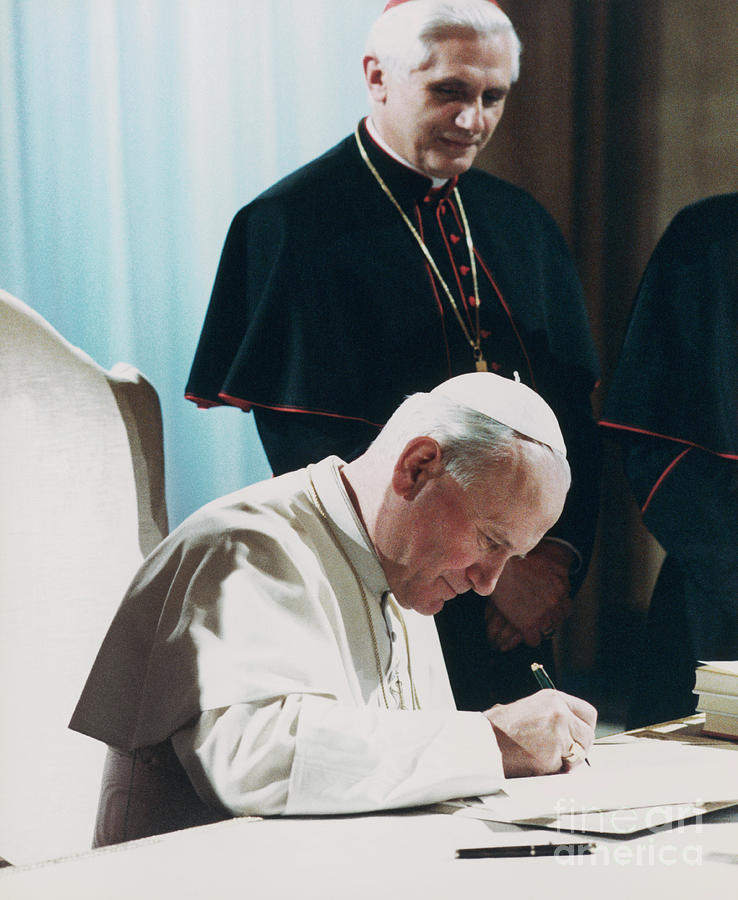
When John Paul II was elected pope in 1978, some American evangelical observers of Rome referred to him as “J2P2.” About ten years later that nickname receded, an indication of a significant transition in his pontificate: this pope was becoming even more popular than Star Wars. It is easy to see now why American evangelicals fell in love with pope John Paul II. He was instrumental in the defeat of Communism, courageous in defense of traditional marriage, and relentless in his advocacy of the culture of life.

Why didn’t Paul VI a enjoy similar press? After all, a re-reading of his widely lampooned Humanae Vitae reveals it to be a brilliant, if flawed, critique of our technological age. But Paul VI’s tired and melancholy demeanor lacked the vigorous and telegenic charisma of John Paul II, a master of modern media.

Timothy George compared the winsome attractiveness of John Paul II to the ultimate American evangelical icon, Billy Graham. “Many of the things said of the pope you’d say of Billy Graham,” George recently told Christianity Today. “From an evangelical base he’s tried to reach out and be embracing and yet be faithful to the gospel. And you put those two together, Billy Graham and the pope, you have there the winsome, visible face of world Christianity in the last half century.”

Again, this is understandable, and there is much for Protestants to be thankful for in this remarkable 25-year pontificate. But can it be said from a Protestant perspective that John Paul II’s legacy was marked by theological progress? How ought we to evaluate what Mark Noll described as Roman Catholicism’s “dramatically altered relations with Protestant evangelicals”? Are we led to imagine that the Reformation is over? There are reasonable grounds for skepticism on the part of Protestant confessionalists.

This is not to question the pope’s openness to the theory of evolution, as some Protestant fundamentalists and Roman Catholic traditionalists have. John Paul II hardly endorsed Darwinism; he merely invited Christians to engage in legitimate scientific inquiry without succumbing to scientism. No, John Paul II was clean here, although it was left for his successor, Benedict XVI, to state the matter with greater theological precision when he emphasized that “we are not some casual and meaningless product of evolution.”

In following through with the work of Vatican II, John Paul proclaimed the church’s openness to the future. But should Protestants be encouraged when “aggiornamento” replaces the take-no-prisoners exclusivism of pre-Vatican II Rome with the universalism of Vatican II? A perusal of Crossing the Threshold of Hope should dispel any doubt that John Paul II is a modernist, especially with regard to his attitude toward other religions. John Paul II seems to articulate his own version of Open Theism here: salvation is open to all “people of good will” (though only Rome possesses the fullness of that salvation). Jews are older brothers in this vague and universal faith, and he goes on to make frightening concessions to the “deep religiosity” of Buddhists, Hindus, and Moslems, reserving his criticism of the latter to the “fundamentalists” among them. “It will be difficult to deny that this doctrine is extremely open,” he writes. “It cannot be accused of an ecclesiastical exclusivism” (emphasis original).

The old-style Protestant modernist Shailer Mathews insisted that Modernism was not liberalism. Modernists, he wrote, were evangelicals who use the scientific, historical, social method in understanding and applying evangelical Christianity to the needs of living persons. Mathews’ call for Christian accommodation to modern times reads much like John Paul II’s. Perhaps there is no American Protestant he may resemble so much as Charles Briggs, who though conservative by inclination and committed to traditional doctrines such as the virgin birth, sought to bring American Presbyterians into the modern world, introducing them to confessional revision, higher criticism and doctrinal tolerance.

Another similarity between the recent pope and Protestant modernism was his reticence to apply church discipline to Roman Catholic dissenters. Rising to his defense, many have pointed out how imprudent excommunication would have been. Dissent was far too entrenched in the American Roman Catholic higher education, which had become a barren wasteland beyond correction. A crackdown would involve not just the prominent – he could not limit it to the likes of Hans Küng – but would have involved tens of thousands. So the pope was between a rock and a hard place, and his hands were tied.

Somehow that rings hollow for a pope credited with dismantling communism. Where is the sign of contradiction? And whatever happened to his slogan, “Be not afraid”? He’s the POPE, for crying out loud. A more plausible explanation seems to be that discipline was less beyond his power than contrary to his style. So the dirty work was inherited by his successor, Benedict XVI, and Roman Catholic conservatives have already appealed to him to take serious disciplinary action.

Where Noll’s “dramatically altered relations” is most evident is in ways John Paul II’s papacy has encouraged American evangelicals to collapse spiritual warfare into cultural warfare. Under the pope’s leadership and example American Roman Catholics and evangelicals have found common cause in lobbying for the culture of life. This has led to the confusing and divisive work of “Evangelicals and Catholics Together” in 1994 and its successors. To be sure, evangelicals argue that theological differences remain – there’s the whole Mary thing – but these are relegated to the theological periphery. “The disagreements that Protestants have with John Paul II are things that are in addition to the foundations of the faith,” said Southern Baptist Richard Land. In a more theologically literate age, confessional Protestants would call that doctrinal indifference.

In a commonly misunderstood section in his book, Christianity and Liberalism, J. Gresham Machen suggested that Presbyterian orthodoxy had more in common with Rome than with Protestant liberalism. Machen’s predicament was that if forced to choose between Protestant modernism, which had all but abandoned the exclusivity of the Christian religion, and Roman Catholicism, a faith that in the 1920s was still affirming that outside the church there is no ordinary possibility of salvation, the decision would have been to side with the Christian though flawed expression. That choice took on a different dimension after Vatican II when in its effort to engage the modern world the Roman Catholic hierarchy embraced modernism. So with the magisterium of John Paul II, who fleshed out Vatican II’s modernism, Machen would not have been confronted with a choice. For all of his gifts and virtues, John Paul II was a theological modernist. Evangelical adulation of his papacy gives every suggestion of a dance with modernism.

JRM

Orthodox Presbyterian Lady

At one point in our church life the missus and I were part of a missional work whose name we might have a hand in choosing. To avoid the common and somewhat tired names such as Redeemer or Calvary, I wanted to invoke the name of saints and was thinking especially of a set of Presbyterians with the name John — Muether, Machen, Witherspoon, Knox, and Calvin. To claim their names, I wanted to use Sts. Johns Church, a name that reflected a debt to these Presbyterians and that also acknowledged the Protestant conviction of the sainthood of all believers.

Needless to say, Sts. Johns was an epic fail.

A recent sermon on 2 (two?) John reminded me of this old idea. The epistle begins with this odd construction:

The elder to the elect lady and her children, whom I love in truth, and not only I, but also all who know the truth, 2 because of the truth that abides in us and will be with us forever

Our pastor plausibly argued that this was not an individual communication between the apostle John and a certain woman in the early church. Instead, “lady” was a word synonymous with a congregation or set of congregations in a city. (I also perked up that John referred to himself as an elder — “hey, that’s my office!”)

The last two verses of the epistle also make sense of this rendering of “lady”:

12 Though I have much to write to you, I would rather not use paper and ink. Instead I hope to come to you and talk face to face, so that our joy may be complete.

13 The children of your elect sister greet you.

If John were simply writing to one person, then this would be an odd communication to reach the status of canonical writing. And if it were also about one lady, then John was apparently writing to a set of sisters akin to Jane and Cassandra Austen.

So if lady does refer to a church, then it’s time (#metoo) that we put the word to ecclesiastical use.

No Assembly Required

Another batch of back issues from the Nicotine Theological Journal has been posted. The July 1999 issue proves just how cutting edge the NTJ is. Well before Keller or Piper were debating multi-site congregations, other technologically driven pastors were conceiving of an entirely different understanding of gathering with the saints and angels. Here is an excerpt:

“I will tell of thy name to my brethren,” David vows to God in Psalm 22. “In the midst of the assembly I will praise thee. From thee comes my praise in the great assembly; I shall pay my vows before those who fear Him.” David understands that redemption has consequences. His praise must not be private or domestic, but it must be public, in the presence of fellow God-fearers. Not until we worship solemnly with the saints do we express adequately our gratitude to God for our deliverance.

Unlike the psalmist, evangelical Christians today seem terribly confused as to why they are to gather for worship. Consider this metaphor, popularized by Chuck Swindoll. Worship is still important, we are assured, and it is as vital for the church today as the huddle is for a football team, for in both cases that is where the players gather together to learn the plays. The flaw in this metaphor is obvious. The huddle is not the action in football. It is the lull in the action, a moment so uneventful that the well-conditioned TV viewer can use it to race to replenish his beer. So to compare worship to a football huddle is to encourage the mistaken notion that the real world is “out there,” and that the church gathered for worship is somehow something less.

As bad as that is, far worse yet is the increasingly popular conviction that Christians can engage the world with a no-huddle offense. As far as assembling together, more and more are encouraged merely to phone it in. This is not entirely new. As early as the 1950s, dial-a-prayer services were as popular as phoning for the time or the weather or for movie announcements. In a 1964 article in Christianity Today, many pastors were extolling the efficiency of this automated ministry. Said one, it was the only way he could talk to 200 people a day. What is more, his church could minister this way to people at two in the morning without waking up the pastor. Beyond efficiency, its popularity owed to parishioners enjoying anonymity without feeling lonely.

AND THEN CAME THE INTERNET. Any surfer knows that religious communities are thriving in cyberspace. We visited one recently, the First Church of Cyberspace (found at “Godweb.com”). Characteristic of an age that cannot distinguish between profession and self-promotion, the website opens not with a description of its beliefs but with positive comments from recent visitors. Guest book kudos come from Baptist, Presbyterian, and Universalist circles, from as far away as Germany and Japan. Much of the enthusiasm is brief and to the point: “Wow!” or “Cool!” Perhaps what impresses visitors most is the non-fundamentalist character of First Church. From the church’s home page, the surfer is but a couple of hyperlinks from what is euphemistically described as “Adult Christianity.”

OF COURSE, A CYBERCHURCH IS admittedly unconventional, and that is its great advantage, boast its afficionados. One church website designer has claimed that “all elements of congregational life can be experienced through the Internet,” including the sacraments (don’t ask). And all the while – and here is the real virtue – it is in the “real world.” By contrast, a church gathered traditionally is mired in the past, with members who are missing the action. We know of one Presbyterian megachurch that recently appointed to its large staff a “Minister of Technology.” This minister is urging his church to make room for technology, lest it become “too painfully obvious that we have become completely irrelevant.” (He omits the other painful reality of ecclesiastical technophobia: that ministers of technology will find themselves unemployed.)

This then is the church in the technological age – no assembly required. We can forgo the gathering, because technology has conquered the restraints of time and space. One megachurch in Central Florida is explicitly making this claim. Recently this church changed its name from a “Community Church” to “a Church Distributed,” because it had discovered a “new form” of the church (which will eventually become the norm, it predicts). . . .

If You Need Some Ecclesiology to Go with Your W-W

The OPC is seeking applications from college students and seminarians for its Summer Institute. This year’s sessions will be conducted again at Shiloh Lodge from June 19 to 21 in New Hampshire’s White Mountains. Successful applicants will have their travel and lodging expenses covered.

The Summer Institute offers a glimpse of Reformed ministry as understood and practiced in the OPC. Instructors include John Muether, Greg Reynolds, and (all about me) D. G. Hart. Students will spend several days considering the following topics:

The OPC’s distinguishing characteristics and continuity with the Reformed tradition.

The centrality, nature and benefits of being a confessional church.

The importance of the means of grace in the church’s mission.

The church’s calling as a pilgrim people.

The work of a minister of the Word in an organized church and a mission work.

For more information, go here. The application deadline is April 16 but extensions may be granted.

Speaking of Conferences

That tears it! John Muether and I have co-authored three separate books, one on the history of the OPC, one on worship, and one on the history of American Presbyterianism. We have at least one more book in the works, a defense of Protestantism against Roman Catholicism. And we have plans for many more. We even thought about a series of books on Presbyterian eldership, entitled Ruling Elders Rule! Sequels include How Ruling Elders Rule! Where Ruling Elders Rule! When Ruling Elders Rule! You get the point.

But now I see that Mr. Muether has turned on his old friend. Last week I spotted a new book by James McGoldrick, Presbyterian and Reformed Churches: A Global History (published by Reformation Heritage Books). This was a shock and horror to someone who has just completed a first draft of a global history of Calvinism. I had thought that I had a corner on the market.

And to make matters worse, Mr. Muether has endorsed the book. He calls it a “remarkable achievement.” He should have written, “don’t bother with this book since Hart’s forthcoming volume is a remarkable achievement.”

I’ll be seeing Muether this week at OPC Christian Education Committee meetings and I’m not planning on buying him a drink. No matter that I cannot remember the last time I picked up a check.

Old Life Leaven

The new issue of Ordained Servant features the addresses that John Muether and I gave at the pre-General Assembly this past June. Here is the conclusion from Muether’s talk about the different interpreters — from Marsden and Noll to Woolley and Dennison — of Orthodox Presbyterian history:

THE OPC AS BIG AND SMALL

The OPC is a doctrinal church in an anti-doctrinal age, according to Woolley, a culture of dissent in an establishmentarian age, per Dennison, and a spiritual body in a politically-saturated and culture-obsessed age, writes Hart. If this is a countervailing narrative to the broader and more popular telling, it is not a new story that is being narrated. Rather, this is an echo from our Presbyterian past.

Let us return one more time to 1986 and the failed union vote. As we noted, the vote was perceived as looking backward not forward, inward instead of outward, exclusive rather than inclusive. What is striking about the rhetoric surrounding the union that didn’t happen was its similarity to arguments that accompanied a union that did happen, a century earlier in American Presbyterian history: the 1869 reunion between the Old School Presbyterian Church and the New School Presbyterian Church that healed the breech that took place in 1837. That reunion was also accompanied by a pervasive sense that Presbyterians were confronting a forward-looking ecumenical moment that had to be seized. The Civil War had just ended and the fractured Union needed a united Presbyterian witness. Both camps, New School and Old School, generally expressed hopefulness over this opportunity.

Amid the enthusiasm Charles Hodge sounded his dissent, fearing that Old School Presbyterian identity would be lost for the sake of national expedience. Hodge’s fears proved accurate. In Lefferts Loetscher’s words, the reunion of 1869 produced the largely unintentional consequence of a “broadening church.” Within twenty-five years of the reunion, northern Presbyterians began serious efforts at creedal revision, setting the stage for the Presbyterian controversy of the 1930s.

This is not to suggest that a similarly catastrophic future would have confronted the OPC had it merged with the PCA. But what is noteworthy in this comparison is that Hodge refused to concede that opposition to union relegated him to a position of sectarian isolationism. Hodge believed that the Old School Presbyterian Church had a unique role to fulfill. His plea was not a call for an inward, backward, and exclusive church. On the contrary, he believed that Presbyterians could best serve other denominations first by being faithful as confessional Presbyterians.

As reframed, the OPC’s “alien” identity, for all its reputation for being isolated and uncooperative, may point in the direction of genuine ecumenicity. The OPC serves the universal church when it is steadfastly and self-consciously Reformed. When we narrate the OPC in this way, we can appreciate better the Reformed catholicity of our small church. The OPC continues to serve as a leader in shaping Reformed faith and witness for several emerging Reformed churches throughout the world. It is possible for us to imagine, along with Hodge, Machen, and Van Til, a vital ecumenical role for a confessionally precise church.

So who narrates the OPC? This is not a call to silence any voices either within or beyond the church. It is an appeal to listen carefully to all speakers, taking note of the assumptions of the narrators. And it suggests an answer to the protest of twenty-five years ago: the OPC did not lose its story. American pilgrims continue to discover the OPC in their wanderings through the wasteland of Evangelical or mainline Protestantism. Contemporary discussions in the denomination reveal its ongoing commitment to the whole counsel of God. Issues before our recent General Assembly—the character of Reformed worship, the principles of biblical stewardship, and the relationship between justification and good works—these reveal a church making the progress that Paul Woolley was actively promoting.

At seventy-five, the OPC still displays a willingness to proclaim to other churches and to a watching world the Reformed faith in all its fullness. To invoke the words of R. B. Kuiper, the OPC on its seventy-fifth anniversary is still very small. But it continues to stand for something very big.

An Anniversary that Deserves More than a Mug

The Orthodox Presbyterian Church turns 75 today. Festivities have so far included lectures, presentations from the General Secretaries of the Assembly’s standing committees, a banquet tonight, and the opportunity to purchase handsome coffee mugs. Thankfully, the Assembly’s organizers resisted the chief temptation of our time — t-shirts (which are fine to wear under shirts with collars but should be reserved for the boudoir or basketball court).

The OPC has also produced two new books to mark the event, Confident of Better Things, a collection of essays edited by John Muether and Danny Olinger, and Between the Times: The Orthodox Presbyterian Church in Transition, 1945 to 1990 by yours truly.

The latter title covers a number of important episodes during the period when second generation Orthodox Presbyterians decided what to do with the legacy and heritage of Machen, Van Til, Murray, Stonehouse, Young, and Woolley. It includes chapters on the creation of the Trinity Hymnal, the formation of Great Commission Publications, Westminster Seminary’s relationship to the OPC, relations with the PCA and RPCES, and the demise of the Presbyterian Guardian.

One of the more interesting parts of this middle period was the OPC’s desire and protracted effort to merge with the Christian Reformed Church. To honor the anniversary and whet readers’ appetites, the following is an excerpt from chapter seven, “The OPC and the Christian Reformed Church, 1956-1973”:

The OPC’s dependence on theologians and churchmen from immigrant backgrounds characterized its first three decades of existence and gave to the denomination a unique character and international outlook. Westminster Seminary was the source of this foreign presence. Names such as Cornelius Van Til, Ned B. Stonehouse, and R. B. Kuiper were not common fare among American Presbyterians. And even though John Murray’s name was more common than Dutch family names among Presbyterians whose ties to Scotland and Ireland were apparent in the colonial era and first half of the nineteenth century, even his Presbyterianism — the Scottish Free Presbyterian Church — differed in important respects from the American tradition out of which the OPC came. Yet, the OPC did not simply find a place for these foreign Calvinists, as if the church were a haven for the world’s Reformed masses struggling to be free. If anything these Dutch and Scottish Calvinists helped to preserve the conservative Presbyterianism they had learned at Princeton Seminary and that Machen had established at Westminster. In turn, these hyphenated Presbyterians helped to define the the OPC. Because the denomination had emerged from the northern Presbyterian mainline church, it was obviously American in its formal expressions. But because of the presence of foreign leadership — a point that the OPC’s critics never tired of making — the church was also un-American.

The Dutch-American connection was particularly strong and a significant influence upon the OPC’s ecumenical relationships before 1970. Here the ties went back again to Old Princeton. Geerhardus Vos’ decision to complete his theological studies — after transferring from Calvin Seminary — at Princeton Seminary and Princeton’s subsequent appointment of Vos in 1892 as professor of biblical theology established a unique kinship between conservative American Presbyterians and Dutch-American Calvinists of which the OPC was practically the sole beneficiary. Of course, the relationship also benefitted the Dutch communion. As an ethnic religious body on the margins of Anglo-American culture and Protestantism, the CRC was naturally looking for ways to assimilate. Conservative Presbyterians at Princeton and Westminster were particularly attractive half-way houses from ethnic isolation to mainstream respectability. But again, not to be missed in this relationship is the leadership of Dutch-Americans within the OPC. The church did not merely provide a comfortable home for ethnic Calvinists who hoped to be successful in the United States on American terms. In fact, the situation was almost the reverse. The OPC became a comfortable home for Reformed orthodoxy and Presbyterian practice because hyphenated Calvinists assumed positions of leadership in the denomination.

The downside of ethnic leadership, as disaffected critics never ceased to mention, was the OPC’s difference from other conservative Protestants who followed the ethos and piety of American Christianity more than a Reformed faith less encumbered by United States developments. The upside was an ability to see the Reformed faith without the blinders of national pride or patriotic civil religion. So appealing was this international Calvinism that the OPC almost decided to unite with the Christian Reformed Church. In fact, at a time when American Protestants were increasingly identifying Christianity with the American “way of life,” the OPC was contemplating ways to establish closer ties to Dutch-American Reformed Protestants.

Make My Joy Complete?

After last night’s Phillies’ 1-0 victory over the Braves — their tenth in-a-row — it is hard not to feel down-right gleeful as a Phillies fan. Not only have the Phils seemed to work out many kinks from an injury ridden season and a poor first half, but they are doing this without Jimmy Rollins who was 2007 MVP of the National League. (Does Phil’s GM Reuben Amaro get enough credit for acquiring Wilson Valdez, even while receiving accolades for picking up Roy Oswald to make up for the indiscretion of giving up Cliff Lee?)

The problem with my joy is that it comes with knowledge of friends’ grief. Back in 2008 when the Phils won it all, they owed part of their success to the Met’s failure. Granted, the Metropolitans’ September ’08 performance was not as bad as 2007 when the Phils came from 7 1/2 games back to win the division (and then get crushed by the Rockies in the first round). But the Mets did have a 3 1/2 game lead in 2008 with three weeks to go. Normally, a Philadelphia fan gets a huge kick from seeing the home team win and any New York team lose — yes, Philadelphia does not always wear its inferiority complex with aplomb — who does? But in this case, my sidekick at Old Life is a Mets fan. So I couldn’t celebrate as heartily as I wanted because I could well imagine some of John Muether’s pain. By the way, one way I have found to like Mets fans — it is very hard, after all — is to remember that these are New Yorkers who decided not to root for the Yankees. That makes their value go way up.

This year the Metropolitans have not been a factor since the All-Star game, so my mirth could find outlets even in the company of Mr. Muether. But now comes my empathy for a friend who is a fairly strong Braves fan. He will remain nameless, but knowing his own hopes for the Braves and how the Phils may have seriously hurt Atlanta’s chance to make the playoffs, my step today has been a little heavier than it would be if say the Phils had just swept Blue Jays. (Does Canada even deserve a baseball franchise? Why not Canadian baseball with only 2 outs per inning and bases 100 meters apart?)

It may be a stretch, but I find an analogy here in the realm of debates about 2k. The opponents appear to be very quick and ready to celebrate apparent contradictions, failure to answer questions, and departures from Reformed worthies. The spirit that informs anti-modern 2k proponents is one of a Philadelphia fan after an Eagles defeat of the New York Football Giants — strident and ungracious. I am not one to play the 1 Cor. 13 card. Sometimes debate gets personal and feelings get hurt. It comes with the territory and certainly the blogosphere encourages bluster. But I cannot figure out why anti-2k folks feel the urge not only to win but to subject the other side to humiliation.

Of course, they haven’t won any more than another Phillies pennant will somehow make up for the losingest franchise in professional sports history.