Catechesis or Seminary?

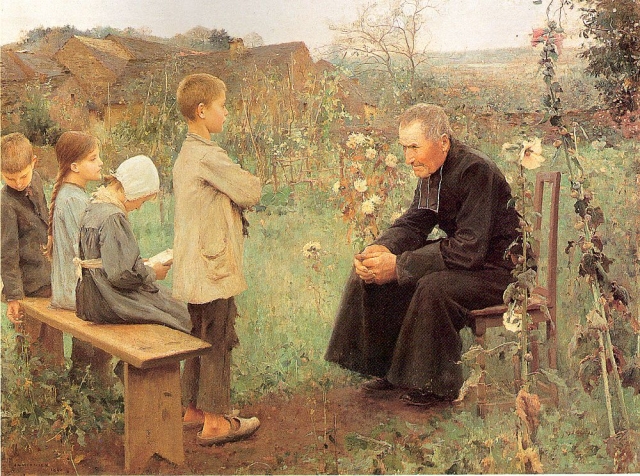
Imagine if this woman had simply relied on the means of covenant nurture to acquire a better understanding of God and salvation:

Is seminary absolutely necessary to get that foundation (or any of the other things I’ve mentioned)? No, not necessarily. Could a person learn all I learned without a seminary education? Probably. But it’s harder to do it on your own. There’s something to be said about surrounding yourself with trustworthy, godly professors who will guide you to a deeper faith in God and knowledge of his Word.

Well, there it is. That’s what I’d tell a friend if they asked whether I’m glad I went to seminary. I’d refill her coffee, double check the time to ensure we weren’t late for preschool pickup or whatever errands we were supposed to be doing, and if we still had an extra minute we’d discuss the ways seminary might be possible for her if she were interested.

No matter where God leads me from here, I’ll never regret the time I spent in seminary.

Makes me wonder if I would have had to go to seminary if my church had offered the kind of instruction that I was seeking. Did I really need Greek and Hebrew to understand what the Confession of Faith lays out so well?

The Shelf Life of 2k — Part Two

This is part two of the interview David Strain conducted with mmmmeeeeeEEEEE:

Here’s the second installment. There’s more to come. Enjoy…..

1. Is there a connection between 19th century revival/revivalism and the kind of socio-political agendas often advocated by both the Christian Right and Left today?

Definitely. Many evangelicals and Reformed do not understand that the kind of evangelical activism they now promote or perform was first part of the Second Great Awakening – the bad one. Not only was Finney interested in converting people, but he also wanted a righteous and just society. Evangelicals responded by forming a ton of voluntary societies that did in many respects transform American society (if you were not a member of the Whig or Republican parties, you may not have appreciated all of these reforms.)

So the Second no-so-great Awakening drove a wedge between Protestants, those with a high view of the church (Episcopalians, Lutherans, and some Old School Presbyterians) and those with a low view of the church and a high view of America. The ethno-cultural school of political historians has produced a body of literature on these ecclesial differences, and this work has actually informed my own writing on confessional Protestantism. The term “confessional” itself comes from political history and it stands for high church Protestants who are less concerned about social and political matters compared to the eternal realities of the gospel.

One other historical reference worthy of comment here is that the Second not-so-great Awakening was really the soil from which the Social Gospel sprung. I sometimes wonder why today’s “conservative” evangelicals are so willing to repeat the efforts and arguments that “liberal” Protestants were making a hundred years ago. Also, if you look at the books written by leaders of the religious right, people like Falwell and Ralph Reed, you see the Second not-so-great Awakening cited as a model or inspiration for contemporary political activism.

As the kids used to say, “What’s up with that?”

2. Should the church tell people how to vote for specific candidates, based on issues like abortion or gay marriage?

Definitely not. The church may and should speak to all the laws of the Decalogue, including the sixth and the seventh. Why the first four don’t receive more attention is anyone’s guess – could it be that social activism makes matters like worship and the Sabbath less important? But beyond explaining what God’s word requires, the church needs to let members apply them in their lives according to the callings and consciences. I mean, would anyone want the church to tell members never to eat meat offered to idols? It looks to me that if Christian liberty applies to the affects of idolatry, it also applies to electoral politics and the legislators voted into office.

3. Does the church have a prophetic voice, challenging sin wherever it finds it, even in politics and culture?

It depends what you mean. Expounding and teaching God’s word does involve challenging sin, obviously. But what people often mean is they want the church to apply the truths of the word to specific circumstances. I actually think this stems from a desire for the church to be relevant, to be doing something important. If the church is the place where the kingdom of grace is advancing, I don’t see why cleaning up pockets of cultural crime in the United States is more relevant than that. So people need to see how amazing the work of the church is, and how trivial, ephemeral, and fading the affairs of politics and culture are in comparison. But even so, the church has a prophetic voice simply by proclaiming the whole counsel of God. I wonder if people who say the church needs to be a prophetic voice actually appreciate that a minister standing in the pulpit each Sunday is representing the prophetic office of Christ.

4. Is there a place for para-church agencies and what are the boundaries of legitimate para-church work?

There has to be a place for the parachurch because the church can’t run everything. So everything that is not the church is parachurch.

The real question is parachurch agencies that engage in religious work. I don’t think a hard rule exists here except in those areas of evangelism and missions, work that the church is to oversee directly. But when it comes to educational endeavors, publishing, flexibility is in order

5. How do you respond to those who believe that the work of the church is to ‘transform society’ or to ‘bring in the Kingdom’?

First, I say that the coming of the kingdom is not evident in transforming society. As I’ve said, the church through word, sacrament, and discipline, is advancing the kingdom of grace, which is hastening the kingdom of glory (I’m using the language of the Shorter Catechism here). And because the church is not called to transform society – she already has enough on her plate – then she is not called to transform society. Individual Christians in their vocations are called to a host of tasks that do, I guess, contribute to social transformation. (I don’t like that language because it has a progressive political valence that I oppose for political and cultural reasons – both libertarian and localist and at times agrarian.) But the church doesn’t transform society nor should she as an institution (in distinction from her members’ callings).

This doesn’t mean that some of the aspects of social transformation, such as government, policy, and legislation are unimportant or “worldly.” They are worldly but in the good sense of the created order and the way that God superintends this world. Society is a good thing and Christians as citizens or in other capacities should be dutiful in their obligations to neighbors and magistrates. But social transformation is not where the kingdom of Christ happens.

6. If cultural transformation isn’t the church’s work, what is?

The work of the church is word, sacrament, prayer, discipline, catechesis, diaconal care and fellowship. It is not sexy and it does not generally attract headlines. But these are God’s ordained means for building his kingdom.

From DGH on The Death of Prayer Meetings Submitted on 2015 05 12 at 10:52 am

Mark, you are so good at quoting from historical figures that I’m a little taken aback by your throwaway reference to John Calvin. Since he had preaching services during the week, I’m surprised to learn that he advocated a mid-week prayer meeting: “Church history also gives us many good examples (e.g., Calvin in Geneva).”

Here’s a question, though. Say you are a congregation that already has two prayer meetings. Each one takes place on Sunday, one in the morning and one in the evening. These instances of corporate prayer, as you may have guessed, are part of the sanctification of the Lord’s Day. Are you advocating that we add another, for the sake of sanctifying Wednesday night (sure hope it doesn’t conflict with Hockey Night in Canada)?

Or what if you are part of a congregation that only has one service on the Lord’s Day — in the morning, for instance? Do you think a church should first start an evening Sunday service before adding a mid-week prayer meeting? Or is corporate prayer so important that Christians should leave their homes and offices for it, even though they may already pray in those non-church settings alone or with other Christians?

I am having trouble figuring out why you might advocate corporate prayer the way you do. For instance, you say that one reason is that people are too busy. But that’s the same argument that people use against a second service on Sunday. I can well understand that people have vocations that make attending church functions like Bible study, youth group, even catechism difficult. I can also well understand a session that is reluctant to add to a church member’s burdens, someone who already is committed to and practices keeping the Lord’s Day holy.

I don’t know why you don’t see the potential burden unless you don’t understand the doctrine of vocation. Isn’t it Reformed to think that someone is actually serving God by carrying out their civil, secular, professional, and family duties? If they perform those tasks on the Lord’s Day, then Houston we have a problem. But if they honor their callings during the week and cant’ attend a church function to which officers cannot attach a “thus saith the Lord,” are you really suggesting that to be truly holy and pious people need to pray together at the church building (instead of with their families or over the course of their work days)?

Maybe the problem is that you don’t appreciate the importance of Lord’s Day worship and week-day vocation.

Or maybe you simply have forgotten that all of life is worship (thanks to our southern correspondent):

The New Testament model for worship is not just about singing praises. It is living a life of service. It’s about far more than music. It’s helping your neighbor bring in the groceries, providing for the elderly, taking care of those who cannot take care of themselves, helping the poor and needy—these are all examples of biblical worship.

Actually, I’d prefer that you not follow this Framean understanding of every-square-inch liturgy, but you may want to recognize that your version of pietism is out of whack with the neo-Calvinist high intellect pietism. For neo-Cals, missing a mid-week prayer service is no problem since a believer must 24-7 be engaged in some means of grace. As you yourself have argued, grace can be a fairly expansive category that extends to God’s work of creation and providence. So if someone at church who is following Kuyper misses a prayer meeting because they are redeeming culture by watching Downton Abbey, which seventeenth-century theologian are you going to quote against them?

I Wonder What He thinks of Earnestness

From the fellow who thought the comparison of Scripture reading to oatmeal needed an injection of sanity:

I had never heard the phrase “God’s ordinary means of grace” until I was introduced to the reformed faith. As a result I had no doctrinal or experiential category for the true significance of those ordinary elements that make up the corporate life of a biblically informed church. If you are unfamiliar with the term “ordinary means of grace” it refers to those elements of our gathered worship to which the Lord has attached his blessing: the preaching and reading of God’s Word, the sacraments (Lord’s Supper and Baptism), prayer, praise, and fellowship.

These ordinary means of grace are the things that the Lord has given his church. They are not the inventions of man. We call them means of grace because the Lord has appointed them as means by which he blesses and builds his church. We call them ordinary because there is nothing about them that is spectacular. They are not rare like miracles. They are ordinary. They are to be practiced regularly in our Lord’s Day gatherings precisely because we regularly need what God offers us through them. But these are gifts not given to movements. God has given these means of grace to his church.

Sounds rather oatmealish manna-like to me.