Why Worry About Change?

When you can always interpret.

George Weigel tries to get out in front of Pope Francis’ upcoming encyclical on the family. But he couldn’t beat Cardinal Kasper (and, oh, by the way doesn’t a Cardinal outrank a layman in teaching authority?):

As is his wont, Cardinal Walter Kasper was first out of the starting blocks, announcing that the apostolic exhortation (whose date of publication he got wrong) would be a first step in vindicating his proposals for a “penitential path” by which the divorced and civilly remarried could be admitted to holy communion—despite the fact that his proposal had been roundly criticized and rejected at both Synods and in various scholarly articles and books in between. The Kasper spin was then picked up by some of the usual media suspects, who called on the usual Catholic talking heads on the port side of the Barque of Peter, who took matters further by speculating that the apostolic exhortation would open up even more revolutionary paths, involving the Church’s eventual acceptance of same-sex marriage and other matters on the LGBT agenda.

But not to worry, the Council that many think unsettled the church has actually settled what popes can do:

By declining Paul VI’s suggestion about a papacy “accountable to the Lord alone,” Vatican II made clear that there are limits to what popes can do. On the bottom-line matters at issue in the two recent Synods, for example, no pope can change the settled teaching of the Church on the indissolubility of marriage, or on the grave danger of receiving holy communion unworthily, because these are matters of what the Council’s Theological Commission called “revelation itself:” to be specific, Matthew 19.6 and 1 Corinthians 11.27-29. Nor has Pope Francis indicated in any public statement that he intends any deviation from what is written by revelation into the constitution of the Church.

Michael Sean Winters is even later to the pre-publication spin and offers his own prebuttal.

But what if the bishop whose job it is to interpret Scripture and tradition interprets dogma so it doesn’t change but its meaning does? This was the option favored by Protestant and Roman Catholic modernists. If modernism could happen once, why couldn’t it happen again (as if it ever went away)?

And then we have the problem of reason and what people with minds do to texts. Sam Gregg recently invoked Benedict XVI’s Regensburg address to call not his communion but the entire West to its former high esteem for reason:

One of the basic theses presented by Benedict at Regensburg was that how we understand God’s nature has implications for whether we can judge particular human choices and actions to be unreasonable. Thus, if reason is simply not part of Islam’s conception of the Divinity’s nature, then Allah can command his followers to make unreasonable choices, and all his followers can do is submit to a Divine Will that operates beyond the categories of reason.

Most commentators on the Regensburg Address did not, however, observe that the Pope declined to proceed to engage in a detailed analysis of why and how such a conception of God may have affected Islamic theology and Islamic practice. Nor did he explore the mindset of those Muslims who invoke Allah to justify jihadist violence. Instead, Benedict immediately pivoted to discussing the place of reason in Christianity and Western culture more generally. In fact, in the speech’s very last paragraph, Benedict called upon his audience “to rediscover” the “great logos”: “this breadth of reason” which, he maintained, orthodox Christianity has always regarded as a prominent feature of God’s nature. The pope’s use of the word “rediscover” indicated that something had been lost and that much of the West and the Christian world had themselves fallen into the grip of other forms of un-reason. Irrationality can, after all, manifest itself in expressions other than mindless violence.

Gregg warns rightly that “irrationality is loose and ravaging much of the West—especially in those institutions which are supposed to be temples of reason, i.e., universities.”

But if Father Dwight is any indication, irrationality also has its moments well within the confines of Roman Catholic parishes (even beautiful ones). If you wonder why the virgin Mary is the Queen of Heaven, just take a rational look at your Bible:

We simply have to read the Scriptures with Catholic eyes and understand the Jewish context of the Scriptures to see how the Catholic beliefs about Mary are all contained in the Scriptures. The problem is, they are not stated explicitly. Instead they are locked in the Scriptures to be understood and teased out. As the church came to understand more fully who Jesus really was they then began to understand more fully the role of his Mother, and as that became clear they also began to see that these truths were already there in the Scriptures. . . . The truths about Mary are subservient to the truths about Jesus because she is always subservient to her Son and always points to her Son. It is about him. It is not about her. . . .

Luke chapter 1:26-38 and Revelation 12. Consider first the passage from Luke. This is, of course, the story of the Annunciation of Jesus birth by the Angel Gabriel to the Virgin Mary. . . . The angel Gabriel is called “the Angel of the Lord”. He is the main messenger direct from God. Therefore his words can be taken as a direct revelation from God. His message to Mary is therefore God’s message to the world. He declares solemnly that Mary’s Son will be the Son of the Most High, but he will also be the heir of David and the King of the Jews and furthermore his kingdom will have no end. In other words, he is king of heaven.

In the Jewish understanding of monarchy the Queen of heaven was not the king’s wife, but the king’s mother. Solomon’s mother Bathsheba played this role in the Old Testament. It follows therefore that if Jesus is to be the heir of David’s throne and be king, then his mother would be the Queen. Furthermore, if Jesus is also to reign over the kingdom of heaven, then his mother would be the Queen of Heaven.

At some level, Christians on both sides of the Tiber need to give up the idea that their convictions are rational in the sense that people with well functioning minds will recognize the point of Christianity. Aside from the noetic affects of the fall which predispose unbelievers to suppress the truth in unrighteousness, Christians also affirm truths that defy reason — like the resurrection and the Trinity.

But if what Father Dwight does with Scripture is any indication of the interpretations that attend sacred and infallible texts, no amount of bishops and cardinals bringing their conciliar foot down on papal authority will prevent interpreters from interpreting.

#interpretationhappens

The More Things Change

The more apologists say they don’t.

Odd is the way that Protestants who notice changes in Roman Catholic life hear that they don’t have the correct paradigm for understanding the past. Odder still is that Roman Catholics who are in fellowship with the Bishop of Rome (and so have the right paradigm) don’t deny but notice changes:

Still, the Church of Pius was vastly different and I do not think there is any denying it. Great theologians, who would later play a key role at the Council, men like Henri de Lubac and John Courtney Murray, were silenced. Giovanni Battista Montini was exiled to Milan for his “liberalism”, and not given a red hat, but he would go on to become the greatest pontiff of the twentieth century. Pius’ obsession with communism muted his voice in denouncing the fascism of Italy and Germany and he was one of the few modern pontiffs not to issue an encyclical on social teaching. Even the visuals were vastly different: Compare this video of Pius’ coronation with a typical Pope Francis Mass.

Perhaps most importantly for the forthcoming discussion, there were obvious doctrinal developments, even changes, in the 74 years between 1939 and 2013. In 1939, the Assumption of the Virgin Mary was a theological opinion, not an officially proclaimed dogma of the Church. There were no “Fortnights for Freedom” because the Church still officially condemned religious liberty. And, while the Church taught that marriage must be open to procreation, she did not yet teach that every conjugal act must be open to procreation.

If you were to count back 74 years from 1939, you would see a vastly different Church. In 1865, the papal states, though considerably shrunken in 1860, were still in existence and the pope was the sovereign of all Rome, living in the Quirinal, not the Vatican. The Syllabus of Errors, condemning all things modern, was only one year old. On May 16th of 1865, Pope Pius IX appointed the convert Henry Edward Manning as the Archbishop of Westminster, and Manning would play a key role in the development of Catholic social teaching. He also kept a fellow Anglican convert, John Henry Newman, under a cloud of suspicion. The Kulturkampf, with its persecution of the Church in Germany, and the First Vatican Council, with its definition of papal infallibility,were still a few years in the future. In France, the Church flourished with spiritual energy and Marian visitations. Six years prior, Charles Darwin had published his book Origin of the Species which was the challenge all religions in profound ways yet, drawing on her intellectual resources, it was the Catholic Church that fared better than most at integrating his seminal work on evolution with the biblical account of creation. That intellectual work had to wait until Pius IX went to his eternal reward.

In the United States, of course, the Civil War came to an end that year. The war had broken the nation’s three largest Protestant churches – the Baptists, Methodists and Presbyterians – into northern and southern branches, but the Catholic Church and the Episcopal Church remained united. Bishop Patrick Lynch of Charleston, South Carolina, had conducted a diplomatic mission to Rome on behalf of the confederacy the year before and, in 1865, he was refused permission to return until his northern confreres secured a presidential pardon. Planning was underway for the Second Plenary Council of Baltimore. Canon law was still undeveloped in the United States and, so, there were no pastors with canonical rights, and the selection of bishops was still a complicated process beginning with the priests of a diocese and the suffragans of the ecclesiastical province both drawing up ternas of candidates for submission to Propaganda Fide. Yes, the Church in the U.S. was still governed through that congregation because we were considered mission territory.

Jump back another 74 years, to 1791, and we see a Church that was virtually prostrate. The popes had been forced to suppress the Society of Jesus, which had been the most stalwart support for papal authority, seventeen years prior. Pope Pius VI had gone to Vienna nine years earlier to cope with the spread of enlightenment ideas, sponsored by the Emperor Joseph II, but the trip had been a failure. And, of course, in France, the Assembly in 1791 mandated that all clergy take an oath to the Civil Constitution on the Clergy, adopted the previous year, provoking a schism that would last more than ten years and which laid the groundwork for the violence against the clergy that would commence in earnest in 1792 and last through the “Terror,” culminating with the suppression of the peasants in the Vendee. In the United States, on the other hand, our new, first bishop, John Carroll, was undertaking his first full year in office and, already, moving to help the Church engage the culture and avoid a sectarianism that he rightly feared would harm the Church in the U.S.

When you add that papal teaching (not dogma but infallible) comes precisely out of these changing contexts, you do wonder what the converts see who think they have escaped the fluidity and diversity of — yuck — Protestantism.

The Problem with Universal Jurisdiction

Maureen Mullarky fears a resurgence of anti-Catholicism in response to Pope Francis’ discussions of economic and political matters:

As Francis’ insinuates himself into geopolitics and seeks to influence America’s immigration policies, Blanshard’s long-dormant question—Is this a foreign power?— begins to stir. Catholics themselves recoil from his will to inflate the episcopal jurisdiction of the Chair of Peter into an imperial mandate to determine secular agendas. Catholics and non-Catholics alike wince at the spectacle of Francis grinning delightedly with Iran’s President Rouhani. They shrink from his embrace of Raúl Castro, wonder at his regard for major figures of liberation theology, and resent his effort to undermine American authority over its own borders.

A solution to this would be a pastor who only ministers God’s word.

But the complications of universal jurisdiction become more complex. Imagine what a Roman pontiff will do with a Donald Trump presidency:

the Vatican is surely worried about the candidacy of Donald Trump. Vatican diplomats tend to be drawn from the same families, attend the same schools, and read the same magazines and newspapers, as their secular counterparts. It is no secret that the governments of Europe are appalled and frightened at the prospect of a Trump presidency, and that fright is surely shared at the Vatican. And, because opposition to immigrants is such a central part of Trump’s political rise, and concern for immigrants has been such a central focus of Pope Francis’ articulation of the Church’s social doctrine, it surely occurred to the Vatican leadership that an archbishop who has spent the last nine years in Mexico could be uniquely valuable at this point in time. As well, immigration is one issue on which the U.S. bishops are not only united, but on which they are totally in sync with the Vatican.

Again, the solution may be to worry less about worldly matters and attend more to the keys of the kingdom, the one not of this world.

But what if having all that power and having so much to say about the world’s affairs leads to pride?

Pope Francis, it seems to me, is described as a “humble” leader for a few reasons:

He rejects various aspects of papal ceremonial.
He moved out of the papal apartments.
He says things like bishops should “smell like their sheep.”
He emphasizes the “bishop of Rome” title.
He says he values decentralization and dialogue, has had a Synod and tweaked the Curial structures just a bit.

Perhaps.

But perhaps it is also fair to ask…

..knowing the role of the Pope, and understanding how easily misunderstood the role of the Pope is by most people today, is it a mark of humble leadership to allow your own words to become the dominant public face of Catholicism – on a daily basis?

So here’s the paradox. No, the contradiction: to brush away certain external expressions of papal authority while actually doubling down on the authority. Communicating in one way the supposed diminishing of the role while at the same time using the role to speak authoritatively to the entire world out of your own priorities on a daily basis.

If this isn’t clear, think of it this way: Change up the situation and imagine it happening in your workplace, your school or your parish with a new boss, principal or pastor.

What would you think then?

Here’s another comparison:

The Catholic Mass developed over time as an elaborate ritual in which the priest-celebrant was hidden behind a mysterious language, ceremony and vestments. It was, it was claimed, necessary to strip all of that so that the people could more directly encounter Christ. The end result is that all we have to look at now is the priest, and the “proper” celebration of Mass is completely dependent on his personal manner and how his style makes us feel.

One wonders if this is the best way to encourage humble leadership.

For all the reforms of Vatican II, the legacy of papal supremacy haunts even the least hierarchical of popes.

Communicants, Siblings, Friends, and Others

When you have a comprehensive view (w-w) of the world, when you think that your faith informs (or should) everything you do, hard are those distinctions that 2k so readily supplies, like — this is the church so Christian rules apply, this is not the church so freedom applies.

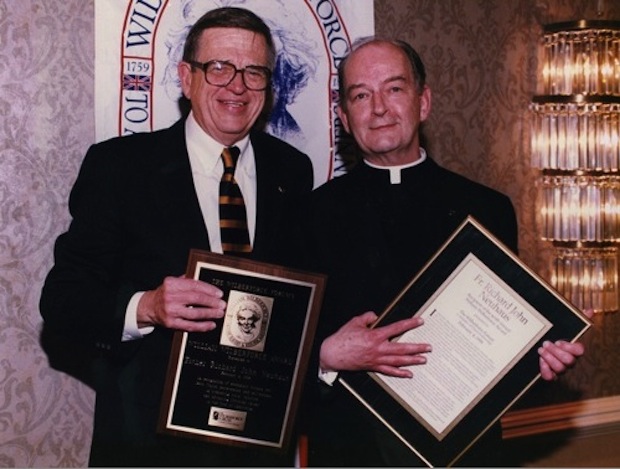
This problem is no less challenging for Roman Catholics than for neo-Calvinists since both are in the comprehensiveness business of showing how faith relates to EVERYthing a Christian does. Cathleen Kaveny took the comprehensiveness and catholicity of Rome in an arresting direction when she accused Richard John Neuhaus and the First Things crowd of partisanship and undermining the bonds of Roman Catholic unity:

Some conservative Catholics have blamed Pope Francis for sowing division among the members of the Body of Christ. But the charge is more properly lodged against one of the heroes of conservative Catholicism: the late Richard John Neuhaus.

It was Neuhaus, after all, who advanced the view that conservative Roman Catholics have more in common with orthodox Jews and Evangelical Protestants than they do with progressive members of their own religious communities. In fact, that view was an operational premise of First Things magazine under his leadership. This approach is based on a thoroughly distorted view of religious realities and commitments.

Does honoring Jesus as the Son of God count as a commonality? Like their conservative counterparts, progressive Roman Catholics acknowledge the divinity of Jesus Christ, and find the interpretive key to the Hebrew Bible in the New Testament. Orthodox Jews do not—indeed, must not—treat Jesus as the Messiah foretold in the Book of Isaiah. It would be blasphemous for them to do so.

Does living in the grace imparted by the sacraments count as a commonality? Both progressive and conservative Roman Catholics believe that God’s grace is channeled through the seven sacraments. Many Evangelical Protestants do not have the same view of grace or the sacraments; they often view the Eucharist as a memorial of a past event, not a way of being present with Christ here and now.

In trying to find common ground with evangelicals, then, Neuhaus was not truly Roman Catholic but actually Protestant:

Ultimately, Neuhaus’s focus was on nurturing these commonalities in the American political context—he was building a political movement. For a variety of partially overlapping reasons, conservative Roman Catholics, Evangelical Protestants, and orthodox Jews were inclined to vote Republican in political elections. Along with George Weigel and Robert George, Neuhaus coached Republican politicians in Catholic-speak to win national elections. . . . But here’s the irony of Neuhaus’s project: in treating theological belief and commitment as mere instruments of political will, Neuhaus’s view of religion resonated more with Feuerbach, Marx, and Leo Strauss than with the church fathers. In separating his own church of the politically pure from the hoi polloi of the body of Christ, his ecclesiology better reflects Protestant sectarianism than Roman Catholicism.

For the record, I too took issue with Evangelicals and Catholics Together for putting politics ahead of theology and for locating Christian unity not in ecclesiastical contexts but in parachurch groupings.

But Rusty Reno didn’t particularly care for Kaveny’s shot at Neuhaus. And so he tried to justify finding fellowship among religious people who were political liberals and then got mugged by reality:

many of the founding figures who played such a prominent role in First Things, as well as early readers like me, came to some shared conclusions. We became less and less impressed with the modern conceit that ours is a time of the unprecedented. We became more and more convinced that our traditions contained an inherited wisdom—a divine revelation—that provides greater insight into the human condition than any modern method, mentality, or revolution. Again, in the magazine’s early years, it was an exciting and invigorating to find others who were coming to the same post-liberal conclusions, whether they were Jewish, Catholic, or Protestant.

That is mainly true but does not represent the nature of Evangelicals and Catholics Together. Otherwise, ECT should have been called Evangelicals and Liberal Protestants and Roman Catholics and Mormons and Jews and Stanley Hauerwas Together. But at least Reno recognizes different layers of commonality:

When it comes to many things that are important to me, I have more in common with friends than with my brother. But my brother’s still my brother. It in no way compromises the truth of our fraternal bond for me to link arms with those with whom I have more in common politically, intellectually, or even theologically. The same goes for the sacramental bond that units us in Christ.

That is more or less a 2k point. But a 2ker would not call a magazine about religion and public life First Things. It’s not elegant but Penultimate Things or Proximate Things or Common Things would work better.

That left Michael Sean Winters to settle the debate and he did so (in neo-Calvinist-friendly ways) by taking issue with Reno’s separation of life into different spheres:

There may be “other dimensions” as Reno notes, but surely, for the Christian, those other dimensions need to be related to “what matters most.” It was this dualism between the Catholic faith and Catholic morality that stalked Neuhaus’s writings and continues to afflict the journal he founded. This dualism not only colored Neuhaus’ judgment, but it kept much of his otherwise enjoyable controversial writings at a fairly superficial level. It also led him to overlook the failings of his own team, both in politics and in religion: His defense of the Iraq War and of Fr. Maciel were stains on Neuhaus’ intellectual project that deserve attention and explanation by those who champion him.

. . . Reno, too, puts his sacramental beliefs in one silo, and his moralizing in another, and never the two need challenge each other. That is not how Catholics think when we are thinking at our best.

Apparently, 2k thinking is a no-no for Roman Catholics as much as it is for neo-Calvinists. Everything belongs to God. Or the papacy has universal jurisdiction (which is a topic for discussion in its own right). Which makes it hard to justify solidarity with people of a different faith.

But if you limit that solidarity to the church and find all sorts of room for cooperation outside the church, problem solved. Why does that solution seem so impious?

The Politics of the Holy Spirit

Michael Sean Winters first argues that the Second Vatican Council was revolutionary:

Douthat also insists that there was nothing revolutionary about Vatican II. I do not want to get hung up on semantics. If he wishes to make a Burkean point, that there is a difference between reform and innovation, and revolutionaries innovate, I am mostly in agreement, but while the Council did not itself innovate per se, it reformed a lot. Through much of the nineteenth and the first-half of the twentieth century, Rome carried on an extensive correspondence with the American hierarchy on the subject of interreligious events. The officials in Rome did not like the idea of a Catholic priest saying a prayer at a civic event alongside ministers of other religions. What caused Rome to change its mind? In the postwar era, they recognized that the needed America as a bulwark against communism and that non-Catholics would be needed too. Now, interreligious events characterize all local churches and all papal trips. If that is not a revolution, I am not sure what is and, I dare say, it might even qualify as an innovation, a necessary one to be sure and novel only because previously no country, like the U.S. had experienced the admixture of religious groups to the extent that we did.

And among confessional Protestants like Missouri Synod Lutherans and Presbyterians, participating in interreligious services can still get a pastor in trouble. Separated brothers or more like distant cousins seven times removed.

But Winters thinks the Holy Spirit was responsible for the revolution:

Most egregiously, not once does one grasp in his analysis of Vatican II that the Holy Spirit was active in the deliberations of the Council, and that this is not only testified to by those who participated in it, but by our Catholic beliefs about the Spirit’s presence in the Church. If the Spirit was not active at Vatican II, why should we think it was active at Trent or Nicaea? One can deride, as Douthat does, those who invoked “the spirit of the Council” to justify positions that were actually in conflict with the texts of the Council, but there really was a “spirit of the Council” and Pope Francis is not wrong to invoke it. Yes, the “spirit of the Council” was invoked to justify silly things but not by Pope Francis or Cardinal Kasper.

So will Winters allow that the Holy Spirit was also behind the U.S. Constitutional Convention or England’s Really Exceptional Glorious Revolution? Lots of churches adjusted to liberalism. American Presbyterians did in 1789. It took the Vatican longer. But why invoke the third person of the Trinity for something so ordinary?

The dangers of exceptionalism are everywhere.

Is This A Good Way to Think about the Incarnation?

Is it true much less infallible?

What did Jesus actually bring, if not world peace, universal prosperity, and a better world? What has he brought?

The answer is very simple: God. He has brought God. He has brought the God who formerly unveiled his countenance gradually, first to Abraham, then to Moses and the Prophets, and then in the Wisdom Literature – the God who revealed his face only in Israel, even though he was also honored among the pagans in various shadowy guises. It is this God, the God of Abraham, Isaac, and Jacob, the true God, whom he has brought to the nations of the earth.

He has brought God, and now we know his face, now we can call upon him. Now we know the path that we human beings have to take in this world. Jesus has brought God and with God the truth about our origin and destiny: faith, hope, and love. It is only because of our hardness of heart that we think this is too little. Yes, indeed, God’s power works quietly in this world, but it is the true and lasting power. Again and again, God’s cause seems to be in its death throes. Yet over and over again it proves to be the thing that truly endures and saves.

What's In Your Kitchen?

John Zmirak adds to the confusion that Protestants have about papal audacity and the magisterium’s authority:

There is such a thing as a cafeteria Catholic. That term refers to people who pick and choose from the Church’s non-negotiable teachings, based on what seems right to their private consciences formed by the secular culture around them; their own urgent desires; and the writings of disaffected Jesuits, and radical nuns who traded in Thomas Aquinas for Karl Marx, Carl Rogers or Carl Jung. Do you find the Church’s historical teaching on divorce too much of a “hard saying”? There are theologians, up to the level of Cardinal Kasper (the friend of the Zeitgeist), ready to nuance it into oblivion. Do you feel that the Church’s condemnation of abortion or homosexual “marriage” is too “patriarchal”? Here’s a coven of nuns ready to teach you all about the love of Goddess.

But when theologically faithful Catholics question the current pope’s exotic economic views, which he himself has said are not binding on Catholics, suddenly those who dissent from core Church teachings are ready to break out the thumbscrews and light the stake.

In the piece that so offended Michael Sean Winters and provoked our phantom debate, I showed how the statements of popes over the centuries on economics and politics were at such variance with each other that it was simply false to pretend that the Magisterium extended to cover such questions. By definition, the Magisterium includes only teachings that have remained fundamentally consistent since the time of the Apostles. It is those teachings, along with the Bible, that form the core of Catholic faith. So if we find that popes and councils have differed with each other on an issue (as they indisputably have over slavery, lending at interest and religious freedom), then those papal teachings are not part of the ordinary Magisterium. They may contain worthy insights, like St. John Paul II’s forays into philosophy, but they are not part of the Faith.

There are some Catholics who are uncomfortable admitting facts like these. For whatever reason, these people — whom I will call Feeding Tube Catholics — crave the certainty that the Holy Spirit guides every single step taken by the church through its 2,000 years of history. The Holy Spirit picks each pope, they believe, and guides his daily steps, public statements and decisions. So whatever the pope is saying at the moment, you should simply shut down your critical faculties and believe it — regardless of what previous popes and councils might have taught. Those go into the Memory Hole, and pfft! They never existed.

Well wouldn’t that be nice? Except that then we’d have to explain why the Holy Spirit picked so many corrupt and cruel pontiffs, and why throughout the Renaissance He seemed to favor the cardinals who offered the highest bribes. That’s kind of a weird coincidence, isn’t it? We’d also have to ask why the Holy Spirit inspired one pope to dig up his innocent predecessor and try his corpse for heresy. Why did the Holy Spirit guide popes like Gregory XVI, Pius IX and Leo XIII to denounce religious freedom as a diabolical snare, then direct Pope Paul VI and Vatican II to declare religious freedom a fundamental right, based in both divine revelation and natural law?

The answer I usually get to questions like these is along the lines of: “Shut up, you sound like a Protestant.” Commentators like Mark Shea have demanded that Catholics adopt a pet-like “docility” to whatever the Vatican is saying at the moment, while one learned writer at First Things called on conservatives to accept Pope Francis’ statements on economics as the fruit of a “spirit-led Magisterium.” To which one must respond: Did the same Spirit lead all those previous popes who contradicted each other on issues ranging from slavery to the right of Protestants to worship freely without being arrested by the Inquisition? He sure seems to change His mind a lot.

Before he became Pope Benedict XVI, Cardinal Ratzinger addressed the threat of Feeding Tube Catholicism, which if seriously pursued would reduce Catholics to the kind of mindless zombies imagined in the worst stereotypes of anti-Catholics like Jack Chick. Ratzinger had already pointed out one case where a pope (Pius IX) had issued a comprehensive manifesto of political statements (the Syllabus of Errors), only to be later contradicted by a council in its documents (Gaudium et Spes). Ratzinger spoke specifically of the case of Pope John Paul II, whose teaching on the death penalty differed from that of previous popes. Ratzinger sharply distinguished between dissent on issues where the church had spoken clearly and consistently, such as abortion and euthanasia, and disagreement with a pope who was saying something new. Ratzinger reminded us that the teaching of the Church is not some Moscow-style “party line” meant to wipe clean the minds of believers like the shake of an Etch-a-Sketch.

Let me propose instead of Cafeteria or Feeding Tube Catholicism a kind of Thomistic golden mean. Let’s call it Knife-and-Fork Catholicism. No, we won’t pick and choose from the Church’s teachings as if we were scanning for our favorite muffin type at a Shonee’s breakfast bar. Nor will we lie back, brain-dead, as the latest pope’s latest statements are downloaded into our brains like one of Apple’s or Microsoft’s non-optional updates.

Instead we will sit up like men and women with knives and forks at a restaurant. We will accept the balanced, healthful meals sent out by a chef whom we trust. But if there seems to be some kind of mistake, if we find on our plates gorge-raising dollops of stale Cuban, Venezuelan and North Korean prison rations, we drop our forks. We assume there has been a mistake, since none of this was on the menu. We send the chef a message that we will pass, in the happy faith that the restaurant’s Owner will agree and understand.

So far, I detect all three stripes of Roman Catholic here at Old Life. Many converts are Feeding Tube faithful — all that papal audacity in denial of all that history.

Some of the cradles seem to be the Cafeteria type, picking and choosing among the two infallible dogmas.

And some are Knife-and-Fork, level headed, understand discrepancies in the past and the present, and register dissent.

But what puzzles me is how it is John Zmirak’s pay grade to determine which meal is balanced and healthful. For most of Roman Catholic history, that determination was the responsibility of the bishops, the ones who would protect the church from error and shepherd the flock. So while I don’t want to upset John by comparing him to Luther, I’m not sure how his independence of thought is any different from Luther’s before the excommunication ax fell.

Biblical Pessimism

Today’s reading took me again to Roman Catholic and Kuyperian expressions of optimism. In the face of mounting evidence that our society is coarsening, Billy Boyce and Michael Sean Winters affirm hope. First, pastor Boyce (the Kuyperian):

But there is a way forward. Kuyper’s emphasis on the antithesis keeps us humble, recognizing that there will always be spiritual warfare in this age against the powers of darkness. Simultaneously, Kuyper’s emphasis on common grace allows us to participate in the public sphere with hopefulness that, by our faithfully sowing seeds of righteousness, we can reap a harvest of flourishing for the common good. To quote Dr. Vincent Bacote, “Ultimately this is a vision of a society where change occurs because Christians participate in the realm of common grace, and, as a result, the world gets better.”[3]

There may never be a Golden Age (I’m an amillennialist, after all), but this does not mean that we cannot look for cultural renewal in this life. Because we acknowledge the presence of sin, we can view our past with honesty, as a mixed bag of good and bad. But because we know God is at work, we can hope for more. Our hymnal teaches us that “not with swords’ loud clashing, nor roll of stirring drums, but with deeds of love and mercy, the Heavenly Kingdom comes.” These deeds of love and mercy are powerful, and they include all sorts of cultural participation, even politics. Ours is a long march forward; our enlistment in the Church Militant is for the entirety of this age.

If not a Golden Age, at least point to an instance of cultural renewal. If we can spot that, then we might identify the ingredients that make for such positivity. Without the specifics — 1550 Geneva? 1630 Boston? 1900 Amsterdam? — we have only haze.

Michael Sean Winters (Roman Catholic) also keeps hope alive:

These prophets of doom may or may not be culturally attuned, but they misunderstand who is in charge. Maybe it is just that I have been reading Kuyper, but it seems to me that a truly holy preacher of the Gospel does not invite his listeners to despair, but to hope, hope not in their own efforts, but in God’s promises. Love and labor, then, not breast-beating and complaints about slippery slopes. Besides, sometimes we humans even slip up the hill.

So what does the Bible say about what Christians should expect from their futures on planet earth?

Anyone remember the curse?

To the woman he said,

“I will surely multiply your pain in childbearing;
in pain you shall bring forth children.
Your desire shall be for your husband,
and he shall rule over you.”

And to Adam he said,

“Because you have listened to the voice of your wife
and have eaten of the tree
of which I commanded you,
‘You shall not eat of it,’
cursed is the ground because of you;
in pain you shall eat of it all the days of your life;
thorns and thistles it shall bring forth for you;
and you shall eat the plants of the field.
By the sweat of your face
you shall eat bread,
till you return to the ground,
for out of it you were taken;
for you are dust,
and to dust you shall return.” (Genesis 3:16-19 ESV)

Unless I’m mistaken, the curse is still in effect. Mothers chime in if you want to correct that impression.

Remember Paul’s counsel to Timothy:

For the time is coming when people will not endure sound teaching, but having itching ears they will accumulate for themselves teachers to suit their own passions, and will turn away from listening to the truth and wander off into myths. As for you, always be sober-minded, endure suffering, do the work of an evangelist, fulfill your ministry. (2 Timothy 4:3-5 ESV)

Not much forward rhetoric there.

How about Peter’s closing words?

This is now the second letter that I am writing to you, beloved. In both of them I am stirring up your sincere mind by way of reminder, that you should remember the predictions of the holy prophets and the commandment of the Lord and Savior through your apostles, knowing this first of all, that scoffers will come in the last days with scoffing, following their own sinful desires. They will say, “Where is the promise of his coming? For ever since the fathers fell asleep, all things are continuing as they were from the beginning of creation.” For they deliberately overlook this fact, that the heavens existed long ago, and the earth was formed out of water and through water by the word of God, and that by means of these the world that then existed was deluged with water and perished. But by the same word the heavens and earth that now exist are stored up for fire, being kept until the day of judgment and destruction of the ungodly.

But do not overlook this one fact, beloved, that with the Lord one day is as a thousand years, and a thousand years as one day. The Lord is not slow to fulfill his promise as some count slowness, but is patient toward you, not wishing that any should perish, but that all should reach repentance. But the day of the Lord will come like a thief, and then the heavens will pass away with a roar, and the heavenly bodies will be burned up and dissolved, and the earth and the works that are done on it will be exposed.

Since all these things are thus to be dissolved, what sort of people ought you to be in lives of holiness and godliness, waiting for and hastening the coming of the day of God, because of which the heavens will be set on fire and dissolved, and the heavenly bodies will melt as they burn! But according to his promise we are waiting for new heavens and a new earth in which righteousness dwells. (2 Peter 3:1-13 ESV)

Is waiting for the world to get torched much of a plan for cultural renewal?

But let’s not leave out Jesus’ pessimism:

“So when you see the abomination of desolation spoken of by the prophet Daniel, standing in the holy place (let the reader understand), then let those who are in Judea flee to the mountains. Let the one who is on the housetop not go down to take what is in his house, and let the one who is in the field not turn back to take his cloak. And alas for women who are pregnant and for those who are nursing infants in those days! Pray that your flight may not be in winter or on a Sabbath. For then there will be great tribulation, such as has not been from the beginning of the world until now, no, and never will be. And if those days had not been cut short, no human being would be saved. But for the sake of the elect those days will be cut short. Then if anyone says to you, ‘Look, here is the Christ!’ or ‘There he is!’ do not believe it. For false christs and false prophets will arise and perform great signs and wonders, so as to lead astray, if possible, even the elect. See, I have told you beforehand. So, if they say to you, ‘Look, he is in the wilderness,’ do not go out. If they say, ‘Look, he is in the inner rooms,’ do not believe it. For as the lightning comes from the east and shines as far as the west, so will be the coming of the Son of Man. Wherever the corpse is, there the vultures will gather.

“Immediately after the tribulation of those days the sun will be darkened, and the moon will not give its light, and the stars will fall from heaven, and the powers of the heavens will be shaken. Then will appear in heaven the sign of the Son of Man, and then all the tribes of the earth will mourn, and they will see the Son of Man coming on the clouds of heaven with power and great glory. And he will send out his angels with a loud trumpet call, and they will gather his elect from the four winds, from one end of heaven to the other. (Matthew 24:15-31 ESV)

Perhaps hoping for a restoration of cultural standards in the United States comes up a tad short of the kind of cataclysm that seems to await sinners in the hands of a righteous God.

Of course, some might want to point to any number of Old Testament prophecies as the basis for hope (even while avoiding signing up for Jack Van Impe‘s newsletter):

The wolf shall dwell with the lamb,
and the leopard shall lie down with the young goat,
and the calf and the lion and the fattened calf together;
and a little child shall lead them.
The cow and the bear shall graze;
their young shall lie down together;
and the lion shall eat straw like the ox.
The nursing child shall play over the hole of the cobra,
and the weaned child shall put his hand on the adder’s den.
They shall not hurt or destroy
in all my holy mountain;
for the earth shall be full of the knowledge of the LORD
as the waters cover the sea.

In that day the root of Jesse, who shall stand as a signal for the peoples—of him shall the nations inquire, and his resting place shall be glorious.

In that day the Lord will extend his hand yet a second time to recover the remnant that remains of his people, from Assyria, from Egypt, from Pathros, from Cush, from Elam, from Shinar, from Hamath, and from the coastlands of the sea.

He will raise a signal for the nations
and will assemble the banished of Israel,
and gather the dispersed of Judah
from the four corners of the earth.
The jealousy of Ephraim shall depart,
and those who harass Judah shall be cut off;
Ephraim shall not be jealous of Judah,
and Judah shall not harass Ephraim.
But they shall swoop down on the shoulder of the Philistines in the west,
and together they shall plunder the people of the east.
They shall put out their hand against Edom and Moab,
and the Ammonites shall obey them.
And the LORD will utterly destroy
the tongue of the Sea of Egypt,
and will wave his hand over the River
with his scorching breath,
and strike it into seven channels,
and he will lead people across in sandals.
And there will be a highway from Assyria
for the remnant that remains of his people,
as there was for Israel
when they came up from the land of Egypt. (Isaiah 11:6-16 ESV)

But if that is what the hopefuls are optimistic about, then they may want to stay away from the U.S. State Department’s diplomatic team in the Middle East.

When Christianity Goes Cosmic

Roman Catholics fall for neo-Calvinists.

Michael Sean Winters closes his reflections on James Bratt‘s biography of Kuyper with a big finish:

It would be wrong to finish this treatment of Bratt’s book without mentioning Kuyper’s most famous quote, uttered in his “sphere sovereignty” speech inaugurating the Free University: “there is not a square inch in the whole domain of our human existence over which Christ, who is Sovereign over all, does not cry: Mine!” All of us, Catholics or Calvinists, must seek to rediscover that insight in our lives and our thought, perhaps not with the comprehensiveness or brilliance that Kuyper brought to the task, but as a check on our willingness to live out the designation “Christian.” It is one of the gifts of Pope Francis that, by word and gesture, he lives this conviction: The environment, the economy, our sexual lives, all of it is not really ours but His. Even our very lives are given to us as if on loan, and there will be a reckoning for how we lived those lives, whether it was for ourselves or for Him. It is this – and ultimately, only this – that distinguishes Christian social and cultural criticism from other flavors. Its absence betrays us as chaplains to the status quo. Its presence, in Kuyper’s life and in our own, can be the occasion for miracles.

When transformation isn’t inspiring enough, work in the possibility of working miracles.

Why Kuyperians Don't Like 2k

Michael Sean Winters is reading James Bratt’s biography of Abraham Kuyper and quotes the following assessment of the Dutch statesman:

Nowhere did he so minimize the effects of sin as in his assumptions about the macro level of social development. Sometimes – for instance, in his speech against “Uniformity” – he could spy a fearful momentum that was greater than any particular part, and on many occasions he noted individual persons, policies, agencies, or communities perverting their social potential. But in formal theory Kuyper more often celebrated than worried about the direction of the whole. Here he shared in his era’s cult of “progress.”

Notice the connections. Minimize the effects of sin to think that the whole of society is improving.

How do people invariably view 2k? Too pessimistic, nothing we can do.

How do 2kers respond? Yes, things are bad but God has done great things. Salvation comes from him. Improving social conditions may be positive — don’t let the unintended consequences hit you between the eyes, DOH! — but social improvement is not salvation.

How do 2kers perceive neo-Calvinists? As blurring the gospel into social or holistic aspects, or as being excessively optimistic about human potential for overcoming sin and its consequences.

2k puts the total in Total Depravity. Neo-Calvinists have plans for restoring creation to its original order.

Can anyone possibly explain why Calvinists would be optimistic about anything other than the plan of salvation?