The PCA Back in the Day: This Time for Real

This is the last of a retrospective inspired by the current assembling of the PCA General Assembly. What follows is the fourth assessment of the PCA’s 2010 Strategic Plan. It is by Martin Hedman, who was then the pastor of Mission Presbyterian Church in La Hambra, California. The entire series was published in the Spring 2010 issue of the Nicotine Theological Journal.

Sufficiency of Scripture for PCA Planning

Several years ago a young man came before our presbytery to be licensed to preach. As is our practice, the Candidates and Credentials committee led the initial questioning, asking a subset of the questions he had prepared as part of his written examination. The young man was poised and confident in his answers. Clearly he had prepared, knew his material and answers well. The committee asked this man to define justification. His answer? “Justification is an act of God’s free grace, wherein he pardons all our sins, and accepts us as righteous in His sight, only for the righteousness of Christ imputed to us, and received by faith alone.”

Beautiful answer! Right out of the Shorter Catechism. Unlike many men who try to memorize the catechism and recite its answers during a floor exam, he did not hesitate or stutter in any way. Many of his answers were just like this one, well spoken and directly from the catechism.

After asking a number of selected questions out of the written exam, the committee opened up the questioning to the floor of presbytery. As usual, a number of questions concerned matters of clarification, some to flesh out answers or reasoning, and some to explore additional territory. At one point – I don’t remember who it was but do recall it was one of the older men – a presbyter commended the young candidate on his ready answers and his felicity in using the catechism. The presbyter then asked a question something like this: “You clearly know what the doctrine of justification is. Can you tell us what it means for you in your daily life as a Christian?”

“Whoa!” I thought to myself. “Is this a veiled attack? Is it wrong for a guy to know his catechism? Was this a some squishy-soft, feel-good, pietistic jab?”

And then I watched as the young candidate really, genuinely struggled with his answer. The poise and confidence were gone as he searched an answer. What he said I don’t recall but it wasn’t very satisfying. I don’t even recall if there was a follow up by the questioner. What did stay with me was the thought that this shouldn’t be so hard to answer.

Having learned about them from the guy (i.e. R. Scott Clark) who came up with the acronyms, I am in no way interested in either QIRC (Quest for Illegitimate Religious Certainty) or QIRE (Quest for Illegitimate Religious Experience). At the same time, the Reformed faith acknowledges the necessary link between doctrine and practice. They are inseparable.

Nevertheless, too often we seem to have trouble connecting them. It may be the young theologian on the floor of presbytery who hasn’t thought through the implications of the doctrine of justification – doctrine leading to practice. Or it may be the denominational committee that wants to be strategic and forward thinking but hasn’t thought through the biblical foundations – practice without foundation in doctrine. The latter is the case with the recently proposed and passed SP for the PCA. Both problems flow from a lack of appreciation for the sufficiency of Scripture. This is especially evident in the SP.

To illustrate let me take one example from the plan itself. The original draft of the SP called for “safe places” in which to discuss controversial theological matters, or in some cases give men the opportunity to express new ideas without having to worry about being brought up on charges. Prior to actual presentation to GA the wording was changed to “civil conversation.”

First, this presupposes a problem within the PCA’s current theological environment which I do not grant but will set aside for the sake of brevity. Second and more important, the plan proposes a solution that seems completely ignorant of Scripture. Granting that there are times and places where elders, deacons and others do not hold civil conversations, and even that those occasions are far more prevalent than we ought to be comfortable with, what is the solution?

The SP proposes places to enter into civil conversations, by means of public forums at General Assembly, similar forums at presbyteries, and the gathering together of those who disagree to discuss how to get along with each other. Will this work? I have no idea. No. Wait. Actually, I do. The supposition of “uncivil” conversations also presupposes that people are getting together, in some fashion, for uncivil purposes. So, we are going to establish more places to have more conversations? And that will somehow magically make them civil? Who comes up with this sort of sociological claptrap?

Answer: those who don’t look to Scripture, in other words, those who by their proposals and actions demonstrate that they don’t take the sufficiency of Scripture seriously. Sure, maybe they do for doctrinal purposes. After all, that’s what 2 Tim 3:16 says: “All Scripture is breathed out by God and profitable for teaching, for reproof, for correction, and for training in righteousness.” Isn’t this the “go-to” verse to show that we don’t need Tradition (a la the Roman Catholics), that we are right to proclaim our belief in sola scriptura?

Of course it is. But there’s more. The last clause says that Scripture is also profitable – sufficient – for training in righteousness. And verse 17 explains why: “that the man of God may be competent, equipped for every good work.”

So, if we want men to hold civil conversations, an example of righteous living and certainly a biblically sound good work, shouldn’t we look to Scripture for how and why men should do so? Of course we should. But we don’t make that connection nearly as often as we should. We want to be wise. We want to take action, be responsible, and see results. We want something to happen as a consequence of our having done something. We are, sadly, manifestly unsatisfied with the preached and taught Word of God and the Spirit’s promised ability to make it go out and not return void. In this, we show a lack of belief in Scripture.

Do we want civil conversations? Then we need something better, something more grounded and solid than clever schemes. We need God’s Word. We need his Spirit to change hearts, convict men of sin, and produce the fruit of repentance, so that we might walk in a manner worthy of the Spirit’s effectual calling.

Here is just one, all too short, example of what we need to be saying to each other, admonishing and exhorting one another with, if we really desire godly exchanges of opinions and ideas in the PCA:

Ephesians 4:11-25 tells us, among other things, that we have proclaimers and teachers of God’s Word to help us grow up in the fullness of Christ, that we are to speak the truth in love, so that we might grow up in every way into Christ, and that we speak the truth with our neighbor because we are members of one another. We have God’s Word, we are in Christ and we are to grow up in Christ, we are united in Christ – if all these are true then how can we not be of a mind to speak truth to each other in love? If we don’t, how can we claim, how can we hope, to grow into the fullness of Christ? Far better than meetings and forums is a solid grasp of who we are in Christ and all the implications that flow from that blessed reality.

Now there’s a strategy! We believe and confess that God’s Word works effectively for the building up of God’s people in righteous and holy living. We need to put that belief into practice!

God’s Word really is sufficient – for doctrine, and yes for training and competence in righteous living, including civil conversations with our brothers and sisters in Christ.
The Return of The PCA Back in the Day

This is the third in a series of pieces – inspired by the PCA General Assembly assembling in Chattanooga – that appeared in the Spring 2010 issue of the Nicotine Theological Journal in light of the PCA’s approval of its Strategic Plan. This one comes from Wes White, who was then pastor at New Covenant Presbyterian Church in Spearfish, South Dakota.

Why I Voted “No”

How can you be against “civil conversations,” “more participation in General Assembly,” and “God’s global mission”? Many people have asked this question about the opponents of the PCA’s so-called SP. I believe that there are two ways in which we can view the PCA’s SP, either in the abstract, simply in terms of what the words say, or in the concrete in terms of what those who put the plan together actually want to accomplish. I think the latter way of viewing it is the more appropriate one, but, in either case, I would have voted “no” on every single point.

In the abstract, the SP may seem quite harmless. The problem is that we need to begin by asking, why do we need a strategic plan at all? What are we trying to accomplish? What the PCA calls “strategic planning” has been going on for a while. In the year 2000, the nine Coordinators of the Committees and Agencies of the PCA thought we needed a plan for the future. The result was a 24-person Strategic Planning Steering Committee. They reported at the 2003 GA with a booklet entitled Being Revived + Bringing Reformation. This report outlined the mission, vision, and strategic priorities of the committee.

The second phase of strategic planning began in 2004 with the re-constitution of the SP committee. Its task was three-fold: engaging ruling elders, preparing the next generation, and organizing resources to better serve our corporate mission. The re-constituted committee proposed to changes to church life. The first was the restructuring of General Assembly to limit parliamentary options on the floor of General Assembly and place a much greater emphasis on the committees of commissioners and especially the overtures committee. The second was the creation of the Cooperative Ministries Committee (CMC), a body where the various committees and agencies of the PCA could communicate with one another and “facilitate” further strategic planning. Both of these items were proposed at the 2005 General Assembly and passed at the 2006 General Assembly.

While I do believe that the changes to the PCA’s Rules of Assembly Operation (RAO) have been helpful, one thing is rather obvious. Little progress has been made on the major goals set forth by the 2004 committee. The proportion of Ruling to Teaching Elders is about the same as it was in 2006. The next generation is doing roughly the same thing as it was in 2006. Missions aren’t that much different either.

What have we really accomplished in these areas? Not much, it seems to me. What makes us think that this will be any different? We may feel good about passing these things, but I don’t see any evidence that it will make any difference.

One problem is that little to no research has assessed the perceived problems. In his talk to the Administrative Committee (AC), TE Bryan Chappell, president of Covenant Seminary and author of the informational part of the plan, noted that the number of candidates to the ministry had dropped from 599 in 2004 to 298 in 2008. I asked him in committee if anyone had conducted research to assess this drop. His answer was “no,” and, in his opinion, he didn’t think you could do research on who was not there, but he did suggested that the lack of civil conversations was responsible. This is precisely the problem. Until we figure out why these figures are the way they are, I do not know how good a plan can be. (By the way, in 2009, the numbers were back up to around 550 candidates for ministry. What happened? That would be a good study for strategic planners.)

In sum, I opposed this plan in the abstract because it will not accomplish anything. But two additional problems are worth mentioning.

First, the SP came to the floor in a way that was contrary to the RAO. The CMC cannot present anything directly to the General Assembly. According to 7.3.c. of the RAO, strategic planning must include matters that normally come under the work of our other committees and agencies. Any action must be presented through the “appropriate” committee, which clearly means the committee or agency that normally presents such matters to the Assembly. Instead, the CMC presented it all through the AC, even though the matters in the plan related to Covenant College and Seminary, Mission to North America, and other committees. This point was part of a protest against the Assembly’s action in passing the SP.

Second, the AC included a funding plan that basically involves of tax on congregations. They must pay and if they do not for one year, they will owe back taxes plus the current year’s assessment. They will also lose their vote at GA until the local church and all their pastors pay what they owe to AC. This funding scheme is being proposed through an amendment to Book of Church Order 14-1. The problem is that the amendment says that General Assembly may “require” contributions for the support of General Assembly; whereas, BCO 25:8 states, “The superior courts of the Church may receive monies or properties from a local church only by free and voluntary action of the latter.” The Amendment is contrary to other parts of the Constitution and should have been ruled out of order.

In the concrete, the trouble with the SP is that revisions to language at the Assembly may not actually change what the planners originally intended. I am not confident that CMC and AC have corrected for the errors of their first proposal.

For example, the first theme of the SP was “safe places.” They changed the wording to “civil conversations,” but does that really change what the authors intended when they wrote “safe places”? Moreover, in these safe places (and this is in the latest version of the SP), it says that one way that it will be safe is that there will be “nothing chargeable in this context.” This is clearly contrary to the discipline of the church.

Another example is the idea that our missions would focus on “Gospel eco-systems.” This is a term apparently invented by Tim Keller to describe his model for planting churches in “city centers.” According to the SP, this means not only planting PCA churches but that we will fund research on “how to multiply them beyond the PCA.” I believe that our goal should simply be to plant churches. We should do this wherever God leads us and not set a priority as to where we are to work. However, according to Tim Keller, “If you have an…effective, contextualized way of communicating the gospel and embodying the gospel for center city residents, you’re actually going to win large numbers of them, it’s just going to happen.” Thus, it should be the PCA’s priority to multiply Gospel eco-systems, since they are certain to work. The logic behind this model contradicts the sovereignty of the Holy Spirit.

It is interesting to note that one of the persons who spoke in favor of “God’s Global Mission” was a missionary to the Indians in northern Alberta, Canada. He argued passionately for the “global mission” part of the plan, and I appreciated much of what he said. However, he should realize that “Gospel eco-systems” was changed to “centers of influence.” Does he think that Atlanta will view northern Alberta as a “center of influence”?

So, of course, I am for God’s global mission but do not believe in Gospel eco-systems. I’m not interested in establishing “centers of influence.” I am interested in personal evangelism and church planting. I did not see that as an emphasis in this plan, and thus I voted against this whole section because it was clear to me that our “leaders” were leading us in a different direction.

Why did I vote against the SP? I voted against it because the SP lacks real strategy, because it was passed in a way that was contrary to our BCO and RAO, and because I do not agree with the priorities of those who put this plan together and who will be in charge of its implementation.

Son of The PCA Back in the Day

While American Presbyterians think more about Chattanooga than Tehran — thanks to the PCA General Assembly — here is the second installment from contributors to the Spring 2010 issue of the Nicotine Theological Journal on the denomination’s 2010 Strategic Plan.

This one comes from Lane Keister, who was then a PCA pastor serving in CRC and RCA congregations in North Dakota.

No doubt many in the upper echelons of the PCA were quite disturbed to find resistance to the ideas of the Strategic Plan (hereafter SP). After all, this was a plan designed to unify the denomination, and very little unification has happened as a result of this plan. Most of the action points of the plan passed with very significant minority opposition. Furthermore, the reasons for the majority vote were not always admirable. There were a fair number of people voting just in order to show confidence in the leadership, or because they liked certain people championing the cause of the plan. Many had not even read the plan. This tends to remind me of the way in which the government health care package was passed. In my opinion, this is a terrible way to do the business of the church. If people are going to go to General Assembly, they are responsible for knowing what is on the docket, and being prepared for the arguments, such that real debate can happen.

I was speaking with my brother-in-law, an OPC minister, and he mentioned that he had watched a good deal of the debate on the floor, and was frankly shocked at how little actual debate transpired. He immediately asked when we were going to arrive at our senses, and proceed to a delegated assembly (like the OPC). This point is profoundly relevant, since a great deal of the expenses that the Administrative Committee incurs have to do with the General Assembly, and one of the most controversial aspects of the SP was the funding proposal. There are too many delegates to have the GA at any regular church of the PCA, even our largest. The expense of renting a convention center in a major city is astronomical. Furthermore, the debates cannot be tight and to the point with so many delegates at the assembly. My brother-in-law added that the “debate” was little more than political posturing, with very little in the way of biblical, confessional, or church polity argumentation. This has been true of the PCA’s GA for many years now. Someone needs to propose a delegated model. The Administrative Committee no doubt needs to be funded (they foot the bills for the Standing Judicial Committee, among other things). However, it would lower expenses and allow for greater parity between the number of ruling and teaching elders conducting the church’s business. As Benjamin Shaw argued, the interests of the people who want “more seats at the table” (Shaw only mentions women, but probably this is true of the other groups mentioned; this certainly seems to be Shaw’s drift) would be served better by ruling elders than by teaching elders. Greater parity means they have a greater voice.

On the funding plan itself, I have been of two minds. On the one hand, Ligon Duncan’s arguments are very plausible. The Administrative Committee needs funding, and all too often, we have been going about things in a congregational way. On the other hand, critics who argue that the plan constitutes a violation of conscience have a point. Personally, I am not persuaded by the critics. Why would this arrangement violate a person’s conscience any more than the current registration fee does? The response is that the Administrative Committee is a denominational agency, and that we are setting a precedent by making funding of the hierarchy mandatory. This is plausible, but we still make funding of the denominational agency mandatory through registration fees for GA. This problem, again, would be alleviated through a delegated assembly. As many have said, connectionalism has to go both ways. It cannot only be a grass-roots movement from bottom up. Otherwise, we are just congregationalists with some Presbyterian tendencies.

Some of the more controversial wording of the SP was changed. Other NAPARC denominations will be happy to know that commissioners called early for eliminating language about leaving NAPARC (North American Presbyterian and Reformed Council). So also was the language that could implied a safe haven for heretics to propagate their errant views with no accountability. More “seats at the table” cannot be granted constitutionally, and so this language also dropped out.

I was pleased to see that the Northwest Georgia Presbytery’s proposal (calling for greater attention to the traditional ordinances) passed, although I was disconcerted to see that it did not function as a substitute for the SP. Very clearly, it was intended that way. The overture had everything to do with how one goes about doing God’s will in the church. Is it by some strategic plan, or is it by the means of grace God has instituted? So now the PCA has in effect said that we need the means of grace plus this strategic plan in order to succeed as a denomination.

The PCA Back in the Day

Since everyone in NAPARC is thinking about the PCA’s General Assembly meeting this week, Old Life turns back the clock with a series of essays written in response to the 2010 General Assembly’s adoption of its “Strategic Plan.” (Warning: assessments may be as dated as the author’s biographies.)

The first came from Jason Stellman, who was then pastor of Exile Presbyterian Church in Woodinville, WA. His essay was “The PCA Has Issues.”

Much like the kid brother of a member of your group of friends growing up who desperately wanted to fit in with the older guys, so the PCA has begun to display a similarly desperate tendency to seek the approval of those whom we seek to impress. The problem, of course, is that it is unclear just whose approval we’re seeking–it may be that of other missionally-minded churches, it may be that of the culture itself. But either way, like that kid brother, those who crave affirmation just end up annoying the rest of us who couldn’t care less.

It’s not that we Old School Presbyterians don’t care about pleasing anyone, of course. We certainly seek the approval of Jesus Christ in whose name we minister each Lord’s Day. Here’s the thing, though: Jesus doesn’t make me feel bad because my church is small; Jesus doesn’t chide me for not having transformed my city into the kingdom of God on earth; and Jesus doesn’t make me feel guilty because of all the white people who show up for church each Sunday (whites are fine in the suburbs, but ethnics are needed in The City, where real ministry happens). My point is that it is the smile of God that we should be seeking, not street cred (and God smiles at faithfulness, not necessarily at nickels and noses).

Why the rant? The reason is simple enough: the PCA’s Strategic Plan, the points of which were adopted at this summer’s General Assembly, represents the latest in our denomination’s hand-wringing over how supposedly irrelevant we have become (I mean, we didn’t even grow numerically in 2009!). Whether it’s withdrawing from NAPARC (which the original version of the Plan suggested) or shifting our discussions of worship and mission from the context of church courts to “safer places” with “more voices at the table,” the fact is that the movers and shakers of the PCA have determined that we’ve got to do something (did I mention that we didn’t grow in 2009?).

My aim here is not to discuss the Plan in detail, but rather to direct attention to what it says about us as a denomination. It seems that the everyday and ordinary are just fine when we’re surrounded by tokens of blessing and bounty, but when those outward, visible tokens disappear then we must come up with something out of the ordinary to make up the slack and restore what the locusts have eaten.

What many of the PCA’s leaders have failed to appreciate is the degree to which a church’s philosophy of ministry is indicative of its understanding of the Christian life more broadly. I’ve been told that Jewish rabbis are fond of saying “Our calendar is our catechism,” by which they mean that their faith is instilled and passed down by means of the regular rhythm of the synagogue’s times of worship and prayer. A similar principle is true in Christianity: we communicate the what by means of the how. If the Christian life is to be understood as one of marked and measurable success, then what better way to convey that expectation than by inventing new strategies and methods to deal with perceived failure? And contrariwise, what lesson is conveyed by an insistence upon the ordinary means of grace than that the Christian life is characterized by some ups but lots of downs, by smatterings of already amid plenty of not yet?

This ordinary-means-of-grace ethos was captured beautifully by PCA pastor Jon Payne, who submitted to the Assembly what was originally intended as an alternative to the SP. Its points include: a renewed commitment to exegetical, God-centered, Christ-exalting, Holy Spirit-filled, lectio-continua preaching; to the sacraments of baptism and the Lord’s Supper for the spiritual nourishment, health and comfort of the elect; to private, family and corporate prayer; to–and delight in–the Lord’s Day; to worship God according to Scripture; and to sing the Psalms in private, family, and public worship.

The first thing one is likely to notice while perusing Payne’s proposal is just how mundane and unexciting it all sounds. Absent are the clarion calls for the transformation of society and the democratization of the church’s leadership, and in their place we find a renewed commitment to sacraments, psalm-singing, and Sabbath-keeping. If you think about it, what lies at the back of the disagreement on the part of the Old-School opponents of the SP and its New-School supporters is the relationship of the church’s mission and marks. As the (original) SP’s talk of leaving NAPARC suggests, it is apparently not enough for a congregation to exhibit the marks of a true church if those congregations are not sufficiently “missional.” But aren’t the preaching of the gospel, the administration of the sacraments, and the practice of church discipline themselves the mission? And isn’t this what NAPARC churches do?

The mere exhibiting of these marks, however, hardly sounds “strategic.” A strategy, after all, is “a plan, method, or series of maneuvers or stratagems for obtaining a specific goal or result.” If you want to lose twenty pounds this year, you had better implement a strategy. But it is here that the analogy breaks down with respect to Christ’s church, for while the means are given to the church’s officers, the results are out of our control. “The winds blows where it will,” Jesus tells us, and though we can see its effects we cannot harness its power or predict it path. “So it is with everyone who is born of the Spirit.” This admission does not breed apathy, any more than an appreciation of divine sovereignty breeds prayerlessness. On the contrary, it is precisely because we believe that God is in control that we bring our petitions to him, and likewise, it is precisely because we believe that God will add his blessing to the means of grace that we insist so strongly upon their centrality in the life and ministry of the church. Last I checked, Jesus didn’t tell his disciples to go out and build him a church, but promised rather to be the Architect himself: “On this rock I will build my church, and the gates of hell will not prevail against it.”

But this is risky business, this stepping back and allowing Jesus to determine the success and relevance of the church. Size matters, at least in the minds of most American evangelicals, and nickels and noses simply cannot be guaranteed by such out-of-date methods as preaching and serving communion. But shouldn’t this be the point where faith comes in? If strategies are intended to bring about specific results, then what’s the point of faith (or the Holy Spirit, for that matter)? You get on the treadmill and cut out the Oreos, and you’ll lose that weight. You adopt a culturally savvy mission, and you’ll grow a relevant church. But all this talk of strategies and expected results makes the church sound like a mere human institution beholden to the laws of the free market rather than a Body whose growth comes in spurts unpredictable.

It’s gut-check time for the PCA. Are we as a denomination going to trust in the tried and true means of grace that Christ has ordained for the growth of his church, and commit our expectations concerning that growth to the Spirit who alone can bring it about? Or, are we going to fall into the old trap of sacrificing the church’s marks on the altar of “mission,” as defined by the cultural guardians of all things relevant? Many of our Reformed forefathers stood at this very same crossroads and blinked, and we have their failures to thank for the liberal Protestant churches that litter the current landscape. The temptation to innovate is strong, but what we must remember is this: choosing the old paths is what makes us a church, while seeking the novel is what will makes us a cliché.

Reasons to Subscribe to the NTJ (other than sending an email address)

You might read something like this (from the Spring 2009 issue – a roundtable on the state of the Presbyterian Church in America):

Can This Marriage Be Saved?

Just to lay my cards on the table up front, I will admit that both my ecclesiastical background and my geographical location are very different from Mr. Dunahoo’s. Having been reared in megachurch evangelicalism in Southern California, and currently pastoring a PCA in the Seattle area, I have neither the broadness of perspective that Dunahoo enjoys, nor the memories of this denomination’s early days that he retains. Still, I’ll do my best to make some worthwhile remarks about the Presbyterian Church in America, both present and future.

Dunahoo lists five distinct groups within the PCA. In my four years as a member of the Pacific Northwest Presbytery, I can identify groups 1 and 2 (the “Reformed Fundamentalists” and the “Reformed Evangelicals”) in this neck of the ecclesiastical woods. That’s not to say the others don’t exist elsewhere, but as I said, my experience is limited to the fringe of the movement (“fringe” being used literally with respect to my presbytery’s location, and perhaps metaphorically with respect to its self-perception. More on this below). Now although I balk at the label affixed to me by Dunahoo (I happen to think of “Fundamentalist” as rather antithetical to “Reformed”), I do consider myself to fit squarely into his first category. I believe the Westminster Confession and Catechisms to be the most faithful articulation of biblical truth, and I believe that it is my calling and duty as a minister to expound Holy Scripture through the lens of the doctrinal standards to which I have submitted myself.

I would venture to say that Dunahoo’s second group, the Reformed Evangelicals, is the largest subgroup within the PCA. I may be wrong about this, but my excuse for such misperception is that the denomination’s official publications, as well as its seminary, all seem to presuppose the missional model, with hardly a paragraph being written in their literature that doesn’t remind the reader to redeem this or transform that. Words like “contextual” and “incarnational” are nearly as important in church planting circles as the phrases “Word and sacraments” or “the ordinary means of grace.” Apparently, word, water, and wine are all well and good provided they’re dispensed with sufficient cultural exegesis and social sensitivity. But I digress.

What I do find refreshing about Dunahoo’s perspective is, well, its perspective. In other words, he doesn’t simply draw a circle around himself and his friends and act as if there is no one else in the denomination besides his own subgroup. The reason I mention this is that I know what it is like to be treated like a virtual alien simply because I haven’t drunk the contextual Kool-Aid. I still feel the sting from the lashing I received at the PCA’s Church Planters’ Assessment when, in a certain exercise, I dared use the word “covenantal” while giving a mock church planting presentation to a pretend presbytery. Apparently it is a cardinal sin to assume that presbyters in the PCA understand the nomenclature used in chapter seven of the Westminster Confession (I’m not bitter anymore, really). My point here is that the sooner the confessionalists and transformationists (or, groups 1 and 2) recognize each other’s existence, the better. True, the two may never become one, but at least they’ll realize they are shacked up as roommates in the same house.

In the Pacific Northwest Presbytery where I am a member, the line dividing the Reformed Fundamentalists from, well, everyone else was recently made painfully apparent. At our stated meeting in October 2007, Rev. Peter Leithart and I jointly requested that presbytery appoint a study committee to evaluate Leithart’s Federal Visionist views and compare them with the Westminster Confession, with a particular emphasis on the nine “Declarations” of the previous summer’s General Assembly report on Federal Vision theology more broadly. The committee ended up split 4-3, with the majority concluding that Leithart’s views, though at times confusing and unhelpful, were nonetheless within the bounds of confessional orthodoxy, while the minority (of which I was a part) found his views to strike at the vitals of the Reformed system of doctrine.

When we met a year later to present the reports, the debate on the floor of presbytery was rather telling (to say the least) in that it largely ignored the narrow issues that the committee was charged to address and focused instead on the larger (and, strictly speaking, irrelevant) question, “What is the PCA?” The concerns voiced were primarily focused on self-identity instead of whether Leithart’s theology was Reformed or not. The greatest fear on the part of the members of presbytery was that by voting to depose one of our own we’d become, well, like the OPC. In other words, we already represent a mere fraction of Christian believers anyway, and now, by defrocking everyone who fails to cross their t’s and dot there i’s the way we’d like them to, we will just paint an even smaller circle around ourselves, eventually paling into utter obscurity and irrelevance.

It seems to me that the events of the Pacific Northwest Presbytery’s October 2008 meeting demonstrate, albeit microcosmically, the identity crisis of the PCA as a whole. As the “A” in our name would seem to suggest, we are perhaps unduly fixated on being big, noteworthy, and successful, and whatever stands in the way of such success must be viewed with a measure of suspicion. Hence the ho-hum attitude on the part of Dunahoo’s “Reformed Evangelicals” towards a simple, ordinary-means-of-grace ministry that dismisses the fanfare and obsession with how many artists show up at our wine- and cheese-tasting soirees, and gives attention rather to preaching Christ and administrating the Supper each Lord’s Day. As much as the OPC’s obvious irrelevance (ahem) stands as an ominous warning to the movers and shakers at Covenant Seminary and sends chills down the collective spine of the powers that be in Atlanta, the fact is that our older cousin, though a runt in the Presbyterian litter, enjoys the freedom of Mere Presbyterianism to a degree that the PCA cannot (at least not as long as we’re pining for the approval of the artsy-fartsy, the bohemian, the indy, and the soul-patched).

Not being prone to prognostication, I am loath to guess where the rocky marriage between the confessionalists and transformationists will take the PCA. If Tim Keller’s work with the Gospel Coalition is any indication, it is at least possible that the Reformed Evangelicals will continue to value cultural engagement and renewal more highly than confessional exactitude, perhaps to the point of secession. Or to look at it from the other direction, if the so-called Reformed Fundamentalists continue to be made to feel hopelessly irrelevant and out of touch when we settle for a Sabbath-oriented, means-of-grace-driven piety, a withdrawal could potentially occur. Then again, we could just continue with the live-and-let-live, quasi-congregationalism that we now enjoy, according to which I can be left alone to don my Geneva gown on Sunday provided I don’t hassle the PCA pastor in the next town over for using multimedia and drama to reach the “teenz.”

But either way, the Emergents are certainly right about one thing: the church, if not a mess, is nonetheless messy.

Jason Stellman is pastor of Exile Presbyterian Church (PCA) in Woodinville, Washington.

Making Sense of the PCA

From the Archives: Nicotine Theological Journal (Spring, 2009)

Making Sense of the PCA

I have been a minister of the Presbyterian Church in America from its founding. I attended the Convocation of Sessions, the Advisory Convention, and the first General Assembly in 1973. I have not been what one would call “a player” over the past 30 years, but I have been “involved.” I was one of the early Reformed University Ministry (RUM) campus ministers, had a full term as a member of the Committee on Mission to the World, and served on the Creation Study Committee. I edited work for children’s curriculum for Great Commission Publications. I have traveled to Japan, Philippines, Ukraine, France, and Turkey in connection with MTW mission work.

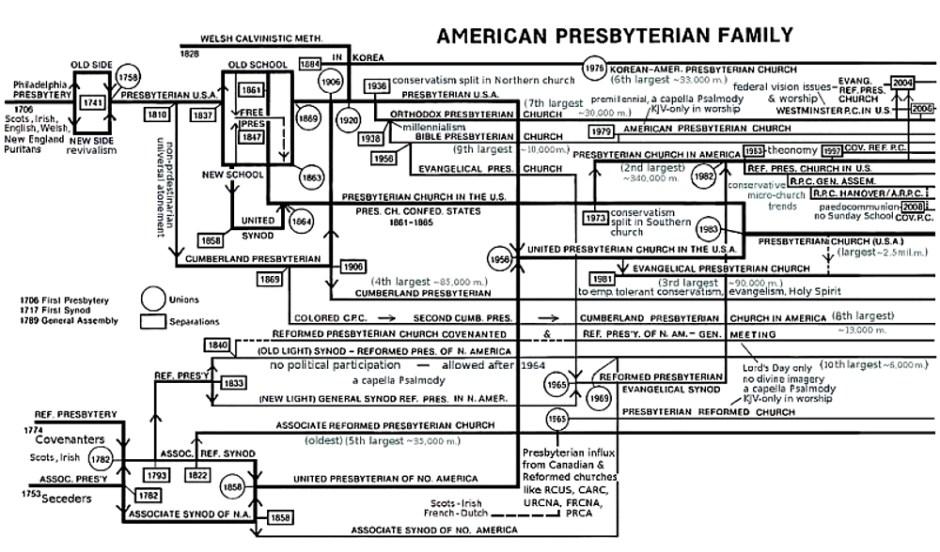
As our denomination has experienced recent tensions about confessional subscription, our mission, and worship, I have struggled to understand how we got here. My working hypothesis is that the PCA is a majority New Side/New School Presbyterian Church, with a substantial minority that is either New Side/Old School or Old Side/Old School.

The differences between the Old and New Side Presbyterians focused primarily on their differing views of revivals. The New Side believed the revivals or George Whitefield, which first disturbed and then converted sinners within and without the church and awakened and stirred to holiness and action true believers, had biblical precedents. Itinerant ordained and non-ordained speakers were often the instruments of revival. Religious experience was intensely personal and greatly concerned with whether or not one had been genuinely converted.

Old Siders had a higher view of the church as an institution, more confidence in the work of settled, ordained ministers carrying out the ordinary ministry of word and sacrament, and a greater emphasis on corporate religious life. Tensions over subscription pushed New Siders toward a looser view, with the Old Side arguing for strictness. Neither side was monolithic.

If the First Great Awakening balkanized the Old and New Sides, the Second Great Awakening returned the favor for the Old and New School Presbyterians. Despite this similarity, the major issue in the nineteenth century was not revivalism but confessionalism. Old Schoolers had differing appraisals of the earlier awakenings, but they shared a growing unease about the Second Great Awakening with its Arminian theology and its new measures.

In order to defend the theology of the Second Awakening New Schoolers had to take a broad view of the Westminster Standards and a much weaker view of what was involved in an officer’s ordination vows. The New School strongly favored mission over theology while the Old School held that theology defines and directs mission. Because of its emphasis on mission the New School favored working with parachurch societies to accomplish evangelism and missions, while the Old School believed the church alone was responsible for spreading the gospel and building up the saints. Part of the mission-orientation of the New School was its commitment to engage social issues, such as slavery and temperance, as part of an effort to Christianize America. Old Schoolers countered with the spirituality of the church. Not surprisingly, the New School had a low view of the church while the Old School maintained and defended jure divino Presbyterianism.

How does this explain the PCA? In my view, the majority of the PCA consists of three groups all of which share a New Side/New School orientation: the Columbia Seminary founding generation, the Reformed Presbyterian Church, Evangelical Synod (RPCES) influx, and the rising leadership consisting primarily of large urban/metropolitan church pastors and denominational executives.

Most of the founders of the PCA had been educated at the most conservative of the PCUS (Southern Presbyterian) seminaries in the 1950s and 1960s. While Columbia could trace her heritage all the way back to Thornwell, the most eloquent Southern Old School voice, little remained of Thornwell’s influence (William Childs Robinson being the exception) by the time PCA leaders received their training at Columbia. Students were considerably more conservative than the faculty at Columbia, but they were never much exposed to the old Confessional orthodoxy of the Southern Church. They believed in the Bible, in “the fundamentals,” in the gospel, and in evangelism and missions. They took their ordination vows with sincerity but they did not consider how those vows bound them to the Westminster Confession. In fact, many of these brothers were influenced by teachings that were inconsistent with Calvinism. I think of semi-Pelagianian, Invitation System revivalism, dispensationalism, and perfectionism. In addition, they were suspicious of church institutions and authority (having witnessed and experienced the corruption and abuse of the mainline Southern church) and were eager to cooperate with any evangelicals to win the world for Christ, maybe even “in this generation.”

It was not clear at the time of Joining and Receiving (J&R) in 1982 what the impact of the influx of the RPCES would be, but time has proved that it broadened and strengthened the New Side/New School segment of the PCA. The RPCES was the result of the union of the dwindling Reformed Presbyterian Church in North America, General Synod (a “new light” break-off from the Covenanters), and the larger Evangelical Presbyterian Church (from the McIntire wing of 1936.) Although RPCES was more Reformed and Presbyterian than McIntire’s Bible Presbyterians, its roots remained New School, and, though there was some indication the RPCES might move toward Princeton Old School positions, this did not materialize. The RPCES was and remains New Side/New School and so injected into the PCA another dose of New Side/New Schoolism.

What then of the rising leadership? The one word, which best catches the outlook and agenda of this group, consisting primarily of large urban pastors and denominational executives, is “missional.” In the New Side/New School tradition, mission is the church’s defining characteristic and responsible for its vitality and unity.

This “missional” orientation has been notably evident in recent worship services at the General Assembly. Mission requires us to rethink what it means to be church and to sit loose on doctrinal formulations, on polity issues, on how we worship, and on what the nature of the mission of the church is, so that as we understand more of this “post-everything” culture and figure out how to respond, we can make the necessary adjustments to further the church’s mission. This is decidedly the New Side/New School outlook, dressed in new clothes, but with the substance of the body unchanged.

This represents the majority of the PCA’ teaching and ruling elders. A majority holds to the New Side/New School type of Presbyterianism. At the same time a substantial minority in our church, with Old and New Side proclivities, holds to Old School Presbyterianism. This means that issues of doctrine, polity, subscription, worship, and mission remain live ones for the foreseeable future. The soul of the church is at stake for both the majority and minority.

William H. Smith is pastor of Covenant Presbyterian Church (PCA) in Louisville, Mississippi.

Can The PCA Turn Back the Clock to 2001?

James Kessler doesn’t think so:

The PCA is not going back to 2001. Rewriting our constitution is not going to happen, not only because no party has sufficient numbers to accomplish that, but also because there are too many men and women committed to a biblically defined Confession and the great commission who are located in contexts that are more diverse, more agnostic and apathetic, more questioning and less steeped in a church tradition while being more hospitable to Gospel conversations than ever. Every year we plant dozens of new churches in an age of de-churching. When I began in ordained ministry in 2006, in Columbus Ohio, outside the traditional region of the PCA, we had three churches in a city of more than two million. Now we have seven, with more on the way. Every year RUF takes on scores of campus ministry interns seeking to learn how to minister the Gospel in a pluralistic society. The Unity Fund produced 48 minority ordination scholarships last year. Even the places where the PCA was born have been changing, and there is no going back because the harvesters in the white fields are not who they once were. Friends, this PCA is not going away as long as you are on mission. But preserving it will not only require your good will, it will require your work.

The odd thing is, the group responsible for that change in the PCA, the Presbyterian Pastoral Leadership Network, doesn’t seem to exist. It has zero assets and zero income.

But PPLN was responsible for the shift in the PCA that Pastor Kessler celebrates. This is how the Nicotine Theological Journal (July 2002) rendered the 2002 PCA General Assembly:

The defection of the Briarwood associate pastor [to First Baptist Birmingham] hardly reduced the ranks of its delegates to the 30th General Assembly of the PCA. Briarwood sent 21 delegates to the GA that met in Birmingham last month, more than many presbyteries sent. These commissioners were not merely availing themselves of a home court advantage, but they were on a mission, representing a portion of the Presbyterian Pastoral Leadership Network’s effort to stack the Assembly with votes. The PPLN voter turnout drive proved enormously successful. Though we did not attend the PCA Assembly, we have struggled to read some reports about its deliberations. Our struggle has mainly to do with working through the awful “TE”/“RE” nomenclature. (A compelling case against the two office view can be made simply on the basis of English prose.)

REPORTS WE READ HAVE varied from denial – “things went much better than anyone had ever expected,” gushed Clair Davis in pcanews.com – to disaster – “we were more than just defeated, we were routed,” wept Andy Webb on his Warfield elist. Of course, post mortem rhetoric of this sort is typical, and we should forgive exhausted commissioners who lapse into hyperbole.

But there is one aspect of PCA analysis that we cannot abide. It is the recurring habit to link the denomination’s fragmentation with the struggles of youth. The PCA is a young church, so goes this line of thinking, and its indiscretions will naturally accompany the awkwardness of childhood. World magazine displays the most recent example of this reasoning. Its July-August 2002 issue euphemistically described the victory of PPLN juggernaut under the heading, “Growing Pains in the PCA.” This toddler of a denomination is still growing, and the PPLN initiatives were helpful means of promoting further growth in the young church. As the old commercials put it for Wonder Bread, PPLN builds strong bodies.

HOWEVER ONE INTERPRETS THE struggles in the PCA, one cannot distort them into the pains of youth. Rather, they more closely resemble the symptoms of an old and dying church. Pre-Assembly caucusing, bussing in votes, stifling the voice of the minority, establishing competing websites – these are not the indiscretions of the young and the naïve. Indeed the actions of the last Assembly have even prompted some TE’s and RE’s (see, now we’re doing it) to propose that PCA presbyteries redesign themselves along ideological rather than geographical lines. This is not a novel idea within American Presbyterianism. It is generally floated as the desperate attempt to maintain a semblance of unity in worn out and creaky denominations, and ideological presbyteries are often predecessors of church divisions.

Curiously, Clair Davis argued, contrary to the claims of World magazine, that the PPLN initiatives were wise precisely because the PCA was not numerically growing. 80% of the PCA had not shown any growth during the previous year. Whether or not the church is growing numerically, at least this much is clear: the PCA is a thirty-something denomination that shows all the indications of premature aging.

Will the National Partnership to which Pastor Kessler belongs have a fait similar to PPLN? If the past is not as important as the current, if what Presbyterians used to fight about no longer make sense in pluralistic, urban, and socially aware settings, what will come of the National Partnership by 2040? Chances are they will be as relevant then as Charles Erdman is to the PCUSA today — not much.

That’s not the fault of Pastor Kessler or his colleagues. It is the function, though, of updating the church to contemporary developments. The flower fades. So do the headlines.

By the way, what does “good faith subscription” do to confessionalism? What is the point of having a long, scholastic, and elaborate confession when all you want are the fundamentals of the confession and catechisms? Why not switch from the Westminster Standards to the Gospel Coalition’s Confessional Statement? Presbyterian nostalgia?

Are Some Sins Easier to Condemn, Easier to Erase?

What if bigotry were as hard to discern and remedy as same-sex attraction and concupiscence?

Think about the categories used in the PCA report on Human Sexuality:

Second, according to the system of the Westminster Confession of Faith, we should not be surprised, but rather expect that concupiscence in general, and specific instances like homosexual attraction bigotry, would continue in the life of a believer. The Confession is clear; corruption remains “in every part” (13.2). We would never say to a new believer who has a history of destructive anger, “Now that you are a Christian, you will never again feel a rush of anger rise up within you at the wrong time, for a selfish reason, out of proportion to the situation, or in any other way that contradicts God’s law.” Neither should we communicate to a believer with a history of homosexual attraction bigotry the expectation that this will simply disappear.

“…according to the doctrinal system of the Westminster Confession of Faith, we should not rule out, but rather expect that concupiscence in general antipathy to others, and specific instances like homosexual attraction bigotry, would be areas in which the believer would see some progress toward truly righteous feelings and actions. Our previous point had to do with the danger of creating the expectation that our experience of corruption will entirely disappear in this life if we are regenerate. This point addresses what might be considered an error on the other end of the spectrum, the error of asserting that change is not possible or not to be sought. But just as the Confession is clear that corruption remains in every part, it is also clear that the sanctifying work of the Spirit is felt in the “whole man.” Someone with homosexual attraction who hates other groups ought not close himself or herself off to the pursuit of, and hope of, real change in those attractions inclinations, even if that change is incomplete and mixed. …

Finally, we can discern a very practical value to the distinction between the sin that is constituted by our “corruption of nature…and all the motions thereof” and the “actual transgressions” that proceed from it. Even where original sin is manifested in the form of sinfully disordered desires or feelings inclinations, including homosexual attraction bigotry, there is significant moral difference between that initial “motion” of corruption and the decision to cultivate or act on it. To feel a sinfully disordered sexual attraction hatred (of any kind) is properly to be called sin—and all sin, “both original and actual” earns God’s wrath (WCF 6.6)—but it is significantly less heinous (using the language of the WLC 151) than any level of acting upon it in thought or deed. The point here is not to encourage those with homosexual attraction who are bigoted to become comfortable with or accepting of it. Rather, it is to counter the undue heaping of shame upon them as if the presence of homosexual attraction bigotry itself makes them the most heinous of sinners. On the contrary, their experience is representative of the present life of all Christians. John Owen has said, “…yet sin doth so remain, so act and work in the best of believers, whilst they live in this world, that the constant daily mortification of it is all their days incumbent upon them.” Our brothers and sisters who resist and repent of enduring feelings of same-sex attraction bigotry are powerful examples to us all of what this “daily mortification” looks like in “the best of believers.” We should be encouraged and challenged by their example and eager to join in fellowship with them for the mutual strengthening of our faith, hope, and love.

Is it possible to think about tribalism, bigotry, undue attachment to groups, or racial supremacy the way the PCA instructs officers and members to think about same sex attraction? Both are disordered inclinations. But when people condemn bigotry between racial groups, they tend not to see it as something that lurks in a fallen human being, even in a regenerate soul:

​Racism should be denounced by religious and civic leaders in no uncertain terms. Equivocal talk about racist groups gives those groups sanction, something no politician or pastor should ever do. As Christian scholars, we affirm the reality that all humans are created in the image of God and should be treated with respect and dignity. There is no good moral, biblical, or theological reason to denigrate others on the basis of race or ethnicity, to exalt one race over others, or to countenance those who do.

Would the authors and signers of this statement ever add, “there go I but for the grace of God”? Or is such a condemnation an indication to others that you do not approve of racism in those who are. As such, a statement is mainly a way to avoid confusion. By signing or issuing a statement, I too show that I am not a racist and detest those who are.

Wait. What about hate the sin, love the sinner?

Even more difficult – what if the sins of the sixth and seventh commandments — heck the whole darned Decalogue — reside in each and every Christian’s heart? That might produce statements that are less finger wagging, and more understanding like the PCA’s report.

It might also indicate that human beings are not Pelagian when it comes to racial bigotry. That is, the soul does not have a racist switch that you flick on after coming into the world loving and kind, and then flick off when you repent and condemn racism in yourself and others.

In fact, if sin can be systemic, no better place to look than not in bureaucracy but in the human heart.

Will the PCA Repent of Homophobia?

I have not read the PCA report on sexuality, but from reading and listening to comments about it, I am inclined to think that leadership in the PCA thinks about racism differently from same-sex attraction, that one is something the church needs to condemn vigorously, the other is a condition around which the church needs to tread delicately.

Consider the following expressions of repentance:

As an organization, we need to more deeply self-examine and change. While there have been some strides over the last eighteen months, we haven’t been sufficiently aggressive in pursuing, supporting and developing Black and Latino leadership in the US. We repent. Though we have aspired to be a trans-denominational ministry, our training materials and events in the US have lacked the rich presence and leadership of Black and Latino theologians and are still largely distilled through a majority culture theological lens and ministry practices. We repent. A significant portion of our time, expertise and resources in the ministry have been focused on educated white leaders in center cities, and we could have done more as it relates to the historic and systemic segregation in the American church. We repent.

be it resolved, that the 44th General Assembly of the Presbyterian Church in America does recognize, confess, condemn and repent of corporate and historical sins, including those committed during the Civil Rights era, and continuing racial sins of ourselves and our fathers such as the segregation of worshipers by race; the exclusion of persons from Church membership on the basis of race; the exclusion of churches, or elders, from membership in the Presbyteries on the basis of race; the teaching that the Bible sanctions racial segregation and discourages inter-racial marriage; the participation in and defense of white supremacist organizations; and the failure to live out the gospel imperative that “love does no wrong to a neighbor” (Romans 13:10); …

In humility, we repent of our ongoing racial sins. We repent of past silence in the face of racial injustice. We repent of a negligent and willful failure to account for our unearned privilege or to surface the unconscious biases that move us to protect our comfort rather than risk speaking against racial injustice. We repent of hearts that are dull to the suffering of others.

If, as the Confession of Faith has it, sanctification is “imperfect in this life” and part of “a continual and irreconcilable war” (13.2), these repeated expressions of repentance make sense. Less plausible is how they fit with the idea of private confession of sin, as in, “he that scandalizeth his brother, or the church of Christ, ought to be willing, by a private or public confession, and sorrow for his sin, to declare his repentance to those that are offended, who are thereupon to be reconciled to him, and in love to receive him.” (15.6)

First Part of Review of PCA Statement on Same-Sex Attraction

Posted at Juicy Ecumenism today and then not:

Calvin vs. Wesley: A Review of the Presbyterian Church in America’s Report on Human Sexuality, Part One

The Rev. Karen Booth is a graduate of Drew Theological School and an ordained elder in the Peninsula-Delaware Annual Conference of The United Methodist Church. She is the author of “Forgetting How to Blush: United Methodism’s Compromise with the Sexual Revolution.”

Disclaimer: Please bear in mind that my views are based on my background as a seminary trained, local church pastor who has had some additional experience working with ministries of sexual sanctification. I am not a professional theologian, nor do I have access to specific archival material that would have been relevant. I do thank Dr. David Watson and Dr. Scott Kisker of United Theological Seminary for helping me think through some of the Wesleyan theology.

In June 2019, the conservative Presbyterian Church in America (PCA) faced a General Assembly that included more legislative petitions about LGBT issues than any other subject. The concerns stemmed from a provocative conference called Revoice, which was co-sponsored by the denomination’s Covenant Seminary and hosted by a local PCA church in St. Louis.

Though there are nuances, Revoice (the conference and movement that followed) generally affirms a traditional Christian sexual ethic while tolerating, accepting or even celebrating homosexual orientation and/or LGBT identity as long as there is a concurrent commitment to celibacy. This stance is sometimes referred to as “Side B,” with “Side A” being LGBT-identified persons who do not consider same-sex intimacy to be essentially immoral. There is also a “Side C” for those who are unsure and a “Side X” for those who believe that BOTH desire and behavior can be transformed through the power of Jesus Christ.

Though one writer suggested that the PCA controversy was mostly about “language” and “terms,” another recognized that there were serious underlying theological and pastoral issues at stake: “another way of describing the debate is whether homosexual orientation/desire is sinful and therefore must be mortified or if it is a natural inclination that can just be kept in check through celibacy.”

Fearful that endorsing Revoice could ultimately lead to more progressive positions on sex and marriage, delegates sought further clarity. As a result, the General Assembly voted to affirm the more traditional Nashville Statement, a document developed by the complementarian Council on Biblical Manhood and Womanhood, and to establish a study commission.

The seven-member Ad Interim Study Committee on Human Sexuality (hereinafter “Committee”) included pastors, theologians, Christian educators, and professional counselors who had diverse opinions about Revoice. This caused even more controversy, raising doubt that they would ever be able to reach biblically faithful consensus.

Nonetheless, the Committee completed its work within a year and officially released its Report on May 28. After wide distribution and study, the Report will be perfected and then accepted or rejected at the rescheduled General Assembly in June 2021.

The Report primarily consists of Twelve Statements that summarize the Committee’s findings, with longer essays explaining the underlying theological and doctrinal foundations. There are also suggestions for pastoral care and apologetics, an annotated resource list, and an exhortation to maintain unity amidst the diverse legislative proposals that will surely follow.

The first two Statements deal with marriage (the monogamous union of one man and one woman) and the binary nature of male/female creation (a unique expression of God’s image and His perfect will). Neither issue is currently up for debate; the former is explicitly addressed in both the Westminster Confession and the PCA Book of Church Order and the latter is implied. Both are referred to multiple times to defend other portions of the report.

The remaining material concentrates on four sets of related topics:

The moral nature of same-sex attraction, desire and temptation,
The compatibility (or not) of the concepts of homosexual orientation and gay Christian identity with Scripture and doctrine,
The significance of redemption, sanctification, Christian community and pastoral care for same-sex attracted persons, and
An apologetics strategy for sharing God’s truth and grace about human sexuality with an unbelieving world.
The Study Committee recognized that the first topic was key to all else that followed:

What do we believe the Bible teaches us about our condition as fallen human beings? What does it mean to be saved from this state?

How does regeneration affect our experience of fallenness?

How we answer these questions will determine how we answer the more specific questions about our experience of sexuality.” (Report, Page 14, lines 17-41)

So, the Calvinistic theological reasoning (Statements 3-6 and essay #1) goes something like this:

Original sin is a comprehensive (total) depravity and corruption that humans have inherited as a result of the Fall and for which they are held culpable/guilty. This essential corruption remains to some degree even after justification and regeneration. The outworking of this original corruption results in ACTUAL sin, which includes not only evil/immoral behavior but also impulses, feelings, desires and internal temptations, even those that are not agreed to by a conscious act of will (concupiscence). Both original and actual sin must be repented, grieved and hated.

Bottom line: “the experience of same-sex attraction is not morally neutral; (it) is an expression of original or indwelling sin that must be repented of and put to death.” And “these desires within us are not mere weaknesses or inclinations to sin but are themselves idolatrous and sinful.” (Report, page 8, lines 6-8, 20-21)

The second claim was the Committee’s unambiguous answer to Revoice leaders who argued that same-sex attraction is not in-and-of-itself sinful, but rather a sort of “disability” or “handicap.” As already noted, this understanding of the sinfulness of same-sex attraction will shape the Committee’s conclusions on sexual orientation/identity, Christian life from unbelief to sanctification, discipleship and community, pastoral care and apologetics.

Obviously, this theological understanding is quite different from the official stance of The United Methodist Church (UMC). The denomination morally prohibits same-sex behavior, by stating that the “practice of homosexuality” is “incompatible with Christian teaching.” But it doesn’t even mention, let alone condemn, the experience of same-sex attraction.

This policy was initially adopted into our Social Principles at the 1972 General Conference almost by accident. (See here and here.) It was reaffirmed after our first official study (“Committee to Study Homosexuality,” 1989-92) and endorsed yet again in more recent legislation and proposals regarding amicable separation. After almost fifty years of squabbling over sex and marriage, it’s pretty much become “conventional wisdom” in the UMC.

But is this conventional wisdom rooted in Wesleyan thinking? Providentially, yes.

Though it wasn’t originally conceived by Albert Outler or Georgia Harkness or any of the other “heavy hitters” that drafted proposals for our post-merger Social Principles, it nonetheless accurately reflects our Wesleyan heritage. As John Trinklein noted in his dissertation, Wesley’s discussion with his pastors at the 1759 Conference

clarified that there was a difference between sin “properly so-called” and sin “improperly so-called”. In his understanding, only that which is a “voluntary transgression of a known law” is truly a ‘sin’; any “involuntary transgression of a divine law, known or unknown” is “naturally consequent on the ignorance and mistakes inseparable from mortality”—and therefore not a ‘sin’ … Total corruption and the irresistible inclination to sin have indeed been passed on to us, but only our own voluntary (“proper”) sins can damn us. (pages 123-126)

Although humans are not damned for Adam’s transgression, Wesley nonetheless believed that the corruption of original sin left them stained, broken and hopeless – categorically unable to escape their inherited sin nature or do anything good on their own. (See here, here and here.) The hope, for Wesley and his followers, would be found in his manifold understandings of God’s grace.

This will be explored more fully in Part Two of the blog post. For now, here are a few of my personal observations.

Even though I disagree with its Calvinist underpinnings, I think the major strength of the PCA Report is its solid grounding in theology and doctrine. Once it is approved, the denomination will have not only a brilliant tool for teaching, but a firm foundation to fall back on if its traditional sexual ethic is ever challenged in the future. When the UMC decided (even if by default) to deal with sexuality issues from a “social concerns” perspective, it set the stage for almost constant struggle over terms and definitions. How I wish we had begun with something like this PCA document. How I yearn for something like it in the future.

I have not yet studied the entire PCA document, but I hope that their initial finding – that same-sex attraction itself is sinful – will be somewhat mitigated later on. Because, unless it is presented, taught and preached with great compassion and sensitivity, it can be soul crushing to those who struggle against SSA. If it only adds to their already heightened sense of personal shame, they will be less inclined to seek any kind of help from the church. I think we’ll discover in Part Two that the Wesleyan way of grace offers a more hopeful and potentially more transformative approach.