Supersessionist Shrug

An apologist’s post caught my eye and led to an exchange that produced this assertion:

I did admit Rome’s problems, but I didn’t bother laying them out in detail because that wasn’t the point of the post. And as I pointed out in the post and have said over and over again in our exchange, they don’t really affect my conclusion one way or another. If my main argument were that Protestants don’t act like Christians and Catholics do, you would have a point. But I never said that and never would. Sure, Rome has a lot of ‘skeletons:’ the Catholic Church is the oldest and largest of the communions; it makes sense that there would be more crimes, sins, and failures in her past than in that of the others. What of it? A one-by-one comparison of the crimes of the different Christian churches, even if we agreed on what constituted a crime, would tell us nothing about which one among them had the best claim to being the church founded by Christ. Again, the evil done by the Church is accounted for by hypothesis: that of being a Divine commission entrusted to fallen humanity.

Imagine if Jeremiah had said that to the Israelites. Don’t worry about your sins, you go all the way back to Abraham:

“Thus says the LORD of hosts, the God of Israel: You have seen all the disaster that I brought upon Jerusalem and upon all the cities of Judah. Behold, this day they are a desolation, and no one dwells in them, because of the evil that they committed, provoking me to anger, in that they went to make offerings and serve other gods that they knew not, neither they, nor you, nor your fathers. Yet I persistently sent to you all my servants the prophets, saying, ‘Oh, do not do this abomination that I hate!’ But they did not listen or incline their ear, to turn from their evil and make no offerings to other gods. Therefore my wrath and my anger were poured out and kindled in the cities of Judah and in the streets of Jerusalem, and they became a waste and a desolation, as at this day. (Jeremiah 44:2-6 ESV)

Too old to fail? Where would anyone reading the whole Bible come up with that?

But if the church is so different from Israel in a supersessionist way, then the lessons of Israel don’t apply to the church. And by the way, don’t bother reading the epistle to the Hebrews.

Nothing Could Possibly Go Wrong

Didn’t the Reformation start with objections to the cash nexus between grace and financial contributions? So how much did the Council of Trent reform ecclesiastical abuses in the light of recent announcements about new criteria for becoming a saint?

To approve a miracle, at least 5 out of the 7 members of the body of medical experts within the congregation must approve, or 4 out of 6, depending on the size of the group, as opposed to a simple majority.

In case a miracle report is rejected on the first go-around, it may only be reexamined a total of three times.

In order to reexamine a miracle claim, new members must be named to the consulting body.

The president of the consulting body may only be confirmed to one additional five-year term after the original mandate expires.

While in the past payments to experts could be made in person by cash or check, now the experts must be paid exclusively through a bank transfer.

I don’t know about you, but my impression of the miraculous is that if part of a group of believers thinks an unusual event was not miraculous, then it probably was not. Generally speaking, the works of God are pretty straight forward to those with eyes of faith (questions about ongoing miracles notwithstanding). And do we really need science to tell validate a miracle? Isn’t faith sufficient?

But the kicker is the financial aspect to these policy changes:

In his book “Merchants in the Temple,” Italian journalist Gianluigi Nuzzi charged the congregation was among the most reluctant Vatican offices to cooperate with new transparency measures imposed as part of Francis’s project of Vatican reform, and asserted that the average cost of a sainthood cause was about $550,000.

U.S. Catholic officials traditionally have used $250,000 as a benchmark for the cost of a cause from the initial investigation on a diocesan level, to a canonization Mass in St. Peter’s Square at the Vatican, though that cost can increase depending in part of how many people take part in the canonization ceremony and the logistics of organizing the event.

In March, Pope Francis had already approved a new set of financial procedures for the congregation, outlining procedures for handling contributions and specifying which authorities are charged with overseeing the flow of money.

Also notice that even though the path to sainthood has become more — let’s say — complicated, those already saints stay saints:

The new rules are not retroactive, and hence they do not invalidate any beatifications or canonizations performed under earlier procedures.

Fulton Sheen’s advocates are no doubt disappointed.

For any apologist out there, this is the sort of thing that makes no sense to a Protestant (and is truly audacious). We do concede that sainthood can be bought. The price that Jesus paid with his precious blood is worth more than all the silver and gold you can put in a Vatican bank safe. So yes, there is a payment for sanctity. But it is entirely beyond the economic calculations of this world.

One might think that after five hundred years, Roman Catholic bishops might have learned that lesson.

Buyer’s Remorse or Remorse over Buyers?

Alan Jacobs warns converts who would be apologists:

Waugh is one of those converts in whom Catholics take great pride. If I were in their position, I would do everything in my power to prevent the world from finding out that he belonged to my communion. If the rightly administered sacraments are presumed to be instruments of grace, it appears that Waugh, at any rate, was invulnerable to their power. I would appreciate it if my Catholic brothers and sisters took the unremitting nastiness of the man more seriously. I have yet to hear one say that when Waugh took the Sacrament he did so unworthily, though I do not believe, given his gleeful and freely expressed hatred of almost everyone he knew, that anyone could reasonably say that he did so worthily.

He believed that by becoming Catholic he had ensured his own salvation, and from that elevated seat taunted his friends who remained Outside: “Awful about your obduracy in schism and heresy,” he wrote to the Anglican John Betjeman. “Hell hell hell. Eternal damnation.” Only some wholly unacquainted with Waugh’s views would think he was joking. Betjeman certainly didn’t.

Those Were the Days (again)

What a church with discipline (and even a little 2k) looks like:

[The] argument for Trump recalls an earlier episode in Catholicism and political theology, the condemnation of L’Action française (AF) by Pope Pius XI in 1927. AF was an anti-liberal political movement in early twentieth-century France. It was a monarchist and nationalist movement centering on the French literary figure Charles Maurras, who held that in order for France to become great again, she must exhibit a national, religious, and political unity that could only be achieved by sloughing off liberal republicanism and embracing “integral nationalism.”

Maurras himself had lost his Catholic faith and was an agnostic, but his “throne and altar” politics appealed to many Catholic clergy and laity. Maurras saw the Catholic Church as a French institution capable of uniting Frenchmen politically. The Church was basically an instrument for implementing Maurras’s cry of “la politique d’abord,” or “politics first!” (Compare this with Trump’s recent appeal to evangelical Christians.) Maurras was also politically anti-Semitic, for Judaism was not French and not a religion capable of uniting the French. Maurras later obtained the sixteenth seat in L’Academie française, the same seat occupied by Cardinal Dupanloup in the nineteenth century. He supported the Vichy regime and spent five years in prison after World War II for doing so. He died with little support, even though he had influenced an entire generation of French politicians and intellectuals, Charles de Gaulle among them.

In spite of Maurras’s anti-Semitism and because his movement promised restitution and renewed privilege for a beleaguered Church, many Catholics supported AF. The waves of the French Revolution had continued to break over the Church in France, with the most recent assault at the time being the 1905 Law of Separation, which finally separated the Church from the Republic, except that all Church property was placed under state ownership and under the management of government-supervised lay committees. To many French Catholics, the Law of Separation showed the futility of Leo XIII’s ralliement policy of trying to find a modus vivendi for French Catholics in the Third Republic’s secular democracy. Hence the swing to anti-liberal, monarchist, restorationist movements like AF, movements generally labeled “integralist.”

One of the Catholics supporting AF was Jacques Maritain, who had affiliated himself with AF on the advice of his spiritual director, Fr. Clérissac. Maritain hoped that he could temper the components of integral nationalism incompatible with Catholicism through his association with Maurras in their joint publication Revue Universelle, for which Maritain wrote for seven years.

The Vatican had contemplated a condemnation of AF for some time, and the Holy Office’s desire to place Maurras’s writings on the Index was checked only by the outbreak of World War I. But late in 1926 after hearing of more French Catholic youth joining AF, Pius XI prohibited Catholic membership in AF’s “school” and Catholic support for AF’s publications. In early 1927, the official condemnation and excommunications began, shocking many French Catholics. Two French bishops lost their sees for failing to comply with the condemnation, and the great ecclesiologist Billot lost his cardinal’s hat. Papal ralliement was here to stay, and any party spirit suffused with pagan attitudes was deemed incompatible with Catholic political involvement. The condemnations were a watershed moment for Maritain, who quickly began to reevaluate his political and social commitments in light of his ultimate commitment to the Catholic faith. His apology for the condemnation of AF, Primauté du spirituel (1927), set the trajectory for his most famous political works, Humanisme intégral (1936) and Man and the State (1951). These works later influenced the Fathers of Vatican II, including Pope Paul VI.

It is possible for popes to act even when they are not temporal princes.

The Vatican wanted Catholics to refuse an attractive but ultimately self-defeating choice in supporting AF, and today American Catholics face a similar sort of choice. Now Trump is dissimilar to Maurras in many ways. The latter was revered for his intellectual and literary ability and had coherent and firm philosophico-political commitments, while Trump has demonstrated a shocking ignorance of Christianity and malleable, opportunistic political positions. Although both in a sense promoted the “liberty of the Church,” Maurras did so through throne and altar restorationism while Trump does so through an appeal to religious liberty.

So what’s the lesson?

The lesson from the AF crisis bears mentioning today. The Church, both her teaching office and her living members, constantly must discern whether new means for political action are compatible with a genuine concern for the common good and the integrity of Catholics involved in politics.

Is such discernment the consequence of losing confidence in the bishops?

Who is going to save our Church? Do not look to the priests. Do not look to the bishops. It’s up to you, the laity, to remind our priests to be priests and our bishops to be bishops. Archbishop Fulton Sheen

But I thought episcopacy and apostolic succession was what made Protestantism look like such a poor alternative for western Christians.

As White and Christian As Ever

Some think the United States is becoming less white and less Christian:

These racial and ethnic changes are dramatic, but they only partially account for the sense of dislocation many whites feel. In order to understand the magnitude of the shift, it’s important to also assess white Christian America’s waning cultural influence. It’s impossible to grasp the depth of many white Americans’ anxieties and fears—or comprehend recent phenomena like the rise of the Tea Party or Donald Trump in American politics, the zealous tone of the final battles over gay rights, or the racial tensions that have spiked over the last few years—without understanding that, along with its population, America’s religious and cultural landscape is being fundamentally altered. . . .

It’s true that mainline numbers dropped earlier and more sharply—from 24 percent of the population in 1988 to 14 percent in 2012, at which time their numbers stabilized. But beginning in 2008, white evangelical Protestant numbers began to falter as well. White evangelical Protestants comprised 22 percent of the population in 1988 and still commanded 21 percent of the population in 2008, but their share of religious America has now slipped to 18 percent.

Meanwhile, some can’t help but notice that the Democrats and Republicans have nominated white Protestants:

Too little noted, Protestant America has managed to nominate two Protestant candidates for president. As Clausewitz famously observed, “war is simply a continuation of political intercourse, with the addition of other means.” My corollary, from which most Americans might prefer to avert their eyes: “Politics is simply a continuation of religious intercourse, with the addition of other means.”

While almost ignored it is a telling and, perhaps, a defining aspect of the 2016 election. In his imperfect but authentic way, Donald Trump is reflecting certain of the Calvinist values underlying his beautiful Presbyterian faith. Hillary Clinton is reflecting, in her own imperfect but authentic way, the values of her beautiful Methodist faith.

If you’re not convinced that America is still white and Christian, then you haven’t tried out the apologists’ argument that Roman Catholicism hasn’t changed.

Confused but Not Dazed

Father Dwight has counsel for discouraged Roman Catholics:

4. Regarding Pope Francis – Many conservative Catholics are troubled by Pope Francis. They think he is a textbook 1970s liberal. He’s not. Take time to understand his context and background from Argentina. Read this post to put things into perspective. Get to know the man and pray for him. It is ok to disagree with him and question his judgement. He’s not infallible all the time you know, but you can do so with an open heart and a desire to understand and be with him and learn from him. What’s the alternative? You set yourself up as the judge of the Holy Father? Hmmm. There’s not much mileage in that now is there?

Once upon a time the western church had councils because Rome had three popes.

Also, it’s a free country, right? So separated siblinghood is an alternative. But being Roman Catholic means you have to accept whatever the bishops do? Fr. Dwight might make sense in a pay-pray-obey environment. But the world of immigrant parishes is long gone. Root-root-root for the Fightin’ Irish.

5. Regarding Cafeteria Catholics – Are you maddened by so called “devout Catholics” who openly endorse same sex marriage, women priests and are “pro choice”? Join the club. They annoy me too. Are you also annoyed by the bishops and priests who take the same view? I’m with you. However, remember that the Catholic Church is universal. We’re not a sect where everyone agrees. We’re inclusive and that’s why we’re Catholic. The Church has always had dissidents, rebels and downright bad Catholics. Have you ever read the Old Testament or taken a close look at the twelve apostles? The saints and sinners are all in together. The weeds and the wheat, the goat and the sheep are mixed. Jesus will sort it out one day, and stop for a moment and ask yourself, are you a perfect saint yet? I’m not. I’m still learning and growing and repenting. So I guess we must offer the mercy (and benefit of the doubt) to others that we would wish to receive.

Isn’t the church supposed to stand for the truth? And if observers of Pope Francis need context to understand him and his unwillingness to do something about dissent and error in the church, has not Fr. Dwight entered the cafeteria of choosing what he wants to believe? Why does he get to have perspective on the church’s problems that Pope Francis doesn’t because of his Argentinian background?

6. Regarding You and the Church – I’ve heard some Catholics grumble that the church has let them down. But what did you expect of the church in the first place? The church is divine, but she is also human. The church is a work in progress, an ark of wounded warriors, a tribe of troubled pilgrims, a family of lost children looking and longing for home. When you see the church like this, instead of hoping that the church will be the instant answer to all your problems you will be more content. Our role in the church is to be faithful, prayerful, hard working and stable in our love for Christ and his people.

But Roman Catholicism was supposed to be an upgrade, better than Protestantism. Isn’t that why Fr. Dwight left fundamentalism for Anglicanism and then left Anglicanism for Rome? So shouldn’t the standards for the bearer of the truth, the only true church, be higher? If converts knew that Rome was going to be as incoherent and liberal as the PCUSA or the Church of England, why leave Tim Keller? Or is it that this is godly mess and Protestants only have ungodly messes (and of course, having ONE mess is better than having many).

7. Regarding Priorities – The main thing is to stay close to Jesus and Mary. How do you do this? The Catechism says we experience Christ in five specific ways: 1) in the Sacred Scriptures 2) in the person of the priest 3) in the person of the poor 4) in the fellowship of believers 5) in the Eucharist. I can guarantee you, if you make these five things your priorities, then you will have a solid, sure and secure relationship with Jesus Christ. These five meeting places of Christ assume that your life is bathed in prayer and that you have as your main priority being with Jesus and Mary in these ways. If you get this right the other worries fall away.

Jesus is good and having his Spirit is really good. Mary is good but she is not exactly going to save. But is Fr. Dwight suggesting we can have Mary or Jesus apart from the Bishop of Rome?

Lots of sorting to do. Sure would be nice to have a hierarchy to do this for the faithful.

Not Winning

Even if evangelicals think they are:

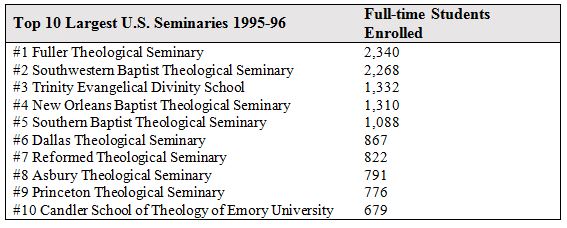
Since the 1995-96 academic school year, Princeton Theological Seminary has seen 30 percent fewer full-time enrolled students. Reformed Theological Seminary saw a 33 percent decrease to 547 full-time students while Candler School of Theology experienced a 39 percent drop to 414 full-time students.

Joe Carter spins this as victory for the Gospel Allies:

Kenneth Kantzer, the late academic dean of Trinity Evangelical Divinity School, once said that in 1890 all of the Protestant theological seminaries in the United States—with the notable exception of Harvard—were evangelical. Forty years later, though, almost all of them had become liberal (i.e., denied basic tenets of orthodoxy). By the 1950s, only four of the top ten largest seminaries were sponsored by evangelical denominations. Of those four, three were part of the SBC, which was struggling at the time to take back control of its schools from liberal professors.

By the 1990s, the trend had shifted once again back toward conservative evangelicalism. After the “conservative resurgence” in the SBC, all six of the denomination’s seminaries were solidly orthodox. And by 1995, only two liberal-leaning seminaries remained on the list of top ten schools by enrollment (Princeton at #9 and Candler School of Theology at #10).

Doesn’t he know that for some Southern Baptists, evangelical is a “Yankee” word.

And what does he not understand about Kenneth Kantzer’s reasons for leaving Fuller Seminary?

Roman Catholic apologetics are catchy.

Make It Stop

Yet another press release on evangelicals who have found a home that is sweet and located in Rome. And once again, the great appeal is authority (papal, infallible, audacious?):

What I came to realize is that little progress will be made on the major issues (or many secondary issues) of theology until one settles the issue of religious authority. That single concern is related to numerous key facets of the Christian faith, the most impactful of which were the canon of Scripture and its orthodox interpretation.

The canon of Scripture (the books included in the Bible) is a huge issue for anyone who considers the Bible to be the Word of God and the authority for one’s faith. If one thinks the early Church went astray somehow, it becomes a very difficult problem because the biblical collection itself was not settled until centuries after the apostles died. If the Church was in error by then, how can the “Bible-Only Christian” be sure he really has the inspired Word of God? And if the Church was kept from error while it determined the canon, why was it not likewise kept from error during the councils and creeds it produced at the same time? As I looked at the major alternate theories of canonization, I discovered the historical truth that the Church is ultimately the standard.

This was also the case with doctrine. It is well known that there is rampant disagreement among the various sects, denominations, and cults of Christianity—but where is the line drawn? Christians often speak of “orthodoxy,” “heresy,” “essentials,” and “fundamentals”—but by what authority are these words defined, and doctrines labelled? For the Christian who denies that the Church is the standard, there seemed to be no non-circular means of doing so.

I’ve asked before and no one answered. So I’ll ask again. With all that authority, how do you explain the bad stuff? What about Marquette University? What are the bishops doing? Pope Francis? The converts?

Working in my Marquette office one afternoon in the spring of 2010, I heard unusual sounds coming from the normally quiet lawns outside my window. I was surprised to see a modest assembly of students and professors preparing to march in protest. Against what? Minutes later, an email arrived informing me that the university’s then-president, Robert Wild, S.J., had voided a contract extended to Jodi O’Brien to join us as Dean of the College of Arts and Sciences. Though the contract had already been signed, Fr. Wild—perhaps under external pressure—decided that O’Brien, a partnered lesbian whose research included queer studies, was not an appropriate choice to represent our mission and identity.

Although an ordinary person with a passing knowledge of the moral teachings of the Catholic Church would think such a decision obvious, the department chairs in the college soon gathered and voted almost unanimously to censure Wild’s decision. The press, meanwhile, demanded an explanation. On the ­defensive, the university allegedly paid a considerable sum in order to break the contract. Officials were soon exercising themselves to demonstrate their concern for equitable treatment of gays and lesbians. The university would initiate projects, courses, conferences, and the like to explore issues of sex and gender! The clear implication was that change would come, though slowly. Marquette would get with the sexual-liberation program so that something like the O’Brien affair would never happen again.

Since 2010, the campaign for sexual diversity at Marquette has advanced rapidly. Last year, the university announced the expansion of the former Gender and Sexuality Resource Center (established in the wake of the O’Brien dustup) into two new initiatives: a Center for Gender and Sexualities Studies and an LGBTQ Resource Center. How much funding has been increased has not been disclosed. We also now have an Office of Institutional Diversity and Inclusion, which offers faculty and staff awards for excellence in, yes, “diversity and inclusion.” Again, how much this will cost hasn’t been revealed. We do know, however, that funds have been promised to support the development of new courses that advance the cause. A faculty fellows program in diversity is also in the works.

The whole article is worth reading, but this paragraph is particularly telling:

For the last two generations, American Catholic ­theology departments have been at the forefront of a campaign of dissent against Catholic sexual morality. This campaign has often been led by Jesuits and Jesuit universities. Unlike attempts to attract more minority students, or programs to empower students from disadvantaged backgrounds—efforts in full accord with Catholic social teaching—this campaign of dissent has sometimes been underhanded, even dishonest. It has also been ruthless, working hard to suppress and punish any who speak up for the Church’s teaching. The way Marquette has adopted and promoted the mishmash of LGBTQ ideology over the last few years is consistent with that tradition of dissent.

So why don’t the converts ever include these developments in their touting of Rome’s authority and certainty? Are they unaware?

Whatever the reason, the Marquette situation may explain Rachel Lu’s counsel (which doesn’t say much about the hierarchy that is supposed to keep everything neat and orthodox):

In that spirit, try not to pay too much attention to Church politics. Catholic politics is, well, politics. Unless your profession requires it, you probably don’t need to obsess about it, and there are much more edifying ways to immerse yourself in the faith. But whatever you do, don’t trust journalists to educate you about Catholicism.

What Must I Do To Be Married?

It used to be that Hebrews were the forerunners of the church. Just look at what Jesus says to his disciples on the road to Emmaus. Turns out Bible readers were wrong. It was the Stoics who prepared the way for Christianity:

The Stoics actually lived lives full of joy, peace, and meaning. Though bereft of God’s divine revelation in the Old and New Covenants, they stretched their God-given powers of reason to the limit, reaching many of the same conclusions that Christians came to regarding life, liberty, and love. . . .

How close were they to divine truth? Musonius Rufus is considered one of the first pro-life philosophers. He praised large families, extolled fidelity in marriage, argued against abortion and contraception, and connected the purpose of marriage to procreation and the unitive value between husband and wife. Quite astounding for someone who was born a few decades before Jesus Christ.

The Stoic philosophers were not interested in pie-in-the-sky theorizing. Rather, they focused on eminently practical topics like: should a child obey his parents? How should we dress ourselves? What is the meaning of pain and hardship? Must we learn what is good and follow it?

Nor were they interested in sin, damnation, sacrifice or expiation.

Kevin Devin Rose left Protestantism for this?

Since We’re Talking about Talking

The Pertinacious Papist cautions Roman Catholic apologists about how to talk to confessional Protestants (via Greg Krehbiel). An excerpt:

Get Over Jack Chick Already

Along with these accusations of hard hearts and thick skulls comes the staple of apologetic discussion: your apologists are meaner than ours. Yes, we all know that some anti-Catholics misrepresent Catholicism. Guess what? It goes the other way, too. And yes, we all know that some people can be very mean. Guess what? People are sinners. I even heard a rumor that one of the apostles wasn’t a choir boy.

Along those lines, former Protestants who have converted to Catholicism are not necessarily experts on any form of Protestantism, including the one they left, and they can misrepresent Protestant doctrine. Do you trust a former Catholic’s knowledge of Catholicism? Then don’t expect Protestants to trust a convert’s view of Protestantism.

When it comes to the “your apologist beats up old ladies” argument, the best thing to do is to get over it. Or, as a friend says in a slightly different context, “don’t feed the energy creature.”  I’s best to ignore rude noises at the dinner table, and I think we can treat the apologetic variety of those rude noises the same way. Fussing and whining about how mean the other guy is just makes you a crybaby.

23,000 Denominations

Some Catholics have the apologetic equivalent of Alzheimers. They criticize Protestantism because there are (so the story goes) 23,000 separate Protestant denominations, all teaching different things. And then a minute later the Catholic apologist will speak to a Methodist as if he is a Baptist, or a Lutheran as if he’s a Pentecostal. If they all teach different things, then for heaven’s sake don’t treat all Protestants the same.

It is very annoying to a confessional Presbyterian to be treated as if he’s guilty of the same errors as the non-denominational charismatic. Listen to what the other guy is really saying without putting his words through an apologetic filter that says “this guy is a Protestant, and I’ve read all about those guys.” You may find that you have more common ground than you suspected.

BAD HABIT: Learning about Protestant doctrine from Catholic sources.
BAD HABIT: Learning about generic Protestant doctrine and applying it to all Protestants.
REMEDY: Let your Protestant friend speak for himself. Listen to what he’s saying without imposing any doctrinal template on his words. . . .

No One Ever Heard of ____ Until the Reformation

It’s very common for a Catholic apologist to argue that Protestant doctrine is unhistorical, that nobody held to Protestant positions until the Reformers came along and invented them all out their fevered brains. (Remember, of course, that there are all kinds of Protestants, and on many issues the Reformers would be on the Catholic side arguing against many modern Protestant beliefs.)

The claim goes like this. “No one ever heard of sola scriptura, or sola fide, or doubted the canonicity of the deuterocanonical books, [or whatever,] until Martin Luther.”

Really now. Have you read all the Christian theologians of east and west from the time of Christ until 1517? If you’re particularly ambitious, you may have read bits and pieces from a very small sample of the church fathers. The Reformers were serious scholars, and they also read the church fathers. They did not believe their doctrines to be novelties, and only an expert on the history of doctrine is qualified to say that they were. And there are experts on both sides of that question.

Pointing out the contrast between the faith of the early church and the faith of your modern Protestant friend is a very effective apologetic tool. It’s very easy to show how Catholic doctrine developed from the faith of the early church, and it’s very hard to show any continuity between the early church and the faith of Bethel Bible Church down the road. So don’t spoil a good argument with claims you can’t prove or defend.

BAD HABIT: Asserting a universal negative.
BAD HABIT: Repeating extravagant claims you read in apologetic literature that the apologist himself could not possibly have known.
REMEDY: Stick to what you really know.

What’s that Verse Scott Hahn Uses?

Every once in a while I meet someone on the train, or in a store, and I get a sense that person is an Evangelical Christian. I spent a lot of years among Evangelicals, and I got to know their mannerisms. Sometimes it’s a certain tone of voice, or a choice of words. When someone’s been baptized into Evangelicalism, it starts to wear off on him. It makes a difference.

Scripture is the same way. When you start talking to someone about the faith, it’s very obvious who has and who has not devoted himself to Bible reading. It comes out.

Again and again I’ve run across well meaning Catholic apologists who seem to know Scott Hahn better than they know their Bibles. Believe me, it shows, and every decently trained Protestant is going to spot it and recognize that apologist for what he is. The Protestant will know that the Catholic is just proof-texting — that he hasn’t internalized the text. It’s just something he cites to prove his point, and when he does read the Bible, it’s only to find ammunition for the next battle. The Protestant will assume that the Catholic apologist lacks a personal relationship with Christ, and he’ll have all the more reason to mistrust Catholic arguments.

If you’re that apologist, it’s time to stop, retire, apologize to your opponents, wish them well, and spend some time (a few years, perhaps) getting to know God through His word. Donate all your apologetics books to your priest and spend the next few years reading nothing but the Bible and the catechism. Your goal isn’t to find 25 reasons why Protestants are wrong about Baptism. Your goal is to listen to what God says to you about your soul.

When apologetics is a distant memory, if you still feel the call to witness to other Christians about the Catholic faith, praise the Lord. You’ll be better prepared.

BAD HABIT: Using the Bible like a tool to win arguments with other Christians.
REMEDY: Quit apologetics, major in Bible study and work on your personal relationship with Jesus.

What Good is an Infallible Bible?

“What good is an infallible Bible without an infallible church to interpret it?” I’ve heard that too many times to count. What good is an infallible Bible? That any Christian can seriously ask the question defies belief. We want to know what God is like. We want to know how He regards us, and what we have to do to please Him, and here we have, not just a document, and not just a pretty good document, but the very words of God.

What good is the Bible? That kind of language makes Protestants roll their eyes. “Those Catholics really don’t get it, do they?” Any serious Evangelical knows scores of people whose lives have been miraculously transformed by reading the Bible. Besides that, the Evangelical himself has personally experienced God speaking to him in the words of Scripture.

When a Catholic says, “What good is an infallible Bible?” he has given up any claim to credibility with that Evangelical. It would be like asking a man who was just rescued from the desert, “What good is water without a crystal glass to drink it in?”

BAD HABIT: Trying to magnify the church and Catholic doctrine by disparaging the Bible.
REMEDY: Always speak of the Bible reverently. Read Psalm 19 and 119 and learn to regard the Bible the way king David did. Never, ever even consider saying “What good is the Bible?” You’d be better off to cut out your tongue and chop off your fingers.

Now, some will complain that I’ve missed the point of the question. The Catholic doesn’t mean to disparage the usefulness of the Bible, but the usefulness of the Bible as the sole guide for the church. I’ll get to that, but I felt it necessary to point out the horrible blunder that is made by making the point by criticizing the Bible.

The Catholic apologist looks around at the mess in the Protestant world and wonders why Baptists interpret the Bible one way while Presbyterians, Lutherans, Methodists and the Assembly of God all interpret it differently. He concludes, correctly, that the Bible alone is not a sufficient guide to regulate faith and life.

It is clear that something else is necessary, and that something else is an authoritative church.

But the Catholic apologist typically makes two errors while making this argument. The first is to imply that authority requires infallibility, which is clearly not true since parents and governments have authority but are not infallible. The second error is to claim that infallible Scripture requires, in the very nature of the case, an infallible interpreter: that it does no good to have infallible Scripture unless someone can tell us infallibly what it says.

The obvious reply to the question “What good is an infallible Bible without an infallible church?” is “What good is an infallible church without an infallible church interpreter?”

Just as the Catholic criticizes the variety of opinion among those who confess the authority of an infallible Bible, so the Protestant can criticize the variety of opinion among those who confess the authority of an infallible church. Traditionalists come to mind.

The problem is that there has to be a break in the chain somewhere. God is infallible, we are not. If we diagram the progression from God’s infallible self-revelation to our fallible perception of that revelation — for simplicity’s sake let’s just say the steps are A then B then C then D — the infallible part has to get lost somewhere. It starts off infallible in God’s mind and ends up a muddled mess in mine. It really doesn’t matter where you put the transition; the logical problem is the same. We can ask, “What good is an infallible A without an infallible B?” just as well as we can ask “What good is an infallible C without an infallible D?” It’s simply the wrong question.

The Protestant confesses that Scripture is infallible, but the church that tells us which books belong in Scripture is not. The Catholic confesses that the Magisterium is infallible, but the ministers who teach us what the Magisterium says are not. Both have to move from an infallible something to a fallible something, so the Catholic apologist has to guard against unleashing an attack dog that bites his own leg.

BAD HABIT: Tossing around infallibility as if it solves everything.
REMEDY: Focus on the need for an authoritative church. Once that is established, then work on infallibility.