TKNY Even in UK

Even while in Ireland, I could not evade Tim Keller. One morning while reading the magazine Standpoint, I read a column which contained this:

As well as being one of the great delaying mechanisms of modern times, YouTube is one of the great gifts of our age. It not only allows us to watch videos of cats and people falling over, but also serious discussions like the recent one between Tim Keller and the sociologist Jonathan Haidt at NYU. What a model discussion it was. Haidt (whose book The Righteous Mind is one of the best explanations of modern politics I know) is respectful towards religion while being an atheist. Keller is a deeply learned reader of philosophy and sociology, and a pastor. Perhaps most striking was the agreement from both speakers over not only what is broken in our culture but what might be done to fix it. Particularly interesting was the observation that our society’s rewarding of outrage (fuelled by social media) means that we are ever less-inclined to give people what we used to call “the benefit of the doubt”. Increasingly, we put the worst possible gloss on people’s words and intentions so that any discussion across boundaries (believers versus non-believers, Left versus Right) becomes almost impossible. Can the urge be resisted? Perhaps, but we would have to have the right role models. Haidt and Keller are certainly two such.

A deeply learned reader of philosophy and sociology? That does not sound like Machen’s “specialist in the Bible.” But how would the op-ed writers and journalists know whether a pastor was properly explaining God’s word?

In the same issue, though, I read a review of Rodney Stark’s book about anti-Catholic myths:

Few now believe in the teaching of Luther or Calvin on Justification, or sola scriptura, but, as we see in the case of Sir Simon Jenkins, the myths of Catholic iniquity are embedded in many a Briton’s sense of who they are. Just as the French do not like to admit that their philosophes paved the way for totalitarianism, or Americans that the founding fathers of their Land of the Free owned slaves, so no amount of historical research will persuade today’s sceptics and secularists that, from the fall of the Roman Empire to the rise of the nation state, the Catholic Church was the source of most that is best in our civilisation; and that death camps and gulags are only to be found when Christianity lost its hold on the conscience of Europeans.

Imagine if Tim Keller had spent as much time defending the imputed righteousness of Christ as making belief in God plausible. Would he be as popular as he is? One reason for asking is that all the hype about New York City has not put a dent in the Roman Catholic apologists’ argument that the future of western civilization hangs on the fortunes not of the Big Apple but The Eternal City.

In the hierarchy of cities, New York may have to get in line behind Rome. Doh!

Which Matters More, Branding or Order of Precedence?

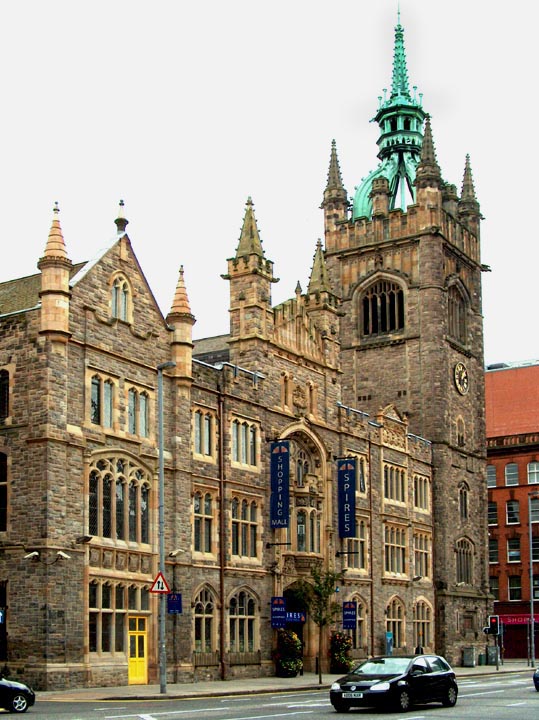
Old Life took a wee vacation last week thanks to (all about) my trip to Belfast which included delightful discussions with a historian who must remain anonymous for the sake of his good name and sightseeing with an old (not as old as mmmmeeeeeeEEE) friend who also deserves protection from tawdry associations with this blog.

I had the privilege of speaking informally with folks from the Presbyterian Church in Ireland and the Evangelical Presbyterian Church. Those communions are not in fellowship thanks to the split in 1927 over liberalism in the PCI, a debate that has all the earmarks of the so-called fundamentalist controversy in the U.S. In fact, W. J. Grier, who studied at Princeton Seminary with J. Gresham Machen, took some inspiration from conservatives in the U.S. to oppose the teaching of J. E. Davey, who taught church history and theology at Union College (in effect the seminary for Irish Presbyterians). When the trial against Davey failed, Grier led the formation of a new Presbyterian communion.

That parallel suggests that PCI is to the EPC what the PCUSA is to the OPC. But such reading of American dynamics into Ireland misses how different American Presbyterianism is. If anything, the U.S. equivalent to the PCI is the Evangelical Presbyterian Church (the American one that had Tim Keller speak at its GA). The PCI is more evangelical than the PCUSA and does not go out of its way to be inclusive. Whether it will ever go out of its way to discipline erroneous views is another matter.

Another difference is that the PCI’s moderator is tenth in the Orders of Precedence in the United Kingdom.

I have no idea how to reconcile the Wikipedia chart with the church’s website about political status in Northern Ireland. But I do suspect the matter has something to do with the Regium Donum, a “royal gift” from Charles II to dissenting Protestants (outside the Church of Ireland — Anglican) to support their ministry. In fact, the royal recognition of the PCI’s moderator means that he receives invitations to affairs in London held by the British government. I suspect it also means some sort of royal representative at PCI General Assemblies the way that the Queen still sends a delegate to the Free Church of Scotland.

This difference with the USA is striking. The federal government or POTUS never sends representatives or invitations to moderators of Presbyterian communions in the U.S. Not even the Presbyterians in the “Protestant establishment,” the PCUSA, have the standing that Presbyterians do in the UK. American Presbyterians are pikers compared to Presbyterians in the British Isles.

But we American Presbyterians compensate with celebrity.

Which raises the question whether a brand like Tim Keller has more influence in national (or urban) life than a royal gift. I am asking because inquiring minds want to know.

The World Is Turning Rod and Leaving Tim Behind

The piece on Rod Dreher and the Benedict Option in the New Yorker was remarkable on several levels. It was generally positive, respectful, and long. This was the case despite Dreher’s tendency to sound a tad hysterical about sexual irregularities and deviance. This quote by Andrew Sullivan, a gay man who has gone head to head with Rod over the years, was telling:

Sullivan has a long-standing disagreement with Dreher over same-sex marriage, but he believes that the religiously devout should be permitted their dissent. “There is simply no way for an orthodox Catholic to embrace same-sex marriage,” he said. “The attempt to conflate that with homophobia is a sign of the unthinking nature of some liberal responses to religion. I really don’t think that florists who don’t want to contaminate themselves with a gay wedding should in any way be compelled to do so. I think any gay person that wants them to do that is being an asshole, to be honest—an intolerant asshole. Rod forces you to understand what real pluralism is: actually accepting people with completely different world views than your own.”

In “The Benedict Option,” Dreher writes that “the angry vehemence with which many gay activists condemn Christianity” is the understandable result of a history of “rejection and hatred by the church.” Orthodox Christians need to acknowledge this history, he continues, and “repent of it.” He has assured his children that, if they are gay, he will still love them; he is almost—but not quite—apologetic about his views, which he presents as a theological obligation. He sees orthodox Christians as powerless against the forces of liquidly modern progressivism; on his blog, he argues that “the question is not really ‘What are you conservative Christians prepared to tolerate?’ but actually ‘What are LGBTs and progressive allies prepared to tolerate?’ ” He wants them to be magnanimous in victory; to refrain from pressing their advantage. Essentially, he says to progressives: You’ve won. You wouldn’t sue Orthodox Jews or observant Muslims. Please don’t sue us, either.

“What I really love about Rod is that, even as he’s insisting upon certain truths, he’s obviously completely conflicted,” Sullivan said. “And he’s a mess! I don’t think he’d disagree with that. But he’s a mess in the best possible way, because he hasn’t anesthetized himself. He’s honest about a lot of the questions that many liberal and conservative Christians aren’t really addressing.”

Notice that Dreher, who is outspokenly anti-gay marriage, did not receive the chorus of criticism that Tim Keller did at Princeton Seminary even from such mainstream organs and figures as the New Yorker and Andrew Sullivan.

To be sure, the PCUSA is not the New Yorker, but at a time when the magazine has identified President Trump and his supporters as an alien force in national life, a fair piece about Dreher is not what readers would have expected.

So why does Dreher receive more acclaim than Keller? The reason could be that the former promotes a thick (as he understands it) Christian identity, complete with communitarian obligations, while Keller stands for a Christianity that is chiefly reasonable and appeals to the mind. In other words, Dreher is appealing to a larger conception of Christianity that encompasses more of one’s identity than intellect while Keller is largely about defending the Apostles’ Creed (as he explained a while back in an interview at First Things) — or a Christian minimum. Rod is maximalist where Tim is a minimalist.

Naomi Schaeffer Riley picked up on this difference when she contrasted Dreher and Keller:

Keller sees an integral part of the church’s mission as being present in the big cities — no matter how culturally degraded they may seem. “Christians ought to be present and engaged everywhere that there are people. But across the world people are flocking to cities at the rate of millions per year.

“Christians don’t all need to live in cities, but they should at least be moving there in the same proportions as the people whom they want to serve.”

His approach may be falling out of favor among some more orthodox believers. Last month, the Wall Street Journal reported on a small but growing number of Christians who, “feeling besieged by secular society . . . are taking refuge” in small, often isolated communities away from negative cultural influences and surrounded by other believers.

This “Benedict Option” was named in honor of St. Benedict, who fled the moral degradation of Rome. It’s also the title of a new book by Rod Dreher, who, writing in Christianity Today, calls it a “strategic withdrawal” by “serious Christian Conservatives [who] could no longer live business-as-usual lives in America.”

Though Dreher doesn’t say Christians should all flee to isolated enclaves, those are where such withdrawal would be easiest.

Keller believes Christians in New York cannot retreat into homogeneity. They’ll be regularly faced with people who fervently disagree with them. Keller’s church is a multi-ethnic one and even if the believers have a similar religious outlook, they hail from a variety of different backgrounds.

That fear of homogeneity and retreat also explains, by the way, while Keller is somewhat uncomfortable with going all in on Presbyterianism (from his interview at First Things):

I don’t believe you can reach New York with the gospel if you only plant Presbyterian churches. There are all kinds of people who’ll never be Presbyterians. It just doesn’t appeal to them. Some people are going to be Pentecostals, some people are going to be Catholics. I mean, I know that sounds¯I’m not talking about that certain cultures reach certain people. It’s much more complicated than that. Even though there’s something to that. We all know that certain cultures seem to have more of an affinity toward a certain kind of Christian tradition than others, but I wouldn’t want to reduce it to that at all. I would just say that I only know that God seems to use all these kinds of churches to reach the whole breadth of humanity, and so that’s why we give money to start churches of other denominations, and give free training to it. And we’ve done about a hundred in the New York area, where we’ve helped people. It’s very important to us.

For Keller, apparently, Christianity resists taking overly specific and particular forms (think ecclesiology, liturgy, even creed). His ministry can transcend different cultures and expressions of Christianity. That comes up short against those Christians that Schaeffer identifies as wanting a more than “business-as-usual” faith.

But the Allies at Gospel Coalition back Keller over Dreher when they say they want both a Christianity that is meaty and one that is mainstream:

The Benedict Option is named for Benedict of Nursia, a 4th century monk who launched a monastic movement that preserved Western civilization. Today, writers like Rod Dreher enjoin Christian​s​ to take similar steps to “develop communities based on a shared sense of orthodoxy (right belief) and orthopraxy (right practice), for the sake of forming ourselves and the next generation in the Christian faith.”

The New York Times columnist Ross Douthat has called Redeemer Presbyterian Church in New York City, where Tim Keller serves as senior pastor, an effective example of the Benedict Option for our twenty-first century, post-Christian context. Like other TGC-inspired communities, Redeemer aims to blend countercultural biblical faithfulness with a Christ-exalting, city-embracing vision.

That dual commitment to faithfulness and cultural affirmation did work for the post-World War II world. It was precisely the vision of the Neo-Evangelicals who formed the National Association of Evangelicals, founded Christianity Today, and cheered and prayed for Billy Graham. It was and is a faith that harmonizes well with a nationalism confident of its role in the world, and generally progressive in its estimate of where history is going or at least who the good guys are in that narrative.

But at a time when that post-war internationalist order is under serious strain (think Brexit, Scottish Independence, Trumpian nationalism), the appeal of a rational, enlightened Christianity may have hit a wall. What Christians seem to understand is that they need a faith little more “deep-down diving and mud upbringing,” that can withstand a social order that is not congenial to their religious convictions. It is a faith that bears more resemblance to the politics of identity than to United Statesist Christianity. This faith does not go along but separates. It makes more claims on adherents than a faith that primarily relies on mental exercises demanded by w-w. It recognizes that the world is more hostile than previous generations supposed and that Christians need to be more intentional about their convictions.

Why someone living in New York City, the place that cultivated the boorish Donald Trump, doesn’t see that cities (from culture to economics) may be a problem for the practice of demanding Christianity is a real mystery.


What Princeton Seminary Could Learn from the Pentagon

Peter Berger notices a sector of American religiosity where true inclusion and diversity reigns — the military chaplaincy:

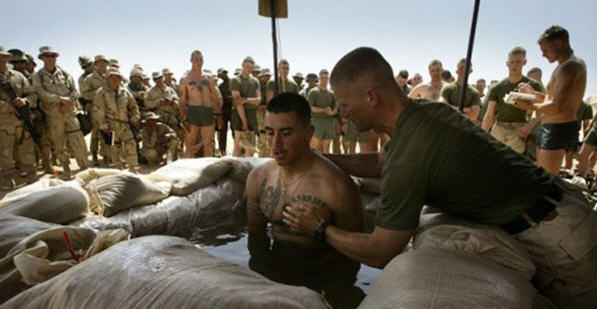
One particularly interesting development is that the military chaplaincy, in its Protestant group, is increasingly filled with Evangelicals, who feel more at home in the military than among largely liberal mainline clergy, whose concerns over gender and multiculturalism Evangelicals don’t resonate with. Some years ago I presided over a seminar dealing with whatever issues members of the seminar were concerned about. One of the seminar students was an Evangelical Air Force chaplain. This was the issue she wanted to think through: She served on a small base in the Arctic where she was the only Protestant chaplain. Of course she was not expected to perform religious services that did not agree with her own beliefs. But she was expected to facilitate services for any group of Air Force personnel. A group of Air Force women wanted to perform the rituals of Wicca, which defines itself as a modernized version of the old witches’ Sabbath. How, she asked, could she help organize a worship service of the devil without betraying the core of her Christian faith? I tried to convince her that the devil part was not to be taken seriously, that Wicca was a rather harmless form of nature worship—dancing naked in the moonlight and showing respect for menstrual blood. She said that the way I spoke about this showed I did not take the religious beliefs of this group seriously. I’m afraid she was quite right. In the end she had no choice unless she wanted to resign from the chaplaincy—so the would-be witches did their thing as facilitated by a nonsectarian Evangelical minister. (Religious freedom bears strange fruit, including the struggle of conscience of an Evangelical pastor ordered to go against her conscience by her commanding officer.)

Here’s the thing: if NAPARC communions and the PCUSA wonder about the fit between Tim Keller and a liberal Presbyterian seminary, why are those same NAPARC communions willing to send their pastors off to work not only with ordained women but even witches? I keep asking. I’m still not hearing many answers.

Public Intellectuals, Public Protestants

This piece is making the rounds, one about the sorts of public intellectuals that now sound off at TED talks and other such progressive forums. And it got me thinking about differences between Presbyterians and Princeton Seminary:

Early on, [Drezner] he makes a crucial distinction between old-fashioned “public intellectuals” and the now-trendy “thought leaders.” The latter model is one that sells itself less to an identifiable “public”—something that has become increasingly difficult to define in a society continually segmenting itself according to ever-more-narrow criteria—than to plutocratic patrons. Once upon a time, we relied on intellectuals to “speak truth to power,” as the saying goes. Of course, real life was never so simple. But the adversary culture that arose in the bohemia of Greenwich Village in the early 20th century and among the (mostly) Jewish intellectuals who founded the independent Partisan Review in the 1930s offered at least a basis from which both to critique capitalism and to imagine alternative systems that might one day replace it.

Today, our most famous purveyors of ideas sell themselves to the wealthy much like the courtiers of the Middle Ages. Drezner notes that these ideas are therefore shaped by the “aversion” that plutocrats share toward addressing the problems we face. Inequality? Global warming? Populist nihilism? An explosion of global refugees? From a Silicon Valley perspective, Drezner notes, such things are not a failure of our system but rather “a piece of faulty code that need[s] to be hacked.” Examining data from a survey of Silicon Valley corporate founders, Drezner notes their shared belief that “there’s no inherent conflict between major groups in society (workers vs. corporations, citizens vs. government, or America vs. other nations).”

So is Machen more like the old Jewish intellectuals who spoke truth to power, while Keller is more like the “famous purveyors of ideas”? Does that explain why Princeton repudiated Machen altogether but still made a place for Keller who still went there to speak about planting churches?

Just an obsession.

Why Didn’t Douthat Recommend Keller?

When Ross encouraged liberals to go to church on Easter, he even mentioned Marilynne Robinson:

Liberals, give mainline Protestantism another chance.

Do it for your political philosophy: More religion would make liberalism more intellectually coherent (the “created” in “created equal” is there for a reason), more politically effective, more rooted in its own history, less of a congerie of suspicious “allies” and more of an actual fraternity.

Do it for your friends and neighbors, town and cities: Thriving congregations have spillover effects that even anti-Trump marches can’t match.

Do it for your family: Church is good for health and happiness, it’s a better place to meet a mate than Tinder, and even its most modernized form is still an ark of memory, a link between the living and the dead.

I understand that there’s the minor problem of actual belief. But honestly, dear liberals, many of you do believe in the kind of open Gospel that a lot of mainline churches preach.

If pressed, most of you aren’t hard-core atheists: You pursue religious experiences, you have affinities for Unitarianism or Quakerism, you can even appreciate Christian orthodoxy when it’s woven into Marilynne Robinson novels or the “Letter From Birmingham Jail.”

Did Princeton Seminary spook Douthat? Shouldn’t Jonathan Merritt be outraged that Douthat snubbed Keller?

United Statesist Christianity

We need a new name for Christianity in the United States. The contributors to this podcast at Christianity Today are still lamenting the turnout of white evangelicals for Donald Trump and so one of them called for more attention to what it means to be evangelical. Are you kidding? We’ve had almost four decades of scholarship on evangelicalism, and at least three of chanting the integration of faith and learning, and we still don’t know what evangelical is? Please.

Then comes the objection to calling Lee Stroebel, whose new film is drawing attention to the Bill Hybels-spawned apologist, a fundamentalist.

A note or two about Strobel, the legal-affairs journalist. He did his undergraduate degree at a top j-school, the University of Missouri, and then went to Yale University to get his law degree. That gives some clues as to his approach to research and writing.

Strobel converted to Christianity in 1981 and, after a few years, went into ministry – becoming a “teaching pastor” at the world famous Willow Creek Community Church in the Chicago suburbs.

Now, WIllow Creek – led by the Rev. Bill Hybels – has for decades been known as, literally, a globel hub for the “seeker friendly” school of mainstream (some would say somewhat “progressive”) evangelicalism. Hybels, of course, became a major news-media figure in the 1990s through his writings and his role as one of the “spiritual advisors” and private pastors to President Bill Clinton.

Willow Creek is not a fundamentalist church.

From there, Strobel went west and for several years served as a writer in residence and teaching pastor at Saddleback Community Church, founded and led by the Rev. Rick “The Purpose Driven Life” Warren. In addition to writing one of the bestselling books in the history of Planet Earth, Warren has also received quite a bit of news-media attention through his high-profile dialogues with President Barack Obama, both during Obama’s first White House campaign and in the years afterwards.

Saddleback is not a fundamentalist church.

Fair points. I don’t think Stroebel is a fundamentalist either. But evangelical is increasingly meaningless even among Protestants who haven’t read (hades!, heard of) Deconstructing Evangelicalism.

So why not simply identify Christianity in the United States according to the degree to which its adherents adapt their faith (or pick and choose) to national norms? (Do remember that in 1899 Leo XIII identified Americanism as a heresy.) Once upon a time, Protestants came to North American and tried to transmit the version of Protestantism (works for Roman Catholics and Jews also) they brought to a New World setting. Some confessional Protestants still do this and triangulate their ministry in the U.S. according to precedents set in Europe whether at the time of the Reformation or when specific episodes upset national churches (think Scotland, England, Netherlands, Germany). Presbyterians in NAPARC still live with a foot (or – ahem – toe nail) in Old World Protestantism even as they have repudiated (except for the Covenanters) the political structures that animated their European predecessors.

But then along came awakenings and parachurch associations and increasingly Protestantism in the U.S. was known less for the fingerprints of its European origins than for those innovators (Whitefield and Moody) or structures (American Bible Society or National Association of Evangelicals) who were as independent of Old World Protestantism as their nation was of the United Kingdom. Once freed from European constraints, American Christianity used markets, earnestness, activism, and relevance as the basis for Christian identity. Evangelicalism was the kinder gentler version of fundamentalism. But neither showed the slightest bit of deference to the churches that came out of the Reformation.

Now, even the labels fundamentalist and evangelical make little difference. The gatekeepers won’t stand at the gate and even if they did the gateway has no wall to make the gate functional. Anyone can be a Christian on their own terms, with celebrities and parachurch agencies gaining the most imitators. But those instances of fame collect no dues, make no demands, and provide no institutional support. It’s like belonging to Red Sox Nation. Wear your bumper sticker. Listen to your Tim Keller sermon (now on sale for $1,500). Got to the next Gospel Coalition conference. You have Jesus in your heart and United Statesist Christianity has lots of proprietors to make your heart burn.

The good thing about United Statesist Christianity is that it allows its adherents to revel in exceptionalism. If America is a great nation, United Statesist Christianity is no less exceptional. Instead of a Pretty Good Awakening, United Statesist Christianity puts the Great back in Great Awakening.

If Princeton Refuses to Award a PCA Pastor, Why is Redeemer NYC Awarding a Liberal Congregationalist?

Word on the street has it that Redeemer Presbyterian Church has given Marilynne Robinson its first Commission of Faith and Work. Doesn’t Robinson know that Tim Keller is kind of toxic? Has she no sense of solidarity with her mainline Protestant women and LBGT+ ministers and church members? (Or, didn’t Princeton’s president know that Keller was about to approve an award to Robinson?)

Better question: why is a church whose officers subscribe the Confession of Faith and Catechisms recognizing a woman who sometimes preaches and whose theological reflections, while thoughtful, hardly line up with the PCA’s confessional teaching?

Here’s the explanation:

The commission aims to address the tide of uncertainty that the humanities now face with distinctly Christian support. Historically, in times of uncertainty and transition, the humanities have provided reminders of hope and grace to combat our fear and doubt. They center us in the miracle of the Imago Dei, sounding the peal of God’s presence in our lives. As Robinson so wisely states in one of her many erudite essays: “I experience religious dread whenever I find myself thinking that I know the limits of God’s grace, since I am utterly certain it exceeds any imagination a human being might have of it. God does, after all, so love the world.”

The logic is that the humanities are on the ropes. The humanities need support from Christians. The humanities need such support because they testify to God’s “presence in our lives.”

Imagine the testimony to God’s presence if a pastor proclaimed that Jesus Christ died for sinners. Why clutter the gospel with the valuable though limited insights of the humanities?

Humanities are valuable. So are the social and natural sciences. But the humanities are not divinity — duh. The church doesn’t gain status by hanging out with celebrity writers. It reduces God’s saving power to human aspirations.

Which novelist can say she does this?

Remember this, at least — the things in which the world is now interested are the things that are seen; but the things that are seen are temporal, and the things that are not seen are eternal. You, as ministers of Christ, are called to deal with the unseen things. You are stewards of the mysteries of God. You alone can lead men, by the proclamation of God’s word, out of the crash and jazz and noise and rattle and smoke of this weary age into the green pastures and beside the still waters; you alone, as minsters of reconciliation, can give what the world with all its boasting and pride can never give — the infinite sweetness of the communion of the redeemed soul with the living God. (Selected Shorter Writings, 205)

Postscript: Do humanists of this sort need the support of a confessional Presbyterian church?

Do you believe in sin?

Well, it depends how you define the word. The way I would read Genesis is a phenomenon . . . what it describes is a human predisposition to what amounts to self-defeat — to be given a wonderful planet and find yourself destroying it. Or, to have a wonderful civilization and then engage yourself aggressively in ways that destroy your civilization and another besides. If you look at human history or practically any human biography, it’s very hard to say that people don’t incline toward harmful and self-destructive acts, whether they intend to or not.

You are talking about sin on a large scale as you talk about it now. What about cheating on your wife?

Definite sin. A big 10. I think that in a certain way I was perhaps taught that the Ten Commandments are like a lot of the law of Moses in the sense that they name as transgressions things that you might not derive by reason as being transgressive — things like keeping the Sabbath or not making idols. These are markers in reality that are divine in their origins in the sense that human beings might not necessarily have come up with them.

Aside from that, one of the things that is true of the Bible certainly — in the case like David, for example — is that people do things that are utterly prohibitive to them, evil even. And I am speaking here of David arranging the death of Uriah so he could marry Bathsheba. And yet, there is always a huge variable at play — how does God respond to this and the difference of what we could measure as projected transgressions, the difference between that and the same thing as seen through the eyes of love or grace. These are very different things.

So I believe in sin in the sense that people do harm. I believe in grace in the sense that we cannot make final judgments about the meaning or the effect of what we do.

Presbyterian Polity 201

Presbyterian polity 101 is rule by elders.

201 is living in submission to the rule of elders within a communion’s assemblies unless a member or officer appeals the rules.

So imagine if Tim Keller were as particular about the rules of the PCA and NAPARC as Craig Barnes, president of Princeton Seminary, is about the PCUSA:

On the question of who can receive the award: anybody can. Again, this is a family argument within the Reformed communions between the PCUSA and the PCA. And as a Presbyterian seminary, it’s in our bylaws, we have to uphold the polity and the procedures of the Presbyterian Church (U.S.A.). So once the award became a matter of affirming a man who doesn’t believe women can be ordained, you know, that’s a problem for us. And that’s what the entire controversy became about. Not [about] what I wanted, which was just to have Tim Keller on campus to speak, because we have all kinds of people speaking.

We’ve had other people receive this award in the past who aren’t particularly Reformed, even. If you look at the list of previous recipients, it isn’t that we have criteria like that for the award. It’s just that this particular issue for Presbyterians against other kinds of Presbyterians — the award just became impossible to maintain, because we were, through the award, affirming Keller’s position on women’s ordination.

What do the rules of the PCA polity say about cooperating with Baptists and Pentecostals in the ministry of word and sacrament? Think The Gospel Coalition and City-to-City (partners for C2C churches are Acts 29 and Christian Reformed Church).

Not to be missed is that the Kuyper award has not exactly gone to people who battled modernism the way Kuyper did. Notice too that if you can’t tell the difference between Presbyterians and Methodists, you may have trouble with discerning modernism.

Between Tim and Carl — The NAPARC Dilemma

Rod Dreher calls attention to one NAPARC pastor who is not thrilled with current ecclesiastical options and so curious about — wait for it — The Benedict Option:

Meanwhile younger evangelicals are busy recapitulating the 20th century church’s fatal embrace of theological liberalism. As long as it’s packaged in an emotionally compelling way, their elders can be induced to swallow it as well, as “The Shack” easily demonstrates.

Within the more conservative strains of Reformed and Lutheran Protestantism there are other problematic dynamics. I have many Lutheran friends, but I’ll stick to generalizing about the Reformed. There is a spectrum in the PCA, for instance. The disciples of Tim Keller are almost as ready to give away the store in the name of reaching the culture as the mainstream evangelicals are, and there is a small but significant number of these Young Turks who are busy trying to combine AngloCatholicism and hipster feminism into a small enough package to smuggle into the PCA. On the other extreme are the Confessionalist Conservatives (with whom I mostly identify, tho less and less) many of whom seem to be suffering from Asperger’s Syndrome. Carl Trueman’s denomination is chock full of these. The focus here is on doctrine in an increasingly nuanced form, but it’s not particularly connected to real life most of the time. They tend to build small, unattractive churches full of Christians with advanced degrees in physics or engineering. They love doctrinal controversy, not because they love controversy, but because they love debating ideas. But regular people have no desire to follow the subtle arguments and hate the atmosphere of conflict coupled with a lack of any recognizably pleasing social interaction, so they run away pretty quickly. At my worst, I could easily fall into these pitfalls (indeed, I have) but the Lord is graciously restraining me and reshaping me, and by grace I am better than I was.

Pastor Brian, as he identifies himself in Rod’s comment boxes, should add that an important help to his dismissal of Keller’s giving away the story is the doctrinal zeal for which Carl Trueman’s Asperger Presbyterians are known.

But missing from this pastor’s dilemma is a recognition that the politics of identity (think race and gender) are leaving Tim Keller without a secure legacy in the PCA. Could it be that Keller is too white for the Leadership and Diversity Resource (talk about an Orwellian title) of the PCA?

When Wy Plummer invited one African-American seminarian to Chattanooga, Tennessee, to see a multiethnic PCA congregation, he had no idea the weekend would turn into an annual event attracting hundreds of men and women in Reformed denominations.

The event is now called Leadership and Development Resource (LDR), a weekend for African -Americans to see that they have a place in Reformed denominations. Since blacks are usually the minority in a PCA church, many feel as though they need to hide their ethnic culture in order to fit in at church, Plummer said. . . .

Now Plummer works with Tisby and Michelle Higgins to organize the annual gatherings. As LDR attracts more people, Higgins wants to equip teams to host regional LDR gatherings.

Plummer believes that LDR is playing a key role in creating diversity in the PCA. It gives Reformed African-American leaders the chance to address a national audience. For whites who attend, it is a place to learn about how African-Americans preach, pray, and worship.

If the OPC is getting too much doctrinal precision (haven’t heard that one before), has the PCA been getting too much Keller? Then again, the PCA establishment has to know that if push comes to shove and they have too choose between Tim and Kathy Keller or Jemar Tisby and Michelle Higgins, they’ll choose New York City over Chattanooga.

These days, though, you never know.