Making Sense of the PCA

From the Archives: Nicotine Theological Journal (Spring, 2009)

Making Sense of the PCA

I have been a minister of the Presbyterian Church in America from its founding. I attended the Convocation of Sessions, the Advisory Convention, and the first General Assembly in 1973. I have not been what one would call “a player” over the past 30 years, but I have been “involved.” I was one of the early Reformed University Ministry (RUM) campus ministers, had a full term as a member of the Committee on Mission to the World, and served on the Creation Study Committee. I edited work for children’s curriculum for Great Commission Publications. I have traveled to Japan, Philippines, Ukraine, France, and Turkey in connection with MTW mission work.

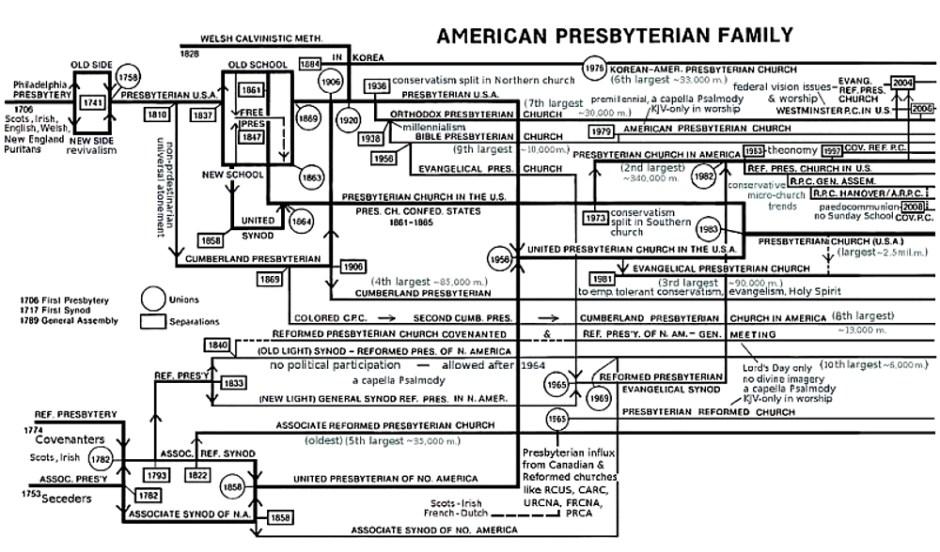
As our denomination has experienced recent tensions about confessional subscription, our mission, and worship, I have struggled to understand how we got here. My working hypothesis is that the PCA is a majority New Side/New School Presbyterian Church, with a substantial minority that is either New Side/Old School or Old Side/Old School.

The differences between the Old and New Side Presbyterians focused primarily on their differing views of revivals. The New Side believed the revivals or George Whitefield, which first disturbed and then converted sinners within and without the church and awakened and stirred to holiness and action true believers, had biblical precedents. Itinerant ordained and non-ordained speakers were often the instruments of revival. Religious experience was intensely personal and greatly concerned with whether or not one had been genuinely converted.

Old Siders had a higher view of the church as an institution, more confidence in the work of settled, ordained ministers carrying out the ordinary ministry of word and sacrament, and a greater emphasis on corporate religious life. Tensions over subscription pushed New Siders toward a looser view, with the Old Side arguing for strictness. Neither side was monolithic.

If the First Great Awakening balkanized the Old and New Sides, the Second Great Awakening returned the favor for the Old and New School Presbyterians. Despite this similarity, the major issue in the nineteenth century was not revivalism but confessionalism. Old Schoolers had differing appraisals of the earlier awakenings, but they shared a growing unease about the Second Great Awakening with its Arminian theology and its new measures.

In order to defend the theology of the Second Awakening New Schoolers had to take a broad view of the Westminster Standards and a much weaker view of what was involved in an officer’s ordination vows. The New School strongly favored mission over theology while the Old School held that theology defines and directs mission. Because of its emphasis on mission the New School favored working with parachurch societies to accomplish evangelism and missions, while the Old School believed the church alone was responsible for spreading the gospel and building up the saints. Part of the mission-orientation of the New School was its commitment to engage social issues, such as slavery and temperance, as part of an effort to Christianize America. Old Schoolers countered with the spirituality of the church. Not surprisingly, the New School had a low view of the church while the Old School maintained and defended jure divino Presbyterianism.

How does this explain the PCA? In my view, the majority of the PCA consists of three groups all of which share a New Side/New School orientation: the Columbia Seminary founding generation, the Reformed Presbyterian Church, Evangelical Synod (RPCES) influx, and the rising leadership consisting primarily of large urban/metropolitan church pastors and denominational executives.

Most of the founders of the PCA had been educated at the most conservative of the PCUS (Southern Presbyterian) seminaries in the 1950s and 1960s. While Columbia could trace her heritage all the way back to Thornwell, the most eloquent Southern Old School voice, little remained of Thornwell’s influence (William Childs Robinson being the exception) by the time PCA leaders received their training at Columbia. Students were considerably more conservative than the faculty at Columbia, but they were never much exposed to the old Confessional orthodoxy of the Southern Church. They believed in the Bible, in “the fundamentals,” in the gospel, and in evangelism and missions. They took their ordination vows with sincerity but they did not consider how those vows bound them to the Westminster Confession. In fact, many of these brothers were influenced by teachings that were inconsistent with Calvinism. I think of semi-Pelagianian, Invitation System revivalism, dispensationalism, and perfectionism. In addition, they were suspicious of church institutions and authority (having witnessed and experienced the corruption and abuse of the mainline Southern church) and were eager to cooperate with any evangelicals to win the world for Christ, maybe even “in this generation.”

It was not clear at the time of Joining and Receiving (J&R) in 1982 what the impact of the influx of the RPCES would be, but time has proved that it broadened and strengthened the New Side/New School segment of the PCA. The RPCES was the result of the union of the dwindling Reformed Presbyterian Church in North America, General Synod (a “new light” break-off from the Covenanters), and the larger Evangelical Presbyterian Church (from the McIntire wing of 1936.) Although RPCES was more Reformed and Presbyterian than McIntire’s Bible Presbyterians, its roots remained New School, and, though there was some indication the RPCES might move toward Princeton Old School positions, this did not materialize. The RPCES was and remains New Side/New School and so injected into the PCA another dose of New Side/New Schoolism.

What then of the rising leadership? The one word, which best catches the outlook and agenda of this group, consisting primarily of large urban pastors and denominational executives, is “missional.” In the New Side/New School tradition, mission is the church’s defining characteristic and responsible for its vitality and unity.

This “missional” orientation has been notably evident in recent worship services at the General Assembly. Mission requires us to rethink what it means to be church and to sit loose on doctrinal formulations, on polity issues, on how we worship, and on what the nature of the mission of the church is, so that as we understand more of this “post-everything” culture and figure out how to respond, we can make the necessary adjustments to further the church’s mission. This is decidedly the New Side/New School outlook, dressed in new clothes, but with the substance of the body unchanged.

This represents the majority of the PCA’ teaching and ruling elders. A majority holds to the New Side/New School type of Presbyterianism. At the same time a substantial minority in our church, with Old and New Side proclivities, holds to Old School Presbyterianism. This means that issues of doctrine, polity, subscription, worship, and mission remain live ones for the foreseeable future. The soul of the church is at stake for both the majority and minority.

William H. Smith is pastor of Covenant Presbyterian Church (PCA) in Louisville, Mississippi.

Machen, Golden State, and Social Justice

What binds these three items together? Warrior, as in Machen’s Warrior Children, Golden State Warriors, and Social Justice Warriors.

The average American (unless you are LeBron James) thinks positively of the NBA franchise. If that American is under 30, she likely adds Social Justice to Golden State since both are very popular.

Your average Presbyterian in one of the NAPARC communions, you might think, would add Machen happily to the Golden State Warriors since J. Gresham Machen was arguably the greatest defender of historic Presbyterianism during the twentieth century. And if you are a conservative Presbyterian under 30 you might also want to add Social Justice to Machen and the Golden State team because Social Justice and Golden State are very popular.

But what does the PCA do? It embraces Social Justice and disdains Machen — Golden State is probably agreeable.

Consider that two of the more prominent figures in the PCA during the last twenty years are John Frame, who coined the phrase, “Machen’s Warrior Children,” and Tim Keller. Almost everyone knows Frame’s opposition to Machen’s spiritual offspring. Keller less so. Here is part of his take on twentieth-century conservative Presbyterianism:

A more normal result of church splits is the pruning off of branches in a way that both wounds and yet, ironically, does not last. Something of this pattern, I think, can be seen in the history of the Orthodox Presbyterian Church. Early in its history, after the death of J. Gresham Machen, the OPC went through a split in which its New Side/New School branch left, led by J.Oliver Buswell of Wheaton College and Carl T. McIntire. But, no surprise, by the 1970s the OPC had grown a new ‘pietist/revivalist’ wing under the influence of Jack Miller. The New Life Churches and their Sonship course was classic revivalism, and it did not fit well with the more doctrinalist cast of the OPC. While not a formal split, like that of 1937, the New Life churches were made to feel unwelcome and nearly all left in the early 90s to swell the pietist ranks of the PCA.

Whenever a Reformed church purifies itself by purging itself of one of its impulses, it finds that within a generation or two, its younger leaders are starting to at look in a friendly way toward the lost parts.

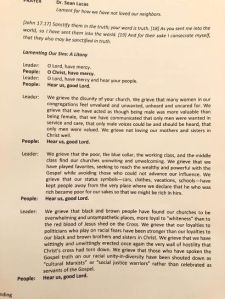
With that kind of suspicion about Machen’s Warriors, the liturgy at the PCA’s General Assembly this week was notable:

Notice that last line, the contrast between social justice warriors and servants of the gospel.  The idea that social justice is an extension of critical race theory was one that the curmudgeon, Bill Smith, proposed. Curiously enough, Sean Lucas accused Bill Smith of the genetic fallacy.

And that raises a question of whether Pastor Lucas himself has committed the liturgical fallacy. Does simply praying that Social Justice Warriors need to be celebrated as “servants of the gospel” measure up to the rigors of logic? Simply praying it doesn’t make it so.

But it does seem safe to say that Bill Smith is in Sean Lucas’ head.

You Can Get Away With More With A Committee

Sorry to see that the Christian Curmudgeon is hanging up his cleats as a blogger. It seems that his bishop is hands on (unlike the loosey-goosey way in which Presbyterians operate):

One of the vows a Reformed Episcopal minister (presbyter, minister, pastor, priest – you choose) takes is to obey his Bishop. My Bishop, whom I consider also to be my pastor of 5 years and my friend of 50+ years, has directed me not to continue my work as a Blogger. While I know he has been from time to time displeased with the content of my Blogs and other comments as they related to the Reformed Episcopal Church, his reason(s) for directing me not to Blog have to do with me – who I am and my life’s failings. In this case, the fault is not at all with him and entirely with me.

I remain a Reformed Episcopalian. I am in agreement with the 1662 Book of Common Prayer (though my preference would be the Edwardian Prayer Book), the 39 Articles of Religion, and the preaching, teaching, and writing of the English martyr Thomas Cranmer, and the Founding Principles of the Reformed Episcopal Church. I also accept and submit to Episcopal government. I believe in Prayer Book worship, the Articles, the equality of ministry of Word and Sacrament, weekly Holy Communion, and the Church Year.

I for one will miss Bill’s posts. The Christian world does not have enough contrarians and few that could spot the folly of mob mentalities the way Bill did from a Reformed Protestant perspective.

I hear that the PCA is fairly hands off. I wonder if Bill be tempted to return if only to have another round with Tim Keller.

Lent Is Methodist

Bill Smith, always worth a read, thinks Old Life has declared another war on objections to Lent. He acknowledges two chief objections among Reformed Protestants to Lent — the regulative principle of worship and the fear of Romish practices. The regulative principle should actually take care of the matter for the sake of corporate worship and the life of the church. If a Christian wants to engage in some kind of Lenten activities as a means to holiness, well, whatever floats your sanctification. But for officers in the church to make Lent the norm for a congregation or a communion, then they better come with something more than “it looks like a pretty good idea” and “our motives are generally pious.” Plus, if church members may opt out of Lenten abstemiousness, then what’s the point of officers calling for the wider body to “special” actions during a certain number of days in late winter?

Still, Bill is not content with those objections. He returns fire and argues that Lent is actually a reasonable form of temporary form of sanctification:

Another objection is that those who observe Lent use it as a time for the temporary repentance from certain sins which are normally indulged, while Jesus calls us to repent of all sins all the time. It may well be that some poorly instructed Christians view Lenten practice in that way, but in my experience I have never heard anyone who observes Lent speak of a temporary giving up of sin.

Fine. So a Christian who pursues holiness 365/12 now adds an intense time of repentance for a specified forty days before a Sunday some communions designate Easter. Maybe that’s how it works among Reformed Episcopalians.

But why THESE forty days and not another thirty in September and October, or maybe a dozen or so in late spring and early winter? Why not more intense forms of repentance sprinkled throughout the year? Or why not leave each family and person to decide when and for how long to engage in certain times of self-denial? Why these days that some designate as Lent?

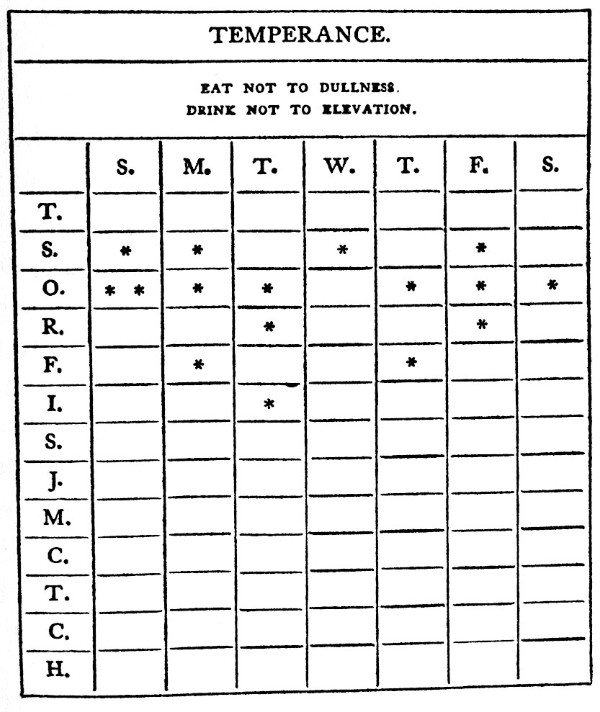
Could it be that some churches embrace a formula for Lent and so follow the spiritual equivalent of an Excel spreadsheet for the pursuit of holiness? The Lent practitioner follows these forty days with the other saints of similar inclinations and so doesn’t have to consider whether another time of fasting and prayer is needed or useful for another time during the year?

That kind of methodical piety is what Charles Briggs called, “Methodist.” It was a word he applied to the proponents of the First Pretty Good Awakening who insisted that godliness manifest itself in certain predictable and uniform ways. Of course, the idea of likening the church calendar to revivalism is oxymoronic. But to everyone who concedes that believers mature and bear different kinds of spiritual fruit in the course of their lives, the idea that you can prescribe a certain number of days — the same ones every year — for extra special holiness, and the one that requires the same kind of religious zeal to prove your conversion, are not so far removed. Both pietism and prescribed liturgicalism promote a one-size fits all spirituality that is perfect for bureaucracies, but not so hot for the diversity of human experience.

In Christ There is no White, but Lots of Multi-culture

Trigger warning for those who oppose Lutherans (does that include Princeton Seminary these days?), I’m about to quote from a Lutheran pastor who thinks confessional Protestant churches face straw-man objections about how blinkered and ineffective they are:

We are not better than you. However, we do have the same struggles as you do. Namely, we struggle with sin. We have the same inclinations toward pride, jealousy, selfish ambition and self-aggrandizement that you do. We like things a certain way. We like our carpets certain colors. We like people to dress certain ways because those ways make us feel comfortable. We can be hypocritical, judgmental and prejudiced without cause. We are all of these things because we are sinners. No, dear culture, we are not better than you. But that is why we are here every Sunday. We do not seek to be confirmed in those things that divide us. We seek to be forgiven for the times when we do not act like Christ. And we are. We are forgiven and renewed by Christ, and that makes all the difference. You do not want us to judge you by your checkered-past of sins? Why would you judge us by ours?

The church is for sinners of whom we are the worst. The church is the place where God has ordained the forgiveness of sins to take place. The church exists to proclaim the Gospel. It exists to proclaim that you are a sinner, but you are a forgiven sinner when repentant. Why would you exclude yourself from that because you are surrounded by other sinners? Are you differentiating sins and making one sin worse than another? Judging, by chance? Hmmm. Interesting. Please forgive the snark, but this is the point that is made time and time again by the historical Christian Church. We are sinners and we are saints! We are forgiven only by the blood of Christ. The blood of Christ is for us. The blood of Christ is for you. We beg you, come–for your sake, not ours.

The church is bigger than you. This is the part that you might not like to hear, but it is the truth. The church is not about you, your preferences or your tastes. The church is about Jesus. It is about the Son of God who came down to earth in humility as part of His creation. It is about this same God-man who dies willingly on the cross bearing the sins of the whole world–bearing your sins. It is about Jesus who left your sins in the tomb and rose victorious to reign for you. It is about the victorious Christ who will come again, who will create a new heaven and a new earth, who will restore these lowly bodies to be like His glorious body by the power that allows Him to subdue all things to Himself. This is the church in which uncounted saints have had their uncounted sins forgiven. Uncounted souls have been saved through the waters of Holy Baptism, taught through countless hours of instruction, bowed at numerous altars and received the infinite body and blood of Jesus Christ for the forgiveness of sins and strength for their lives in Him. This church is the voice of ages of martyrs who have not recanted the faith that we make to appear so malleable. This church has a language, an order, a life that is bigger than you. It is a life that includes 90-year-old Uncle Bud and 9-day-old Stryker. It is a life that is big enough to include you also. So if you want to be part of this church, show some initiative. Learn the language. Learn the story of the church that spans all time and space in the promises and words of Jesus.

Some in the PCA, though, may deem this understanding of the church as “white normativity.” Duke Kwon explains:

White Normativity is defining ministry to certain communities and contexts with qualifiers— “ethnic ministry,” “urban ministry,” “international ministry,” or “outreach ministry”—while calling ministry to the majority culture simply, “Ministry.”

It’s savoring the doctrine of justification in Galatians—which we should do, yes—while overlooking the original context in which the Apostle points to cross-cultural fellowship as one of the preeminent fruits—and proofs—of our justification. It’s embedded in an ecclesiology that habitually warns against the dangers of emotionalism in worship, yet ignores entirely the spiritual dangers of joylessness. When was the last time you heard a workshop or read an article that warned against intellectualism in worship?

White Normativity is moral silence on social issues that are ancillary to white communities, but core concerns of black and brown communities. It’s dismissing as “political” what is in fact personal and pastoral and practical theological for brothers and sisters of color. White Normativity is desiring diversity without discomfort. It tries to add diversity without subtracting control. It’s the preservation of dominant culture authority in the name of theological purity. It’s what makes so many young seminarians of color that I’ve spoken to nervous about entering the PCA, as they all-too-often feel forced into a false choice between ethnic identity and theological fidelity.

Because what keeps folks of color out of our churches, friends, is not public racial hostility. And the greatest hindrance to racial harmony in our denomination is not crass bigotry. It’s our shared, institutional blindness to the exclusivity of a white normativity that is protected by plausible deniability.

Mr. Kwon thinks the church should follow Multi-cultural Normativity instead:

Multicultural Normativity is when the Church is a resurrection Banquet Hall more than a Lecture Hall—and, occasionally if you dare, maybe even a Dance Hall. Multicultural Normativity rejects “racial reconciliation” as a pursuit of interpersonal harmony unless it also seeks interracial equity and mutuality. Because it’s about inclusion, not just “diversity.” It’s placing men and women of color in positions of influence and leadership. It’s inviting Irwyn Ince to serve as chair of the Overtures Committee one day again, not because we’re debating racial reconciliation but simply because he’s a Bad Man! Because diversity is about who’s on the team, but inclusion is about who gets to play.

So I wonder, does Mr. Kwon think only white Protestants need to feel discomfort, or does it go both ways — that the banquet hall has to make room for the lecture hall also? Is Mr. Kwon willing to make room for the Gospel Coalition and fans of Tim Keller? Or has PCA church planting been captive to white normativity?

Bill Smith has been asking these questions. So far, the answers are only coming from folks that might fall in the category of white normativity.

Machen Day 2011

I am not sure if our favorite PCA blogger had J. Gresham Machen’s birthday in mind when he posted a piece on the fortunes of Machen’s kind of confessionalism within the PCA, but it was good preparation for today’s festivities. The same goes for Westminster Seminary California which has released Scott Clark’s interview with me about Machen’s legacy and the chapter I wrote for W. Robert Godfrey’s festschrift, a recording that may put party-goers quickly to sleep.

But whether these resources were designed to highlight today’s anniversary, the following may provide reasons for donning party hats and blowing horns:

There are entirely too many denominations in this country, says the modern ecclesiastical efficiency expert. Obviously, many of them must be merged. But the trouble is, they have different creeds. Here is one church, for example, that has a clearly Calvinistic creed; here is another whose creed is just as clearly Arminian, let us say, and anti-Calvinistic. How in the world are we going to get the two together? Why, obviously, says the ecclesiastical efficiency expert, the thing to do is to tone down that Calvinistic creed; just smooth off its sharp angles, until Arminians will be able to accept it. Or else we can do something better still. We can write an entirely new creed that will contain only what Arminianism and Calvinism have in common, so that it can serve as the basis for some propose new “United Church.” . . . .

When we pass from these modern statements to the great creeds, what a difference we discover! Instead of wordiness we find conciseness; instead of an unwillingness to offend, clear delimitation of truth from error; instead of obscurity, clearness; instead of vagueness, the utmost definiteness and precision.

All these differences are rooted in a fundamental difference of purpose. These modern statements are intnded to show how little of truth we can get along with and still be Christians, whereas the great creeds of the church are intended to show how much of truth God has revealed to us in His Word. (“Creeds and Doctrinal Advance”)

The Danger of Revivals and of Their Critics

Our favorite PCA blogger has once again kicked up a little e-dust with a review of Kenneth Stewart’s new book, Ten Myths about Calvinism: Recovering the Breadth of the Reformed Tradition. The review itself is worth reading, as is a subsequent post that explains the author’s perspective (the author being pastor William H. Smith aka The Christian Curmudgeon). But what is particularly striking about the review and its responses (some from Ken Stewart himself) is how sensitive the topic of revivalism is.

Not to make this all about me (about which it generally is), but Stewart even calls my interpretation of revivalism “dangerous.” In fact, one of the underlying factors in Stewart’s purpose and in the book’s reception will be the way Reformed Protestants consider the relationship between being Reformed and being evangelical. Some like Stewart – John Frame may be the most notable exponent of this – tend to view evangelicalism and Reformed Protestantism as co-extensive, with Reformed being in some constructions a subset of evangelicalism. Others like the informal members of the Old Life Theological Society regard this relationship as more troubled than peaceful because of important differences between evangelicals and Reformed Protestants.

One of those differences is revivalism. Stewart believes that Reformed Protestants have generally been supportive of revivals. He even wonders who would not be in favor of unbelievers being converted and believers becoming more devout. Stewart believes that the critics of revivals have been a minority view, and that such folks are – well – dangerous. Is this the evangelical academic version of Gilbert Tennent’s “The Danger of An Unconverted Ministry”?

But the critics of revival, like myself anyway, are not opposed to conversion nor to increased godliness among the saints (why we need to call that revival is another matter). At the same time, critics of revival see that revivals generally undermine those aspects of church life that make Reformed churches Reformed. If you look at the Old Side Presbyterians critique of the supposedly good First Pretty Good Awakening, their concerns about subscription and church polity were not without merit. Similar criticisms informed the Old School Presbyterian critiques of the pro-revival New School Presbyterians. New Side and New School Presbyterians were of course pro-revival and so less attached to Presbyterian convictions and practice that was becoming officers who had taken vows about being Presbyterian. (Do evangelicals have vows?)

Here is how Charles Hodge put the division among colonial Presbyterians during the allegedly Calvinistic revivals of the First Pretty Good Awakening (danger alert!!):

It appears from this history that the great schism was not the result of conflicting views, either as to doctrine or church government. It was the result of alienation of feeling produced by the controversies relating to the revival. In these controversies the New Brunswick brethren were certainly the aggressors. In their unrestrained zeal, they denounced brethren, whose Christian character they had no right to question. They disregarded the usual rules of ministerial intercourse, and avowed the principle that in extraordinary times and circumstances such rules ought to be suspended. Acting upon this principle, they divided the great majority of the congregations within the sphere of their operations, and by appealing to the people, succeeded in overwhelming their brethren with popular obloquy. Excited by a sense of injury, and alarmed by the disorders consequent on these new methods, the opposite party had recourse to violent measures for redress, which removed none of the evils under which they suffered, and involved them in a controversy with a large class of their brethren, with whom they had hitherto acted in concert. These facts our fathers have left on record for the instruction of their children; to teach them that in times of excitement the rules of order, instead of being suspended, are of more importance than ever to the well-being of the church; that no pretence of zeal can authorize the violation of the rules of charity and justice; and on the other hand, that it is better to suffer wrong than to have recourse to illegal methods of redress; that violence is no proper remedy for disorder, and that adherence to the constitution, is not only the most Christian, but also the most effectual means of resistance against the disturbers of the peace and order of the church. (Constitutional History, Part II, pp. 249-50)

So the criticisms of revivalism and evangelicalism more generally is not necessarily the product of idiosyncratic or Dutch Reformed (as Stewart alleges) outlooks. It may simply follow from reading the splits in American Presbyterianism caused by revivals.

But to make sure my own views of revivalism are not obscure, and to let folks see if they are dangerous, I conclude by listing my major objections:

1) Revivalism (and evangelicalism generally) is anti-formal because of an emphasis on the work of the Spirit (especially in conversion but also in preaching). This stress makes presbyters or church members less worried about the wording of creeds or the requirements of polity than they should be. “It’s the Spirit that matters, not whether presbytery follows church order.”

1a) Revivalists (and evangelicals generally), because of their anti-formalism, disregard the importance of the sacraments. Perhaps the greatest example of this is the way that pro-evangelical Reformed folk regard Baptists as Reformed.

2)Revivalism (and evangelicalism generally) cultivates an appetite for the extraordinary in matters of devotion. This leads to a piety that is often discontent with the outward and ordinary means of grace that God has instituted in the church, such as the word preached by ordinary ministers, and the ordinary elements of bread, wine, and water, or even the really dull aspects of session and presbytery meetings.

3) Revivalism (and evangelicalism generally) does not know what to do with children of the covenant except to demand conversion. How you take a child who has grown up participating in family and corporate worship, has tried to lead a pious life, has prayed regularly, and tell him to convert from his wicked ways is beyond me. It is also a recipe for spiritual schizophrenia or a baptized child going to a non-Reformed church as an adult.

These views may be dangerous. But how could anyone who has studied the history of the church look at revivalism or evangelicalism as Christian expressions without problems? Reformed churches, of course, have problems too. But you can’t be Reformed if you think that basic aspects of your creed and ministry are your problems. And that is what evangelicals want from Reformed Protestants – give up those distinct aspects that make you Reformed (in doctrine, worship, and polity) and we’ll give you a seat under the big evangelical umbrella. (I might be tempted if they were serving drinks with umbrellas, but that would be really, really dangerous.)

Is This Where Neo-Calvinism Leads?

Our favorite PCA blogger (why? He’s more my age than Stellman) has adapted an older article from the Nicotine Theological Journal for his blog, calling it “Bye, Bye Kuyper.” Here is an excerpt:

Christians have come to believe that they worship God as much in their weekday jobs as they do on the Lord’s Day gathered with the congregation to pray, sing, read, and preach. In fact, Monday can be more important than Sunday. Sunday’s gathering is justified not by offering God acceptable worship and dispensing the means of grace, but only if it has some good effect on one’s work and leisure Monday through Saturday.

Ministers who lead in worship, preach the Word, and administer the sacraments are doing nothing more important than the politician or housewife (or husband) or professor of physics or laborer. In fact he may be doing something less important as he provides only the spiritual inspiration for those who really advance the kingdom. The Christian school is as important as the Church, perhaps more important if we want to prepare our young people to conquer the world for Christ.

The whole thing has led to a denigration of the traditional mission of the church. Churches are embarrassed to say that they have no more to offer than the ordinary means of grace. Ministers feel they must apologize if they do no more than preach the Word, administer the sacraments, show lost sheep the way to the fold, and help make sure the gathered sheep have the provision and protection they need as they make their way to the heavenly sheepfold. The world, it is contended, will rightly condemn the church if it does not see the “practical effects” of its existence (hence the church must distribute voters’ guides to promote Christian political agendas, create faith-based ministries to provide cradle to grave welfare, put on get seminars so everybody can communicate and have good sex, and offer concert seasons and art shows to provide the congregants and community with cultural experiences).

I know that not all Kuyperians approve of the way Kuyperianism has been domesticated. But what I am still waiting for is an account of neo-Calvinism that avoids the unhinging of the church that The Christian Curmudgeon describes. It is one thing to say that voters’ guides are a problem. It is another, though, to say that voting is kingdom work. It seems to me that Kuyperians are so reluctant to give in to the spirituality of the church that they end up making the world safe for both Jim Skillen and Jim Wallis.