A Wrestling Match Over the Resurrection

Chris Gehrz thinks a belief in the resurrection will produce activist evangelicals (maybe even social justice types):

What would happen if evangelicals let the reality of the resurrection penetrate into our hearts and give us the vitality and power of Christ’s victory over death?

First, it would cause us to value life all the more. Yet many “pro-life” evangelicals seem to care little when their preferred presidential administration closes this country to those seeking refuge from war and gang violence. Or when it ignores the deaths of thousands of Americans in Puerto Rico. Or when it leaves unaddressed (or worsens) problems with health care, drug abuse, poverty, and climate change that threaten the lives of millions.

Second, a living orthodoxy of resurrection would leave us evangelicals more hopeful and less fearful. Instead, as I observed in our book, “The same people who argue most strenuously for the historicity of the resurrection can seem the least likely to live as if Jesus Christ has actually conquered the grave.”

The resurrection as the basis for social policy and legislation — I have not seen that one before. But Gehrz thinks this corresponds with what Paul says in 1 Cor 15:58: “Therefore, my beloved brothers, be steadfast, immovable, always abounding in the work of the Lord, knowing that in the Lord your labor is not in vain.”

That is not the way I typically think about the resurrection, especially after what Paul writes just before that verse:

… flesh and blood cannot inherit the kingdom of God, nor does the perishable inherit the imperishable. 51 Behold! I tell you a mystery. We shall not all sleep, but we shall all be changed, 52 in a moment, in the twinkling of an eye, at the last trumpet. For the trumpet will sound, and the dead will be raised imperishable, and we shall be changed. 53 For this perishable body must put on the imperishable, and this mortal body must put on immortality. 54 When the perishable puts on the imperishable, and the mortal puts on immortality, then shall come to pass the saying that is written:

“Death is swallowed up in victory.”
55 “O death, where is your victory?
O death, where is your sting?”

Instead of turning Christians into transformationalistizationers of culture, the reality of death and the hope of the resurrection would seem to teach believers that this world is inconsequential to the world to come, that as Paul writes elsewhere, “to live is Christ, to die is gain.” We may not labor in vain. But we die and we receive glory, and that puts the affairs of this life in a different perspective, as it seemed to for Paul:

16 So we do not lose heart. Though our outer self is wasting away, our inner self is being renewed day by day. 17 For this light momentary affliction is preparing for us an eternal weight of glory beyond all comparison, 18 as we look not to the things that are seen but to the things that are unseen. For the things that are seen are transient, but the things that are unseen are eternal. (2 Cor 4)

Gerhz even seems to agree with this when he writes, “a lived belief in literal resurrection should lessen our fear of both literal and metaphorical death.” If true, then it would less our fears of inequality and injustice since Christians will have a life to come.

But by trying to appropriate the resurrection for social justice, Gehrz seems to be guilty of what Paul warned against:

20 Where is the one who is wise? Where is the scribe? Where is the debater of this age? Has not God made foolish the wisdom of the world? 21 For since, in the wisdom of God, the world did not know God through wisdom, it pleased God through the folly of what we preach to save those who believe. 22 For Jews demand signs and Greeks seek wisdom, 23 but we preach Christ crucified, a stumbling block to Jews and folly to Gentiles, 24 but to those who are called, both Jews and Greeks, Christ the power of God and the wisdom of God. 25 For the foolishness of God is wiser than men, and the weakness of God is stronger than men.

Christian teaching on salvation transcends the politics and economics, which likely explains why Paul had so little to say about the social injustice of the Roman Empire. Christianity is an otherworldly faith because Christians await the resurrection of the dead when Christ returns.

Does this mean Christians should eschew politics of only vote for Republicans? Probably not on politics, it’s a free church when it comes to the ballot box. Which is to say that Christians have all sorts of material for sorting out the social and political problems that come with a fallen world.

We don’t need to baptize them in the miracles of redemption.
Thank You, Lord, I’m Not a Christian-Identity Christian

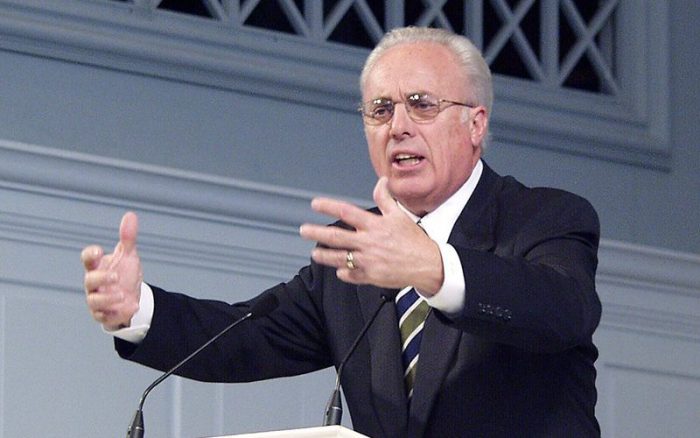
Can the social justice warriors tell the difference between John MacArthur and Louis Beam? I was not aware of Mr. Beam until I listened to a remarkable discussion of Katherine Belew’s book, Bring the War Home at bloggingheadstv. Nor was I aware of a statement about social justice from Founders Ministries until I saw Ryan Burton King’s explanation of why he could not sign it (which I saw somehow through the blur of retweets).

Beam was a Vietnam veteran who became a prominent figure, so I’ve learned, in paramilitary, Christian identity, and the Klan. Belew makes the point about a fairly large — between 5,000 and 250,000 — network of white nationalists that connected people like Beam to Timothy McVeigh, the Oklahoma City bomber.

MacArthur, of course, is that famous pastor who is the Jerry Falwell of California minus the politics. In fact, MacArthur is taking heat for not calling the church to get behind movements and networks that resist the intersectional dynamics of racism, sexism, economic exploitation, heteronormativity — I’m tapped out — and a whole lot more.

Listening to the podcast which I highly recommend, I couldn’t help but wonder if the folks who accuse the United States of harboring white nationalism can actually tell the difference (or make distinctions) between the KKK and the OPC, or if it is a case of either you’er for us or you’re against us and if you’re against us then you are antithetically (thank you Abraham Kuyper) on the side, intentionally opposed to us? I for one would think that anyone with antennae for social justice who owns a home would rather have John MacArthur as a neighbor than a guy like Beam who stockpiled guns, trained terrorists, and who did not exactly respect the rule of law.

I also wonder if those alarmed by the direction in the United States since the presidential election of 2016 can do the math and recognize that 81% of evangelicals (maybe 60 million) is a lot larger than the 250,000 who may traffic in Christian Identity networks. That might sound scary except when your remember that if — and I say if though apocalypticism seems to be one potential tie — if the two groups overlap, then 59,750,000 evangelicals are not part of white nationalist organizations. (Thank the Lord for Geerhardus Vos and amillennialism.)

One last thought, around the 31 minute mark, Robert Wright wondered how such a small group of terrorists could ever think they would take down the most powerful nation on God’s green earth. That made me wonder how Christian transformationalists could ever think they could redeem New York City. Is there a connection between transformationalism and Christian Identity?

Nah.

Machen’s Unpardonable Sin

A tweet went out on Sunday that had quotations from a letter that J. Gresham Machen to his mother about the prospects of African-American students moving into the dormitory where he lived at Princeton Seminary. Since Machen was a Southern Democrat who believed in the separation of whites and blacks (what we call racism or white supremacy), he was not thrilled with the prospect. Here is the tweet:

Scott Clark has addressed Machen’s racism here and the way that we view the past, often times, anachronistically, here.

Without taking away from the gravity of this revelation, which I had discovered while researching Machen, which I had also known generally since racism has been so prevalent in U.S. history (why are people shocked by this when we hear constantly that most if not all white people still to this day in the United States, personally or institutionally, are racist, including orthodox believers?), it might be useful for those appalled by the news to take stock and look at the sin of racism in the light of salvation and the gospel.

Some, for instance, might say that David was a sinner whom we still regard highly as a saint. A man guilty of adultery and murder, and standing by the rape of his daughter by his son, David was no model of holiness. But he repented, so we may have reason to think he had a conscience and his spirit responded to a challenge from God (through Nathan).

Machen is different because he never repented. Had he lived until the 1970s, as some Presbyterians in the PCA have done, he might have seen the sinfulness of his ways. But in all likelihood, Machen died guilty of the sin of racism, and unrepentant to boot.

Will Machen not go to heaven for this? Does Christ’s death and resurrection not cover the penalty for sin, even heinous ones like racism? According to the Belgic Confession (Art. 24):

We believe that our salvation consists in the remission of our sins for Jesus Christ’s sake, and that therein our righteousness before God is implied: as David and Paul teach us, declaring this to be the happiness of man, that God imputes righteousness to him without works. And the same apostle says, that we are justified freely by his grace, through the redemption which is in Jesus Christ. And therefore we always hold fast this foundation, ascribing all the glory to God, humbling ourselves before him, and acknowledging ourselves to be such as we really are, without presuming to trust in any thing in ourselves, or in any merit of ours, relying and resting upon the obedience of Christ crucified alone, which becomes ours, when we believe in him. This is sufficient to cover all our iniquities, and to give us confidence in approving to God; freeing the conscience of fear, terror and dread, without following the example of our first father, Adam, who, trembling, attempted to cover himself with fig-leaves. And verily if we should appear before God, relying on ourselves, or on any other creature, though ever so little, we should, alas! be consumed. And therefore every one must pray with David: O Lord, enter not into judgment with thy servant: for in thy sight shall no man living be justified.

If the Reformation got justification right, Machen’s sin should still be covered by Christ’s righteousness imputed to him by faith. Indeed, Machen received the covering of Christ’s righteousness because of his faith (assuming he had it), not because he avoided the sin of racism (which he obviously did not avoid). And the active obedience of Christ, imputed to Machen by faith, was one of his great comforts as he lay dying — “no hope without it” was his telegram to John Murray.

Now, if Machen’s critics want to allege that he is not eligible for salvation thanks to his explicit racism, it is a free country. But that will throw a wrench into the works of salvation for most of us since in 100 years or so who among us can stand on that great day of popular perceptions of justice?

Have You Considered Working in a Qualification?

I haven’t listened to either Truth’s Table or Pass the Mic for a while because the impression I generally took away when I listened was that I am guilty of something on the border of racism if not the genuine article. I did not see myself in some of the specific complaints about white people or white Christians in the U.S. But then came the invocation of systemic racism that left me wondering (as with climate change and the wealthy 1%) what was I supposed to do. If I didn’t have to work, perform house and yard maintenance, and be a somewhat normal partner in a marriage, perhaps I could devote my time to reducing racism both in aspects of my personal affairs (by implication, I think) and in the wider society. But even if I did that, what possible difference would it make? If Dr. King did all that he did and racism is still as prevalent as it was in the 1960s, I find it hard to fathom that I could possibly make a difference.

Hint for justice warriors: the need to escalate rhetoric is understandable if you want to move people to see the dangers of which you complain; but if you portray the enormity in catastrophic categories, you may leave the awakened feeling powerless in the face of such overwhelming force.

Part of the problem, then, is rhetoric. Here are some recent examples available without having to download an mp3 file:

There are several reasons why white evangelicals are reluctant to denounce racism, but for the sake of brevity, I will name one: power. Racism is ultimately about power. The power to subjugate, influence legislation, oppress, exclude, marginalize, and lord said power over the powerless. White evangelicals are reluctant to denounce racism because of the benefits that accrue to them as a result of said power. The benefits of being at the head of the table, being the standard by which everything and everyone else is measured against, the benefits of having all of the course curriculum center white authors and viewpoints exclusively from elementary school through graduate school including seminary.

Here the assertion involves apparently all white evangelicals. Since I am a Presbyterian, I guess I’m off the hook. But I wonder if the person who said this would apply it to Ligon Duncan?

Here’s another broad claim:

we live in a patriarchal society that benefits men over against women. Nevertheless, men are definitely harmed by cultural expectations of biblical masculinity. It infantilizes men, by painting them as these warriors and outdoorsmen who are hunters who know nothing about domesticity: cooking food, cleaning the house, caring for their children. In this way, the message that is communicated is that a “biblical man doesn’t need to know those things because that’s the woman’s job.” He can’t even be trusted to stay home with the kids while his wife goes away for a weekend. Additionally, men are confined to these rigid categories that revolve around sports and machismo. Toxic masculinity must be dismantled in order to give men the liberty to express themselves in other ways, through the arts, the sciences, literature, and a host of other ways. We are embodied souls; not droids.

Since I do the shopping, cooking, cleaning (bathrooms and kitchen sink), in addition to the manly work of grass cutting, snow shoveling, and wood hauling, I don’t entirely agree about the patriarchal point, though the missus will chalk up my endeavors to wanting to control everything. But again I wonder if this applies to David Platt?

Here’s one more:

The gospel of male dominance, like that of white supremacy, is a poison dispensed through cultural diffusers. Today’s good Christian man is far too charming for misogyny. But since he is often ignorant to the narratives of oppressed people (including those in the Bible), he does not know he’s being discipled into the role of benevolent master. Like most categories of dehumanization, the misogynist interpretation of Scripture which gave us the “biblical manhood and womanhood” movement (correction: issa dead horse debate), places both subhuman and superhuman categories on women and men, and ignores non-binary identity altogether.

Yes, that is straightforward and the female interlocutors may have a point. But this is so fraught with binary categories as to make me suspect that even Brad Mason is guilty of white supremacy. Can that be?

My sense is that the hosts at Truth’s Table (and Pass the Mic) have a lot of allies in the church and secular society. That reality suggests that racism and misogyny are not as pronounced as they allege, especially since their views are readily available in the mainstream press, universities, and Hollywood. Indeed, another reason for giving up downloading and listening was that I hear these arguments in lots of other forums.

They all are, of course, right about misogyny and racism which are forms of hatred that Christians should fight in themselves and discourage in others. But I have a hard time thinking these assertions about the quantity or pervasiveness of such attitudes are correct. I deem the ladies’ and the men’s depictions of the United States and the “white church” rhetorically excessive.