When You’re In the Business of Righteous Politics, It’s Hard to See the Beam in Your Own Eye

The BeeBee’s don’t seem to care for Kenneth Woodward’s complaint about the Democrats’ politics of righteousness, but the former religion editor for Newsweek and ongoing Roman Catholic makes a lot of sense. Who knew the Democrats were the Moral Majority before Jerry Falwell formed the Moral Majority?

The party’s alienation from the white working class began in the streets of Chicago outside the 1968 Democratic National Convention. There, antiwar protesters and activists for a host of countercultural causes fought the police of Mayor Richard J. Daley while the nation watched on television. As President Bill Clinton later observed in the first volume of his memoirs, Vietnam was only one point of contention in what was really a wider clash between generations, social classes and moral cultures:

“The kids and their supporters saw the mayor and the cops as authoritarian, ignorant, violent bigots. The mayor and his largely blue-collar police force saw the kids as foul-mouthed, immoral, unpatriotic, soft, upper-class kids who were too spoiled to appreciate authority, too selfish to appreciate what it takes to hold a society together, too cowardly to serve in Vietnam …”

The 1968 convention marked the end of the New Deal coalition that had shouldered Franklin Roosevelt, Harry Truman, John F. Kennedy and Lyndon B. Johnson to the White House. It wasn’t that white working-class Americans turned away from the party so much as that political reformers representing the young, the newly wealthy, the suburban and the higher educated deliberately cut party ties with them. “Boss” Daley, the authoritarian Irish Catholic mayor from the blue-collar Bridgeport neighborhood, became the poster boy for all that was “bigoted” and socially regressive in neighborhood-based, white ethnic America.

The new era

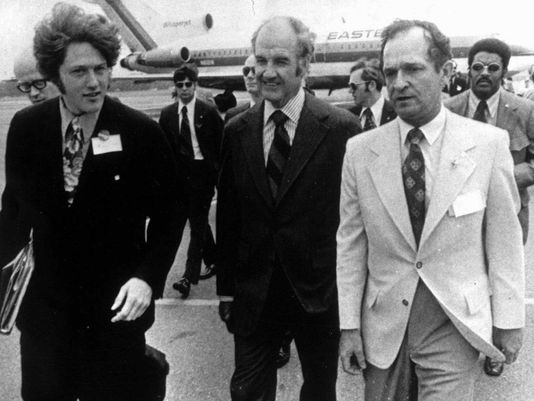
Over the next four years, a commission on party structure and delegate selection, with Sen. George McGovern as chairman, introduced a series of reforms ensuring that, culturally as well as politically, the delegates to the 1972 Democratic convention would resemble the young activists who had battled the police in Chicago more than delegates who had been seated inside. The McGovern Commission, as it came to be called, established state primaries that, in effect, abolished the power of the old city and state bosses, most of whom came from white ethnic stock. The commission also established an informal quota system for state delegations to assure greater representation of racial minorities, youths and women that by 1980 became a mandate that half of every state delegation must be women.

The 1972 Democratic platform formally introduced the party’s commitment to identity politics. Rejecting “old systems of thought,” the platform summoned Democrats to “rethink and reorder the institutions of this country so that everyone — women, blacks, Spanish speaking, Puerto Ricans, Native Americans, the young and the old — can participate in the decision-making process inherent in the democratic heritage to which we aspire.” There was also this: “We must restructure the social, political and economic relationships throughout the entire society in order to ensure the equitable distribution of wealth and power.” The delegates put flesh on these lofty moral commitments by adding a plank commending the forced busing of students in order to achieve racial balance in public schools. Blue-collar Boston exploded.

McGovern naively took for granted the traditional party loyalty of union leaders and the white working class. But these pillars of the New Deal collation recognized that McGovern’s creation of a new “coalition of conscience” built around opposition to the war, identity politics and a redistribution of wealth excluded some of their own conscientiously held moral convictions. McGovern went on to lose every state but Massachusetts and the District of Columbia — and with them the party allegiance of blue-collar workers, union leaders and — what often amounted to the same voters — conservative Roman Catholics.

Jimmy Carter was not a member of McGovern’s coalition of conscience: He had his own powerful sense of moral righteousness, one he derived from his Southern Baptist heritage of personal rectitude rather than McGovern’s secularized Methodist heritage of moral uplift and social reconstruction. There was much in that mix that was admirably righteous, especially the instinct to protect racial and sexual minorities from social oppression. The problem is that pursuing righteousness by expanding individual rights at the expense of communal values often creates greater social conflict. As sociologist Robert Bellah argued in 1991, “rights language itself offers no way to evaluate competing claims.” One side wins, the other loses.

Shazzam! You mean that entering the public square with the certainty that you are pursuing holiness and your opponents are depraved is bad for The Union? You mean “I’m right and you’re wrong” is divisive? Who knew? (Actually, most married couples do.)


How to Make Mencken a Christian

Turn doubt into fruit of the Spirit:

Doubt signals that this process of dying and rising is underway. Though God feels far away, at that moment God may be closer than we realize—especially if “know what you believe” is how we’re used to thinking of our faith.

Doubt isn’t cool, hipster, or chic. Doubt isn’t a new source of pride. Don’t go looking for doubt; don’t tempt it to arrive out of time. But neither is doubt the terrifying final word.

Doubt is sacred. Doubt is God’s instrument, will arrive in God’s time, and will come from unexpected places—places out of your control. And when it does, resist the fight-or-flight impulse. Pass through it—patiently, honestly, and courageously for however long it takes. True transformation takes time.

Being conscious of this process does not relieve the pain of doubt, but it may help circumnavigate our corrupted instinct, which is to fear doubt as the enemy to be slain. Rather, supported by people we trust not to judge us, we work on welcoming the process as a gift—which is hard to do when our entire life narrative is falling down around us. But we are learning in that season, as Qohelet did, to trust God anyway and not to trust our “correct” thinking about God.

Doubt is divine tough love. God means to have all of us, not just the surface, going-to-church, volunteering part. Not just the part people see, but the parts so buried no one sees them.
Not even us.

Imagine how great it must be to have faith.

Grade Giver, Grade Thyself

Actually don’t. The optics are off, but end-of-year blogging brings out the worst of the medium:

There is always both wheat and chaff in hurried weekly commentaries. A look back on the past year of my RNS writings reveals plenty of both.

I was right, I think, in my claim that progressive and conservative evangelicals are heading for divorce, though it will never be an entirely clean or complete one.

I was right that America’s national character is eroding — that one sign of that erosion is the nature of our politics and another is the nature of our social media.

My improved peace of mind and retention of good relations with friends and family suggest I was right to abandon Facebook last summer.

I was right that clergy entanglement with American politics is an abiding temptation that regularly makes clergy useful idiots to politicians.

I was right that the (mainly white) Christian right’s embrace of Donald Trump was deeply discrediting to the Christianity that group purports to represent. At least, I believe I was right.

I also think I was right in my regular critiques of the campaign rhetoric and policy proposals of Mr. Trump. Now we all hold our breath to see what kind of president he will actually be.

I was right that differences about ideology, politics, and faith continually tear at the fabric of our society, our churches, and our friendships.

I was right that middle ground on the LGBT issue is eroding.

I was right that the resolution of the Wheaton College/Larycia Hawkins case and her forced departure deeply wounded the cause of Christian higher education, not to mention Professor Hawkins and Wheaton.

It goes on.

Why don’t the smartest people in society not see the problem of self-evaluations? Have they never watched a Coen brother’s movie?

Where’s Waldo 2016 Update

Since some of the comments of late are echoing the union-with-Christ-centric reading of Reformed soteriology that animated many posts here, I offer a refresher on Calvin’s understanding of first-importance matters when he was explaining to Cardinal Sadoleto what Protestants believed about salvation. Note first the priority of forensics — this is about sin, guilt, law, legal verdicts:

We bid a man begin by examining himself, and this not in a superficial and perfunctory manner, but to sift his conscience before the tribunal of God, and when sufficiently convinced of his iniquity, to reflect on the strictness of the sentence pronounced upon all sinners. Thus confounded and amazed at his misery, he is prostrated and humbled before God; and, casting away all self-confidence, groans as if given up to final perdition. Then we show that the only haven of safety is in the mercy of God, as manifested in Christ, in whom every part of our salvation is complete. As all mankind are, in the sight of God, lost sinners, we hold that Christ is their only righteousness, since, by his obedience, he has wiped off our transgressions; by his sacrifice, appeased the divine anger; by his blood, washed away our stains; by his cross, borne our curse; and by his death, made satisfaction for us. We maintain that in this way man is reconciled in Christ to God the Father, by no merit of his own, by no value of works, but by gratuitous mercy. When we embrace Christ by faith, and come, as it were, into communion with him, this we term, after the manner of Scripture, the righteousness of faith.

Oh, yes, he talks about communion. That’s not union, at least in the English language I use.

Second, the obedience boys should observe Calvin’s understanding of works in relation to faith:

What have you here, Sadolet, to bite or carp at? Is it that we leave no room for works? Assuredly we do deny that, in justifying a man, they are worth one single straw. For Scripture everywhere cries aloud, that all are lost; and every mans’s own conscience bitterly accuses him. The same Scripture teaches, that no hope is left but in the mere goodness of God, by which sin is pardoned, and righteousness imputed to us. It declares both to be gratuitous, and finally concludes that a man is justified without works, (Rom. iv. 7.) But what notion, you ask, does the very term Righteousness suggest to us, if respect is not paid to good works ? I answer, if you would attend to the true meaning of the term justifying in Scripture, you would have no difficulty. For it does not refer to a man’s own righteousness, but to the mercy of God, which, contrary to the sinner’s deserts, accepts of a righteousness for him, and that by not imputing his unrighteousness. Our righteousness, I say, is that which is described by Paul, (2 Cor. v. 19,) that God bath reconciled us to himself in Jesus Christ. The mode is afterwards subjoined — by not imputing sin. He demonstrates that it is by faith only we become partakers of that blessing, when he says that the ministry of reconciliation is contained in the gospel. But faith, you say, is a general term, and has a larger signification. I answer, that Paul, whenever he attributes to it the power of justifying, at the same time restricts it to a gratuitous promise of the divine favor, and keeps it far removed from all respect to works. Hence his familiar inference — if by faith, then not by works. On the other hand — if by works, then not by faith.

Funny how far union with Christ was from Calvin’s explicit explanation of Protestant soteriology. Maybe union comes in the Development of Calvinist Doctrine. One man’s development is another’s change.

Why Doesn’t Mere Orthodoxy Take Heed of Full Orthodoxy

Matthew Loftus thinks conservative Christians have more in common with immigrants from non-Christian countries because of the civilizational angle:

If globalism and liquid modernity are the problem, then immigration restriction is cutting off one of the few sources of new citizens who might possible share your views on the priority of faith and family and the importance of religion in providing some moral undercurrent (or restraint) for the state’s actions. Both Putin and Trump appear to be happy to throw a bone to religious conservatives in order for their loyal support, but neither has any respect for human life in the eyes of the state and would happily preside over a fiefdom full of people lost in drugs, alcohol, gambling, or sex as long as they stay in power. There won’t be much civilization left to defend because modernity will continue its corrosive destruction through the institutions we love and believe in– the individualistic atomism that is hollowing out our civilization is a juggernaut that cannot be stopped by an authoritarian state and closed borders.

The lesson for Trumpsters is apparently apparent, but why not for big city pastors who trumpet (see what I did there?) urban life as the kingdom coming? When oh when will the young restless sovereigntists ever see that modernity clings to very institutions that they consider to be “traditional” or conservative (like Gospel Coalition and Tim Keller New York City Inc.)?

Imagine if the head pastor at Redeemer NYC had to respond to this:

…resisting the corrosive and disenchanting forces of modernity is going to require solidarity across ethnic, national, and religious lines because there is a large bundle of assumptions about the self, the world, and God that we share. What’s more, intentionally assimilating people into otherwise racially and religiously homogeneous communities might be one of our best chances at building that solidarity and preventing these newcomers from becoming balkanized (or, God help us, Democrats). Whether you want real civilization that is communal instead of individualistic or genuine ideology that governs according to principle rather than power-grabbing, immigrants and refugees are conservatives’ allies.

Can Mr. Loftus ever imagine that Old School Presbyterians are closer to his concerns about modernity, community, and the self than New Calvinists who thrive in the oh so modern settings of the Internet, weekend conferences, and celebrity pastors and authorettes? If you want real solidarity among believers, try strong local congregations with clear lines of accountability who send commissioners to wider church assemblies to oversee the lives of officers and church members. It’s not magic and it’s often not as thick as village life in the Outer Hebrides, but Presbyterianism is as good a Christian effort as any to resist modernity. You sure won’t find it in the Big Apple unless you live in the ghetto.

Law Enforcement: More Art than Sanctification

Mencken finds wisdom from the mayor of Toledo:

There are, to be sure, on the scrolls of the State, and on the books of the city, statutes and ordinances which forbid the commission of certain sins, and even enlarge venial offenses to the proportions of crimes for the sake of prohibiting them; and, having enacted this legislation, society seems to be content, because the theoretical remedy has been provided against evil. All that remains, according to the theory, is to “enforce” these statutes and ordinances, and the evils will vanish, the sins cease. But these remedies are theoretical only. They do not search out the mysterious and obscure causes of crime; they are concerned solely with the symptoms or surface indications of those deeply hidden causes. But, however that may be, these statutes and ordinances can be administered only by human agencies, and in their administration are encountered human obstacles. (VIRTUE BY STATUTE. From “The Enforcement of Law in Cities,” by Brand Whitlock)

If John Piper’s preaching can’t transform the human heart (without the Holy Spirit), how are Barney Fife and Andy Griffith?

Could You Write this after 9-11?

David Koyzis tries to turn B. B. Warfield into a Kuyperian and quotes this:

For there shall be a new heaven, we are told, and a new earth. Under these new heavens, in this new earth, shall gather redeemed humanity, in the perfection of its idea, and in perfect harmony with its perfected environment. In the perfection of physical vigour: for what is sown in corruption shall have been raised in incorruption, what is sown in dishonour shall have been raised in glory, what is sown in weakness shall have been raised in power, what is sown in selfishness shall have been raised in spirituality. In the perfection of social organization and intercourse: for there shall be none to hurt or destroy in all God’s holy mountain, and all the people of the Lord shall have learned righteousness. In the perfection of spiritual communion with God: for then it is that the Lord shall make Himself known to His people and shall dwell with them, and they shall need no Temple to which men should require to repair in order to meet the Lord, for the Lord God the Almighty and the Lamb are the Temple thereof, and the grace of the Lord shall flow down the streets in a river of the water of Life washing into every nook and corner.

Such is the picture the Scriptures draw for us of the salvation of our God. And let us not fail to note that it is a picture of a saved world. As no sphere of human life is left untouched by it; as on its touch, every sphere of human life is transformed; so the completeness and the profundity of its renovation of man is matched by the wideness of its extension over man. It is the renewed heavens and the renewed earth that we are bidden to contemplate; and dwelling in them in endless bliss renewed humanity.

Hard not to think that with the British Empire chugging along, the Ottomans still in charge of an unruly part of the world, the Austro-Hungarians doing their part to keep order in the Balkans, and western dominance spreading around the globe, the world was getting better and that Christians (of a kind) had a large hand in that betterment. This quotation comes from a book published in 1913.

But when the world looks less stable and life less predictable, can any Reformed Protestant still be post-millennial? (And doesn’t Koyzis have a duty to protect Warfield’s good name?)

It’s Funny Because It’s True

That was Homer Simpson’s reaction to the video, “Football to the Groin” (as I recall). Good humor has a strong does of reality, that was the lesson implied in Homer’s quip. And Babylon Bee’s top ten books for 2016 also suggest that Old Life criticisms of the Protestant world have a strong resemblance to reality. These indicate that OL and BB share not a w-w but a wariness about evangelical hype and cliches:

1.) Whatever Tim Keller wrote, probably: Honestly, we didn’t read any Tim Keller books this year. But we’re sure that whatever he wrote was pretty good. So the number 1 book of the year is whatever he wrote. Pick your favorite and put it in this slot. Congratulations, Tim!

3.) The Purpose Driven Ferret — Rick Warren: While fans of the Purpose Driven series have hundreds of variants to choose from, Rick Warren may have outdone himself with this special edition of The Purpose Driven Life, written exclusively for the close cousin of the polecat. Your ferret will love learning how to fulfill its God-given purpose as Warren masterfully uses over 250 different translations of the Bible to drive home his point.

6.) Worldview: The Worldview: Worldview Edition — Al Mohler: Al Mohler is right in his wheelhouse when writing about worldviews, and his latest work, Worldview: The Worldview: Worldview Edition is an excellent guide to worldviews and the worldviews that view them in the world.

7.) Hyphenating To The Glory Of God — John Piper: Piper focuses with white-hot, laser-like intensity on, as he puts it, “the all-other-punctuation-mark-surpassing splendor” of the hyphen. Soul-stirring and paradigm-shattering, you should not miss this all-too-important, not-exactly-like-his-usual-books-but-still-vintage-John-Piper work.

9.) ? — Rob Bell: “I was thinking about what I wanted my new book to convey,” Bell said thoughtfully in a short YouTube video designed to promote the May release of New York Times bestseller ?. “And it suddenly hit me—I really have no idea. I mean, about anything.” This masterful work features thousands of question marks arranged on each page in no discernible order, as well as several chapters written in Sanskrit.

The lesson: the way to avoid ridicule is stop doing ridiculous stuff.

Make It Stop

Yet another conversion account with these un-Francis like asides from a former Dutch Calvinist:

I also realized that there was actually no real Protestant faith in itself. The Protestant faith was founded on a protest against a faith, the Catholic Faith. Why would I ever want to part of a “church” that was actually no church at all; one that was racked by division and founded on protest!

The blindness that had always covered me was now gone. I saw that there were countless Protestant denominations, and that they all disagreed with each other on at least one important point of doctrine. This defied the very nature of Truth itself, and rendered all of them imperfect. I finally saw that there must be an authority to clear the air, which I now understand is the See of Peter.

But these questions soon evaporated into joy:

Towards the end of the Vigil, when I saw a number of people receiving their First Sacraments, I knew God was calling me to do the same thing. Mother Church was opening her arms out to me, and even though I knew many crosses would come my way if I ran to Her, I could not resist Her love. Family members of mine would shun me, professors would shake their heads as I had received prestigious scholarships in the Reformed Theology department, my future would be so uncertain, and friends would laugh, but it didn’t matter anymore.

Why doesn’t the fine print of conversion include mention of a stop in purgatory?

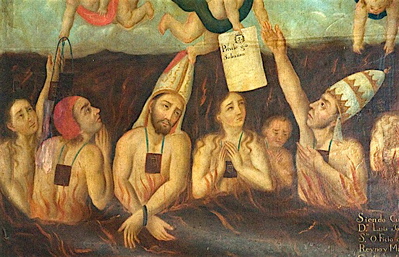
Purgatory (Lat., “purgare”, to make clean, to purify) in accordance with Catholic teaching is a place or condition of temporal punishment for those who, departing this life in God’s grace, are, not entirely free from venial faults, or have not fully paid the satisfaction due to their transgressions.

The faith of the Church concerning purgatory is clearly expressed in the Decree of Union drawn up by the Council of Florence (Mansi, t. XXXI, col. 1031), and in the decree of the Council of Trent which (Sess. XXV) defined:

“Whereas the Catholic Church, instructed by the Holy Ghost, has from the Sacred Scriptures and the ancient tradition of the Fathers taught in Councils and very recently in this Ecumenical synod (Sess. VI, cap. XXX; Sess. XXII cap.ii, iii) that there is a purgatory, and that the souls therein are helped by the suffrages of the faithful, but principally by the acceptable Sacrifice of the Altar; the Holy Synod enjoins on the Bishops that they diligently endeavor to have the sound doctrine of the Fathers in Councils regarding purgatory everywhere taught and preached, held and believed by the faithful” (Denzinger, “Enchiridon”, 983).

Further than this the definitions of the Church do not go, but the tradition of the Fathers and the Schoolmen must be consulted to explain the teachings of the councils, and to make clear the belief and the practices of the faithful.

Temporal punishment

That temporal punishment is due to sin, even after the sin itself has been pardoned by God, is clearly the teaching of Scripture. God indeed brought man out of his first disobedience and gave him power to govern all things (Wisdom 10:2), but still condemned him “to eat his bread in the sweat of his brow” until he returned unto dust. God forgave the incredulity of Moses and Aaron, but in punishment kept them from the “land of promise” (Numbers 20:12). The Lord took away the sin of David, but the life of the child was forfeited because David had made God’s enemies blaspheme His Holy Name (2 Samuel 12:13-14). In the New Testament as well as in the Old, almsgiving and fasting, and in general penitential acts are the real fruits of repentance (Matthew 3:8; Luke 17:3; 3:3). The whole penitential system of the Church testifies that the voluntary assumption of penitential works has always been part of true repentance and the Council of Trent (Sess. XIV, can. xi) reminds the faithful that God does not always remit the whole punishment due to sin together with the guilt. God requires satisfaction, and will punish sin, and this doctrine involves as its necessary consequence a belief that the sinner failing to do penance in this life may be punished in another world, and so not be cast off eternally from God.

Venial sins

All sins are not equal before God, nor dare anyone assert that the daily faults of human frailty will be punished with the same severity that is meted out to serious violation of God’s law. On the other hand whosoever comes into God’s presence must be perfectly pure for in the strictest sense His “eyes are too pure, to behold evil” (Habakkuk 1:13). For unrepented venial faults for the payment of temporal punishment due to sin at time of death, the Church has always taught the doctrine of purgatory.

Can you really be so happy about the uncertainty that awaits 99.9% of those who have to make, grace-assisted of course, satisfaction for their sins? If perfection is necessary, how can the imperfect ever be perfect? Protestantism may seem like a legal fiction. But Rome’s fiction is moral. Alien righteousness matters and this convert doesn’t seem to know that her welcoming mother church not only rejects but condemns such teaching.

Who shall ascend the hill of the LORD?
And who shall stand in his holy place?
He who has clean hands and a pure heart,
who does not lift up his soul to what is false
and does not swear deceitfully.
He will receive blessing from the LORD
and righteousness from the God of his salvation. (Psalm 24:3-5 ESV)

Gospel Coalition as Harlem Globe Trotters

One of our many southern correspondents notified me of TGC’s year-end pitch for charitable donations. At the end of Collin Hanson’s post is a link to TGC’s 2016 Annual Report. Curiously absent are the financials. The Allies encourage people to give but those people have to trust TGC staff about funds.

The similarities and differences between the Coalition and a church are striking. Since I serve on the Christian Education Committee of the OPC and am also one of the OPC’s representatives on Great Commission Publication’s board of trustees, I see strong similarities among the OPC, PCA, and TGC at least in the arena of education, curriculum development, and publication. TGC’s report on website hits, best selling books or pamphlets, and plans for 2017 titles is the sort of information I see four times a year as an OPC/GCP officer. But what I don’t see from TGC is any financial spread sheet. Since the church and parachurch both operate in a voluntary world of free-will gifts, support, and self-identification of members, you might think that giving supporters some insight into the Coalition’s funds would be not only wise but honorable.

Chalk up one for the church over the parachurch.

Another note of concern for TGC supporters may be the popularity of Jen Wilkin. According to TGC’s report:

Our all-time bestselling resource on any paid platform is Jen Wilkin’s Sermon on the Mount study with LifeWay, but it may end up topped by her 2016 TGC release, 1 Peter: A Living Hope in Christ.

Jen Wilkin may be a great lady — I’ve never heard of her though she appears to take hairstyle-advice from Ann Voskamp (not Jen Hatmaker) — but do supporters of TGC have no trouble with a non-ordained person teaching the Word of God to Christians? Maybe Ms. Wilkin is ordained. Either way, TGC’s efforts to attract support from conservative Reformed Protestants runs up against church polity that again separates the parachurch from the church (not in a good way, by the way).

But when you look at TGC’s report, you have to come away impressed with all the effort the Allies put into their labors. But what would happen if those same people put their energies into the PCA with Tim Keller or into the Southern Baptist Convention with Ms. Wilkin who goes to The Village Church (is there only one?) or into the Evangelical Free Church with D. A. Carson (does he belong to the EFC?). Where’s the efficiency? Sure, a TGC supporter could argue that the OPC or PCA or SBC are competing with TGC and these other Protestants should join forces with the Allies. But this is always what happens with “unity” projects among Christians. You form one agency to unite everyone and simply add one more organization or church to the landscape. The United Church of Canada did not unite Anglicans, Methodists, and Presbyterians. It added the United Church to the Presbyterian, Methodist, and Anglican churches.

And then there is the question of officers or pastors who hold credentials in the PCA or SBC adding their energy and resources to another Christian organization. If I play football for the Philadelphia Eagles, would the NFL allow me to play for a European football league midweek during the season (or even in the summer)? Or if I am a contributing editor to Atlantic Monthly, do I write regularly for The New Republic? These are obviously apples and oranges — publishing and sports are not ministry (though to hear some neo-Calvinists. . .). But questions about which is the primary outlet for Coalition contributors and officers is a real question that supporters of TGC should question. If I give to TGC, do I want Tim Keller spending a lot of time on committee work for his presbytery?

Chalk up another for the church.

One last observation that makes me think TGC more like an exhibition sports team (Harlem Globe Trotters) than a Major League Protestant Communion: I went to the staff page of TGC and noticed that no one works in a central office. The executive director lives in Austin, Texas (no church mentioned). The executive editor lives in Birmingham, Alabama and is part of a local community church. When it comes to the nuts and bolts of the organization, payroll, accounting, general housekeeping, again staff is scattered. The director of operations lives in Austin (no church listed). The director of program development lives in Cedar Rapids, Iowa (no church listed). The director of advancement lives in Minneapolis, Minnesota (no church listed). The manager of operations lives in Minneapolis (no church listed). The business manager lives in Austin (no church listed). And yet, for full-time staff’s location in places far away from the Big Apple, TGC’s major publishing project for 2017 is a print version of Keller’s New City Catechism. When terrorists band together, we call them non-state actors to distinguish them from the military personnel of nation-states. Nation-states engage use coercive force legitimately (ever since 1648). Terrorist organizations do not. Does that make the Allies spiritual terrorists who have no geographical or ecclesiastical home?

The impression TGC gives overall is doing all the stuff a church does (including solicitation of funds) without many of the rules that give accountability to churches in their work of word and sacrament ministry. The Allies produce conferences and literature and a website presence that provides much of the teaching and encouragement that churches also give. And yet, the Coalition has no mechanism for discipline or oversight or even ecumenical relations. To be in TGC’s orbit is like following an exhibition basketball team instead of the National Basketball Association. I guess, when your home team is the Sixers, the Globetrotters look pretty good. But it’s not real basketball.