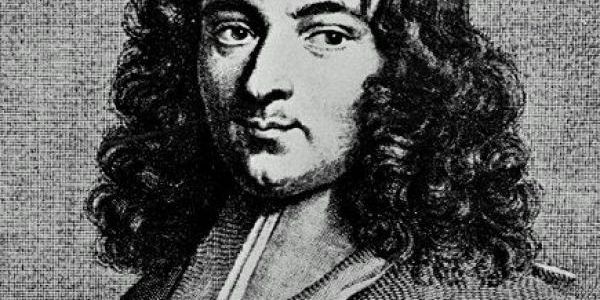
The Patron Saint of Calvinist 2k?

The Anabaptists may have seen the problems with Constantinianism, but they weren’t fans of religious tolerance the way Pierre Bayle was:

Bayle’s passion for religious liberty reflected his circumstances. Unlike better-known champions of tolerance such as Voltaire or John Locke, he had first-hand experience of persecution. He was the son of a poor Calvinist pastor in a small French town near the Spanish border. Protestants such as the Bayles were a harassed minority in France, where roughly 95 per cent of the population was Catholic.

Thousands of Bayle’s co-religionists had been massacred in the late 16th century, and even though Protestants won some freedoms at the end of the French wars of religion in 1598, their position worsened during Bayle’s lifetime. He fled to the Netherlands in 1681, when he was in his early thirties. A few years later, one of his brothers was arrested and died in a French prison. If he had converted to Catholicism, he would have been released. Bayle never got over his brother’s death.

Bayle had the misfortune to be not only a heretic in Catholic eyes, but also an apostate, for which the punishments were still worse. In his youth, he had briefly been convinced by the intellectual case for Catholicism and had converted. After about a year and a half as a Catholic, however, he decided that he had been mistaken and switched back. He followed his conscience, and this became the linchpin of his case against persecution. Why would God have given us a conscience if He did not mean us to use it?

Even if an alleged heretic, such as Bayle, was in error and was worshipping the wrong God, or worshipping Him in the wrong way, might this not be an honest mistake? He used a well-known example of mistaken identity to make his point. The wife of the peasant Martin Guerre sincerely believed an impostor to be her long-lost husband. When the real Martin Guerre returned to his village, the impostor confessed and was executed for adultery and fraud. But Guerre’s wife went unpunished, because her error had been made in good faith. Bayle reasoned that “heretics” should be treated in the same way. If they had searched diligently for the truth and acted conscientiously, they were guilty of no sin. Nobody should punish them or try to compel them to act against their honest beliefs.

Do we need religion to prop up morality? Bayle didn’t think so (and he hadn’t even listened to Angelo Cataldi):

Nor was Bayle much troubled by the notion of atheism, either, which is perhaps the most modern thing about him. Locke maintained that unbelief cannot be tolerated, because it is bound to lead to the moral collapse of any society foolish enough to allow it. Voltaire thought the same. Bayle seems to have been the first person in the Christian world to deny this conventional opinion. Morality, he reasoned, can exist perfectly well without religion.

Bayle was also unimpressed by contemporary apologists:

When an exceptionally bright comet was spotted by a German astronomer in late 1680, it caused a panic. Comets had presaged countless disasters, from the fall of Carthage to the Norman invasion of Britain, or so it was widely believed. Hundreds of alarmist pamphlets were published across Europe and in North America, announcing that the new comet was a dire warning from God to repent immediately.

Bayle set out to show that it would be against God’s nature to use celestial phenomena to send messages to mankind. With typical thoroughness, he offered eight main arguments for this conclusion, supported them with several hundred texts, ancient, medieval and modern, and made sideswipes at dozens of other superstitions along the way.

The argument of which he was most proud was original, effective and simple. It was that any such divine warnings would be bound to backfire and achieve the opposite of what God supposedly intended.

It was easy to show from scripture that God abhorred the worship of false gods. ­According to the prophets, idolatry seemed to rile Him even more than murder, theft or adultery. Yet most people on the planet are not Christians. As Bayle put it, the majority of human beings “remain idolators or have become Mohammedans”. So, if God put awe-inspiring warnings in the sky, most people would just embrace their false religions even more fervently. Why would He send harbingers of doom that could only “reanimate false and sacrilegious devotion almost everywhere on Earth” and “increase the number of pilgrims to Mecca”?

Bayle didn’t try to play God (which should be obvious to Reformed Protestants):

Why is there so much wickedness and suffering in the world? Bayle went through the standard theological answers to this question and knocked down each one, often with a vivid analogy. Is God absolved of man’s evil by His gift of free will – which makes everything man’s fault? No, Bayle answered: that would be like giving a knife to a man when you know he will use it to commit murder. The gift does not absolve the giver. Did God permit man to rebel so that He could send Jesus as a redeemer? That, Bayle replied, would make God “like a father who allows his children to break their legs so that he can show everyone his great skill in mending their broken bones”.

The real answer, he insisted, is that we cannot comprehend why God allows evil. A true Christian must simply accept that He does.

I can’t vouch for Bayle’s personal devotion, but he may be one of those many bridges between Protestantism and Enlightenment.


Those Were the Days (again)

What a church with discipline (and even a little 2k) looks like:

[The] argument for Trump recalls an earlier episode in Catholicism and political theology, the condemnation of L’Action française (AF) by Pope Pius XI in 1927. AF was an anti-liberal political movement in early twentieth-century France. It was a monarchist and nationalist movement centering on the French literary figure Charles Maurras, who held that in order for France to become great again, she must exhibit a national, religious, and political unity that could only be achieved by sloughing off liberal republicanism and embracing “integral nationalism.”

Maurras himself had lost his Catholic faith and was an agnostic, but his “throne and altar” politics appealed to many Catholic clergy and laity. Maurras saw the Catholic Church as a French institution capable of uniting Frenchmen politically. The Church was basically an instrument for implementing Maurras’s cry of “la politique d’abord,” or “politics first!” (Compare this with Trump’s recent appeal to evangelical Christians.) Maurras was also politically anti-Semitic, for Judaism was not French and not a religion capable of uniting the French. Maurras later obtained the sixteenth seat in L’Academie française, the same seat occupied by Cardinal Dupanloup in the nineteenth century. He supported the Vichy regime and spent five years in prison after World War II for doing so. He died with little support, even though he had influenced an entire generation of French politicians and intellectuals, Charles de Gaulle among them.

In spite of Maurras’s anti-Semitism and because his movement promised restitution and renewed privilege for a beleaguered Church, many Catholics supported AF. The waves of the French Revolution had continued to break over the Church in France, with the most recent assault at the time being the 1905 Law of Separation, which finally separated the Church from the Republic, except that all Church property was placed under state ownership and under the management of government-supervised lay committees. To many French Catholics, the Law of Separation showed the futility of Leo XIII’s ralliement policy of trying to find a modus vivendi for French Catholics in the Third Republic’s secular democracy. Hence the swing to anti-liberal, monarchist, restorationist movements like AF, movements generally labeled “integralist.”

One of the Catholics supporting AF was Jacques Maritain, who had affiliated himself with AF on the advice of his spiritual director, Fr. Clérissac. Maritain hoped that he could temper the components of integral nationalism incompatible with Catholicism through his association with Maurras in their joint publication Revue Universelle, for which Maritain wrote for seven years.

The Vatican had contemplated a condemnation of AF for some time, and the Holy Office’s desire to place Maurras’s writings on the Index was checked only by the outbreak of World War I. But late in 1926 after hearing of more French Catholic youth joining AF, Pius XI prohibited Catholic membership in AF’s “school” and Catholic support for AF’s publications. In early 1927, the official condemnation and excommunications began, shocking many French Catholics. Two French bishops lost their sees for failing to comply with the condemnation, and the great ecclesiologist Billot lost his cardinal’s hat. Papal ralliement was here to stay, and any party spirit suffused with pagan attitudes was deemed incompatible with Catholic political involvement. The condemnations were a watershed moment for Maritain, who quickly began to reevaluate his political and social commitments in light of his ultimate commitment to the Catholic faith. His apology for the condemnation of AF, Primauté du spirituel (1927), set the trajectory for his most famous political works, Humanisme intégral (1936) and Man and the State (1951). These works later influenced the Fathers of Vatican II, including Pope Paul VI.

It is possible for popes to act even when they are not temporal princes.

The Vatican wanted Catholics to refuse an attractive but ultimately self-defeating choice in supporting AF, and today American Catholics face a similar sort of choice. Now Trump is dissimilar to Maurras in many ways. The latter was revered for his intellectual and literary ability and had coherent and firm philosophico-political commitments, while Trump has demonstrated a shocking ignorance of Christianity and malleable, opportunistic political positions. Although both in a sense promoted the “liberty of the Church,” Maurras did so through throne and altar restorationism while Trump does so through an appeal to religious liberty.

So what’s the lesson?

The lesson from the AF crisis bears mentioning today. The Church, both her teaching office and her living members, constantly must discern whether new means for political action are compatible with a genuine concern for the common good and the integrity of Catholics involved in politics.

Is such discernment the consequence of losing confidence in the bishops?

Who is going to save our Church? Do not look to the priests. Do not look to the bishops. It’s up to you, the laity, to remind our priests to be priests and our bishops to be bishops. Archbishop Fulton Sheen

But I thought episcopacy and apostolic succession was what made Protestantism look like such a poor alternative for western Christians.

Do Historians Do This?

Last night’s conversation at Presbycast about a lot of things Presbyterian, together with current research on Roman Catholic debates during the 1980s about the church and American identity, got me thinking about whether I, as a historian of J. Gresham Machen and the OPC get away with writing this kind of evaluation of the PCUSA. What follows is from Jay Dolan’s The American Catholic Experience (1985) [Dolan taught history for many years at Notre Dame]. Here’s his description of what happened in the United States after Vatican II:

Another change that transformed the religious world of Catholics was a new understanding of sin. The traditional concept of sin was grounded in a system of laws, some of which were rooted in Scripture or the natural law, while others were promulgated by the church. The new Catholic morality argued for a more personal, less legalistic, approach to sin. The virtue of love became primary, together with the individual conscience. The implications of this shift, publicized in both scholarly and popular works, was tremendous. Perhaps most dramatic was the decline in confession. A 1974 study found that only 17 percent of the Catholics surveyed went to confession monthly, compared to 37 percent in 1963. Soon form followed function, and reconciliation rooms, where priest and penitent could interact face to face, replaced the dark confessional box. Penitential services became popular, and on some occasions a public general absolution replaced private confessions. (434).

For those who say nothing changed after Vatican II, Dolan is a contrary voice and a recognized authority on Roman Catholicism in the United States to boot (not a blogger or apologist).

But that’s not the primary reason for unearthing this quote. The point is this: what if I wrote this about the PCUSA after the OPC’s formation? What if I asserted in a book published by a trade press (Doubleday) that the PCUSA had become liberal, that it changed its theology on sin and salvation, and that these departures from historic Presbyterian practices constituted a “new” Presbyterianism, or Protestantism for a “new age.”

Of course, while wearing my OPC hat, I think that about the PCUSA. But I can’t get away with that in the mainstream publishing world without running the risk of being ostracized from the profession as the Gary North of American historians. Call me a coward. But historians of American religion cannot make certain claims about communions everyone knows to be theologically accurate because they don’t want to admit that the fundamentalists had a point.

It could also be a function of 2k. What is acceptable for churchmen’s judgments is not so for professional historical scholarship. We don’t always succeed but we do try to keep theological judgments from informing historical analysis. Sometimes that’s artificial. But it’s also the case that professional academics is not the place to settle ecclesiastical conflicts.

Still, why do those academic calculations not apply to Jay Dolan, the history of Roman Catholicism in the United States, or Doubleday? Is it a function of academic seniority? Once you acquire tenure you can write whatever you want?

Or is it that what Dolan said is actually good history and that converts and apologists have yet to catch up with the church they’ve joined and celebrated?

Tim Keller with Hair (and coiffed to boot)?

Let this be a lesson to the PCA where some want women to do the same things that men already do (sometimes poorly):

Since the 1990s women have found plentiful opportunities to fill positions in the upper echelons of the national security apparatus. Although we have not yet had a female commander-in-chief, three women have served as secretary of state and two as national security adviser. Several have filled Adlai Stevenson’s old post at the United Nations. Undersecretaries, deputy undersecretaries, and assistant secretaries of like gender abound, along with a passel of female admirals and generals.

So the question needs be asked: Has the quality of national security policy improved compared to the bad old days when men exclusively called the shots? Using as criteria the promotion of stability and the avoidance of armed conflict (along with the successful prosecution of wars deemed unavoidable), the answer would, of course, have to be no. Although Madeleine Albright, Condoleezza Rice, Susan Rice, Samantha Power, and Clinton herself might entertain a different view, actually existing conditions in Afghanistan, Iraq, Libya, Syria, Somalia, Sudan, Yemen, and other countries across the Greater Middle East and significant parts of Africa tell a different story.

The abysmal record of American statecraft in recent years is not remotely the fault of women; yet neither have women made a perceptibly positive difference.

Not Winning

Even if evangelicals think they are:

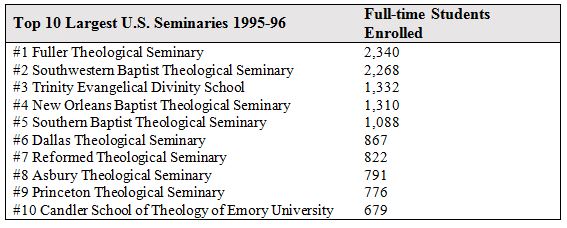
Since the 1995-96 academic school year, Princeton Theological Seminary has seen 30 percent fewer full-time enrolled students. Reformed Theological Seminary saw a 33 percent decrease to 547 full-time students while Candler School of Theology experienced a 39 percent drop to 414 full-time students.

Joe Carter spins this as victory for the Gospel Allies:

Kenneth Kantzer, the late academic dean of Trinity Evangelical Divinity School, once said that in 1890 all of the Protestant theological seminaries in the United States—with the notable exception of Harvard—were evangelical. Forty years later, though, almost all of them had become liberal (i.e., denied basic tenets of orthodoxy). By the 1950s, only four of the top ten largest seminaries were sponsored by evangelical denominations. Of those four, three were part of the SBC, which was struggling at the time to take back control of its schools from liberal professors.

By the 1990s, the trend had shifted once again back toward conservative evangelicalism. After the “conservative resurgence” in the SBC, all six of the denomination’s seminaries were solidly orthodox. And by 1995, only two liberal-leaning seminaries remained on the list of top ten schools by enrollment (Princeton at #9 and Candler School of Theology at #10).

Doesn’t he know that for some Southern Baptists, evangelical is a “Yankee” word.

And what does he not understand about Kenneth Kantzer’s reasons for leaving Fuller Seminary?

Roman Catholic apologetics are catchy.

Reformed Protestants Who Pick Nits

John Piper posted for the recent anniversary of John Calvin’s birthday about the origin of Calvinism. He went right to John Calvin and his conversion:

He was born in July 1509, in Noyon, France, and was educated at the best universities in law, theology, and classics. At the age of twenty-one, he was dramatically converted from tradition-centered medieval Catholicism to radical, biblical, evangelical faith in Christ and His Word.

Radical? At least it wasn’t earnest.

This is the sort of understanding of Reformed Protestantism that drives folks in Zurich nuts. At least a decade before John Calvin arrived in Geneva, Ulrich Zwingli was already reforming the churches of Zurich. Calvin was only twelve when Zwingli started on his way to Protestantism.

Nor should Martin Bucer be forgotten. He initiated reforms in the city of Strasbourg a year or so after Zwingli’s activities. Bucer also put his stamp indelibly on Calvin when in 1538 Geneva’s city authorities told Calvin to leave. Calvin ministered in Strasbourg for two years to a French speaking congregation and taught at Strasbourg’s academy, an institution that was a model for the Geneva Academy.

The point is that Reformed Protestants acknowledge the importance of Calvin but don’t put all their hero-worship eggs in one basket.

Piper to his credit quotes Benjamin Warfield who wrote:

The Calvinist is the [person] who sees God behind all phenomena, and in all that occurs recognizes the hand of God…

Is it too much to ask the New Calvinists to see the hand of God in the old Calvinism that emerged in places like Zurich and Strasbourg well before John Calvin was even a Protestant?

Those Were the Days (again)

When considering the development of doctrine, do not discount that winners make the final decision. Even legitimate councils that rescue the papacy can be found to be in discontinuity:

Once again, Christendom found itself split, but if the concilarist theologians had prevailed at the time of the Great Schism, in this phase the Pope was sustained by a great theologian: the Spanish Dominican, Juan de Torquemada (1388-1468) (not to be confused with the Inquisitor of the same name). Torquemada decorated by Eugene IV with the title Defensor fidei, is author of a Summa de Ecclesia, wherein he affirms with vigour the primacy of the Pope and his infallibilitas. In this work, he dissipates with great precision the ambiguities that had been created in the 14th century starting with the hypothesis of a heretic Pope. This case, according to the Spanish theologian, is concretely possible, but the solution to the problem should not be sought in any way in concilarism, which negates pontifical supremacy. The possibility of heresy in the Pope, does not compromise the dogma of infallibility, as even if he wanted to define a heresy ex cathedra, his office would be lost at that very same moment. (Pacifico Massi, Magistero infallibile del Papa nella teologia di Giovanni de Torquemada, Marietti, Torino 1957, pp. 117-122). Torquemada’s theses were developed the following century by one of his Italian confreres, Cardinal Cajetan.

The Council of Florence was very important as, on July 6th 1439, it promulgated the decree Laetentur Coeli et exultet terra, which brought the Eastern Schism to an end, but principally because it condemned concilarism definitively, by confirming the doctrine of the Pope’s supreme authority over the Church. On September 4th 1439, Eugene IV, defined solemnly: “We likewise define that the holy Apostolic See, and the Roman Pontiff, hold the primacy throughout the entire world; and that the Roman Pontiff himself is the successor of blessed Peter, the chief of the Apostles, and the true vicar of Christ, and that he is the head of the entire Church, and the father and teacher of all Christians; and that full power was given to him in blessed Peter by our Lord Jesus Christ, to feed, rule, and govern the universal Church, as is attested also in the acts of ecumenical councils and the holy canons.” (Denz-H, n. 1307).

In the letter, Etsi dubitemus, of April 21st 1441, Eugene IV condemned the heretics of Basel and the “diabolical founders” of the ‘conciliarism’ doctrine: Marsilius of Padua, Jean of Jandun and William of Ockham (Epistolae pontificiae ad Concilium Florentinum spectantes, Pontificio Istituto Orientale, Roma 1946, p. 28, 24-35), but towards Haec Sancta he held a hesitant stance, proposing what in modern terms might be defined as a “hermeneutic of continuity”. In the decree of September 4th 1439, Eugene IV states that the superiority of Councils over the Pope, asserted by the Basel Fathers on the basis of Haec Sancta, is “a bad interpretation given by the Basel Fathers themselves, which de facto is revealed as contrary to the genuine sense of the Sacred Scriptures, of the Holy Fathers, and of the Council of Constance itself.” (Decreto del 4 settembre 1439, in Conciliorum Oecumenicorum Decreta, EDB, Bologna 2002. p. 533). Eugenio IV himself, ratified the Council of Constance as a whole and in its decrees, excluded: “any prejudice to the rights, dignity and pre-eminence of the Apostolic See” as he writes to his legate on July 22nd 1446.

The hermeneutic of “continuity” thesis between Haec Sancta and the Tradition of the Church was soon abandoned. Haec Sancta is certainly the authentic act of a legitimate ecumenical Council, ratified by three Popes, but this is not enough to render binding on the doctrinal level a Magisterial document which is posed in contrast with the perennial teaching of the Church. Today we regard that only those documents, which do not damage the rights of the Papacy and do not contrast with the Tradition of the Church can be accepted from the Council of Constance. These documents do not include Haec Sancta, which is a formally heretical conciliar act.

Instead of scripture, tradition and magisterium, it should be beware the fine print.

Who’s Afraid of Orthodox Presbyterians?

I may have asked this before, but do Hasidic Jews or Amish engage in the wailing and gnashing of teeth that afflicts white Protestants in America? Where are the Hasidic Jews coming out in support of Trump because we need a president to appoint the right Supreme Court justices? And Amish on Twitter? Oxymoron doesn’t cover it. But the Amish do have a record of carving out their own existence in the United States without any ambition to take over “English” society.

Samual Goldman’s review of Mary Eberstadt’s new book, It’s Dangerous to Believe, prompts a repeat of the question: do Jews and Amish engage in the same sort of outrage about America’s decadence as Christians (and relatedly, why don’t Christians, if they really are strangers and aliens, act more like Hasidic Jews and Amish?)? Here’s one part of Goldman’s review:

Why do Jews escape the opprobrium to which traditionalist Catholics or Baptists are subjected? Partly because they have never been more than a tiny minority, but also because they make few claims on political and cultural authority. Apart from a few neighborhoods in and around New York City, no one fears that religious Jews will attempt to dictate how they live their own lives. As a result, they are able to avoid most forms of interference with their communities.

There is a lesson here for the Christian traditionalists for whom Eberstadt speaks. They are more likely to win space to live according to their
consciences to the extent that they are able to convince a majority that includes more liberal Christians and non-Christian believers, as well as
outright secularists, that they are not simply biding their time until they are able to storm the public square. In addition, they will have to develop institutions of community life that are relatively low-visibility and that can survive without many forms of official support. The price of inclusion in an increasingly pluralistic society may be some degree of voluntary exclusion from the dominant culture.

Keep that in mind when thinking about Camden Bucey’s post about the differences between the OPC and PCA. Two quotations stand out in that piece. The first goes to the transformationalism to which the PCA aspired from the get-go well before the elixir of TKNY. According to Sean Lucas:

The PCA has sought to be evangelical Presbyterians and Presbyterian evangelicals, which has given the church a voice to the broader culture. Holding the church together has not been easy. For some, frustrations have arisen from the church’s tendency to opt for an identity that is more comprehensive than pure. Others are disappointed that the church often spends a great deal of time on relatively fine points of Reformed doctrine instead of focusing on mission, cultural engagement, or evangelism.

But the OPC has functioned on the margins of American society and whether intentionally or not, its lack of size and financial resources has nurtured a communion with the outlook of a pilgrim people. According to Charlie Dennison:

While everyone in the OPC understands our opposition to liberalism, some have had trouble understanding the aversion that others have to evangelicalism. They have been unable to accept the conclusion of Cornelius Van Til and others that evangelicalism, as a system, is Arminian. They have been unable to accept the criticism that modern evangelicalism’s view of regeneration is subjective, incapable of rising above a personal experience of sin and grace to the level of the covenant and the federal headship of Adam and Christ. Further, they have been unable to accept the growing historical and social evidence that contemporary evangelicalism is worldly, individualistic, and adolescent, craving acceptance and desperately wanting to make an impact.

I (mmmmeeeEEEE) discussed these differences with CW and Wresby at Presbycast this week (feel the love).

What I have trouble grasping is the appeal of transformationalism and changing the culture. On the one hand, that is so Moral Majoritarian. Haven’t we seen the colossal failure of such efforts, not to mention how self-defeating they are if you want a hip, urban profile in the cultural mainstream? On the other hand, if you want to pass on the faith, which is lower-case-t transformationalism, do you really think you can do it in the public square? Didn’t Mary lose her son in the marketplace?

As Goldman writes, it won’t be easy giving up on Francis Schaeffer’s Christian nationalism. But at some point you need to adjust to the hand you’ve been dealt:

There is no doubt that this will be a hard bargain for adherents of traditions that enjoyed such immense authority until recently. As Eberstadt points out, however, it will also be difficult for progressives who resemble Falwell in their moral majoritarianism. The basis for coexistence must be a shared understanding that the Christian America for which some long and that others fear isn’t coming back—not only because it was Christian but also because it involved a level of consensus that is no longer available to us. There are opportunities for believers and nonbelievers alike in this absence.

If transformationalists finally recognize that Schaeffer and TKNY are in the same Christian nationalist orbit as Falwell, will they finally say “ewww”?

UPDATE

Postscript: In other words, you don’t pray in the public square (even if it’s in the hallowed city):

Mainline Presbyterians and later, evangelicals, may once have been the Republican party at prayer. There may once have been an easy alliance, an assumption of shared religious values between those entities but Ms Dhillon’s prayer last night illustrates how that alliance is coming to an end. This is not a lament. The alliance should never have been. Christians as individuals and private societies (groups) may affiliate as they will but Christians as a group and certainly the visible, institutional church should never become utterly identified with any political party. If evangelicals and other Protestants (e.g., confessionalists) were uneasy with Ms Dhillon’s prayer, I can easily imagine how awkward it must have been for Ms Dhillon to witness the closing prayer and imprecation. Watching it on YouTube last night made me uncomfortable and he professes to be a minister of (some version) of the faith I confess.

Both the opening and closing of last night’s events are a good argument for doing away with public, shared prayers in such, common, secular events. It’s not that delegates to political conventions should not pray. They should. It’s not that candidates should not pray. They should. It’s not that voters should not pray. They should. The question is not whether but when? It is dubious whether it is appropriate to open a common, secular, assembly with prayer. To whom are we praying? In whose name? What are we praying? As a Christian minister of the United Reformed Churches in North America I am not free to offer prayers to God that he has not authorized. I am not free to pray to any other deity than the Triune God of Scripture, to the God and Father of the Lord Jesus Christ. I am not authorized to approach God in any other name than the name of Jesus. It is not a matter of bigotry. It is a matter of truth, eternal life, and salvation. Jesus was raised from the dead. He is the truth (John 14:6). There are not multiple ways to God. Religion is not multifaceted expression of a common religious experience. It is revealed by God to us.

The Trinity is so Fourth Century

While New Calvinists decide how to receive the teachings of Eastern bishops, Roman Catholic cardinals have moved on. According to Christoph Cardinal Schonborn:

AL [Amoris Laetitia] is an act of the magisterium that makes the teaching of the Church present and relevant today. Just as we read the Council of Nicaea in the light of the Council of Constantinople, and Vatican I in the light of Vatican II, so now we must read the previous statements of the magisterium about the family in the light of the contribution made by AL.

The funny thing about the evangelical controversy over the Trinity, the updated version offered by the likes of Ware and Grudem comes for the sake of outdated views of women’s roles.

Appropriating the past is tricky. Best to hire a historian.

Chairman of the Board

Was this what Bryan and the Jasons had in mind?

Francis’s palpable respect for other religious traditions, coupled with his determination that the various faiths must work together to advance shared values such as peace and the care of creation, have made him a global role model for interfaith cooperation. . . .

It’s possible, of course, that people in either India or Turkey unaware of the pope’s record may be briefly swayed by such rhetoric, but the moment such charges are subjected to critical examination they’ll collapse under their own weight.

While the substance of such complaints may not have much merit, there’s nevertheless a sense in which they’re meaningful. In effect, they may be an index that Francis’s ambition to be the “chairman of the board” for religious moderates around the world is working.

Obviously without using that language, that’s a role to which every recent pope has aspired – trying to galvanize a coalition of authoritative moderates within the world’s religious traditions to demonstrate that, as much as religion can be part of the problem, it is also uniquely positioned to be part of the solution.

As someone who doesn’t hail from a traditional Western power, Francis brings a special capacity to pull that off, since he doesn’t carry the same baggage in terms of being associated with either the West’s colonial history or its contemporary military and political choices. His global popularity also means he carries the largest religious megaphone in the world, allowing him to lift the standing of moderate voices in other traditions.

Don’t think too long about where ex-Nazis went after World War II.

Forget also about popes transcending personal experience. Turn STM into ASTM — Argentina, Scripture, Tradition, Magisterium:

From the beginning, it’s been striking how often Pope Francis, when pressed to explain a particular statement or policy choice, will invoke his background in Argentina.

There are really too many examples to count, but just to choose one almost at random, in a session with priests from the diocese of Rome earlier this month, Francis stirred controversy by suggesting there are cases in which it’s better for couples to live together for a while rather than take part in a shotgun wedding.

“Here’s a social fact in Buenos Aires,” he said. “I prohibited religious marriages in Buenos Aires in cases of what we call matrimonios de apuro, meaning ‘in a hurry,’ when a baby is on the way.”

In fact, Francis cited his experience in Buenos Aires no fewer than five times in that address to priests, on multiple topics.

And be sure to love the sinner while hating the sin (except if you are a global capitalist, climate change denier, or a Turk):

Furthermore, the pope did not tell anyone to issue an actual apology. And his focus was not limited to the LGBT community. Rather, he made the broader statement that the Church “must not only ask forgiveness to the gay person who is offended,” but also to all of the people “we could have defended and we didn’t,” including the poor, and women and children who are exploited.

He cited the Catechism, saying that homosexual individuals “must not be discriminated against, (but) must be respected and accompanied pastorally.”

The Catechism teaches that based on Scripture, “tradition has always declared that ‘homosexual acts are intrinsically disordered.’”

Homosexual acts, it continues, “are contrary to the natural law … under no circumstances can they be approved.”
When speaking of homosexual persons, however, the Catechism insists that most gay individuals face “a trial” due to their sexual orientation, and “must be accepted with respect, compassion, and sensitivity. Every sign of unjust discrimination in their regard should be avoided.”

What Pope Francis said, then, clearly echoes Church teaching and displays his genuine pastoral concern for a group that has and frequently still does face hostility, including, at times, from within the Church.

Isn’t independence from tyrannical authority wonderful?