The Christian Option

Rod Dreher explains what the Benedict Option is not:

I have written here a thousand times that the Ben Op does not advocate an Amish total withdrawal from public life, but rather what I call a “strategic retreat”: for Christians to take a few steps back for the sake of deepening our own knowledge of and practice of the faith, precisely so we can live in this post-Christian society more resiliently. The Ben Op is about getting far, far more serious about formation, as well as deepening one’s involvement with local community.

He goes on to cite Alasdair MacIntyre, the philosopher who inspired this option:

My own critique of liberalism derives from a judgment that the best type of human life, that in which the tradition of the virtues is most adequately embodied, is lived by those engaged in constructing and sustaining forms of community directed towards the shared achievement of those common goods without which the ultimate human good cannot be achieved. Liberal political societies are characteristically committed to denying any place for a determinate conception of the human good in their public discourse, let alone allowing that their common life should be grounded in such a conception. On the dominant liberal view government is to be neutral as between rival conceptions of the human good, yet in fact what liberalism promotes is a kind of institutional order that is inimical to the construction and sustaining of the types of communal relationship required for the best kind of human life. . . .

The flourishing of the virtues requires and in turn sustains a certain kind of community, necessarily a small-scale community, within which the goods of various practices are ordered, so that, as far as possible, regard for each finds its due place with the lives of each individual, or each household, and in the life of the community at large. Because, implicitly or explicitly, it is always by reference to some conception of the overall and final human good that other goods are ordered, the life of every individual, household or community by its orderings gives expression, wittingly or unwittingly, to some conception of the human good. And it is when goods are ordered in terms of an adequate conception of human good that the virtues genuinely flourish. “Politics” is the Aristotelian name for the set of activities through which goods are ordered in the life of the community.

Where such communities exist — and they cannot help but exist—it may be possible for some to live lives they understand.

What is distinctly Christian about this? How can common virtues turn into “ultimate human good” without Christ paying the penalty for sin, without the prior work of the Holy Spirit in regenerating people dead in trespasses and sin? Is human good available to everyone simply by virtue of reason and contemplation? Then why call for Christians to live more resiliently and intentionally as Christians when the possibility of human flourishing is available to anyone who reads Aristotle?

If the fall happened and everyone descended from Adam “by ordinary generation” is turned in on themselves, hate God, and elevate the creature over the creator, then perhaps the Benedict Option should really be the Jesus Option. That likely sounds a tad fundy. But for the stark circumstances that follow human sin, band aids and habits won’t do.

If C. S. Lewis Had Died Only Three Years Later

He would have gone to meet his maker a separated brother instead of a heretic thanks to the reclassification of Protestants by bishops consulting at Vatican II. Joseph Pearce remembers the coincidence of Lewis’ death and John F. Kennedy’s assassination, but forgets the simultaneous meeting of the council in Rome:

Lewis in his life was outside the Church but looking towards it and leading numerous others towards it also. He has played a significant part in the conversion of countless people to the Catholic Church, the present author and the aforementioned Peter Kreeft included. He not only believed in purgatory, he believed that he was going there. Shortly before his death, he asked his friend, Sister Penelope, to visit him in purgatory, if visits from heaven were allowed.

Is Lewis in purgatory? It is not for us to say, but surely it is inconceivable that one who loved Christ so much and led so many others to Christ and His Church could be in hell.

Is John F. Kennedy in purgatory? Again, it is not for us to say. It is true, however, that he was a cafeteria “Catholic,” like his latter-day “Catholic” counterparts Nancy Pelosi and Melinda Gates, who had turned away from the Church, preferring to serve the zeitgeist to the Heilige Geist, the spirit of the age to the Holy Spirit. There has to be a price to pay for those “Catholics” who have led so many others away from the Church in their open defiance of Rome and their scarcely concealed contempt for Her teaching. There is little doubt that Dante would have consigned JFK to hell. We should hesitate to do likewise.

Where are Lewis and John F. Kennedy now? Let’s just say that purgatory leads to heaven and that heresy and apostasy leads to hell.

Would Pearce have written it that way in 1963 before he learned that Protestants were separated brothers? And what of all the Christians that Lewis led into the church that Henry VIII liberated from the papacy?

But in an age of ecumenism, despite the insistence of Bryan and the Jasons, the idea of no salvation outside the church has vanished along with the Berlin Wall. Pearce is not alone:

Jack’s memories of religious instruction as a child were of attendances during his boarding school years at an Anglo-Catholic church. Although impressed by the dedication of the priests he disliked what appeared to be the copying of “Roman rituals”. Anti-Catholic slogans had sometimes been chalked on the walls of the family home during Jack’s early years in view of the fact that the cook and the housemaid employed by the family were Catholic. One read: “Send the dirty papists back to the Devil where they belong.” Jack’s nurse, Lizzie Endicott, taught him as a young child to stamp in puddles and “kill all the little popes”.

Jack was, of course, far too intelligent and perceptive to have allowed these early incidents to form his later opinions. Nevertheless, he is said to have been annoyed, in 1931, that a “papist” publisher had handled one of his books, The Pilgrim’s Regress. Of course, if Jack had converted to Catholicism, his marriage to Joy Davidman, a divorced woman, would have been unthinkable and it is unlikely that the huge literary output that she inspired in him would ever have been written.

It is perhaps understandable that with his dislike of Protestant fundamentalism, superstition and extremes of emotion, Jack chose to take a middle path, although his aim was always to help the cause of reunion or at least make it clear why we ought to be reunited. For him, the essence of Christianity was exemplified by Thomas à Kempis in his Imitation of Christ, with its emphasis on self discipline, humility and love. In following this, Jack was a true disciple and a strong ambassador for Christianity.

The Puritan Fetish

Why do Reformed Protestants think appealing to the Puritans settles it?

Why does Patrick Ramsey think John Ball’s view of justification is significant?

While denying the Roman Catholic doctrine that love is the life and soul of justifying faith, John Ball (1585-1640) strenuously affirmed that justifying faith cannot be without love. Faith and love are distinct graces which are “infused together” by the Holy Spirt at regeneration and “the exercise of faith and love be inseparably conjoined (Treatise of Faith, 45-46).” Where there is justifying faith there is love: “As light and heat in the Sun be inseparable, so is faith and love, being knit together in a sure bond by the Holy Ghost (pg. 38).

If faith and love are distinct yet inseparable, so it is sometimes argued, “then Faith alone doth not justify (pg. 56).” The presence of love at the moment of justification implies that it is along with faith a co-instrument of justification. Ball responded to this objection by appealing to a common turn of phrase regarding the role of faith in justification: faith alone justifies but the faith which justifies is not alone. Or as it stated in the Westminster Confession of Faith: “Faith, thus receiving and resting on Christ and His righteousness, is the alone instrument of justification; yet is it not alone in the person justified, but is ever accompanied with all other saving graces, and is no dead faith, but worketh by love.”

And why does William Evans think the Puritans founded America (tell that to the Virginians)?

America was founded by Puritans. They viewed themselves as in covenant with God, as a new Israel. They thought that the covenant promises made to Israel applied quite literally to them. They thought that if Americans were obedient God would bless our land, just as he blessed ancient Israel. That’s why many American Christians love to quote 2 Chronicles 7:14: “if my people who are called by my name humble themselves, and pray and seek my face and turn from their wicked ways, then I will hear from heaven and will forgive their sin and heal their land.” This is where American exceptionalism, our notion of America as a special, chosen nation originates from.

But if Evans is right about the amillennialism, why don’t we abandon the Puritans (who were a tad preoccupied with being a chosen people)?

The point should be clear to us now—with the coming of the Messiah, the notion of the “promised land” is christologically defined. The promise of “land” is fulfilled concretely in Christ, who rules over the world as God’s kingdom, and his people. A principle of redemptive history is that when God takes something away, he replaces it with something much, much better.

All this should be a warning to us not to identify the Promised Land with any particular nation, or particular piece of real estate. The covenant promises of God regarding land do not apply to America as a nation in covenant with God, or as some sort of new Israel. God’s plans are not going down the tube because of America’s present unfaithfulness. We know that ultimate individual and collective transformation are God’s work that will not be completed until Christ comes again, and that, while real (albeit provisional) successes are at times realized today, this eschatological horizon implies that the ministry of the church is not going to usher in the millennium.

The More Things Change

The more apologists say they don’t.

Odd is the way that Protestants who notice changes in Roman Catholic life hear that they don’t have the correct paradigm for understanding the past. Odder still is that Roman Catholics who are in fellowship with the Bishop of Rome (and so have the right paradigm) don’t deny but notice changes:

Still, the Church of Pius was vastly different and I do not think there is any denying it. Great theologians, who would later play a key role at the Council, men like Henri de Lubac and John Courtney Murray, were silenced. Giovanni Battista Montini was exiled to Milan for his “liberalism”, and not given a red hat, but he would go on to become the greatest pontiff of the twentieth century. Pius’ obsession with communism muted his voice in denouncing the fascism of Italy and Germany and he was one of the few modern pontiffs not to issue an encyclical on social teaching. Even the visuals were vastly different: Compare this video of Pius’ coronation with a typical Pope Francis Mass.

Perhaps most importantly for the forthcoming discussion, there were obvious doctrinal developments, even changes, in the 74 years between 1939 and 2013. In 1939, the Assumption of the Virgin Mary was a theological opinion, not an officially proclaimed dogma of the Church. There were no “Fortnights for Freedom” because the Church still officially condemned religious liberty. And, while the Church taught that marriage must be open to procreation, she did not yet teach that every conjugal act must be open to procreation.

If you were to count back 74 years from 1939, you would see a vastly different Church. In 1865, the papal states, though considerably shrunken in 1860, were still in existence and the pope was the sovereign of all Rome, living in the Quirinal, not the Vatican. The Syllabus of Errors, condemning all things modern, was only one year old. On May 16th of 1865, Pope Pius IX appointed the convert Henry Edward Manning as the Archbishop of Westminster, and Manning would play a key role in the development of Catholic social teaching. He also kept a fellow Anglican convert, John Henry Newman, under a cloud of suspicion. The Kulturkampf, with its persecution of the Church in Germany, and the First Vatican Council, with its definition of papal infallibility,were still a few years in the future. In France, the Church flourished with spiritual energy and Marian visitations. Six years prior, Charles Darwin had published his book Origin of the Species which was the challenge all religions in profound ways yet, drawing on her intellectual resources, it was the Catholic Church that fared better than most at integrating his seminal work on evolution with the biblical account of creation. That intellectual work had to wait until Pius IX went to his eternal reward.

In the United States, of course, the Civil War came to an end that year. The war had broken the nation’s three largest Protestant churches – the Baptists, Methodists and Presbyterians – into northern and southern branches, but the Catholic Church and the Episcopal Church remained united. Bishop Patrick Lynch of Charleston, South Carolina, had conducted a diplomatic mission to Rome on behalf of the confederacy the year before and, in 1865, he was refused permission to return until his northern confreres secured a presidential pardon. Planning was underway for the Second Plenary Council of Baltimore. Canon law was still undeveloped in the United States and, so, there were no pastors with canonical rights, and the selection of bishops was still a complicated process beginning with the priests of a diocese and the suffragans of the ecclesiastical province both drawing up ternas of candidates for submission to Propaganda Fide. Yes, the Church in the U.S. was still governed through that congregation because we were considered mission territory.

Jump back another 74 years, to 1791, and we see a Church that was virtually prostrate. The popes had been forced to suppress the Society of Jesus, which had been the most stalwart support for papal authority, seventeen years prior. Pope Pius VI had gone to Vienna nine years earlier to cope with the spread of enlightenment ideas, sponsored by the Emperor Joseph II, but the trip had been a failure. And, of course, in France, the Assembly in 1791 mandated that all clergy take an oath to the Civil Constitution on the Clergy, adopted the previous year, provoking a schism that would last more than ten years and which laid the groundwork for the violence against the clergy that would commence in earnest in 1792 and last through the “Terror,” culminating with the suppression of the peasants in the Vendee. In the United States, on the other hand, our new, first bishop, John Carroll, was undertaking his first full year in office and, already, moving to help the Church engage the culture and avoid a sectarianism that he rightly feared would harm the Church in the U.S.

When you add that papal teaching (not dogma but infallible) comes precisely out of these changing contexts, you do wonder what the converts see who think they have escaped the fluidity and diversity of — yuck — Protestantism.

The Problem with Universal Jurisdiction

Maureen Mullarky fears a resurgence of anti-Catholicism in response to Pope Francis’ discussions of economic and political matters:

As Francis’ insinuates himself into geopolitics and seeks to influence America’s immigration policies, Blanshard’s long-dormant question—Is this a foreign power?— begins to stir. Catholics themselves recoil from his will to inflate the episcopal jurisdiction of the Chair of Peter into an imperial mandate to determine secular agendas. Catholics and non-Catholics alike wince at the spectacle of Francis grinning delightedly with Iran’s President Rouhani. They shrink from his embrace of Raúl Castro, wonder at his regard for major figures of liberation theology, and resent his effort to undermine American authority over its own borders.

A solution to this would be a pastor who only ministers God’s word.

But the complications of universal jurisdiction become more complex. Imagine what a Roman pontiff will do with a Donald Trump presidency:

the Vatican is surely worried about the candidacy of Donald Trump. Vatican diplomats tend to be drawn from the same families, attend the same schools, and read the same magazines and newspapers, as their secular counterparts. It is no secret that the governments of Europe are appalled and frightened at the prospect of a Trump presidency, and that fright is surely shared at the Vatican. And, because opposition to immigrants is such a central part of Trump’s political rise, and concern for immigrants has been such a central focus of Pope Francis’ articulation of the Church’s social doctrine, it surely occurred to the Vatican leadership that an archbishop who has spent the last nine years in Mexico could be uniquely valuable at this point in time. As well, immigration is one issue on which the U.S. bishops are not only united, but on which they are totally in sync with the Vatican.

Again, the solution may be to worry less about worldly matters and attend more to the keys of the kingdom, the one not of this world.

But what if having all that power and having so much to say about the world’s affairs leads to pride?

Pope Francis, it seems to me, is described as a “humble” leader for a few reasons:

He rejects various aspects of papal ceremonial.
He moved out of the papal apartments.
He says things like bishops should “smell like their sheep.”
He emphasizes the “bishop of Rome” title.
He says he values decentralization and dialogue, has had a Synod and tweaked the Curial structures just a bit.

Perhaps.

But perhaps it is also fair to ask…

..knowing the role of the Pope, and understanding how easily misunderstood the role of the Pope is by most people today, is it a mark of humble leadership to allow your own words to become the dominant public face of Catholicism – on a daily basis?

So here’s the paradox. No, the contradiction: to brush away certain external expressions of papal authority while actually doubling down on the authority. Communicating in one way the supposed diminishing of the role while at the same time using the role to speak authoritatively to the entire world out of your own priorities on a daily basis.

If this isn’t clear, think of it this way: Change up the situation and imagine it happening in your workplace, your school or your parish with a new boss, principal or pastor.

What would you think then?

Here’s another comparison:

The Catholic Mass developed over time as an elaborate ritual in which the priest-celebrant was hidden behind a mysterious language, ceremony and vestments. It was, it was claimed, necessary to strip all of that so that the people could more directly encounter Christ. The end result is that all we have to look at now is the priest, and the “proper” celebration of Mass is completely dependent on his personal manner and how his style makes us feel.

One wonders if this is the best way to encourage humble leadership.

For all the reforms of Vatican II, the legacy of papal supremacy haunts even the least hierarchical of popes.

What Good Do Church Statements Do?

I noticed today at Cardinal Sean Patrick O’Malley’s blog a statement by the Massachusetts’s bishops on opiate abuse:

The abuse and misuse of opioids has become a national and local epidemic that has increasingly been felt in the Commonwealth of Massachusetts in recent years. On average, four people lose their lives each day in this state, due to illegal and legal drug overdoses. It is a disturbing trend that must be stopped. In this year of Divine Mercy in the Catholic Church, we, the four Bishops of Massachusetts join health care professionals, law enforcement, first responders, elected officials and countless others affected by this epidemic in calling for a comprehensive plan to address this growing crisis.

Given the scope of the problem, we feel some degree of urgency to find a solution to this public health and policy crisis that has reached dangerous levels. The lives negatively impacted by this disaster represent all economic, age, gender or racial categories. The impact is far reaching, leading to the eventual breakdown of families, friendships, neighborhoods and communities.

The solution to this tragic problem is not easy to define; it will be even more difficult to implement. The enormity of the problem, however, calls for an immediate and sweeping response. As that response is crafted, we must be mindful that on one hand, medical professionals must continue to care for their patients by prescribing these powerful drugs for long and short term pain management. On the other hand, overuse by the patient, along with access to vast quantities of opioids by unintended users, often leads to abuse, addiction and death. We exhort health care providers to demand improved education within their own professional groups about the appropriate indications, prescriptions and use of opioid medications.

We must offer help, support and comfort to those who have formed an addiction to prescription pain killers, as well as to those individuals who have formed an addiction to illegal drugs. While new legislation alone will not solve the opioid crisis in Massachusetts, it is a critical step that must be taken soon. We urge the Governor and the legislature to continue their work on this legislation and to provide the necessary resources, human and fiscal, to implement comprehensive education and treatment services to address and correct this ever-growing crisis.

We encourage our sisters and brothers who are suffering addiction or the addiction of loved ones to turn to their faith community for support, counsel and compassion, and we pray that those most affected will receive the physical, emotional and spiritual help that they need.

How different is something as unspecified as this call to action from the sorts of complaints that students have been bringing against university administrations, such as the Black Students Union at Johns Hopkins University?

1. We demand a public address to be held by the administration (including but not limited to President Ron Daniels, Provost Lieberman, Provost Shollenberger, and the Board of Trustees) to The Johns Hopkins community in which President Ron Daniels will announce an explicit plan of action detailing how the following demands will be instated.

2. We demand that The Johns Hopkins University creates and enforces mandatory cultural competency in the form of a semester long class requirement for undergraduate students as well as training for faculty and administration.

3. We demand that the Center for Africana Studies be recognized as a Department.

4. We demand an increase in the number of full-time Black faculty members, both in the Center for Africana Studies and throughout other departments within the institution. Moreover, we demands equal representation of self-identifying men, women, and non-binary Black individuals within these positions.

5. We call on The Johns Hopkins University Krieger School of Arts & Sciences to support the hiring of faculty concerned with the history, culture, and political position of peoples of African descent. Calls for diversifying faculty are important, but equally crucial is attracting faculty whose work creates a scholarly community dedicated to Africana studies.

6. We demand accountability for peers, faculty, and staff who target Black students both inside of and outside of the classroom. Attending to such situations must transition from a passive email sent to the student body, to an active stance taken against racial intolerance by the administration. Perpetrators that aim to make Black students uncomfortable or unsafe for racial reasons must complete additional diversity training and face impactful repercussions for their actions.

7. We demand a transparent five year plan from The Johns Hopkins University Office of Undergraduate Admissions regarding the welcoming of and retention of Black students. We demand black bodies be removed from diversity marketing campaigns until Hopkins addresses the low quality of life here that many Black students experience and the problems with retaining Black students all four undergraduate years and then takes the necessary steps to resolve them.

8. We demand more Black professors within the Women, Gender and Sexuality program to add a new dimension to the Department on intersectionality and inclusivity that is currently being neglected and ignored.

Actually, in most cases the students’ demands are much more specific than the bishops’ statement. If Massachusetts were a Roman Catholic state, the call by church officials to governmental officers to look into a certain matter might make sense. Or, if the bishops sent a memo to the administrators and public health officials at Roman Catholic hospitals and medical schools and asked for policy recommendations, they might have more to say even while not exactly ministering God’s word. But at the end of the day is a statement like this from the church anything more than an indication that bishops care? Didn’t church members already know that?

Blame Trump on the Mainline

So argues Mark Tooley:

Neither Sanders nor Trump would have been possible or even conceivable as serious presidential candidates during the decades of Mainline Protestant hegemony in American public life.

Excluding JFK, all presidents (including Unitarians) have had ties to Mainline Protestants, who shaped America’s political ethos for most of four centuries. Mainline Protestantism helped create American civil religion, a broad vaguely Protestant view of God that permitted all religious groups, including Catholics and Jews, to fully participate in public life without having to minimize their own religious convictions.

American democracy consequently remained very religious but also non-theocratic, tolerant and diverse, with all sects invested in America’s affirmation of religious liberty.

Through the mid-20th century, Mainline Protestantism provided the political language and ethical tools for governance and accommodation, especially for the great reform movements that expanded human equality. The Civil Rights Movement was perhaps Mainline Protestantism’s last great moral crusade, redeeming its earlier failures to address slavery and segregation.

But the great Mainline Protestant membership and wider cultural collapse began in the early 1960s. Then, one of six Americans belonged to the seven largest Mainline denominations. Today, fewer than one of 16 do.

Tooley fails to ask whether that political hegemony came with the price of theological modernism? After all, to maintain your place in the establishment, you can’t be vigorous about the particulars of your religious communion.

Tooley goes on to observe a certain tackiness among evangelicals:

Evangelicalism, lacking that magisterial heritage, is less self-confident, often uncomfortable with political power, is prone to extremes and often highly individualistic, impatient with human institutions.

These same handicaps plague even more the world of the religiously unaffiliated, who often lack the traditions, formal human communities, ethical tools and moral vocabulary for governance. They are especially vulnerable to the impulse of the moment.

So, if the the downfall of the mainline paved the way for Trump, how much more the corruption of the Roman Catholic Church which paved the way for magisterial reformers?

Those Who Want History Straight Deserve to Get It Good and Hard

History does not conform to apologetics.

So says the American Jesuit, Robert Taft:

“It’s not true that at the beginning we had one Church centered in Rome, and then for various historical reasons certain groups broke off,” he said. “It’s just the opposite. At the beginning we had various churches, as Christianity developed here and there and someplace else, and gradually different units began to be formed.”

“That’s the reality,” Taft said, “and we have to accept it.”

So confirms the Capuchin order:

The Annuario Pontificio, the Vatican’s statistical yearbook, lists about 800 men’s orders in the Church, all of which have a story to tell. Precisely because Capuchins don’t call attention to themselves, however, several interesting elements of their tale are often lost.

The order was born in 1525 when a friar named Matteo da Bascio decided the Franciscans of his day had abandoned the initial vision of St. Francis of Assisi, and he wanted to get back to a strict observance of penance, prayer, and poverty.

That implied criticism didn’t sit well with other Franciscans, and with the support of influential Church authorities, they hounded Bascio and his initial companions, who were forced to take shelter from Camaldolese monks.

In 1528, the “Capuchins” (so named for the hood they wear with their habit) got papal permission to organize, but their problems were hardly over.

Within 20 years, Bascio had left his new order to return to the Observant Franciscans, while another early Capuchin leader, Bernardino Ochino, spurned the Catholic faith altogether to join forces with John Calvin in Geneva. Eventually Ochino’s support for polygamy and his rejection of the Trinity was too much even for the Calvinists, and he went into exile first in Poland and then in Slovakia.

The new order came under suspicion of heresy and narrowly avoided being suppressed, while for a time Capuchins were forbidden to preach. (This makes it a rich irony that since 1743, the Capuchins have had the privilege of supplying the official Preacher of the Papal Household; since 1980, that role has been held by the Rev. Rainero Cantalamessa.)

Those Were Really the Days

Christendom, Schristendom:

I recently described the tumultuous years 1675-1685, and how they shaped the future of Europe and North America. Here, I want to explore the implications for the politics of religion in this era, and for some of the stereotypes we might have. Everyone knows that religion played a vital role in the Early Modern era: according to customary stereotypes, Protestants fought Catholics, Catholics fought Protestants, and Christians struggled against Muslims. All those statements are correct as far as they go, but they stand in need of some nuance. (Orthodox Christians also had their conflicts, but I will leave those out here).

As they say in Hail Caesar: Would that it were so simple …. [mirthless chuckle].

To recap briefly, I described the Protestant-led Hungarian/Magyar revolt against the (Catholic) Holy Roman Empire in the late 1670s. That in turn led to the Muslim Ottomans intervening on the side of the Hungarian rebels. The resulting war led to the siege of Vienna in 1683, and the ensuing battle, which really marked the end of Islamic expansion into Europe. Most historians would agree that this really marked a turning point in European (and world) history.

Looking at the battle of Vienna, several thoughts come to mind. For one thing, it is odd to realize just how late that happened, and how in fact it coincides so closely with an event like the settlement of Pennsylvania or (almost) the Salem witch trials – or indeed, the height of the Royal Society in London. It’s also sobering to think through the “might have been” of an Ottoman victory in that war, which might theoretically have extended Islamic power deep into southern Germany, and who knows how much further? If that had occurred, then the immediate cause would have been tensions and persecutions between Protestants and Catholics within the Holy Roman Empire.

Further afield, an Ottoman victory would, oddly, have been good news for France’s Most Christian King, Louis XIV (1643-1715). Both Louis and the Emperor Leopold were zealous Catholics, who (as we have seen) actively persecuted Protestants within their own realms, and both wished to uproot those Protestant minorities completely. Even so, dating back to the sixteenth century, the Catholic French had a long-standing entente cordiale with the Ottomans, on the basis that both had a common enemy in the Habsburgs. In the 1540s, the French allowed the Ottoman fleet to winter at their port of Toulon, and built mosques to make the Turkish forces feel welcome.

Recall that the Empire included what we would today call Germany and Belgium as well as Austria (and several other countries). When Louis tried to push the French border eastward to the Rhine, he was encroaching on Imperial territory. He was the Empire’s aggressive neighbor on the West, as the Ottomans were on the East. Cooperation made great sense, regardless of faith.

Hence, the revival of the alliance in the 1670s. The (Catholic) French originally supported the (Protestant) Hungarian/Magyar revolt, and later:
In 1679 and 1680, Louis XIV through his envoy Guilleragues encouraged the Ottoman Grand Vizier Kara Mustafa to intervene in the Magyar Rebellion against the Habsburg, but without success. Louis XIV communicated to the Turks that he would never fight on the side of the Austrian Emperor Leopold I, and he instead massed troops at the eastern frontier of France.

That is what gave the Ottomans the confidence to launch the assault on Vienna, although at the last minute in this campaign, Louis shifted his support to the Habsburgs. So much for any sense of Christian political unity, or indeed of Christendom as such.

A few years afterwards, Ireland witnessed the pivotal Battle of the Boyne (1690). The Protestant William III defeated the Catholic James II in a victory that established Protestant supremacy in the island for two centuries afterwards. Not surprisingly, the battle lives on as a potent myth for both sides in Irish religious divisions. William was “of Orange,” and still today, Protestant Orangemen proclaim King Billy’s triumph each year when they march on the anniversary of the Boyne, on July 12. Patriotic Irish Catholics see the Boyne as a national calamity.

Yet neither Catholics nor Protestants ever like to confront the full context of the battle. When Calvinist William triumphed in 1690, his victory was celebrated joyously by his international Catholic allies, including the Emperor Leopold, and the Pope, Alexander VIII. Austrian (Catholic) cathedrals sang a Te Deum to hymn the victory. Why? Because James II was allied to Louis XIV, and any defeat of Louis must be excellent news, not to mention long-overdue payback. My enemy’s enemy is my friend, and arguably a great Christian warrior.

Religious politics in this era were distinctly messy.

Would a Christian emperor like Constantine have prevented this? An infallible pope certainly did not.

What about a Christian lord like Jesus who sits at the Father’s right hand? In which case, Christ’s rule may have a lot less to do with Europe, America, South Africa, or Scotland and a lot more to do with NAPARC.

Grammatico-Historical Interpretation of the Constitution

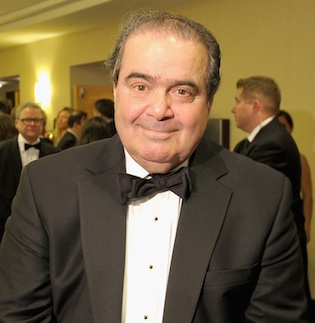
Lots of posts out there about Antonin Scalia as the faithful Roman Catholic. But the man sure sounded like he learned how to read the Constitution from Protestants:

Nonetheless, there is no escaping a verdict on his influence on American jurisprudence, and that verdict is not affected by the fact that he was a good buddy to prominent liberals. He was an advocate of two judicial ideologies, neither of which is intellectually tenable and which conflict with each other. Originalism was Scalia’s core ideological commitment, the idea that the Constitution should be interpreted as it was understood at the time of its ratification. He employed Originalism to question the idea that the Constitution is a “living document,” as liberal jurists held.

To be sure, there was a need for a conservative corrective after the high court starting snooping around the “penumbras” of the Constitution. As Justice Elena Kagan said in mourning Scalia’s death, “His views on interpreting texts have changed the way all of us think and talk about the law.” But, whether the Constitution is alive or not, the people whose government it intends to frame are most certainly alive and their circumstances change. Laws that cannot change with the lived circumstances of a people soon become disconnected from reality, and that disconnect will lead to the law being held in derision or ignored. . . .

Scalia’s other ideological commitment was to Textualism, the idea that the actual words must be interpreted in a kind of fundamentalist manner. This could conflict with Originalism. For example, an originalist would, like an historian, search for explanations as to what was intended by the drafters of a given text, to confirm that original intent and guarantee against latter day misinterpretations. But, Scalia famously loathed citations to legislative history. Textualism rests on the supposition that the Constitution is a self-interpreting text and if that were true, why would we need a Supreme Court? In practice, Textualism resulted in the conclusion that any given text meant exactly what Antonin Scalia thought it meant.

Of course, it’s not clear that Scalia’s hermeneutic was all positive. But it hardly sounds like it’s a product of deferring to the magisterium or to the development of dogma.