Jumping on the Eagles’ Bandwagon

Here is how one Roman Catholic writer saw the faith of Eagles‘ players as a win for the good guys (meaning the faith tradition centered in Vatican City):

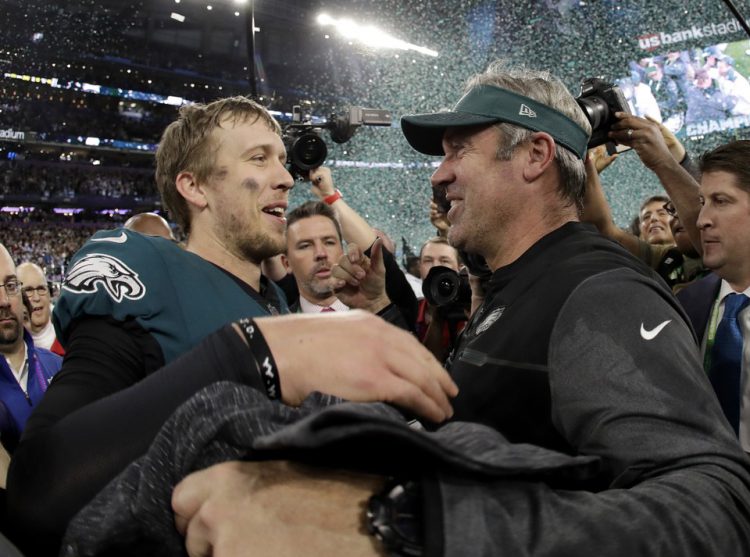
On Sunday night, the Philadelphia Eagles beat the New England Patriots to become Super Bowl winners for the first time in history. But as national news outlets reported the big win, only a few also highlighted the quarterback’s Christian faith and his dream of becoming a pastor.

And he’s not the only player who praises God. A majority of them credit Him as their inspiration, and publicly, on Twitter.

In his Twitter bio, Eagles quarterback Nick Foles lists himself as a “believer in Jesus Christ” and uses his account to share quotes from the Bible. He tweets messages like “with God all things are possible” and “Thank you God for another day.”

And while quarterback Carson Wentz stayed off the field due to injuries, he offered God thanks shortly before the game.

“God’s writing an unbelievable story and he’s getting all the glory!” he exclaimed. After the game he added, “God is so good!!!! World Champions!!!!”

Two days after the game, Wentz turned to God after another life-changing event: He proposed to his girlfriend.

“She said YES!” he announced. “God is doing some amazing things and I can’t thank him enough!”

Acknowledging God is nothing new for Wentz. He uses Twitter to cite the Bible, give God credit, and even post pictures of himself with teammates kneeling on the field — to pray.

“My life is lived for an Audience of One,” he likes to remind his followers.

Likewise, running back Jay Ajayi tweets “GOD IS GREAT.” And wide receiver Nelson Agholor, along with left tackle Halapoulivaati Vaitai and right guard Brandon Brooks, tells fans “God is good.”

Following their win, wide receiver Torrey Smith tweeted, “God is amazing.” Left guard Stefen Wisniewski declared, “Let all the Glory be to Jesus!!” (Instead of stressing before the “big game,” Wisniewski contemplated Bible verses.)

In his Twitter bio, tight end Zach Ertz also identifies as a “believer.” Right tackle Lane Johnson wishes “God Bless America.” Wide receiver Alshon Jeffery regularly tweets out “God Bless.”

On defense, Brandon Graham once posted a picture of the team in prayer. “Win, Lose, or Draw we make sure we give God all the glory because he is the reason we are able to go out each and everyday and play this game,” the left defensive end stressed in the caption.

No mentions of Mary, the church, sacraments, or the bishops. It could be that these players are Roman Catholic, but they don’t talk like it. In fact, lines like “God is great” or “God is good” could actually be Islamic.

Which raises the question of just how firm Roman Catholics’ resolve is in maintaining the differences between Luther and Francis. Of course, Francis has met and hugged Protestants during the 500th anniversary of the Reformation observances. And outlets like Commonweal, America, or National Catholic Reporter are hardly going to bang the gong for Tridentine Roman Catholicism. But lay writers like Katie Yoder working for Catholic Voter? Doesn’t she worry that, at the very least, these Eagles are going to spend a very, very long time in Purgatory without all the assistance of the church’s sacramental system?

But that worry would get in the way of the boosterism that regularly afflicts religious “journalism.”

Postscript: Is that a WWJD bracelet on Nick Foles?
Could Billy Graham Stand in Alan Jacobs’ Great Day?

Jacobs is a smart fellow and should have enough sense to beware of crowds. If the group is running one way, to paraphrase Glenn Loury, “head for the other.” Right now, group-think is decidedly against any evangelical who supported or voted for Trump.

I did not vote for Trump nor am I an evangelical. So I am a neutral in all the Trump- and evangelical-bashing.

Jacobs recently attributed Jerry Falwell, Jr.’s folly in coddling up to the current POTUS to the poor education he received from his father, Jerry Falwell I:

Point the first: Jerry Falwell, Jr., though not a pastor and holding no advanced degrees in Bible or theology, graduated from two institutions founded by his pastor father for the express purpose of offering seriously Christian education: Liberty Christian Academy and then Liberty University. (JF Jr.’s college major was Religious Studies.)

Point the second: As is evident from the statements that French discusses in his post, Jerry Falwell, Jr. shows no evidence of having even the most elementary understanding of what the Bible says and what the Christian Gospel is.

The problem, as discerning readers will already have noted, is how to reconcile these two points. How could someone raised as Jerry Falwell, Jr. was raised, educated as he was educated, living as he now lives, say that Jesus “did not forgive the establishment elites”? Could he really not know that Jesus said of those establishment elites who killed him, “Father, forgive them”? And this is not an isolated incident. Quite often in recent months JF Jr. (like a number of other evangelical leaders) has made statements that clearly contradict some of the best-known passages in the Bible.

Notice what happens if you apply these standards to Billy Graham. Did his “decisionism” actually express the gospel faithfully? You don’t need to read white papers from the Orthodox Presbyterian Church to know that the greatest evangelical of all time may have not used the best of methods or theology to reach the unconverted or lukewarm. Just listen to Tim Challies:

Last weekend Billy Graham preached at what may be his final crusade, preaching before up to 82,000 people at a time. A headline at Pastors.com proclaimed the crusade a great success, indicating that some 12,000 people made decisions for Christ. In a previous article I expressed concerns with Graham’s ecumenism and the fact that Roman Catholic counselors would be present at the event and any people who made decisions and indicated they were from a Catholic background would be directed back to their Catholic churches. Today I’d like to examine the idea of the “decision” that weights so heavily at these crusades.

If you were to do a survey of church history, reading books and documents from the first century all the way to the early nineteenth century, you would find no mention of “decisions for Christ.” Similarly one would find no reference to the altar calls which are the culmination of every modern evangelistic crusade. Those elements, which are found in nearly every evangelical church today, were inventions generally attributed to evangelist Charles Finney who lived from 1792 to 1875. He emphasized the need for a decision, usually made by “coming forward” to approach the altar. Becoming a believer became synonymous with making a decision and proving that decision by taking physical action. It is important to note that this system is entirely foreign to the Scriptures.

Bam!!

By the way, Billy Graham’s theological education was not exactly first-rate, but it didn’t prevent him from preaching his entire life. Nor did it raise questions about the institution where Alan Jacobs used to teach — Wheaton College — which in 1943 granted Graham a degree in — wait for it — anthropology.

In addition to Jacobs’ fastidiousness about Falwell’s theology is the professor’s distaste for the Liberty University president’s politics. Just say Donald Trump and you’ve said all you need to.

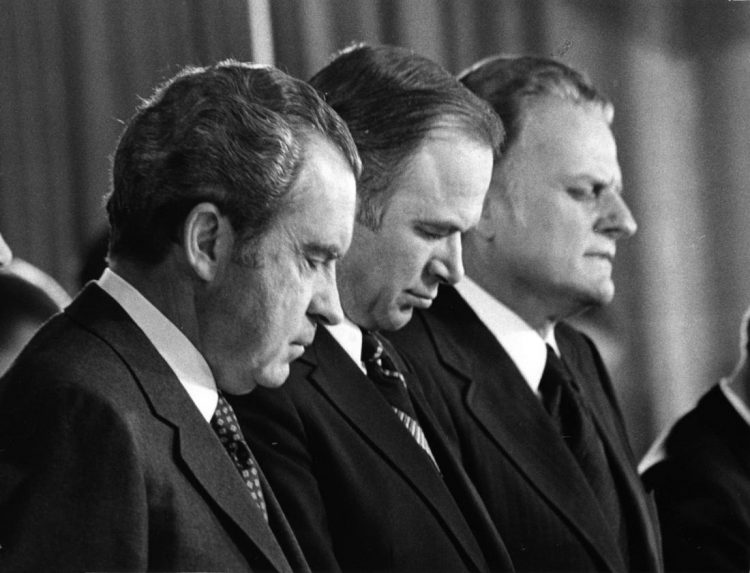
But just how reassuring were Billy Graham’s political ties during his long career? What would Jacobs’ have written about Billy Graham conducting worship services in the Nixon White House? And it went beyond worship:

Rev. Billy Graham, the Montreat-based, world-renowned evangelist, long ago addressed some of his troublesome interactions with President Richard Nixon, but disclosures about their behind-the-scenes connections have kept surfacing.

Now, formerly classified and otherwise hidden parts of the daily diary kept by Nixon’s chief of staff, H.R. Haldeman, have added even more to the record on Nixon and Graham’s tight relationship.

Last week, on the day before Graham celebrated his 96th birthday, the Nixon Presidential Library posted most of the previously unreleased parts of Haldeman’s “candid personal record and reflections on events, issues and people encountered during his service in the Nixon White House,” as the library describes the diary.

The records add a new level of detail on how Nixon and Graham consulted and bolstered each other during contentious times, with dissent over the Vietnam War sweeping the country, the Watergate scandal erupting, and both men sizing up their standing in national debates.

Most of the records came in the form of audio recordings, which can be heard below.

They expand on how Graham advised Nixon to make more effective speeches, clinch his 1972 re-election bid, address the nation’s spiritual woes and conduct matters of war and diplomacy.

“I talked to Billy Graham during the day,” Haldeman, who ultimately became the key conduit between the preacher and the president, noted in one newly released tape from May 8, 1971, the day Nixon made a major address on his decision to expand the war in Southeast Asia.

“And he said to tell the president to get tough, that that’s what people wanted.”

The point here is not to besmirch Billy Graham. If you were an evangelical you had to scratch your head a lot. Instead, the point is to wonder about the bar that critics of evangelicals like Alan Jacobs are now raising for the likes of Jerry Falwell II. Old Life holds no brief for Mr. Falwell’s mix of religion and politics. But some can wonder where the critics were in the days of Billy Graham.

As the Church Lady used to say, “isn’t that convenient.”

When You Ignore the Context

You have lose your outrage over evangelical hypocrisy.

John Fea argues that Damon Linker nails it when the latter writes:

No informed evangelical today seriously hopes for a reversal of same-sex marriage. (Even in the unlikely event that the Supreme Court’s Obergefell decision affirming a right to same-sex marriage were overturned, public opinion would by this point strongly support legalizing the institution through democratic means.) What they do hope for is protection from persecution for their religiously based views of sexual morality. That can be done most effectively by the appointment of judges who are friendly to religious freedom and the reining in of the power of executive branch bureaucracies to apply anti-discrimination law to every corner of American life. The Trump administration has been doing a lot of both. And evangelicals are understandably elated about it.

Those who loathe and fear the religious right should keep all of this in mind when they mock evangelicals for their cynical political maneuvering. The willingness of evangelicals to embrace Trump is a function not of their strength but of their weakness. It may not look that way from the outside, with an increasingly Trumpified Republican Party exercising so much control in Washington and in state houses around the country. Yet evangelicals are right to recognize that people like them have by now long since decisively lost the culture and the political support of the bulk of the American electorate.

The moral majority has shrunk to become a moral minority surrounded by a sea of secularism. For all the talk of the president serving as God’s instrument in the 2016 election, most evangelicals understand very well that he’s an emissary from the wider secular world. But that makes his willingness to serve as their strong man and protector all the more remarkable — and all the more an occasion for gratitude and loyalty.

But Linker’s point is not simply that evangelicals support Trump out of fear and weakness, thus adding to the woe of being hypocrites. His point is that evangelicals the alternative to Trump as even worse:

Like the residents of an urban neighborhood who gladly pay a local mob boss a share of their earnings in return for safety and security, evangelicals have made a transactional calculation. In return for obsequious, gushing, unconditional support, Trump will serve as their protector, surpassing all prior Republican presidents in his willingness to advance a religious right agenda for which he personally feels nothing but indifference.

The character of this arrangement shows just how much the situation for evangelicals has changed since the administration of their previous presidential champion, George W. Bush.

Bush spoke frequently and convincingly about his faith, and he backed it up by advocating for the passage of a constitutional amendment to ban same-sex marriage and working to get anti-same-sex-marriage referendums on the ballots of numerous states in the run-up to the 2004 presidential election. Trump, by contrast, expressed explicit support for LGBTQ rights in his acceptance speech at the 2016 Republican convention.

Meanwhile, in the intervening eight years, a Democratic president and just about every member of his party shifted from opposing gay marriage to supporting it while denouncing the remaining holdouts as bigots. Then, in the blink of an eye, progressives immediately began waging the next battle in the anti-discrimination wars: a defense of the rights of the transgendered, including an insistence that all public discussion and debate of the issue begin by affirming the absolute malleability of gender, a position radically incompatible with historic Christianity’s teachings on sexual morality.

This is the context in which the evangelical embrace of Trump needs to be understood.

John left that out of his post. He also leaves this context out of his apparent loathing for the so-called “court” evangelicals. His categories for evaluating Trump and evangelicals are chiefly moral. He leaves out the context of politics.

Normal for a fundamentalist or evangelical, odd for a historian.

Imagine if the PCA were Big Enough

Then you wouldn’t need the Gospel Coalition.

So why don’t the leaders of neo-neo-evangelicalism acknowledge that a parachurch organization with a public profile generated largely by the world-wide interweb used by celebrity pastors who sometimes go to conferences and meet with ordinary neo-neo-evangelicals is a capitulation to contemporary culture? Where is all the discernment that comes from reading sociology, history, and cultural and art criticism?

What if limiting your ministry to the confines of a communion is counter-cultural? Is being counter-cultural simply a pose or does it also require subtraction — rejecting (at least some aspects of) culture?

Then, these reflections might lose some of their pietistic earnestness (sorry for the redundancy):

“If they are not controlled by Scripture and confessionalism, then of course [evangelicals] are going to fit into the grid of the broader and more secular culture,” Carson said. “By and large, these cultural evangelicals work out their cultural bondage in more conservative ways than their agnostic counterparts, but it is difficult to believe that racism is less evil than sexual promiscuity.”

Exactly. And if pastors let confessions and church polity control their ministry, they might put their own communion, the one in which they vowed to minister God’s word and the holy sacraments, ahead of all other extra-denominational activities. In other words, can you really act like you are being counter cultural when the rest of the culture is turning from denominational Christianity to none (denominational) Christianity?

“I see TGC as occupying the same space that evangelicalism’s founding fathers—like Carl Henry, Harold Ockenga, John Stott, J. I. Packer, and Billy Graham—occupied,” Keller said. They wanted to be evangelicals, not fundamentalists; to engage with non believers and with society, and not just to withdraw, Keller said.

“We don’t want to be pietists, but we don’t want to be captive to the spirit of the age either,” Keller said. “But that is actually a hard place to be. It’s a lot easier to retreat to your fortress or to just go along with the crowd. But TGC, from the very beginning, wanted to avoid going in either direction. We wanted to be prophetic from the center, as Don [Carson] says.”

What would really be counter-cultural would be commitment to word-and-sacrament ministry when the spirit of the age, thanks to Henry, Ockenga et al, is to overlook considerations like baptism, the Lord’s supper, ordination, and the sufficiency of Scripture (which would limit pastors from dabbling in sociology and cultural criticism).

In point of fact, creating a brand though social media, the way the gospel allies do, is about as beholden to the zeitgeist as someone could imagine. When I think of being counter-cultural, I don’t think of the Gospel Coalition. I think of the Amish.

Post-script: notice that evangelicalism didn’t start with Luther, the Puritans, Edwards, or Finney. It began in the 1940s. What I’m saying.

Talk about Digging Up Your Lede and Making a Mountain out of It

Can you believe it?. Jen Hatmaker is so courageous that she’s even had death threats for — wait for it — opposing Trump:

Last fall, Jen Hatmaker, a popular evangelical author and speaker, started getting death threats. Readers mailed back her books to her home address, but not before some burned the pages or tore them into shreds. LifeWay Christian Stores, the behemoth retailer of the Southern Baptist Convention, pulled her titles off the shelves. Hatmaker was devastated. Up until that point, she had been a wildly influential and welcome presence in the evangelical world, a Christian author whose writings made the New York Times best-seller list and whose home renovation got its own HGTV series. But then 2016 happened, and, well, of course everything changed.

During the campaign, as other white evangelicals coalesced around the Republican nominee, Hatmaker effectively joined the coterie of “Never Trump” evangelicals, telling her more than half a million Facebook followers that Donald Trump made her “sad and horrified and despondent.” After the “Access Hollywood” tape leaked and prominent evangelical men came to Trump’s defense, she tweeted: “We will not forget. Nor will we forget the Christian leaders that betrayed their sisters in Christ for power.” Then, in an interview with Religion News Service columnist Jonathan Merritt, she made what was a stunning admission for her evangelical community: She said she supported same-sex relationships.

That’s when the full weight of conservative Christian outrage crashed down on Hatmaker. There were soon angry commenters and finger-wagging bloggers. She says people in her little town of Buda, Texas, just south of Austin, pulled her children aside and said terrible things about her and her husband. She was afraid to be in public, and she wasn’t sleeping or eating well. “The way people spoke about us, it was as if I had never loved Jesus a day in my life,” Hatmaker recently told an audience in Dallas. The gilded auditorium was quiet, its 2,300 seats filled to capacity with nearly all women. “And I was just an ally,” she said. “Think about how our gay brothers and sisters feel.”

Can you believe bloggers went after her? Talk about the valley of the shadow of death.

How does Jen go on in such an unjust world where fills a plus-2,000 seat auditorium? She manages:

She forged ahead anyway. In July, she debuted her weekly interview-style podcast, and it quickly shot to the top 10 in the religion and spirituality category on iTunes. By the end of the summer, Of Mess and Moxie hit the New York Times best-seller list. She created a fall event series, the Moxie Matters Tour, with her friend and Belong Tour alum, singer-songwriter Nichole Nordeman. They scaled it back from the original tour’s arenas, booking more intimate spaces like churches and theaters. After several of the stops on their 11-city tour sold out, the duo added eight more dates to the calendar after the new year.

The size of Hatmaker’s audience—her “tribe” as she calls it—has held steady despite the backlash she has faced, she told me. But she says there has still been some turnover, with fans lost and fans gained because of her comments. Recently, when Trump made a Pocahontas joke in front of Navajo veterans, Hatmaker tweeted that he was “incapable of maturity, decency, self-awareness, or shame. He humiliates us every single day. We can never stop calling out this behavior.” As sexual misconduct charges against powerful men continued to break, she wrote a note of solidarity with victims on Facebook, adding, “Voting for molesters because we prefer them to stay in power is evil,” which prompted thousands of shares and a lively debate in the comments section about whether someone who opposes abortion can support Roy Moore’s pro-choice Democratic opponent, Doug Jones. When a commenter posted, “She’s talking to YOU, Alabama,” Hatmaker replied, “And Franken and Spacey and dirty clergy and all of them. Let no one escape.”

Hatmaker also recently tweeted that the evangelical subculture “tends to elevate a very homogeneous voice: white, mostly male, women who don’t upset the power differential we’ve come to count on (white, conservative, straight, Republican).” Going against the grain, she wrote, threatens “commercial success.” But Hatmaker notes that a mentor recently advised her to just lead whatever followers she had. “I really took that advice,” she told me. “And I have felt real free since.”

Notice, that means Jen is to evangelicalism what Trump is to the political establishment. But don’t dare tell Jen or the journalist who covered her, Tiffany Stanley, that celebrity has both a tremendous upside and can easily turn toxic if fans abandon the star (think Garrison Keillor). Jen Hatmaker is a prophet, a truth-teller, whom the press can use to show the bigotry of evangelicals. Remember — death threats (but no mention of contacting the police of FBI).

And also, do remember how courageous Jen is according to the feature story writer:

While she’s against abortion, she takes pains to say she has an expansive view of what “pro-life” means. And she doesn’t think holding that view necessarily ties her to the GOP, even at a time when white evangelicals are as closely affiliated as ever with the Republican Party.

That’s almost as radical as saying Jen “supports same-sex relationships.” What does support mean? And what is a same-sex relationship? Code for gay marriage? Or a way to get credit as tolerant and progressive without ever having to stand in protest with gay Americans?

I tried to find at Jen’s website whether she attended or supported the Women’s March last January. I didn’t see much, but apparently the Trump Administration has been so traumatic that she had to do a podcast series on food. The first show was yummy:

Welcome to our all new series on (wait for it) FOOD! We kick off this series on one of our most FAVORITE topics with the amazing cookbook author and host of Food Network’s Aarti Party, Aarti Sequeira! Aarti got her start as a journalist and working CNN, dreaming of becoming the next Oprah. Always a lover of food, she began blogging about cooking and she and her husband started a YouTube cooking-variety show in their tiny L.A. home kitchen. Eventually Aarti competed on and won Season 6 of Food Network Star with her trademark food signature: American favorites with an Indian soul. She has gone on to to star in her highly successful show, along with appearances on The Talk, Dr. Oz and the Today Show (where she freaked out Al Roker by telling him she licked his plate!). By the end of this episode, you’ll want to steal Aarti’s leftovers (like Jen confesses she actually once did). BONUS INTERVIEW: Jen chats with one of our own from The Tribe, the designer of our amazing pink podcast logo; Jenny Mecher of ThreeLetterBirds.com.

Way to stick it to the man.

Did Tiffany Stanley even bother to look at Hatmaker’s website? Crediting this evangelical celebrity with being part of the resistance is like thinking Division 1 athletes are bookish.

Morality Divides, Coalitions Unite

That is, as some may tell, an riff on the old line used during the fundamentalist controversy to counter conservatives — “theology divides, ministry unites.”

Our friend, Chortles Weakly explains how officers in NAPARC communions who also hold official positions in The Gospel Coalition — can anyone identify the Allies? — are looking the other way when it comes to the Second Commandment, the bedrock of the Regulative Principle:

As the cultural exegetes must surely agree, an organization’s use of images, technology, and messaging strategies is fair game for critics. What follows is my attempt to critique some of the ways TGC uses images and innovates. The standard will not be something I learned in business school, the standard will be the confessions of the Reformed churches.

My concern here is not really with Reformed churches as such (which cannot actually align with TGC) or with members (who are free to consume as they will). It is with the officers (elders and pastors) of confessionally Reformed churches who participate in TGC leadership, given the fact that TGC’s content so strongly influences the one culture that really matters, the one culture that truly ought to be ordered according to the Bible – the household of faith, the church of God.

My concern is that the officers of confessionally Reformed churches (basically those from denominations affiliated with the North American Presbyterian & Reformed Council – NAPARC) who sit on the TGC council are giving their stamp of approval to some things that are specifically forbidden by the Bible, the Reformed confessions, and the historic practice of the Reformed churches.

The TGC web page over the recent Thanksgiving weekend provided a notable example of TGC-endorsed aberrant practices. The front page of the site used an image of a nativity scene (with the second person of the Trinity supposedly represented) in support of an article on “8 New Resources for Advent”. This is not an isolated instance. Pictures of Jesus and commendations of movies and materials depicting him are nothing new at the TGC web site.

What specifically is wrong with images of Jesus? Well, simple logic tells us that any image of Christ is necessarily a lie – the Bible is not a picture book. No image of Christ can be accurate. Can inaccurate images be a help to those who view them? Some will argue that serve an essential pedagogical use when it comes to children. Some, as were heard at the last General Assembly of the Presbyterian Church in America, will argue that we cannot appreciate the humanity of Jesus without images.

The Westminster Larger Catechism, to which the presbyterian ministers on the TGC council have taken vows of subscription, would seem to speak both to images of Christ and things like Advent in question 109:
Picture

Q. 109. What sins are forbidden in the second commandment?

A. The sins forbidden in the second commandment are, all devising, counseling, commanding, using, and any wise approving, any religious worship not instituted by God himself; the making any representation of God, of all or of any of the three persons, either inwardly in our mind, or outwardly in any kind of image or likeness of any creature whatsoever; all worshiping of it, or God in it or by it; the making of any representation of feigned deities, and all worship of them, or service belonging to them; all superstitious devices, corrupting the worship of God, adding to it, or taking from it, whether invented and taken up of ourselves, or received by tradition from others, though under the title of antiquity, custom, devotion, good intent, or any other pretense whatsoever; simony; sacrilege; all neglect, contempt, hindering, and opposing the worship and ordinances which God hath appointed. (http://opc.org/lc.html)

Now, I am aware that there are officers who take exceptions (where allowed) to portions of this section, especially concerning mental images. I am aware that some presbyterian bodies have in the last few decades allowed loose or “system” subscription to confessional documents. Still the question must be raised: Should a NAPARC church officer sit on a quasi-ecclesial body’s board when that that body condones and promotes violations of the second commandment as defined by the confessional standards of the officers’ own denominations?

At a time when America is leading the crusade for obedience to God’s law, do Gospel Allies really want to be caught on the sidelines?

Not So Messy

The folks at Witness have abandoned a theological system (Reformed) to rally around a racial (black) identity. Jemar Tisby explained:

Christianity is not some otherworldly religion that is only concerned with our spiritual lives. True faith acknowledges that our souls inhabit bodies and we experience the world in a physical and material way. So Christianity is also concerned with our reality as a people who have been marginalized due to the racial caste system in America.

We are a “black Christian collective” because we are made in the image of God and part of that image includes our melanated skin along with the culture and experiences that go along with it….

As a “black Christian collective,” The Witness has returned to its original mission to serve black people. The move from “African American” to “black” acknowledges this endeavor is international scope. The Witness is for the entire African diaspora. We are also a collective in the sense that a variety of black Christians from different denominations, ages, regions, and experiences all contribute their perspectives. The Witness is not the voice of black Christians; it is the microphone that amplifies those who have often gone unheard.

I was curious, in light of these changes, what The Witness’ perspective or counsel on the shootings in Texas might be. After all, the congregation is white and the shooter was white. So how would black Christians speak to or about Sutherland Springs?

It turns out, they sound like any other U.S. evangelical (white or person of color):

Tragedies like this provoke many discussions and debates around issues such as domestic violence, gun control, and church security protocols. We absolutely need to address these issues and seek concrete solutions, but that is not the focus of this post. Honestly, I don’t feel like I have the proper words at this point. I am tired saints. I have been to war and back and I am tired of violence.

Will you join me in praying that those in Sutherland Springs would be comforted by the God of all comfort? Is it alright if we include Charleston, Las Vegas, Orlando, San Bernardino, Blacksburg, Aurora, and all of those who have been struck by this plague of gun violence?

Let us pray.

Father God, we cry out to you. We thank you that we can approach your throne of grace boldly through the person and work of Jesus Christ. We thank you that you have caused us to be born again by the power of your Spirit who now indwells us and testifies with our spirits that we are the sons and daughters of God.

Father, you are able to do exceeding abundantly above all that we ask or think. We come to you now and we ask that your kingdom would come and that your will would be done on earth as it is in heaven. Lord God, bring healing to the families and communities impacted by these tragedies. We ask that you invade every place of darkness with your glorious light. Let grace abound.

I do wonder about the use of the word “darkness,” but otherwise, kudos to The Witness for showing solidarity with white Baptists.

The Problem with Cessationism

Cessationists apparently have the reputation of not believing in miracles after the apostolic age:

No issue has been more controversial among Protestants in the past 40 years than the charismatic gifts and the role of miracles in the post-apostolic age. The issue was controversial in previous eras of Protestant history, too, although theological lines were not usually drawn as hard and fast as they are between “cessationists” and “continuationists” today.

In the 1700s and 1800s, suspicion of claimed miracles was connected to anti-Catholicism. Protestant critics saw the Catholic tradition as riddled with fake claims of miracles. Ridiculing the fake miracle claims of Catholics (such as icons bleeding a liquid that turned out to be cherry juice) became a staple of Reformed polemics against the Catholic Church. So when seemingly miraculous events happened in Protestant churches, even sympathetic observers warned against the threat of bogus miracles.

Odd, but the cessationists I know all affirm the ongoing reality of miracles. How could you ever believe in people lost in sin becoming regenerate without resorting to the miraculous work of the Holy Spirit?

The real problem comes with the “gift” of speaking in tongues. Why do we need ongoing revelations from God if scripture is sufficient?

1. Although the light of nature, and the works of creation and providence do so far manifest the goodness, wisdom, and power of God, as to leave men unexcusable; yet are they not sufficient to give that knowledge of God, and of his will, which is necessary unto salvation. Therefore it pleased the Lord, at sundry times, and in divers manners, to reveal himself, and to declare that his will unto his church; and afterwards, for the better preserving and propagating of the truth, and for the more sure establishment and comfort of the church against the corruption of the flesh, and the malice of Satan and of the world, to commit the same wholly unto writing: which maketh the Holy Scripture to be most necessary; those former ways of God’s revealing his will unto his people being now ceased. (CofF 1.1 emphasis added)

6. The whole counsel of God concerning all things necessary for his own glory, man’s salvation, faith and life, is either expressly set down in Scripture, or by good and necessary consequence may be deduced from Scripture: unto which nothing at any time is to be added, whether by new revelations of the Spirit, or traditions of men. (CofF 1.6 emphasis added)

Continuationists who want to defend tongues are in the same predicament as Roman Catholics who defend the continuing infallible teaching of the magisterium and the authority of tradition. Does God’s word have all we need for salvation and godliness? Or do we need ongoing revelations for becoming right with God? If you make an infallible pope or a Spirit-filled Christian the arbiter of Christianity, you deny the sufficiency of Scripture.

Selah.

Evangelicals Need to Take a Page from Roman Catholics (year 501)

Inspired by some minor reflections on personal identity and politics, I present recent findings on Roman Catholics and the 2016 Presidential election.

According to our May 2017 survey, just over three-quarters of American Catholics said that they voted in the November 2016 presidential election. Of those who voted, 43 percent said they voted for Trump while 48 percent said they voted for Clinton. The other nine percent voted for minority candidates. This is fewer Trump voters and more Clinton voters than the percentages among self-identified Catholics as reported in the exit polls, which reported 52 percent voting for Trump, 45 percent voting for Clinton, and 3 percent going to other candidates. But this survey took place six months after the election and some may have been recalling the candidate they wish they had voted for rather than their actual vote.

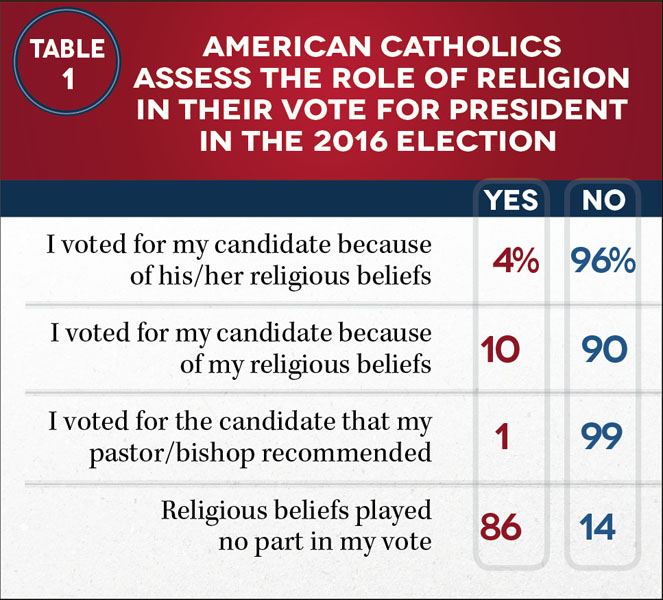
We began our 2017 survey with a series of questions about the possible role religious beliefs might have played among American Catholics In the 2016 election.

The responses of American Catholics to the questions cited in Table 1 make clear their assertion that their religious beliefs were not relevant to their vote for president in the 2016 election. The great majority (86 percent) said that religious beliefs (their own or that of the candidates) played no role in their vote. Just one in ten said that they voted for their candidate because of their own personal religious beliefs and even fewer — just 4 percent — said that they voted for their candidate because of the candidate’s religious beliefs.

Beliefs and values that are essential

That raised the question whether and to what extent did Catholics who voted for Trump differ in their religious beliefs and practices from Catholics who voted for Clinton. We have a standard block of questions about the beliefs and values that many consider essential to being a “good Catholic” that we have asked, in some form, on every survey since 1987. Table 2 compares the proportion of Trump and Clinton voters who say that each item is “essential to your vision of what it means to be Catholic.”

Catholics who supported Trump and Catholics who supported Clinton generally share very similar beliefs about how essential each of these items is to their vision of what it means to be Catholic. Differences of less than 10 percentage points between the two are not statistically significant. Both types of Catholic voters rank all ten items in virtually the same order.

Belief in the resurrection of Jesus, devotion to Mary as the Mother of God, and the papacy are essential to more than half of Trump voters and Clinton voters. Only about half saw charitable efforts to help the poor as essential and the percentage who saw the celibate male clergy as essential continues to have only a small percentage of support among either Trump or Clinton voters.

In other words, religion had little to do with the vote. That seems precisely what evangelicals should be doing. If you can segregate politics from faith, you don’t have the problem of evangelicals leaving the fold because of the movement’s political significance. Faith is one part of your life. Politics another.

Roman Catholics are doing it. Why can’t evangelicals?

Gospel Coalition Haiku

Why does a complementarian organization promote a congregation that belongs to a communion that ordains women?

Here‘s an explanation of complementarianism’s importance from TGC poobahs:

Probably all of us who share The Gospel Coalition’s vision to renew our faith in the gospel of Christ and to reform our ministry practices to conform fully to the Scriptures have been asked, “So why is TGC complementarian? Are you saying only those who uphold male leadership in the home and church believe the gospel?”

If you’ve ever wondered and asked the question yourself, we hope you’ll watch this video featuring TGC founders Don Carson, Tim Keller, and John Piper. Keller opens with a hermeneutical argument about what sometimes happens when we apply arguments in favor of egalitarianism to biblical passages that relate directly to the gospel. He also explains why TGC’s confessional statement and theological vision for ministry go beyond basic gospel doctrines to include such issues as gender roles. As Piper explains, TGC wants to say things that protect the gospel, display the gospel, and release the gospel for human flourishing. And our current age demands that believers model and argue the biblical case for Christ-like headship.

“We live in a culture where for the last 30 or 40 years, the collapse of the meaning of biblical masculinity has not produced a beautiful egalitarian society,” Piper observes. “It has produced a brutal masculine society.”

Here‘s a profile of puff piece on Hope Church, the largest Presbyterian Church in the nation (even larger than Redeemer NYC) that avoids questions about gender by featuring the topics of race and ethnicity:

The principles were solid: Churches should reflect their neighborhoods, and relationships are a good way to show God’s love to the unchurched. But the results were decidedly monoethnic congregations.

Within 20 years, Hope was the largest church in Memphis, regularly drawing 7,000 worshipers each weekend. But in a city that was nearly 60 percent black, less than 1 percent of them were African American.

At first, Hope reflected its neighborhood. The city to Hope’s south—Germantown—was 93 percent white in 2000, and 90 percent white in 2010. But its county—Shelby—fell from 47 percent white in 2000 to 41 percent white in 2010. And Cordova, the small suburb where Hope sits, dropped from nearly all white in 1988 to 68 percent white in 2010.

So Strickland and Morris set out to do what had never successfully been done before—to convert a white megachurch into a multiracial congregation.

They’re doing it.

Today, one out of five people who attends Hope is black. Of the 106 staff, 18 are nonwhite—including the senior pastor. The congregation sings hymns, contemporary Christian, and black gospel. Members work in predominately black, underresourced neighborhoods in north Memphis together through Hope’s community development corporation. They attend biannual three-day urban plunges and regularly spend eight weeks eating dinner with someone of another ethnicity.

Here’s the Evangelical Presbyterian Church’s statement on women’s ordination (Position Paper, 1984):

Thus, while some churches may ordain women and some may decline to do so, neither position is essential to the existence of the church. Since people of good faith who equally love the Lord and hold to the infallibility of Scripture differ on this issue, and since uniformity of view and practice is not essential to the existence of the visible church, the Evangelical Presbyterian Church has chosen to leave this decision to the Spirit-guided consciences of particular congregations concerning the ordination of women as elders and deacons, and to the presbyteries concerning the ordination of women as ministers.

It is in this context that the Evangelical Presbyterian Church states in its Book of Govern-ment, Chapter 6, titled “Rights Reserved to a Local Church” that “The local church has the right to elect its own officers” (6-2). This right is guaranteed in perpetuity.

Does this mean that race trumps gender?