When the PCA Might actually Want to Follow Southern Baptists

I do not pretend to know the Byzantine world of Southern Baptist life but I do follow one SBC website, SBC Today, to keep tabs on the opposition to Calvinism in the Convention. Some of the staunchest voices against the so-called Calvinist takeover appear at SBC Today.

Another arresting wrinkle to these anti-Calvinists is first their defenses of Paige Patterson and their current opposition to Social Justice Warriorism. Here is an excerpt from a resolution the editors posted today:

Whereas social justice is showing it’s true colors at George Washington University and other campuses in 2018 where they are holding classes and seminars seeking to combat “Christian Privilege,” and attacking Christianity for it’s prominence in society using the social justice ethic, wherein the seminar at GWU students are taught “American Christians receive things they don’t deserve and are not worthy of getting,” and

Whereas Southern Baptists ought to furthermore be warned by the example of the Methodist and Episcopal denominations that have already embraced the social justice movement, and instead of growing in number, these same denominations continue to lose membership at an alarmingly fast rate, and

Whereas we have a present crisis point in the Southern Baptist Convention, in that the same social justice has been recently defended and promoted by Russell Moore of the ERLC within the Southern Baptist Convention, with Dr. Moore writing multiple articles and hosting events promoting social justice, and

Whereas the social justice agenda in the Southern Baptist Convention has become pervasive in some seminaries and state conventions, even to the point that it is apparently an unwritten rule not to speak against the social justice movement, or one’s job or position will be in jeopardy, and

Whereas we are repeatedly warned in Scripture concerning such error and being deceived, with Ephesians 5:6, Hebrews 13:9, Colossians 2:8, and 1 Timothy 4:1 being just a few of these warnings, and

. . .Whereas true Christian theology builds people up to be resilient in the face of trials, but social justice seeks to stoke discontentment (1 Corinthians 10:10; Hebrews 13:5), and

Whereas our own denomination must reject this harmful social justice philosophy in it’s entirety, and

Whereas biblical doctrine and the Christian ethic must be chosen over social justice, then be it

RESOLVED, That the messengers to the Southern Baptist Convention, meeting in Dallas, Texas, June 13–14, 2018, decry and reject the terms and framework of social justice as insufficient to adequately reflect the Gospel of Jesus Christ and the Christian worldview; and be it further

RESOLVED That the entities of the Southern Baptist Convention be encouraged to avoid the terms “social justice” and social justice warrior” when referring to Christian ethics or activism, and that the Holy Scriptures be used as a guide without mimicking the verbiage of the Anti-Christian social justice movement, and be it

RESOLVED That all SBC Colleges and Universities be encouraged to review their teaching programs with special attention given to Humanities Departments to ensure that Marxist based social justice is not being taught in our colleges, universities, and seminaries, and be it

RESOLVED, That we encourage churches in preaching, teaching, and in discipleship to address the issues of racial reconciliation, poverty, the environment, sexual and gender issues, immigration, and education from a Christian worldview and reject the ideological underpinnings and verbiage of the social justice movement.

So here’s another wrinkle. Why are Calvinists in the PCA and SBC more prone to heed the calls for social justice while the opponents of Calvinism in the SBC find it easier to spot the errors implicit in certain efforts to use the gospel to underwrite politics? Just today, another Protestant declaration went live and invoked the legacy of Martin Luther King, Jr. to support a set of policy ideals that target the Trump administration’s errors. Will the recent defenders of King in the PCA and SBC worlds sign this new resolution? I doubt it if only because the worlds of Red Letter Christians and The Gospel Coalition are so far apart, and such support could be toxic in PCA and TGC networks.

But of late, they have been tracking in remarkably similar trajectories. And when that happens, when those who affirm total depravity, limited atonement, and perseverance of the saints wind up in gospelly poses with Protestants for whom Calvinism is bizarre, Reformed Protestants want to know what’s in the New Calvinist water.

The Spirituality of the Church Means No Need for a White Paper on Israel

If you wonder why Roman Catholics in the public eye are a little sensitive about the review of the Edgardo Mortara memoir, it may have something do with the Vatican’s not-so-great history with European Jews or the state of Israel. Massimo Faggioli reminded readers of Commonweal of that vexed past:

Rome looks at the anniversary of the State of Israel with a complex perspective very different from that of Evangelical Protestants in the United States. In less than fifty years, the Vatican has moved from opposing the Zionist movement, to a de facto recognition of the State of Israel, to a de iure recognition. In 1947, the Vatican supported UN Resolution 181, which called for the “internationalization” of Jerusalem. In the encyclicals In multiplicibus curis (1948) and Redemptoris nostra (1949), Pius XII expressed his wish that the holy places have “an international character” and appealed for justice for the Palestinian refugees. In its May 15, 1948 issue, the official newspaper of the Holy See, L’Osservatore Romano, wrote that “modern Zionism is not the true heir to the Israel of the Bible, but a secular state…. Therefore the Holy Land and its sacred places belong to Christianity, which is the true Israel.” The description of Christianity as the “true Israel” (verus Israel) is a reminder that it wasn’t until decades after the Shoah that the church fully recognized the connections between supersessionism, theological anti-Judaism, and anti-Semitism.

Vatican II helped reconcile Catholicism and Judaism. But the relationship between the Vatican and the State of Israel remained complicated. During his trip to the Holy Land in Jordan and Israel in January 1964, Paul VI was very careful never to utter the word “Israel,” thus avoiding even the suggestion of recognition. The questions of who should control the Holy Land and whether to recognize the State of Israel were not addressed by Vatican II’s Nostra aetate, whose drafting was closely scrutinized not only by bishops, theologians, and the Vatican Secretariat of State, but also by diplomats, spies, and Arab and Jewish observers. Vatican II ended before the Six Day War of 1967 and the subsequent occupation of Palestinian territories, which permanently changed the geo-political situation in the Middle East. From then on, Israel was in firm possession of the whole of the Holy Land west of the Jordan River, including all the Christian holy places. This led the Vatican to modify its position in a pragmatic way. In an address to cardinals in December 1967, Paul VI called for a “special statute, internationally guaranteed” for Jerusalem and the Holy Places (rather than internationalization). We cannot know what Vatican II would have said if the occupation of the Palestinian territories and the capture of Jordanian-controlled East Jerusalem (and the Old City) had taken place before or during the council. But we do know that Arab states and Arab Catholic bishops and patriarchs at Vatican II were strongly opposed to anything that sounded like a recognition of the State of Israel.

Yowza!

But that is the sort of corner into which you can paint yourself when you are a church with temporal power (that is, the Papal States) and with assumptions that you should be at the “running things” table.

A spiritual as opposed to a political church doesn’t have such worries. Add some amillennialism and you can even free yourself from the evangelical Protestant habit of trying to determine the date of the Lord’s return by monitoring developments in the Middle East. Like the Confession of Faith says (chapter seven):

5. This covenant was differently administered in the time of the law, and in the time of the gospel: under the law, it was administered by promises, prophecies, sacrifices, circumcision, the paschal lamb, and other types and ordinances delivered to the people of the Jews, all foresignifying Christ to come; which were, for that time, sufficient and efficacious, through the operation of the Spirit, to instruct and build up the elect in faith in the promised Messiah, by whom they had full remission of sins, and eternal salvation; and is called the old testament.

6. Under the gospel, when Christ, the substance, was exhibited, the ordinances in which this covenant is dispensed are the preaching of the Word, and the administration of the sacraments of baptism and the Lord’s Supper: which, though fewer in number, and administered with more simplicity, and less outward glory, yet, in them, it is held forth in more fullness, evidence and spiritual efficacy, to all nations, both Jews and Gentiles; and is called the new testament. There are not therefore two covenants of grace, differing in substance, but one and the same, under various dispensations.

Now that the coming of the kingdom of grace is no longer bound up with a Jewish state, people are free to support Israel as an outpost of democracy without a whiff of immanentizing the eschaton.

If Gospel Coalitions Can’t Unite, What about Social Gospels?

Paul Carter is worried about factionalism dividing the unity of young Calvinists (largely identified with the Gospel Coalition). He’s also worried that the young Calvinists are in over the heads on politics:

The YRR movement has been fueled by some very admirable concerns: the desire to trust in Scripture, the desire to worship God as he is and not as culture dictates, the desire to reach the nations with the saving Gospel of Jesus Christ – these are noble and appropriate motivations. But mixed in with these there were no doubt some motivations of lesser quality.

There was a desire, for example, to be different than the generation that went before.

The Baby Boomers were indifferent to doctrine – by and large – and in bed with the Republican Party – metaphorically speaking. The YRR crowd wanted to make it clear that they were different. For the first 10 years or so of the movement this meant largely avoiding the political implications of the Gospel.

At T4G 18 that all began to change.

Politics was back on the table.

To a certain extent this was inevitable – the Gospel has social and political consequences. But the YRR movement does not appear prepared to facilitate that conversation. The movement appears poised to fracture under the pressure posed by long neglected issues and implications.

If Jesus taught his disciples to turn the other cheek, what need has a Christian to own a handgun?

If the Gospel has broken down the wall of hostility and made of us one new people – then why are we still talking about black and white?

If the mission of the church is to take the Gospel to the nations, then why are so many Christians opposed to immigration?

I’m not telling you what the answers are I’m just telling you what the questions are. Questions are being asked that for over a decade were not being asked and the weight of those questions threatens to derail the movement.

Here’s why the young Calvinists can’t avoid talking about race, immigration, and guns. Not only does The Gospel Coalition feed a steady diet of gospelly reflections about the latest headlines at Fox or MSNBC, but these people actually believe that the Bible speaks to government policies on race, immigration, and guns. They have a comprehensive w-w that requires the Bible to speak – period – totally – period – to all of life – period (thanks Aaron Sorkin). The spirituality of the church is not an option.

As much as critics might want to accuse defenders of the spirituality of the church of racism, they should actually consider that a reduced scope for Scripture and the church is much like classical liberalism. Government is supposed to be limited in its operations; in the case of the United States the Constitution was supposed to inform that limitation. But for Fascists, Communists, and some aspects of Progressivism, a limited government won’t get done all you want government to do. Plus, a government that provides mere basic services won’t generate the aspirations that people need to make a nation great or exceptional.

The same goes for the transformationalizationalists. A reduced footprint for Christianity is not good enough. The church needs to do more than proclaim the gospel, conduct faithful worship, provide discipline, and care for widows and orphans (with 1 Tim. 5 scrutiny). How could Christianity ever make people go “wow” if the church restricted what it did to word, sacrament, and discipline (and let all the other agencies of a civil society pitch in on the aspirational stuff)?

In the heart of most people beats the pulse of a Yankee fan, which helps to explain Kuyperianism, Youthful Calvinism, and Roman Catholicism. Comprehensivalists all.

Did He Read Religious Affections Too Many Times?

Tim Challies explains the come-to-Calvinism moment for the young and restless when John Piper spoke:

So why and how has Piper caught the attention of this generation? I think we can sum it up in one word: authenticity. The college students attending those early Passion conferences, they’re a mix. They’re the last of Gen-X and the very first of the Millenials. A generation that, above all, values authenticity. This rising generation wants genuine, authentic faith and they’ve grown weary of preachers who water down their messages in a desperate attempt to be relevant. In Piper, that rising generation has found their authentic preacher. They’ve found someone who really, really believes what he’s saying and who is not going to pander to them in any way at all. And they honor that. They can’t listen to Piper and be unaffected by his passion. From his unglamorous clothes to his sweeping hand gestures to his dramatic facial expressions, to his booming voice. Students know that Piper truly sees the glory of God and just can’t help but declare it. Even if they don’t know what they believe, they sure know what he believes. And it is contagious. His authenticity is the bridge to his theology. Students are first drawn by his authentic passion, then they’re captivated by his view of God. So when Piper takes the stage toward the end of that rainy day at the conference, hundreds of young people have made sure to shuffle back from the porta potties to their seats. They’re now leaning forward expectantly. They’re ready to hear his passion again. But even they could not have expected what happened next.

Has he not ever seen actors play roles authentically? Since when is passion a mark of being genuine? And why would anyone think they know — I mean epistemologically know — what John Piper believes because of his clothes or body movements? As Jesus said in the Sermon on the Mount, men look on the outside of a person but God sees the heart. That implies that only God knows for sure whether John Piper is authentic; for those in his church who hold him accountable and his family, they may have a better read on the sincerity of the pastor. But in a big crowd you think you know the state of the speaker? I bet even Jonathan Edwards would caution against that kind of gullibility.

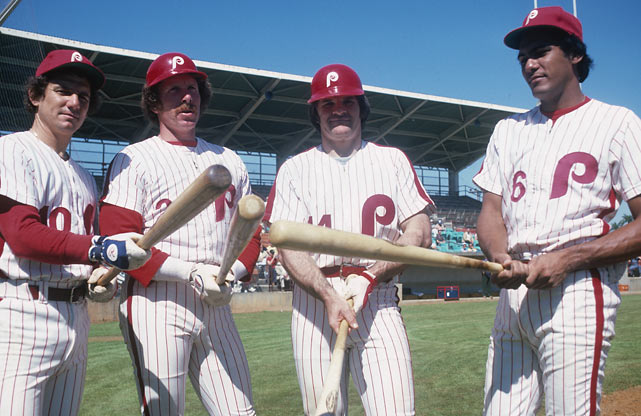
Challies may not know it but he is doing exactly what Philadelphia fans did with Mike Schmidt. The all-star third baseman was not emotional. He was stoical. And the fans thought he didn’t care, that Schmidt was simply going through the motions. When Pete Rose arrived and played in his gung ho way, the fans jumped on the emotional bandwagon. Schmidt was the high strung thoroughbred to Rose’s siss-boom-bah hustle.

And no one knows whether Rose cared about winning more than Schmidt. Not even their hair dressers.

Obviously, Tim Has Not Read Meredith

Tim Challies posted a brief for medical missions that could help anyone understand why a health gospel is not far removed from a wealth version:

2. You are able to proclaim the gospel at a time in life when your listeners are keenly aware that there are serious problems they cannot remedy in their own strength, and there are worrisome risks they must accept. They know they need God’s help, and they want it. . . .

4. Medical evangelism affords the opportunity to tell people about Christ in the context of helping them with no expectation of personal gain. It confirms that their well-being is your motivation in telling them the gospel.

5. Medical work gives credibility to the evangelist. It shows that he not only wants to help his listeners, but that he can help them. If the physical problem can be remedied, then what the physician has to say about the spiritual problem should be worth listening to as well.

On the flip side, someone might be prone to exhibit faith in order to win the attention of the physician. And sometimes missionaries may want to be thought of as compassionate or humanitarian. Whatever happened to mixed motives?

1. Patients strive diligently to come to you. You do not have to go to them, apologizing for invading their privacy or encroaching on their time.

3. You can evangelize a large geographical area–while traveling only a few miles from home. At Marrere, people came from all over the province and from an additional four states as well. Those five provinces represented half the nation.

Congregations and church buildings accomplish the same purpose, even if indigenous peoples who come to church may be interested in gaining the attention of the Western Christians and the benefits that follow.

6. Mission hospitals provide conspicuous testimonies before entire communities of the transforming work Christ accomplishes in Christians. In primitive cultures, the kind of medical care Christians provide stands in marked contrast to the carelessness and lack of compassion that often characterizes other care-givers.

Or, medical missions show the advances that come from studying bodies as natural phenomena. You don’t need a witch doctor to get well. You don’t need a Christian physician either. What you need is a good medical practitioner.

Why spiritualize medicine? And why, in the process, make the means of grace, word and sacrament, common or even inferior?

Meredith Kline’s logic in his minority report is still worth pondering for the ecclesiology on which it is based. Here is an excerpt:

It is now further to be observed that ithe church finds itself in conflict with the most important principles of biblical ecclesiology as soon as it adopts the traditional approach to medical missions, the approach recommended in the committee’s report. It would seem evident that a physician commissioned by the church to devote his full time to performing in the name of the church what is alleged to be an ecclesiastical function is thereby appointed as some sort of officer of the church. Which office he is supposed to occupy is somewhat obscure-the convenient title of “missionary” is bestowed on him and that covers a multitude of problems. Yet, his work does not coincide with that of any of the church officers as described in’the standards of government of the Orthodox Presbyterian Church. The committee’s report presents his ministry as one of mercy and presumably then he would be, in terms of the committee’s position, a specialized variety of deacon. . . . However, since there is no biblical evidence of deacons or any others practicing ordinaay medicine as an official ecclesiastical function, what the modern church has actually done is to invent the new office of the ecclesiastical medic.

But leaving aside the question of the medical missionary’s official status, there remains the fact that the function of medicine is, according to the committee’s insistence, a properly ecclesiastical function. Therein the committee would find the justification for its policy of medical missions. But if, operating on such assumptions, the church proceeds to commission physicians to practice medicine as an ecclesiastical function, the question at once arises: By what standards is this work to be performed and governed? The church may not abandon responsibility for the nature of the performance of any ecclesiastical function carried out in the church’s name. . . .

Unless, then, the church has lost the third mark of a true churdh and is prepared to disclaim responsibility for exercising disciplinary supervision over its medical work, it will be obliged to adopt a set of standards by which to judge of the medical qualifications of those whom it would appoint and by which afterwards to govern their labors. Such a code of medical practice is, however, not provided in the Word of God.

Presumably, the church will desire to practice medicine according to the present state of the art (that, indeed, becomes the fourth mark of the true church). It will then probably be the latest medical journals that are elevated to the position of standards of the church alongside the Bible. In any case, the Scriptures will no longer be the sole authority and rule in the government of the church. And, of course, there are not available to the church from any source standards of absolute authority and validity for the practice of medicine like the divine norms available to the church in the canon of Scripture for regulating the functions that are indispensably the church’s proper ministry. Thus, when the church usurps to itself from the sphere of human culture the function of medicine, it involves itself in the relativism, the uncertainties, and the fallacies of expert human opinion and repudiates the character of absolute divine authority that is the glory of its true ministry.

Nor is that the end of the dilemma for the church entangled in the medical profession. Such a church must also be ready to submit to the interference of the state in its own proper ecclesiastical functioning in a way clearly prejudicial to the prerogatives of Christ as Head of the church. For the missionary doctor has no license to operate in independence of the civil regulations governing the practice of medicine nor does he have diplomatic immunity from the sanctions of the civil court by which those regulations are enforced. Consequently, the church that commissions him must acknowledge the right of the state to interfere in its government and ministry so far as to determine who is and who, is not qualified to be appointed by the church to one of its own offices or ministries; to establish the particular procedures that the medical appointee must follow in fulfillment of his ecclesiastical ministry; and, in case of malpractice, to inflict temporal penalties on him for his official ecclesiastical shortcomings and virtually to compel his suspension or deposition.

Surely the church that submits to such state interference has thereby removed itself from under the exclusive lordship of Christ as King (in a special sense) of the church. And the church that insists that the practice of medicine is one of its proper divinely assigned functions has no choice but to submit to that kind of state control and in so doing to become guilty of giving unto Caesar that which belongs unto God. (Minutes of the OPC’s Thirty-First General Assembly, 54-55)

Another reason New Calvinists need a doctrine of the church (but won’t find one at The Gospel Coalition).

On the Way to the CRC

Tim Challies linked to Chris Gordon’s piece on the demise of confessionalism in the Christian Reformed Church. Challies seemed to find Gordon’s piece a worthwhile caution: “This strong article warns certain Reformed denominations against going down paths that will necessarily lead to destruction.”

But when you look at the six features of CRC declension, don’t at least three of them apply to the New Calvinists?

1. The Abandonment of the Authority of Scripture–This was the first domino to tip knocking everything else over. No longer was Scripture the final say regarding doctrine and life, but major doctrines were called into question due to cultural pressure.

2. The Abandonment of Reformed Principle of Worship–Historic Reformed convictions and principles laid out in the confessions were abandoned based on seeker sensitive assumptions.

3. The Abandonment of the Sabbath and the Second Worship Service–Even the word Sabbath was abandoned in embarrassment. The evening service was jettisoned by claiming better opportunities for Bible studies and home gatherings to reach the lost and love their neighbor.

4. The Abandonment of Gospel-Centered Expository Preaching–Expository gospel-centered sermons through books of the Bible were replaced with topical messages often addressing the current social justice discussion of the culture.

5. The Abandonment of God Assigned Roles in the Church (Women’s Ordination)–The classic distinctions between creation roles and functional hierarchy were abandoned in support of full equality of function in ecclesiastical offices.

6. The Abandonment of Moral Standards for Her Members–Those committing gross sins were no longer called to repentance, but instead welcomed into the life of the church upon the assumption that “justice” demands it. Nicholas Wolterstorff, a professor at Calvin College of over thirty years claimed that biblical justice requires that people of homosexual orientation be granted “the great good of civil and ecclesial marriage.”

New Calvinists of the kind at Gospel Coalition have given up number 2, 3, and parts of number 4. If the cultural servings of Gospel Coalition on-line are any indication, efforts to understand media and politics are more important than explaining the catechism or biblical commentary.

So why don’t New Calvinists see affinities between themselves and progressive Protestants?

Bigger is Bigger

The appeal of Roman Catholicism is size. It has 1.2 BILLION members. It has 2000 years of history. It has oh so many paintings, galleries, cathedrals, yada yada. Size matters.

Redeemer Big Apple’s appeal is also to size — but it is the big city, and being connected to churches in other big cities, in following a pastor who has enough celebrity even for New York City editors. It’s size has almost nothing to do with the past, at least if Kathy Keller is to be believed:

I’ve saved my most important value for last: carefully screening our language is the most critical thing we can do.

I can’t find enough words to stress how important this is. We must have a care for how we choose our words, our images, and our ideas when we communicate, no matter what we’re communicating — whether it’s donor updates, lectures, or emails about events that are coming up. You absolutely must comb out all of the Christian subcultural phrases that clutter up so much of the Christian church. This is vitally important, and perhaps it’s even more important today than it was 30 years ago, because the cultural moment that we’re in now loathes evangelical Christians, and we don’t need to give them any more reasons to disrespect and dislike us.

Redeemer has been pretty good at this, partly because it was actually one of the major parts of my job description to search and destroy any piousbabble. That’s the word I coined to describe the-language-that-must-not-be-spoken. You’ve heard of psychobabble? That’s pop psychology drawn from catchphrases, media, podcast pontification and other non-academic sources.

Piousbabble are those phrases and those words that creep into your prayers and into your language.. Lord, we just, we just, Lord … We want traveling mercies, we want to bathe it in prayer, and we need prayer warriors, and we need a hedge of protection. All that sounds kind of normal-ish to most Christians. But it’s like Swahili to the nonbelievers and the seekers who are coming.

Does pious babble extend to words like Presbyterian, justification, Holy Spirit (Ghost is even more alarming, I guess), eschatology, ministry, or vocation?

That may explain why Tim Keller thought he needed a catechism other than the one his own communion uses.

But isn’t this piousbabble?

Sixth, that we do not hurt, or hate, or be hostile to our neighbor, but be patient and peaceful, pursuing even our enemies with love. Seventh, that we abstain from sexual immorality and live purely and faithfully, whether in marriage or in single life, avoiding all impure actions, looks, words, thoughts, or desires, and whatever might lead to them. Eighth, that we do not take without permission that which belongs to someone else, nor withhold any good from someone we might benefit.

Even so, if I can count on Kathy Keller to renounce the use of such pious phrases as “dead orthodoxy,” I’m on board.

What If I Want Jordan Peterson instead of Wendell Berry?

The Gospel Allies are always peppering readers with guidance on contemporary culture without ever acknowledging that many Christians would be better served by reading secular publications (like The New Yorker, The American Conservative, Times Literary Supplement).

As the allies make their way through the haze of relevance, some may wonder what their criteria for evaluating writers, ideas, and cultural expressions are.

Take for instance Joe Carter’s estimate of Jordan Peterson (wherein comes a heavy dose of anti-thetical analysis thanks to a quote from Joel McDurmon):

For all of his toppling of great idols of humanism in our day, Dr. Peterson’s thought, from their presuppositions right through many of his conclusions, is as thoroughly humanist, autonomous, and thus ultimately dangerous, as anything any leftist every said. Christians need to be aware of the depths of this problem in Peterson’s thought, and the implications it has for their discernment of his teachings.

But when it comes to Wendell Berry, a writer much admired here but no font of Christian orthodoxy, the Allies print a positive estimate of the farmer-poet:

Reading Wendell Berry reminds us that one result of rooting ourselves in God’s Word should be that we root ourselves in our neighborhoods. These places are likely to be dark and polluted, but in belonging here while stretching toward the light of God’s love, we bear witness to John’s proclamation: “The light shines in the darkness, and the darkness has not overcome it” (John 1:5). Berry’s fictional characters help us imagine what it might look like to be members of God’s household who live with faith, hope, and love—and so bless their neighbors.

Dare I observe that if TGC had given an assignment to a Van Tillian to write about Berry, the article would not be so charitable.

And then to round out the confusion comes a piece that recommends the film of P. T. Anderson (including one — don’t tell John Piper — that has nudity):

Phantom Thread feels like an especially instructive model of a film that I fully expect will be talked about and enjoyed by future generations, long after most 2017 films are forgotten. Director Paul Thomas Anderson is known for making movies (e.g., Magnolia, There Will Be Blood) that aren’t particularly “relevant” but are inarguably good. He is a master of the cinematic form, an auteur who has true, loving interest in the characters and settings he depicts, beyond their utilitarian value as fodder for the zeitgeist. Like Terrence Malick, Anderson makes the films he wants to make, pointing the camera on the things he finds beautiful and interesting, paying little heed to headlines or formulas or convention. Ironically this is often the formula for lasting influence. It certainly has been for Malick and Anderson.

At some point, don’t you wonder that the editors at TGC have less a coherent w-w than they do a desire to pose as up-to-date? And oh, by the way, what does any of this have to do with the gospel?

Why Reformed Protestantism is Safe

You have ways to avoid the excesses of Jonanthan Edwards (which you never learn about from the New Calvinists), John Wesley, and Jim and Tammy Bakker:

From Edwards and Wesley, we receive a fixation on the will, a desire to create enclaves of piety, and a belief in the possibility of the individual’s direct experience of God. In the work of their successors, such as Charles Grandison Finney, we find latent belief in the sinlessness of the true self and an approach to revival characterized by the appearance of improvisation and spontaneity. These preachers cultivated the spirits of the multitude through results-focused experimentalism in the context of camp meetings around the country, sowing in the American character the seeds of enthusiasm that would yield strange harvests in every decade thereafter. The later 19th century saw the development of quasi- and post-Christian reform movements, fads, and pop-philosophies that would call individuals to embrace their higher selves—such as “New Thought,” which centered the will in a larger project of spiritual self-advancement through the unleashing of “the creative power of constructive thinking.”

The 20th century inherited from these enthusiastic forebears an epochal optimism. Even in times of anxiety and despair, there is a hopefulness in the American self, and this hopefulness is built upon that self’s utter reality in a world of mere appearances; though circumstances change, the self remains a firm foundation. The literary critic Harold Bloom captured something of the strangeness of this in his provocative and infuriating book The American Religion. “The soul stands apart,” he writes, “and something deeper than the soul, the Real Me or self or spark, thus is made free to be utterly alone with a God who is also quite separate and solitary, that is, a free God or God of freedom.” In essence, Bloom describes a post-Protestant Gnostic cult of the self: “The American finds God in herself or himself, but only after finding the freedom to know God by experiencing a total inward solitude.”

Bloom’s analysis hinges on a metaphysical intuition: that the self is uncreated, and it knows, rather than believes in, its own innocence and divinity. “Awareness, centered on the self, is faith for the American religion,” Bloom wrote, and this religion of the self “consistently leads to a denial of communal concern.” Christ is internalized to a point of blurred identity with the “real me.” Such are the fruits of what Bloom calls the “doctrine of experience”—an outgrowth from the taproot of religious enthusiasm. Christianity, Bloom suggests, was too cramped for the young, unbounded nation. Abandoning doctrinal encumbrances such as belief in original sin (or sometimes, belief in sin at all), an intuitive and endlessly innovative spirituality grew to meet this need.

* * *
Wild spirits prepared the way for the coming of the Bakkers. Distinct from mainline, fundamentalist, and evangelical varieties of Protestantism—but eventually influential in all three—Pentecostalism grew out of late-19th-century Methodist holiness movements, dramatically emerging through a revival in Los Angeles that began in 1906 and lasted for a decade. With a mandate to seek out the signs and wonders attributed to Christ’s apostles in the book of Acts, Pentecostals trembled, shouted, spoke in tongues, and did much else to startle and shock the sensibilities of average Americans. Promises of dramatic spiritual and physical healing found great purchase among those in poverty, and the new enthusiasm became disreputable both for its excesses and its hard-up—and racially diverse—demographics.

If Tim Keller wants to join that company of enthusiasts, have at it.

What Does Matthew McConaughey Know that the Gospel Industrial Complex Does Not?

I am no fan of religious “journalism” that functions as publicity but here I may be guilty of that of which I complain — at least, to paraphrase the Pharisees, I’m no reporter.

All about mmmmeeeeEEEE, but I really like Nick Foles if only because he is so hard to like, not for having rough edges but for his vanilla qualities. He generally answers reporters questions with generic affirmations of hard work, team spirit, and respect for the other team — in a monotone that is singularly dull. He seems to suffer from the professional QB disease of not being fleet of foot. He even gets that deer-in-the-headlights look when on camera. After a scintillating start in his rookie season (under Chip Kelly, mind you), he fell back to the back of the pack.

Oh, by the way, he just won the Super Bowl, went pass-for-pass with the legendary Tom Brady, and also was MVP. Add to those accomplishments Foles’ profession of faith in Jesus Christ and his on-line seminary studies and you might think the journalists at Christianity Today or the “reporters” at Gospel Coalition would be delighted to draft on Foles’ success the way the Co-Allies did with Bubba Watson at the Masters, if only for the sake of winning more people to Christ. But no. Nothing at either website.

Not even the endorsement from Frank Reich, the Eagles’ Offensive Coordinator (and now the head coach of the Indianapolis Colts), who was once-upon-a-time the president of Reformed Theological Seminary (Charlotte) commanded the gospel industrialists’ attention:

“Nick is the real deal — an authentic Christian who has a contagious love for Christ and for others,” Eagles offensive coordinator Frank Reich told The Washington Post in a text message.

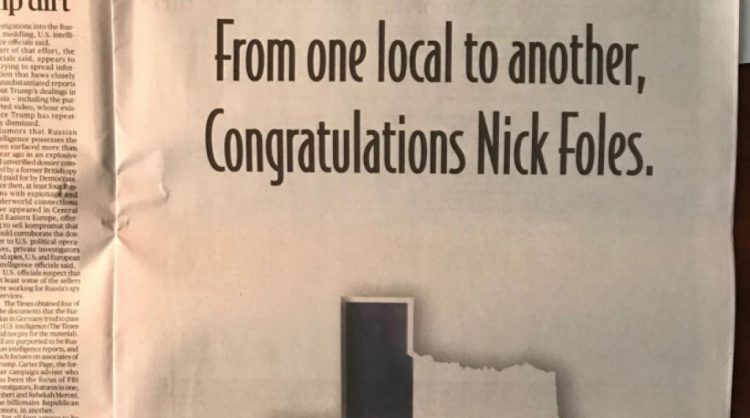
Meanwhile, Matthew McConaughey took out a full-page ad in the Austin American-Statesman to congratulate Foles.

The actor’s response likely has nothing to do with the coverage that even the Washington Post gave to the Eagles’ QB:

Foles’s up-and-down career in the NFL, which included him considering retirement, has prepared him to discuss adversity and character building for a Christian audience. In a video on the YouVersion Bible app, he slipped into preacher mode by reading and explaining 2 Corinthians 12:9.

“This verse has brought so much meaning to my heart and in my life,” he says, later adding, “Everyone feels weak at some time in our lives, but we have to realize when we’re going through that, God’s shaping our hearts and allowing us to grow to become who he created us truly to be.”

He said the week of the Super Bowl that he envisions ministering to students because he understands the temptation with social media and the Internet.

“It’s something I want to do,” he said in an AP story. “I can’t play football forever. I’ve been blessed with an amazing platform, and it’s just a door God has opened, but I still have a lot of school left and a long journey.”

Carson Wentz, the Eagles’ injured starting quarterback, posted an Instagram picture with Foles before the game, writing, “God’s writing an unbelievable story and he’s getting all the glory!”

The Liberty connection may be what puts off the evangelicals in the center of evangelicaldom. Liberty University issued a press release that reads a lot like the kind of features reporting in evangelical publications:

Foles has been bold about his faith during his football career, indicating that he would like to be a youth pastor someday. As the Eagles were presented with the Vince Lombardi Trophy, Foles held his infant daughter, Lily, and said, “Being here with my daughter, my wife, my teammmates, my city, we’re very blessed.” At the post-game press conference, he said God gets the glory. “I wouldn’t be out here without God, without Jesus in my life. I can tell you that, first and foremost in my life, I don’t have the strength to come out here and play a game like that. It’s an everyday walk.”

But Liberty’s president did not even spook the Washington Post’s editors who have been known to be a tad tough on Jerry Falwell, Jr.’s favorite POTUS:

Liberty President Jerry Falwell tweeted after the game: “Congratulations to Liberty student @NFoles_9 on an incredible performance tonight and on becoming the first @LibertyU student to quarterback a winning @SuperBowl team! Amazing job by @Eagles! Great game and a real testament to the character and perseverance of the Eagles team!”

So what gives? Even Liberty University English professor, Karen Swallow Prior, isn’t toxic for Christianity Today’s purposes.

My gut tells me Christianity Today and The Gospel Coalition still hold a grudge against J. Gresham Machen who started Westminster in Center City Philadelphia. But don’t the editors know that Machen protested the change in Blue Laws that allowed the NFL to play on the Lord’s Day?