What’s In Your Hymnal?

I am generally sheepish about singing Charles Wesley and Isaac Watts since both hymn writers knocked the Psalter off its congregational song pedestal and the former, Wesley, is a — well — Wesleyan. But on Sunday, when we sang, “Arise, My Soul, Arise,” the cold heart in this vinegary Calvinist warmed:

Arise, my soul, arise,
shake off your guilty fears;
The bleeding sacrifice,
in my behalf appears;
Before the throne my Surety stands,
My name is written on His hands.

Chorus: Arise (arise), arise (arise), arise
Arise, my soul, arise.
Arise (arise), arise (arise), arise
Arise, my soul, arise.
Shake off your guilty fears and rise

He ever lives above,
for me to intercede;
His all redeeming love,
His precious blood, to plead;
His blood atoned for every race,
And sprinkles now the throne of grace.

Five bleeding wounds He bears;
received on Calvary;
They pour effectual prayers;
they strongly plead for me:
“Forgive him, O forgive,” they cry,
“Nor let that ransomed sinner die!”

My God is reconciled;
His pardoning voice I hear;
He owns me for His child;
I can no longer fear
With confidence I now draw nigh,
And “Father, Abba, Father,” cry.

After attending a marriage service at a Roman Catholic parish this winter, I was surprised to learn that Christians in fellowship with the Bishop of Rome have Wesley and Watts available to them. But I can’t imagine any Roman Catholic who thinks he or she will wind up in purgatory singing “Arise, My Soul, Arise.” I know for some of the readers here, the sense of guilt and fear of condemnation that gripped Luther is not the sort of angst that full confidence in the magisterium, or papal supremacy, or 2,000 years of uncontested (really?) history yields. At the same time, sentiments like Wesley’s were the target for Trent’s condemnations of Protestant teaching on assurance.

So for those Christians who put so much confidence in the papacy, what kind of hymns would they sing? How about the Pontifical Anthem?

O happy Rome – O happy noble Rome
O happy Rome – O happy Rome, noble Rome
You are the seat of Peter, who shed his blood in Rome,
Peter, to whom the keys of the kingdom of heaven were given.
Pontiff, You are the successor of Peter;
Pontiff, You are the teacher, you confirm your brethren;
Pontiff, You who are the Servant of the servants of God,
and fisher of men, are the shepherd of the flock,
linking heaven and earth.
Pontiff, You are the vicar of Christ on earth,
a rock amidst the waves, You are a beacon in the darkness;
You are the defender of peace, You are the guardian of unity,
watchful defender of liberty; in You is the authority.

Pontiff, you are the unshakable rock, and on this rock
was built the Church of God.
Pontiff, You are the vicar of Christ on earth,
a rock amidst the waves, You are a beacon in the darkness;
You are the defender of peace, You are the guardian of unity,
watchful defender of liberty; in You is the authority.
O happy Rome – O noble Rome.

Or, how about “Long Live the Pope His Praises Sound“:

1. Long live the Pope! His praises sound
Again and yet again:
His rule is over space and time;
His throne the hearts of men:
All hail! the Shepherd King of Rome,
The theme of loving song:
Let all the earth his glory sing,
And heav’n the strain prolong.
Let all the earth his glory sing,
And heav’n the strain prolong.

2. Beleaguered by the foes of earth,
Beset by hosts of hell,
He guards the loyal flock of Christ,
A watchful sentinel:
And yet, amid the din and strife,
The clash of mace and sword,
He bears alone the shepherd staff,
This champion of the Lord.
He bears alone the shepherd staff,
This champion of the Lord.

3. His signet is the Fisherman’s;
No sceptre does he bear;
In meek and lowly majesty
He rules from Peter’s Chair:
And yet from every tribe and tongue,
From every clime and zone,
Three hundred million voices sing,
The glory of his throne.
Three hundred million voices sing,
The glory of his throne.

4. Then raise the chant, with heart and voice,
In church and school and home:
“Long live the Shepherd of the Flock!
Long live the Pope of Rome!”
Almighty Father, bless his work,
Protect him in his ways,
Receive his prayers, fulfill his hopes,
And grant him “length of days.”
Receive his prayers, fulfill his hopes,
And grant him “length of days.”

I’ll stick with the Wesleyan.
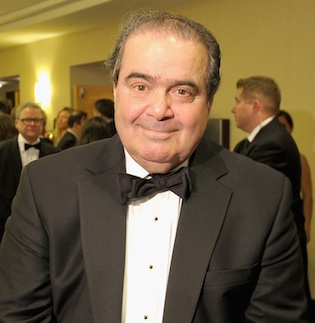
Grammatico-Historical Interpretation of the Constitution

Lots of posts out there about Antonin Scalia as the faithful Roman Catholic. But the man sure sounded like he learned how to read the Constitution from Protestants:

Nonetheless, there is no escaping a verdict on his influence on American jurisprudence, and that verdict is not affected by the fact that he was a good buddy to prominent liberals. He was an advocate of two judicial ideologies, neither of which is intellectually tenable and which conflict with each other. Originalism was Scalia’s core ideological commitment, the idea that the Constitution should be interpreted as it was understood at the time of its ratification. He employed Originalism to question the idea that the Constitution is a “living document,” as liberal jurists held.

To be sure, there was a need for a conservative corrective after the high court starting snooping around the “penumbras” of the Constitution. As Justice Elena Kagan said in mourning Scalia’s death, “His views on interpreting texts have changed the way all of us think and talk about the law.” But, whether the Constitution is alive or not, the people whose government it intends to frame are most certainly alive and their circumstances change. Laws that cannot change with the lived circumstances of a people soon become disconnected from reality, and that disconnect will lead to the law being held in derision or ignored. . . .

Scalia’s other ideological commitment was to Textualism, the idea that the actual words must be interpreted in a kind of fundamentalist manner. This could conflict with Originalism. For example, an originalist would, like an historian, search for explanations as to what was intended by the drafters of a given text, to confirm that original intent and guarantee against latter day misinterpretations. But, Scalia famously loathed citations to legislative history. Textualism rests on the supposition that the Constitution is a self-interpreting text and if that were true, why would we need a Supreme Court? In practice, Textualism resulted in the conclusion that any given text meant exactly what Antonin Scalia thought it meant.

Of course, it’s not clear that Scalia’s hermeneutic was all positive. But it hardly sounds like it’s a product of deferring to the magisterium or to the development of dogma.

If Muslims and Christians Worship the Same God, Can't the Forgiven and Unforgiven Too?

The latest from Wheaton College is that Larycia Hawkins and the College have agreed to part ways. In the leaks that led to this apparently amicable determination was an email from Wheaton’s provost, Stan Jones, who apologized for his handling of the incident. According to Alan Jacobs, Jones wrote:

I asked Dr. Hawkins for her forgiveness for the ways I contributed to the fracture of our relationship, and to the fracture of Dr. Hawkins’ relationship with the College…. I apologized for my lack of wisdom and collegiality as I initially approached Dr. Hawkins, and for imposing an administrative leave more precipitously than was necessary.

But according to some of Jones’ critics, this apology doesn’t go far enough, as Jacobs explains, “because it does not acknowledge Wheaton’s history (and present) of structural racism and sexism.”

Jacobs then asks:

What if, when a brother in Christ apologizes and asks for forgiveness, one were to grant that forgiveness — instead of immediately criticizing him for not having provided a fully adequate account of the reasons he went astray?

I’d follow up with another question: doesn’t the spirit of Dr. Hawkins’ show of solidarity with Muslims provide an analogy for how Jones’ critics might reach out to Wheaton’s provost? I mean, if you can overcome the division between Islam and Christianity by donning a hijab during Advent, can’t you go without a latte for the month of February to show solidarity with Wheaton’s administration?

Jacobs concludes:

So to those who say that Provost Jones’ apology is inadequate, my answer would be: of course it is inadequate. Every act of penitence, including yours and mine, is inadequate.

That could also be instructive for those who think Purgatory is going to take care of residual human guilt. Once humans sin — think one little bite of a piece of fruit — can you ever go back to being acceptable inherently?

No hope without alien righteousness.

Where's Jesus?

Wouldn’t one of those answers that always work in response to any Sunday school question — the Bible, God, or Jesus — be the answer to the dilemma of God’s justice and divine mercy?

But when Pope Francis answers the question, he neglects Jesus and the cross, the ultimate confluence of justice and mercy:

“Sacred Scripture presents us with God as infinite mercy, but also as perfect justice. How are these two things reconciled? How can the reality of mercy be articulated with the need for justice?” the Pope said Feb. 3.

While these two characteristics can seem like opposites, “it’s precisely the mercy of God that brings the fulfillment of true justice,” Francis affirmed.

The Pope made his comments to pilgrims gathered in St. Peter’s Square for his weekly general audience. He recently began a new series of catechesis on the topic of mercy as it is understood in Scripture, in honor of the Jubilee of Mercy.

He said that when we think of justice, what might come to mind is an administration office where victims of an injustice appeal to a judge in court, asking that justice be done.
This, Francis noted, “is retributive justice, imposing a punishment to the guilty, according to the principle that each must be given what is due him.” While certain wrongs can be made right in this way, he said that it “still doesn’t bring true justice.”

Instead, it’s “only in responding with good that evil can be truly defeated,” the Pope said, explaining that this is what we find in the Bible

By helping the guilty person to see the evil done and by appealing to conscience, he can change. Such persons are able “to see their wrong and be open to the forgiveness offered,” Francis said, noting that this is also how families forgive each other, spouses and children included.

Might this be a window into the the problem of Roman Catholic laity not knowing church dogma? And don’t forget how the social justice designs of the mainline Protestant churches eventually made doctrine a trifle.

Get Out of Jail Free

Jesus appears to think that his return will be comparatively sudden:

36 “But concerning that day and hour no one knows, not even the angels of heaven, nor the Son, but the Father only. 37 For as were the days of Noah, so will be the coming of the Son of Man. 38 For as in those days before the flood they were eating and drinking, marrying and giving in marriage, until the day when Noah entered the ark, 39 and they were unaware until the flood came and swept them all away, so will be the coming of the Son of Man. 40 Then two men will be in the field; one will be taken and one left. 41 Two women will be grinding at the mill; one will be taken and one left. 42 Therefore, stay awake, for you do not know on what day your Lord is coming. 43 But know this, that if the master of the house had known in what part of the night the thief was coming, he would have stayed awake and would not have let his house be broken into. 44 Therefore you also must be ready, for the Son of Man is coming at an hour you do not expect. (Matthew 24)

So what does this mean for those in Purgatory? Can Jesus actually let people out before they have made compensations for the temporal consequences of their sin? Will it be like the men in the field? One believer is released from Purgatory but another stays? Or does everyone get out because the return of Christ cancels all penalties for sin?

But if Christ’s return has the power to overturn the claims of Purgatory, imagine what the crucifixion and resurrection might do to both the temporal and spiritual consequences of sin.

Could Christ Have Preached Christ and Him Crucified?

Rick Phillips introduces a tension — though that was not his intention — between Jesus’ preaching and Paul’s. We have the old was-Paul-the-second-founder-of-Christianity problem.

Here‘s is what Christ preached according to Phillips:

I noted 4 main types of ministry emphases highlighted by Jesus in Mark:

1. Jesus declaring his deity as Messiah, together with his teaching about God and salvation (i.e. theology and redemptive history).

2. Jesus preaching the gospel: pointing out his hearers’ need to be forgiven and God’s wonderful remedy through his saving work. Included here would be calls to prospective disciples to believe and follow Jesus.

3. Jesus training and reproving his disciples, including ethical and spiritual instruction and his call to evangelistic labor.

4. Jesus exposing false teachers and religious opposition. This includes the confronting and correcting of false doctrine.

And here is how Paul described his preaching:

And I, when I came to you, brothers, did not come proclaiming to you the testimony of God with lofty speech or wisdom. For I decided to know nothing among you except Jesus Christ and him crucified. (1 Cor 2:1-2)

Again, I don’t think Phillips is trying to drive a wedge between Jesus and Paul, but the way he frames the question does lead in that direction — one that contrasts the way Jesus preached with the way his disciples did (think of Peter in Acts 2). Why isn’t it the case that Jesus is NOT a model for post-ascension preaching — nor is John the Baptist. Until the main event of the death, resurrection, and ascension of Christ, the preaching of biblical prophets is going to be types and shadows. Think Geerhardus Vos.

And also think Marilyn Robinson. This is what can happen if you use Jesus as your model for preaching and leave out Paul:

Since these folk claim to be defenders of embattled Christianity (under siege by liberalism, as they would have it), they might be struck by the passage in Matthew 25 in which Jesus says, identifying himself with the poorest, “I was hungry, and ye fed me not.” This is the parable in hallowed be your name which Jesus portrays himself as eschatological judge and in which he separates “the nations.” It should surely be noted that he does not apply any standard of creed – of purity or of orthodoxy – in deciding whom to save and whom to damn. This seems to me a valuable insight into what Jesus himself might consider fundamental. To those who have not recognized him in the hungry and the naked, he says, “Depart from me, ye cursed, into the eternal fire which is prepared for the devil and his angels.” Neofundamentalists seem to crave this sort of language – more than they might if they were to consider its context here. It is the teaching of the Bible passim that God has confided us very largely to one another’s care, but that in doing so he has in no degree detached himself from us. Indeed, in this parable Jesus would seem to push beyond the image of God as final judge to describe an immanence of God in humankind that makes judgment present and continuous, and that in effect makes our victim our judge. Neither here nor anywhere else in the Bible is there the slightest suggestion that our judge/victim would find a plea of economic rationalism extenuating. This supposed new Awakening is to the first two Awakenings, and this neofundamentalism is to the first fundamentalism, as the New Right is to the New Deal, or as matter is to antimatter’.

Will Believers be Judged for Not Knowing English Historical Theology?

Apparently, Mark Jones believes Lee Irons stands condemned:

I am flabbergasted at the cocksure way by which Irons makes these claims. He castigates Piper for several errors, but ends up making a few blunders himself. One in particular stands out.

He says: “Faith has never been viewed as a condition of justification in Reformed theology…” (emphasis mine).

This is simply false.

So it looks like God won’t be pleased with Lee’s works on judgment day.

But will God look favorably on Jones’ own high estimate of his historical theological chops?

Most of the Early Modern Reformed did not view Romans 2:7-11 as hypothetical, contrary to what some in the Reformed camp today have suggested. Rick Phillips has addressed this question in the past, but I remain concerned about some historical and exegetical issues made therin; his post also strikes me as far too defensive. Better, in my view, is the approach taken by Richard Gaffin in By Faith, Not By Sight.

Should this cause people to despair regarding the future judgment? Only if one is a bona fide hypocrite. Christ will rightfully condemn the hypocrites in the church (Matt. 25:41-46). They are marked out as those who did not do good works. They are those who neglect the weightier matters of the law (Matt. 23:23).

I mean, if believers are going to be judged by their good works as Jones says is writ large in English Protestantism, doesn’t that conclusion apply to blog posts? Is it evidence of saving faith or a good work to mock other believers on grounds of the history of English theology?

Sure, this post may even be evidence of my own sinfulness. But I’m not the one promoting obedient faith.

(On the upside, Dr. Jones has abandoned the third-person bi-lines, sure evidence of holiness.)

The Fine Print about Truth

I recall Francis Schaeffer talking about “true truth” to make the point, if memory serves, that Christians do not endorse relativism. But among the apologists for Rome I don’t recall hearing so many appeals to abstract truth — that is, the idea that the church stands for the truth (but see if you can figure out what that truth is). It’s like Dwight Eisenhower’s old line about America’s faith: “In other words, our form of government has no sense unless it is founded in a deeply felt religious faith, and I don’t care what it is.”

Here’s one apologist on the first leg of the truth-goodness-beauty-three-legged stool:

So, this Church that the Bible tells us was founded by Jesus Christ; this Church that the Bible tells us is the pillar and ground – the upholder and foundation – of the truth; this Church that the Bible tells us is the fullness of Jesus Christ – the fullness of the truth; this Church that the Bible tells us is guided into all truth by the Holy Spirit – the Spirit of Truth; this Church must teach us what? Error? No! This Church must teach us truth. It cannot teach us error. The Church founded by Jesus Christ must teach the truth he fullness of the truth. It cannot teach error!

Does God want everyone to be Catholic? According to the Bible, the Church founded by Jesus Christ contains the fullness of the truth that He has made known to us about Himself. What does the Catholic Church claim about itself? Well, it claims that it contains the fullness of the truth given to us by Jesus Christ. The Bible tells us that the Church founded by Jesus Christ contains the fullness of the truth, and here is the Catholic Church claiming to contain the fullness of the truth, and claiming to have been founded directly by Jesus Christ. If whatever church you are in doesn’t at least claim these things for itself, then you have some thinking and praying to do.

Another appeal to truth that makes the church’s truth qualities more important that Scripture’s:

Truth is truth. It cannot be error, by its very essence and defi­nition. How can truth’s foundation or pillar or bulwark or ground be something less than total truth (since truth itself contains no falsehoods, untruths, lies, or errors)? It cannot. It’s impossible, as a straightforward matter of logic and plain observation. A stream cannot rise above its source.

What is built on a foundation cannot be greater than the foundation. If it were, the whole structure would collapse. If an elephant stood on the shoulders of a man as its foundation, that foundation would collapse. The base of a skyscraper has to hold the weight above it. It can’t be weaker than that which is built upon it. The foundations of a suspension bridge over a river have to be strong enough to hold up that bridge. They can’t possibly be weaker than the bridge, or the structure would collapse.

Therefore, we must conclude that if the Church is the founda­tion of truth, the Church must be infallible, since truth is infal­lible, and the foundation cannot be less great or strong than that which is built on it. Truth cannot be built on any degree of error whatever, because that would make the foundation weaker than the superstructure above it.

Accordingly, given the above biblical passages and many oth­ers, the Catholic “three-legged stool” rule of faith may be defined in the following way:

In the biblical (and historic Catholic) view the inspired, infallible Bible is interpreted by an infallible, divinely guided Church, which in turn infallibly interprets and formulates the true doctrinal (apostolic) tradition.

Here’s another who links truth to freedom (which is oh so American and modern):

The Catholic faith is about freedom because it is about the Truth, the deepest truth about God and about our existence. It appeals to the deepest sanctuary of the heart. If it promotes social institutions, it does so to make space for the voice of conscience in human affairs. Whether it concerns the sacredness of marriage, or of motherhood, or of family, or of life itself, the Church has a responsibility to speak the truth in love.

That sounds like Christianity is an IBM-like institution which supplies the workings that make a society run smoothly. Not sure what the truth is except for something deep.

But that kind of bland identification of Truth with Roman Catholicism, especially with the institutional church instead of with what the Word of God teaches, runs the danger of setting the church above the truth. Rod Dreher relayed the remarks of one of his friends about the dangers of so exalting an institution:

‘Institutionalism’ affects both traditional and progressive Catholics in equal measure. It is one might say – to borrow and misuse a term – the “structural sin” of Catholicism, living in its very bones, in seminaries, parish structures, canon law, etc. Institutionalism can be summarized as something like: ‘the excessive trust in institutional structures – including a complacent belief that the institution takes care of itself, an expectation that those vested with institutional authority can and will exercise sound if not perfect judgment, and finally, and most importantly, the conviction that all problems are institutional ones to be solved by ever-more refined rule-amending, making, or keeping’.

The most obvious manner in which institutionalism manifests itself is in attitudes toward the papacy and ‘creeping infallibility’ (in which the pope is assumed to be infallible even in his ordinary teaching). However, one can also see it among progressive Catholics and their attitude toward Vatican II as well as their oft- vocalized belief that we need a Vatican III to ‘address contemporary problems’ or that this or that rule needs to change. It is this obsession about the institution that makes mincemeat of both the tradition of faith (we need to adapt to the contemporary worldview or else no one will go to church anymore!), cover up evil (we cannot let anyone know about this or else no one will come to church anymore!), or place sole responsibility on Church institutions for failure (if it weren’t for those progressives at Vatican II, everyone would still be coming to church!).

When you look for defenses of or references to truth in the Shorter or Heidelberg catechisms, you don’t find much. The Shorter Catechism refers to truth as one of God’s attributes and defends telling the truth — ahem — in its explanation of the ninth commandment. Heidelberg goes a little farther in equating truth with the gospel:

Question 21. What is true faith?
Answer: True faith is not only a certain knowledge, whereby I hold for truth all that God has revealed to us in his word, but also an assured confidence, which the Holy Ghost works by the gospel in my heart; that not only to others, but to me also, remission of sin, everlasting righteousness and salvation, are freely given by God, merely of grace, only for the sake of Christ’s merits. . . .

Question 40. Why was it necessary for Christ to humble himself even “unto death”?
Answer: Because with respect to the justice and truth of God, satisfaction for our sins could be made no otherwise, than by the death of the Son of God.

That may explain why some Protestants don’t convert, because the truth about salvation is more important than the truth abstracted:

. . . when my friend asked how I could remain theologically conservative in spite of my great learning (not as great as he gave me credit for, by the way), I replied somewhat glibly,”I kept reading the Bible and it kept talking about me.” Although I certainly simplified the matter, the truth was that as I read more, learned more, and thought more, the evangelical understanding of the biblical narrative of creation–fall–judgment–redemption impressed itself upon me, continuing to recount the story of my own life while making sense of the world in a way that nothing else that I studied did. I knew that my own life was peppered by self-deception and sin and needed the grace of God offered in Christ. Further, I saw a world populated with human beings who regularly and vigorously sinned against one another. They too needed the grace of God offered in Christ. Finally, as my more progressive colleagues helped me to discern, there were (and are) sinful structures of oppression the permeated the world. Those caught in them–as either oppressed or oppressor–need the grace of God offered in Christ, while the structures themselves need the perfect king to come in righteous judgment and tear them down. In the end, all other explanations regarding the troubles of this world seemed insufficient, while all other solutions regarding how to address them seemed utterly inadequate. And thus I remained (and remain) evangelical.

The Un-Christian Option

The maker of the videos producing so much outrage about Planned Parenthood conducted an interview with Christianity Today. Among the statements made:

How did you get people to talk to you? There have been other undercover videos about Planned Parenthood in the past, so you would think they’d be more skeptical.

It’s reasonable to think they would be skeptical. We were quite surprised, during the course of this project, how trusting and how willing to talk and negotiate and let us into the inner circle Planned Parenthood was.

All we had to do was say two things. Number one, that we supported their work. And number two, that we wanted to buy their fetal body parts. Those were the magic words. And they were willing to bend over backwards to accommodate that. . . .

There are some critics, who share your beliefs about abortion, who are uncomfortable with the techniques you use. They say misrepresenting who you are and using undercover video is unethical. How do you respond to that claim? And what are the laws about undercover recording in states like California, where you recorded video?

California has a recording law that prohibits the surreptitious recording of what are called “confidential communications,” so California’s recording statute is limited.

I think that there are a minority of people who think that any kind of undercover work is prima facie wrong and unethical. I certainly don’t subscribe to that view. Most people don’t subscribe to that view. Undercover work is a pretty common tactic among law enforcement and journalists. I don’t think the techniques that we use are any more extreme than what is done every day by mainstream investigative journalists.

People don’t realize that it’s a common law liberty in the United States to change your name at will. I think it’s a little silly to say that it’s unethical when it is a common law liberty to present yourself however you want to present yourself. . . .

What are your personal beliefs and how do they inform the work you do?

I am Catholic, and I am a really big fan of Pope Francis. He has been a huge inspiration to me over the past couple of years, especially while doing this project.

Pope Francis’s emphasis on not being closed in on yourself but always moving forward and always being willing to go out towards the margins of human experience—in order to bring the gospel to those margins—was a huge inspiration to me during this project. I don’t think there’s any place more on the existential margins of society than an abortion clinic.

I think that when you have a place like an abortion clinic—which is a place where children are killed on an industrial scale—there is almost a sacramental value in bringing a presence to those places. We were there for good, out of love, and to welcome those children for the brief time that they will be in existence before they die. And to be in contact with and pray for all the abortion workers, the abortion doctors who are there.
As a Christian you are part of the body of Christ. So your presence, even in those darkest of places, can bring the presence of Jesus.

Notice the knots David Daleiden ties himself in. It’s “common law” here to change your name, so deceit is okay, saying exactly what you have no intention of meaning, like “we support your work” and “want to buy fetal body parts.” Well, isn’t isn’t it also legal to have an abortion? Not saying that’s a good thing. But if you use state law to justify violating on of the Ten Commandments, haven’t you given up any claim to moral authority against the other side which could argue in a similar fashion.

Then Daleiden claims the inspiration of Pope Francis and Christianity. Isn’t that a reason not to deceive? Think Sir Thomas More in A Man for All Seasons. He could have saved his life if he had lied and taken the oath, right? If you took a 2k view of this and made it less religious calling and more secular vocation, perhaps you could argue that as a journalist you sometimes don’t follow all of God’s laws in order to get a story. But when you want to claim Christian standing for what you do and then violate Christian morality, that’s a violation.

Feeling at Home

I used this quote over at Patheos but given the excitements round hyeh the last week or so, a reminder about being strangers and aliens from a Roman Catholic intellectual invoking Augustine might be useful. I will include as well Peter Lawler’s comments about the Confederate Flag for good measure:

I really was quite moved when, driving through the heavily gay midtown section of Atlanta last Sunday, I saw so many homes and businesses flying the rainbow flag with the American flag. It’s not a a small thing that so many gays now feel fully at home in their country, where they’re free to live openly as who they are. But I wish more people were moved by Catholic writers calling for the American flag to be removed from the sanctuaries of their churches. Some argue that it never should have been there in the first place, and a Christian should always think of himself, as Saint Augustine says, as an alien or a pilgrim in his country. Still, many Christians have written in the last few days they have come to think of themselves, for the first time, as aliens in their country, and they know they will soon be marginalized if they live loudly and proudly (and charitably) as who they are.

Notice that I’ve managed to avoid waxing judgmental about the Confederate battle flag, although Apple moved to banish Civil War games that show that flag in the context of Confederate soldiers actually going into battle. Well, let me add one point: The main flag fact about the South today, especially the small-town South, is not the Stars and Bars; it’s the Stars and Stripes seen everywhere in places public and private, commercial and residential. The Confederate flag, it goes without saying, is hardly at all and shouldn’t be at all a sign of some present-tense form of allegiance. That doesn’t mean Americans should be deprived of historical literacy just because one flag lost and even deserved to lose. And it shouldn’t be a thought crime to believe that Lee and Jackson were really great generals and even good (although certainly misguided) men.

Now all we need is for President Obama to apologize for flying the gay pride flag.

No, wait. I forgive him. Who says Old Life is angry?