Mencken Day 2025: Holy Orders, Mixed Motives

Holy Clerks

Around no class of men do more false assumptions cluster than around the rev. clergy, our lawful commissioners at the Throne of Grace. I proceed at once to a crass example: the assumption that clergymen are necessarily religious. Obviously, it is widely cherished, even by clergymen themselves. The most ribald of us, in the presence of a holy clerk, is a bit self-conscious, reticent and awed. I am myself given to criticizing Divine Providence somewhat freely, but in the company of the rector of my parish, even at the Biertisch, I tone down my animadversions to a level of feeble and polite remonstrance. I know the fellow too well, of course, to have any actual belief in his piety. He is, in fact, rather less pious than the average right-thinking Americano, and I doubt gravely that the sorceries he engages in professionally every day awaken in him any emotion more lofty than boredom. I have heard him pray for Coolidge, for the heathen and for rain, but I have never heard him pray for himself. Nevertheless, the public assumption that he is highly devout, though I dispute it, colors all my intercourse with him, and deprives him of hearing some of my most searching and intelligent observations.

All that is needed to expose the hollowness of this ancient delusion is to consider the chain of causes which brings a young man to taking holy orders. Is it, in point of fact, an irresistible religious impulse that sets him to studying exegetics, homiletics and the dog-Greek of the New Testament, and on irresistible religious impulse only, or is it something quite different? I believe that it is something quite different, and that that something may be described briefly as a desire to shine in the world without too much effort. The young theologue, in brief, is commonly an ambitious but somewhat lazy and incompetent fellow, and he studies theology instead of medicine or law because it offers a quicker and easier route to an assured job and public respect. The sacred sciences may be nonsensical bores, but they at least have the vast virtue of short-circuiting, so to speak, the climb up the ladder of security. The young doctor, for a number of years after he graduates, either has to work for nothing or to content himself with the dregs of practise, and the young lawyer, unless he has unusual influence or complete atrophy of the conscience, often teeters on the edge of actual starvation. But the young divine is a safe and distinguished man the moment he is ordained; indeed, his popularity, especially among the faithful who are fair, is often greater at that moment than it ever is afterward. His livelihood is assured instantly. At one stroke, he becomes a person of dignity and importance, eminent in his community, deferred to even by those who question his magic, and vaguely and pleasantly feared by those who credit it.

These facts, you may be sure, are not concealed from ambitious young men of the sort I have mentioned. Such young men have eyes, and even a certain capacity for ratiocination. They observe the nine sons of the police sergeant: one a priest at twenty-five, with a fine house to live in, invitations to all christenings and birthday parties for miles around, and plenty of time to go to the ball-game on Summer afternoons; the others struggling desperately to make their livings as piano-movers, tin-roofers, motormen or bootleggers. They observe the young Methodist dominie in his Ford sedan, flitting about among the women while their husbands labor down in the yards district, a clean collar around his neck, a solid meal of fried chicken in his gizzard, and his name in the local paper every day. They observe the Baptist dervish in his white necktie, raiding saloons, touring the bawdy-houses and raising hell generally, his tabernacle packed every Sunday night, a noble clink of silver in his collection-plates, and a fat purse for him now and then from the Ladies’ Aid or the Ku Klux Klan. Only crazy women ever fall in love with young doctors or lawyers, but every young clergyman, if he is so inclined, may have a whole harem, and with infinitely less danger than a struggling lawyer, a bootlegger or a bank clerk runs every day. Even if he is celibate, the gals bathe him in their smiles; in truth, the more celibate he is, the more attention he gets from them. No wonder his high privileges and immunities propagate the sin of envy! No wonder there are still candidates for the holy shroud, despite the vast growth of atheism among us!

It seems to me that the majority of the young men who are thus sucked into holy orders are not actually pious at all, but rather somewhat excessively realistic—that genuine piety is far more apt to keep a youth out of the pulpit than to take him into it. The true devotee, frequenting the sacred edifice constantly, becomes too familiar with the daily duties of a clergyman to see any religious satisfaction in them. In the main, they have nothing to do with religion at all, but are basically social or commercial. In so far as a clergyman works at all, he works as the general manager of a corporation, and only too often it is in financial difficulties and rent by factions among the stockholders. His specifically religious duties are of a routine and monotonous nature, and must needs depress him mightily, as a surgeon is depressed by the endless snaring of tonsils and excision of appendices. He debases spiritual exaltation by reducing it to a hollow and meaningless formality, as a politician debases patriotism and a lady of joy debases love. He becomes, in the end, quite anæsthetic to religion, and even hostile to it. The fact is made distressingly visible by the right rev. the bench of bishops. For a bishop to fall on his knees spontaneously and begin to pray to God would make almost as great a scandal as if he mounted his throne in a bathing-suit. The piety of the ecclesiastic, on such high levels, becomes wholly formal and theoretical. The servant of God has been lifted so near to the saints and become so familiar with the inner workings of the divine machinery that the sense of awe and wonder has oozed out of him. He can no more undergo a genuine religious experience than a veteran scene-shifter can laugh at the wheezes of the First Gravedigger. It is, perhaps, well that this is so. If the higher clergy were actually religious some of their own sermons and pastoral epistles would scare them to death. (Prejudices: Fourth Series 1924)

Mencken Day 2024

In human history a moral victory is always a disaster, for it debauches and degrades both the victor and the vanquished. The triumph of sin in 1865 would have stimulated and helped to civilize both sides. (“The Calamity of Appomattox,” 1930)

Mencken Day 2023

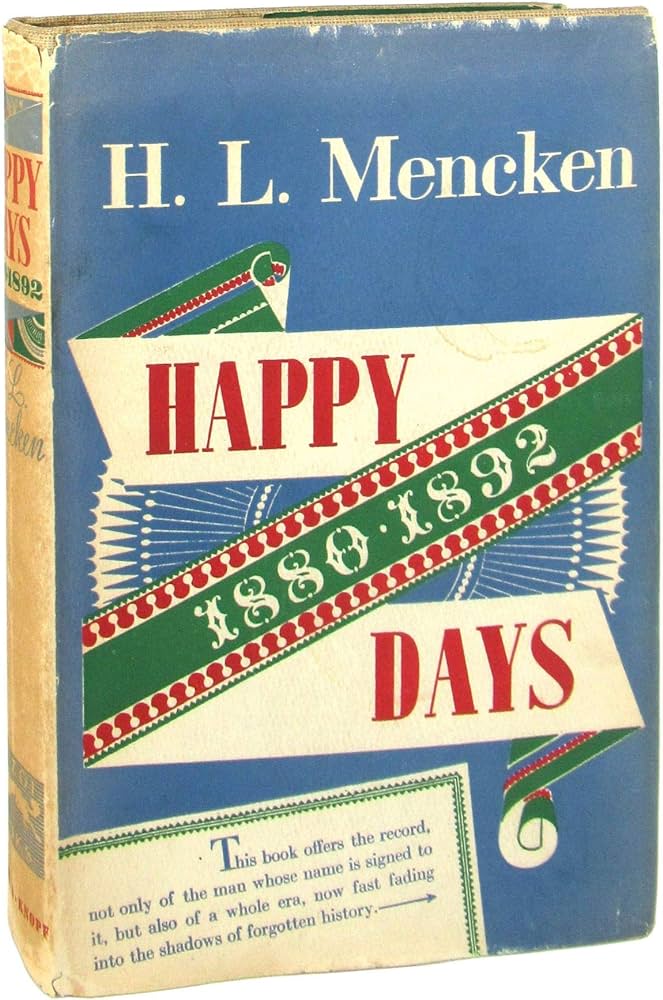
I was on the fattish side as an infant, with a scow-like beam and noticeable jowls. Dr. C. L. Buddenbohn, who fetched me into sentience at 9 P.M., precisely, of Sunday, September 12, 1880, apparently made a good (though, as I hear, somewhat rough) job of it, despite the fact that his surviving bill, dated October 2, shows that all he charged “to one confinement” was ten dollars. The science of infant feeding, in those days, was as rudimentary as bacteriology or social justice, but there can be no doubt that I got plenty of calories and vitamins, and probably even an overdose.  There is a photograph of me at eighteen months which looks like the pictures the milk companies print in the rotogravure sections of the Sunday papers, whooping up the zeal of their cows. If cannibalism had not been abolished in Maryland some years before my birth I’d have butchered beautifully. (Happy Days, 1940)

Christian Patriotism Afterglow

Sparring about Christian nationalism appears to have wound down but since we continue to live in this great land of political liberty — bruised and bloody as it may be — another post about the American Founding may keep the fires of freedom burning. This post also has a Christian connection since it relates to recent debates at the Orthodox Presbyterian Church’s General Assembly about a modern English version of the Westminster Confession and Catechisms. If the Standards may be updated, what about the Declaration of Independence?

The man who led the charge (as pointed out here a few years ago) was H. L. Mencken. The reasons he gave had to do with the severe abridgements of freedom during the reign of the Presbyterian President, Woodrow Wilson thanks to World War I. (Christian nationalists, beware of what you wish.)

Mencken explained his modern version this way:

The following attempt to translate the Declaration of Independence into American was begun eight or ten years ago, at the time of of my first investigations into the phonology and morphology of the American vulgate. I completed a draft in 1917, but the publication was made impossible by the Espionage act, which forbade any discussion, however academic, of proposed changes to the canon of the American Koran. In 1920 I resumed the work and have since had the benefit of the co-operation of various other philologists, American and European. But the version, as it stands, is mine. That such a translation has long been necessary must be obvious to every student of philology. And this is Better Speech Week.

The great majority of Americans now speak a tongue that differs materially from standard English, and in particular from the standard English of the eighteenth century. Thus the text of the Declaration has become, in large part, unintelligible to multitudes of them. What, for example, would the average soda-fountain clerk, or City Councilmen, or private soldier, or even the average Congressman make of such a sentence as this one: “He has called together legislative bodies at places unusual, uncomfortable and distant from the depository of their public records, for the sole purpose of fatiguing them into compliance with his measures”? Or this one: “He has refused for a long time, after such dissolutions, to cause others to be elected, whereby the legislative powers, incapable of annihilation, have returned to the people at large for their exercise”? Obviously, such sonorous Johnsonese is as dark to the plain American of 1921 as so much Middle English would be, or Holland Dutch. He may catch a few words, but the general drift is beyond him.

So Mencken figured that if he produced a modern version of the Declaration, the American people might become more concerned about encroachments by the government on their freedoms. Here is a portion of that revision:

When things get so balled up that the people of a country have to cut loose from some other country and go it on their own hook, without asking no permission from nobody, excepting maybe God Almighty, then they ought to let everybody know why they done it, so that everybody can see they are on the level, and not trying to put nothing over on nobody.

All we got to say on this proposition is this: First, you and me is as good as anybody and maybe a damn sight better; second, nobody ain’t got no right to take away none of our rights; third, every man has got a right to live, to come and go as he pleases, and to have a good time however he likes, so long as he don’t interfere with nobody else. That any government that don’t give a man these rights ain’t worth a damn; also people ought to choose the kind of government they want themselves, and nobody else ought to have no say in the matter. That whenever any government don’t do this, then the people have got a right to can it and put in one that will take care of their interests. Of course, that don’t mean having a revolution every day, like them South American coons and Bolsheviki, or every time some jobholder does something he ain’t got no business to do. It is better to stand a little graft, etc., than to have revolutions all the time, like them coons, Bolsheviki, etc., and any man that wasn’t a anarchist or one of them I. W. W.s would say the same. But when things gets so bad that a man ain’t hardly got no rights at all no more, but you might almost call him a slave, then everybody ought to get together and throw the grafters out, and put in new ones who won’t carry on so high and steal no much, and then watch them. This is the proposition the people of these Colonies is up against, and they have got tired of it, and won’t stand it no more. The administration of the present King, George III, has been rotten from the jump-off, and when anybody kicked about it he always tried to get away with it by strong-arm work. Here is some of the rough stuff he has pulled…

Mencken Day 2022

Remember when American became a monarchy?

The abdication of Congress is certainly not as overt and abject as that of the German Reichstag or the Italian Parliamento; nevertheless, it has gone so far that the constitutional potency of the legislative arm is reduced to what the lawyers call a nuisance value. The two Houses can still make faces at Dr. Roosevelt, and when a strong body of public opinion happens to stand behind them they can even force him, in this detail or that, into a kind of accounting, but it must be manifest that if they tried to impose their will upon him in any major matter he could beat them easily. The only will left in the national government is his will. To all intents and purposes he is the state.

We have thus come to a sort of antithesis of the English system, under which Parliament is omnipotent and the King is only a falseface. It would be rather absurd to call the change revolutionary, for it has been underway for more than a hundred years. Since Jackson’s first election, in fact, Congress has always knuckled down to the President in times of national emergency. After 1863 Lincoln ruled like an oriental despot, and after 1917 Wilson set himself up, not only as Emperor, but also as Pope.

My gifts as a constructive critic are of low visibility, but the state of affairs thus confronting the country prompts me to make a simple suggestion. It is that a convention be called under Article V of the Constitution, and that it consider the desirability of making Dr. Roosevelt King in name as well as in fact. There is no constitutional impediment to such a change, and it would thus not amount to a revolution. The people of the United States are quite as free, under Article V, to establish a monarchy as they were to give the vote to women. (“Vive Le Roi! 1933)

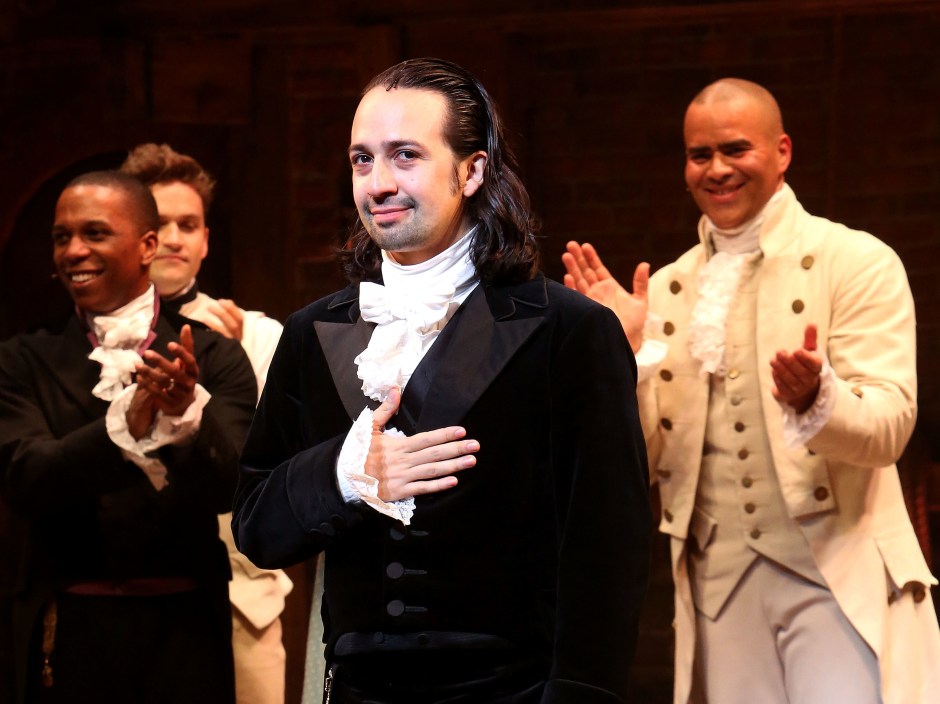
Before Lin-Manuel Miranda, H. L. Mencken

If Miranda updated the Founders (Happy July 4th, by the way) in the vernacular of hip-hop (or is it rap?), Mencken was two steps ahead when he put the Declaration of Independence into the language of the common American circa 1920. So he began:

WHEN THINGS get so balled up that the people of a country got to cut loose from some other country, and go it on their own hook, without asking no permission from nobody, excepting maybe God Almighty, then they ought to let everybody know why they done it, so that everybody can see they are not trying to put nothing over on nobody.

All we got to say on this proposition is this: first, me and you is as good as anybody else, and maybe a damn sight better; second, nobody ain’t got no right to take away none of our rights; third, every man has got a right to live, to come and go as he pleases, and to have a good time whichever way he likes, so long as he don’t interfere with nobody else. That any government that don’t give a man them rights ain’t worth a damn; also, people ought to choose the kind of government they want themselves, and nobody else ought to have no say in the matter. That whenever any government don’t do this, then the people have got a right to give it the bum’s rush and put in one that will take care of their interests. Of course, that don’t mean having a revolution every day like them South American yellow-bellies, or every time some jobholder goes to work and does something he ain’t got no business to do. It is better to stand a little graft, etc., than to have revolutions all the time, like them coons, and any man that wasn’t a anarchist or one of them I.W.W.’s would say the same. But when things get so bad that a man ain’t hardly got no rights at all no more, but you might almost call him a slave, then everybody ought to get together and throw the grafters out, and put in new ones who won’t carry on so high and steal so much, and then watch them. This is the proposition the people of these Colonies is up against, and they have got tired of it, and won’t stand it no more.

It goes on, and on, probably too on. Mencken made his point with those first two graphs.

But those who admire his cleverness, usually miss Mencken’s point for putting the vaunted Declaration in the idiom of Woodrow Wilson’s America. The reason was to defend civil liberties at a time when war policies had not been particularly sensitive to constitutional provisions. He was not mocking the Founders. He was deriding his fellow American who had lost sight of limited government and civil liberties. You’d almost think he was writing about America during a pandemic (I mean war on virus):

When, during the Wilson-Palmer saturnalia of oppressions, specialists in liberty began protesting that the Declaration plainly gave the people the right to alter the goverment under which they lived and even to abolish it altogether, they encountered the utmost incredulity. On more than one occasion, in fact, such an exegete was tarred and feathered by the shocked members of the American Legion, even after the Declaration had been read to them.

What ailed them was that they could not understand its 18th-century English. I make the suggestion that its circulation among such patriotic men, translated into the language they use every day, would serve to prevent, or, at all events, to diminish that sort of terrorism.

Happy Birthday, Mr. President

If George Washington were alive today, what a shining mark he would be for the whole Camorra of uplifters, forward-lookers and professional patriots! He was the Rockefeller of his time, the richest man in the United States, a promoter of stock companies, a land-grabber, an exploiter of mines and timber. He was a bitter opponent of foreign alliances, and denounced their evils in harsh, specific terms. He had a liking for all forthright and pugnacious men, and a contempt for lawyers, schoolmasters and all other such obscurantists. He was not pious. He drank whisky whenever he felt chilly, and kept a jug of it handy. He knew far more profanity than Scripture, and used and enjoyed it more. He had no belief in the infallible wisdom of the common people, but regarded them as inflammatory dolts, and tried to save the republic from them. He advocated no sure cure for all the sorrows of the world, and doubted that such a panacea existed. He took no interest in the private morals of his neighbors. (H. L. Mencken, Damn! A Book of Calumny, 1918)

Celebrate and Honor Lincoln Carefully Out There

Here’s help from H. L. Mencken:

Some time ago a publisher told me that there are four kinds of books that never, under any circumstances, lose money in the United States first, detective stories; secondly, novels in which the heroine is forcibly debauched by the hero; thirdly, volumes on spiritualism, occultism and other such claptrap, and fourthly, books on Lincoln. But despite all the vast mass of Lincolniana and the constant discussion of old Abe in other ways, even so elemental a problem as that of his religious faith surely an important matter in any competent biography is yet but half solved. Here, for example, is the Rev. William E. Barton, grappling with it for more than four hundred large pages in “The Soul of Abraham Lincoln.” It is a lengthy inquiry the rev. pastor, in truth, shows a good deal of the habitual garrulity of his order but it is never tedious. On the contrary, it is curious and amusing, and I have read it with steady interest, including even the appendices. Unluckily, the author, like his predecessors, fails to finish the business before him. Was Lincoln a Christian? Did he believe in the Divinity of Christ? I am left in doubt. He was very polite about it, and very cautious, as befitted a politician in need of Christian votes, but how much genuine conviction was in that politeness? And if his occasional references to Christ were thus open to question, what of his rather vague avowals of belief in a personal God and in the immortality of the soul? Herndon and some of his other close friends always maintained that he was an atheist, but Dr. Barton argues that this atheism was simply disbelief in the idiotic Methodist and Baptist dogmas of his time that nine Christian churches out of ten, if he were alive to-day, would admit him to their high privileges and prerogatives without anything worse than a few warning coughs.

As for me, I still wonder. (“Five Men at Random: Abraham Lincoln”)

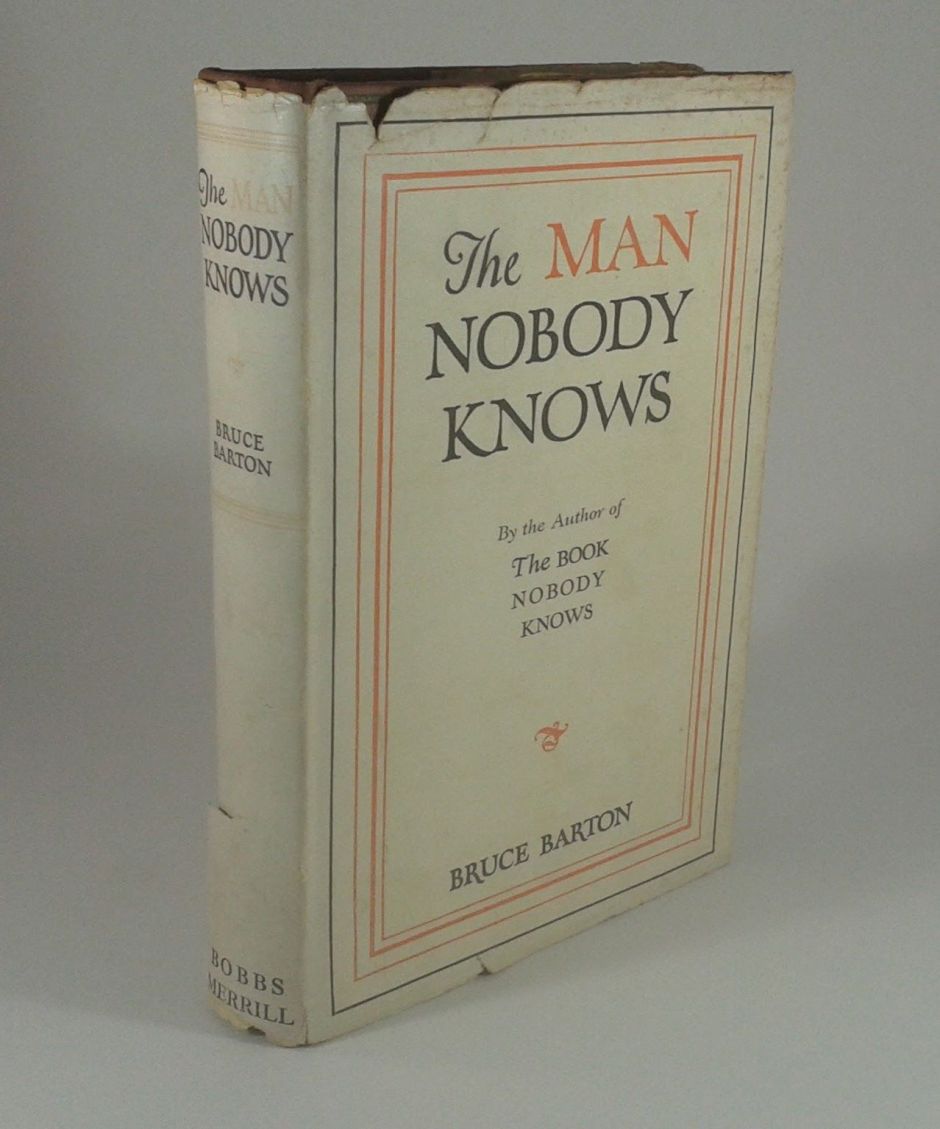
The Congregationalist pastor, William E. Barton was, by the way, the father of Bruce Barton, the same writer who turned Jesus into a model business executive in The Man Nobody Knows

Day After Mencken Day 2021

When little Felix comes home to his patriotic and Christian home with the news that the Fathers of 1776 were a gang of smugglers and profiteers, and when his sister Flora follows with the news that Moses did not write his own obituary and that the baby, Gustave, was but recently indistinguishable from a tadpole, and later on from a nascent gorilla—when such subversive and astounding doctrines are brought home from the groves of learning there ensues inevitably a ringing of fire- bells, with a posse on the march against some poor pedagogue.

What I maintain is simply that the vigilantes are right and the pedagogue wrong. His error lies in assuming that taxpayers lay out their hard-earned money for the breeding of traitors and atheists; taxpayers actually lay out their money for the breeding of more taxpayers like themselves. And their natural desire that this program be followed strictly is supported by the overwhelming force of the state, which loses strength and authority in direct ratio as its citizens become heretics. What holds it up is not primarily brute force, as so many theorists argue; what holds it up is the fact that, on all really essential questions, the vast majority of its citizens think exactly alike—that there is never any general doubt of the fundamental communal superstitions. Once those superstitions are seriously challenged, the whole fabric of the state begins to crumble. The true function of the pedagogue is not to attack them, but to propagate them. His is a sort of priestly office. He is not paid to marshal doubts and weigh probabilities; he is paid to expound revelation. If he finds himself temperamentally unable to discharge that solemn and awful duty, then he should quit pedagogy and go into bootlegging or some other free craft. So long as he is publicly consecrated to the birch, he can no more depart from his text-book with seemliness than a Christian clergyman could depart from his sworn belief in witches.

It is these sick and wounded of the army of learning, I suspect, who are responsible for most of the academic Bolshevism that now fills the newspapers. Having been purged, by their superior education, of the fundamental communal superstitions—or, at all events, of a few of them—they get revenge upon the society that ill-uses them by inoculating the children of honest Rotarians with their own odd and often nonsensical heresies. These are the fellows who, at frequent intervals, commit scandalum magnatum by teaching that the American patriot infantry, at Bunker Hill, ran all the way down the hill, or that General Grant was a heavy lusher, or that the Bolsheviki have not really nationalized women, or that the world is older than the Bible says, or that the Nordic Blond, biologically, is no more than a bald chimpanzee. And these are the fellows who yell that they are undone when indignant trustees give them the gate.

It seems to me that those who protest against their thus getting the gate fall into the elemental error of assuming, only too often, that an American college is the exact equivalent of a European university. It is called a university, and so they accept it as one in fact. But it is really nothing of the kind. There has been but one genuine university in the United States in our time—the Johns Hopkins under Gilman—and it turned itself into a college with frantic haste the moment he died. The college student differs from a university student in a most important way: his formal education, when he matriculates, is not completed, but simply entering upon its last stage. That is to say, he has not yet taken in the whole of that body of correct and respectable ideas which all of us must somehow absorb before we are competent to think for ourselves—at all events, to any rational purpose and effect.

Only too often the fact is overlooked that even the most bold and talented of philosophers must suffer that stuffing before he is ready to go it alone. Aristotle, you may be sure, had the Greek alphabet rammed into him like any other Greek of his time, and studied the multiplication table, and learned the elements of Greek civics, and all that was then accepted about the nature of the Persians, the functions of the liver, and the aorist. Kant was grounded in Prussian history, the humoral pathology, and the Leibnitzian law of preestablished harmony. Even Nietzsche had to master the grammar-book, the catechism and the Lutheran psalm-book, that he might be a good German and keep out of jail. Such training takes time, for children naturally resist it; it takes more time in America than elsewhere because our elementary-schools, in late years, devote themselves mainly to fol-de-rols borrowed from the Boy Scouts, Greenwich Village and Bernarr Macfadden. Thus the young American, when he enters college, is still only half-educated in the conventional sense. At least three of his four years are consumed in completing the lowly business of making him fit to vote, keep a checkbook accurately, and understand what is in his newspaper. Every now and then some humorist subjects a class of freshmen to what is called a general information test. Four-fifths of them invariably turn out to be as ignorant as so many European schoolboys of ten or eleven.

Obviously, it is as imprudent to parade political heresies before such infants as it would be to lecture on obstetrics before girls of thirteen. When they are graduated at last, they are perhaps ripe for it, but when they are graduated they commonly depart the halls of learning for the bond business. The relatively few who remain seem to suffer no damage from such ideas as they encounter in the graduate-schools. At all events, there is never any complaint that they are being ruined, nor do they themselves complain that the notions of the salient anarchists are being withheld from them. Most of them, having no desire save to get their Ph. D.’s and settle down as pedagogues, are probably anaesthetic to whatever play of ideas goes on about them. A few, taking fire, afterward lecture scandalously in the prairie “universities” to which they are doomed, stir up the students to revolt against their colleagues, and so get themselves cashiered. But not many. Nor is the practical damage serious. There is always room enough for the minority of genuinely intelligent fellows in the graduate-schools whence they came. The spotlights of Babbitt do not bathe these schools, for his sons are not in them; thus they are quite free to monkey with ideas all they please, even with red-hot ones. (H. L. Mencken, “In the Rolling Mills,” Prejudices, Sixth Series, 1927)

Mencken Day 2020

“Life in the Republic grows increasingly uncomfortable to men of the more urbane and seemly sort, and, despite the great material prosperity of the country, the general stock of happiness probably diminishes steadily. For the thing that makes us enjoy the society of our fellows is not admiration of their inner virtues but delight in their outward manners. It is not enough that they are headed for heaven, and will sit upon the right hand of God through all eternity; it is also necessary that they be polite, generous, and, above all, trustworthy. We must have confidence in them in order to get any pleasure out of associating with them. We must be sure that they will not do unto us as we should refuse, even for cash in hand, to do unto them. It is the tragedy of the Puritan that he can never inspire this confidence in his fellow-men. He is by nature a pedant in ethics, and hence he is by nature a mucker. With the best of intentions he cannot rid himself of the belief that it is his duty to save us from our follies— i. e., from all the non-puritanical acts and whimsies that make life charming. His duty to let us be happy takes second, third or fourth place. A Puritan cannot be tolerant—and with tolerance goes magnanimity.

The late Dr. Woodrow Wilson was a typical Puritan—of the better sort, perhaps, for he at least toyed with the ambition to appear as a gentleman, but nevertheless a true Puritan. Magnanimity was simply beyond him. Confronted, on his death-bed, with the case of poor old [Eugene V.] Debs, all his instincts compelled him to keep Debs in jail. I daresay that, as a purely logical matter, he saw clearly that the old fellow ought to be turned loose; certainly he must have known that Washington would not have hesitated, or Lincoln. But Calvinism triumphed as his intellectual faculties decayed. In the full bloom of health, with a plug hat on his head, he aped the gentry of his wistful adoration very cleverly, but lying in bed, stripped like
Thackeray’s Louis XIV, he reverted to his congenital Puritanism, which is to say, bounderism. (“From the Memoirs of a Subject of the United States,” Prejudices, Sixth Series)