Why You Don’t Need the Westminster Confession (or Calvin or Winthrop) to do Protestant Politics?

One of the tendencies in the critics of Kevin DeYoung’s defense of John Witherspoon and the American revision of the Westminster Confession (not mentioned here) is a need to base contemporary political reflection and action – even – on past Protestant models. The critics of DeYoung did this by reference to the meaning of the Westminster Confession. Others at American Reformer have also argued for a recovery of early modern Protestant politics. The advantage of this argument is that it paints Witherspoon, American Presbyterians, and always 2k advocates in the corner of departing from Reformed orthodoxy.

But what if you don’t need pre-Lockean understandings of politics and the good society to have a Protestant voice in liberal political structures? What if today’s Protestants who want to advocate for Christian norms looked to Presbyterians who both accepted the terms of liberal democracy and free markets and advocated Protestant-friendly positions on matters of political debate? What if you could be a kind of Christian nationalist without needing to read all of the pre- or early-modern Protestant theologians on the divine mandate for the Christian magistrate and a godly commonwealth?

That is what happened in the 19th century in England, Scotland, Ireland, Canada, and the United States. Presbyterianism began in 16th century England and Scotland as a force of opposition to rule by bishops and continued as a form of checks upon elites in both government and the church, Presbyterians saw overcoming injustices of the past with improvements that led to a fairer future. Such a disposition almost always places Presbyterians on the side of freedom and limited government whether in the form of freedom of conscience or ecclesiastical autonomy from meddling magistrates. This cast of mind nurtured in Presbyterians at least sympathy if not outright support for political and economic reforms that reduced the authority and wealth of the few and expanded society’s benefits as broadly as possible. Such an outlook, as in the case of the United States, could lend support for small government and reliance on voluntary associations for improving social conditions. But even where the state’s footprint in managing the forces of modernization was larger than the American form of government, Presbyterians generally supported those “good” governments whose rule extended the blessings of modern society as widely as possible.

For this reason, increase in suffrage, more extensive representation in government, free trade and better distribution of goods for more affordable prices, higher rates of literacy and advanced learning, and greater suppression of vices, not to mention the separation of church and state were all policies on Presbyterians’ horizon on the phase of their particular nation’s evolution.

Among the proponents of these views were Charles Hodge in the United States, William McKerrow in England, Thomas Chalmers in Scotland, Henry Cooke in Ireland, George Monro Grant in Canada, and James McCosh – can you believe it – in Scotland, Ireland, and the United States. These Presbyterians may have been on different places on the page of Reformed theology and Presbyterian worship, but their outlook on government and society stemmed from their understanding of Presbyterianism in its modern, liberal, political version. Advocates of the spirituality of the church or its 2k nomenclature may take issue with these Presbyterians, but they show you don’t need to turn the clock back before 1789 to have Presbyterian politics.

It goes without saying that the constellation of political and economic positions adopted by these Presbyterians was a long way from the godly commonwealth of the Scottish Reformation or England’s Second Reformation. But after the Glorious Revolution (1689), Presbyterians learned by experience and reflection that the same political arrangements that lightened the church’s burden from an overreaching magistrate were also among the tools by which modern nations could fashion a generically Christian society.
After All These Years It’s Still Theonomy vs. 2K

From David VanDrunen’s review of Brad Littlejohn’s Called to Freedom: Retrieving Christian Liberty in an Age of License.

On a general level, Littlejohn at times seems to jump from the observation that without certain virtues, people won’t use their outward freedoms well the conclusion that civil officials may therefore legitimately restrict these freedoms. But although the observation is valid, the conclusion doesn’t necessarily follow. On what basis do civil officials have authority, for example, to restrict market transactions or prohibit non-Christian religions for the “common good” when no force or fraud is involved?

Perhaps instructive is Littlejohn’s understanding of civil authorities as “fathers of their people” who ought to “exercise paternal care” for them. There is some similarity between fathers and civil magistrates, but there are also so many differences that it seems dangerous to invoke this analogy as grounds for specific government regulations. For one thing, fathers have extensive authority over even minute details of their children’s lives. On that analogy, civil officials could regulate almost anything. Perhaps even worse, the analogy presumes that citizens are children. This seems to work at cross-purposes to Littlejohn’s oft-stated ideal that citizens be morally mature and self-governing.

We see another reason for Littlejohn’s openness to extensive government authority in his support for the “classical Protestant theory of religious liberty.” He explains this theory as follows: In Romans 13 and 1 Peter 2, God calls civil authorities to punish evil and praise the good (although not, contra Littlejohn, to “reward” or “promote” the good). The natural moral law defines what is evil and good. The Ten Commandments summarize the natural moral law. This means, in Littlejohn’s telling, that civil officials have authority to enforce the “full scope” of the Ten Commandments.

But there’s a problem with this reasoning. The fact that civil officials punish evil and praise the good doesn’t entail giving them jurisdiction over all that is evil and good. What’s more, the natural moral law—what we know about right and wrong from the testimony of nature—doesn’t provide nearly enough guidance for civil authorities on which religion to promote or restrain. The testimony of nature itself doesn’t reveal truths about the Trinity, atonement for sin, the church, and other core matters.

At best, Littlejohn’s belief that civil magistrates may restrain non-Christian worship and proselytizing needs more extensive argument. Could Scripture provide it? One might appeal to the precedent of Old Testament kings under the Mosaic theocracy, which is exactly what many pre-modern Christian theologians did. But since contemporary political communities are not God’s holy people, in redemptive covenant with God, such appeals are highly problematic. Littlejohn briefly glances at these issues but doesn’t really discuss them.

At one point, Littlejohn states that Christians can disregard ungodly rulers when they issue clear commands to transgress Scripture. Yet in other cases, he argues, we can cheerfully tolerate them. Are there really no other instances when Christians might justly disregard such rulers? When rulers act contrary to the laws of their own community, for example, shouldn’t citizens commit to following the law instead?

Littlejohn himself, when discussing political freedom as liberty under law, appeals to the classical notion that law should be consensual. In other words, it ought to emerge from “time-tested customs and communal practices, unwritten laws that written laws should respect.” This is indeed a noble idea. But if we take it seriously, it requires the people to have a great deal of independence to forge their own ways of life, which entails corresponding limitations on civil authority. It would have been interesting to see Littlejohn develop this theme and reflect more on its implications.

Even if Littlejohn’s conception of the extent of civil authority needs further defense, his larger perspective on Christian liberty is solid, insightful, and sometimes eloquent. Called to Freedom usefully clarifies the issues at stake, even if it doesn’t settle all of them. It should stimulate, but not end, important discussions on what it means to be free.

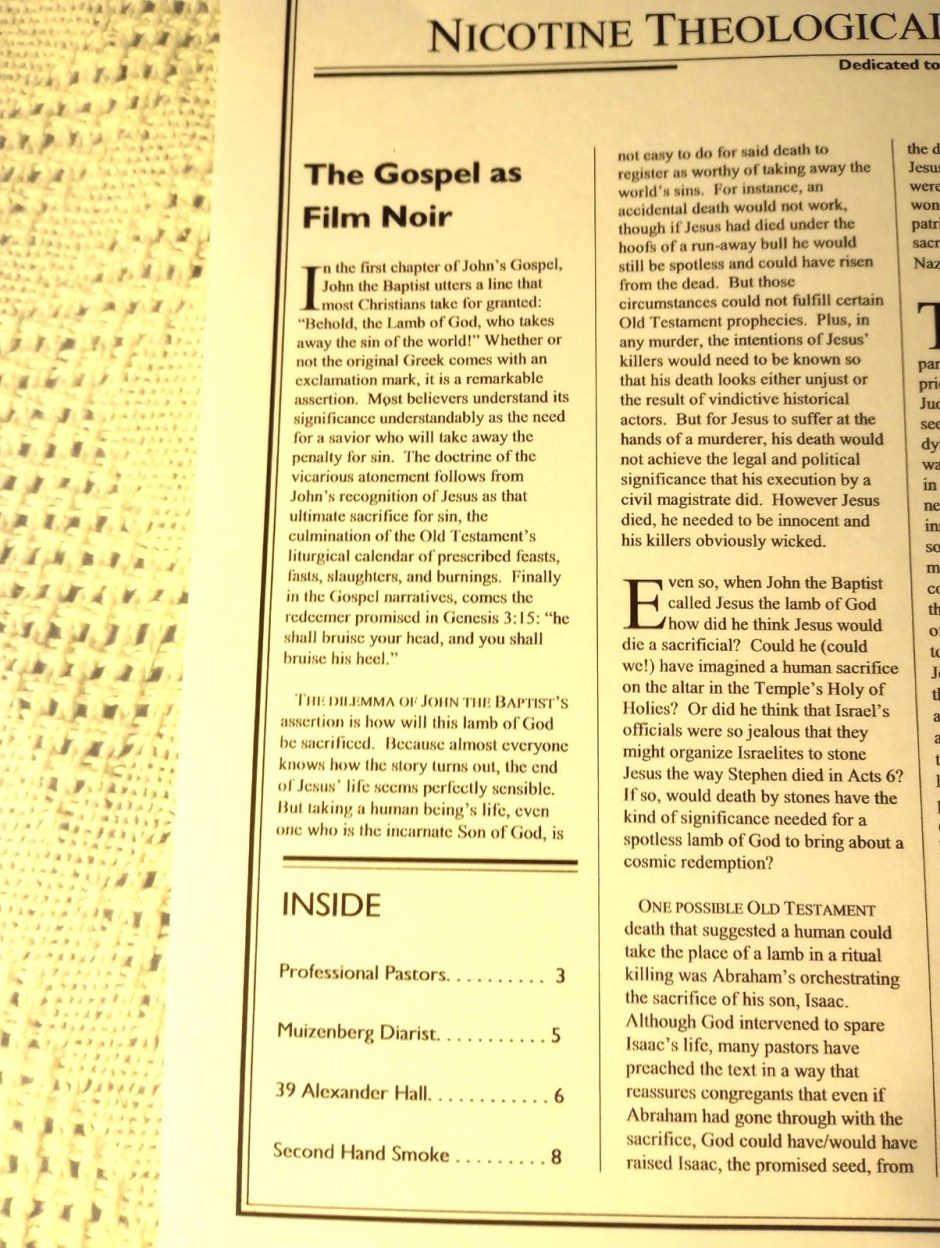
Summer 2023 NTJ Available (pdf)

To repeat, this is not a typo. The Summer 2023 issue is now available at Oldlife.org. Huzzah? Maybe not.

In it, readers will find a case for shorter (8-10 years) pastorates as opposed to the increasingly common one of decades long tenures for pastors. Here is an excerpt:

In lengthy pastoral tenures a congregation becomes so comfortable with their minister (and vice versa) that the identity of the place has more to do with the people in this particular setting than with the denomination. Such a situation makes it harder to find a successor to the long-term pastor. A congregation might need to conduct a lengthy search to find that one person who has just the right gifts for this group of Christian. At that point, the congregation might well forget the nature of the ministry according to the common standards of the denomination. They might want “our guy” more than, for instance, a generic Presbyterian pastor who can do all the things that a man trained for the Reformed ministry is supposed to do. The congregation might forget what it means to belong to a certain communion because it functions largely within its own local context with its own pastor. A pastoral search could then depend more on personal qualities than on the demands of presbytery and the denomination’s corporate witness.

Conversely, expectations for relatively short pastorates, say from five to seven years, likely nurture a sense of belonging to a wider communion in which ideally all of the ministers should be able to serve in any congregation. Instead of building up a kind of co-dependency between minister and congregation thanks to a long tenure, a series of medium-term calls may encourage church members to deepen their membership in the broader communion beyond the congregation.

Summer 2023 NTJ (not a typo) Is Out

For those who have subscribed (simply by sending an email address), the Summer 2023 issue of the Nicotine Theological Journal is in their inbox. In that number readers will see the entire short piece that begins this way:

Idolatry in the Negative World

Aaron Renn says that American Christians now experience a culture that is hostile to the Christian faith in contrast to previous eras that either viewed Christianity positively or in which believing was neutral, neither offensive nor appealing. He argues the change came sometime around 2014.

Another change seems to have occurred that may say more about American Protestants than about the nation they inhabit. Somewhere in the mix of changing perceptions of American society and churches, conservative Protestants developed a different conception of sin. One sign of this change was a worship service recently broadcast from Moody Memorial Church in Chicago (Moody, of course, named after the urban evangelist, Dwight L. Moody). The broadcast included the prayer of confession. In it the pastor asked forgiveness on behalf of the congregation for desiring sex, money, and power.

That trilogy struck this listener as odd. . .

Prostitution: A Modest But Entirely Reformed Proposal

From the Archives: Nicotine Theological Journal (October, 1997)

Prostitution: A Modest But Entirely Reformed Proposal

In all of the discussion in Reformed circles about the role of women in modern society, one topic has been sadly neglected. This topic relates to a profession occupied by women for centuries, but for which their contribution has never been recognized or appreciated, especially by Reformed people. Indeed this profession has usually been vilified even though the women practicing it, themselves had often been victims of the worst sort of brutalization. I speak of the profession of prostitution.

The church for centuries, in an oppressive and patriarchal manner (I may be guilty of redundancy here), has censured prostitution. But have we ever carefully examined this traditional stance of the church? In this modern time may not the spirit lead us into some new examination of the Scriptures and some new understanding of this complex issue? Have we taken seriously the testimony of women that they feel called to and fulfilled by this work? For many the money is good. Just as we have learned that making money on the Sabbath is good in the modern world, so in the matter of prostitution we may need to rethink.

Three Pillars
Let me suggest that the case for prostitution rests on three pillars. The first pillar is the key text of Scripture: “Whatever you do, do it all for the glory of God” (I Corinthians 10:31). The second is the clear parallel between slavery and prostitution. The third is understanding properly those texts that seem to condemn prostitution.

THE FIRST PILLAR IS CRUCIAL. I Corinthians 10:31 shows that Paul has completely broken with old forms of ethical thinking and made ethics radically teleological. Actions must be judged solely by whether the intention is to glorify God or not. Paul says that what appears to be an act of idolatry -eating meat offered to idols- is not idolatry if the intention is to glorify God. This radical reorientation of ethics has been largely missed by the church through the centuries, but it is time to allow this seminal verse to have its full weight in our thinking. It is not actions but intentions that determine whether something is right or wrong. Our children have been trying to help us see this point for a long time with their oft repeated observation, “I didn’t mean it.”

Once this text really grips us, we cannot help but see its application to prostitution. It is not the action, but the intention that is crucial in evaluating any human activity. If one feels called to glorify God in the calling of prostitution, then it surely is the Bible-approved thing to do.

The Bible itself gives clear application of this great principle in the case of Rahab. Rahab the prostitute is a model of faith, courage, and devotion. Scripture nowhere condemns her for being a prostitute or says that she ceased to be a prostitute. Obviously she continued to be a faithful prostitute.

THE SECOND PILLAR IN THE defense of prostitution is the obvious parallel to slavery. Prostitutes, like slaves, have often been treated like chattel. They have been abused, victimized and oppressed. They have been controlled by heartless pimps as slaves were by cruel masters.

Historically the church has sought to remedy prostitution by urging prostitutes to stop being prostitutes. But isn’t that like suggesting to slaves that the problem with slavery was the work rather than the bondage? Prostitutes do not need to stop working; they need to be liberated. They need to have their work honored and properly compensated. They need freedom to practice their profession when, where and how they choose. That kind of liberation was the solution to slavery and is clearly the only responsible solution to the enslavement of prostitutes.

The third pillar relates to biblical texts that seem to oppose prostitution. Indeed some may feel at the outset that the biblical position is so obvious that no further examination is necessary. But the history of the church teaches us that there are always alternative perspectives and interpretations of every text in the Bible. We must not feel bound to any traditional interpretation- which is, after all, just the work of men- but must be open to new ideas and the leading of the spirit. (See Jeremiah 42 and 43.)

Two kinds of texts have been used to oppose prostitution. First are the OT’s warnings about harlotry. While these texts are numerous, they are not meant to be universal in their application. In OT times prostitutes were associated with pagan temples and pagan worship. The harlotry condemned in the OT is the harlotry that links sex to idolatry and false religion. Modern prostitution has nothing to do with idolatry and so is not condemned in these texts.

The second set of texts that seems to condemn prostitution are those related to the seventh commandment, “You shall not commit adultery.” Some of you will think that this text is crystal clear. But think again. Adultery is a violation of the spiritual-physical union of a marriage. But prostitution has nothing to do with spiritual unions. It is a purely physical relationship, and so it cannot effect the personal union of marriage. Moreover many social scientists believe that prostitution has beneficial social consequences. Therefore we should recognize that prostitution is not condemned by the seventh commandment.

Now some may think that there is a still clearer biblical condemnation of prostitution. Paul did say, “Do you not know that your bodies are members of Christ himself? Shall I then take the members of Christ and unite them with a prostitute? Never!” (I Corinthians 6:15). But let us not approach this text as if we were fundamentalists. We must recognize that Paul has not given full play to his basic teleological ethics in this text. (Perhaps he even intended that I Cor 10:31 be a correction of his statement here in I Cor 6:15.) Paul seems confused about the relation of the physical with the spiritual in this one place- a confusion which he avoids in the main thrust of his writing. He probably wrote this way to encourage us to use our ingenuity to figure out his real, full meaning. In any case it is clear that Paul cannot mean what he says.

THE CONCLUSION WE MUST reach is that prostitution is not condemned in the Bible. If it is not condemned, then it must be legitimate. Indeed the general thrust of the Bible not only permits it, but rather tends to encourage it- if done to the glory of God. We may well be disobedient to God if we oppose prostitution.

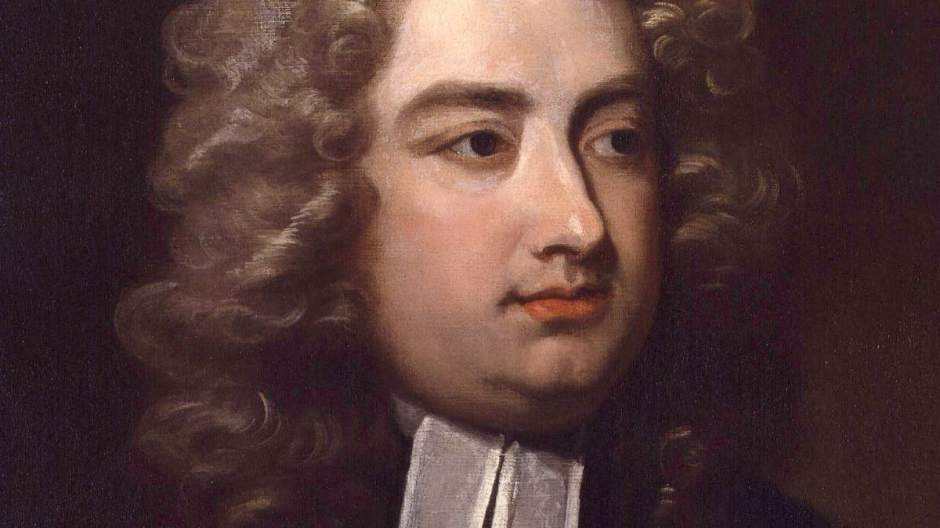
My modest proposal will not, I expect, gain immediate, universal support. Such proposals seldom do. Jonathan Swift experienced that with his original “Modest Proposal” when he suggested during a famine in Ireland that parents should eat their children. Yet the reasonableness and practicality of this proposal have stood the test of time. There can be no doubt that fewer adults would have died if they had eaten their children.

My conclusion that prostitution is not only legitimate, but that it is one more profession to be redeemed by earnest Christians, may seem radical at first glance. But, thoughtful reader, I want to assure you that this conclusion has been reached following the hermeneutical principles laid down by Louis Berkhof. Indeed, this conclusion was in many ways anticipated by the great Reformer Martin Luther. He once said, “All callings are honorable with the possible exceptions of burglary and prostitution.” This great student of the Scriptures was already beginning to see the radical implications of teaching that every profession is a calling.

SO WHEN YOUR DAUGHTER comes to you with tears in her eyes and asks, “Mom and Dad, why can’t I be a prostitute?”, don’t be harsh, judgmental or old-fashioned. Don’t undermine her self-esteem. Don’t stand against the work of the Spirit to break down oppression and to redeem another area of life. Encourage her to use all her gifts. Encourage her to pursue her calling.

Thanks to the new hermeneutic, whoring has become honorable in the church.

I. M. Free

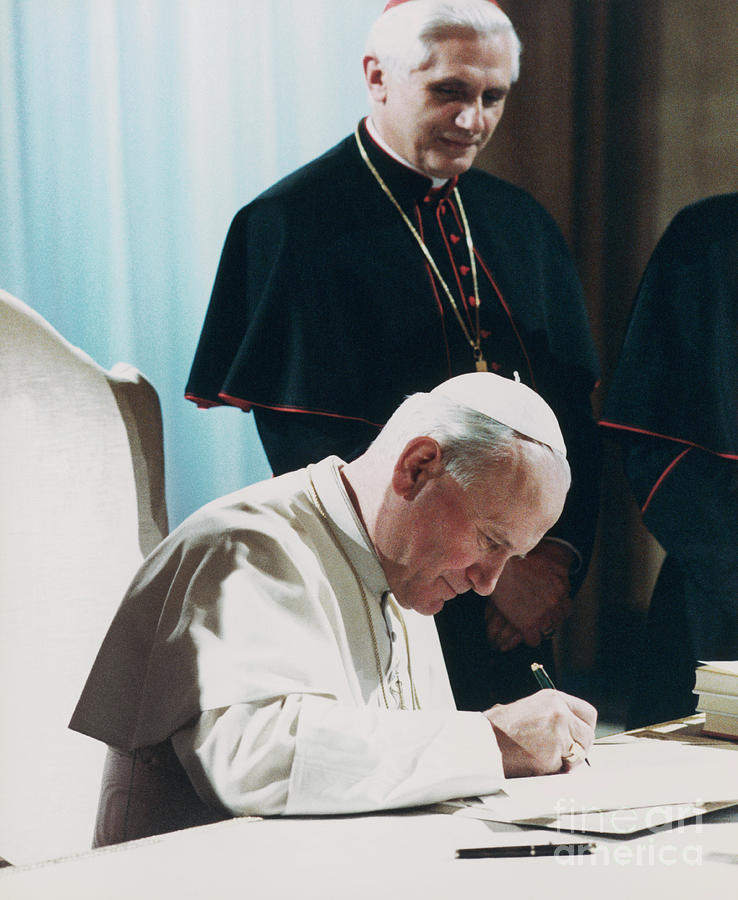
The Last Time a Pope Died

From the October 2005 issue of the Nicotine Theological Journal

The Faith of Modernism

When John Paul II was elected pope in 1978, some American evangelical observers of Rome referred to him as “J2P2.” About ten years later that nickname receded, an indication of a significant transition in his pontificate: this pope was becoming even more popular than Star Wars. It is easy to see now why American evangelicals fell in love with pope John Paul II. He was instrumental in the defeat of Communism, courageous in defense of traditional marriage, and relentless in his advocacy of the culture of life.

Why didn’t Paul VI a enjoy similar press? After all, a re-reading of his widely lampooned Humanae Vitae reveals it to be a brilliant, if flawed, critique of our technological age. But Paul VI’s tired and melancholy demeanor lacked the vigorous and telegenic charisma of John Paul II, a master of modern media.

Timothy George compared the winsome attractiveness of John Paul II to the ultimate American evangelical icon, Billy Graham. “Many of the things said of the pope you’d say of Billy Graham,” George recently told Christianity Today. “From an evangelical base he’s tried to reach out and be embracing and yet be faithful to the gospel. And you put those two together, Billy Graham and the pope, you have there the winsome, visible face of world Christianity in the last half century.”

Again, this is understandable, and there is much for Protestants to be thankful for in this remarkable 25-year pontificate. But can it be said from a Protestant perspective that John Paul II’s legacy was marked by theological progress? How ought we to evaluate what Mark Noll described as Roman Catholicism’s “dramatically altered relations with Protestant evangelicals”? Are we led to imagine that the Reformation is over? There are reasonable grounds for skepticism on the part of Protestant confessionalists.

This is not to question the pope’s openness to the theory of evolution, as some Protestant fundamentalists and Roman Catholic traditionalists have. John Paul II hardly endorsed Darwinism; he merely invited Christians to engage in legitimate scientific inquiry without succumbing to scientism. No, John Paul II was clean here, although it was left for his successor, Benedict XVI, to state the matter with greater theological precision when he emphasized that “we are not some casual and meaningless product of evolution.”

In following through with the work of Vatican II, John Paul proclaimed the church’s openness to the future. But should Protestants be encouraged when “aggiornamento” replaces the take-no-prisoners exclusivism of pre-Vatican II Rome with the universalism of Vatican II? A perusal of Crossing the Threshold of Hope should dispel any doubt that John Paul II is a modernist, especially with regard to his attitude toward other religions. John Paul II seems to articulate his own version of Open Theism here: salvation is open to all “people of good will” (though only Rome possesses the fullness of that salvation). Jews are older brothers in this vague and universal faith, and he goes on to make frightening concessions to the “deep religiosity” of Buddhists, Hindus, and Moslems, reserving his criticism of the latter to the “fundamentalists” among them. “It will be difficult to deny that this doctrine is extremely open,” he writes. “It cannot be accused of an ecclesiastical exclusivism” (emphasis original).

The old-style Protestant modernist Shailer Mathews insisted that Modernism was not liberalism. Modernists, he wrote, were evangelicals who use the scientific, historical, social method in understanding and applying evangelical Christianity to the needs of living persons. Mathews’ call for Christian accommodation to modern times reads much like John Paul II’s. Perhaps there is no American Protestant he may resemble so much as Charles Briggs, who though conservative by inclination and committed to traditional doctrines such as the virgin birth, sought to bring American Presbyterians into the modern world, introducing them to confessional revision, higher criticism and doctrinal tolerance.

Another similarity between the recent pope and Protestant modernism was his reticence to apply church discipline to Roman Catholic dissenters. Rising to his defense, many have pointed out how imprudent excommunication would have been. Dissent was far too entrenched in the American Roman Catholic higher education, which had become a barren wasteland beyond correction. A crackdown would involve not just the prominent – he could not limit it to the likes of Hans Küng – but would have involved tens of thousands. So the pope was between a rock and a hard place, and his hands were tied.

Somehow that rings hollow for a pope credited with dismantling communism. Where is the sign of contradiction? And whatever happened to his slogan, “Be not afraid”? He’s the POPE, for crying out loud. A more plausible explanation seems to be that discipline was less beyond his power than contrary to his style. So the dirty work was inherited by his successor, Benedict XVI, and Roman Catholic conservatives have already appealed to him to take serious disciplinary action.

Where Noll’s “dramatically altered relations” is most evident is in ways John Paul II’s papacy has encouraged American evangelicals to collapse spiritual warfare into cultural warfare. Under the pope’s leadership and example American Roman Catholics and evangelicals have found common cause in lobbying for the culture of life. This has led to the confusing and divisive work of “Evangelicals and Catholics Together” in 1994 and its successors. To be sure, evangelicals argue that theological differences remain – there’s the whole Mary thing – but these are relegated to the theological periphery. “The disagreements that Protestants have with John Paul II are things that are in addition to the foundations of the faith,” said Southern Baptist Richard Land. In a more theologically literate age, confessional Protestants would call that doctrinal indifference.

In a commonly misunderstood section in his book, Christianity and Liberalism, J. Gresham Machen suggested that Presbyterian orthodoxy had more in common with Rome than with Protestant liberalism. Machen’s predicament was that if forced to choose between Protestant modernism, which had all but abandoned the exclusivity of the Christian religion, and Roman Catholicism, a faith that in the 1920s was still affirming that outside the church there is no ordinary possibility of salvation, the decision would have been to side with the Christian though flawed expression. That choice took on a different dimension after Vatican II when in its effort to engage the modern world the Roman Catholic hierarchy embraced modernism. So with the magisterium of John Paul II, who fleshed out Vatican II’s modernism, Machen would not have been confronted with a choice. For all of his gifts and virtues, John Paul II was a theological modernist. Evangelical adulation of his papacy gives every suggestion of a dance with modernism.

JRM

Machen Day 2022: Been There, Done That

In What is Faith?, Machen defended the intellectual nature of faith and needed to counter trends in American higher education. Sounds relevant.

The intellectual decadence of the day is not limited to the Church, or to the subject of religion, but appears in secular education as well. Sometimes it is assisted by absurd pedagogic theories, which, whatever their variety in detail, are alike in their depreciation of the labor of learning facts. Facts, in the sphere of education, are having a hard time. The old-fashioned notion of reading a book or hearing a lecture and simply storing up in the mind what the book or the lecture contains this is regarded as entirely out of date. A year or so ago I heard a noted educator give some advice to a company of college professors advice which was typical of the present tendency in education. It is a great mistake, he said in effect, to suppose that a college professor ought to teach; on the contrary he ought simply to give the students an opportunity to learn.

This pedagogic theory of following the line of least resistance in education and avoiding all drudgery and all hard work has been having its natural result; it has joined forces with the natural indolence of youth to produce in present-day education a very lamentable decline. . .

The undergraduate student of the present day is being told that he need not take notes on what he hears in class, that the exercise of the memory is a rather childish and mechanical thing, and that what he is really in college to do is to think for himself and to unify his world. He usually makes a poor business of unifying his world. And the reason is clear. He does not succeed in unifying his world for the simple reason that he has ho world to unify. He has not acquired a knowledge or a sufficient number of facts in order even to learn the method of putting facts together. He is being told to practise the business of mental digestion; but the trouble is that he has no food to digest. The modern student, contrary to what is often said, is really being starved for want of facts.

Certainly we are not discouraging originality. On the contrary we desire to encourage it in every possible way, and we believe that the encouragement of it will be of immense benefit to the spread of the Christian religion. The trouble with the university students of the present day, from the point of view of evangelical Christianity, is not that they are too original, but that they are not half original enough. They go on in the same routine way, following their leaders like a flock of sheep, repeating the same stock phrases with little knowledge of what they mean, swallowing whole whatever professors choose to give them and all the time imagining that they are bold, bad, independent, young men, merely because they abuse what everybody else is abusing, namely, the religion that is founded upon Christ. It is popular today to abuse that un-popular thing that is known as supernatural Christianity, but original it certainly is not. A true originality might bring some resistance to the current of the age, some willingness to be unpopular, and some independent scrutiny, at least, if not acceptance, of the claims of Christ. If there is one thing more than another which we believers in historic Christianity ought to encourage in the youth of our day it is independence of mind. (What is Faith?, 15, 16-17)

How Liberal Protestantism Happens (and it’s even worse when it claims to be conservative)

When you ask the church to do something that it can’t, you have a problem.

Here is the premise for Mark Tooley’s brief for churches building community: Matt Yglesias.

Left leaning commentator Matthew Yglesias, who’s Jewish, tweeted today: “Think I’m becoming a Straussian/Putnamist who instrumentally wants to get everyone to go to church again.” Columnist Ross Douthat, who’s Catholic, responded: “Be the change you seek.” Yglesias retorted: “Not gonna sell out the chosen people like that! But I’m gonna go neocon and root for the Christians vs the post-Christians.”

Tooley then goes on about how much Protestant churches civilized America:

Churches and denominations were central to building America’s democratic ethos. They civilized and socialized the early frontier. They created a wider civil society supporting politics, education, charity and community building. Regular church goers have never been a majority in America. But churches as institutions were foundations and pillars of wider society that benefitted all. Typically savvy non religious people have recognized their centrality to American culture and civic life.

He even defends civil religion:

What critics of civil religion fail to see is that Christianity has a duty to society to help create the language and architecture for constructive civil life that benefits all. Christianity wants all to be fed, clothed, housed, provided health care, treated with dignity, given security, and equipped with the political tools to live harmoniously in peace. Christians seek the common good for all society, not just what directly benefits themselves. But this promotion of the common good certainly benefits Christians and itself witnesses to the power, grandeur and truth of the Gospel.

This is out of the playbook of Tim Keller on the church and social capital.

Tooley thinks that evangelicals and secularists fail to see the value that churches add to civil society:

Nondenominational Christianity and evangelicalism often lack this long history and self-understanding as cultural stewards. They often focus more exclusively on individual faith and spiritual needs sometimes from a consumerist perspective. Sometimes their adherents see themselves more as a tribe or a subculture than as parcel to wider society with wider responsibilities.

That could be the reason for some. But for others, the problem is that the social mission of the church is not only hard to find in Peter or Paul or Jesus (is that bar too high?), but also that when Protestants were best at creating social capital, they forgot about Jesus and the world to come. That’s why Machen was important. He saw what the social purpose of the church was doing to stuff like doctrine, preaching, evangelism, and missions.

The rejection of the Christian hope is not always definite or conscious; sometimes the liberal preacher tries to maintain a belief in the immortality of the soul. But the real basis of the belief in immortality has been given up by the rejection of the New Testament account of the resurrection of Christ. And, practically, the liberal preacher has very little to say about the other world. This world is really the center of all his thoughts; religion itself, and even God, are made merely a means for the betterment of conditions upon this earth.

Thus religion has become a mere function of the community or of the state. So it is looked upon by the men of the present day. Even hard-headed business men and politicians have become convinced that religion is needed. But it is thought to be needed merely as a means to an end. We have tried to get along without religion, it is said, but the experiment was a failure, and now religion must be called in to help. (Christianity and Liberalism)

How does Tooley think the mainline churches went off the rails? Some conservatives believe it happened because pastors let this world become as important as the world to come, not to mention that talking about otherworldliness with members of Congress and professors at Yale produces cringe.

But if you want to see Tooley’s argument salvage a Protestant liberal as a conservative, look at Geoffrey Kabaservice’s rendering of William Sloane Coffin, Jr., who according to the New York Times combined the social gospel with 1960s activism (at Riverside Church, “an institution long known for its social agenda — he used his ministry to draw attention to the plight of the poor, to question American political and military power, to encourage interfaith understanding, and to campaign for nuclear disarmament”).  But liberal Protestantism can become conservative when it supplies social glue:

In doctrinal terms, Coffin was indeed a conservative, even an orthodox one. He retained the traditional Protestant liturgy, from the opening prayer to the confession to the benediction, resisting the wave of reform that swept over most denominations in the 1960s. His congregation sung the powerful old New England hymns. . . . The civil rights and antiwar activism of the 1960s seemed part of a much older American history when set to the hymn’s ominous, rolling cadences and the spine-tingling words of McGeorge Bundy’s ancestor, the nineteenth-century poet James Russell Lowell: “once to every man and nation / Comes the moment to decide, / In the strife of truth with falsehood, / For the good or evil side; / Some great cause goes by forever / ‘Twixt that darkness and that light.”

If social ministry can turn Coffin into a conservative, even doctrinally orthodox Protestant, Tooley has some work to do.

Here’s maybe not the but a thing: civil society does not depend on Christians. Believers often make good neighbors, though you’d never know from evangelical scholars these days. Invariably, Christians take out the trash, support Little League, donate books to the public library’s book sale fund raiser, approve of taxes to support police and fire departments. They also vote, which can be an anti-democratic form of social behavior if the ballot goes for the wrong candidate. If civil society has declined in America, it is not because of churches or their members. Rotary, the Elks, and Odd Fellows have also faded in the fabric of American society. For a host of reasons, Americans don’t join a host of voluntary organizations any more. One hunch is the social world that the internet has created. Another factor may be the outgrown size of national politics in the attention of journalists, teachers, and even radio talk show hosts.

But even if the path to a health America went through the social capital generated by churches, the question remains: is this what Scripture teaches?

Liberal Presbyterianism before Erdman

Not science or naturalism but politics, community, social capital, and civility have weakened Presbyterian convictions way more than higher criticism or evolution. The situation in Scotland after the Glorious Revolution and the restoration of Presbyterianism in the Kirk:

This new urban sociability reflected and contributed to the pan-British and European shift towards latitudinarianism near the turn of the century. The clergy’s co-operation in pursuits that lay outside the narrow boundaries of theology fostered camaraderie among individuals from across the religious spectrum. ‘We perfectly agree with you in your sentiments’, the London Society for the Reformation of Manners wrote to their Scottish counterparts, ‘that however Christians may differ in opinion as to other things, yet they should all agree in advancing the common interest of Christianity in promoting the practice of piety and virtue.’ In turn, the Scottish Societies resolved ‘not to meddle with the particular opinions or practices of persons in religion, [for] although we differ in our sentiments as to some things, yet that we are united in our zeal for God, our charity for men, and concern for our country, do invite and entreat all’. When the Scottish Society for Propagating Christian Knowledge sought donations to establish parochial libraries throughout northern Scotland in the early 1700s, they relied on English clergymen of all theological stripes for assistance. An analysis of the libraries’ catalogues reveals an interesting result from the joint endeavour. In addition to the expected staples of orthodox Presbyterians, English men and women sent discourses that were disproportionately comprised of moderate English Episcopalian bishops or archbishops, such as John Tillotson, Gilbert Burnet, Edward Stillingfleet and Benjamin Hoadly, as well as Robert Leighton, the former archbishop of Glasgow who had attempted to unite Presbyterians and Episcopalians in the 1670s. Furthermore, scientific and philosophical writings by John Locke, Francis Bacon, Robert Sibbald, Robert Boyle,William Chillingworth, Hugo Grotius and Samuel von Puffendorf, in addition to Cicero and Euclid, were also quite popular. Records for Inverness, Dumbarton, Dingwall, Dumfries, Sleat, Duriness, Kilmoor, South Uist and Bracadle all confirm this pattern to be the norm.

Against this trend of tolerance and intellectual innovation, a majority of Presbyterians vehemently resisted with protests in the General Assembly and legal depositions in the parishes. There was a noticeable dichotomy between the Assembly’s leanings and those of the Presbyterians who comprised it. How, then, did the moderates attain their victories and enforce their influence? They relied upon the Williamite state, which was committed to forging inclusive national churches in Scotland and England, to turn a numerical disadvantage into an opportunity via diplomacy and undemocratic means – namely, the strategic manipulation of key religious institutions. (Ryan K. Frace, “Religious Toleration in the Wake of Revolution: Scotland on the Eve of Enlightenment, 1688-1710s,” Journal of the Historical Association, 2008, 369-70)

Can You Write This After 2019? (finale)

Another entry under the category of timelines, to go with part one and part two.

What did the black church need roughly fifteen years ago?

We are now living in a generation of African Americans who are significantly unchurched. For three centuries, the black church stood as the central institution of black life. Its relevance was unquestioned and its moral and spiritual capital unparalleled. Now, the church is largely viewed as irrelevant by vast numbers of mostly young African Americans, despite concerted efforts to make the church a multipurpose human service organization with housing, child care, after school, health care, economic development and other social service programs. It seems the more the church does the less relevant it becomes.

The reason for this state of affairs is that the unbelieving world tacitly understands that the primary reason for the church’s existence is not temporal. Though the world is wracked with pain and suffering, it intuitively grasps the fact that the answers it longs for are transcendent, not earthly. So, the more the church appeals to the world’s felt needs and physical deprivations, the more irrelevant it becomes to those who lack a true and saving knowledge of Jesus Christ. (Thabiti Anyabwile, The Decline of African American Theology: From Biblical Faith to Cultural Captivity [2007] 244-45)