Imagine This Much Concern About Joel Osteen

When faith is so important to social order and national identity, political woes become spiritual crises:

Many of the evangelical leaders who have endorsed Trump have done so due to fears about what the American church’s future will be in a post-Obergefell America. Will religious liberty for Christian business owners be protected? Will state-level abortion restrictions be done away with? Will Christian universities and seminaries continue to exist? Will Christian parents have the freedom to give their children a Christian education?

All of these concerns are completely valid. Both Matt and myself have been abundantly clear on that point for some time now. We really are facing something of a doomsday scenario in American Christianity.

But freedom to worship or preach the Bible is chopped liver? Even freedom to stigmatize bad preachers?

I could turn out to be wrong and even more foolish than I already appear, but Christians really need to show their faith and take a breath about this election. I remember while studying at L’Abri during the 1976 presidential contest Francis Schaeffer talking about the choice between Jimmy Carter (bad) and Gerald Ford (good) in Manichean terms. I also remember not being convinced.

But the land of the free and home of the brave has a way of turning believers apocalyptic.

The Limits of W-w

Like I say, transformationalism is good on inspiration but not so good on transformation. Jim Bratt gave a peak behind the curtain of neo-Calvinist culture in the U.S. in his last post before heading to China on a Fulbright (happy trails, Jim):

Boy, do we need that now. I’m thinking of the death this past week of Tim LaHaye. The span of tomfoolery he pumped out in the name of Christianity has created lasting disrepute for the faith. The creation “science.” The “end-times” irresponsibility, compounded of self-pity, blaming others, and a certain cultural idolatry. All of it redolent of the John Birch Society swamp from which he first slithered. Still, it’s the sort of religious fantasy you can expect to hit the American best-seller list. The death that really strikes home for me is the moral nadir of Mr. Family Values, “Dr.” James Dobson. His endorsement of Donald Trump puts paid to any pretense that the ethics and politics he pushed, lo, these many years have come to anything but authoritarian nationalism with a particular macho strut. For that is Trump. Dobson’s worse for covering it with smarmy God-talk.

I say this hits home for me because back when I was on a denominational committee studying the future of the CRC’s magazine, The Banner, we were given some research stats of readership habits and opinion. James Dobson turned out to be the CRC’s #1 rated authority on current events. Charles Colson was its #1 theologian. The Fraud and the Felon atop the Calvinist hit parade. Two minor sins in that revelation somehow stuck out for me. Dobson, a member of the Church of the Nazarene. Read rank Armininian. Colson, invoking the name of Kuyper as he bullied along.

All this, I mused, was the price of that “Americanization” to which the CRC, as an immigrant church, had been long pushed to accede. Well, nationalist mush compounded by militancy turns out to be the bitter fruit of that process. And so it is today.

I don’t pretend that Kuyper ever represented more than a small fraction of Dutch people claiming a Reformed commitment. Ditto, in Dutch-American Reformed circles, for The Forum, The Journal, or Perspectives. But these magazines have fought hard and punched way above their weight because of that magic formula that Kuyper caught, and taught. And it’s worth carrying on their mission, worth trying to maintain cultural, political, and theological integrity above the open sewer into which white-American Christianism has descended.

I bring this up not to delight in the sufferings of neo-Calvinists, nor to take a shot at Jim on his way out of the blogosphere. Bratt, it must be said, is honest about the state of neo-Calvinism and properly annoyed at its abuses.

I do refer to this to remind those would-be Kuyperians that the neo-Calvinist project is a lot harder than it sounds. Take every thought captive. Christ is Lord of every square inch. Television (and plumbing) redeemed. Integration of faith and learning. New York City as a tipping point for global revival. Bratt’s own account of the CRC is a ready warning that even with all the infrastructure of neo-Calvinist culture — church, school, catechesis, denominational magazine, world-and-life bleep, you are a poor match for mass culture in a liberal capitalist democracy.

Take every though captive? More like, kid yourself that you are large and in charge.

I truly admire the grit and determination of Dutch-American Calvinists. They are one of the true success stories of transplanting a distinct form of Old World Calvinism to the New World. They were BenOp Calvinists before the Benedict Option became hip.

But as all immigrant groups know, leaving the ghetto for the suburbs is part of the American dream. So for w-w to happen you may need to hunker down in the ghetto (or if Amish on the farm or if Benedictine in the monastery). But if you are going to live and move and have your being as a citizen of a modern nation state, chances are many of your square inches will be taken captive.

And if you want a theological rationale or explanation for that, for being part of the mainstream society but not, learn, live, and love 2k. The water’s warm.

Not Winning

Even if evangelicals think they are:

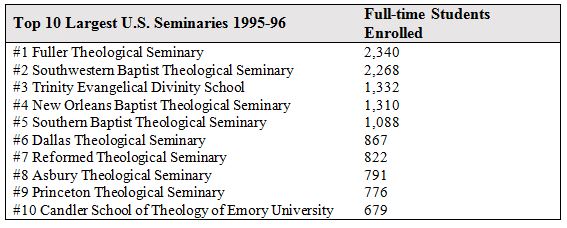
Since the 1995-96 academic school year, Princeton Theological Seminary has seen 30 percent fewer full-time enrolled students. Reformed Theological Seminary saw a 33 percent decrease to 547 full-time students while Candler School of Theology experienced a 39 percent drop to 414 full-time students.

Joe Carter spins this as victory for the Gospel Allies:

Kenneth Kantzer, the late academic dean of Trinity Evangelical Divinity School, once said that in 1890 all of the Protestant theological seminaries in the United States—with the notable exception of Harvard—were evangelical. Forty years later, though, almost all of them had become liberal (i.e., denied basic tenets of orthodoxy). By the 1950s, only four of the top ten largest seminaries were sponsored by evangelical denominations. Of those four, three were part of the SBC, which was struggling at the time to take back control of its schools from liberal professors.

By the 1990s, the trend had shifted once again back toward conservative evangelicalism. After the “conservative resurgence” in the SBC, all six of the denomination’s seminaries were solidly orthodox. And by 1995, only two liberal-leaning seminaries remained on the list of top ten schools by enrollment (Princeton at #9 and Candler School of Theology at #10).

Doesn’t he know that for some Southern Baptists, evangelical is a “Yankee” word.

And what does he not understand about Kenneth Kantzer’s reasons for leaving Fuller Seminary?

Roman Catholic apologetics are catchy.

Whatever Happened to Boomer Irony?

While the missus is still away, I watched a documentary over the weekend about folk music in Greenwich Village, Greenwich Village: Music that Defined a Generation. It was largely celebratory. Only scant attention to drugs, the cost of success and selling out, envy of Bob Dylan. And then there was politics. I had really hoped they would not go there but they did: folk music changed everything. The last segment included stars talking about how music changed the world. One example was how Harry Chapin rallied musicians to sing together (of all things) and so raise funds for worthy causes. No mention of how those funds were administered. No mention directly of folk music’s inspiration of either Martin Luther King or Malcolm X. And no images of Rev. King with ear buds during his marches while he listened to Don McLean or Peter, Paul, and Mary (and why did Mary come up last in the list?) and evaded barking dogs.

I’d have expected New Yorkers with New York sensibilities to be a little less self-congratulatory. But then there are the Yankees and their fans.

But amazingly, for a movie made after — underscore after — A Mighty Wind and Inside Llewyn Davis (okay, Greenwich Village and Inside LD came out the same year), how can you ever play folk music straight? Don’t you need a measure of ironic distance, a little self-awareness that you are the one touting yourself?

It struck me that folk musicians were for the left what evangelicalism is to Christianity.

And then comes this from another boomer New Yorker:

CoyrCxpXEAAcrLI

Forget irony. Whatever happened to the fall that follows pride?

Beaver Cleaver Was Lost in His Trespasses and Sins

Trigger warning to self: you’ve engaged Carl Trueman critically before and it did not go well. So be careful, be very careful.

The reason for bringing up Dr. Trueman again, even if ever so gingerly, has to do with his recent evaluation of Rusty Reno’s new book about prospect for a Christian society. Trueman writes:

I simply am not convinced that change can be achieved on any significant scale. The causes of the modern malaise are complicated, and their solution must be equally elaborate. For example, as George Grant and David Schindler have shown, technology brings with it a different view of reality from that of traditional Christianity. This mindset is now deeply embedded in our world. The entertainment industry mediates much of what is taken for reality and grips the moral imagination of the masses. The globalized economy has transformed communities and community expectations in ways we have yet to fathom. To borrow that hackneyed but poetic phrase from Marx, all that is solid melts into air. Zygmunt Bauman’s argument, that we live in a time when even the most longstanding and reliable social structures are in permanent flux, seems to me compelling. It must be accounted for by any hope that depends upon the solidity of concepts or institutions from the past. How does one reform or recapture or rebuild that which has been robbed of solid existence?

I generally agree.

But where I push (not shove) back is with the idea that modernity alone has these problems. Ever since the fall, it seems to me, the possibilities of pursuing lives of holiness and passing on the faith have been hard. Just remember what Paul warned Timothy about the “last days”:

understand this, that in the last days there will come times of difficulty. 2 For people will be lovers of self, lovers of money, proud, arrogant, abusive, disobedient to their parents, ungrateful, unholy, 3 heartless, unappeasable, slanderous, without self-control, brutal, not loving good, 4 treacherous, reckless, swollen with conceit, lovers of pleasure rather than lovers of God, 5 having the appearance of godliness, but denying its power. Avoid such people. 6 For among them are those who creep into households and capture weak women, burdened with sins and led astray by various passions, 7 always learning and never able to arrive at a knowledge of the truth. (2 Tim 3:1-8)

Was Paul predicting a time when Marx, Freud, and Nietzsche would dominate understandings of human nature and the created order, or was he talking about life in the Roman Empire circa 60 AD? My understanding is that he was talking about life in the Mediterranean world then.

So why do Christians believe modernity is so much worse than any other time? Well, it sure seems that Roman Catholics have a certain nostalgia for the Christian society of medieval Europe, neo-Calvinists for the Christian society of the Kuyperian era of Dutch history, evangelicals in the U.S. for the First Pretty Good Awakening that of course led up to the Christian founding of the United States. Here Protestants want to recalculate critiques of modernity since Kuyper and George Whitefield both fall on the modern side of the divide between medieval and modern periods. In other words, Protestant critiques of modernity play into the hands of certain Roman Catholic apologetics (even if nostalgia for the flourishing of the Middle Ages seldom extends to the Crusades or the Inquisition).

But surely anyone with eyes and ears has to admit that we are living in worse times than 1950s American when Ward and June Cleaver reared Wally and the Beave. I have eyes and ears. I will concede that the 2010s are worse than the 1950s, though I did live through 1968 and that was not a good time. But on a scale of fallen humanity, are modern or contemporary times really worse than what Noah lived through, or Lot, or Jeremiah, or our Lord himself? Doesn’t the fall mean we always live in desperate times?

The point here is not that people who believe in original sin should be relativists when it comes to assessing the way humans live together or proposing ways that are better for a common life together and for the proclamation of the gospel. But I think it is a mistake to cultivate the notion that human flourishing is possible whether by putting in place the right policies or institutions, or by thinking about the past a certain way. I know Dr. Trueman knows this. But it sounds like he thinks we are living through one of the worst times in human existence. No matter how pleasant and reassuring Beaver Cleaver’s America was, it was not the new heavens and new earth. When sin abounds, it’s not a good time. The Cleavers were certainly flourishing as we now count such living, but they were also drowning in sin (and never in church). Shouldn’t that perspective inform the way we view the West post-Foucault?

Prexit

State sovereignty goes hand in hand with ecclesiastical sovereignty, or it sure looks like it.

Michael Lind explains the phenomenon of Trump and what it means for Democrats and Republicans:

The culture war and partisan realignment are over; the policy realignment and “border war” — a clash between nationalists, mostly on the right, and multicultural globalists, mostly on the left — have just begun.

***

For the nationalists, the most important dividing line is that between American citizens and everyone else—symbolized by Trump’s proposal for a Mexican border wall. On the right, American nationalism is tainted by strains of white racial and religious nationalism and nativism, reinforced by Trump’s incendiary language about Mexicans and his proposed temporary ban on Muslims entering the U.S.

But while there is overlap between nationalists and racists, the two are not the same thing. The most extreme white nationalists don’t advocate nationalism as a governing philosophy in our multiracial country; they hope to withdraw from American life and create a white homeland within the nation-state. Nationalism is different than white nationalism, and a populist American nationalism untainted by vestiges of racial bigotry might have transracial appeal, like versions of national populism in Latin America.

The rise of populist nationalism on the right is paralleled by the rise of multicultural globalism on the center-left.

For multicultural globalists, national boundaries are increasingly obsolete and perhaps even immoral. According to the emerging progressive orthodoxy, the identities that count are subnational (race, gender, orientation) and supranational (citizenship of the world). While not necessarily representative of Democratic voters, progressive pundits and journalists increasingly speak a dialect of ethical cosmopolitanism or globalism — the idea that it is unjust to discriminate in favor of one’s fellow nationals against citizens of foreign countries.

Now watch (thanks to our W. Michigan correspondent) how church affairs line up with temporal politics, with ecumenists (globalists) on the left opposing the constraints of denominationalists (nationalists) on the right:

Many who witnessed the continuing denominational imprisonment of the Lord’s body and blood experienced ecumenical agony. The late Emilio Castro, the WCC general secretary who hired me, was a Methodist pastor who yearned for eucharistic sharing. He would say, “I’m not even asking the Catholics (or Orthodox) to recognize the validity of the Lord’s Supper that we Methodists celebrate. I’m simply asking them to accept that I see the body and blood of Jesus Christ fully present in their Eucharist.”

In spring 1994 I sat in a restaurant with Castro and his longtime Orthodox friend and WCC colleague Ion Bria, a priest in the Romanian Orthodox Church. The two lifted their wine glasses and said to each other with tears in their eyes, “Someday, before we die, we shall be able to share the body and blood together, with our churches’ blessings.” But they never did. Nor, if they were still living, could they do so today.

So I returned to ecclesiastical disobedience. That became more complicated once I was elected general secretary of the Reformed Church in America. When I assumed that post, I didn’t know all that would be demanded of me as general secretary, but I knew I couldn’t go forward without retreating. I knew I needed regular times away, with a spiritual director, and the nourishment of Christ’s body and blood. A Carmelite retreat center near my home in New Jersey provided all this.

As a church official, I wanted more than ever to show absolute respect for my Catholic hosts. But their invitation to receive at the table was unambiguous. On my retreat days, I’d often be invited to read one of the scriptures at their eucharistic service.

Indifference to church polity and theology like this is why confessional Protestants exited from the modern ecumenical movement.

Arguably the most astounding aspect of contemporary ecumenical discussions is that the leader of the only true church is also apparently indifferent to ecclesiastical laws:

This tension in how we understand the Eucharist is one that, remarkably, Pope Francis himself has acknowledged. Last November he met with a Lutheran congregation in Rome and responded to one member, Anke de Bernardinis, who is married to a Catholic and who asked what it would take for them to receive the Eucharist together. The pope’s spontaneous ten-minute answer was revealing, unprecedented, and even stunning.

Francis said, “I ask myself the question. To share the Lord’s banquet: is it the goal of the path, or is it a viaticum (food or provision accompanying one on a journey) for walking together?” He posed that question rather than give the doctrinal response—that she could either become Catholic or continue to pray with her husband over the pain of a divided church.

Pope Francis went on to focus on baptism. “I ask myself. But don’t we have the same baptism? If we have the same baptism, shouldn’t we be walking together?” Then he went further. “The supper? There are questions that only if one is sincere with one’s self and the little theological light that one has, must be responded to on one’s own. See for yourself. This is my body. This is my blood. Do this in remembrance of me—this is a viaticum that helps us to journey on.”

And Francis didn’t stop there, going on to address the classic dividing line over the meaning of Christ’s “real presence.” The pope recalled a Protestant pastor and friend who told him, “We believe that the Lord is present there.” So he said to the Lutheran woman, “You believe that the Lord is present. And what’s the difference? There are explanations and interpretations, but life is bigger than explanations and interpretations.”

Having noted the trademark tension between official policy and actual practice, Pope Francis concluded by saying he would not “dare to give permission to do this” but then repeated, “One Lord, one faith, one baptism. Talk to the Lord, and then go forward. And I wouldn’t dare—I don’t dare say anything more.”

In ecumenism, as in diplomacy, ambiguity can be a helpful tool, allowing room for movement on issues where formal agreement is not yet possible. Pope Francis opened the door more than a crack.


Chairman of the Board

Was this what Bryan and the Jasons had in mind?

Francis’s palpable respect for other religious traditions, coupled with his determination that the various faiths must work together to advance shared values such as peace and the care of creation, have made him a global role model for interfaith cooperation. . . .

It’s possible, of course, that people in either India or Turkey unaware of the pope’s record may be briefly swayed by such rhetoric, but the moment such charges are subjected to critical examination they’ll collapse under their own weight.

While the substance of such complaints may not have much merit, there’s nevertheless a sense in which they’re meaningful. In effect, they may be an index that Francis’s ambition to be the “chairman of the board” for religious moderates around the world is working.

Obviously without using that language, that’s a role to which every recent pope has aspired – trying to galvanize a coalition of authoritative moderates within the world’s religious traditions to demonstrate that, as much as religion can be part of the problem, it is also uniquely positioned to be part of the solution.

As someone who doesn’t hail from a traditional Western power, Francis brings a special capacity to pull that off, since he doesn’t carry the same baggage in terms of being associated with either the West’s colonial history or its contemporary military and political choices. His global popularity also means he carries the largest religious megaphone in the world, allowing him to lift the standing of moderate voices in other traditions.

Don’t think too long about where ex-Nazis went after World War II.

Forget also about popes transcending personal experience. Turn STM into ASTM — Argentina, Scripture, Tradition, Magisterium:

From the beginning, it’s been striking how often Pope Francis, when pressed to explain a particular statement or policy choice, will invoke his background in Argentina.

There are really too many examples to count, but just to choose one almost at random, in a session with priests from the diocese of Rome earlier this month, Francis stirred controversy by suggesting there are cases in which it’s better for couples to live together for a while rather than take part in a shotgun wedding.

“Here’s a social fact in Buenos Aires,” he said. “I prohibited religious marriages in Buenos Aires in cases of what we call matrimonios de apuro, meaning ‘in a hurry,’ when a baby is on the way.”

In fact, Francis cited his experience in Buenos Aires no fewer than five times in that address to priests, on multiple topics.

And be sure to love the sinner while hating the sin (except if you are a global capitalist, climate change denier, or a Turk):

Furthermore, the pope did not tell anyone to issue an actual apology. And his focus was not limited to the LGBT community. Rather, he made the broader statement that the Church “must not only ask forgiveness to the gay person who is offended,” but also to all of the people “we could have defended and we didn’t,” including the poor, and women and children who are exploited.

He cited the Catechism, saying that homosexual individuals “must not be discriminated against, (but) must be respected and accompanied pastorally.”

The Catechism teaches that based on Scripture, “tradition has always declared that ‘homosexual acts are intrinsically disordered.’”

Homosexual acts, it continues, “are contrary to the natural law … under no circumstances can they be approved.”
When speaking of homosexual persons, however, the Catechism insists that most gay individuals face “a trial” due to their sexual orientation, and “must be accepted with respect, compassion, and sensitivity. Every sign of unjust discrimination in their regard should be avoided.”

What Pope Francis said, then, clearly echoes Church teaching and displays his genuine pastoral concern for a group that has and frequently still does face hostility, including, at times, from within the Church.

Isn’t independence from tyrannical authority wonderful?

Modernity is Biblical

I understand that many think the modern world has frustrated human flourishing, but what happens if the basic ingredients of the modern West that are supposedly the fault of the Reformation are actually medieval?

According to Richard Landes (Heaven on Earth), traditional societies are organized by a “prime divider,” a boundary between elites and commoners. He follows Ernest Gellner in called these “agro-literate” societies, since that phrase names two key technologies that mark the division. More generally, “Elites construct prime dividers along four major lines: legal privilege, stigmatization of manual labor, restricted access to the technologies of knowledge, and weaponry— all imposed by potentes who possess ‘honor’ and ‘status’” (216).

Modernity is a product of civil polities that undermines these prime dividers. Landes isolates four main elements in the formation of an alternative social order:”isonomia [equality before the law], widespread literacy, dignity of manual labor, and positive-sum attitudes that transcend honor-shame dynamics” (227). He discovers these in “the communes of eleventh-century Europe, the peasant rebellions of the late Middle Ages (e.g., England, 1381) and early modern period (e.g., Germany, 1525), the Puritan Revolution of the seventeenth, the American and French of the eighteenth, and the Socialist and Zionist movements of modern times.” Each “made appeals to equality before the law, all spoke of manual labor as a unique source of dignity, all leaned heavily for their support on the existence of a class of commoners who could read or cared about the contents of texts, and all, at least in their nascent stages, emphasized the importance of overcoming the obsession with externally defined ‘honor’” (227).

And get this, what happens if the modern world actually originated in ancient Israel?

Landes thinks that ancient Israelite civilization was more decisive in the rise of the modern world: “this culture emphasized the importance of isonomia, mass education, manual labor, and the substitution of integrity for honor, long before, and with much greater consistency and depth, than Greek or even Athenian society. And perhaps because of this consistency—unlike Athens, there were few voices of dissent on any of these matters—the culture and its traditions survived in an unbroken chain from the ancient world to the present. Moreover, since the principal (but not sole) source of these values, the Hebrew Bible, became the canon of the dominant religion of European society, these attitudes found much more accessible expression—and to a much wider audience—through religious than through classical studies” (230).

After examining each of these themes in the Bible, Landes notes the continuity between Hebrew prophecy and the aspirations of modern social and political reformers: “the goal of demotic millennialism (as imagined in the millennial song of Isaiah/Micah) is to dismantle traditional, belligerent authoritarian and socially stratified (prime-divider) societies, and replace them with a universal network of free, productive civil polities, living in mutual and voluntary peace and exchange, enforced by a discourse of judicial fairness. It is at once a modern ideal and an ancient prophetic dream” (239).

Thanks for Nothing, Confederates

If you guys had merely held a referendum on secession instead of shooting guns, we might find Christian support for a U Sexit strategy comparable to British believers’ support for Brexit (via Chris Gerhz):

Practising Christians are the most likely among faith communities in England to support the Eurosceptic ‘Brexit’ position.

Muslims, meanwile, are the most Europhile of all the religious groups, a new survey has found.

The findings came in the new Populus Hope Not Hate survey which throws light for the first time on what different religious groups feel about the EU referendum in June.

“All the questions suggest that professing Christians are currently more likely than average to take up Eurosceptic positions, with Muslims the most Europhile,” reports religious researcher Clive Field.

Terry Teachout explains why U Sexit may be necessary (thanks to Rod):

In a totally polarized political environment, persuasion is no longer possible: we believe what we believe, and nothing matters but class and power. We are well on the way to becoming a land of jerking knees.

Never before have I felt so strongly that Americans are talking past instead of to one another. It is, I fear, our future and our fate—which is why I have come to believe that I will live to see Red and Blue America negotiate a “soft disunion.” No, there won’t be a second civil war. I can’t imagine the citizens of Blue America waging a shooting war over much of anything, least of all continued union with people whom they disdain. (Red America is a different story.) But the gap that separates the two Americas has grown so deep and wide that I find it increasingly difficult to imagine their caring to function as a single nation for very much longer. If I’m right, then I expect that they will ultimately find a more or less polite way to stop doing so.

Isn’t polarization what happens when we place personal over national identity? But just try issuing yourself a passport that will get you past customs. Not even calling the church an embassy will work:

Leeman descends from global height in his Preface to mountain-top height in his Introduction. And here, one gets a sense of his concerns. “A fundamental assumption of…many democratic Westerners, is that local churches are one more voluntary organization.” (21) In contrast, claims Leeman, “The church is a kind of embassy, only it represents a kingdom of even greater political consequence to the nations and their governors. And this embassy represents a kingdom not from across geographic space but from across eschatological time.” (22)

Isn’t that treasonous?

Every Member Ministry Means No Christian Soldiers

Only a few neo-Confederates and Covenanters may disagree, but most Reformed Protestants assume that men ordained to the ministry of the word may not serve in capacities that involve the use of the physical sword (police, military, and even civil magistrate). The logic goes something like this:

Civil magistrates may not assume to themselves the administration of the Word and sacraments; or the power of the keys of the kingdom of heaven; or, in the least, interfere in matters of faith. (Confession of Faith, 23.3)

One could well suppose that if magistrates (who hold the civil sword) can’t have the keys of the kingdom, those who do have the power of the keys shall not assume the power of the civil magistrate. That fits with what the Form of Government says about ecclesiastical power:

All church power is wholly moral or spiritual. No church officers or judicatories possess any civil jurisdiction; they may not inflict any civil penalties nor may they seek the aid of the civil power in the exercise of their jurisdiction further than may be necessary for civil protection and security.(3.4)

So imagine what happens to this delicate balance between civil and ecclesiastical power when all of a sudden every Christian is a minister. How could we ever allow a minister to fight in a war, to operate under the authority of the Department of Defense, to bring criminals to justice?

Pope Francis may have the solution — to turn Christianity into a pacifist religion by opposing capital punishment and abandoning just war theory.

If Christians may not serve as soldiers or as executioners, then we need to revise assertions like this:

Public life is not just about politics but all the areas of human activity — thefamily, the workplace, shops and restaurants, leisure and the arts. It is the specific role of lay people to sanctify each and every environment of the world.

Sometimes “every” and “all” make you wish for dualism.