Fun With Numbers

Would it surprise readers to learn that Tim Keller and I, according to the intersectionality meter, enjoy more privilege than 96 percent of the rest of Americans? Would it also surprise anyone that Tim Keller and I have more privilege than Donald Trump? Because if you move the slider on Christianity from Christian to Not Christian (sorry Donald), your oppression footprint decreases, from a 5 to a 14, which means Trump has more privilege than 88 percent other Americans. Throw in income, with differences for religion, and here his how the picture changes: Trump (rich) 11, me (moderate) 5, Keller (more than me), 4. So in the intersectionality sweepstakes, Tim Keller has more privilege than Donald Trump and I. (And since Keller and I are Christians, that may make both of us Christian nationalists.)

This fits what Keller himself has even admitted.

Keller acknowledged white privilege and ways he’s benefited from it, but with his characteristic wit he added, “I’m not going to feel sorry for myself because that is a very white thing to do.”

Or:

John [Piper] and I are both old enough to remember the complicity of evangelical churches and institutions with the systemic racism in the US before the civil rights movement. I took my first church in a small town in the South in the early 1970s. The courts had recently ruled that the whites-only public swimming pool, operated by the town with taxpayers’ money, had to be integrated. So what did the town do? It shut the pool down completely, and the white people of the town opened a new private swimming pool and club, which of course, did not have to admit racial minorities. Because I was a young pastor, our family was often invited to swim there, and swim we did, not really cognizant of what the pool represented.

Here’s some more fun with numbers. What does minority and majority populations mean without nationalism? The world’s total population is 7.7 billion. The United States’ population is roughly 330 million. That means Americans (third in total behind China and India) are 4 percent of the world’s population. In majority/minority statistics, that looks decidedly like a minority.

But I get it with power and wealth Americans look a lot bigger and wealthier than the rest of the world’s peoples. Doesn’t some of that size and power extend to minorities within the United States, such that Amish or Armenian-Americans in the United States have more power and wealth than people living in Nigeria or Guiana?

And what about minority groups not based on race or ethnicity but on religion? Are members of the Presbyterian Church in America — roughly 350,000 — a minority compared to Japanese-Americans at 1.4 million, or Korean-Americans, or Chinese-Americans at almost 5 million? Can ethnicity and wealth simply turn those numbers around so that a denomination that is 7 percent the size of Chinese-Americans has the same sort of privilege as — well — Tim Keller?

And don’t even get me started on how flawed Asian-American is as a category?

However you slice it, the numbers only make sense if you start with the United States and its population, which makes you some kind of nationalist.

If You Go Back to 33, Why Bother with 1776?

While John Fea has tried to live tweet David Barton’s claims about America’s Christian founding, Roman Catholics in the U.S. also feel the need to make America safe for faith. Which allows a repetition of a point: not integralism but Americanism is the default setting for Roman Catholics in the U.S. That is, American Roman Catholics, contrary to the worst anti-Catholics like Paul Blanshard, were never ambivalent about American exceptionalism or the need to modify aspects of church life to assimilate the church to American ways.

And so, Roman Catholic defenders of America have come out parading once again for July 4th. A little early to the festivities was Matthew Schmitz who used the approaching national holiday to vindicate Sohrab Ahmari over against David French:

David French of National Review said that Ahmari was forsaking America’s historical commitment to “neutral principles” such as free speech and due process. By insisting that governments should re-order the public square towards the common good, Ahmari was “forsaking the framework for ordered liberty established by the Founders.”

But the idea that America was founded on “neutral principles” is a myth. From its beginnings, America has been characterized by what Tocqueville called the “intimate union of the spirit of religion with the spirit of liberty.” The Americans whose representatives drafted the Constitution did not seek to end this union, but to place it on a stable footing.

In 1813, John Adams wrote to Thomas Jefferson: “The general Principles, on which the Fathers Achieved Independence, were … the general Principles of Christianity … and the general Principles of English and American Liberty.” The former are not neutral principles.

Every early administration except Jefferson’s summoned America to days of humiliation, fasting, and prayer. Americans were urged to “confess and bewail [their] manifold sins and transgressions, and by a sincere repentance and amendment of life … and through the merits and mediation of Jesus Christ, obtain pardon and forgiveness.” Is this neutrality?

…As these men show, the belief that politics should be ordered to the common good and the highest good is not only classical and Christian, but American. We need to reinvigorate this tradition, not by going back to colonial arrangements, but by pioneering new ways to unite the spirits of Christianity and liberty.

David Barton could not have said it better, though Schmitz’s praise may seem odd for a convert from Protestantism to Roman Catholicism if only because he fails to mention his examples all came from Protestants. Roman Catholics at the time (and down to Vatican II) were hostile to civil liberty, freedom of ideas, and free markets. That difference between medieval and modern is pesky for those who embrace one of the most modern nations on earth.

Then today at The American Conservative, the man who likely decided to run Schmitz’s piece, Michael Warren Davis, another convert, wrote positively about the Puritans’ settlement in North America and their influence on the founding. He quotes John Wintrop’s “A Model of Christian Charity” and then writes:

This is the high ideal that lies at the heart of our nation’s founding: not wealth or strength or freedom, but charity. This is the divine purpose for which America was founded: that we might love as ought to love.

Love her, too, while you’re at it. Love America the way we mortals can only love when we’ve grown old enough to accept that our mother is flawed, as we are. Love her all the more because she won’t be around forever.

From the woodlands of Maine to the mountains of Virginia, from the golden shores of California to the black sands of Hawaii, from the lakes of Michigan to the endless ranges of Kansas—every last one of us has a chance to be as wise as Greeks, as virtuous as Romans, as cultured as Englishmen, and as loving as Christians. That’s worth celebrating.

Again, what a great development to have Roman Catholics praising — of all people — Puritans on the occasion of America’s birthday. Might they also recommend the Puritans’ teaching and worship to anyone struggling with the way the bishops have been conducting their affairs during abuse scandal? If not, if Protestants still need to get right with the Vatican to have an awesome Christianity, then Davis should add that the bishops were also wrong for a long time about political liberty (as in “error has no rights,” a phrase used by top Vatican officials against John Courtney Murray as late as the 1950s).

But then comes a mild corrective from yet another convert, Chad Pecknold, again from the webpages of the Catholic Herald where Davis works. Pecknold is not so convinced that Puritans were a healthy influence on the United States’ political culture of liberty:

[Tocqueville] cites approvingly Cotton Mather’s discussion of “holy liberty” in Magnalia Christi Americana. Tocqueville is struck by how this “holy liberty” is freedom for goodness, for truth, for justice, for God. In this sense, what makes Puritan liberty different from the liberty of 1789 is precisely that it is not liberty “for secular purpose,” but for holy purpose. Where France divorced liberty from religion, the Puritans united “the spirit of religion and the spirit of liberty.”

This seed, this germ, Tocqueville writes, is “the key to nearly the whole book.” So the Puritan seed was dispersed, fragmented, and scattered. Its children could favor different aspects of the originating spirit. It could combine with other species, if you will, and yet American diversity would always have this common root. Yet Tocqueville also sees something profoundly unstable in the Puritan seed — it is sectarian, and not “the whole.” The Puritan seed lacks a unifying principle, and cannot supply the American people with a stable, common creed.

In one of his more Catholic insights, Tocqueville believes the Puritan seed is made to be divided, to be diversified through a great plurality — yet moving in two directions. Tocqueville writes, “our descendants will increasingly divide into only two parts, some leaving Christianity entirely and others embracing the Church of Rome.”

Tocqueville is no Augustine for America, but he does have an important insight into American polarization. In the end, he thinks one part of America will view liberty as the flight from Christianity, and the other will see that a culture of freedom requires its full embrace.

See what he did there? On the one hand, Pecknold thinks Tocqueville recognized that the Puritans provided an unstable foundation for a nation — to much sectarianism — though it is odd that when Puritans were more doctrinally sane as opposed to their Congregationalist successors, they supported the American founding with vigor. Of late, Congregationalists have been willing to live with Jeremiah Wright as one of their pastors in good standing.

On the other hand, Pecknold, by a magic trick only rivaled by Doug Henning, makes Roman Catholics, the ones with the “full embrace” of Christianity, as the true successors to the Puritans who united the “spirit of liberty with the spirit of religion.”

It seems fairly plausible to conclude that Roman Catholics ponder the American founding more than Matthew 16:18-19. On the upside, it sure beats running the Fourth of July through Abraham Lincoln.

Fascism and Modern Roman Catholic Societies

Can anyone point to an example of a society that went with the Protestant side of the Reformation producing a fascist government? Donald Trump does not count because the U.S. has yet to adopt a fascist government (that is, if you don’t read the paleo-conservatives on Abraham Lincoln).

This is not meant to tar Rome with the fascist brush (mainly), but it is to ponder what Michael Walzer wrote about liberalism and the “art of separation.” Peter Meilaender summarized it this way (from a golden oldie):

The “separation of civil society and political community creates the sphere of economic competition and free enterprise, the market in commodities, labor, and capital” (Walzer 1984, 316). It is true, of course, that “market freedom entails certain risks for consumers,” but, as Walzer points out, “so does religious freedom” (Walzer 1984, 316). Similarly, the “abolition of dynastic government separates family and state” and in this way creates the possibility for people to pursue careers according to their talents, opening up the “sphere of office and then the freedom to compete for bureaucratic and professional place, to lay claim to a vocation, apply for an appointment, develop a specialty, and so on” (Walzer 1984, 316-17). Finally, Walzer writes, the same process, by separating “public and private life” (Walzer 1984, 317), enables new forms of domestic intimacy that are profoundly important to most of us. In the privacy of our homes we become free to pursue “a very wide range of interests and activities…: reading books, talking politics, keeping a journal, teaching what we know to our children, cultivating (or, for that matter, neglecting) our gardens” (Walzer 1984, 317). Raising our own chickens, we might add, or not raising them! “Our homes are our castles, and there we are free from official surveillance” (Walzer 1984, 317).

The virtue of Walzer’s analysis is to correct the one-sided portrayal of modernity as a story of decay, fragmentation, and alienation, the loss of a pre-modern, pre-liberal Eden. The story of modernity is also one of increasing richness and diversity, of freedom and pluralism, of a world in which, to borrow a line from C. S. Lewis, “Everything is getting more itself and more different from everything else all the time” (Lewis 2003, 281). Lewis was not describing the spheres of society—family, work, church, state, and so on—but his point is analogous to Walzer’s. As he writes in the preface to The Great Divorce, “life is not like a river but like a tree. It does not move towards unity but away from it and the creatures grow further apart as they increase in perfection” (Lewis 2001, viii). A new, richer, and redeemed form of community will one day arise—can arise—only as the outcome of that increasing process of differentiation.

Indeed, Christians are especially well placed to understand the characteristic forms of modernity not simply as examples of fragmentation and loss but rather of differentiation and enrichment, as a process in which the various spheres of society gradually become more and more themselves and less and less something else.

In contrast to differentiation and separation, Roman Catholics — perhaps thanks to the neo-medievalism that lurks in all nostalgia for Christendom — prefer integration, hence the current appeal of integralism. David Frum picked up on this in his poignant piece about D-Day. At the end of the war:

France did enter Germany as a victor. French armies, supplied by the United States, subordinate to U.S. command, were stood up in 1944–45. France was allotted an occupation zone in Germany and awarded a permanent seat on the UN Security Council. (Italy was not even invited to join the United Nations until 1955.) Allied officialdom agreed to believe de Gaulle’s story that the France that fought Nazi Germany was the only real France.

But everyone understood the story was not true. The French military defeat in 1940 had torn apart social wounds dating back decades and longer. Conservative and Catholic France reinterpreted the battles of 1940 as a debacle only of the liberal and secular France that had held the upper hand since the founding of the Third Republic in 1871 and especially since the Dreyfus affair that began in 1894. When the reactionary French writer Charles Maurras was sentenced to life imprisonment for collaboration, he supposedly replied, “It’s the revenge of Dreyfus.”

Most French business leaders and civil servants collaborated out of opportunism or necessity. The Germans held hundreds of thousands of captured French soldiers as hostages for years after 1940. But more than a few leading French people, including many intellectuals and churchmen, collaborated out of a species of conviction. A French cardinal led the recruitment of French volunteers to fight alongside the Germans in Russia in 1941. “How can I, in a moment so decisive, refuse to approve the common noble enterprise directed by Germany, dedicated to liberate Russia from the bonds that have held it for the last twenty-five years, suffocating its old human and Christian traditions, to free France, Europe, and the world from the most pernicious and most sanguinary monster that mankind has ever known, to raise the peoples above their narrow interests, and to establish among them a holy fraternity revived from the time of the Christian Middle Ages?” Cardinal Alfred Baudrillart wrote, in his endorsement of the Anti-Bolshevik Legion.

Frum then notices the anti-liberalism that lurked in those French who wanted a return to throne and altar (some differentiation but not the Anglo-American separation of powers):

The loss of the war against Germany enabled such people to launch a much more congenial culture war at home, to purge France of “liberty, equality, and fraternity,” the slogan of 1789, and establish in its place “work, family, fatherland,” the slogan of Vichy. Since 1905, France had been defined as a secular state. The Catholic Church had been reduced to one sect among others: Protestant, Jewish, even Muslim. (In 1920, the French government had subsidized the building of a grand mosque in thanks for the First World War service of Muslim troops. The great military cemetery near Verdun has a special section for Muslim soldiers, their graves angled away from the others in order to face Mecca.)

Vichy put an end to all that. The defeat of France by Germany was ideologically reinterpreted as a victory of “deep France” over a shallow liberal metropolitan veneer. Subjugation was reinterpreted by Vichy ideologues as redemption. Enmity was shifted from the occupying Germans to the liberal commercial “Anglo-Saxons.” Vichy propagandists produced cartoons in which Mickey Mouse, Donald Duck, and Popeye were depicted dropping bombs on France at the behest of Jewish masters.

The point is not that DeGaulle but that the Roman Catholic urge for order and unity often manifests itself in a certain kind of anti-liberalism.

And so integralism returns (and don’t forget the appeal of integration to those neo-Calvinists who bang the gong hard for the Lordship of Christ over every square inch without thinking very hard about sphere sovereignty.

Soldiers Who Die

This is a re-post from another website. Today seems as good a day as any to copy and paste.

________________

Alasdair MacIntyre complained about the modern nation-state almost 25 years ago in ways that foreshadowed some of today’s antagonism to nationalism. He wrote:

The modern nation-state, in whatever guise, is a dangerous and unmanageable institution, presenting itself on the one hand as a bureaucratic supplier of goods and services, which is always about to, but never actually does, give its clients value for money, and on the other as a repository of sacred values, which from time to time invites one to lay down one’s life on its behalf. As I have remarked elsewhere, it is like being asked to die for the telephone company. Alasdair MacIntyre, “A Partial Response to My Critics

Michael Brendan Dougherty doesn’t exactly address nationalism but instead responds to a New York Times video that makes loyalty to nation sound like a piece of human existence from a primitive time:

The video …constantly invokes borders, for a reason: To make nationality sound silly. It indeed would be dumb to base your identity “just based on borders,” but in fact the relationship is the other way around. The identity is based on a shared homeland, or territory, along with shared law. National loyalty makes possible the kind of self-sacrifice that is necessary for living in peace with strangers. And in fact, the notable thing about national loyalty isn’t the times when, aggravated, it motivates us in war. War was very common before modern nationalism. Much more notable is the everyday peace and neighborliness that national loyalty fosters between people who may not share a tribe or a religious creed. Without nationality, we may still be trying to settle the wars of religion. With it, we were able to contribute to common treasuries whereby we provide for one other regardless of our ethnic background and religion. The border is just what you draw around this home.

The Times chooses Rocky IV to belittle its subject as well. It is a silly movie, which deploys the idea of national conflict in a heavy-handed way. But its effect “on our brains” is not in itself insidious, but commonplace and even comforting. National legends and patriotic songs exist to bind our emotions and our imaginations, to our national homes and to the people that share them. Sometimes, yes, they inspire a hatred of those who might work to destroy them. The most obvious alternative to binding our emotions to our national homes isn’t some higher peace. It’s something baser, as we’ll see.

Dougherty is valuable for countering journalists and government officials who fail to recognize the ways in which nation-states have preserved order, stability, law, and prosperity more than they have also sent citizens to war for some time ignoble reasons.

But I still wonder about MacIntyre’s point. Is dying for nation (or country) truly noble? More personally, would I be willing to fight for the sake of the United States? I can conceive of dying to save my wife or being willing to die if someone demanded that I deny Christ. But the nation?

Two pieces of Americana give this question weight. One is the Stephen Spielberg movie, The Post, which isn’t great and elides many of the important questions it raises about journalism during a war and a newspaper’s conflicted interests to turn a profit, beat a competitor to the story, and report for the good of the nation (truth and social stability). But one scene was particularly poignant, the one where Katherine Graham, the paper’s owner, confronts Robert McNamara, one of the chief strategists for the Kennedy and Johnson administrations in conducting the war in Vietnam, to ask what he knew and when he knew it. Once the Pentagon Papers come out and the public knew that many in the Johnson administration never thought victory was possible, Graham wants to know how McNamara could avoid saying something when her son (who survived) went to fight in Vietnam. Simply as a friend of the family, McNamara could (and should?) have let his friend know that this war was flawed. But he did not. The question Graham thinks but never asks is “would you have let my son die for such a foolish war?”

Another war movie that avoids this point is The Fighting Sullivans, a 1944 film about the five Sullivan brothers from Waterloo, Iowa, who all died when a Japanese torpedo sank the ship on which they were serving in the Pacific during World War II. The movie turns the boys into heroes, examples of bravery, fine, upstanding citizens. The book about the movie, the family, and the town by Bruce Kuklick, The Fighting Sullivans, shows how Hollywood was guilty of hype, the Sullivan family was not as reputable as the movie portrayed them, and that the town of Waterloo was almost always ambivalent about turning the city into a monument to honor a family that was a challenge.

But Kuklick scores his biggest point when he writes in the conclusion:

10 percent of the film conveys the most important fact entailed by the call to duty in even a democratic nation in a good war. The five brothers surrendered their lives to the state. FULL STOP. For those who lose their children in war, no closure exists. FULL STOP. Such deaths defeat families. FULL STOP. It is hard to combine the sentimentality of 90 percent of the film with the shocking 10 percent. (172)

Which leaves us with MacIntyre’s question. The United States may not be great. It may only be pretty, pretty, pretty good. But even if it were great, is that good enough to sacrifice your life?

Can Your Two Kingdom Theology Do This?

Remember when anti-2kers put the “R” before 2k to assert that two-kingdom theology is radical? A recent Twitter thread keeps that complaint alive:

https://platform.twitter.com/widgets.js

The odd thing is the way critics will leap to connect dots between ideas and events (like the shooting in Poway that involved an OPC church member) and never read the sources closest to the congregation and its pastor. Here is a paragraph from the book on covenant theology that the pastor of that OPC congregation wrote:

The doctrine of the new covenant guards us against triumphalism. The new covenant shows us that the kingdom of God is no longer identified with any geopolitical nation on earth. This is particularly critical to grasp in American culture, where there is a tendency to confuse the kingdom of God with the United States. Americas, however, is not in covenant with God as a nation. It had no representative on Mount Sinai. The only nation in covenant with God is God’s new global nation, that is, his new covenant church. “But you are a chosen race,” says the apostle Peter, “a royal priesthood, a holy nation, a people for his own possession, that you may proclaim the excellencies of him who called you out of darkness into his marvelous light” (1 Pet 2:9). In the new covenant, the church is no longer limited to the physical descendants of Abraham but is made up of all the nations of the earth, people of every race, color, and language. While the old covenant was an era of driving the nations out of God’s holy land, the new covenant is an era of believers living side by side with unbelievers in patience and love. Today is the day of salvation, not judgment. God’s judgment is delayed until his return. (148)

That is not radical. It is moderate in the sense that it compels Christians to recognize that they live this side of glory in societies with non-Christians. It also reduces expectations for the Christian or moral capacities of a nation and its government. It is precisely an understanding of covenant theology and the gospel that contra Jemar Tisby and Timothy Cho is fundamentally at odds with white nationalism. There is nothing nationalist about it.

But the critics who for years have wailed and nashed teeth over 2k’s capitulation to secular society and “neutral” government are precisely those who wanted a nation with a Christian identity. Even those people who protest the United States’ long history of racism, want the nation to become Christian in the way it oversees and regulates race relations. Believe it or not, that understanding of church and state does not make a lot of room for non-Christians.

But 2k is radical. I get it.

The Baggage in the Trunk of Antiquity

More reflections on the meaning of Notre Dame from Alan Jacobs:

What it reminds us about the long and complex intertwining of the western church with the modern nation-state. You can’t understand the current rebuilding project without understanding the crowning of Charlemagne by Pope Leo III, in St. Peter’s Basilica on Christmas Day of the year 800; and Pope Gregory VII’s role the Investiture Controversy, with its culmination in the humiliation of Henry IV in the snow at Canossa; and the emergence of the Cuius regio, eius religio principle in the Reformation era; and the violent dechristianizing of France during the Revolution; and the vain struggle of Pio Nono against the unification of Italy, ending in the elimination of the Papal States and the loss of all secular power for the Papacy; and the emergence of the Deutsche Christen in the Nazi era, when German pastors competed with one another to defend the celebrate the subservience of (especially but not only) the Lutherans to Hitler.

That long slow transfer of power is over now. The tiger the Church hoped to tame has eaten it. The building on the Île de la Cité dedicated 800 years ago to the Blessed Virgin Mary belongs wholly to the bureaucrats now. The rest of us will just have to stand by to see what they do with it.

Two cheers for Lockean liberalism?

Historians’ Lanes and When to Change Them

John Fea declares he is not going to believe William Barr’s evaluation of the Mueller report until he sees it for himself. Why? Because John is a historian:

Why? Because Barr’s letter is a secondary source. It is his own interpretation of the complete Mueller report. I have no idea if Barr’s summary is accurate until I read the entire Mueller’s entire report. This is how historians work. We go to the source. (Of course, future historians will also need to examine Mueller’s sources as well).

At this point, we know that Barr wrote the letter. One of the first things historians do when they read a document is “source” it. In other words, we take into consideration the author of the document.

We know, for example, that Barr is the Attorney General of the United States. This gives him some degree of authority. On the other hand, Barr is a Donald Trump appointee. This should also factor-in to how we interpret the document.

Barr quotes Mueller’s report in the document, but we do not know the larger context from which he pulled the quotes. (For example, some outlets are reporting that Barr did not quote an entire sentence from the Mueller report). This is just like when pseudo-historians like David Barton quote John Adams out of context and conclude that the United States was founded as a Christian nation.

Again, until I can read the document and do my best to interpret for myself (perhaps with the help of the writings of experts) I do not trust it. Check back with me later.

The problem here is that Fea’s identity does not go all the way down. He regularly links to journalists‘ and op-ed writers’ pieces without ever checking the sources that these other writers used. In which case, using the Barr summary to teach a lesson about the ways historians work seems like a way to avoid revealing political loyalty.

Other times, John has seemed to do history the way moralizers moralize. That was particularly the case in a recent post by Marie Griffith about the responsibilities of scholars at a university department dedicated to the study (not advocacy) of religion and politics:

At Religion & Politics, we have repeatedly pointed out that white supremacist and anti-Muslim ideologies are being energized by the speech and actions of Trump, along with the highest levels of his administration. It is not simply that Trump is hateful or seems worrisomely unwell, as many commentators have pointed out; it’s that the form of hatred he emboldens is deadly. . . .

Observers who deplore the violence will perhaps do small but important things, like donate money to fundraising efforts for the victims’ families or vow to help Muslims in their local communities feel safe. We’ve done it before; we’ll do it again. Having been through things like this so many times before, many despair that anything will change.

Pursuing big goals, however, is a marathon, not a sprint; and there will be no finish line in the race to end hate in the world. If the long history of clashes, collusions, and other interactions between religion and politics teaches us anything, it’s that. Once more, we grieve; once more, we resolve to do what we can—all that we can—to quell the fires of racism, anti-Semitism, and anti-Muslim bigotry that burn ferociously today.

Those are undoubtedly worthwhile goals but they sound more like the work of a humanitarian NGO than the task of the university.

Let the historical profession be historical.

New Rome

If you were thinking Constantinople you would be wrong. The New Rome is Roman Catholicism after Vatican II.

Here are a couple of data sets. One from Lawrence King and Robert Miller:

When Vatican II promulgated its Declaration on Religious Freedom (Dignitatis humanae), few expected that fifty years later the view that people do not have a right to religious liberty would become popular again. Yet this doctrine—commonly known as integralism—is experiencing a resurgence among some conservative Catholic intellectuals.

Integralism is the doctrine that (ideally, if not always in practice) the state should endorse the Catholic faith and act as the secular arm of the Church, punishing heresy among the baptized and suppressing false religious practices if they threaten Catholicism. This doctrine was taught by several nineteenth-century popes. Then, in 1965, the Second Vatican Council taught that all human beings have a right to religious freedom and that it is wrong for the state or anyone else to use force in matters of religion. . . .

From 1978 to 2013, the conservative position was dominant. Popes John Paul II and Benedict XVI insisted that Vatican II was an incremental development of the Church’s ongoing tradition, not a radical break with the past. The Catechism of the Catholic Church (1992) was an authoritative statement of this position, weaving pre-1962 and post-1962 Catholic teachings into a seamless whole. Conservative theologians deployed two powerful arguments: Against the liberals, they argued that rejecting the Church’s traditional teachings is profoundly un-Catholic. Against the traditionalists, they argued that rejecting the Church’s recent teachings, both of the Council and of the post-conciliar popes, was equally un-Catholic.

Since the election of Pope Francis in 2013, however, this conservative synthesis has been put in serious question. While not formally rejecting any of John Paul II or Benedict XVI’s teachings, Francis has scuttled many of their initiatives, removed their most ardent supporters from office while promoting several of their critics, and has taken positions on certain matters (such as gradualism in moral theology) that appear to be at odds with the views of his predecessors. As a result, some conservative theologians have concluded that Francis may be teaching serious errors.

However, once a Catholic theologian concludes that the current pope is in error, he or she opens the lid of a very deep box. If the pope has been teaching false doctrine regarding moral gradualism since 2013, then isn’t it possible that all the popes since 1965 have been teaching false doctrine regarding religious liberty? The conservatives’ strongest argument against traditionalism—“How can you call yourself Catholic if you reject the authority of the pope?”—is no longer available. As a result, some conservative Catholic thinkers have recently been reevaluating traditionalist claims on a variety of matters, including integralism.

There is a certain irony in this. Integralism extends the religious authority of the pope and bishops into the sphere of civil law, and yet the people who most adamantly defend integralism today are rarely fans of the current pope.

Or this from James Chappel, Catholic Modern:

Whatever we might think of the Church’s activism on these fronts, one thing at least is clear: it has embraced modernity. With few exceptions, Catholic thinkers and leaders take for granted that they are living in a religious plural world, and that their task is to collaborate with others in the name of the common good. They no longer call for church-state fusion or the revocation of religious freedom. They invoke, instead, human rights. They are more likely, too, to agitate for civil rights and pursue Christian-Jewish dialogue than they are to revive the Church’s long history of anti-Semitism.

Catholics have their own idea of what a just modernity should look like, of course. . . . They do not, in other words, call for an overturning of the secular order and a reinstatement of the Church as the sole guardian of public and private morality. These aspects of Catholic engagement are so familiar to us that we can sometimes forget how recent they are. A devout Catholic in 1900, anywhere in the world, would have been shocked to learn that the Church would one day support values like these. Sometime between 1900 and the present, the Church became modern. (1-2)

This is a much more serious problem than Protestants with 33,000 denominations or EIGHTY-ONE PERCENT of evangelicals voting for Trump. It means that the church, the hierarchy, the infallible magisterium, was wrong about the world, sin, and the devil for much of medieval and modern history. Roman Catholicism was not simply about grace and spiritual matters. It claimed to be the source of order in society and truth about the way humans should order their earthly affairs.

It’s like saying the Bible teaches a judgment day when the saved and lost will be separated and then realizing that Scripture teaches universal salvation. Protestants may disagree about what the Bible means, but they still regard it (the ones who believe it) to be true. Modern Roman Catholics, even before the revelations of sexual scandals for the past two decades, do not believe that popes before John XXIII were telling the truth about the church and its function in the world. And once you question the church’s function in the world, you question implicitly its teaching about salvation.

Changes on the Left and the Right

Not even development of doctrine can keep up with the flips and flops, the yings and yangs, of English-speaking Roman Catholics. Massimo Faggioli provides a bird-watchers guide:

There is, for example, a new wave of ultramontanism that looks to an idealized conception of Rome for its points of reference. There is also a related resurgence of “integralism,” inspiring conferences at the University of Notre Dame and Harvard. The new integralism takes a step beyond the more tentative Catholic post-liberalism, or the simple proclamation of the crisis of liberal Catholicism. Integralism is the attempt to imagine for the Catholic Church—but also for the world in which the church lives—a future that rejects the “liberal” separation between temporal and spiritual power, and subordinates the former to the latter.

According to Sacramentum Mundi (first published between 1968 and 1970, and now available online—its general editor was Karl Rahner, SJ) integralism is

the tendency, more or less explicit, to apply standards and directives drawn from the faith to all the activity of the Church and its members in the world. It springs from the conviction that the basic and exclusive authority to direct the relationship between the world and the Church, between immanence and transcendence, is the doctrinal and pastoral authority of the Church.

Here one can detect a subtle difference between the classic definition of integralism and its twenty-first-century variety. This new strain is focused almost exclusively on the political realm. In fact, what it resembles most is another phenomenon of nineteenth-century Catholic culture: intransigentism—the belief that any concession to, or accommodation with, the modern world endangers the faith. Unlike mere conservatism, which values elements of the past and seeks to preserve them, intransigentism rejects the modern outright and preemptively. This has consequences for the theological thinking of Catholics who today call themselves integralists, traditionalists, and ultramontanists. For these Catholics, the past sixty years—and especially Vatican II—either do not matter at all or matter only if they can be interpreted as a confirmation of the church’s past teaching.

Roman Catholic liberals also are hardly steady:

It is interesting how different the liberal Catholicism of the nineteenth century is from the liberal Catholicism of today, and how similar the Catholic intransigentism of the nineteenth century is to the intransigentism of today. Liberal Catholicism today is much more accepting of individualistic, bourgeois society than it was in the nineteenth century, when it had a more prophetic edge. But intransigentism hasn’t really changed much in the past 150 years, especially when it comes to the question of the confessional state—a question on which the church’s official teaching has changed during this period. It would be interesting to ask the proponents of this kind of Catholicism what they make of the plight of Catholics who have to live as minorities under integralistic non-Christian confessional regimes, and why those Catholics do not seem to be so afraid of liberalism.

Faggioli may regard himself as closer to the mainstream of Roman Catholic thought thanks to his regard for Pope Francis and his Italian background. But when you ponder all the changes in Roman Catholic teaching about various aspects of modern society since Vatican II, you hardly see the sort of continuity to which the Villanova University professor aspires. Roman Catholics in the U.S. certainly have their moments. But it is not as if the bishops, the Vatican, or the papacy has stayed on track. Roman Catholics can pick their favorite pope after World War II — John XXIII, Paul VI, John Paul II, Benedict XVI, or Francis — according to their reading of the tradition, the modern world, and personal preference.

It’s almost as chaotic as Protestants reading the Bible.

What Would it Take for a Minster to Go to Jail?

These days the short answer has something to do with children (or not reporting someone who had something to do with children). But for high minded ministers, what about the ministering word and sacrament could get you locked up?

Doug Wilson’s recent encounter with FBI agents got me thinking:

A few weeks ago, I got a call from an FBI agent (apparently on the road) to see if I would be in my office later that afternoon. I acknowledged that I would be, and we arranged a time. At that arranged time, two field agents showed up, very personable, professional and polite. As far as I knew, it could be anything from running a security check on someone who had me down as a reference to hauling me off for thought crimes against our Brand New Republic.

I asked them if I should have a colleague sit in, and they said that would not be necessary. So then, we sat down, and though I may not have looked like I was all agog, I was all agog on the inside. Imagine my delight when it turned out that our topic was “No Quarter November,” specifically the first post in that series, and more specifically than that, the first paragraph in that post. As you may recall, the title of that post was “Burn All the Schools.” And here is the offending paragraph.

H.L. Mencken once suggested a shrewd educational reform that has somehow not caught on. He said that there was nothing wrong with our current education establishment that could not be fixed by burning all the schools, and hanging all the teachers. Now some might want to dismiss this as an extreme measure, but visionaries are often dismissed in their own day. “You may say I’m a dreamer, but I’m not the only one . . .”

From this Wilson deduce that:

There are two kinds of Christian leaders in the world, dividing them broadly into two camps. Mention that someone has gotten a visit from the FBI on the basis of something he said in a sermon, on a podcast, on his blog, or in the church newsletter, and Christian leaders will sort themselves out accordingly. One group shakes the head disapprovingly, worried about the testimony, and what does this do to the good reputation among outsiders (1 Tim. 3:7)? The second kind of Christian leader hears of something like this, and his heart sinks. “Why can’t something like that ever happen to me?” And his wife says, “Honey, don’t . . .”

One kind of Christian leader thinks that it is an honor to be honored. The other believes that it is an honor to be dishonored, a grace to be disgraced. There is obviously more to it, but that basic division explains a lot of other things too.

Now someone might be ready with a quick comeback. “Yeah, Wilson, but you didn’t get visited by the FBI because of Jesus. You got visited because you quoted that old reprobate Mencken.”

To which I reply that perhaps a lot more pastors ought to be quoting Mencken.

That’s a strange admission that preaching Christ and him crucified will not land you in jail. It may in China. It may in Eritrea. But in the United States it won’t. Even the little old ornery OPC, for all of its warts and few crackpots, is able to minister scripture as a confessional Presbyterian communion without fear of police raids or federal penalties. Is the United States great, or what?

And yet, to maintain the narrative that the United States (and liberalism) is the second coming of the fall, and to prove their bona fides as “real” male ministers, some pastors get Chris Matthews tingle up the leg at the thought of going to jail.

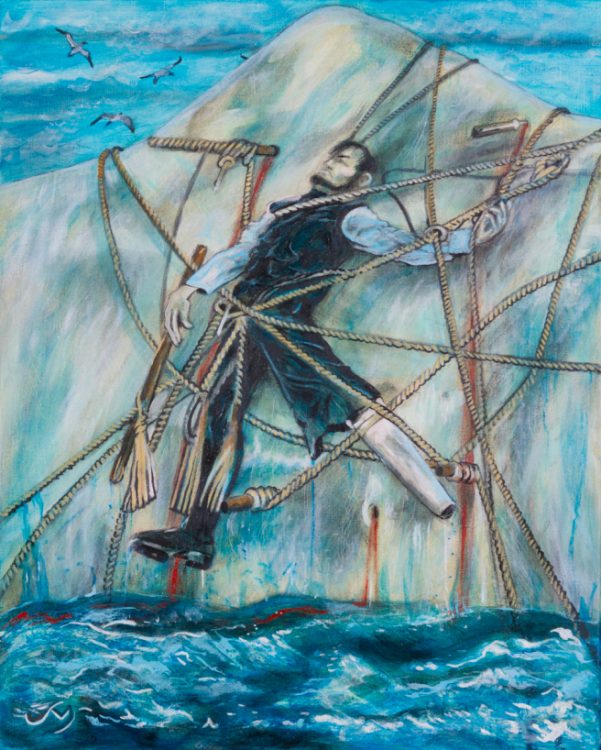
Now, I like Mencken as much as the next white male Protestant, but I have never advocated preaching him. Yet, while Wilson entertains preaching Baltimore’s bad boy, Tim Bayly reached for Herman Melville:

In my first message at the conference, I quoted Melville’s maxim, “the pulpit leads the world.” During the Q&A afterward, a pastor ministering in a hipster neighborhood of an eastern seaboard city was quite exercised over the statement, calling out “what’s your authority for saying ‘the pulpit leads the world’?”

I answered that I hadn’t cited it, but my source was Melville’s Moby Dick, leading him to interrupt saying he didn’t care where the quote came from, following with “where does it say that in the Bible?”

To which I responded that the entire Bible says it, from the prophets through the book of Acts where we read of the preaching of the Gospel turning the ancient Roman Empire on its head and getting the Jewish leaders to gnash their teeth.

He continued adamant in his denial, at which point I probed whether he was an R2K acolyte of men like Darryl Hart and David VanDrunen?

Bingo. And later in the conference, this pastor interrupted my message on the sin of effeminacy, saying I should stick to preaching the simple Gospel. He was quite adamant about it and I had to ask him if he’d please let me finish and we could talk afterward?

This is the preaching of Reformed pulpits in our nation today, and it leads me on this morning following our midterm elections to make the obvious point that everything going on in these United States right now, from our White House to our Congress and Supreme Court down to our state capitals and governors’ mansions down to our mayors and school district superintendents, even to the words squawking in our police cars and the smiles and frowns of our crossing guards, is the product of our pulpits.

Notice the concession to the spirituality of the church (and its foundation in the sufficiency of Scripture). If you want to preach about politics, you need to look beyond the Bible to American authors. Mencken and Melville are preferable to Charles Dickens and Flannery O’Connor, though Christians reading non-Christian fiction is generally a good thing. But not in the pulpit, not even The Wire.