Evangelicals Need to Take a Page from Roman Catholics (year 501)

Inspired by some minor reflections on personal identity and politics, I present recent findings on Roman Catholics and the 2016 Presidential election.

According to our May 2017 survey, just over three-quarters of American Catholics said that they voted in the November 2016 presidential election. Of those who voted, 43 percent said they voted for Trump while 48 percent said they voted for Clinton. The other nine percent voted for minority candidates. This is fewer Trump voters and more Clinton voters than the percentages among self-identified Catholics as reported in the exit polls, which reported 52 percent voting for Trump, 45 percent voting for Clinton, and 3 percent going to other candidates. But this survey took place six months after the election and some may have been recalling the candidate they wish they had voted for rather than their actual vote.

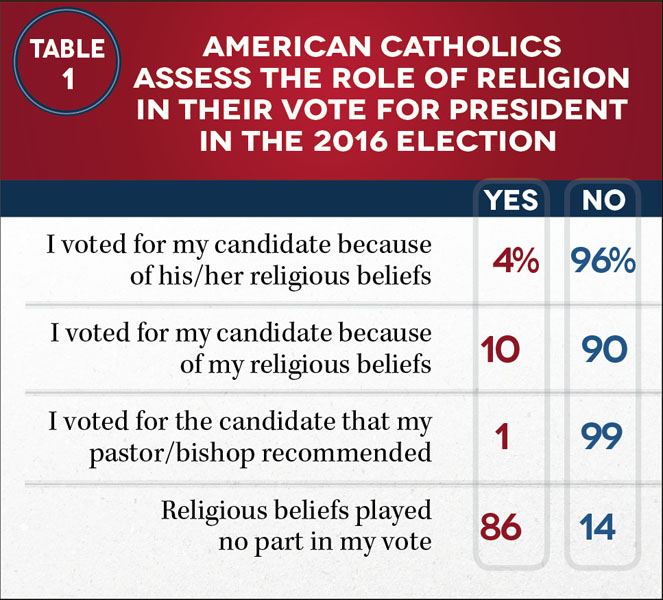
We began our 2017 survey with a series of questions about the possible role religious beliefs might have played among American Catholics In the 2016 election.

The responses of American Catholics to the questions cited in Table 1 make clear their assertion that their religious beliefs were not relevant to their vote for president in the 2016 election. The great majority (86 percent) said that religious beliefs (their own or that of the candidates) played no role in their vote. Just one in ten said that they voted for their candidate because of their own personal religious beliefs and even fewer — just 4 percent — said that they voted for their candidate because of the candidate’s religious beliefs.

Beliefs and values that are essential

That raised the question whether and to what extent did Catholics who voted for Trump differ in their religious beliefs and practices from Catholics who voted for Clinton. We have a standard block of questions about the beliefs and values that many consider essential to being a “good Catholic” that we have asked, in some form, on every survey since 1987. Table 2 compares the proportion of Trump and Clinton voters who say that each item is “essential to your vision of what it means to be Catholic.”

Catholics who supported Trump and Catholics who supported Clinton generally share very similar beliefs about how essential each of these items is to their vision of what it means to be Catholic. Differences of less than 10 percentage points between the two are not statistically significant. Both types of Catholic voters rank all ten items in virtually the same order.

Belief in the resurrection of Jesus, devotion to Mary as the Mother of God, and the papacy are essential to more than half of Trump voters and Clinton voters. Only about half saw charitable efforts to help the poor as essential and the percentage who saw the celibate male clergy as essential continues to have only a small percentage of support among either Trump or Clinton voters.

In other words, religion had little to do with the vote. That seems precisely what evangelicals should be doing. If you can segregate politics from faith, you don’t have the problem of evangelicals leaving the fold because of the movement’s political significance. Faith is one part of your life. Politics another.

Roman Catholics are doing it. Why can’t evangelicals?

Celebrating a Reformed Church

I saw a story today about the U.S. bishops having to calculate the uprightness of the Republican tax plan:

After Paul Ryan told an audience at Georgetown University that his legislative work conforms to Catholic social teaching “as best I can make of it,” he homed in on the importance of reducing the federal deficit. “The overarching threat to our whole society today is the exploding federal debt,” he said. “The Holy Father, Pope Benedict, has charged that governments, communities, and individuals running up high debt levels are `living at the expense of future generations’ and `living in untruth.’”

That was in 2012—a smart (if incomplete) retort to scholars, bishops, and commentators who argued that Ryan’s budget priorities ran afoul of Catholic social doctrine. But on October 25, House Republicans under the Wisconsin congressman’s leadership approved a budget blueprint that would bring about an alarming increase in federal debt to achieve tax cuts weighted to benefit the rich. Even in the annals of federal budgeting, an additional gap of $1.5 trillion or more over ten years is a lot of money. When the Senate put forth this plan, which the large majority of Ryan’s caucus rubber-stamped, the Congressional Budget Office warned that “the high and rising debt that is projected would have serious negative consequences for the budget and the nation.” . . .

To give Ryan the benefit of the doubt, there is still time to work out a more principled budget. But, like just about every American politician who claims support in Catholic teaching, he needs to go beyond cherry-picking. He’ll need to consider factors beyond the deficit—especially distributive justice, which, as Pope Benedict wrote in his 2009 encyclical Caritas in veritate, the church has highlighted “unceasingly.”

The U.S. Conference of Catholic Bishops highlighted this facet of Catholic teaching in an October 25 letter on “moral criteria to assist Congress during deliberations on possible tax reform.” The letter said that the tax burden should not be shifted from the rich to the poor, and noted that the Republicans’ “Unified Framework for Fixing Our Broken Tax Code” states that a revised tax code “would be at least as progressive as the existing tax code.” . . .

The bishops’ moral criteria also include concern for the poor; strengthening families; “adequate revenue for the sake of the common good”; avoiding cuts to poverty programs to finance tax reform; and encouraging charitable giving.

I don’t know what Ryan would make of this list, which was part of a letter to all members of Congress from Bishop Frank Dewane of Venice, Fla., chairman of the bishops’ Committee on Domestic Justice and Human Development. But these are points the bishops have made time and again as they advance the notion that a budget is a moral document. Before the House vote on October 25, the bishops’ conference took the step of posting a notice online saying that “Christ teaches that we should find Him the `the least of these,’ (Matthew 25). Call on your Representatives to not forget the poor as they debate and vote on the budget resolution.”

On Reformation Day 2017 I’m so thankful for pastors who actually attend to God’s word and leave politics to politicians.

I’m also glad for reformers who created a separate realm for the church so that secular society could be secular.

I’m especially glad that Orthodox Presbyterian pastors and elders, as gifted as they are, don’t feel responsible for explaining tax policy to Congress.

Send the Confederate Monuments to Canada

After all, as Wilfred Laurier asserted, where else does a nation honor both the victors and the defeated?

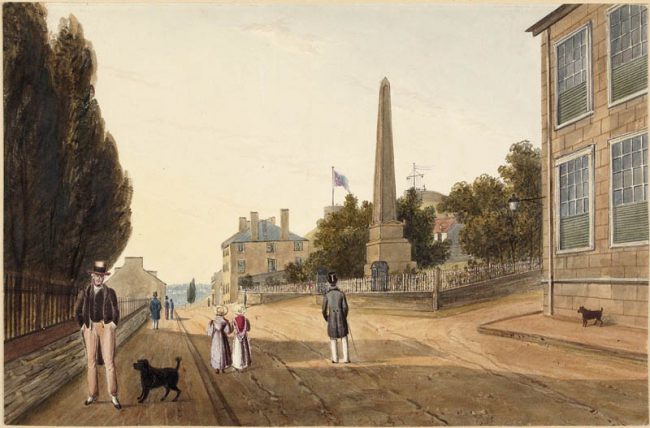
Where is the Canadian who, comparing his country with even the freest countries, would not feel proud of the institutions which protect him? Where is the Canadian who, passing through the streets of this old city and reaching the monument raised a few steps from here to the memory of the two brave men who died on the same field of battle while contending for empire in Canada, would not feel proud of his country? In what other country under the sun can you find a similar monument reared to the memory of the conquered as well as of the conqueror? In what other country under the sun will you find the names of the conquered and the conqueror equally honored and occupying the same place in the respect of the population? (The Benefits of British Institutions, 1877)

Laurier, Canada’s first francophone Prime Minister (1896-1911), was referring to the Wolfe-Montcalm Monument that memorialized the two generals who fought on opposite sides and died in the Battle of the Plains of Abraham, a decisive battle in 1759 during the Seven Years War when the British rolled back French colonial presence in North America.

Canada’s capacity to honor both anglophones and francophones in one monument may give provide reasons for thinking of the nation up north as exceptional.

Before Calvin

What would happen if critics of 2k had to think about the relationship between the church and magistrates before emperors got religion (and who knows if they grasped Christianity for the right reasons)?

In the current issue of New Horizons, David VanDrunen explains where 2k reflection on the state starts — not in 1536 but in 33.

The apostolic church lived under civil magistrates who did not confess Christ and sometimes persecuted people who did. Yet New Testament texts such as Romans 13:1–7 and 1 Peter 2:13–17 taught that God had ordained civil magistrates and that believers ought to honor and submit to them.

Following the Roman emperor Constantine’s conversion to Christianity in the early fourth century, the status of Christians in society changed. The contemporary church historian Eusebius, in his Ecclesiastical History, described the Roman Empire under Constantine as the fulfillment of Old Testament texts prophesying that war would cease and the wicked would be cut off: Constantine was realizing Christ’s kingdom on earth. Shortly thereafter, Augustine (354–430) provided a much more modest view. In his City of God, Augustine described Christians as sojourners, on a pilgrimage in this world toward the heavenly city. He acknowledged that Christians should participate in their political communities, but he taught that all earthly rulers and empires are provisional, not to be confused with Christians’ eschatological hope.

In the fifth century, the “Christendom” model emerged. As described by Pope Gelasius I, there are “two powers” that exercise authority under God in this world: the emperor has authority over “temporal affairs” for the sake of “public order,” and the priest controls the sacraments and “spiritual activities,” toward the goal of “eternal life.” Priest and emperor should submit to one another in their proper spheres.

This model was helpful in important respects. It affirmed that civil governments are legitimate, ordained by God. It also taught that their jurisdiction is limited and subject to God’s authority.

But notice the problems:

First, it essentially wed the church to the state in a confessionally unified Christian society. The New Testament, however, never suggests that Christians should expect or seek such a society.

Second, the state was expected to enforce the church’s claims about doctrine and worship by punishing dissenters with the sword. This reality sat uncomfortably beside New Testament teaching that Christ’s gospel and kingdom do not advance by the weapons of this world. Many who sought to reform the church—such as John Hus in the fifteenth century—would meet untimely ends as victims of this church-state alliance.

So long as a Protestant city council supports our guy, John Calvin, we forget about the problems of a religious magistrate? It’s our civil government.

And so long as that Cadillac CTS that only gets 13.8 mpg is a comfortable ride to church, we forget about the price of gas or limits on fossil fuels? It’s our gas guzzler.

O Canada!

Colonial religion north of the border was no more decent and orderly than it was in the U.S. of A. (though hats off to the Roman Catholics for allowing Presbyterians to use their facility):

For a time after the fall of Montreal to the British in 1760, the Presbyterians were content to worship with the city’s Anglicans. With the arrival in 1786 of John Bethune, a former army chaplain and Church of Scotland minister, they formed a congregation of their own, meeting in a rented room on Notre Dame St. But when Bethune himself moved on to Upper Canada the following year, they moved back with the Anglicans. Hard feelings? None has been recorded.

Then, in 1791, the Presbyterians moved once again to a new foster home, this time to nothing less than a Catholic one. The Recollet fathers invited the Presbyterians to use their handsome chapel in Notre Dame St. for worship once their own Sunday mass was over.

And so they did, for about a year, in front of an altar most unPresbyterian in its embellishment, a hint of incense perhaps lingering in the air. Again, no one seemed to mind.

Like the Presbyterians, the Recollets were used to sharing. They had already lent their chapel to the Anglicans, and in 1809, when the Presbyterians’ church was being reroofed, they would once again welcome the Scots.

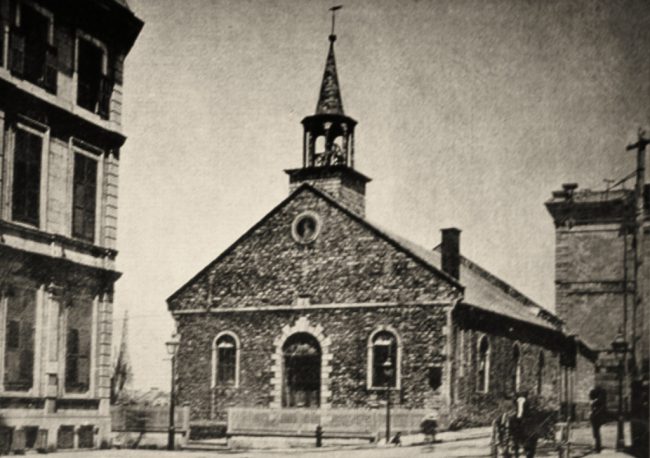
The Scotch Presbyterian Church that opened in the fall of 1792 was a plain fieldstone structure seating more than 500 people. In time, it took its name from the street where it stood, St. Gabriel. The site, which backed onto the Champ de Mars, is now occupied by part of the Old Court House on Notre Dame St.

Many Scots in the city, among them James McGill, Alexander McKenzie and William McGillivray, had grown wealthy in the fur trade, and money for the project was quickly raised to build the church. But as The Gazette noted, the speedy five months in which the work was completed also reflected “great honor on the Gentlemen of the Church of England in this City, by their having liberally contributed to the Undertaking.”At least two Catholics also contributed.

The Glasgow-born McGill was typical of the blurred lines among the various denominations here. Arriving in Montreal in 1766, he worshiped with the Anglicans and continued to rent a pew with them even after leaving with John Bethune’s new congregation. When the St. Gabriel St. Church opened, he rented a pew there as well. In 1796, he was happy to serve as the sole Protestant on a provincial commission charged with repairing and maintaining Catholic churches in Montreal.

The Presbyterians’ first minister, John Young, was an odd man. He was physically imposing – he stood six-foot-six tall, with “an eye in his head like a hawk” – but his character was flawed. Almost certainly, he was an alcoholic and what we would now call a problem gambler.

In 1788, he became pastor of a united congregation in Schenectady and Currie’s Bush, in upstate New York. But two years later, he sought to resign when his flock brought serious charges against him, probably for drunkenness. Chagrined, he made his way to Montreal and, a minister without a congregation, was doubtless pleased to find himself wooed by a congregation without a minister.

In December 1790, he was cleared of the original charge of misconduct. But when the American Presbyterians then censured him for “abruptly leaving his charge, in the sight of the slanderous accusations, and taking a journey into Canada without the knowledge of his people,” he surely concluded he had little future in Schenectady. He briefly returned, before finally throwing in his lot with the Montrealers early in 1791.

He was then about 32 years old, and was soon conducting services for the Presbyterians here. On Sept. 18, in the Recollets’ chapel, he administered the sacrament of the Lord’s Supper “in accordance with the usages of the Church of Scotland.” He took a leading part in the campaign to build a permanent home for his congregation.

Expiration Date Passed

Apparently Ta-Nehisi Coates’ magic has worn off. Several writers have recently taken issue with his ideas about race relations and whiteness (and white superiority). Thomas Chatterton Williams, who was one of the first black authors to take Coates on, returns for another at bat under with the approval of editors at the New York Times (not the New York Post or the Washington Times). This must be serious.

At the Atlantic though, where Coates writes regularly and achieved some of his fame, his editors still think Coates is brilliant and that they bask in the brilliance by publishing and endorsing his ideas. For instance, on a recent podcast about Charlottesville and the Confederate Monuments, Jeffrey Goldberg described President Trump’s reaction, in which he wondered if taking down Robert E. Lee leads to Jefferson and Washington, in cataclysmic terms:

It is an amazing moment when the president of the United States can’t delineate the difference between the Civil War and the Revolutionary War. I think this is a breakpoint in modern American history.

Hasn’t Goldberg read Coates? Someone well before Trump showed a lack of nuance in describing white supremacy in U.S. history:

For the men who needed to believe themselves white, the bodies were the key to ta social club, and the right to break the bodies was the mark of civilization. “The two great division of society are not the rich and poor, but white and black,” said the great South Carolina senator John C. Calhoun. “And all the former, the poor as well as the rich, belong to the upper class, and are respected and treated as equals.” And there it is — the right to break the black body as the meaning of their sacred equality. And that right has always given them meaning, has always meant that there was someone down in the valley because a mountain is not a mountain if there is nothing below.

You and I, my son, are that “below.” That was true in 1776. It is true today. (Coates, Between the World and Me, 104-105).

So what do the editors at the Atlantic think of a staff writer who cannot tell the difference between the Civil War and Revolutionary War?

How History Makes the World a Better Place

Sometimes even boomers know the score. Take Camille Paglia (via Rod Dreher):

Paglia believes there is a causal connection between young Americans’ ignorance of history and their dim view of present conditions. At a conference in Oxford, Paglia stated again, in response to a student who criticized her and others for telling youths not to be so sensitive and snowflaky, “There is much too much focus on the present.”

Or try Rod Dreher:

Imagine that the US was involved in a major overseas war in which over 11,000 American soldiers died in one year alone (1967). For a point of comparison, fewer than 7,000 US troops have been killed in Iraq and Afghanistan over the past 14 years of combat there.

Imagine that 17,000 US soldiers would die in 1968, and 12,000 in 1969 fighting that war

Imagine that you might be drafted to go fight there.

Imagine what it would be like if you were convinced the war was profoundly immoral, and you had to choose between deserting the country and bearing arms in that war.

Imagine that many college campuses had become hotbeds not of snowflakey sit-ins, but of serious violence.

Imagine that domestic bombings by left-wing radicals had become a routine part of American life (e.g., five per day in an 18-month period in the early 1970s).

Imagine that two of the nation’s most prominent political leaders (MLK and RFK) Bobby were gunned down three months apart.

Imagine that your government and military were lying to Congress and to the American people about the war, and had been for years (as was revealed with the 1972 publication of the Pentagon Papers).

Imagine that major American cities were burning in race riots.

Imagine that cops in a major American city staged what was later called “a police riot” outside a political party’s national convention, and beat the hell out of protesters.

Could it be that Rod Dreher had it rougher than Ta-Nehisi Coates?

The mind reels.

I Thought John Fea Is Evangelical

John linked to a report from Baylor on the outlook of Trump voters. Among those voters are these characteristics:

• are members of white Evangelical Protestant churches

• consider themselves “very religious”

• think of the United States as a Christian nation

• believe that God is actively engaged in world affairs

• fear Muslims and refugees from the Middle East

• believe that women are not suited for politics

• oppose LGBTQ rights

Here’s what’s odd about this finding. I’m betting John and I are on the same side of these bullet points.

He and I consider ourselves very religious.

He and I think the United States is not a Christian nation.

He and I believe likely that God is actively engaged in world affairs since we tend not to be deists.

He and I do not fear necessarily Muslims or refugees from the Middle East, though I bet if those Muslims or refugees had fought for ISIS John might be a little afraid as I would be.

He and I do not think that women are unsuited for politics, though John was far more congenial to Hillary Clinton than I was.

He and I likely overlap on rights for LBGTQ folks, though I also suspect that the extent of those rights might be qualified.

In which case, neither John nor I fit the profile of evangelicals who voted for Trump. And yet, John still self-identifies as evangelical. I do not and have not for at least 25 years.

In which another case, why does John object to Trump as strongly as he does? Is it because he identifies as evangelical even while the majority of evangelicals voted for Trump? That disconnect could make you wonder about the group to which you belong. I imagine if Bruce Springsteen came out in favor of Trump, John would have as much psychic discomfort as I would if Ethan Coen trashed J. Gresham Machen.

In which a third case, isn’t what matters here not someone’s religious w-w but his or her politics? I can belong to a communion that includes (or used to) Kevin Swanson and that’s okay because the OPC does not require fidelity on political or cultural matters. But if you are part of a religious group that includes a wide swath of Protestants and think that faith should inform a lot of what you do — not to mention that the group has been identified with a certain political trajectory for FORTY years, evangelical support for Trump might give you pause. In other words, if you think religion and politics need to be consistent, then you might assume that a self-identified Calvinist is also a political conservative (which Donald Trump is not). But doesn’t that also mean that if you are an evangelical, your politics should align in some way with the rest of the evangelical world? Being evangelical surely doesn’t make you a liberal (though evangelical professors seem to think otherwise). And oh by the way, some of the biggest opponents of Donald Trump like Russell Moore also oppose policies like gay marriage. In other words, you don’t need to oppose Trump and go over to the editorial page of The New Republic.

Even so, nothing on that list of Trump voters’ attributes is inherently Christian.

Regarding those qualities now as sub-Christian is going to take a little more work than simply finding Trump repugnant. Ever since Ronald Reagan, most Christians in either the Democrat and Republican parties would have agreed with those convictions.

In which a fourth case, Donald Trump justifies rewriting the rules governing yucky evangelicalism.

Alien Southerners

Has it occurred to many that the same people who have major reservations about the Confederate Monuments generally favor amnesty for undocumented aliens? Sure, that might seem like an inconsistency but the nooks and crannies of citizenship for aliens have more square inches than a container of Thomas’ English muffins.

Consider, for instance, the recent statement by the American Historical Association, the (trigger warning) Cadillac historical professional bodies:

Decisions to remove memorials to Confederate generals and officials who have no other major historical accomplishment does not necessarily create a slippery slope towards removing the nation’s founders, former presidents, or other historical figures whose flaws have received substantial publicity in recent years. George Washington owned enslaved people, but the Washington Monument exists because of his contributions to the building of a nation. There is no logical equivalence between the builders and protectors of a nation—however imperfect—and the men who sought to sunder that nation in the name of slavery.

Thing is, historians do not have the power to determine who is an American citizen. After the Civil War, President Johnson and Congress had to walk a very delicate line between preventing rebels to resume power of state governments while also honoring that the southern states had never seceded and so their governments were still legitimate. Here‘s one angle of the tight rope, namely that President Lincoln advised leniency (more than the AHA):

Lincoln desired to hasten the end of hostilities and quickly reestablish the fraternity of the parted Union. After asking Lincoln what to do with the defeated rebel armies in March 1865, General William Tecumseh Sherman remarked that, “all [Lincoln] wanted of us was to defeat the opposing armies, and to get the men composing the Confederate armies back to their homes at work on their farms and in their shops.” Additionally, the Secretary of the Navy remarked after Lincoln’s last cabinet meeting that Lincoln “was particularly desirous to avoid . . . any vindictiveness of punishment.” Other members of Lincoln’s party were not so forgiving. Many felt that Lincoln’s policies and desires were too soft and wished to punish former Confederates more harshly. They feared that former Confederates, returned to power, would not accept the fruits of Union victory, namely emancipation, and would harass black and white former Unionists in the South. To this extent, The New York Herald on April 16, 1865, estimated that Andrew Johnson’s policy towards former Confederates would be “more tinctured with the inflexible justice of Andrew Jackson than with the prevailing tenderness of Abraham Lincoln.”

Here’s how amnesty worked:

It was under these proclamations that, from May 1865 to December 1868, former Confederates flooded the office of Andrew Johnson with thousands of amnesty requests, with the numbers eventually tapering off as the exemptions narrowed. Each request for amnesty included a signed copy of the oath certifying the individual’s compliance, as well as a personally-written request and a third party endorsement, generally by the governor of that person’s state. The personally written requests generally followed the same sequence: the individual introduced himself and his place of residence and often proclaimed his age. He then described his actions (and/or sentiments) before secession, his conduct during the war, the clause under which he was exempted, and whether or not he had any property confiscated from him. The petitions ranged from brief requests for amnesty to “long and well-prepared defenses” of their conduct.

Petitioners were “anxious” to have their amnesty requests granted and their rights and privileges as citizens of the United States resumed. Their exemption from amnesty precluded them from such activities as the “transfer of titles or properties” and the obtainment of copyrights and patents, making business very difficult. Some were even tentative to marry. Until these individuals were pardoned, they lacked civil rights and faced the prospect of having their property confiscated. Above all, they lacked political rights, and thus could not take part in the discourse involving Reconstruction, and were unable to participate in the future of the South. Thus, asking for pardon was the “sensible thing for these people to do.”

Imagine that. Wanting a working society rather than attitudinal purity.

Finally, President Johnson declared “unconditionally, and without reservation, … a full pardon and amnesty for the offence of treason against the United States, or of adhering to their enemies during the late civil war, with restoration of all rights, privileges, and immunities under the Constitution and the laws …”

That pardon went to everyone but Robert E. Lee. He did not receive his executive pardon until Michigan’s own, President Ford:

Lee sent an application to Grant and wrote to President Johnson on June 13, 1865:

“Being excluded from the provisions of amnesty & pardon contained in the proclamation of the 29th Ulto; I hereby apply for the benefits, & full restoration of all rights & privileges extended to those included in its terms. I graduated at the Mil. Academy at West Point in June 1829. Resigned from the U.S. Army April ’61. Was a General in the Confederate Army, & included in the surrender of the Army of N. Va. 9 April ’65.”

On October 2, 1865, the same day that Lee was inaugurated as president of Washington College in Lexington, Virginia, he signed his Amnesty Oath, thereby complying fully with the provision of Johnson’s proclamation. But Lee was not pardoned, nor was his citizenship restored. And the fact that he had submitted an amnesty oath at all was soon lost to history.

More than a hundred years later, in 1970, an archivist at the National Archives discovered Lee’s Amnesty Oath among State Department records (reported in Prologue, Winter 1970). Apparently Secretary of State William H. Seward had given Lee’s application to a friend as a souvenir, and the State Department had pigeonholed the oath.

In 1975, Lee’s full rights of citizenship were posthumously restored by a joint congressional resolution effective June 13, 1865.

At the August 5, 1975, signing ceremony, President Gerald R. Ford acknowledged the discovery of Lee’s Oath of Allegiance in the National Archives and remarked: “General Lee’s character has been an example to succeeding generations, making the restoration of his citizenship an event in which every American can take pride.”

When will the social justice warriors be heading for Grand Rapids to show their rectitude on the facade of the Ford Presidential Library? If they go, they’ll find good beer.

How Liberalism Abets Sin

People who self-identify as Christian scholars have issued a statement that condemns racism:

Racism should be denounced by religious and civic leaders in no uncertain terms. Equivocal talk about racist groups gives those groups sanction, something no politician or pastor should ever do.

The Christian basis for such denunciation is that all humans are created in the image of God. So far, so uncomplicated.

The statement also includes an affirmation of civil liberty:

Even as we condemn racism, we recognize that the First Amendment legally protects even very offensive speech.

The statement could include freedom of assembly, and freedom to publish. But these Christians see that our laws protect speech even when it is offensive.

Now imagine if the abolitionists had made similar assertions about slavery:

Slavery should be denounced in no uncertain terms.

Even as we condemn slavery, we recognize that the First-Amendment legally protects slavery advocates to express their ideas.

I don’t think that kind of toleration was in William Lloyd Garrison’s playbook.

I am aware, that many object to the severity of my language; but is there not cause for severity? I will be as harsh as truth, and as uncompromising as justice. On this subject, I do not wish to think, or speak, or write, with moderation. No! no! Tell a man whose house is on fire, to give a moderate alarm; tell him to moderately rescue his wife from the hands of the ravisher; tell the mother to gradually extricate her babe from the fire into which it has fallen; —but urge me not to use moderation in a cause like the present. I am in earnest—I will not equivocate—I will not excuse—I will not retreat a single inch—AND I WILL BE HEARD. The apathy of the people is enough to make every statue leap from its pedestal, and to hasten the resurrection of the dead.

And so, the problem that proponents of certain moral positions in public face is that in a free society, we make room for sinners.

Even as we condemn adultery, we recognize that we don’t want police going into private homes to see what people are doing.

Or

Even as we condemn the desecration of the Lord’s Day, we recognize that those who try to observe the Fourth Commandment should not receive special protections from law enforcement officials for their beliefs.

Or

Even as we condemn Communism, we recognize that the freedom of association allows the Communist Party USA to enjoy the protections of tax laws and civil and corporate codes.

In other words, a liberal society will not allow government to root out sin. It even protects its practice.

That is an especially difficult aspect that this statement does not address. The authors acknowledge that racism has taken many forms in U.S. history:

Slavery was formally abolished in 1865, but racism was not. Indeed, it was often institutionalized and in some ways heightened over time through Jim Crow legislation, de facto segregation, structural inequalities, and pervasively racist attitudes.

American law and policy have addressed some of these instances of racism — Jim Crow, structural inequalities, voting rights. But can legislation do anything about racist attitudes or the efforts of those who hold them to meet and publish?

Probably. But then you may no longer have a free society.

In which case, what does speaking out do?

Even without liberalism, will always have sin with us. With it, we have different interpretations of sin and so vice receives protection.