All Political Sermons are Bad

In the spirit of J. Gresham Machen, remember that if you don’t mix religion and politics, you don’t have to perform the contortions that allow you to affirm Civil Rights legislation (as a work of God) and oppose Prohibition (not as a work of God even though Protestants did think it was a work of God). Just keep politics out of the church.

But that’s not what Christians do.

And American Presbyterians have been guilty for a long time before liberal Protestants went all in on the Social Gospel. Mark Tooley reminds:

This week I studied at the Army War College at Carlisle Barracks in Pennsylvania, a fort dating to the 1700s, when President George Washington led an army there in route to suppress the Whiskey Rebellion. Farmers in western Pennsylvania had revolted against the authority of the new republic to tax the whiskey they distilled from grain otherwise expensive to ship from their remote frontier.

Quickly realizing this threat to the new nation’s cohesion, Washington in 1794 summoned the militias from Pennsylvania and nearby states into an army of 13,000 that he personally led against the rebellion. At an evening celebration of greeting for the President and his army, the town of Carlisle illumined a special proclamation simply declaring: “The Reign of the Laws.”

Such a poignant and wonderful exclamation: “The Reign of the Laws.” The people saluted Washington, but they, like he, did not place their faith in his personal rule but in impartial law as the antidote to anarchy.

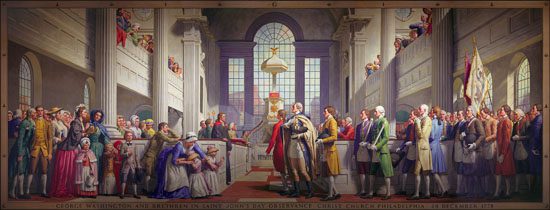
While in Carlisle Washington worshiped at the stone Presbyterian church, which I visited, and where he heard Dr. Robert Davidson preach “A Sermon on the Freedom and Happiness of the United States of America.” Washington described it in his diary: “Went to the Presbyterian meeting and heard Dr. Davidson preach a political sermon, recommendations of order and good government and the excellence of that of the United States.”

Washington’s summary was fair and succinct, but the sermon merits elaboration, both for illustrating how Christians in early America viewed God’s purposes for their nation, and for modeling, at least in part, how we today might view government, justice and nationhood providentially.

The sermon is based on King David’s question in 2 Samuel 7:23: “And what one nation in the earth is like Thy people, even like Israel?” Pastor Davidson warned against being “carried away by the spirit of the times, to substitute mere political harangues in the place of the Gospel of Christ,” recalling, per Proverbs 27:34, that “righteousness exalteth a nation; but sin is a reproach to any people.” And he noted the “duties of citizens are not to be considered as topics foreign to the Gospel” as the “Gospel views man in every condition in which man can be placed.”

Davidson heralded the “great goodness of God to our own state and nation in particular; our high and many privileges, the gratitude due from us to God for them; and the wise improvement which we ought to make of them.” As a national comparison, Davidson recalled:

The history of the Jewish nation, if read with suitable views, and especially in order to gain an acquaintance with the ways of God to men, would be one of the most instructive that could merit our attention. …We see how much superior, in point of privileges, the Jewish nation was, to all the other nations around them.

As God had showed unmerited and unprecedented favor to the Hebrew nation, Davidson urged considering the “great goodness of the Divine Being to our state and nation in particular; – our high privileges; the gratitude which we owe to God for them…” And he recalled:

This part of the New World presented itself as a place of refuge for those who wished to enjoy religious and civil freedom, unmolested, and to the greatest extent. They hoped that here they could worship God according to their consciences, and would be at a secure distance from all the insults of tyranny.

After reciting the British oppressions precipitating the American Revolution, Davidson declared the new independent nation had the “freest and best form of civil government, which could be learned from the wisdom and experience of ages,” and that with “all the imperfections” still “is one of the most free and excellent under the sun.”

Of the American republic, Davidson further rhapsodized:

This is a government, which all the real friends of freedom in the old world appear to admire; and under the wings of which the oppressed of every nation would wish to take refuge. Here is liberty and equality, according to the just acceptation of those favorite terms; liberty, civil and religious to the utmost extent that they can be, where there is any government at all; and an equality of rights, or provision made for the equal protection of the lives and properties of all. That all men should be equal, as to abilities, station, authority, and wealth, is absolutely, in the present state of things, impossible. But where every citizen has a voice in making the laws, or in choosing those who make them, and is equally under their protection, – there is equality.

I for one (why not five) am convinced that modernism did not begin with adapting Christianity to biology, higher criticism, or immigration reform. It began when Christians, like Pastor Davidson, started to adapt Christianity to modern nations like the United States. Once you start making the Bible say things it doesn’t, it’s hard to stop.
How Did Nancy MacLean Miss Calvinism?

The Duke historian’s book, Democracy in Chains: The Deep History of the Radical Right’s Stealth Plan for America has generated lots of attention and the debate appears to be one more indication of how much the United States resembles Turkey. For those who missed it, here is how the story at the Chronicle summarized the book:

At the heart of this purported plot is a Nobel-winning economist whose ideas MacLean characterizes as “diabolical” and “wicked”: James McGill Buchanan. Buchanan, a libertarian who taught at George Mason University and died in 2013, developed a novel way of analyzing government that would have far-reaching consequences for democracy, MacLean argues. In his view, self-interest dictated the behavior of public officials and those who tried to influence them. The incentives that shaped officials’ actions — winning re-election, expanding their bureaucratic turf — encouraged profligate government spending at the expense of a minority of taxpayers. This violated the taxpayers’ freedom and burdened the economy.

In MacLean’s telling, Buchanan was both an intellectual and a “deeply political foot soldier of the right.” Over time, she says, he came to believe that the best way to bring about radical change was to focus on the rules, not the rulers. Freedom would flourish only by imposing legal and constitutional shackles that prevented public officials from responding to the will of democratic majorities. In the late 1990s, MacLean writes, a like-minded billionaire, Charles Koch, seized on Buchanan’s ideas as a “personal operational strategy” for his campaign to “save capitalism from democracy — permanently.” Because most Americans didn’t support their ideas, that strategy required stealth: small, piecemeal moves that could win approval without provoking an outcry.

This is one more instance where I marvel at professionals who work in privileged and hierarchical environments like universities with tenure and ranks become indignant defenders of democracy. As if any senior professor would submit to democratic rule at his or her institution — let the students, groundskeepers, and athletic trainers in on running the university.

But I do wonder if MacLean might have made her story even juicier if she had thrown in that Buchanan (sort of a Presbyterian name, no?) was part of a sinister plot of Calvinists to control America. After all, the way Sam Tanenhaus describes Buchanan’s contribution sure sounds like the economist knew the fall infected politics:

Yet race, MacLean acknowledges, was not ultimately a major issue for Buchanan. Fending off desegregation was only a skirmish in the long campaign to revive antigovernment ideas. That campaign dated back to the nation’s founding, gained new strength in the pre–Civil War nullification arguments of John Calhoun, and reached its modern apogee in debates over taxes and spending. Here the enemies were unions (“the labor monopoly movement,” in Buchanan’s phrase), leftish policy makers, and also Keynesian economists. Together these formed a “ruling class” that was waging war against the marketplace. This was not a new argument, but Buchanan gave it fresh rigor in his theory of “public choice,” set forth in his pioneering book, The Calculus of Consent (1962), written with Gordon Tullock. Governments, they argued, were being assessed in the wrong way. The error was a legacy of New Deal thinking, which glorified elected officials and career bureaucrats as disinterested servants of the public good, despite the obvious coercive effects of the programs they put into place. Why not instead see politicians and government administrators as self-interested players in the marketplace, trying to “maximize their utility”—that is, win the next election or enlarge their department’s budget?

Real Calvinists don’t believe in public good and reach for their two-edged sword whenever a public servant serving servers invokes such immodest language.

Why Never Trumpers Need the Falwells

Because they are both fundamentalists of the double-separatist variety.

Here’s something for John Fea to consider (as he passes on advice to the new White House press secretary, Sarah Huckabee Sanders):

There is a moral argument, I suppose, for men and women who chose to go into this administration to serve in Cabinet-level or sub-Cabinet positions out of a sense of obligation to the country. (The better argument is that working in this administration inevitably leads to enabling wrongdoing and horrible policy decisions, but I understand the rationale of those who disagree with me.) However, there is no moral argument for going directly into the president’s senior/political staff, which in this administration means defending indefensible conduct, denying reality and encouraging others to lie in defense of the administration. You cannot serve in a dishonorable White House honorably.

Now substitute mainline Protestant churches (read modernist) for Cabinet and president in that quotation and you have the same argument that prompted Bob Jones to reject Billy Graham’s — get this — crusades when in 1957 the revivalist started cooperating with mainline churches. It was the same rationale that led the OPC to reject the leadership of the National Association of Evangelicals for including in its membership ministers, laity, and congregations that belonged to the mainline churches. That was double-separatism then, and historians like John Fea who know a thing or two about fundamentalism have argued that such institutional purity lacked Christian charity and was even ornery.

But if applied to the secular realm, such double-separatism makes perfect sense.

Pardon me for thinking evangelical historians are not up to their A-game with Trump. Is it because they’ve gone soft on Russia?

America’s Elite Class

Daniel Drezner does not wince when talking about elitism in the United States. His inspiration was the David Brooks column on Italian sandwiches, about which Drezner writes:

Brooks argued that “The educated class has built an ever more intricate net to cradle us in and ease everyone else out. It’s not really the prices that ensure 80 percent of your co-shoppers at Whole Foods are, comfortingly, also college grads; it’s the cultural codes.”

I agree with my Post colleague Tim Carman that outside The Anecdote That Shall Not Be Named, the column was “an otherwise temperate take on the restrictions and social codes that keep the middle class in its place.” As a fully paid-up member of this class, there clearly are expected modes of behavior, and not knowing the unspoken rules of the game acts as a barrier to those trying to enter the meritocratic class. It can still be done, but it’s like learning an additional language.

Then Drezner worries that some of the Trump clan may actually stumble their way into the elite class by being able to order the right Italian sandwich meats:

Based on my own conversations, it would seem that most traditional D.C. wonks look at most of the Trump family and see a bunch of wealthy, not-very-bright boors who do déclassé things like eat their steaks well-done and with ketchup. Indeed, there is a whole conservative genre defending the Trumps for some of their gauche tendencies. Most of the Trumps gleefully ignore the cultural codes that Brooks describes, because they are rich enough to not care.

Then we get to Jared Kushner and Ivanka Trump, and the narrative switches.

The rest of the Trumps might scream bridge and tunnel, but Jared and Ivanka have undeniably mastered the cultural codes of the educated class. It is hard to read a profile of either of them without words like “polished” or “poised” appearing.

Take the opening sentences to Jill Filipovic’s Politico essay from May: “Ivanka Trump is the poised, polished face of a chaotic White House, a bright young mother who many suspect is a voice of reason and moderation among the Steve Bannon acolytes in the West Wing, whispering socially liberal values in her daddy’s ear.” Look at the Post’s Style Section profile of Ivanka from this month: “Ivanka Trump’s office: clean, white, quiet. A zone of punctual start times and promptly offered water bottles, and a conference table at which she conducts meetings. A short, winding walk away from her father’s Oval Office downstairs.” Or as T.A. Frank noted in Vanity Fair, “let’s agree that one of the finest qualities of Jared Kushner is his tailoring. The fit is so good. Even with bespoke work, that’s hard to achieve.”

Let me posit that in mastering the cultural codes of the educated class, Kushner and Ivanka somehow fooled even veteran D.C. observers into presuming that they might actually be qualified and competent as well. Which all evidence suggests is not true.

Drezner believes that expertise on policy is what qualifies someone to rule in America, not expertise in self-promotion, food, or fashion.

As someone who values education, I am hard pressed to knock learning. But my education also tells me that in the United States, you don’t need to be educated to hold public office. George Washington and Abraham Lincoln did not have college educations. Never mind going to the Kennedy School of Government. By the same token, George W. Bush went to Yale and see what good that did him when it came to America’s educated elite.

And don’t forget about those brain surgeons that the Kennedy and Johnson administrations leaned on to devise a policy for the Vietnam War. Sometimes education doesn’t make you a good administrator — just ask any egg-head professor to chair his or her department. See what snafus ensue.

The reality is that with all of Drezner’s brain power, and it is considerable, he could not be POTUS. Well, he could. But he’d have to run for office and somehow portray himself as an ordinary ‘merican because despite the number of college graduates in this fair republic we don’t very often elect Ph.D.’s as POTUS (this is why Senator Sasse where’s not Harvard but Nebraska swag). Last time we did we had Woodrow Wilson and what did he do — used all of his intellectual fire power to fight a war to make THE WORLD, not just the United States, but THE WORLD, safe for democracy (which by the way means that we fought the war not to have educated elites running things)?

Which leads to the real point of this post: the story that the press and scholars are missing is what a novel state of affairs it is to have a POTUS who has no experience with government. Why no feature stories on what it’s like to have to do so many things that you’ve never done before? Or what is it like to be trailed by Secret Service agents? Or what’s it like to live in the White House? Many Americans could possibly imagine being in Donald Trump’s shoes (though what it’s like to be a billionaire is beyond me). We would not have the first clue about running a government as massive as the federal one. And that could be an exciting set of stories. But what we seem to get is reporting about how Trump is subhuman and stupid. Imagine if Bill Gates were POTUS. Would he be prone to the same mistakes? But he’s not the kind of jerk that Trump is so the press goes Jerry Falwell, Sr.

I still wonder, though, whether any of the people criticizing Trump, even Drezner, claim to know what to do as POTUS? Do the journalists or professors of foreign policy have white papers on Iran and how to deploy the CIA or State Department? (And if education is a pre-requisite for governing in the U.S., what is our foreign policy supposed to be with poorly educated rulers of other countries? Doesn’t this way of thinking involve a kind of hierarchy that is supposed to be antithetical to social justice?)

The reality is that nothing in American government prepares you for what you might face in the White House along the lines of war and diplomacy, not to mention the vast scale of administering the federal agencies. Jim Kenney, the mayor of Philadelphia has a degree from Lasalle University? Does that mean he’s not fit to hold a higher office? The governor of Massachusetts, Charlie Baker, has a degree from Harvard and an MBA from Northeastern. But can he stand on that great hill of U.S. foreign policy?

What I was hoping would happen with the Trump presidency was a chance to see the federal government through the eyes of a real outsider. The Trump administration might be an occasion for a POTUS self-study. What is necessary for the executive branch of the federal government? What is so complicated as to create barriers to other citizens serving in public office short of getting the right set of degrees and making the right connections? But alas all we are getting is how Trump fails to reassure many Americans that Washington is the capital of the greatest nation on God’s green earth (well, at least a few steps up from Russia).

Nothing Could Possibly Go Wrong

In 1872 the Protestant churches in Scotland handed over all their schools to the State on the explicit condition that Scottish State Education should continue to be Christian. From that day on the Scottish Education system (unlike the American one) has officially been Christian. The Catholics, being wiser than the Protestants, didn’t trust the State and so they kept their own schools. Even within living memory most schools in Scotland would have had ‘religious’ worship, school chaplains and bible teaching. The ethos of the schools were largely Christian. But this is now virtually unrecognisable. Secular humanists/atheists have cuckoo like taken over the State education system and are now using Salami tactics (piece by piece) to dismantle the remaining parts of it – crying tolerance and equality in order not to tolerate Christianity and in order to prevent Christians from receiving the equal education that the UN Human Rights charter demands.

2k Protestants were not so gullible.

And that’s why 2kers give two cheers (sometimes three) for the separation of church and state. It is impossible for established churches to remain faithful. They will always need to do the magistrate’s bidding and reflect the attitudes of the citizenry.

Selah.

How to Love America

Noah Millman proposes this (while meditating on G. K. Chesterton):

People feel an attachment, and a willingness to fight to protect, their homes, and their communities. That can take noble and ignoble forms — sometimes fighting to defend your community means committing injustice (as, for example, if you band together with your neighbors to prevent someone from a disfavored ethnic group from moving to the neighborhood). But the feeling is rooted in a direct experience, not an abstract attachment.

For any political community larger than a city, though, that attachment necessarily becomes abstract. So you need to teach your children why they should care about that larger community, be proud of it, and treat it as constituent of their identity.

Chesterton famously quipped that the sentiment, “my country, right or wrong” is like the sentiment, “my mother, drunk or sober.” But the thing about the latter is that she is your mother whether she’s drunk or sober — it’s just that your obligations change based on her condition. If she’s drunk, you won’t let her drive — instead, you’ll make sure she gets home safely.

The question, then, is how you teach your children to see their country as, in some sense, like a mother when their relationship is necessarily abstract rather than directly felt. A love of country based on the lie that your mother is never drunk will be too brittle to survive any kind of honest encounter with reality. But it seems to me equally problematic to say that you should love your country because it is on-balance a good one. Does anyone say about their mother that they love them because on-balance they are sober?

While Millman stresses the particular (a people, a place, a way of life — think baseball), Kevin DeYoung goes abstract and is thankful for the “idea” of America:

The United States of America began with the conviction that a nation should be founded upon truth. Not simply values or preferences, but upon truths. Self-evident truths that were true, are true, and will remain true no matter the time, the place, or the culture.

And central among these truths is the belief that all men are created equal. No one possesses more intrinsic worth for being born rich or poor, male or female, artisan or aristocracy. Of course, this truth, as much as any, unmasks our history of hypocrisy, for 3/5 of a person is an eternity from equality. But truth is still true. We all come into the world with the same rights and the same dignity–whether “gated community” in the world’s estimation or “trailer trash.”

These unalienable rights, we must note, are not granted by the Declaration of Independence. Our rights do not depend upon government for their existence. They are not owing to the largesse of the state or the beneficence of any institution. The rights of man are the gifts of God. The Creator endows; the state exists to protect. These unalienable rights can be suppressed or denied. But they cannot be annulled. We possess them–no matter what kings or parliaments say or presidents and congress decree–by virtue of being created in the image of our Creator.

Oh, by the way, if all humans have these rights irrespective of government, then how is that the basis for founding a nation? Didn’t this way of thinking lead in France to Napoleon’s wars to teach Europe liberty good and hard?

The thing is, if you stress ideas you wind up with a creedal nation, one that you tend to treat like a church, with people divided into the camps of orthodox and heretics, saints and pagans. Protestants suffer from this affliction and it shows in the recent anti-liberalism of Peter Leithart and Jake Meador.

Leithart took Matt Tuininga to task for turning Calvin into a liberal. Leithart added an objection to liberalism that fits with the nation-as-idea mentality:

Virtually none of liberalism’s theological critics objects to these forms and procedures as such. Their complaint isn’t against representative government or voting or freedom of speech and association. No one advocates a fusion of Church and state.

Rather, they claim that such a formal, procedural description masks the basic thrust of liberalism. Liberalism’s stated aim is to construct a society without substantive commitments, leaving everyone free to choose whatever his or her or hir own may be. Liberalism’s common good is to protect society from adopting any single vision of the common good. That’s a deviation from classical and traditional Christian politics (including Calvin’s), which sought to orchestrate common life toward a common end—the cultivation of virtue or the glory of God. In fact—and this is the other side of the critique—liberal societies do have substantive commitments. The liberal state pretends to be a referee, but beneath the striped shirt it wears the jersey of the home team. Under the cover of neutrality, liberal order embodies, encourages, and sometimes enforces an anthropology, ecclesiology, and vision of the good society that is often starkly at odds with Christian faith. Tuininga never confronts that line of analysis.

Since the U.S. is a liberal nation, it’s its liberal order becomes its an orthodoxy. But I thought the liberalism of the founders was not to form a society. They already had one — a people, a place, and a way of life. What they wanted was a liberal government, one that would not take sides in religion and other matters. If the U.S began to replace a liberal government with a liberal society, you could blame the centralizing and bureaucratizing effects of a national government that needed to organize the economy, schools, and industry to fight world wars, even cold ones. It really helps when the churches jump on the bandwagon and tell American officials the government is making the nation great.

Jake Meador thinks that the current spate of intolerance that liberals direct toward Christians is a function of liberalism itself:

If the move that western Christians attempt to make in response to all these challenges is to simply rebuild liberalism, then whatever victories we win will be short term. Liberalism is the soil from which the current regime has grown. It’s emphasis on individual autonomy and self-definition and the illegitimacy of unchosen authorities is precisely how we ended up where we are today.

So, two points: First, trying to Make Liberalism Great Again is probably no more realistic than trying to return America to the 1950s. In both cases, the order in question was the unique product of historical circumstances that our own era does not share. Thus any attempt to recreate said order is doomed to fail. Second, we need better language and concepts to make our case to both those within our church communities and those outside the church. Liberalism is not the way forward. It is the way toward further and deeper darkness. If we start thinking about common goods, shared life, and the neighborly arts, then we may be onto something. But all of these things, of course, assume a sort of communitarian sensibility that has always had a hard time reconciling itself to the deeply democratic, egalitarian nature of American Christianity. Therefore, whatever our project ends up being, it figures to be a long-term thing.

Meador should likely include Protestantism as the soil out of which liberal progressivism grew. Protestants were intolerant of Roman Catholics and other outsiders. Remember the threat that parochial schools posed to public ones and the way that American governments insisted no parochial school receive a whiff of public funding (still in the balance in SCOTUS’s recent Trinity Lutheran v. Comer decision). He has a point about “common goods, shared life, and the neighborly arts.” I wish he had included baseball and drip coffee makers. But why these way-of-life matters are at odds with liberalism baffles me.

A truly liberal government, like the one the founders hoped for, was one with a fairly small footprint within the broader American society. Government, in other words, is not society. Communities and people groups have existed within the terms set by the founders for better or worse for the better part of two centuries.

The challenge for the U.S. on this holiday of independence is to figure out how to separate the nation from the government, so that officials do somethings, people and communities do other, and we have a national identity that does not revolve around an idea like liberty and justice for all, and the military campaigns that justify such abstract convictions.

To paraphrase Meador, Americanism or the liberal international order that the U.S. has maintained in its capacity as leader of the free world is not the way forward, at least for building attachments to the nation. We still need less national government, more attachments to people, places, and the ways of life that emerge from them.

Franklin and the French

When Ben Franklin made Philadelphia great:

In 1776 Franklin was the most potent weapon the United States possessed in its struggle with the greatest power on earth. Lord Rockingham observed at the time that the British ministers would publicly play down Franklin’s mission to France, but “inwardly they will tremble at it.” The British government had good reason to tremble. Franklin was eventually able not only to bring the French monarchy into the war against Britain on behalf of the new republic of the United States but also to sustain the alliance for almost a half-dozen years. Without his presence in Paris throughout that tumultuous time, the French would never have been as supportive of the American Revolution as they were. And without that French support, the War for Independence might never have been won. (Gordon Wood, The Americanization of Ben Franklin, 171)

Theology of Glory

Lutherans can read the times through the lens of the theology of the cross:

But it’s an entirely different question whether churches should be participating in state-run programs like that one — when they consider their own self-interest.

Secularists worry that when federal or state money goes to churches, to support either charities or efforts like the one at stake in Trinity Lutheran Church of Columbia v. Comer, the state is in effect promoting religion. But there’s growing evidence that the influence goes the other way: State support causes churches to become more secular, and generally to weaken.

In short, believers should be wary of the freedom the Court has just affirmed.

Evangelicals don’t:

In their decision on the Trinity Lutheran case the Court answered these questions, ruling that the government can’t discriminate against religious organizations and exclude them from receiving a generally available public benefit simply because they are religious.

“The Court’s decision is good for kids and good for religious liberty,” says Hannah Smith, senior counsel at Becket Law, a non-profit religious liberty law firm that filed a friend-of-the-court brief on the school’s behalf. “Trinity Lutheran was simply asking that the government play fair, treat churches equally, and help the preschool make its playground safer for children. Today’s decision does just that.”

Neither do Roman Catholics:

Most court watchers expected the Court (with Gorsuch now on the bench) to side with the religious school on a narrow 5-4 ruling. But, the Supreme Court decided 7-2 in favor of Trinity Lutheran!

Experts agree the decision could pave the way for upholding the constitutionality of other state programs (like school vouchers) where religious groups provide a service for the public benefit.

Chief Justice John Roberts writing for the majority stated: “The exclusion of Trinity Lutheran from a public benefit for which it is otherwise qualified, solely because it is a church, is odious to our Constitution.”

NOTEWORTHY: Justice Neil Gorsuch actually wrote his own opinion in the case (joined by Justice Thomas). And the newest Justice noted that the First Amendment “guarantees the free exercise of religion, not just the right to inward belief (or status)” (emphasis his).

We at CatholicVote have been making precisely this point for years. Religious exercise isn’t just about privately holding a religious belief or attending religious services. You may recall President Obama tried to quarantine our constitutional rights by defining this broad freedom as merely the “right to worship”.

Haven’t these people heard that appearances are deceptive, that praying in public, fasting, or giving alms may not be all they seem to be.

Northern Ireland Proves American Exceptionalism

The attempt by Conservatives to form a government with the Democratic Unionist Party, the anti-Catholic organization of Northern Ireland, has generated attention on a form of politics that has white American evangelicals scratching their heads. On the one hand, the DUP is even more conservative on social issues than America’s religious right:

The DUP is also wed to a list of views regarding society and the culture wars. They believe in six-day Creation, reject homosexuality and are opposed to abortion. All well and good. I agree with them, but when these positions and doctrines (rooted in faith apprehended revelation) are put into a political platform wed to nationalism and violence… we have a problem. Their conduct leads not only to the discrediting of these Biblical doctrines but places them within a framework of political extremism, coercion and threat. Holding them means one is potentially part of a sect devoted to political violence and the desire for power.

On the other hand, the DUP has no place for American conservatives’ attachment to small government:

Within the broader context of Northern Ireland, the DUP’s position on “social issues” is not peculiar, therefore, but neither is their position on finance best described as “conservative.” Their strategy is to seek the extension rather than the limitation of the state, and the success of this policy, widely shared among Northern Ireland parties, has contributed to the fact that the area has the UK’s highest public spending per person, with tax revenues of £8,580 per person in 2016 falling far short of the public spending per person of £14,020. Northern Ireland’s taxpayers contribute little more than half of what it costs to run the province.

In point of fact, the DUP’s commitment to big government on social and economic matters makes the most sense to me. How you have a government that enforces Christian morality but then turns liberal when it looks at markets is incoherent. If you have small government that trusts responsible citizens not to abuse the freedoms of the market place, why do you need the state to enforce Christian ethical norms?

Everyone’s Doing It or Stop It (another anti-civil religion post)

Inspired by a post that questions Reinhold Niebuhr’s contributions to foreign policy and national politics, here goes a few morsels I ran across while teaching Christianity and politics last fall.

As much as conservatives and (some) evangelicals perceived the former president as a captive to secularism and relativism, President Obama’s use of civil religion was down right gobsmacking, so much so you wonder what the secular left was thinking when he said this:

For me, the celebration of Easter puts our earthly concerns into perspective. With humility and with awe, we give thanks to the extraordinary sacrifice of Jesus Christ, our Savior. We reflect on the brutal pain that He suffered, the scorn that He absorbed, the sins that He bore, this extraordinary gift of salvation that He gave to us. And we try, as best we can, to comprehend the darkness that He endured so that we might receive God’s light.

And yet, even as we grapple with the sheer enormity of Jesus’s sacrifice, on Easter we can’t lose sight of the fact that the story didn’t end on Friday. The story keeps on going. On Sunday comes the glorious Resurrection of our Savior.

“Good Friday may occupy the throne for a day,” Dr. King once preached, “but ultimately it must give way to the triumphant beat of the drums of Easter.” Drums that beat the rhythm of renewal and redemption, goodness and grace, hope and love. Easter is our affirmation that there are better days ahead — and also a reminder that it is on us, the living, to make them so.

Or this:

Around the world, we have seen horrific acts of terrorism, most recently Brussels, as well as what happened in Pakistan — innocent families, mostly women and children, Christians and Muslims. And so our prayers are with the victims, their families, the survivors of these cowardly attacks.

And as Joe mentioned, these attacks can foment fear and division. They can tempt us to cast out the stranger, strike out against those who don’t look like us, or pray exactly as we do. And they can lead us to turn our backs on those who are most in need of help and refuge. That’s the intent of the terrorists, is to weaken our faith, to weaken our best impulses, our better angels.

And Pastor preached on this this weekend, and I know all of you did, too, as I suspect, or in your own quiet ways were reminded if Easter means anything, it’s that you don’t have to be afraid. We drown out darkness with light, and we heal hatred with love, and we hold on to hope. And we think about all that Jesus suffered and sacrificed on our behalf — scorned, abandoned shunned, nail-scarred hands bearing the injustice of his death and carrying the sins of the world.

And it’s difficult to fathom the full meaning of that act. Scripture tells us, “For God so loved the world that He gave His only Son, that whoever believes in Him should not perish but have eternal life.” Because of God’s love, we can proclaim “Christ is risen!” Because of God’s love, we have been given this gift of salvation. Because of Him, our hope is not misplaced, and we don’t have to be afraid.

And as Christians have said through the years, “We are Easter people, and Alleluia is our song!” We are Easter people, people of hope and not fear.

Now, this is not a static hope. This is a living and breathing hope. It’s not a gift we simply receive, but one we must give to others, a gift to carry forth. I was struck last week by an image of Pope Francis washing feet of refugees — different faiths, different countries. And what a powerful reminder of our obligations if, in fact, we’re not afraid, and if, in fact, we hope, and if, in fact, we believe. That is something that we have to give.

His Holiness said this Easter Sunday, God “enables us to see with His eyes of love and compassion those who hunger and thirst, strangers and prisoners, the marginalized and the outcast, the victims of oppression and violence.”

To do justice, to love kindness –- that’s what all of you collectively are involved in in your own ways each and every day. Feeding the hungry. Healing the sick. Teaching our children. Housing the homeless. Welcoming immigrants and refugees. And in that way, you are teaching all of us what it means when it comes to true discipleship. It’s not just words. It’s not just getting dressed and looking good on Sunday. But it’s service, particularly for the least of these.

And whether fighting the scourge of poverty or joining with us to work on criminal justice reform and giving people a second chance in life, you have been on the front lines of delivering God’s message of love and compassion and mercy for His children.

This is the theology of progressivism. Jesus died to better the world, to advance equality, reduce poverty, spread peace. Conservatives have their own civil religion. It is just as bad. Jesus didn’t die for a stronger military or free markets. If reading Reinhold Niebuhr doesn’t prevent you from this excess, then reading Reinhold Niebuhr is pointless.

So cut it out. Join the 2k movement and hope in a kingdom (not a republic or democracy) not of this world.