Why Mencken Matters

He is a reminder that belief is not normal (to fallen human beings).

The reason for that aside is Regis Martin’s article about the stupidity of atheists (trigger warning for the w-w deniers):

…people do not arrive at atheism as a result of hours heuristically spent perusing the philosophical journals. That is because it is not a matter of the intelligence that compels one to choose disbelief, but a movement of the will. One would have to be pretty witless if, on the strength of a syllogism, one were to conclude that there is no God. An atheist can no more eliminate God’s existence by his refusal to believe than a blind man can by his inability to see expel the sunlight. “The essence of God does indeed lie beyond the scope of intelligence,” Fr. Murray freely concedes, “but his existence does not.” And not to know at least that much, “is to nullify oneself as a man, a creature of intelligence.” Because belief in God is, very simply, the bedrock truth upon which everything else depends. To think otherwise, he argues, amounts to “a miserably flat denouement to the great intellectual drama in whose opening scene Plato appeared with the astonishing announcement that launched the high action of philosophy—his insight that there is an order of transcendent reality, higher than the order of human intelligence and the measure of it, to which access is available to the mind of man.”

In which case, we should never trust an atheist or unbeliever with any sort of responsibility (and we should live in a Christendom because only God-affirmers have the bedrock for truth).

But what if faith is not natural? What if philosophical inquiry and logical deduction still don’t make a man or woman believe? What if, get this, Paul was right?

28 And since they did not see fit to acknowledge God, God gave them up to a debased mind to do what ought not to be done. 29 They were filled with all manner of unrighteousness, evil, covetousness, malice. They are full of envy, murder, strife, deceit, maliciousness. They are gossips, 30 slanderers, haters of God, insolent, haughty, boastful, inventors of evil, disobedient to parents, 31 foolish, faithless, heartless, ruthless. 32 Though they know God’s righteous decree that those who practice such things deserve to die, they not only do them but give approval to those who practice them. (Romans 1)

Imagine that: Reformed Protestants take atheists more seriously than Roman Catholics because of the doctrine of total depravity. If you start with the reality that all people are lost in their trespasses and sins, that their minds are “darkened” as a result, you set your expectations of unbelievers accordingly. But if you look at faith as the bedrock of understanding the world (think w-w), and you need to trust your neighbors not to do irrational things, then you are going to attribute belief in God to them (and meanwhile deny total depravity).

Mencken matters because he’s proof that unbelievers are smart, and that the Holy Spirit is more powerful than reason in giving people faith in Jesus Christ as their savior.

Reading about Machen in The Reformed Journal

Reformed Protestants 50 and up may have spent some of their reading hours with The Reformed Journal, a magazine of Dutch-American Calvinist provenance that came into existence as a forum for Christian Reformed Church progressives. I read it from my days as a seminary student until 1990 when it folded. I didn’t always agree with the politics or theology, but it was provocative and thoughtful.

Given the “progressive” character of the magazine, I should not have been surprised that TRJ’s regular contributors were slightly sympathetic but underwhelmed by J. Gresham Machen. That outlook bothered me because the deeper I went into the archives, the more impressed I was by the man who started Westminster Seminary and the OPC (with lots of help from others). In light of yesterday’s post with an excerpt from Machen’s testimony at his trial and with some reflections still fresh from the fall Presbyterian Scholars Conference (where several participants were experiencing the joy of post-PCUSA life but still not on board with Machen’s own version of that experience), I reproduce some high or low lights of TRJ takes on Machen.

First comes Rich Mouw’s argument that Machen’s departure actually hurt the cause of conservatism in the PCUSA (one echoed by George Marsden at the Wheaton conference):

Barbara Wheeler and I have argued much about the issues that threaten to divide us, but we share a strong commitment to continuing the conversation. She regularly makes her case for staying together by appealing to a high ecclesiology. The church, she insists, is not a voluntary arrangement that we can abandon just because we do not happen to like some of the other people in the group. God calls us into the church, and that means that God requires that we hang in there with one another even if that goes against our natural inclinations.

I agree with that formulation. And I sense that many of my fellow evangelicals in the PCUSA would also endorse it. The question that many evangelicals are asking these days, though, is whether God expects us to hang in there at all costs.

One of my reasons for wanting to see us stick together is that a Presbyterian split would be a serious setback for the cause that I care deeply about, namely the cause of Reformed orthodoxy. I spend a lot of time thinking about how people with my kind of theology, have acted in the past, and I am convinced that splits inevitably diminish the influence of the kind of orthodoxy that I cherish — for at least two reasons.

First, the denomination from which the dissidents depart is typically left without strong voices to defend orthodox. This is what happened in the early decades of the 20th century when J. Gresham Machen and his colleagues broke away from the northern Presbyterian church.

I know that this is not a very popular thing to say in this setting, but I happen to be a strong admirer of Machen. I think that he pretty much had things right on questions of biblical authority, the nature of Christ’s atoning work, and other key items on the theological agenda. But I have strong reservations about his ecclesiology and I regret that his views about the unity of the church led him to abandon mainline Presbyterianism. As long as he remained within the northern church, he had a forum for demonstrating to liberals that Calvinist orthodoxy could be articulated with intellectual rigor. When he and his friends departed, this kind of witness departed with them.

The evangelicals who stayed on in the northern church generally did so because they were not as polemical as the Machen group; they were also not nearly as inclined as the Machenites to engage in sustained theological discussion. This meant that the quality of theological argumentation in mainline Presbyterianism suffered for several decades — some would even say up to our present time.

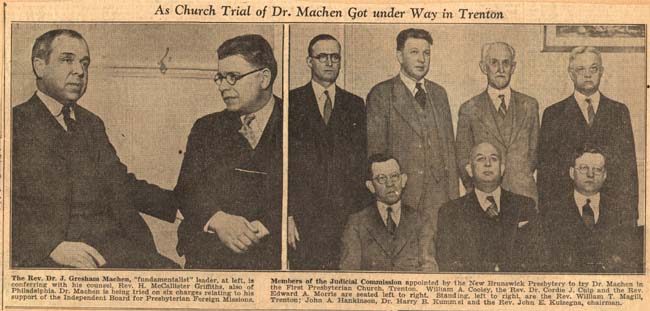
Not to let facts get in the way here, but Mouw would do well to remember that the PCUSA brought Machen to trial and excommunicated him. Yesterday’s post shows that Machen was not eager to flee even if it would have been a lot more pleasant. Whether his actions were legitimate or constitutional is another question. But he asked about the constitutionality of PCUSA actions and that didn’t endear him to the people who stayed. In fact, they tried him for having the temerity to question the soundness of the Board of Foreign Missions — as if that’s never happened — and the administrative fiats that condemned dissent.

I too wonder if Mouw considers that from 1869 until 1920 the PCUSA became infected by the social gospel and Protestant ecumenism. During that very same time Princeton Seminary as the voice of Reformed orthodoxy in the northern church was still dominated by conservatives. What happened during the years when Princeton kept alive the theology that Mouw values? Princeton and it’s orthodoxy became marginal and then a nuisance — hence the reorganization of Princeton Seminary in 1929. The idea that had Machen stayed conservatives would have done better is naive and ignores what actually happened before Machen “left.” Plus, what kind of high ecclesiology settles for articulating “Calvinist orthodoxy with intellectual rigor”?

George Marsden and Mark Noll regularly wrote for TRJ and again the returns on Machen were not always positive. First, Marsden:

Both at the time and since critics of Machen have suggested that there was something peculiar about him. Most often mentioned are that Machen remained a bachelor and his very close relationship to his mother until her death in 1931. Neither of these traits, however, was particularly unusual in the Victorian era, which certainly set many of Machen’s social standards.

More to the point is that he does seem to have had a flaring temper and a propensity to make strong remarks about individuals with whom he disagreed. One striking instance is from 1913 when Machen had an intense two-hour argument with B. B. Warfield over campus policy, after which Machen wrote to his mother that Warfield, whom he normally admired immensely, was “himself, despite some very good qualities, a very heartless, selfish, domineering sort of man.” You can imagine that, if someone says things like this about one’s friends, that it might be easy to make enemies. Machen does not seem to have had a great ability to separate people from issues, and this certainly added to the tensions on the small seminary faculty. Clearly he was someone whom people either loved or hated. His students disciples were charmed by him and always spoke of his warmth and gentlemanliness. His opponents found him impossible, and it is a fair question to ask whether, despite the serious issues, things might have gone differently with a different personality involved.

This observation continues to baffle me, as if people do not distinguish public from private statements. Maybe we are only learning that lesson after Donald Trump, but historians generally know that in the archives you find people saying all sorts of things that they wouldn’t say in public. In private we blow off steam, unless we are all walking John Piper’s and sanctified all the way down. I also don’t understand why Marsden starts his sentence on Machen’s personality with the man’s opponents found him impossible. Hello. The feeling was mutual. But Machen as a sanctified believer was supposed to find his adversaries hedonistically delightful?

And finally, Mark Noll’s estimate on the fiftieth anniversary of Machen’s death:

By reading controversies within Princeton Seminary, Presbyterian missions, and eventually the Presbyterian denomination as battles between two separate religions, “Christianity and Liberalism,” Machen undermined the effectiveness of those Reformed and evangelical individuals who chose to remain at Princeton Seminary, with the Presbyterian mission board, and in the Northern Presbyterian Church. By committing himself so strongly to theological and ecclesiastical combat, Machen left successors who were ill-equipped to deal with the more practical matters of evangelism, social outreach, and devotional nurture. By pursuing the virtues of confessional integrity, he opened the door to sectarian pettiness.

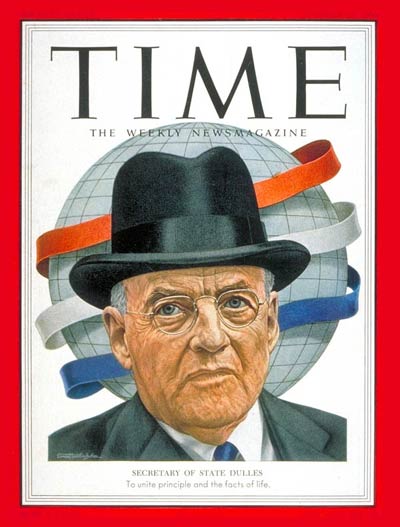
No real sense here that blaming the victim is a potential downside of such an interpretation. The perspective seemed so often in TRJ to be that Machen was a man on a mission and looking for a controversy. The bureaucrats and seminary administrators were innocent. (Yes, the lawyer who defended modernists in the 1920s, John Foster Dulles, became the Secretary of State who crafted the Eisenhower administration’s Cold War policies — the very administration that the founding editors of TRJ questioned.) The Presbyterian hierarchy simply responded — with a hammer, mind you — to Machen’s provocations. That could have been the case but no one argued that. They largely reduced Machen to a cantankerous figure who got what most of us would expect if we rock the boat the way he did.

And now in hindsight I wonder what these same men would think of Abraham Kuyper who was also part of a church that came out of the Netherlands’ state church. Didn’t Kuyper’s GKN (Reformed Churches of the Netherlands) make it a lot harder for conservatives who stayed in the NHK (Dutch Reformed Church)? And didn’t Kuyper’s Free University make life more complicated for orthodox theologians who remained at Leiden or Utrecht? (In other words, why wouldn’t it be possible to imagine Machen akin to Kuyper? Why doesn’t the Kuyper glow trickle down to Machen? Because Kuyper became Prime Minister and Machen merely president of the Independent Board for Presbyterian Foreign Missions?)

And what of John Calvin? Was he wrong to leave France? Did he leave Huguenots in the lurch? Was the Roman Catholic Church worse off without Calvin’s ministry and theological reflection? Or does the mind boggle at the questions you need to start asking other historical figures when you become so demanding of a figure of which you disapprove?

Why Machen Left the OPC

He died (on this day eight decades ago).

Machen’s reasons for being a critic of the PCUSA — to the point that some thought he was impossible and failed to show Christian charity — were clear in his testimony before the Presbytery of New Brunswick (you know, the one that the Synod of Philadelphia created to make the revivalists feel welcome), the body that tried, found him guilty, and excommunicated him from the mainline church:

Suppose a minister obtains his ordination by promising to support the boards and agencies, as he is required to do by the plain intent of that addition to the manual of the Presbytery of New Brunswick and by the plain intent of the action of the 1934 General Assembly. Suppose he later becomes convinced that the boards and agencies are unfaithful to their trust. Let us even take an extreme case. Let us suppose that he has become convinced that those in charge of the boards and agencies are guilty of actual embezzlement. That case, is, of course, entirely hypothetical, but an extreme case does illustrate plainly the principle that is involved. Let us insist upon putting that extreme case. Here is a minister who has promised that he will, as long as he remains a minister in the Presbyterian Church in the U.S.A., support the boards and agencies as they are established by successive General Assemblies. He he has become convinced that those boards and agencies are positively dishonest, even with the kind of dishonestly that is contrary to the criminal laws of the land.

What course of action is open to such a minister? He is convinced that the boards and agencies are dishonest. The general assembly is convinced that they are honest. What shall he do in such a situation? . . . Only two courses of action are open to a minister who is in such a quandary.

In the first place, he may continue to support boards and agencies which he holds to be dishonest. That course of action would plainly involve him in dishonesty. An honest man cannot possibly recommend to people that they should give to agencies which he hold to be dishonest.

In the second place, a minister who is in such a quandary may withdraw from the Presbyterian Church in the U.S.A. That plainly means evasion of the solemn responsibility which he has as a minister. I really wonder whether those who advocate this action of the General Assembly have ever thought this thing through. Do they really mean to tell us that just because a majority in the General Assembly has made a mistake one year and has placed in charge of the missionary funds of the church men who are dishonest, therefore a minister should withdraw from the church and allow that dishonesty to go on? I say that such conduct is an evasion of a solemn responsibility. No, it is the duty of a minister in such a situation to remain in the church and to seek by every means in his power to bring about a change in that policy of the General Assembly which he regards as involving dishonest. Meanwhile (and this should be particularly observed), he cannot for any consideration whatever give a penny to what he regards, rightly or wrongly, to be a dishonest agency; and still less can he recommend to any other persons the support of such an agency. . . .

I could never promise to support any human agency as a condition of my being ordained. I could not promise to support the Independent Board for Presbyterian Foreign Missions, which I believe now to be sound in the faith. . . . It is at the very heart and core of my ordination pledge, in accordance with the law of the Presbyterian church, that I should repeatedly examine any agency that appeals to me for support in the light of the Word of God, and support it only if it is in accord with that blessed Word. Moreover, in determining whether it is in accord with that Word, I must be governed by my conscience, as God may give me light, and not by the pronouncements of any human councils or courts.

If that is contrary to Presbyterian law, then I should certainly be removed from the Presbyterian Church in the U.S.A. But all the glorious history of the Reformed faith should teach a man if the Word of God does not teach him, that it is not contrary to Presbyterian law but is at the very heart of Presbyterian law. (Statement to the Presbytery of New Brunswick, 347-48, 349)

Those in fellowship with the Bishop of Rome, eat your hearts out.

Make It Stop

Yet another conversion account with these un-Francis like asides from a former Dutch Calvinist:

I also realized that there was actually no real Protestant faith in itself. The Protestant faith was founded on a protest against a faith, the Catholic Faith. Why would I ever want to part of a “church” that was actually no church at all; one that was racked by division and founded on protest!

The blindness that had always covered me was now gone. I saw that there were countless Protestant denominations, and that they all disagreed with each other on at least one important point of doctrine. This defied the very nature of Truth itself, and rendered all of them imperfect. I finally saw that there must be an authority to clear the air, which I now understand is the See of Peter.

But these questions soon evaporated into joy:

Towards the end of the Vigil, when I saw a number of people receiving their First Sacraments, I knew God was calling me to do the same thing. Mother Church was opening her arms out to me, and even though I knew many crosses would come my way if I ran to Her, I could not resist Her love. Family members of mine would shun me, professors would shake their heads as I had received prestigious scholarships in the Reformed Theology department, my future would be so uncertain, and friends would laugh, but it didn’t matter anymore.

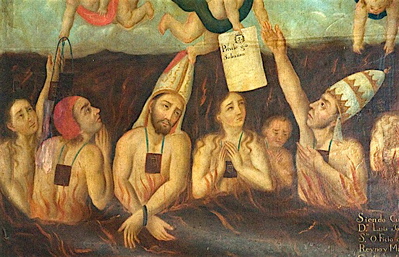
Why doesn’t the fine print of conversion include mention of a stop in purgatory?

Purgatory (Lat., “purgare”, to make clean, to purify) in accordance with Catholic teaching is a place or condition of temporal punishment for those who, departing this life in God’s grace, are, not entirely free from venial faults, or have not fully paid the satisfaction due to their transgressions.

The faith of the Church concerning purgatory is clearly expressed in the Decree of Union drawn up by the Council of Florence (Mansi, t. XXXI, col. 1031), and in the decree of the Council of Trent which (Sess. XXV) defined:

“Whereas the Catholic Church, instructed by the Holy Ghost, has from the Sacred Scriptures and the ancient tradition of the Fathers taught in Councils and very recently in this Ecumenical synod (Sess. VI, cap. XXX; Sess. XXII cap.ii, iii) that there is a purgatory, and that the souls therein are helped by the suffrages of the faithful, but principally by the acceptable Sacrifice of the Altar; the Holy Synod enjoins on the Bishops that they diligently endeavor to have the sound doctrine of the Fathers in Councils regarding purgatory everywhere taught and preached, held and believed by the faithful” (Denzinger, “Enchiridon”, 983).

Further than this the definitions of the Church do not go, but the tradition of the Fathers and the Schoolmen must be consulted to explain the teachings of the councils, and to make clear the belief and the practices of the faithful.

Temporal punishment

That temporal punishment is due to sin, even after the sin itself has been pardoned by God, is clearly the teaching of Scripture. God indeed brought man out of his first disobedience and gave him power to govern all things (Wisdom 10:2), but still condemned him “to eat his bread in the sweat of his brow” until he returned unto dust. God forgave the incredulity of Moses and Aaron, but in punishment kept them from the “land of promise” (Numbers 20:12). The Lord took away the sin of David, but the life of the child was forfeited because David had made God’s enemies blaspheme His Holy Name (2 Samuel 12:13-14). In the New Testament as well as in the Old, almsgiving and fasting, and in general penitential acts are the real fruits of repentance (Matthew 3:8; Luke 17:3; 3:3). The whole penitential system of the Church testifies that the voluntary assumption of penitential works has always been part of true repentance and the Council of Trent (Sess. XIV, can. xi) reminds the faithful that God does not always remit the whole punishment due to sin together with the guilt. God requires satisfaction, and will punish sin, and this doctrine involves as its necessary consequence a belief that the sinner failing to do penance in this life may be punished in another world, and so not be cast off eternally from God.

Venial sins

All sins are not equal before God, nor dare anyone assert that the daily faults of human frailty will be punished with the same severity that is meted out to serious violation of God’s law. On the other hand whosoever comes into God’s presence must be perfectly pure for in the strictest sense His “eyes are too pure, to behold evil” (Habakkuk 1:13). For unrepented venial faults for the payment of temporal punishment due to sin at time of death, the Church has always taught the doctrine of purgatory.

Can you really be so happy about the uncertainty that awaits 99.9% of those who have to make, grace-assisted of course, satisfaction for their sins? If perfection is necessary, how can the imperfect ever be perfect? Protestantism may seem like a legal fiction. But Rome’s fiction is moral. Alien righteousness matters and this convert doesn’t seem to know that her welcoming mother church not only rejects but condemns such teaching.

Who shall ascend the hill of the LORD?
And who shall stand in his holy place?
He who has clean hands and a pure heart,
who does not lift up his soul to what is false
and does not swear deceitfully.
He will receive blessing from the LORD
and righteousness from the God of his salvation. (Psalm 24:3-5 ESV)

Christmas as Old School Presbyterianism’s Coexist Moment

Mustafa Akyol’s column on Christmas in Turkey revealed that paleo-Calvinists share much in common with conservative Muslims and Jews during the holiday season:

Islamists in Turkey, every year, come out on the streets or in their media with the slogan, “Muslims do not do Christmas.” Of course, they have every right to not to celebrate a religious feast that is not a part of their religion. But they not only refrain from Christmas; they also protest it.

In fact, those Islamists of Turkey, and other likeminded Christmas-despisers, often “do not know what they are doing,” to quote the noble words of the very person whose birthday is at question here. They typically condemn Santa Claus costumes and Christmas trees as signs of “Western cultural imperialism.” But Christianity is not merely Western; it is also African, Asian and, in fact, global.

Hmm. Christmas as a global solvent of local Reformed Protestant teachings and practices. Go figure.

Jews — ya think? — have similar problems with Christmas.

Israel, too, seems to have a similar problem.

I read about this in an Al-Jazeera English story titled, “Israeli rabbis launch war on Christmas tree.” It reported how the Jerusalem rabbinate issued a letter warning hotels in the city that “it is ‘forbidden’ by Jewish religious law to erect a tree or stage New Year’s parties.” In Haifa, a rabbi, Elad Dokow, went even further, called the Christmas tree “idolatry,” and warned that it was a “pagan” symbol that violated the kosher status buildings.

At a time when New Calvinists heighten their sensitivity to Muslims and Jews, when will they show a little concern for Old Calvinists?

On 2K, Lutheran 2K, Anabaptists, Theonomy, and Germany

Proto-Protestant supplies perspective.

First, Anabaptists are out:

Westminster West’s Two Kingdom theology breaks at points with the Lutheran variety and is certainly somewhat hostile to Theonomy and yet its retention of Kuyperian Dominionism places it much closer to the Lutheran and Theonomist understandings of the Kingdom than it does to the Anabaptist. Westminster’s version of Two Kingdoms is still very much pro-culture formation and while not Transformationalist in a de jure sense, from the standpoint of ‘radical’ Two Kingdom theology it represents a de facto rejection of Two Kingdoms.

The Anabaptist position if we are to accept that unfortunate label would identify both the Lutheran and Westminster West (or Escondido) positions as being One Kingdom with different nuances and not genuine expressions of Biblical Two Kingdom theology. From my standpoint it’s just a diluted (and thus somewhat improved) One Kingdom or Sacralist understanding of the Kingdom.

Second, Lutherans are as 1k as Kuyperians and theonomists:

Cooper is to be commended in some aspects of his presentation and argument. He does a great job demonstrating the actual Sacralist (One Kingdom) nature of Lutheran so-called Two Kingdom theology, a point I’ve been trying to make for many years. He intimately weds it to the Magisterial Reformation. His proper explanation of Lutheran Two Kingdom theology demonstrates that the charges made by Theonomists regarding its equivalence with the Anabaptist version are completely false.

For example whenever the Theonomists wish to attack what they call Radical Two Kingdom theology they will pin the indifference and acquiescence of the German population in the 1930s on their embrace of Lutheran Two Kingdom theology. Two Kingdom theology led to separatism (it is argued) and passivity. And thus the German Church and people let the Nazis come to power.

And then when Westminster Two Kingdom advocates point to Lutheranism as an example of a Two Kingdom Reformation heritage, and that their view is not guilty of novelty, the Theonomists will suddenly argue that Lutheran Two Kingdoms is more akin to their own Sacralist and Established Church position. They will then argue the Escondido variety is actually a version of Radical Two Kingdom theology.

In other words, the fundamental difference between magisterial and Anabaptist Protestants is that the former do not reject the state or the sword as legitimate spheres for Christians. (Not to mention that magisterial Protestants don’t question Christendom until 1789.)

Third, theonomists lie:

As usual the Theonomists have little interest in the truth of the matter and wish instead to destroy their intra-denominational opponents. Their historical theology is politicised and that’s something that always needs to be recognised when dealing with the Christian Right.

The politicisation of theology can be frustrating but Cooper makes it exceedingly clear. The Lutheran view has a very positive attitude to the state and in reality its model can be described as One Kingdom in two spheres… very much like the Kuyperian model embraced by Westminster West.

Finally, what went wrong in Germany (it wasn’t 2k):

This further demonstrates a point I have often made that it was the Sacral Theology of German Lutheranism that taught moral complacency, compliance and social conformity. They lost their sense of antithesis and equated German Kultur with Christianity. Hitler’s nationalism and anti-communism were sentiments they readily identified with. The German Church didn’t embrace Nazism due to passivity. Rather they (speaking in general terms) actively embraced it, viewing nationalism and political anti-communism (not to mention anti-Semitism) as expressions of piety and Christian culture.

True advocates of Two Kingdom theology are governed by antithesis and would never be taken in by or support such agendas. This is not to blame or slander Lutherans for what happened under the Third Reich but it helps to understand why an ostensibly ‘Christian’ nation would embrace a figure like Hitler and the agenda of his regime.

Certainly Not Calvinist But Not Even Baptist

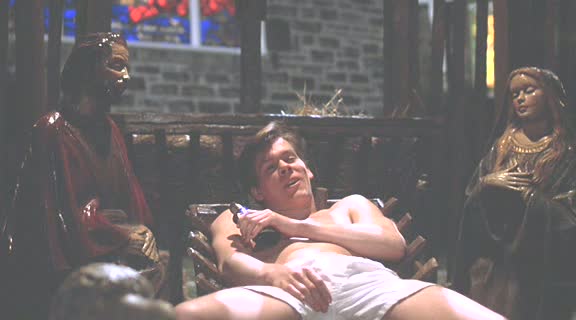
How do you explain selectivity (cafeteria Protestantism) about — wait for it — the Ten Commandments? But the Allies have their ways of satisfying itching ears. Here’s the latest — positive thoughts about Nativity Scenes:

I’ve changed my views because our culture has changed. As society becomes increasingly secular, it seems to me that just about anything that ties Christmas back to the historical account of Jesus’s birth provides an important point of connection. These small displays are an opportunity for engagement and conversation between those in our communities who celebrate nothing more than Santa and those who love the message of the Jesus’s incarnation.

In fact, I’m always intrigued when someone is offended by the presence of a nativity scene. It’s quite fascinating that people can be offended by a collection of miniature ecclesiastical characters. Why do people get upset? Perhaps it’s because they recognize that what’s being said in that small scene is challenging and even personal: “This happened, this is history, there is a Jesus, and you have to deal with him one way or another.” The person who gets annoyed by public nativity scenes is someone I want to have a conversation with.

Actually, it may be that the people who most often miss the message of the nativity scene are Christians. How easy it is to rush through the whole Christmas experience—the music in the mall, the services in your church, the presents in your house—and be left with sweet sentiments but no real worship in your heart. How easy it is to sing along to “Once in Royal David’s City”—

He came down to earth from heaven,
Who is God and Lord of all.

—and feel neither awe nor offense, but simply nothing much at all.

My point is that it’s not only non-Christians who trivialize Christmas. It’s us. The claims the Bible makes about the first Christmas are either fact or fiction, so they’re either awesome or offensive. They should move us to worship or to resistance. But so often Christians seem to be pursuing a pristine Christmas experience that more reflects the store-bought nativity scene than the costly and messy account of the Bible.

Calvinists did not celebrate Christmas. They avoided also any representation of any member of the Trinity. The same goes for Baptists. Until the twentieth century, non-Episcopalian and non-Lutheran Protestants didn’t do Christmas or display its wares. They only way to get around the second and fourth commandments (for the fourth, one day in seven is holy, not Jesus’ birthday) is if you so elevate feelings or evangelism and argue that rules don’t matter (sometimes). That’s more Whitefield than Edwards. In which case, the Allies can’t even honor properly their “homeboy.”

Just to keep score: justification is supposed to result in sanctification.

Good works constitute indispensable evidence of saving grace. Living as salt in a world that is decaying and light in a world that is dark, believers should neither withdraw into seclusion from the world, nor become indistinguishable from it: rather, we are to do good to the city, for all the glory and honor of the nations is to be offered up to the living God. Recognizing whose created order this is, and because we are citizens of God’s kingdom, we are to love our neighbors as ourselves, doing good to all, especially to those who belong to the household of God. The kingdom of God, already present but not fully realized, is the exercise of God’s sovereignty in the world toward the eventual redemption of all creation. The kingdom of God is an invasive power that plunders Satan’s dark kingdom and regenerates and renovates through repentance and faith the lives of individuals rescued from that kingdom. It therefore inevitably establishes a new community of human life together under God.

Maybe the Allies problem with the Decalogue is that they think of obedience too much in the context of the city and not being ye separate. Don’t want to take God’s word too far.

Is Calvinism the Donald Trump of Western Christianity?

This sounds off putting:

Oh, Calvinism—I don’t know if any doctrinal system has ignited more faith-feuds than this. Relationships have been fractured and churches have been split because believing men and women have allowed differing perspectives of God’s sovereignty to arouse the vilest parts of their sinful natures. Devilish pride and hellish rage have ravaged the hearts of Christians on all sides of this issue, dividing and sickening Christ’s beloved Body. It is for this reason that I have shied away from explicitly communicating my Calvinistic or Reformed (whatever you want to call it) theological position. I love the Church and have been fearful of causing unnecessary conflict within her—even among my little herd of faithful readers.

But it turns out TrumpCalvinism has some appeal:

I wasn’t groomed by a specific denomination to read the Bible with sovereignty-sensitive lenses on. The truths were just there—in almost every Spirit-inspired book—staring me right in the face.

God controls the human heart.
God draws people to Jesus Christ.
God causes people to be born again.
God predestined some people to become his children.

This rattled me, as I was under the assumption that my conversion to Christianity had been a decision I made purely of my own volition. I mean, I did make a real, non-coerced choice to follow Jesus. That’s inarguably true. But what the Bible seemed to be saying was that God was wooing, influencing, and even changing me to ensure that I would make that choice. There was something—some effectual, divine work—taking place underneath my desires and decisions.

I didn’t know what to do with this, so I ran to my Christian friends for guidance. They initially told me not to worry about it, saying those passages in the Bible didn’t mean what they seemed to mean. My friends explained that some folks—pesky “Calvinists”—believed that God chooses certain people to be saved. However, such theology contradicts what we know to be true about man’s free will. “God is sovereign, but he doesn’t influence or interfere with our personal decisions,” they told me, “Our choices determine our destiny, not some ‘predetermined’ plan of God.” Because they were far more seasoned in spiritual matters than me, I decided to trust their perspective and lay my curiosities to rest.

For about three days.

I couldn’t read the Bible without being confronted by this stuff!

Okay?!?

Nothing Could Possibly Go Wrong

Didn’t the Reformation start with objections to the cash nexus between grace and financial contributions? So how much did the Council of Trent reform ecclesiastical abuses in the light of recent announcements about new criteria for becoming a saint?

To approve a miracle, at least 5 out of the 7 members of the body of medical experts within the congregation must approve, or 4 out of 6, depending on the size of the group, as opposed to a simple majority.

In case a miracle report is rejected on the first go-around, it may only be reexamined a total of three times.

In order to reexamine a miracle claim, new members must be named to the consulting body.

The president of the consulting body may only be confirmed to one additional five-year term after the original mandate expires.

While in the past payments to experts could be made in person by cash or check, now the experts must be paid exclusively through a bank transfer.

I don’t know about you, but my impression of the miraculous is that if part of a group of believers thinks an unusual event was not miraculous, then it probably was not. Generally speaking, the works of God are pretty straight forward to those with eyes of faith (questions about ongoing miracles notwithstanding). And do we really need science to tell validate a miracle? Isn’t faith sufficient?

But the kicker is the financial aspect to these policy changes:

In his book “Merchants in the Temple,” Italian journalist Gianluigi Nuzzi charged the congregation was among the most reluctant Vatican offices to cooperate with new transparency measures imposed as part of Francis’s project of Vatican reform, and asserted that the average cost of a sainthood cause was about $550,000.

U.S. Catholic officials traditionally have used $250,000 as a benchmark for the cost of a cause from the initial investigation on a diocesan level, to a canonization Mass in St. Peter’s Square at the Vatican, though that cost can increase depending in part of how many people take part in the canonization ceremony and the logistics of organizing the event.

In March, Pope Francis had already approved a new set of financial procedures for the congregation, outlining procedures for handling contributions and specifying which authorities are charged with overseeing the flow of money.

Also notice that even though the path to sainthood has become more — let’s say — complicated, those already saints stay saints:

The new rules are not retroactive, and hence they do not invalidate any beatifications or canonizations performed under earlier procedures.

Fulton Sheen’s advocates are no doubt disappointed.

For any apologist out there, this is the sort of thing that makes no sense to a Protestant (and is truly audacious). We do concede that sainthood can be bought. The price that Jesus paid with his precious blood is worth more than all the silver and gold you can put in a Vatican bank safe. So yes, there is a payment for sanctity. But it is entirely beyond the economic calculations of this world.

One might think that after five hundred years, Roman Catholic bishops might have learned that lesson.

Engaged or Cohabiting

Thanks to Dustin who challenges the Old Life (okay mmmmeeeEEEE) manner of responding to The Gospel Coalition (aka Gospel Industrial Complex and related outlets) I have the opportunity to clarify this old Calvinist’s attitude to the Calvinist wannabes.

The problem with TGC is that is neither fish nor foul. It tries to do the gospel but it also adds a lot of clutter. So if I wanted to read a theological journal, TGC isn’t the place to go because it doesn’t go deep or academic (though it tries to strike a scholarly tone). And if I want to read about culture — TGC has channels from “Current Events” to “Arts and Culture” — why would I read their take before what I normally read — New Republic, New Yorker, American Conservative, and a host of blogs.

So the issue is that TGC doesn’t really investigate the nooks and crannies of theology and worship. How can it when it is a coalition of people in different communions? TGC accentuates the positive. In my mind that is overwhelmingly dull. TGC feels more like an organization interested in boundary maintenance and creating a feeling of belonging than in thinking challenging thoughts. The inspirational bits, whether from earnest piety or the fame of celebrity pastors, don’t overcome the predictability.

When it comes to arts, culture, current events, TGC seems to want to be neo-Calvinist but the New Calvinists haven’t done the intellectual heavy lifting that neo-Calvinist clearly have. As much as I take issue with the integralist aspirations of neo-Calvinists, they are smart, they know the importance of academic rigro rigor and are generally (in their intellectual demeanor) not interested in inspiring. They are especially proficient in philosophy. I don’t happen to believe that philosophy is the area of study to supply the foundation that gives coherence to all human activity — I don’t think such coherence is possible (hide human flourishing under a bushel? Yes!). But I give the neo-Calvinists credit for doing the hard intellectual labor.

I don’t see that kind of intellectual output — no offense — at TGC. Not to mention that I’m not sure what current events or the arts or food shopping on Sundays has to do with the gospel.

So TGC fails on two counts: they dabble at paleo-Calvinism; and they dabble at neo-Calvinism. If the allies want simply to be evangelical, fine. That is actually what they are — a repristination of the New Evangelicalism of Fuller, Christianity Today, and the National Association of Evangelicals minus the Wesleyans and Pentecostals. I’ve seen this stuff before. Not much to see and certainly nothing to take seriously.

In other words, I don’t engage TGC. I live in a world where TGC also lives. In some sense, we live together. But we don’t relate and we certainly don’t commune (or roll on Shomer Shabbos).