What Good Do Church Statements Do?

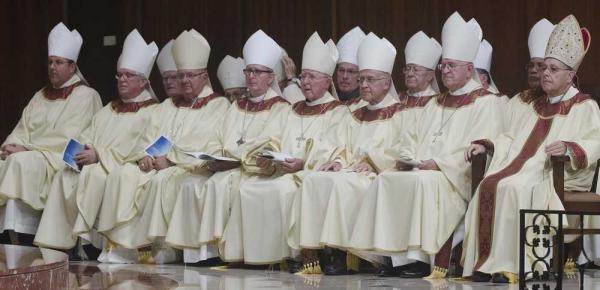
I noticed today at Cardinal Sean Patrick O’Malley’s blog a statement by the Massachusetts’s bishops on opiate abuse:

The abuse and misuse of opioids has become a national and local epidemic that has increasingly been felt in the Commonwealth of Massachusetts in recent years. On average, four people lose their lives each day in this state, due to illegal and legal drug overdoses. It is a disturbing trend that must be stopped. In this year of Divine Mercy in the Catholic Church, we, the four Bishops of Massachusetts join health care professionals, law enforcement, first responders, elected officials and countless others affected by this epidemic in calling for a comprehensive plan to address this growing crisis.

Given the scope of the problem, we feel some degree of urgency to find a solution to this public health and policy crisis that has reached dangerous levels. The lives negatively impacted by this disaster represent all economic, age, gender or racial categories. The impact is far reaching, leading to the eventual breakdown of families, friendships, neighborhoods and communities.

The solution to this tragic problem is not easy to define; it will be even more difficult to implement. The enormity of the problem, however, calls for an immediate and sweeping response. As that response is crafted, we must be mindful that on one hand, medical professionals must continue to care for their patients by prescribing these powerful drugs for long and short term pain management. On the other hand, overuse by the patient, along with access to vast quantities of opioids by unintended users, often leads to abuse, addiction and death. We exhort health care providers to demand improved education within their own professional groups about the appropriate indications, prescriptions and use of opioid medications.

We must offer help, support and comfort to those who have formed an addiction to prescription pain killers, as well as to those individuals who have formed an addiction to illegal drugs. While new legislation alone will not solve the opioid crisis in Massachusetts, it is a critical step that must be taken soon. We urge the Governor and the legislature to continue their work on this legislation and to provide the necessary resources, human and fiscal, to implement comprehensive education and treatment services to address and correct this ever-growing crisis.

We encourage our sisters and brothers who are suffering addiction or the addiction of loved ones to turn to their faith community for support, counsel and compassion, and we pray that those most affected will receive the physical, emotional and spiritual help that they need.

How different is something as unspecified as this call to action from the sorts of complaints that students have been bringing against university administrations, such as the Black Students Union at Johns Hopkins University?

1. We demand a public address to be held by the administration (including but not limited to President Ron Daniels, Provost Lieberman, Provost Shollenberger, and the Board of Trustees) to The Johns Hopkins community in which President Ron Daniels will announce an explicit plan of action detailing how the following demands will be instated.

2. We demand that The Johns Hopkins University creates and enforces mandatory cultural competency in the form of a semester long class requirement for undergraduate students as well as training for faculty and administration.

3. We demand that the Center for Africana Studies be recognized as a Department.

4. We demand an increase in the number of full-time Black faculty members, both in the Center for Africana Studies and throughout other departments within the institution. Moreover, we demands equal representation of self-identifying men, women, and non-binary Black individuals within these positions.

5. We call on The Johns Hopkins University Krieger School of Arts & Sciences to support the hiring of faculty concerned with the history, culture, and political position of peoples of African descent. Calls for diversifying faculty are important, but equally crucial is attracting faculty whose work creates a scholarly community dedicated to Africana studies.

6. We demand accountability for peers, faculty, and staff who target Black students both inside of and outside of the classroom. Attending to such situations must transition from a passive email sent to the student body, to an active stance taken against racial intolerance by the administration. Perpetrators that aim to make Black students uncomfortable or unsafe for racial reasons must complete additional diversity training and face impactful repercussions for their actions.

7. We demand a transparent five year plan from The Johns Hopkins University Office of Undergraduate Admissions regarding the welcoming of and retention of Black students. We demand black bodies be removed from diversity marketing campaigns until Hopkins addresses the low quality of life here that many Black students experience and the problems with retaining Black students all four undergraduate years and then takes the necessary steps to resolve them.

8. We demand more Black professors within the Women, Gender and Sexuality program to add a new dimension to the Department on intersectionality and inclusivity that is currently being neglected and ignored.

Actually, in most cases the students’ demands are much more specific than the bishops’ statement. If Massachusetts were a Roman Catholic state, the call by church officials to governmental officers to look into a certain matter might make sense. Or, if the bishops sent a memo to the administrators and public health officials at Roman Catholic hospitals and medical schools and asked for policy recommendations, they might have more to say even while not exactly ministering God’s word. But at the end of the day is a statement like this from the church anything more than an indication that bishops care? Didn’t church members already know that?

Blame Trump on the Mainline

So argues Mark Tooley:

Neither Sanders nor Trump would have been possible or even conceivable as serious presidential candidates during the decades of Mainline Protestant hegemony in American public life.

Excluding JFK, all presidents (including Unitarians) have had ties to Mainline Protestants, who shaped America’s political ethos for most of four centuries. Mainline Protestantism helped create American civil religion, a broad vaguely Protestant view of God that permitted all religious groups, including Catholics and Jews, to fully participate in public life without having to minimize their own religious convictions.

American democracy consequently remained very religious but also non-theocratic, tolerant and diverse, with all sects invested in America’s affirmation of religious liberty.

Through the mid-20th century, Mainline Protestantism provided the political language and ethical tools for governance and accommodation, especially for the great reform movements that expanded human equality. The Civil Rights Movement was perhaps Mainline Protestantism’s last great moral crusade, redeeming its earlier failures to address slavery and segregation.

But the great Mainline Protestant membership and wider cultural collapse began in the early 1960s. Then, one of six Americans belonged to the seven largest Mainline denominations. Today, fewer than one of 16 do.

Tooley fails to ask whether that political hegemony came with the price of theological modernism? After all, to maintain your place in the establishment, you can’t be vigorous about the particulars of your religious communion.

Tooley goes on to observe a certain tackiness among evangelicals:

Evangelicalism, lacking that magisterial heritage, is less self-confident, often uncomfortable with political power, is prone to extremes and often highly individualistic, impatient with human institutions.

These same handicaps plague even more the world of the religiously unaffiliated, who often lack the traditions, formal human communities, ethical tools and moral vocabulary for governance. They are especially vulnerable to the impulse of the moment.

So, if the the downfall of the mainline paved the way for Trump, how much more the corruption of the Roman Catholic Church which paved the way for magisterial reformers?

Higher Christian Living

Once a person converts to follow Jesus, he or she confronts a number of options for living at a higher spiritual pitch. For Protestants the options run the gamut from the second helping of grace that comes with Holy Spirit baptism to the comprehensive alertness that w-w Protestants promote. Often overlooked in the devotional plans that take you from Christianity 1.0 to Genuine Christianity 2.0 is the contribution of converts to Roman Catholicism.

Mark Shea shows the way:

I was raised Nothing-in-Particular (with a cloudy pagan regard for “the spiritual” and a deep disdain of “organized religion”). Then, at the age of 20, I had a sort of classic “born again” experience after an encounter with the living God revealed in Jesus Christ. Looking around me, I found that the people who had introduced me to Jesus were the non-denominational Evangelicals and charismatics on my dorm floor at the University of Washington. Therefore, putting two and two together, I concluded that this was the Christian community God had given me and that it was my task to learn from them, love them, and receive the love of God through them.

So learn from them I did. I became a member of this community (which eventually coalesced into a small church in North Seattle) and I learned the basics of the Christian faith-trust, prayer, love, good works, fellowship, discipleship, Scripture study-in this place. I regard this time with them as my personal “Old Testament”: that period of preparation for the full reception of Christ which was to come when I became a Catholic.

I think the “Old Testament” metaphor for my time as an Evangelical is apt because I don’t believe for a moment that it was an accident God introduced me to his Son through Evangelicalism any more than I believe it an accident that the whole history of Israel was the preparation for the Advent of Christ. Again and again, I found that things in my own Evangelical background anticipated the teaching of the Catholic Church and the Christ who is fully revealed there just as the teaching of the Old Testament anticipated the Incarnation, Death and Resurrection of Christ. So I am deeply grateful for my time as an Evangelical and regard the good things God gave me through that Tradition as very properly Catholic.

No mention here of the sins involved in belonging to a church not in fellowship with the Bishop of Rome or the mortal sin of disobeying the magisterium. Shea was a Christian, had gone from darkness to light, and had found Christ among Protestants.

Why on earth would Rome have ever anathematized Protestants or their teaching?

If Kuyper Could, Why Can’t Swanson?

Rebecca Hamilton adds U.S. political parties to the list of spheres to be evangelized (now that the Vatican has removed Jewish persons):

We must, if we are survive as a nation and a people, re-take control of these run-away political parties. We must also, if we ever hope to build a culture of life, convert both of them.

That means, my dear pro-life brothers and sisters, that we must stop thinking of the other political party as the devil incarnate and begin to look on it as a mission field, ripe for the harvest. In short, we need to stop following political hucksters who want to use our votes to gain power for themselves to be used for themselves, and follow Christ the Lord.

It was Jesus who told us to go out and convert the world. It is Satan who tells us to look at those folks over there and condemn them and damn them to hell with all the smug self-righteousness we can muster. Even if the thought that converting people is what Christ specifically told us to do doesn’t move you, then consider once again the sheer political cliff that we are standing on due to Justice Scalia’s death.

We’ve been trying to pack this court for almost 50 years now, and what we’ve gotten for our efforts is corporatism that is breaking the backs of the people of this nation and gay marriage.

We need to convert the Democratic Party to a party of life. We need to convert the Republican party to a party of conservatism rather than abject corporatism. We need to convert both of them into entities that are focused on how to help America and Americans rather than just raid the national treasury for those who pay for their political campaigns.

Here’s the problem: maybe the existing parties aren’t ripe for taking over. So why not start a new political party? Abraham Kuyper did and it became the vehicle for his tenure of prime minister:

Moving from the pastorate to the Dutch parliament by age 35, Kuyper also became the editor of a daily newspaper, De Standaard. From this post, he rallied and educated a movement that would have a transformative impact in the 1870s. Besides ushering in a new denomination, that movement would launch the Anti-Revolutionary Party (ARP), which endured for several decades thereafter. (About 30 years ago, it merged with two other parties that were important to Kuyper’s governing coalition.) By 1901, as leader of the ARP, Kuyper would become prime minister, an office he held for four tumultuous years.

His political vision was worked out over decades, and aimed to impede the centralizing tendencies that capitalism appeared to require. The vision rested upon the notion of “sphere sovereignty”: The belief that God created the distinct realms of life—church, education, family, state—to function independently, each ruled by the “ordinances” God had set in place. “It was identifying, celebrating, guarding, and translating those ordinances into action,” Bratt notes, “that defined his ultimate purpose in politics.” Under Kuyper, the ARP sought to convince the nation of these ordinances and align its policy and law according to them. It was a narrow pathway indeed, yet for a time, the ARP was able to follow it with success, thanks in part to an alliance with Roman Catholics seeking to “restore a Christian Netherlands.”

To be sure, I have reservations about parts of the neo-Calvinist project. But Kuyper’s political savvy sure looks much more important and effectual than Christians kvetching about the state of their nation from the relatively comfortable locations of podcasts, blogs, radio shows, or conference addresses. At least Kuyper did more than theorize, cheerlead for w-w, and write op-eds. He built institutions and forged political alliances. Even more, he governed.

If Christians want to “change” their nation, they need to do more than aim at changing the minds of their political representatives (as if that happens).

How to Achieve Unity

I detect something of a breakthrough among Roman Catholics in reaction to Pope Francis’ comments about contraception and the Zika. Christopher Kaczor does his best to help out the pope (even if it is way above his pay grade):

During Pope Francis’ flight from Mexico to Rome, a Spanish reporter posed this question: “Holy Father, for several weeks there’s been a lot of concern in many Latin American countries but also in Europe regarding the Zika virus. The greatest risk would be for pregnant women. There is anguish. Some authorities have proposed abortion, or else to avoiding pregnancy. As regards avoiding pregnancy, on this issue, can the Church take into consideration the concept of ‘the lesser of two evils?’”

In his answer, Pope Francis unequivocally condemned abortion, saying, “Paul VI, a great man, in a difficult situation in Africa, permitted nuns to use contraceptives in cases of rape. [The nuns were in constant danger of getting raped and therefore of pregnancy.] Don’t confuse the evil of avoiding pregnancy by itself with abortion. … [A]s with every human evil, each killing is condemned. On the other hand, avoiding pregnancy is not an absolute evil. In certain cases, as in this one, such as the one I mentioned of Blessed Paul VI , it was clear.”

The first part of the pope’s answer does not raise many questions, as it is a straightforward and unequivocal application of Catholic teaching that intentional killing of innocent human beings is seriously wrong. But what about the Bishop of Rome’s statements on contraception? Do his remarks indicate that using contraception is ethically permissible if the circumstances are dire? . . .

In his interview, Pope Francis could be understood as endorsing the view that the use of contraceptives such as a condom could be permissible in order to prevent the transmission of the Zika virus, which may be transmitted through sexual activity. On the other hand, his remarks are also open to the interpretation that forms of contraception, such as the pill, would be permissible in order to render sexual acts nonprocreative with the motivation that a child not be born with microcephaly. Given that Pope Francis is, in the very same interview, at pains to praise and show his agreement with Paul VI, the first interpretation is the more plausible one.

But other Roman Catholics from the left and right are not buying this and so are showing remarkable unity. Edward Peters finds the Pope’s construction of church teaching dubious:

No longer are we musing about a point of Church history (as interesting as that might be), now we are dealing with Church moral teaching. The stakes become dramatically higher.

So here’s my point: not only does the Congo nuns permission seem NOT to exist, but, even if it does exist in some form, it could NOT, I suggest, by its own terms, be used by Francis (or anyone else committed to thinking with the Church) to call into question the Church’s settled teaching that “each and every marital act [quilibet matrimonii usus] must of necessity retain its intrinsic relationship to the procreation of human life” (Humanae vitae 11) and that therefore “excluded is any action which either before, at the moment of, or after conjugal intercourse [coniugale commercium], is specifically intended to prevent procreation—whether as an end or as a means” (Humanae vitae 14).

Obviously the Congo nuns case (or the Balkan nuns story in the 1990s, to take another variation of the myth) was not about marital acts, it was about religious women facing criminal acts of violent sexual intercourse; the Congo question was not about possible birth defects, it was about stopping rapists’ sperm from reaching ova that perchance had been ovulated. Between women facing rape and wives worried about birth defects there simply is no parallel relevant to the moral question of contraception. One can like that fact or hate it, but one cannot change it or ignore it. Moreover, Church teaching on the immorality of contracepted marital acts is, I believe, taught infallibly; but, even if I were wrong about that technical claim, there is no question about what that teaching is, namely, that contracepting acts of marital intercourse, whether doing so as an end in itself or as means to some other end, is objectively immoral.

So does Peter Steinfels:

The precedents cited to render Francis’s statement consistent with standing teaching strike me as a stretch. Despite the pope’s own fleeting allusion to what is in fact a historically obscure episode involving nuns threatened by sexual assault in the Congo in the early Sixties, Francis was not talking about an apparently proactive prevention of forced conception from rapes that may or may not occur. He was not talking about prevention of transmitting a virus, parallel to HIV, from one marital partner to another. He was talking about the prevention of pregnancy.

And Humanae Vitae condemns any use whatsoever of contraception to prevent pregnancy—even as a “lesser evil … even for the gravest of reasons … even though the intention is to protect or promote the welfare of an individual, of a family or of society in general.” Nor, according to the encyclical, can “a whole married life of otherwise normal relations” justify such a single or temporary use.

My wager is that Pope Francis just doesn’t believe that. He respects it. He admires its author. He looks for the truth in it. But he doesn’t buy it.

But that’s pure guess on my part. The inability of church leaders, including the Holy Father, to speak straightforwardly about contraception has been a great disappointment.

This is unity, but it’s not the kind we’re supposed to notice.

In the Larger Scheme of Things

Should the church engage in politics? John Allen answers, that’s a no-brainer:

And that ministry inevitably has a political edge. Yes, Jesus Christ said “Render unto Caesar what is Caesar’s, and God what is God’s,” which is a charter for church/state separation. However, Christ also said we will be judged for how we treat the least among us, which is a standard with a clearly political dimension.

Popes represent a tradition rooted in prophetic denunciations of injustice and abuses of power, and a Lord who chose to be born into a poor family in an occupied corner of the world’s leading empire of its day.

To insist, therefore, that popes remain apolitical would be to demand that they betray their office.

As if politics were all about finger-wagging. Lobbyists make lousy politicians.

J. Peter Nixon worries what happens when the church’s ministry becomes too oriented to this world:

Last week Pope Francis presided over a Mass to mark the end of the Year for Consecrated Life. Robert Mickens reported here that the Holy Father also gave a short talk to men and women religious at an audience prior to the Mass. “Why has the womb of religious life become so sterile?” he asked.

The answers to that question are complex and manifold. . . . I know enough men and women religious to realize the dangers of sentimentalizing their lives. Those without property can often become proprietary about their roles and responsibilities and unhealthy power dynamics can afflict any community of human beings. The spiritual risks of celibacy are well known, even if they are sometimes exaggerated.

The lives of ordinary believers and the lives of those called to practice the counsels should complement one another, embodying the tension between a Kingdom that is already present and yet still to come. In the past, the balance may have tipped too far in the direction of the latter, leading to the suggestion that the married state was somehow inferior to religious life. Over the last half century, however, we have tipped far in the other direction. Somehow, we must find balance.

The balance may not involve the monastic life, but it could include something like recognizing that this world, and even its attempts to right social wrongs, is not all there is:

So while politics is important business, there are strict limits to what we can achieve by political means. There are no limits at all, on the other hand, to what we can achieve by prayer, fasting, and almsgiving; for that we have the Lord’s promise! We can revive our own faith, awaken the strength of our neighbors, and thereby accomplish what not even a presidential candidate dares to suggest.

“America is great because she is good, and if America ever ceases to be good, America will cease to be great.” So wrote the most acute of all observers of our political scene, Alexis de Tocqueville. Perhaps the most appropriate “political” task for Lent would be to embark on our own private campaigns to make America good again, beginning with ourselves.

Of course, Protestants don’t believe we make ourselves good. But confessional Protestants do understand, in ways that challenge followers of the papacy, an institution fraught with power and political intrigue, that ministering the gospel does more good in the long run than making policy or running for office.

Those Who Want History Straight Deserve to Get It Good and Hard

History does not conform to apologetics.

So says the American Jesuit, Robert Taft:

“It’s not true that at the beginning we had one Church centered in Rome, and then for various historical reasons certain groups broke off,” he said. “It’s just the opposite. At the beginning we had various churches, as Christianity developed here and there and someplace else, and gradually different units began to be formed.”

“That’s the reality,” Taft said, “and we have to accept it.”

So confirms the Capuchin order:

The Annuario Pontificio, the Vatican’s statistical yearbook, lists about 800 men’s orders in the Church, all of which have a story to tell. Precisely because Capuchins don’t call attention to themselves, however, several interesting elements of their tale are often lost.

The order was born in 1525 when a friar named Matteo da Bascio decided the Franciscans of his day had abandoned the initial vision of St. Francis of Assisi, and he wanted to get back to a strict observance of penance, prayer, and poverty.

That implied criticism didn’t sit well with other Franciscans, and with the support of influential Church authorities, they hounded Bascio and his initial companions, who were forced to take shelter from Camaldolese monks.

In 1528, the “Capuchins” (so named for the hood they wear with their habit) got papal permission to organize, but their problems were hardly over.

Within 20 years, Bascio had left his new order to return to the Observant Franciscans, while another early Capuchin leader, Bernardino Ochino, spurned the Catholic faith altogether to join forces with John Calvin in Geneva. Eventually Ochino’s support for polygamy and his rejection of the Trinity was too much even for the Calvinists, and he went into exile first in Poland and then in Slovakia.

The new order came under suspicion of heresy and narrowly avoided being suppressed, while for a time Capuchins were forbidden to preach. (This makes it a rich irony that since 1743, the Capuchins have had the privilege of supplying the official Preacher of the Papal Household; since 1980, that role has been held by the Rev. Rainero Cantalamessa.)

Can Someone Explain Why A Nation Losing Population is Good?

Donald Trump may be wrong about building a wall between Mexico and the U.S., but doesn’t Mexico want to keep its residents and citizens? Would the U.S. like to see lots of its people migrate to Canada? Is California happy when its residents move to Colorado (I know the residents of Colorado aren’t)? I don’t understand the economics — GDP, taxes and so on. But it sure does seem that having more people is better than having fewer. If we had more people in Hillsdale, Trader Joe’s might set up a store here.

What got me thinking about this was Pope Francis’ remarks yesterday to Mexico’s youth:

You are the wealth of Mexico, you are the wealth of the Church. I understand that often it is difficult to feel your value when you are continually exposed to the loss of friends or relatives at the hands of the drug trade, of drugs themselves, of criminal organizations that sow terror. It is hard to feel the wealth of a nation when there are no opportunities for dignified work, no possibilities for study or advancement, when you feel your rights are being trampled on, which then leads you to extreme situations. It is difficult to appreciate the value of a place when, because of your youth, you are used for selfish purposes, seduced by promises that end up being untrue.

I know the magisterium is clearer than the Bible, but wouldn’t this suggest that the youth of Mexico are the wealth of that country, not the U.S.?

So how does that message to young Mexicans cohere with the pope’s pro-immigration speech to Congress?

In recent centuries, millions of people came to this land to pursue their dream of building a future in freedom. We, the people of this continent, are not fearful of foreigners, because most of us were once foreigners. I say this to you as the son of immigrants, knowing that so many of you are also descended from immigrants. Tragically, the rights of those who were here long before us were not always respected. For those peoples and their nations, from the heart of American democracy, I wish to reaffirm my highest esteem and appreciation. Those first contacts were often turbulent and violent, but it is difficult to judge the past by the criteria of the present. Nonetheless, when the stranger in our midst appeals to us, we must not repeat the sins and the errors of the past. We must resolve now to live as nobly and as justly as possible, as we educate new generations not to turn their back on our “neighbors” and everything around us. Building a nation calls us to recognize that we must constantly relate to others, rejecting a mindset of hostility in order to adopt one of reciprocal subsidiarity, in a constant effort to do our best. I am confident that we can do this.

Our world is facing a refugee crisis of a magnitude not seen since the Second World War. This presents us with great challenges and many hard decisions. On this continent, too, thousands of persons are led to travel north in search of a better life for themselves and for their loved ones, in search of greater opportunities. Is this not what we want for our own children? We must not be taken aback by their numbers, but rather view them as persons, seeing their faces and listening to their stories, trying to respond as best we can to their situation. To respond in a way which is always humane, just and fraternal. We need to avoid a common temptation nowadays: to discard whatever proves troublesome. Let us remember the Golden Rule: “Do unto others as you would have them do unto you” (Mt 7:12).

If we applied the golden rule to Mexico, wouldn’t it mean encouraging Mexicans, the wealth of the nation, to stay there and not migrate to the U.S., just as we want residents of the U.S. not to leave?

Then again, I’m not convinced that pastors should speak about economics and immigration policy. Below their pay grade.

Those Were Really the Days

Christendom, Schristendom:

I recently described the tumultuous years 1675-1685, and how they shaped the future of Europe and North America. Here, I want to explore the implications for the politics of religion in this era, and for some of the stereotypes we might have. Everyone knows that religion played a vital role in the Early Modern era: according to customary stereotypes, Protestants fought Catholics, Catholics fought Protestants, and Christians struggled against Muslims. All those statements are correct as far as they go, but they stand in need of some nuance. (Orthodox Christians also had their conflicts, but I will leave those out here).

As they say in Hail Caesar: Would that it were so simple …. [mirthless chuckle].

To recap briefly, I described the Protestant-led Hungarian/Magyar revolt against the (Catholic) Holy Roman Empire in the late 1670s. That in turn led to the Muslim Ottomans intervening on the side of the Hungarian rebels. The resulting war led to the siege of Vienna in 1683, and the ensuing battle, which really marked the end of Islamic expansion into Europe. Most historians would agree that this really marked a turning point in European (and world) history.

Looking at the battle of Vienna, several thoughts come to mind. For one thing, it is odd to realize just how late that happened, and how in fact it coincides so closely with an event like the settlement of Pennsylvania or (almost) the Salem witch trials – or indeed, the height of the Royal Society in London. It’s also sobering to think through the “might have been” of an Ottoman victory in that war, which might theoretically have extended Islamic power deep into southern Germany, and who knows how much further? If that had occurred, then the immediate cause would have been tensions and persecutions between Protestants and Catholics within the Holy Roman Empire.

Further afield, an Ottoman victory would, oddly, have been good news for France’s Most Christian King, Louis XIV (1643-1715). Both Louis and the Emperor Leopold were zealous Catholics, who (as we have seen) actively persecuted Protestants within their own realms, and both wished to uproot those Protestant minorities completely. Even so, dating back to the sixteenth century, the Catholic French had a long-standing entente cordiale with the Ottomans, on the basis that both had a common enemy in the Habsburgs. In the 1540s, the French allowed the Ottoman fleet to winter at their port of Toulon, and built mosques to make the Turkish forces feel welcome.

Recall that the Empire included what we would today call Germany and Belgium as well as Austria (and several other countries). When Louis tried to push the French border eastward to the Rhine, he was encroaching on Imperial territory. He was the Empire’s aggressive neighbor on the West, as the Ottomans were on the East. Cooperation made great sense, regardless of faith.

Hence, the revival of the alliance in the 1670s. The (Catholic) French originally supported the (Protestant) Hungarian/Magyar revolt, and later:
In 1679 and 1680, Louis XIV through his envoy Guilleragues encouraged the Ottoman Grand Vizier Kara Mustafa to intervene in the Magyar Rebellion against the Habsburg, but without success. Louis XIV communicated to the Turks that he would never fight on the side of the Austrian Emperor Leopold I, and he instead massed troops at the eastern frontier of France.

That is what gave the Ottomans the confidence to launch the assault on Vienna, although at the last minute in this campaign, Louis shifted his support to the Habsburgs. So much for any sense of Christian political unity, or indeed of Christendom as such.

A few years afterwards, Ireland witnessed the pivotal Battle of the Boyne (1690). The Protestant William III defeated the Catholic James II in a victory that established Protestant supremacy in the island for two centuries afterwards. Not surprisingly, the battle lives on as a potent myth for both sides in Irish religious divisions. William was “of Orange,” and still today, Protestant Orangemen proclaim King Billy’s triumph each year when they march on the anniversary of the Boyne, on July 12. Patriotic Irish Catholics see the Boyne as a national calamity.

Yet neither Catholics nor Protestants ever like to confront the full context of the battle. When Calvinist William triumphed in 1690, his victory was celebrated joyously by his international Catholic allies, including the Emperor Leopold, and the Pope, Alexander VIII. Austrian (Catholic) cathedrals sang a Te Deum to hymn the victory. Why? Because James II was allied to Louis XIV, and any defeat of Louis must be excellent news, not to mention long-overdue payback. My enemy’s enemy is my friend, and arguably a great Christian warrior.

Religious politics in this era were distinctly messy.

Would a Christian emperor like Constantine have prevented this? An infallible pope certainly did not.

What about a Christian lord like Jesus who sits at the Father’s right hand? In which case, Christ’s rule may have a lot less to do with Europe, America, South Africa, or Scotland and a lot more to do with NAPARC.

Disloyalty

Rod Dreher admits to feeling unpatriotic during his visit to Monticello:

I had a very disconcerting moment, an unusual feeling, I think, for an American to have in a place like Mr. Jefferson’s house. We stood with the guide in the parlor, admiring the oil portraits Jefferson hung along the wall — most of them of historical figures he admired. On the southern wall were three portraits in a row: Francis Bacon, Isaac Newton, and John Locke — described by Jefferson as “my trinity of the three greatest men the world has ever produced.” That, plus the marble bust of Voltaire flanking one side of the door in the entrance hall, really brought home to me how much a man of the Enlightenment Jefferson was. All the Founding Fathers were, but ignorant as I am about colonial history, I had not realized how deeply Jefferson identified with the Enlightenment.

As someone who has been doing a lot of reading lately in European intellectual history, and who has very mixed feelings about the Enlightenment, I was startled by the feeling that Jefferson was, well, wrong about some important matters. Obviously this is contestable, and I expect that most Americans would disagree. The only reason I bring it up was because I felt a bit profane, even unpatriotic, having those thoughts there…. I had a faintly similar sense of alienation. I wondered: Had I been alive during the Revolution, would I have been a Loyalist to the Crown, for the same reasons that being in Jefferson’s house and being confronted in his art by his Enlightened sensibilities made me feel so surprisingly alien.

Protestants don’t experience such a conflict in the presence of the Bible.

If Roman Catholics disagree with the pope, do they feel un-Christian? Can anything other than loyalty to the Bishop of Rome be acceptable in Roman Catholicism?