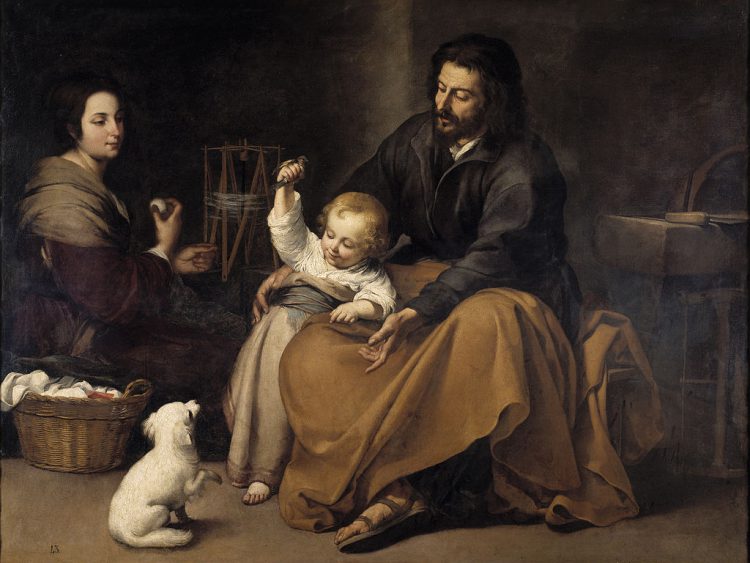
What Did Joseph Know?

A sermon series on Matthew has prompted all sorts of thoughts about the holy family, among them what kind of man Joseph was who would not have sexual relations with his wife (if she really was perpetually a virgin). If Mary was holy, wasn’t Joseph at least remarkable for living celibate even while a married man? (And if sex is not sinful in marriage, and Mary was already sinless, would sex with Joseph have really compromised her righteous standing?)

Here’s the kicker, though. Matthew writes at the end of chapter 1:

24 When Joseph woke from sleep, he did as the angel of the Lord commanded him: he took his wife, 25 but knew her not until she had given birth to a son. And he called his name Jesus.

These verses require modesty. On the one hand, according to John Calvin:

Let us rest satisfied with this, that no just and well-grounded inference can be drawn from these words of the Evangelist, as to what took place after the birth of Christ. He is called first-born; but it is for the sole purpose of informing us that he was born of a virgin. It is said that Joseph knew her not till she had brought forth her first-born son: but this is limited to that very time. What took place afterwards, the historian does not inform us. Such is well known to have been the practice of the inspired writers. Certainly, no man will ever raise a question on this subject, except from curiosity; and no man will obstinately keep up the argument, except from an extreme fondness for disputation.

(Perhaps this post errs on the side of “fondness for disputation.”)

On the other hand, just because the text doesn’t say Joseph did “know” Mary after Jesus’ birth, it doesn’t give grounds for Mary’s perpetual virginity. On Luke 1:34 Calvin writes:

The conjecture which some have drawn from these words [“How shall this be, since I know not a man?”], that she had formed a vow of perpetual virginity, is unfounded and altogether absurd. She would, in that case, have committed treachery by allowing herself to be united to a husband, and would have poured contempt on the holy covenant of marriage; which could not have been done without mockery of God. Although the Papists have exercised barbarous tyranny on this subject, yet they have never proceeded so far as to allow the wife to form a vow of continence at her own pleasure. Besides, it is an idle and unfounded supposition that a monastic life existed among the Jews.

So you take from this immaculate conception and perpetual virginity of Mary? That’s a stretch.

But if you can whack Donald Trump by referring to Joseph as Jesus’ father — even though Matthew goes to great lengths in the genealogy to connect Jesus to the Davidic line through Joseph — then it’s fine for impartial journalists to embrace “orthodoxy.”
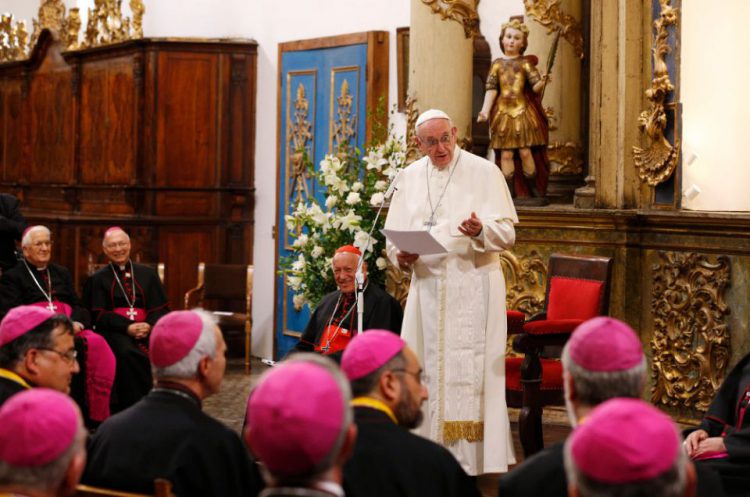
The Dilemma

On the one hand, Roman Catholicism is nothing without the papacy:

There is nothing more distinctly Catholic than the papacy. While just about every other Catholic belief can be found in at least some other Christian denominations, our beliefs about the papacy are unique. Nobody else believes that the bishop of Rome has jurisdiction over the entire Church or that he can infallibly define dogmas; only we do. As a result, these doctrines are essentially what make us Catholic rather than Protestant or Orthodox, so they are extremely important for us.

In addition to the papacy, you need the magisterium:

There is agreement among all Christians that Holy Scripture is the Word of God. But since this Word is conveyed in human language, it does not have the evidence (quoad se—in itself) that the Protestants want to attribute to it. Rather, there is need for a human interpretation on the part of the teachers of the faith whose authority comes from the Holy Spirit. Toward those who hear the Word of God, these teachers represent God’s own authority, making use of human words and decisions (quoad nos—to us). The task of authoritative teaching and governing cannot be left solely to the individual believer who in his or her conscience comes to accept a certain truth. After all, revelation has been entrusted to the Church as a whole. Therefore, the Magisterium is an essential part of the Church’s mission. Only with the help of the living magisterium of the pope and the bishops can the Word of God be passed on in its integrity to the faithful and to all the people of all times and places.

On the other hand, you endure clericalism:

Clericalism affects the whole church. It has been accepted and even lauded by clergy as if it is an anticipation of the Kingdom yet to come. Its hold on us rests comfortably in the symbolic imagination of Roman Catholicism and the Orthodox churches of the East, at once their charm and their curse. That structure must be radically reviewed and reformed if the faith and hope and healthy life of the church are to be revived. As a Quaker colleague once put it to me: “What American adult wants to belong to a church in which he is treated as a child?” Clericalism infects the other Christian churches to a lesser degree and variously, but the Roman Church has simply collapsed under its weight.

According to some, there is nothing to be done about the crisis because the clergy-lay distinction is a matter of the divine will; in other words, “It’s Tradition, a very, very, very old Tradition!” Or could it be that there is something that can and ought to be done that is so radical and church-embracing, so chilling, that it is beyond clerical contemplation? If indeed clericalism is the problem, then the solution is the elimination of that division between clerical and lay Catholics. I am not opposed to leadership, to authority, to structure, to ministry, even to its three-tiered Roman Catholic articulation, but I am opposed to its sacrality and its sanctification. I suppose I am now advocating anti-clericalism, an instinct almost as old as clericalism itself, a historical protest against what the priesthood has done to the church (and a lot for the church, it must be said) through nearly two millennia. Can we count on the clergy to eliminate clericalism? Or the bishops? Or the pope? Not likely! They may badmouth it on occasion, much to their credit. But undo it? Never.

Protestants did not fix this, but they did localize church government. The downside for Protestants is a lack of unity. The upside is not having to act like the apostles’ successors know how to interpret the Bible better than you (as long as you know Greek and Hebrew).

Sin vs. Flourishing

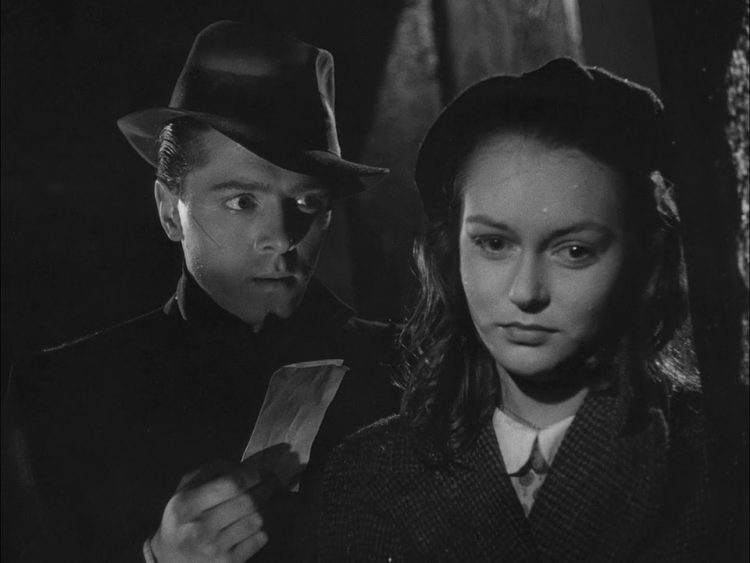
This week’s Mubi selection prompted a viewing of Brighton Rock, an allegedly classic British film noir based on Graham Greene’s novel of the same name.

Pinkie Brown is a small-town hoodlum whose gang runs a protection racket based at Brighton race course. When Pinkie murders a journalist called Fred Hale whom he believes is responsible for the death of a fellow gang-member, the police believe it to be suicide. This doesn’t convince Ida Arnold, who was with Fred just before he died, and she sets out to find the truth. She comes across naive waitress Rose, who can prove that Fred was murdered. In an attempt to keep Rose quiet Pinkie marries her. But with his gang beginning to doubt his ability, and his rivals taking over his business, Pinkie starts to become more desperate and violent. (from IMDB)

The Roman Catholic aspect of the movie was striking. Pinkie seems to know that God exists and will exact a penalty for his life of crime. His wife, Rose, is a Roman Catholic like Pinkie and also has a strong sense of right and wrong even while aiding and abetting her criminal husband. (Yes, the Roman Catholic version of antinomianism — think Mafia dons and whiskey priests — comes to mind.) Here is one description of Greene’s novel and his characters:

All of Greene’s novels were written after his conversion to Catholicism and a religious sense pervades most of them. However, Catholicism was not a vital ingredient in his fiction until Brighton Rock (1938) in which it was developed with a Manichean rigor. . . . In Brighton Rock, for example. Pinkie, the seventeen-year-old Catholic punk, seems possessed by evil and, therefore, in his own eyes—and in those of many of Greene’s readers—capable of being condemned to hell. Brighton Rock is easily classified as a religious novel. But Greene has commented in recent years that Pinkie’s actions were conditioned by the social circumstances in which he had been born and he could not, therefore, be guilty of mortal sin. . . .

[Greene] says, “I don’t believe in hell. I never have believed in hell. . . . They say God is mercy … so it’s contradictory.” (Many years earlier Greene wrote in Lawless Roads, a work of non-fiction: “One began to believe in heaven because one believed in hell, but for a long while it was only hell one could picture with a certain intimacy.” This view is quite close to that of Pinkie in Brighton Rock, except that Pinkie had difficulty in making the leap to a belief in heaven. Still, as Greene noted, one shouldn’t expect unchanging constancy in a writer.)

Greene was, obviously, all over the place when it came to faith. An excerpt from one of his books, which included an interview on faith, suggests he was not in step with the trads, the rads, or the trad-rads:

I don’t like the term ”sin”: It’s redolent of a child’s catechism. The term has always stuck in my throat, because of the Catholic distinction between ”mortal” and ”venial” sin. The latter is often so trivial as not even to deserve the name of sin. As for mortal sin, I find the idea difficult to accept because it must by definition be committed in defiance of God. I doubt whether a man making love to a woman ever does so with the intention of defying God! I always remember the example of a Dominican priest who found his life in Europe too easy and left for Africa, where he lived for years in a hut made out of old tin cans, only to discover that he was suffering from the sin of pride. He came back to England and confided to a friend that during all this time of hearing the confessions of the faithful, he had never come across a single mortal sin. In other words, for him, mortal sin didn’t exist. The word ”mortal” presupposes a fear of hell, which I find meaningless. This being the case, I fear that I’m a Protestant in the bosom of the church.

Vatican officials worried about Greene’s views (and especially the adultery that supplied material for his novels). But they gave him a long leash because England was Protestant and it wouldn’t look good to crack down on Roman Catholic novelists with so many Protestants watching:

Graham Greene and Evelyn Waugh, according to expert opinion, are to be considered the two major living English novelists: being Catholic they do credit to Rome’s faith, and they do credit to it in a country that is of Protestant civilization and culture. How can Rome be gruff and cruel? They are the successors of Chesterton and Belloc and, like them, rather than attempting to convert the small fry, strive to influence superior intelligences and the spirit of the age in a manner favorable to Catholicism. Their level, unlike that of a Bruce Marshall, is not that of average I.Q.s or, like the clergy in general, that of uneducated readers or pure professionals. Their level is the higher intelligentsia in the contemporary world which they sway and influence towards Rome …

All of this is fascinating, but what is striking about Greene’s novels (and the movies based on them), along with Waugh’s Brideshead Revisited, is that the point of becoming Roman Catholic is not to flourish as a human being or civilizationally. The believing characters like Rose, and the defiant non-practicing ones like Pinkie, do not look at Christianity as a way to live the good life. Theirs is a world haunted by moral choices and a God who judges them. Heaven and hell give meaning, not flourishing.

Remember the Paradigm

It feels like Old Life is on the cutting edge of commentary on Roman Catholicism. First, Edgardo Mortara surfaced last week for some at First Things and The American Conservative. Old Life was there and did that four years ago.

Now comes word that the pope’s Secretary of State, Cardinal Pietro Parolin (so much for the spirituality of the church), thinks Pope Francis is tapping a paradigm shift in Roman Catholicism:

“At the end of the day, what resulted from Amoris Laetitia is a new paradigm that Pope Francis is carrying forward with wisdom, with prudence, and also with patience,” said Italian Cardinal Pietro Parolin, the Vatican’s Secretary of State and effectively the most senior figure in the Church after the pope himself.

“Probably, the difficulties that came up [around the document] and that still exist in the Church, beyond certain aspects of its content, are due precisely to this change of attitude that the pope is asking of us,” Parolin said.

“It’s a paradigm change, and the text itself insists on this, that’s what is asked of us – this new spirit, this new approach! … Every change always brings difficulties, but these difficulties have to be dealt with and faced with commitment,” Parolin said.

Old Life was on paradigms a good five years ago.

But the bigger issue is whether Bryan Cross’ paradigm has caught up to his Holy Father.

Theonomists All

If you thought Calvinists and Muslims had a problem accepting political liberalism, wait til you see this (from a review of American Law from a Catholic Perspective: Through A Clearer Lens):

Over and over again, we see the deep chasm between the Catholic understanding of the human person and the anthropology implied by American liberalism. The difference is stark. The former conceives of each human being as a person—a relational being, in relationship to God and others and dependent on God and others. The latter sees each human being as an individual who can make and fashion his own being and existence autonomously and apart from God and others. God is a valid choice, but he is just that, a choice. The Catholic lawyer cannot help but feel a dissonance between his deepest beliefs and the law he is called to practice each day. American Law from a Catholic Perspective helps to remind readers where their allegiances must lie. The attentive reader can begin to see the ways in which he must work to change American law at its very roots to help it conform to the truth proclaimed by the Church. (Briefly Noted)

Doesn’t “at its very roots” mean radical?

And here I thought 2k was rad.

“My Body,” Their Souls

Father Dwight (who seems to write more than Tim Keller) is back with a biblical justification for placing relics under the altar in Roman Catholic churches.

In Revelation 6:9 it is written: And when he had opened the fifth seal, I saw under the altar the souls of them that were slain for the word of God, and for the testimony which they held.

What does it mean “under the altar were the souls of them that were slain for the Word of God and the testimony they held.”?

In the early church, the remains of the martyrs were placed in above ground table tombs. Similar to the one shown here. During the times of persecution the church would gather in the catacombs for worship and the table tombs were used as the altar for Mass. Thus the remains of the martyrs were under the altar.

When they no longer had to worship in secret, the early Christians still wanted the presence of their martyrs to be near them so they opened the tombs, removed the bones and put them into jars which they then placed beneath the altar.

If you visit churches in Rome today you will often seen the jars with relics on display beneath the altar. More than that, you will often see the whole body of the saint on display beneath the altar. Here, for example is the altar beneath which is the relic of Pope St John XXIII.

Call me a literalist, but Rev 6:9 does not say “bodies.” It also says that the author was able to “see” something that is not visible. How do you see a soul?

So notice that when it comes to the body of Christ in the Mass, the bread becomes the very (true) body of Christ. After all, Christ said, “this is my body.” But when it comes to relics, the bones are memorials to the souls under the altar.

I’m confused. Maybe Zwingli can sort it out.

Which Victims Do You Believe?

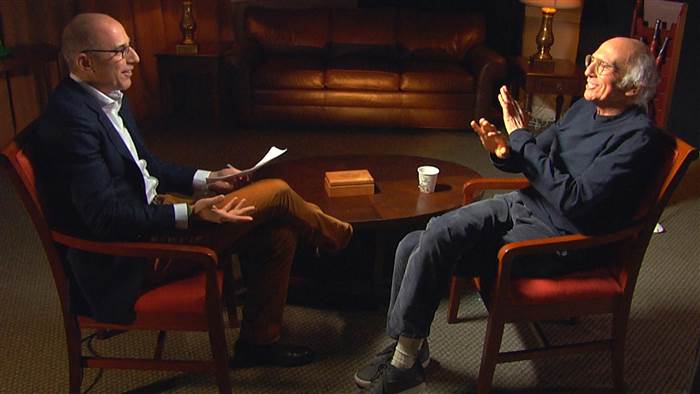
Yet another mainstream figure bites the dust — Matt Lauer of morning news fame whose performance only matter to mmmeeeEEE when he interviewed Larry David; I just can’t figure out any of the appeal of morning network news. Once again, women have come forward to accuse Lauer of inappropriate sexual behavior. NBC executives believed the women. And so Lauer loses his job.

What I can’t understand is the willingness of business, political, and journalistic authorities to believe what is generally one person’s word against another. This is not an opinion based on male privilege. It’s a legal reality hammered home by the Netflix series, The Keepers, in which Baltimore prosecutors and Roman Catholic Archdiocese officials were unwilling to believe the testimony of women who came forward almost 30 years later to accuse a specific priest of molesting them (and setting up meetings for other priests and police). No priest lost his standing (though a trip outside the country swept the controversy under the proverbial rug for a time). The reason as one of Baltimore’s States Attorneys explained was that the testimony of one person — even if memories were credible — was insufficient to start the engine of prosecution. (Of course, what is liable to prosecution in a court of law is not the same as public opinion or the rules of private employers.)

So what happened only six months after The Keepers was gaining some attention from video streamers?

And imagine writing today what one author did about the documentary series when it appeared:

How can anyone believe this?

The central thesis of The Keepers is that an alleged abusive priest, the now-deceased Rev. Joseph Maskell, can be tied to the disappearance and murder of Sr. Cathy. However, some of the central accusers in all of this, who claim that Maskell sexually abused them when they were young girls, have quite a bit of explaining to do.

For example, in 1995, a woman named Jean Wehner – whose claims play a central role in The Keepers – filed a civil lawsuit against Maskell under the name Jane Doe. What was uncovered in the course of her suit can only described as disturbing. It turns out that all of Wehner’s claims of abuse surfaced through the dangerous and discredited practice of “repressed memory therapy.”

It turns out that, according to court documents, Wehner has not just claimed that Rev. Maskell abused her in her life. Wehner has also claimed that she has somehow also been abused by:

four additional priests; three or four religious brothers; three lay teachers; a police officer; a local politician; an uncle; and two nuns.

Good grief. Really, Jean?

For a fuller account of the Archdiocese’s responses, see here.

Is it I or does it seem that Roman Catholics have been a little shy about weighing in on the current spate of revelations if only because of the church’s recent scandal-ridden past? Never to be intimidated, though, is Father Dwight:

What does this new and unexpected social phenomenon mean?

I think it indicates that a new generation of women don’t give two hoots about the old feminist agenda. The main objectives for women have been pretty much obtained-fair pay and fair treatment in the workplace. Now a new generation of women is saying, “We don’t have to put up with the harassment and objectification that still continues.

Hands off!

This is very interesting because, whether they like it or not, the modern women who take this view are echoing a very traditional set of values–ones which their great grandmothers would have recognized.

Its called modesty. In the past women were expected to draw the line, slap the man’s hand away and refuse a kiss until he was worthy.

The woman was the one who was supposed to be pure and unsullied and the keep the horny man at bay.

Father Dwight does realize, doesn’t he, that this “just-say-no” approach did not apparently work for the girls in The Keepers.

Meanwhile, some think the new found disgust with male appetites is not so much a recovery of virtue as an acquisition of power:

…what puzzles many of us is why the definition of deviance varies so dramatically over time. We cannot always predict who will become defined as deviant, and when the definitions will change. We do know that power plays the most important role in identifying who gets to define deviant behavior.

Until recently, allegations of sexual harassment and abuse by powerful men were not taken seriously—they were not viewed as deviant because the acts were perpetrated by powerful men on less powerful women. Now, the power to define sexual deviance has shifted to women—those who have collaborated with the media to bring attention to the issue and reform how such behavior is perceived and dealt with by society.

Until recently indeed — only 4 months ago.

Roman Catholics at Plymouth Rock?

In the department of strange bedfellows comes George Weigel’s praise for the Museum of the Bible:

On September 29, 1952, the publication of the complete Revised Standard Version of the Bible was celebrated at the National Guard Armory in Washington, D.C., and the principal speaker was the U.S. Secretary of State, Dean Acheson. The son of the Episcopal bishop of Connecticut, Acheson movingly described the ways in which the King James Bible, which the new RSV was to supplant, had once shaped American culture and our national life:

In the earliest days in the Northeast, the Book was All. The settlers came here to live their own reading of it. It was the spiritual guide, the moral and legal code, the political system, the sustenance of life, whether that meant endurance of hardship, the endless struggle against nature, battle with enemies, or the inevitable processes of life and death. And it meant to those who cast the mold of this country something very specific and very clear. It meant that the purpose of man’s journey through this life was to learn and identify his life and effort with the purpose and will of God.

That biblical vision helped form the bedrock convictions of the American idea: that government stood under the judgment of divine and natural law; that government was limited in its reach into human affairs, especially the realm of conscience; that national greatness was measured by fidelity to the moral truths taught by revelation and inscribed in the world by a demanding yet merciful God; that only a virtuous people could be truly free.

Of course, the U.S. is a free country and anyone can assemble the past in ways consoling.

But does anyone else feel a certain discomfort with a Roman Catholic recommending the Bible without also mentioning the objections that sometimes Bishops registered against Bible readings in public schools without comment? The United States would not have as many parochial schools as it does if not for Bishops who worried about sending children to public schools where teachers read the Protestant version of the Bible.

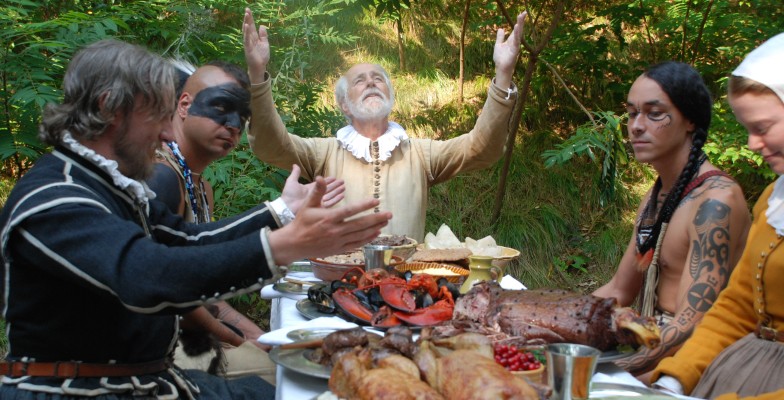
Not to be missed is the odd relationship between the Bible and the founding. If the settlers who came to America and launched the tradition of Thanksgiving wanted a society with a biblical vision at its bedrock, don’t you also have to mention that those same Bible-only Christians were a tad jittery about including Roman Catholics in the nation that emerged from their colonial enterprises?

This may be why some Roman Catholic political theorists are uncomfortable with Roman Catholics getting comfortable with the founding.

The Problem with Cessationism

Cessationists apparently have the reputation of not believing in miracles after the apostolic age:

No issue has been more controversial among Protestants in the past 40 years than the charismatic gifts and the role of miracles in the post-apostolic age. The issue was controversial in previous eras of Protestant history, too, although theological lines were not usually drawn as hard and fast as they are between “cessationists” and “continuationists” today.

In the 1700s and 1800s, suspicion of claimed miracles was connected to anti-Catholicism. Protestant critics saw the Catholic tradition as riddled with fake claims of miracles. Ridiculing the fake miracle claims of Catholics (such as icons bleeding a liquid that turned out to be cherry juice) became a staple of Reformed polemics against the Catholic Church. So when seemingly miraculous events happened in Protestant churches, even sympathetic observers warned against the threat of bogus miracles.

Odd, but the cessationists I know all affirm the ongoing reality of miracles. How could you ever believe in people lost in sin becoming regenerate without resorting to the miraculous work of the Holy Spirit?

The real problem comes with the “gift” of speaking in tongues. Why do we need ongoing revelations from God if scripture is sufficient?

1. Although the light of nature, and the works of creation and providence do so far manifest the goodness, wisdom, and power of God, as to leave men unexcusable; yet are they not sufficient to give that knowledge of God, and of his will, which is necessary unto salvation. Therefore it pleased the Lord, at sundry times, and in divers manners, to reveal himself, and to declare that his will unto his church; and afterwards, for the better preserving and propagating of the truth, and for the more sure establishment and comfort of the church against the corruption of the flesh, and the malice of Satan and of the world, to commit the same wholly unto writing: which maketh the Holy Scripture to be most necessary; those former ways of God’s revealing his will unto his people being now ceased. (CofF 1.1 emphasis added)

6. The whole counsel of God concerning all things necessary for his own glory, man’s salvation, faith and life, is either expressly set down in Scripture, or by good and necessary consequence may be deduced from Scripture: unto which nothing at any time is to be added, whether by new revelations of the Spirit, or traditions of men. (CofF 1.6 emphasis added)

Continuationists who want to defend tongues are in the same predicament as Roman Catholics who defend the continuing infallible teaching of the magisterium and the authority of tradition. Does God’s word have all we need for salvation and godliness? Or do we need ongoing revelations for becoming right with God? If you make an infallible pope or a Spirit-filled Christian the arbiter of Christianity, you deny the sufficiency of Scripture.

Selah.

Evangelicals Need to Take a Page from Roman Catholics (year 501)

Inspired by some minor reflections on personal identity and politics, I present recent findings on Roman Catholics and the 2016 Presidential election.

According to our May 2017 survey, just over three-quarters of American Catholics said that they voted in the November 2016 presidential election. Of those who voted, 43 percent said they voted for Trump while 48 percent said they voted for Clinton. The other nine percent voted for minority candidates. This is fewer Trump voters and more Clinton voters than the percentages among self-identified Catholics as reported in the exit polls, which reported 52 percent voting for Trump, 45 percent voting for Clinton, and 3 percent going to other candidates. But this survey took place six months after the election and some may have been recalling the candidate they wish they had voted for rather than their actual vote.

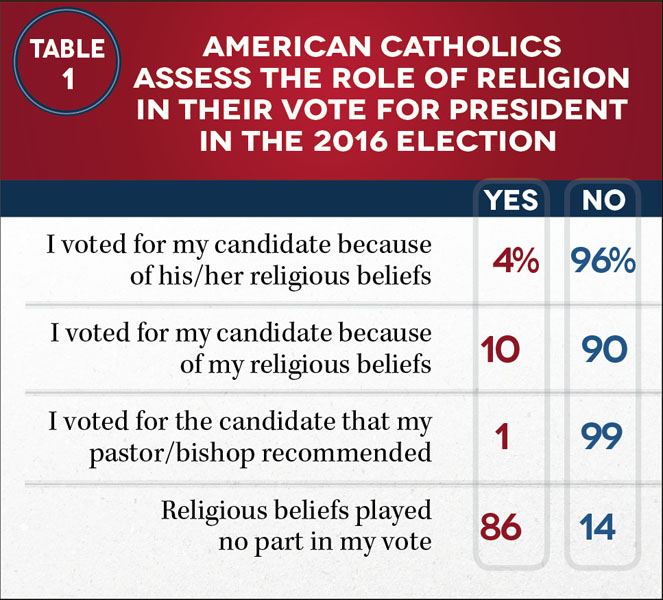
We began our 2017 survey with a series of questions about the possible role religious beliefs might have played among American Catholics In the 2016 election.

The responses of American Catholics to the questions cited in Table 1 make clear their assertion that their religious beliefs were not relevant to their vote for president in the 2016 election. The great majority (86 percent) said that religious beliefs (their own or that of the candidates) played no role in their vote. Just one in ten said that they voted for their candidate because of their own personal religious beliefs and even fewer — just 4 percent — said that they voted for their candidate because of the candidate’s religious beliefs.

Beliefs and values that are essential

That raised the question whether and to what extent did Catholics who voted for Trump differ in their religious beliefs and practices from Catholics who voted for Clinton. We have a standard block of questions about the beliefs and values that many consider essential to being a “good Catholic” that we have asked, in some form, on every survey since 1987. Table 2 compares the proportion of Trump and Clinton voters who say that each item is “essential to your vision of what it means to be Catholic.”

Catholics who supported Trump and Catholics who supported Clinton generally share very similar beliefs about how essential each of these items is to their vision of what it means to be Catholic. Differences of less than 10 percentage points between the two are not statistically significant. Both types of Catholic voters rank all ten items in virtually the same order.

Belief in the resurrection of Jesus, devotion to Mary as the Mother of God, and the papacy are essential to more than half of Trump voters and Clinton voters. Only about half saw charitable efforts to help the poor as essential and the percentage who saw the celibate male clergy as essential continues to have only a small percentage of support among either Trump or Clinton voters.

In other words, religion had little to do with the vote. That seems precisely what evangelicals should be doing. If you can segregate politics from faith, you don’t have the problem of evangelicals leaving the fold because of the movement’s political significance. Faith is one part of your life. Politics another.

Roman Catholics are doing it. Why can’t evangelicals?