
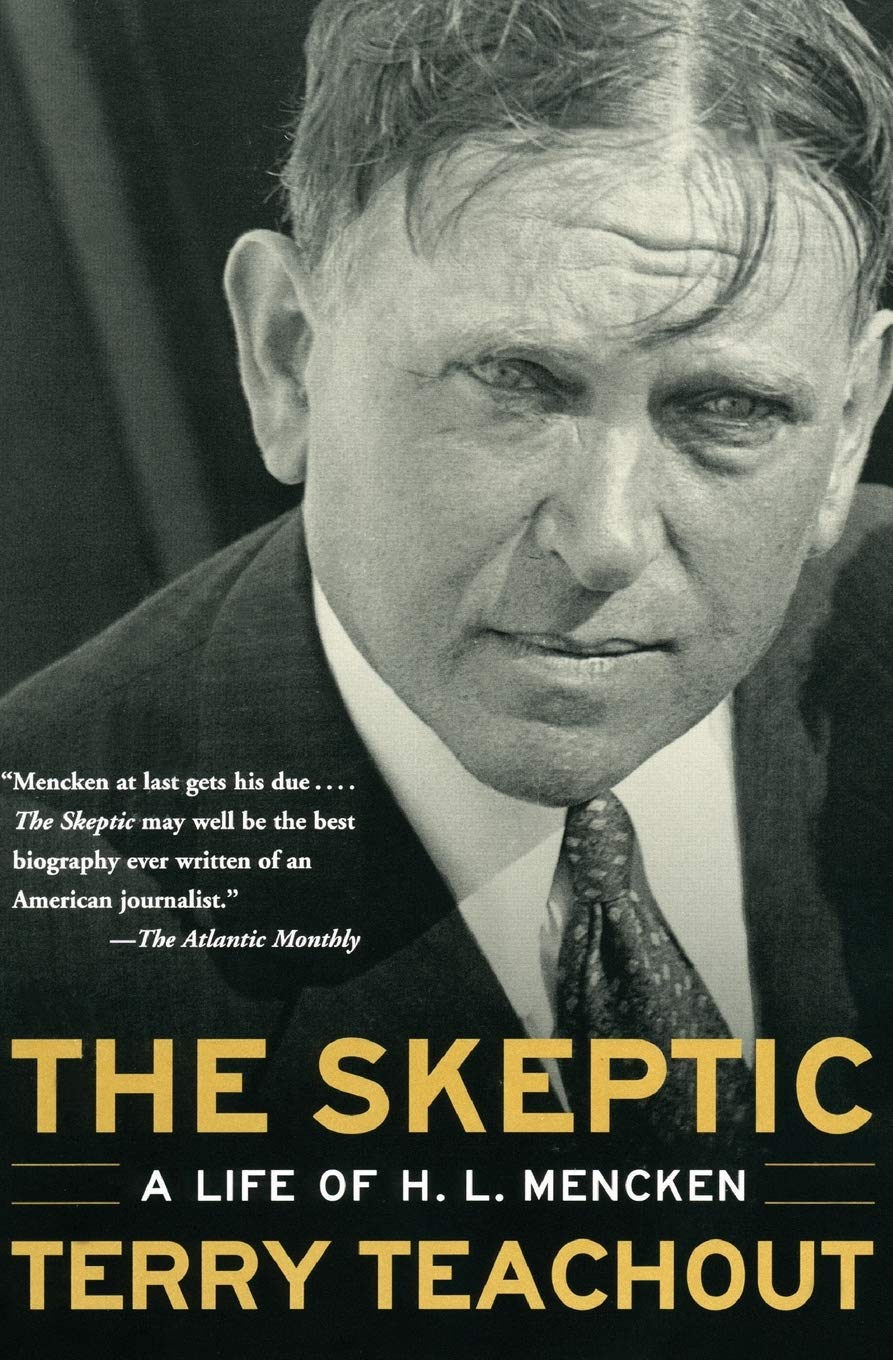
Holy Clerks
Around no class of men do more false assumptions cluster than around the rev. clergy, our lawful commissioners at the Throne of Grace. I proceed at once to a crass example: the assumption that clergymen are necessarily religious. Obviously, it is widely cherished, even by clergymen themselves. The most ribald of us, in the presence of a holy clerk, is a bit self-conscious, reticent and awed. I am myself given to criticizing Divine Providence somewhat freely, but in the company of the rector of my parish, even at the Biertisch, I tone down my animadversions to a level of feeble and polite remonstrance. I know the fellow too well, of course, to have any actual belief in his piety. He is, in fact, rather less pious than the average right-thinking Americano, and I doubt gravely that the sorceries he engages in professionally every day awaken in him any emotion more lofty than boredom. I have heard him pray for Coolidge, for the heathen and for rain, but I have never heard him pray for himself. Nevertheless, the public assumption that he is highly devout, though I dispute it, colors all my intercourse with him, and deprives him of hearing some of my most searching and intelligent observations.
All that is needed to expose the hollowness of this ancient delusion is to consider the chain of causes which brings a young man to taking holy orders. Is it, in point of fact, an irresistible religious impulse that sets him to studying exegetics, homiletics and the dog-Greek of the New Testament, and on irresistible religious impulse only, or is it something quite different? I believe that it is something quite different, and that that something may be described briefly as a desire to shine in the world without too much effort. The young theologue, in brief, is commonly an ambitious but somewhat lazy and incompetent fellow, and he studies theology instead of medicine or law because it offers a quicker and easier route to an assured job and public respect. The sacred sciences may be nonsensical bores, but they at least have the vast virtue of short-circuiting, so to speak, the climb up the ladder of security. The young doctor, for a number of years after he graduates, either has to work for nothing or to content himself with the dregs of practise, and the young lawyer, unless he has unusual influence or complete atrophy of the conscience, often teeters on the edge of actual starvation. But the young divine is a safe and distinguished man the moment he is ordained; indeed, his popularity, especially among the faithful who are fair, is often greater at that moment than it ever is afterward. His livelihood is assured instantly. At one stroke, he becomes a person of dignity and importance, eminent in his community, deferred to even by those who question his magic, and vaguely and pleasantly feared by those who credit it.
These facts, you may be sure, are not concealed from ambitious young men of the sort I have mentioned. Such young men have eyes, and even a certain capacity for ratiocination. They observe the nine sons of the police sergeant: one a priest at twenty-five, with a fine house to live in, invitations to all christenings and birthday parties for miles around, and plenty of time to go to the ball-game on Summer afternoons; the others struggling desperately to make their livings as piano-movers, tin-roofers, motormen or bootleggers. They observe the young Methodist dominie in his Ford sedan, flitting about among the women while their husbands labor down in the yards district, a clean collar around his neck, a solid meal of fried chicken in his gizzard, and his name in the local paper every day. They observe the Baptist dervish in his white necktie, raiding saloons, touring the bawdy-houses and raising hell generally, his tabernacle packed every Sunday night, a noble clink of silver in his collection-plates, and a fat purse for him now and then from the Ladies’ Aid or the Ku Klux Klan. Only crazy women ever fall in love with young doctors or lawyers, but every young clergyman, if he is so inclined, may have a whole harem, and with infinitely less danger than a struggling lawyer, a bootlegger or a bank clerk runs every day. Even if he is celibate, the gals bathe him in their smiles; in truth, the more celibate he is, the more attention he gets from them. No wonder his high privileges and immunities propagate the sin of envy! No wonder there are still candidates for the holy shroud, despite the vast growth of atheism among us!
It seems to me that the majority of the young men who are thus sucked into holy orders are not actually pious at all, but rather somewhat excessively realistic—that genuine piety is far more apt to keep a youth out of the pulpit than to take him into it. The true devotee, frequenting the sacred edifice constantly, becomes too familiar with the daily duties of a clergyman to see any religious satisfaction in them. In the main, they have nothing to do with religion at all, but are basically social or commercial. In so far as a clergyman works at all, he works as the general manager of a corporation, and only too often it is in financial difficulties and rent by factions among the stockholders. His specifically religious duties are of a routine and monotonous nature, and must needs depress him mightily, as a surgeon is depressed by the endless snaring of tonsils and excision of appendices. He debases spiritual exaltation by reducing it to a hollow and meaningless formality, as a politician debases patriotism and a lady of joy debases love. He becomes, in the end, quite anæsthetic to religion, and even hostile to it. The fact is made distressingly visible by the right rev. the bench of bishops. For a bishop to fall on his knees spontaneously and begin to pray to God would make almost as great a scandal as if he mounted his throne in a bathing-suit. The piety of the ecclesiastic, on such high levels, becomes wholly formal and theoretical. The servant of God has been lifted so near to the saints and become so familiar with the inner workings of the divine machinery that the sense of awe and wonder has oozed out of him. He can no more undergo a genuine religious experience than a veteran scene-shifter can laugh at the wheezes of the First Gravedigger. It is, perhaps, well that this is so. If the higher clergy were actually religious some of their own sermons and pastoral epistles would scare them to death. (Prejudices: Fourth Series 1924)







 Old Life