Numbers that Go Crunch in the Night

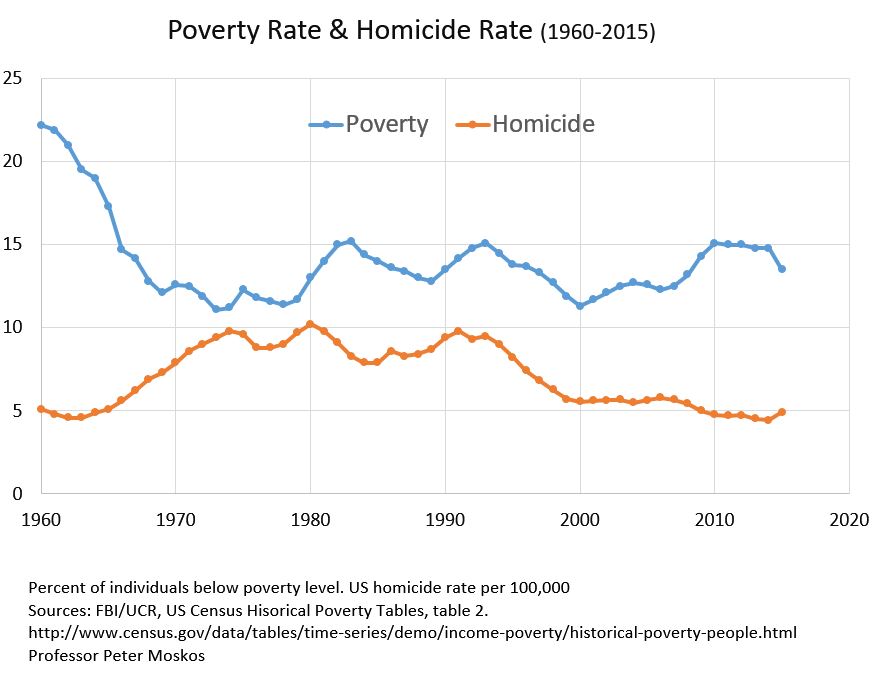
Cop in the Hood explains that crime statistics and poverty are inversely proportional and thus pops the social structure bubble:

When I’m charming people at a cocktail parties with talk of rising crime and the role of police, the good people I talk to, rather than even considering the possibility that police matter and post-Ferguson protests might matter (in a negative way), inevitably try and shift the discussion to greater social issues: poverty, racism, and inequality, the so called “root cause” of crime.

The “root causes” position has long annoyed me. I care about those poverty, racism, and inequality, but in terms of effective crime-preventing policing today, the “root causes” are nothing but a distraction. It’s basically a defeatist way to say we can’t lower crime until we fix society. I’m all for fixing society, but I’m not willing to hold my breath till it happens. Also, the idea that the only way to impact crime is to address structural issues is consistently and demonstrably false.

Last year poverty went down and murder went up. In 2008, the economy tanked, and criminals barely noticed. Between 1965 and 1975, poverty is the US was way down; violent crime way up. In the 1990s, during New York’s great crime decline, the number of New Yorkers living in poverty increased 21 percent. Inflation adjusted household and family income declined. Unemployment approached 10 percent.

Don’t let news get in the way of narrative.

Choose Ye This Day

Donald Trump elicits the inner fundamentalist in all Americans. A recent expression is a drive-by blog post at Commonweal on Senator Ben Sasse:

Well, that didn’t take long. Ben Sasse, Nebraska’s energetic, open-minded, publically engaged Republican senator has been Trumpified.

Citizens expected him, as an outspoken and popular #NeverTrump-er who was relatively uncorrupted by power, to be part of the intraparty resistance to the new president’s ethos, tactics, and character traits. Surely he would have respect for the norms of the Constitution and engage his critics with reason, not mockery. This is, after all, a senator who gives encomia to the Constitution on Twitter and casually banters with his constituents and naysayers about politics and college football.

Sasse was at least critical of last week’s executive order. But this week, with the Supreme Court nomination of Neil Gorsuch, he has showed how quickly the new executive’s behavior can be imitated.

Last night and this morning, Sasse gleefully mocked both protestors and Sen. Minority Leader Schumer.

So the idea is that Sasse should have been sympathetic to protesters and not to President Trump’s nominee for SCOTUS. A sitting senator is supposed to choose unhinged American citizens — and it’s not like we haven’t seen many of such moralists the past 6 years — over the leader of the free world (for now).

And for Mr. Peppard to act as if the protesters to Neil Gorsuch’s nomination are not risible but serious is almost as risible as the recent spate of convulsions over President Trump:

just as worrisome, the fact that he publicly mocked peaceful protestors — which he did again on radio this morning — is an eerie warning that he’s been Trumpified. The new president has shown that he loves to “punch down,” something the old Sen. Sasse would not have done. But executives have a way of modeling behavior that those seeking advancement find difficult not to emulate.

Mocking in juvenile manner (pussy parade anyone?) the duly elected executive of the federal government is not worrisome? And you wonder why Trump is POTUS.

They Can’t Help Themselves

No, I refer not to evangelicals who are going to praise and worship in worship or to Neo-Calvinists who are going to turn every square inch into an outpouring of grace. Instead, I have in mind the media elites who cannot quite get over how smart they are and who continue to notice that Donald Trump did not graduate from the Kennedy School of Government (nor did his supporters graduate from Harvaleton — HarvardYalePrinceton). The issue of that New Republic bemoaned the election’s results began by retreading a column that former editor, Franklin Foer, had written about the George W. Bush administration. (The Franklin Foer, by the way, who left the magazine when he thought it had lost its way.) Here is how the current editors introduced Foer’s 2001 editorial:

FOLLOWING BARACK OBAMA’S election in 2008, a diverse cadre of intellectuals flocked to Washington to serve in the new administration. Eight years later, those same liberal elites are reeling from the election of Donald Trump. He campaigned in direct opposition to the smarty-pants Ivy Leaguers who trod the halls of the White House during the Obama years.

This is part of what Foer himself in 2001 wrote:

Eight years ago, the Clinton administration ushered in what seemed like a social revolution. The Clintonites didn’t just bring an ideology to Washington; they brought a caste. Gone were Poppy’s crusty boardingschool WASPs. In their place was a new kind of elite: multicultural, aggressively brainy, confident they owed their success not to birth or blood but to talent alone. “Perhaps more than any in our history,” wrote The Washington Post’s David Ignatius, “Clinton’s is a government of smart people.” Or at least credentialed people. The White House staff alone boasted six Rhodes scholars. One-third of Clinton’s 518 earliest appointments had attended Harvard or Yale—or both. The president called his staff “the top ranks of a new generation.”

The Clintonites set out to solve America’s problems by thinking smarter thoughts than anyone before them. Almost immediately, the project went awry. They produced a health care plan that was thoroughly rational; it was also mind-numbingly complex, hopelessly bureaucratic, and the product of an undemocratic process. And it almost ruined Clinton’s first term. . . .

Not surprisingly, then, Bush has crafted an administration largely devoid of intellectuals. His staff contains no Rhodes scholars. Of his 14 Cabinet members, only two went to Ivy League colleges, and only one holds a Ph.D., Secretary of Education Rod Paige— and his doctorate is in physical education. The Protestant establishment that shaped W’s father is dead—there is not a single powerful American institution that remains exclusively in WASP hands.

Almost all the wonks who traveled to Austin to instruct Bush in policy have either been ignored in the transition or handed second-tier positions. As Newsweek reported, frustrated onservatives have created an acronym for the administration: NINA, for “No Intellectuals Need Apply.”

Well, aren’t you smart. But if you were really smart and had studied political theory just a smidgeon you might be aware that philosopher kings are not so great an idea, and that democracies don’t always select the smartest governors. A smart person might concede that running things combines a lot of different skill sets, not to mention dependence on providence (or good fortune for the less spiritual).

Heck, only a couple months before the election, New Republic ran a review of a book that argued in effect that only the educated should vote or run for office:

For Jason Brennan, a professor of strategy, economics, ethics, and public policy at Georgetown, the answer lies in sorting Americans by their level of education. His book, Against Democracy, argues for the establishment of an epistocracy, or rule by the wise. Under his scheme, your race is irrelevant, as well as your gender, social class, ethnicity, or even party. If you are informed about politics, you get to vote. If you are not, too bad. “Epistocracy,” in his words, “means the rule of the knowledgeable. More precisely, a political regime is epistocratic to the extent that political power is formally distributed according to competence, skill, and the good faith to act.” . . .

Any suffrage-restricting regime will have to address the question of how we determine who gets to vote, and Brennan has an answer: Just as we test for who can drive, we ought to rely on exams to determine who can have the franchise. To this there is an obvious objection. Tests rarely conform perfectly to the quality they presume to measure. I can fail at geography but nonetheless have good political judgment, just as a political whiz kid who knows the names of every member of Congress could also lack social graces. Any scheme for limiting democracy contains biases. One of the advantages of extending suffrage as widely as possible is that you limit the biases to as few as necessary. . . .

Despite—or perhaps because of—his disdain for politics, Brennan is ignorant of how politics actually work. “In the United States,” he writes, “the Democratic Party has an incentive to make the exam easy, while the Republicans have an incentive to make the exam moderately hard, but not too hard.” He has clearly not been paying attention. In Donald Trump’s America, low-information voters cling to the Republicans, while Democrats are becoming the party of the informed. If you are a liberal, you might consider applauding a scheme to allow 02138 (Cambridge, Massachusetts) more power than 38944 (Leflore County, Mississippi). For Brennan, this is not a problem: His faith in an epistocracy is firm, and let the chips fall where they may, even if the wise turn out to be the most liberal. But it does seem problematic that a libertarian proposes a voting scheme that would give power to the least libertarian sections of the country. Follow Brennan’s advice, and the whole country will eventually become the People’s Republic of Cambridge—and that, I can tell you from personal experience, is no libertarian paradise. (Just try not sorting your garbage here.)

There’s a reason that absent-minded so often goes with professor.

What if Antonin Scalia hadn’t died?

These and other questions haunted James Hohmann six weeks after the election for POTUS (thanks to one of our Southern correspondents).

The question he fails to ask, which may be the most poignant of all: what if the United States is more like Donald Trump than Barack Obama? Different ways of being great, right, since no one is allowed to judge?

Not Blogging?

Remember the old days of trying to have a conversation about race. Turns out blogging is not where Americans are turning:

About 1 in 4 of those surveyed say the office of the president has the best chance of fostering healthy public conversations (23%), while about 1 in 10 say pastors of local churches (11%) or university professors (10%). Members of the media (8%) faired slightly better than business leaders (7%) or members of Congress (6%). Few Americans look to professional athletes (1%) or musicians (less than 1%) to lead healthy conversations about the nation’s challenges.

The most common response: “None of these” (33%).

Among other findings:

Southerners are more likely to look to the president (25%) than those in the Midwest (18%).

Those in the Northeast choose the media (11%) more than those in the South (5%).

Younger Americans—those 18 to 34—look to the media (12%) more than those 65 and older (3%).

African-Americans are the most likely ethnic group to choose local pastors (21%) and the president (37%).

Hispanic Americans are the least likely ethnic group to choose the media (3%).

Christians are more likely to look to pastors (16%) than those from other faiths (1%) or those with no religious preference (2%).

Christians (7%) are less likely to look to professors than those from other faiths (18%) or those with no religious preference (15%).

Americans with evangelical beliefs have faith in pastors (36%) but little faith in the media (3%) or professors (3%) to guide such conversations.

A couple observations.

Notice bond between Southerners and African-Americans (are they they same?) — they trust the president more than other groups. Makes sense for blacks but what the heck did white southerners not learn from that excitement back in the 1860s?

Notice also Christians’ regard for professors. Maybe this explains the lack of Christian intellectuals. The more intellectual, the less trustworthy among the faithful.

Selah.

Happy Year’s End

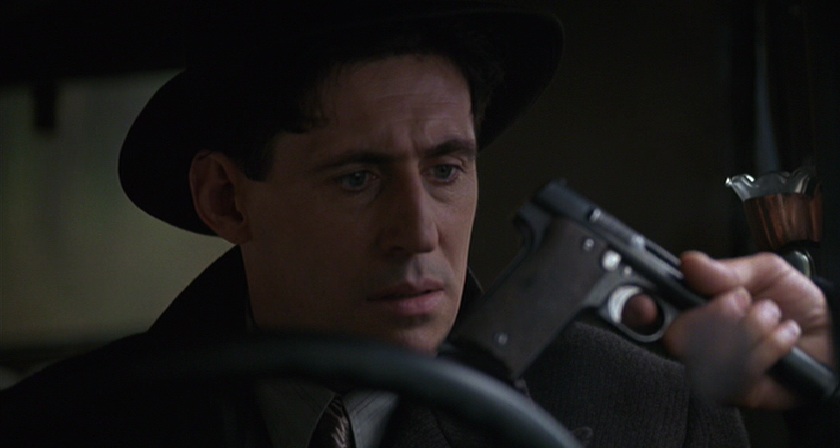
For those staying in tonight, the Old Life movie recommendation for New Year’s reflections is Hudsucker Proxy, the fifth movie that Joel and Ethan Coen made. It is their homage to the genre of RomCom, and it even explains wisely (for mmmmeeeeEEEEE anyway) why people make such a big deal of changing wall calendars. From the script:

NARRATOR (VOICE OVER) It’s 1958 — anyway, for a few mo’ minutes it is. Come midnight it’s gonna be 1959. A whole ‘nother feelin’. The New Year. The future…

The SINGING, a little MORE AUDIBLE, but still not close, is “Auld Lang Syne.”

NARRATOR (V.O.) …Yeah ole daddy Earth fixin’ to start one mo’ trip ’round the sun, an’ evvybody hopin’ this ride ’round be a little mo’ giddy, a little mo’ gay…

We are MOVING IN TOWARDS a particular skyscraper. At its top is a large illuminated clock.

NARRATOR (V.O.) Yep…

We hear a SERIES OF POPPING sounds.

NARRATOR (V.O.) …All over town champagne corks is a-poppin’.

A big band WALTZ MIXES UP on the track.

NARRATOR (V.O.) …Over in the Waldorf the big shots is dancin’ to the strains of Guy Lombardo… Down in Times Square the little folks is a-watchin’ and a-waitin’ fo’ that big ball to drop…

The LOMBARDO MUSIC gives way to the CHANTING of a distant CROWD: “Sixty! Fifty-nine! Fifty-eight!”

NARRATOR (V.O.)…They all tryin’ to catch holt a one moment of time…

The CHANTING has MIXED back DOWN AGAIN TO leave only the WIND. Still TRACKING IN TOWARD the top of the skyscraper, we begin to hear the TICK of its enormous CLOCK. The clock reads a minute to twelve. Above it, in neon, a company’s name: “HUDSUCKER INDUSTRIES.” Below it, in neon, the company’s motto: “THE FUTURE IS NOW.”

NARRATOR (V.O.) …to be able to say — ‘Right now! This is it! I got it!’ ‘Course by then it’ll be past. (more cheerfully) But they all happy, evvybody havin’ a good time.

We are MOVING IN ON a darkened penthouse window next to the clock. The window starts to open.

NARRATOR (V.O.) …Well, almost evvybody. They’s a few lost souls floatin’ ’round out there…

A young man is crawling out of the window onto the ledge. With the opening of the window, “AULD LANG SYNE” filters out with greater volume.

NARRATOR (V.O.) …This one’s Norville Barnes.

Grade Giver, Grade Thyself

Actually don’t. The optics are off, but end-of-year blogging brings out the worst of the medium:

There is always both wheat and chaff in hurried weekly commentaries. A look back on the past year of my RNS writings reveals plenty of both.

I was right, I think, in my claim that progressive and conservative evangelicals are heading for divorce, though it will never be an entirely clean or complete one.

I was right that America’s national character is eroding — that one sign of that erosion is the nature of our politics and another is the nature of our social media.

My improved peace of mind and retention of good relations with friends and family suggest I was right to abandon Facebook last summer.

I was right that clergy entanglement with American politics is an abiding temptation that regularly makes clergy useful idiots to politicians.

I was right that the (mainly white) Christian right’s embrace of Donald Trump was deeply discrediting to the Christianity that group purports to represent. At least, I believe I was right.

I also think I was right in my regular critiques of the campaign rhetoric and policy proposals of Mr. Trump. Now we all hold our breath to see what kind of president he will actually be.

I was right that differences about ideology, politics, and faith continually tear at the fabric of our society, our churches, and our friendships.

I was right that middle ground on the LGBT issue is eroding.

I was right that the resolution of the Wheaton College/Larycia Hawkins case and her forced departure deeply wounded the cause of Christian higher education, not to mention Professor Hawkins and Wheaton.

It goes on.

Why don’t the smartest people in society not see the problem of self-evaluations? Have they never watched a Coen brother’s movie?

Law Enforcement: More Art than Sanctification

Mencken finds wisdom from the mayor of Toledo:

There are, to be sure, on the scrolls of the State, and on the books of the city, statutes and ordinances which forbid the commission of certain sins, and even enlarge venial offenses to the proportions of crimes for the sake of prohibiting them; and, having enacted this legislation, society seems to be content, because the theoretical remedy has been provided against evil. All that remains, according to the theory, is to “enforce” these statutes and ordinances, and the evils will vanish, the sins cease. But these remedies are theoretical only. They do not search out the mysterious and obscure causes of crime; they are concerned solely with the symptoms or surface indications of those deeply hidden causes. But, however that may be, these statutes and ordinances can be administered only by human agencies, and in their administration are encountered human obstacles. (VIRTUE BY STATUTE. From “The Enforcement of Law in Cities,” by Brand Whitlock)

If John Piper’s preaching can’t transform the human heart (without the Holy Spirit), how are Barney Fife and Andy Griffith?

It’s Funny Because It’s True

That was Homer Simpson’s reaction to the video, “Football to the Groin” (as I recall). Good humor has a strong does of reality, that was the lesson implied in Homer’s quip. And Babylon Bee’s top ten books for 2016 also suggest that Old Life criticisms of the Protestant world have a strong resemblance to reality. These indicate that OL and BB share not a w-w but a wariness about evangelical hype and cliches:

1.) Whatever Tim Keller wrote, probably: Honestly, we didn’t read any Tim Keller books this year. But we’re sure that whatever he wrote was pretty good. So the number 1 book of the year is whatever he wrote. Pick your favorite and put it in this slot. Congratulations, Tim!

3.) The Purpose Driven Ferret — Rick Warren: While fans of the Purpose Driven series have hundreds of variants to choose from, Rick Warren may have outdone himself with this special edition of The Purpose Driven Life, written exclusively for the close cousin of the polecat. Your ferret will love learning how to fulfill its God-given purpose as Warren masterfully uses over 250 different translations of the Bible to drive home his point.

6.) Worldview: The Worldview: Worldview Edition — Al Mohler: Al Mohler is right in his wheelhouse when writing about worldviews, and his latest work, Worldview: The Worldview: Worldview Edition is an excellent guide to worldviews and the worldviews that view them in the world.

7.) Hyphenating To The Glory Of God — John Piper: Piper focuses with white-hot, laser-like intensity on, as he puts it, “the all-other-punctuation-mark-surpassing splendor” of the hyphen. Soul-stirring and paradigm-shattering, you should not miss this all-too-important, not-exactly-like-his-usual-books-but-still-vintage-John-Piper work.

9.) ? — Rob Bell: “I was thinking about what I wanted my new book to convey,” Bell said thoughtfully in a short YouTube video designed to promote the May release of New York Times bestseller ?. “And it suddenly hit me—I really have no idea. I mean, about anything.” This masterful work features thousands of question marks arranged on each page in no discernible order, as well as several chapters written in Sanskrit.

The lesson: the way to avoid ridicule is stop doing ridiculous stuff.

The Virtue of Being Vindictive

Morning reading left me stunned with this observation about the way Americans understand recent terrorist acts:

When Muslim Americans commit acts of terrorism, we hold ISIS and Hezbollah and “radical Islam” accountable for their actions, even if they are mentally unstable, and even if there is no direct connection between them and the groups that inspired them. We call these terrorists “self-radicalized.” It is how we see Dzhokhar and Tamerlan Tsarnaev, who bombed the Boston Marathon in 2013; and Omar Mateen, who went on a murderous rampage at the Pulse Night Club in Orlando last June; and Mohamed Lahouaiej-Bouhlel, who killed 86 people and injured 434 at a celebration in Nice on Bastille Day. They did not go to a terrorist training camp, or join an organized cell, or attend an anti-Western madrassa. They learned to hate from a network of web sites and magazines and videotapes. Their madrassa was the media….

[Robert] Dear became radicalized in precisely the same way. But because the media he listened to advocated war in the name of a Christian god, and argued for an ideology considered “conservative,” he is portrayed as no one’s responsibility. In fact, as I learned from hours of speaking with Dear, the narratives he learned from Rush Limbaugh and Alex Jones and Bill O’Reilly and countless far-right web sites meshed perfectly with his paranoid delusions, misogynist beliefs, and violent fantasies. The right-wing media didn’t just tell him what he wanted to hear. They brought authority and detail to a world he was convinced was tormenting him. They were his shelter and his inspiration, his only real community.

The point of Amanda Robb’s piece, coincidental that it comes in New Republic’s issue on President Obama’s legacy, seems to be that right-wing media is evil (just like the party they support). The Planned Parenthood shooter received lots of ideas from radio preachers even more obscure than Jen Hatmaker:

In those days, thanks to the Fairness Doctrine, major broadcast outlets were forbidden from running partisan content without providing equal time to opposing views. But on shortwave channels, right-wing broadcasts were proliferating. Dear tuned in as often as possible. “That’s what turned me on to the conspiracies and the Bible prophecies,” he recalled. His favorites included Brother Stair, a Pentecostal minister who has predicted the end of the world; William Cooper, who preached that aids was a man-made disease; Pete Peters, whom the Anti-Defamation League has called a “leading anti-Jewish, anti-minority, and anti-gay propagandist”; and Texe Marrs, leader of the Power of Prophecy Ministries, who claimed that the federal government committed the Oklahoma City bombing and framed Timothy McVeigh.

Dear also became fixated on small magazines devoted to right-wing conspiracies. He spent hours at Barnes & Noble poring over magazines like The Prophecy Club, The Spotlight, and Paranoia, obsessing over their brand of crackpot theorizing: how the Robert Bork confirmation battle was connected to the JFK assassination, how the World Trade Organization ran a secret “Codex Alimentarius,” how the government operated a series of Deep Underground Military Bases, how it was planning an “American Hiroshima.”

But you know, the Fairness Doctrine paved the way for Rush Limbaugh, Bill O’Reilly’s John the Bapist:

Those in the right-wing media who traffic in hate and conspiracy theories are quick to deny that they should be held responsible for the consequences of their words. After Waco, Rush Limbaugh took to the airwaves to predict that “the second violent American revolution” was imminent. Yet two weeks after the Oklahoma City bombing, he published an op-ed in Newsweek entitled “Why I’m Not to Blame.” After running 29 shows attacking George Tiller as “Tiller the Baby Killer” and saying there was “a special place in hell” for him, Bill O’Reilly dismissed any accountability for inciting the doctor’s murder: “I reported extensively on Tiller and after he was assassinated by a man named Scott Roeder, some far-left loons blamed me.”

So, if we blame ISIS for random acts of mass murder, why not the right-wing media? Possibly because POTUS and the Department of Justice and mainstream media have warned us from jumping to conclusions about Islam or Islamic organizations.

Here’s how the New York Times handled the Boston bombers’ religion:

While Dzhokhar’s adjustment seemed to be going smoothly as he reached his teens, Tamerlan’s disillusionment with their adopted country grew as he got older, as did his influence on his younger brother.

Baudy Mazaev, a Chechen friend of the Tsarnaevs, said that Tamerlan and his mother, Zubeidat Tsarnaeva, “had a deep religious epiphany” involving Islam a few years before the bombing.

Initially, according to friends, Tamerlan’s new religious devotion seemed to only irritate Dzhokhar: Mr. Mazaev said that on one of his visits to the Tsarnaev house during that period, Tamerlan ordered him and Dzhokhar to read a book about the fundamentals of Islam and prayer. After that, Mr. Mazaev said, they began avoiding the apartment.

But the family’s relationship to Islam, and one another, evolved. In February 2011, roughly when the boys’ mother embraced Islam, she separated from her husband, Anzor, a tough man trained in the law in Russia who in Cambridge was reduced to fixing cars in a parking lot. The two divorced that September, and Anzor returned to Russia; his ex-wife followed later.

Tamerlan filled the void as head of the family’s American branch. On Twitter, Dzhokhar wrote that he missed his father. Days before his citizenship ceremony — on Sept. 11, 2012 — he expressed wonder at why more people did not realize that the 2001 attack on the World Trade Center “was an inside job.”

Not exactly a slam dunk link to ISIS or Hezbollah.

What about this treatment of Omar Mateen?

Other hints of a disturbed mind continued to emerge. In 2013, G4S removed Mr. Mateen from his security post at the St. Lucie County Courthouse after he had made “inflammatory comments” about being involved somehow in terrorism. Though far-fetched and even contradictory — he claimed connections to Al Qaeda, the Sunni extremist group, and ties to its near opposite, the Shiite Hezbollah — his comments were troubling enough for the county sheriff’s office to notify the Federal Bureau of Investigation.

The bureau’s subsequent inquiry was inconclusive.

The next year, Mr. Mateen again attracted federal scrutiny, after an acquaintance from his mosque, the Islamic Center of Fort Pierce, carried out a suicide bombing in Syria. According to F.B.I. Director James B. Comey, federal investigators concluded that Mr. Mateen knew the bomber only casually.

The mosque’s imam, Syed Shafeeq Rahman, insisted that Mr. Mateen had never heard teachings at the mosque that would have radicalized him. “There is nothing that he is hearing from me to do killing, to do bloodshed, to do anything, because we never talk like that,” the imam said.

But if you can link an attack on Planned Parenthood to the media that opposed President Obama, well, why not?

And this was an issue of New Republic that celebrated the President’s decency, centrism, and dignity. According to Andrew Sullivan:

People will see the sheer caliber of this man [President Obama]. The grace and poise with which he conducted himself in unbelievably difficult circumstances; the way he withstood abuse and disrespect with extraordinary calm and goodwill. He will in his post-presidency become a symbol, maybe somebody we need more than when he was president, to remind us of what it is to be dignified in public life. Especially if this hideous monster who’s succeeding him continues to despoil the public culture.

So why exactly did the editors include a piece so out of sync with the President’s virtues? Maybe because they only want the other side to be virtuous?