What’s Context for the Goose dot dot dot

A conventional move to undercut your ecclesiastical opponents is to attribute their concerns to “the times.” Their convictions are not timeless truths, the argument goes, but spring from the either unwholesome or ordinary concerns of the here and now. Short-sighted is one way to put it.

Massimo Faggioli employs this tactic to conservatives or traditionalists or critics of Pope Francis in the Roman Catholic world:

The growing neo-traditionalist movement in U.S. Catholicism in some ways echoes the development of the SSPX. There is a similar rejection of Vatican II, for instance, which has also manifested in radical theological dissent against Pope Francis. And just as the 1985 Synod seemed to be a trigger for Lefebvre, the 2014–2015 Synod (along with Amoris laetitia) seemed to trigger contemporary traditionalists. And both movements have seized on interreligious dialogue and religious liberty as key issues. But the context has changed significantly since the 1970s and ’80s. Catholic media and social media have helped in amplifying oppositional voices and weakening the sense of unity in the church. These “para-schismatic” voices have effectively been mainstreamed and globalized, harnessed politically against Pope Francis and the Catholicism emerging from the Global South in an effort to undermine the church’s influence on issues like the environment and migration.

The intra-ecclesial context has also changed. A feature of contemporary Catholic neo-traditionalism today is concern over teaching on the family and marriage, and over the rise of the LGBT movement in the church—something that simply was not there in decades past. If Lefebvre’s movement cannot be understood outside the context of French Catholicism, the French Revolution, and laïcité, the U.S. neo-traditionalist movement is incomprehensible outside the history of the American culture wars. A growing media ecosystem of cable TV outlets, internet channels, and bloggers acting as self-appointed watchdogs has helped nurture the movement, while acting in almost guerilla fashion against Pope Francis.

As much as I appreciate Faggioli’s push back against the anti-liberals and integralists now sprouting up among conservatives who are Roman Catholic, I also know the Villanova University professor is a good enough historian to understand that Roman Catholicism would not be what it is without context. As opposed to the notion that this is the church Jesus founded, you don’t have the power of bishops without the establishment of Christianity under Constantine, or the supremacy of the papacy without the rise of the Holy Roman Empire, or Tridentine faith without Protestantism.

In fact, Faggioli’s own preference for Vatican II Roman Catholicism, hardly the church for all time, is the product of a church that decided modernity — finally — was good and the church needed to catch up. You certainly don’t see that desire for relevance in the apostles, monastic reformers, or pope’s who aspired to divine right monarchy.

In which case, Faggioli’s charge of historicism is not in good faith.

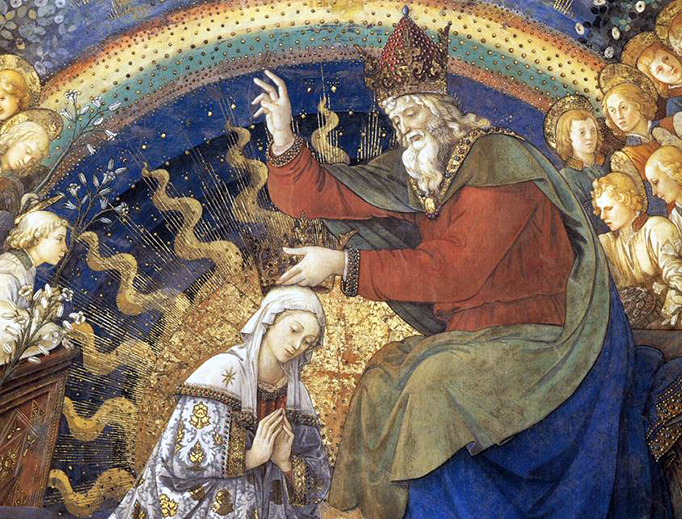
Mary, Queen not of the Scots but the Universe?

That at least is the claim by Roman Catholics, who last week celebrated the Memorial of the Queenship of the Blessed Virgin Mary:

As was the custom in Israel, Mary was predestined to be the Queen Mother of Jesus. Since Jesus was to be King of all creation, his mother Mary — in dependence on Jesus — was to be his Queen. Since Jesus took his earthly flesh from his mother Mary, it was only fitting that her flesh, too, should have been preserved from the stain of original sin.

Mary was acting in her role of Queen Mother when, at the wedding feast at Cana, she turned to her Son for help — and then when she instructed the steward, “Do whatever He tells you.”

Protestants don’t think so, at least the Scot James Orr took a different view on the wholesomeness of queen mothers in the Old Testament:

It stands to reason that among a people whose rulers are polygamists the mother of the new king or chief at once becomes a person of great consequence. The records of the Books of Kings prove it. The gebhirah, or queen mother, occupied a position of high social and political importance; she took rank almost with the king. When Bath-sheba, the mother of Solomon, desired “to speak unto him for Adonijah,” her son “rose up to meet her, and bowed himself unto her, and sat down on his throne, and caused a throne to be set for the king’s mother; and she sat on his right hand” (1 Ki 2:19). And again, in 2 Ki 24:15, it is expressly stated that Nebuchadnezzar carried away the king’s mother into captivity; Jeremiah calls her gebhirah (29:2). The king was Jehoiachin (Jeconiah, Jer 29:2), and his mother’s name was Nehushta (2 Ki 24:8). This was the royal pair whose impending doom the prophet was told to forecast (Jer 13:18). Here again the queen mother is mentioned with the king, thus emphasizing her exalted position. Now we understand why Asa removed Maacah his (grand?)mother from being queen (queen mother), as we are told in 1 Ki 15:13 (compare 2 Ch 15:16). She had used her powerful influence to further the cause of idolatry. In this connection Athaliah’s coup d’etat may be briefly mentioned. After the violent death of her son Ahaziah (2 Ki 9:27), she usurped the royal power and reigned for some time in her own name (2 Ki 11:3; compare 2 Ch 22:12). This was, of course, a revolutionary undertaking, being a radical departure from the usual traditions.

Not the best model for Mary.

And then we have the perspective of Judaism. In addition to Michal and Bathsheba, perhaps not the best of precedents, we have Ataliah:

The daughter of Ahab and Jezebel (or else of Omri), wife of Jehoram of Judah, and sole reigning queen of Judah. Like her husband, she murdered all familial rivals upon her accession to the throne. Only her grandson Joash escaped her clutches thanks to his aunt Jehosheva (Ataliah’s daughter). Ataliah fostered the idolatrous worship of Baal-Melqart, and her reign was odious to the Judahites. She received condign punishment when her son-in-law, the stalwart high priest Jehoiada, proclaimed her grandson Joash as king in a coronation ceremony in the Temple. The despairing Ataliah tore her clothes and protested the act of treason, then was promptly led off and summarily executed at the horse gate of the royal palace. In the aftermath of Ataliah’s demise, the temple of Baal was destroyed and its priest Mattan slain.

But if you can look at queen mothers in the Old Testament as the institutional model for Mary’s status in the Christian faith, you might have no trouble believing the New York Times about slavery in America.

Being A Woke Christian is Biting Off More than You Can Chew

I have already wondered how you can throw around the phrase, white normativity, and not also need to add heternormativity to your Christian activism. But Andrew Sullivan, a man who is gay, married, Roman Catholic, and identifies as conservative, also gives reason for thinking that woke evangelicals and Reformed Protestants are playing with fire if they think they can hold on to doctrinal normativity while berating white normativity and remain silent (or not) about heteronormativity.

First, without even using the phrase, “cultural Marxism,” Sullivan explains why some Americans find the Left, and their woke evangelical supporters, scary (yes, it may be okay to be afraid):

A conservative who becomes fixated on the contemporary left’s attempt to transform traditional society, and who views its zeal in remaking America as an existential crisis, can decide that in this war, there can be no neutrality or passivity or compromise. It is not enough to resist, slow, query, or even mock the nostrums of the left; it is essential that they be attacked — and forcefully. If the left is engaged in a project of social engineering, the right should do the same: abandon liberal democratic moderation and join the fray.

I confess I’m tempted by this, especially since the left seems to have decided that the forces behind Trump’s election represented not an aberration, but the essence of America, unchanged since slavery. To watch this version of the left capture all of higher education and the mainstream media, to see the increasing fury and ambition of its proponents, could make a reactionary of nearly anyone who’s not onboard with this radical project.

Of course, Sullivan is not ready to join the OPC or to sign the Statement on Social Justice and the Gospel. He recognizes a difference between supporting Trump as the embodiment of American norms and seeing Trump as a hedge on the Left’s attempt to remake the nation (even while breaking things):

This, it strikes me, is one core divide on the right: between those who see the social, cultural, and demographic changes of the last few decades as requiring an assault and reversal, and those who seek to reform its excesses, manage its unintended consequences, but otherwise live with it. Anton is a reactionary; I’m a conservative. I’m older than Anton but am obviously far more comfortable in a multicultural world, and see many of the changes of the last few decades as welcome and overdue: the triumph of women in education and the workplace; the integration of gays and lesbians; the emergence of a thriving black middle class; the relaxation of sexual repression; the growing interdependence of Western democracies; the pushback against male sexual harassment and assault.

Yes, a conservative is worried about the scale and pace of change, its unintended consequences, and its excesses, but he’s still comfortable with change. Nothing is ever fixed. No nation stays the same. Culture mutates and mashes things up. And in America, change has always been a motor engine in a restless continent.

But you are not a white racist Christian nationalist supremacist misogynist sinner (where do you put guns?) if you don’t agree with the ladies or men of color who host certain podcasts:

In a new essay, Anton explains his view of the world: “What happens when transformative efforts bump up against permanent and natural limits? Nature tends to bump back. The Leftist response is always to blame nature; or, to be more specific, to blame men; or to be even more specific, to blame certain men.” To be even more specific, cis white straight men.

But what are “permanent and natural limits” to transformation? Here are a couple: humanity’s deep-seated tribalism and the natural differences between men and women. It seems to me that you can push against these basic features of human nature, you can do all you can to counter the human preference for an in-group over an out-group, you can create a structure where women can have fully equal opportunities — but you will never eradicate these deeper realities.

The left is correct that Americans are racist and sexist; but so are all humans. The question is whether, at this point in time, America has adequately managed to contain, ameliorate, and discourage these deeply human traits. I’d say that by any reasonable standards in history or the contemporary world, America is a miracle of multiracial and multicultural harmony. There’s more to do and accomplish, but the standard should be what’s doable within the framework of human nature, not perfection.

Sullivan’s point about the Left blaming nature is what seems to be missing from the self-awareness of woke Protestants. They may agree and receive inspiration from opposing racial and gender hierarchies. But for the Left, these antagonism stem from a willingness to overturn nature. That is a line that Christians should not cross if they want to continue to believe in the God who created humans as male and female, and creatures as feline and canine. You start to argue that to achieve equality we need to do away with natural distinctions and you are going to have trouble with the creator God.

One last point from Sullivan that shows how woke Christians are becoming fundamentalist, but with a real kicker:

This week, I read a Twitter thread that was, in some ways, an almost perfect microcosm of this dynamic. It was by a woke mother of a white teenage son, who followed her son’s online browsing habits. Terrified that her son might become a white supremacist via the internet, she warns: “Here’s an early red flag: if your kid says ‘triggered’ as a joke referring to people being sensitive, he’s already being exposed & on his way. Intervene!” Really? A healthy sense of humor at oversensitivity is a sign of burgeoning white supremacy? Please. More tips for worried moms: “You can also watch political comedy shows with him, like Trevor Noah, John Oliver, Hasan Minhaj. Talk about what makes their jokes funny — who are the butt of the jokes? Do they ‘punch up’ or down? … Show them that progressive comedy isn’t about being ‘politically correct’ or safe. It’s often about exposing oppressive systems — which is the furthest thing from ‘safe’ or delicate as you can get.”

It reminds me of a fundamentalist mother stalking her son’s online porn habit. Doesn’t she realize that it is exactly this kind of pious, preachy indoctrination about “oppressive systems” that are actually turning some white kids into alt-right fanboys? To my mind, it’s a sign of psychological well-being that these boys are skeptical of their authority figures, that they don’t think their maleness is a problem, and that they enjoy taking the piss out of progressive pabulum. This is what healthy teenage boys do.

More to the point, this kind of scolding is almost always counterproductive. Subject young white boys to critical race and gender theory, tell them that women can have penises, that genetics are irrelevant in understanding human behavior, that borders are racist, or that men are inherently toxic, and you will get a bunch of Jordan Peterson fans by their 20s. Actually, scratch that future tense — they’re here and growing in number.

Many leftists somehow believe that sustained indoctrination will work in abolishing human nature, and when it doesn’t, because it can’t, they demonize those who have failed the various tests of PC purity as inherently wicked. In the end, the alienated and despised see no reason not to gravitate to ever-more extreme positions. They support people and ideas simply because they piss off their indoctrinators. And, in the end, they reelect Trump.

Re-elect Trump or no, you have ideological purity.

What If You Are Still an Angry Young Man in Your Forties?

David Koyzis writes about his experience with social justice in ways that might be encouraging to those who would like the woke Christians to step back from the apocalypse.

It is not always easy to love our fellow Christians. After all, they sometimes say things that we find embarrassing and embrace causes that we find repugnant. Their political opinions are hopelessly atavistic or thoughtlessly progressive. They believe the world will end tomorrow and think they can hasten the coming apocalypse. They think they will save their country and bring godliness to everyone. They make all Christians look foolish by their missteps, and we–their betters surely?–are reluctant to associate with them for fear of losing respectability.

How many of us have experienced this for ourselves? I freely admit that I have, and it’s a side of me that I quite dislike. In my youth I developed a burning passion for social justice, for helping the poor and oppressed and for ending the economic structures that hold them in their grip. This produced in me an anger towards anyone else in the church who was less aware of these issues than I. Of course, this included most of my fellow Christians who were busy making a living, raising families and giving time and financial resources to their church and other communities. At least temporarily, my attitude made it difficult for me to sit in church and to listen to sermons that failed to touch on what I had come to believe was so important to a genuine faith. Had someone attempted openly to correct me and thereby coax even a little humility into me, I doubt I would have listened.

This attitude softened considerably in my mid to late twenties, and by the time I reached thirty, I came to recognize that I had succumbed to an unhealthy pride.

And then you remember that some of the loudest voices on race, Trump, white normativity, and Christian nationalism are middle-aged.

The Death of Evangelicalism

At the end of her longish piece on evangelicals and politics in Texas, Elizabeth Bruenig asks this:

Is there a way to reverse hostilities between the two cultures in a way that might provoke a truce? It is hard to see. Is it even possible to return to a style of evangelical politics that favored “family values” candidates and a Billy Graham-like engagement with the world, all with an eye toward revival and persuasion? It is hard to imagine.

Or was a truly evangelical politics — with an eye toward cultural transformation — less effective than the defensive evangelical politics of today, which seems focused on achieving protective accommodations against a broader, more liberal national culture? Was the former always destined to collapse into the latter? And will the evangelical politics of the post-Bush era continue to favor the rise of figures such as Trump, who are willing to dispense with any hint of personal Christian virtue while promising to pause the decline of evangelical fortunes — whatever it takes? And if hostilities can’t be reduced and a detente can’t be reached, are the evangelicals who foretell the apocalypse really wrong?

The either/or implied in these questions, a religion of transformation, one that would make America great because Christian, versus a religion at odds with the culture but looking for non-mainstream ways of preserving it (the Benedict option as it were), is what the leaders of Big Evangelicalism had not at all considered. The Tim Kellers, Russell Moores, and Al Mohlers of the world really did seem to think that Protestants could find some help or encouragement from cultural engagement with political leaders. They also seemed to think that the rest of the Protestant world was on board. They had no idea that some American Protestants saw engagement as fruitless, and possibly only beneficial for those who had access to the engaged.

The old evangelical “paradigm,” the one that began around 1950, is done. Stick a fork in it. What will emerge is not at all clear. But after Trump as POTUS, it is easier for many to see that the Reagans, Bushes, and Obamas of the political class were no more interested in the cultural engagers than the real-estate tycoon turned POTUS is. The Religious Right’s aims were so many fumes left over from mainline Protestantism’s cultural engagement. It is now time to think about Protestantism on the cultural margins.

To her credit, Bruenig understands that.

Hypocrites All

Has anyone wondered what Bible #woke Christians read?

14 Do all things without grumbling or disputing, 15 that you may be blameless and innocent, children of God without blemish in the midst of a crooked and twisted generation, among whom you shine as lights in the world, 16 holding fast to the word of life, so that in the day of Christ I may be proud that I did not run in vain or labor in vain. 17 Even if I am to be poured out as a drink offering upon the sacrificial offering of your faith, I am glad and rejoice with you all. 18 Likewise you also should be glad and rejoice with me. (Phil 2)

It gets worse if you think that suffering is actually part and parcel of flourishing for Christians.

Timelines and Bloodlines

It turns out that the shift along racial lines among evangelical and Reformed Protestants is remarkably recent. Some have objected to seeing 2014 as the turning point, but Jemar Tisby seems to provide the smoking gun:

remembering Brown on the five-year anniversary of his killing would be incomplete without acknowledging the impact that this tragedy had on race relations within American evangelicalism.

I know how that day and the subsequent events affected my faith and my relation to those who I once thought of as my spiritual family.

Six days after Brown’s killing, I wrote for the first time publicly about my traumatic encounters with the police.

Every black man I know has harrowing stories of being pulled over, searched, handcuffed or even held at gunpoint. When I encouraged readers to “pause to consider the level and extent of injustice that many blacks have experienced at the hands of law enforcement officers,” the responses disclosed a deep divide.

Tisby goes on to talk about the criticism that he and other African-American evangelicals for questioning police brutality. He then observes:

Black Christians like me and many others began a “quiet exodus” from white evangelical congregations and organizations. We distanced ourselves both relationally and ideologically from a brand of Christianity that
seemed to revel in whiteness.

Now, after this quiet exodus, we find ourselves wandering in a sort of wilderness. Some are rediscovering the black church tradition and moving in that direction for healing and solidarity. Others, often by necessity, have remained in white evangelical spaces but with a new degree of caution. Some of us still don’t have a faith community to call home.

In sum:

Brown and Ferguson highlighted that when it comes to some parts of conservative evangelicalism, whiteness is not a bug, it’s a feature.

Who can judge another’s personal experience? I do not doubt that 2014 was traumatic for Tisby and many African-Americans, though I still don’t see the issue of police brutality as simply indicative of a black-white divide in the United States. In the hyphenated world in which all Christians live, it seems possible to support in general the functions of the police and oppose racism. In other words, opposition to racism should not be synonymous with hostility to law enforcement. I could well imagine, for instance, someone supporting Robert Mueller’s investigation (part of law enforcement) of the 2016 presidential election and detesting racism.

What is a problem, though, is to write a book with a tone of exasperation that white Christians just don’t get it. Not only does Tisby in his book fault white Christians for being tone deaf to race today. He adds that this is the way it has always been. The white church has been racist and always oblivious.

But if it took 2014 for an African-American Christian to see the problem, might not Tisby also have empathy for those who are five years late?

Meanwhile, to John Piper’s credit, his book on racism came out in 2011. He did not need cops in Ferguson, Missouri to see what Tisby saw three years later. Here is how Collin Hansen reviewed Piper’s book:

Tim Keller writes in his foreword that conservative evangelicals “seem to have become more indifferent to the sin of racism during my lifetime” (11). That would indeed be a major problem, since conservative evangelicals have been responsible for so much of the institutional racism of the last 60 or so years. Piper saw racism in the form of Southern segregation. The church of his youth voted in 1962 to ban blacks from attending services. His mother, however, opposed this motion. Piper’s experience explains the burden for writing this book, in which he argues, “Only Jesus can bring the bloodlines of race into the single bloodline of the cross and give us peace” (14). No political platform, lecture series, listening session, or economic program can cure what ails us. Nothing but the blood of Jesus can wash away our sin and make our diverse society whole again. Sadly, white Christians have so often perpetuated racism that we’ve largely lost the moral authority to help our neighbors confront and overcome this sin.

Bloodlines opens with a brief recap of racial history in the United States focused on the leadership of Martin Luther King Jr. and his masterful writing, particularly “Letter from Birmingham Jail.” This historical jaunt may indicate Piper anticipates a youthful readership who did not live through these events. Or maybe he believes the race problem is worse than ever. He writes, “There are probably more vicious white supremacists in America today than there were in 1968” (27).

Either way, no one can argue the church has made sufficient progress on race. Sunday mornings remain largely self-segregated. But Piper sells himself short as a credible leader when it comes to racial reconciliation. He and his church have made commendable and costly investments to live out what they profess about the gospel that unites Jews and Gentiles. I would have gladly read much more than a few appendix pages on Bethlehem’s experience of trial and error. We need theology that exalts the work of Jesus, and we also need examples from churches that have enjoyed God’s gracious favor in the form of racial diversity and harmony.

With Keller and Piper alert to the problem of racism in white Protestant circles in 2011, Tisby’s dating of the racial rift is curious. It is hard to believe he was not reading Keller and Piper.

Still Confused about Christian Nationalism

The folks at The Witness used the anniversary of the 2017 Charlottesville protests to re-publish the Charlottesville Declaration, an appeal to American churches to repent of and oppose racism. Here is an excerpt:

Now is the time for the Church to again be the moral compass for this nation. Now is the time for a prophetic, Spirit-led remnant to bear credible “word and deed” witness to the glorious Gospel of Jesus Christ.

As in the generation that preceded us, we especially call upon those born-again disciples who still cherish the authority of Scripture and the enablement of the Spirit. We declare that old time religion is still good enough for us in this new era, religion that provides us a full-orbed Gospel of evangelism and activism. May we be salt and light witnesses against the kingdom of darkness, knowing that we war not against flesh and blood, but against principalities, against powers, against the rulers of the darkness of this world, against spiritual wickedness in high places (Ephesians 6:12Open in Logos Bible Software (if available)).

To this end, we call upon white leaders and members of the Evangelical church to condemn in the strongest terms the white supremacist ideology that has long existed in the church and our society. Nothing less than a full-throated condemnation can lead to true reconciliation in the Lord’s body.

According to John Fea, Christian nationalism looks something like this:

The most extreme Christian nationalists create political platforms focused on restoring, renewing, and reclaiming America in such a way that privileges evangelical Christianity. Many of these extreme Christian nationalists may also be described as “dominionists” because they want to take “dominion” over government, culture, economic life, religion, the family, education, and the family. Christian nationalists of all varieties are marked by their unwillingness or failure to articulate a vision of American life defined by pluralism.

As a political movement, Christian nationalism is defined by a fear that America’s Christian identity is eroding, a belief that the pursuit of political power is the way to “win back” America, and a nostalgia for a Christian nation that probably never existed in the first place.

It looks like the Charlottesville Declaration insists that the United States conform to the gospel. Its drafters and signers also exhibit a fear that the nation’s Christian identity is, if not eroding, not sufficiently evident.

So why don’t those opposed to Christian nationalism also oppose The Witness’ Christian nationalism?

Imagine if this reporter read the Nashville Statement on gay marriage and wrote about a grassroots movement to preserve heteromarriage:

Article 1
WE AFFIRM that God has designed marriage to be a covenantal, sexual, procreative, lifelong union of one man and one woman, as husband and wife, and is meant to signify the covenant love between Christ and his bride the church.

WE DENY that God has designed marriage to be a homosexual, polygamous, or polyamorous relationship. We also deny that marriage is a mere human contract rather than a covenant made before God.

Article 2
WE AFFIRM that God’s revealed will for all people is chastity outside of marriage and fidelity within marriage.

WE DENY that any affections, desires, or commitments ever justify sexual intercourse before or outside marriage; nor do they justify any form of sexual immorality.

Article 3
WE AFFIRM that God created Adam and Eve, the first human beings, in his own image, equal before God as persons, and distinct as male and female.

WE DENY that the divinely ordained differences between male and female render them unequal in dignity or worth.

On it goes for eleven more points.

What is worth noticing is that the Nasvhille Statement is not nationalist. It begins by talking about the West, never mentions the United States, and comes in French, Dutch, Japanese, and German versions.

But it is the sort of statement that some who oppose Christian nationalism refused to sign (as did I). Some evangelicals say the statement is “theology for the age of Trump,” others say it’s a “disaster.” But these same critics can’t see any indication of Christian nationalism in a statement that expects the United States to conform to Christian norms on race. I don’t suppose it has anything to do with calculating evangelicalism in relation to Trump. If so, that’s also a Christian version of nationalism since it lets political necessity shape Christian witness.

The lesson seems to be:

It is wrong to say America is a Christian nation when the nation is not Christian.

It is right to say America should be a Christian nation when the nation is not Christian.

The Little Evangelical Engine that Could

If anyone is interested in background to the Presbycast podcast with mmmmeeeeEEEE last night, you might want to look at this very good history on the early days of the National Association of Evangelicals.

In the 1940s, no one would likely have predicted that “evangelical” would become the word to explain most of American Protestantism:

The years following the first convention proved determinative for the fledgling organization. The first among many action items was the 1943 opening of an office in Washington, D.C., to help on a number of fronts, such as supporting evangelical chaplains, assisting mission agencies in dealings with the State Department, championing the cause of religious broadcasting to the Federal Communication Commission, and defending religious liberty. Because the demands were great, NAE called Clyde Taylor, a Baptist General Conference pastor in New England, to oversee the strategic office. Taylor, a former missionary to South America with the Christian and Missionary Alliance and part-time professor at Gordon College, was well suited for the post and for the NAE in general. While he served in a number of roles, Taylor would become the dominant figure in the NAE over the next 30 years.

Continued concern over radio prompted the NAE to form the National Religious Broadcasters (NRB) at its 1944 convention in Columbus, Ohio. NRB was the first of many related service agencies the NAE would charter with a particular purpose in mind. Following the lead of CBS and NBC, the Mutual Radio Network had announced it would no longer sell time for religious broadcasting and turned the Protestant broadcasting slot over to the Federal Council of Churches. NRB, after holding its own constitutional convention later that year, responded to the challenge, eventually persuading the networks to reverse their policies.

In addition to NRB, the NAE created two task-specific commissions in 1944 — the Chaplains Commission, to assist evangelical chaplains in the military, and War Relief Commission, which would eventually become a subsidiary known as World Relief, NAE’s humanitarian assistance arm. The following year, the NAE created the Evangelical Foreign Missions Association (later called the Evangelical Fellowship of Mission Agencies and now Missio Nexus, the largest missionary association in the world), chartered to handle the special needs of missionaries and their agencies.

By 1945 the NAE had also established regional offices in Detroit, Minneapolis, Portland and Los Angeles to promote the cause locally and foster communication with individuals, local churches, denominations and Christian organizations.

Some debate has focused on whether or not the NAE helped itself by founding new agencies rather than consolidating the functions under one centralized structure. Whatever the pros or cons, the arrangement was reflective of the evangelical mood at the time. While evangelicals sensed the value of some level of structure, the dynamic nature of their movement would only tolerate a limited amount of centralization.

Not only did they fear centralization, but they weren’t thinking New York City!!!!

By the 1960s, the NAE was still peripheral:

While NAE momentum was strong from its founding in 1942 through the late 50s, the next two decades would prove to be a time of testing for the organization, just as they were for the country as a whole. Not until the late 70s would any new initiatives galvanize the association into meaningful action. The 60s were particularly difficult. The NAE and most of its leadership were not at all encouraged with the prospect of the 1960 election of John Kennedy, a Roman Catholic, to the presidency — a first in American history. The mood digressed as civil rights, the Vietnam War and a new counterculture divided the nation. Assassinations of the Kennedy brothers and Martin Luther King, Jr., leading political figures, shocked the populace. The state of the church was equally disturbing as liberal theologians proclaimed “God is dead” while some bishops experimented with psychedelic drugs. Young people were leaving churches seemingly as quickly as babies were being born in the 1950s.

NAE faced its own troubles as its executive leadership changed hands more often than did residents of the White House. While George L. Ford, the first permanent and resident executive director (1956-63), had brought needed stability to the organization, his ascendancy to the newly created position of general director in 1963 lasted only one year. Stanley Mooneyham, director of information at the time, was considered by many as heir apparent, but left NAE for a position with the Billy Graham Evangelistic Association. The board then named Clyde Taylor, who was in charge of the Washington operation, to the top post of general director. Taylor would remain in the nation’s capital while the executive director handled administrative matters in the Wheaton, Illinois office. Arthur Climenhaga was named to the Wheaton post, but three years later, in 1967, returned to a post in his own denomination, the Brethren in Christ Church. Billy Melvin, a denominational official with the Free Will Baptists, was brought in to succeed Climenhaga, and following Taylor’s retirement in 1974, was given sole leadership responsibility for NAE.

But Ronald Reagan changed everything:

While President Jimmy Carter had distanced his administration from the expanded NAE office, the new phase of the NAE history swung into full gear with the election of Ronald Reagan in 1980. Reagan had come to power with the wide support of evangelicals. The NAE, increasingly consulted about administration appointments and policy, seized opportunities to influence government further and enjoyed unprecedented access to the White House. The Republican president courted evangelicals for support speaking at the 1983 and 1984 NAE conventions. This was the first time a U.S. president had ever visited an NAE function. At the 1983 convention in Orlando, Florida, Reagan delivered one of his most famous speeches referring to the Soviet Communist system as “the Evil Empire.”

The association was also gaining influence on Capitol Hill. The NAE’s efforts resulted in a number of legislative victories in the 1980s including the passage of bills on drunk driving, church audit procedures, and equal access to public school facilities for religious organizations. But the NAE did not just concern itself with domestic matters. In 1984, the NAE launched the highly-praised Peace, Freedom and Security Studies program in an effort to make a distinct contribution to the public debate.

With new visibility in Washington, Billy Melvin worked tirelessly to highlight the status and role of denominations in the NAE. At the 25th anniversary in 1967, some observers had noted that while denominations held membership in NAE, their role seemed to be minimized. Twenty-five years later the opposite was the case as NAE become more and more identified as a fellowship not just of evangelicals, but as a fellowship of evangelical denominations. Closely related to this change of identity was Melvin’s deliberate effort to persuade new denominations to join the NAE. In the mid-70s Melvin began building relationships with key officials in denominations outside the NAE’s fellowship. By the 1980s, his campaign had paid off as one denomination after another applied for membership in the NAE, enabling NAE’s membership to expand at a level not experienced since the 1940s. Between 1981 and 1990, 15 denominations joined NAE. Total NAE membership reflected in the combined categories of individuals, ministry organizations and constituent denominations reached nearly 4.5 million — a 74 percent increase since 1980. The gain during the decade was greater than the entire NAE membership as of 1960.

Meanwhile, no one knew what evangelicalism was. That was okay. It was apparently big and growing.

Is that why the PCA stays?

Have The Weak and Strong Turned into the Righteous and the Wicked?

Some churches, in effect, make adherence to the Republican party platform a litmus test for Christian orthodoxy. Most black people are not Republican, so political differences can create barriers to belonging.

If churches want to improve the way they teach their members about race, they should start by examining their understanding of the term.

Ask church leaders to define the words “race” and “racism.” Oftentimes there are as many different answers as there are people answering. The key here is to move beyond a narrow concept of racism as only an interpersonal phenomenon. Christians must acknowledge the ways race operates on systemic and institutional levels. Developing a shared language and definitions is a key to improving racial responsiveness.

Lots of imperatives there, but substituting orthodoxy on race for conformity on political affiliation is hardly in keeping with what Paul commanded in Romans 14:

As for the one who is weak in faith, welcome him, but not to quarrel over opinions. 2 One person believes he may eat anything, while the weak person eats only vegetables. 3 Let not the one who eats despise the one who abstains, and let not the one who abstains pass judgment on the one who eats, for God has welcomed him. 4 Who are you to pass judgment on the servant of another? It is before his own master that he stands or falls. And he will be upheld, for the Lord is able to make him stand.

5 One person esteems one day as better than another, while another esteems all days alike. Each one should be fully convinced in his own mind. 6 The one who observes the day, observes it in honor of the Lord. The one who eats, eats in honor of the Lord, since he gives thanks to God, while the one who abstains, abstains in honor of the Lord and gives thanks to God. 7 For none of us lives to himself, and none of us dies to himself. 8 For if we live, we live to the Lord, and if we die, we die to the Lord. So then, whether we live or whether we die, we are the Lord’s. 9 For to this end Christ died and lived again, that he might be Lord both of the dead and of the living.

10 Why do you pass judgment on your brother? Or you, why do you despise your brother? For we will all stand before the judgment seat of God;

Maybe the way around this call to forbearance (even tolerance) is to say that Donald Trump is simply evil. If so, then it would be doubly odd to condemn a chief sinner when Jesus hung out with prostitutes, tax collectors, and other deplorables. Since when does following Jesus mean imitating what he will do when he returns on Judgment Day?

One point to remember about the weak and the strong is that it allows for Christians to feel superior. Some are strong, others weak. Not sure how you turn that into some form of egalitarianism. The strong can handle more than the weak, and so have a better grasp of the gospel than those who form certain kinds of legalism.

So if the supremacy of the strong is a biblical idea, what is so bad with talking about some groups being better than others? Is it really so bad (when so many do it) to believe in the supremacy of the educated? American society in most middling to upper institutions runs on the premise that someone who is educated beyond high school will be a better employee, student, leader, manager than someone with less education. That is not hatred (though it can turn into it) of the uneducated. It is a recognition (perhaps debatable) that education is generally a good preparation for lots of human activities.

The point of the weak and the strong in Paul’s epistle seems to be to recognize difference but not let that be the basis for exclusion or cliques in the church.

I understand that people who moved in religious right circles did not handle their (self-understood) superiority very well. But I don’t think the social justice Protestants are setting a great example. If Paul can say “chill” about activities that some Christians deemed sinful, when did the new set of apostles arrive to declare that Paul’s instructions have hit their expiration date?