What Counts as Evidence?

I have already complained about the assumed powers of Americans to interpret and read signs (or artifacts), now I raise question about the ability to make reasoned arguments based on evidence. Here’s one example:

Chuck Todd channeled the Democratic Party talking points of the hour as he sought to attribute blame for the El Paso massacre to President Trump. Trump chief of staff Mick Mulvaney was on hand to represent the administration. The look on Mulvaney’s face when Todd turned to him said it all (video below).

Todd posed a political accusation as something like a self-evident truth: “You don’t accept the fact that the president’s rhetoric has been a contributing factor at all?”

Todd warmed up for another question with a tendentious argument: “In fairness [sic], the president has spent the last month on Twitter stoking racial resentment. You can try to rationalize…”

What is important to see is that President Trump is bigoted, unpresidential, swinish, and winds lots of people up on Twitter. He does all of this seemingly intentionally. But none of that shows that he was even 20 to 30 percent responsible for the shootings last weekend. On the other hand, the failure of journalists to maintain reasonable standards has enabled #woke pastors to attribute shootings to covenant theology. The ties between media coverage and social justice pastor are likely much closer than those between POTUS and terrorists.

But in other spheres, seemingly less consequential, thresholds for evidence are much higher. Take “proving” the effects of civic institutions:

“unlike philanthropic investments in education and health, investments in our shared civic assets are rarely measured in ways that demonstrate their true impact. After a new park or library is built, it may be required to share data on the increase in visitors but not much else. No one asks: How are the users of this space benefiting? What benefits are surrounding neighborhoods reaping? And what impact did this investment have on our larger societal goals?”

That is right. Funders want data on impact, and the data we typically provide is irrelevant. We are asking the wrong questions. So, what is Marquis’ response to this crisis? Address the “evidence gap.” Rather than lament, oppose, and contest the growing infatuation with metrics, the Civic Commons project seeks to build “a new rationale,” a new measurement system to demonstrate the value of public spaces and assess their contributions to communities.

Although this piece expresses discouragement about establishing more hurdles for the Reimagining the Civic Commons project, at least it shows that some people are skeptical and need to be convinced.

Hooray for reason!

Pastor POTUS and Mass Shootings

Some bloggers claim to give you historical perspective, and others (like mmmmmmeeeeeEEEEE) simply cut and paste:

In the 19th century, presidents had little involvement in crisis response and disaster management, for both technological and constitutional reasons. Their influence was limited technologically because the country lacked the communications capabilities needed to notify the president in a timely manner when disaster struck hundreds of miles away. Even when the telegraph and later the telephone entered the equation, the nation still lacked the mass media needed to provide the American people with real-time awareness of far-flung events. Naturally, this affected the political call for presidents to involve themselves in local crises.

Then there were the constitutional reasons. In the 19th century, there was a bipartisan consensus that responding to domestic disasters was simply not a responsibility of the commander in chief. In the late 1800s, both Democrat Grover Cleveland and Republican Benjamin Harrison made clear that they did not see local disaster response as a federal responsibility. Cleveland vetoed funding appropriated by Congress to relieve drought-stricken Texas farmers in 1887 for this reason. And Harrison told the victims of the Johnstown flood in 1889 that responding to the disaster, which killed more than 2,000 people, was the governor’s responsibility.

That may be the federal government equivalent of the spirituality of the church: POTUS has limited means for specific ends.

But what about the twentieth-century presidency?

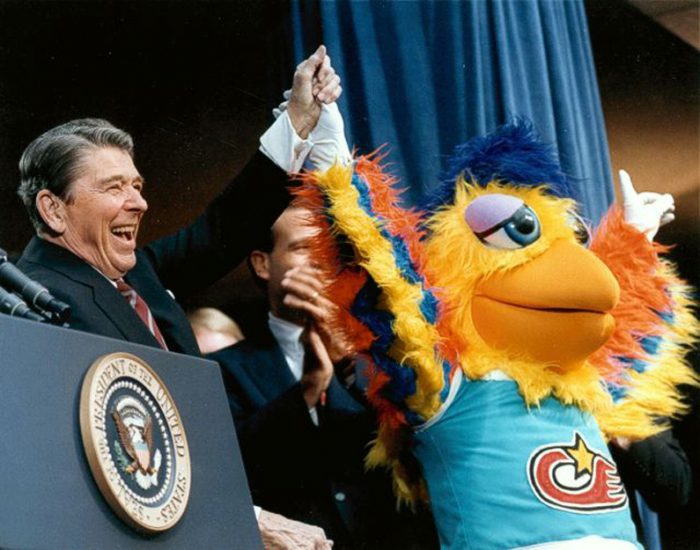
The Austin shooting would remain the deadliest in the nation’s history for 18 years. (In order to abide by a standard definition of “mass shooting,” the following addresses those events identified by the Los Angeles Times in a compilation of mass shootings in the U.S. since 1984.) In July 1984, during Ronald Reagan’s first term as president, a gunman killed 21 people at a McDonald’s in San Ysidro, California. Unlike Johnson, Reagan did not say anything publicly about the shooting. In fact, a search by the New York Times revealed that “[t]he Times did not report any comment from the administration of President Ronald Reagan. His public papers show no statements on the subject in the days following.” McDonald’s suspended its own commercials following the incident, and in this there appears to be some indication of Reagan’s approach to these kinds of matters. When the Tylenol poisonings took place in Chicago in 1982, Reagan had also stood back, letting Johnson & Johnson take the lead in the response. Reagan appears to have been of the view that local tragedies should be handled at the local level, deferring to private-sector entities, when appropriate, to handle problems.

Reagan also appears to have remained quiet after the other two mass shootings during his presidency, one in Oklahoma and one in California. The 1986 Edmond, Oklahoma, shooting appears to be the first one in which a disgruntled post-office employee was the killer, the start of an unfortunate trend of about half a dozen of these shootings that would inspire the phrase “going postal.” Similarly, Reagan’s successor and former vice president, George H. W. Bush, also generally avoided making statements about the four mass shootings during his administration. A January 1989 shooting at an elementary school in Stockton, California, which took place in the last days of Reagan’s tenure, did contribute to a decision early in the Bush administration to issue a ban on the importation of what the New York Times described as “semiautomatic assault rifles.”

Then Bill Clinton turned POTUS into the griever-in-chief:

On a clear spring day, two Colorado high-school students set out to methodically shoot classmates, murdering 13 and then killing themselves. This event was too big and too horrific for a radio address or a brief visit with some of the survivors in another city. Instead, Clinton went to Colorado the next month, just before the Columbine commencement. While there, he gave what appears to be the first major presidential address in reaction to a mass-shooting event. In front of 2,000 people, and joined by First Lady Hillary Clinton, the president told the moving story of a talented young African-American man from his hometown in Arkansas who had died too young. At the funeral, the young man’s father had said, “His mother and I do not understand this, but we believe in a God too kind ever to be cruel, too wise ever to do wrong, so we know we will come to understand it by and by.”

During the speech, Clinton made a number of noteworthy points. First, he recognized that these kinds of shootings were becoming a recurring phenomenon: “Your tragedy, though it is unique in its magnitude, is, as you know so well, not an isolated event.” He also noted that tragedy potentially brings opportunity, saying, “We know somehow that what happened to you has pierced the soul of America. And it gives you a chance to be heard in a way no one else can be heard.” At the same time, Clinton warned of the dangers of hatred: “These dark forces that take over people and make them murder are the extreme manifestation of fear and rage with which every human being has to do combat.” Finally, he expanded on his violence/values dichotomy, exhorting the crowd to “give us a culture of values instead of a culture of violence.” Clinton closed with the story of jailed South African dissident Nelson Mandela, who managed to overcome hatred and become the leader of his country.

All in all, it was a vintage Clinton performance — feeling the pain of the audience, highlighting the importance of values, and trying to bring the nation together in a shared enterprise.

What about Barack Obama and Donald Trump? So far, both have set records:

It is far too soon to know if the Trump administration will surpass the Obama administration’s tragic record of 24 mass shootings in two terms, but Trump’s presidency has already witnessed the worst mass shooting in American history. On October 1, 2017, a 64-year-old man — quite old compared to the profiles of other mass shooters — killed 58 people before killing himself at a country-music festival in Las Vegas.

For the record, the number of mass shootings under the previous presidents runs like this:

Johnson 1
Reagan 3
Bush (I) 4
Clinton 8
Bush (II) 8
Obama 24

That looks like a trend but seemingly 2017 changed everything.

Maybe Not Your Favorite Ice Cream, but Your Favorite Chicken Sandwich

Casey Chalk, formerly of Bryan and the Jasons, but now a frequent contributor at The American Conservative, just gave the green light to Protestants regarding themselves as Christians:

God bless Chick-fil-A. Despite all the negative press over its unabashedly religious conservative identity, the fast food franchise in June climbed from the seventh-largest restaurant chain in the United States to the third. This meant blowing past Wendy’s, Burger King, Taco Bell, and Subway, and earning $10.46 billion in American store sales, up 17 percent for the year. That placed Chick-fil-A behind only McDonald’s ($38.52 billion in U.S. sales) and Starbucks ($20.49 billion). This is a most welcome development, given the growing tentacles of woke capitalism.

…It’s no secret that Chick-fil-A is influenced by conservative Christian beliefs. The company’s official statement of corporate purpose states that it exists “To glorify God by being a faithful steward of all that is entrusted to us. To have a positive influence on all who come in contact with Chick-fil-A.” Much to the chagrin of customers, the chain is also closed on Sundays, a decision made by devout Southern Baptist founder S. Truett Cathy. Corporate leadership was previously outspoken in its opposition to same-sex marriage, though, as its website declares, “the Chick-fil-A culture and service tradition in our Restaurants is to treat every person with honor, dignity and respect—regardless of their belief, race, creed, sexual orientation or gender.” The New Yorker last year ran a hit piece against the chain for standing by its conservative religious values.

Of course, Chick-fil-A also offers delicious fast food. The fried chicken, waffle fries, and unique sauces are all addictive.

That is a different tone than the one he took in his first post at Called to Communion:

I empathize with my many former Catholic brothers and sisters who found great spiritual benefit in evangelicalism since leaving the Catholic Church. However, evangelicalism presents a new series of intellectual and theological dilemmas that are not easily addressed, including the nature of the visible Church, and what reasons may justify severing oneself from the Church. I think Castaldo would agree that choosing a church is not like choosing one’s favorite ice cream – something formed simply by preference. If there is indeed a visible Church, and that Church is the Catholic Church, and if what that Church offers is Christ and what that Church teaches is scriptural, we must beware of abandoning it for any reason.

Chalk should be careful lest his endorsement of Chik-fil-A’s food and its founder’s faith encourage Protestants to think they can find Christ outside the Roman Catholic Church.

Machen Day (eve) 2019

Theological liberalism is one thing, political liberalism is entirely different.

“A school, institute, class or course licensed as provided In this section shall be subject to visitation by officers and employees of the university of the state of New York.” See Laws of the State of New York, 1921, Vol. III, Chapter 667, pp. 2049-2051. This law is so broadly worded that it could not possibly be enforced, even by the whole German army in its prewar efficiency or by all the espionage system of the Czar. The exact measure of enforcement is left to the discretion of officials, and the citizens are placed in constant danger of that intolerable interference with private life which real enforcement of the provision about “courses of instruction in any subjects whatever” would mean. One of the exemptions is in principle particularly bad. “Nor shall such license he required:’ the law provides. “by schools now or hereafter established and maintained by a religious denomination or sect well recognized as such at the time this section takes effect.” One can certainly rejoice that the existing churches are freed, for the time being, from the menace involved in the law. But in principle the limitation of the exemption to the existing churches really runs counter to the fundamental idea Of religious liberty; for it sets up a distinction between established religions and those that are not established. There was always tolerance for established religious bodies, even in the Roman Empire; but religious liberty consists in equal rights for religious bodies that are new. The other exemptions do not remove in the slightest the oppressive character of the law. Bad as the law must be in its immediate effects, it is far more alarming in what it reveals about the temper of the people. A people which tolerates such preposterous legislation upon the statute books is a people that has wandered far away from the principles of American liberty. True patriotism will not conceal the menace, but will rather seek to recall the citizens to those great principles for which our fathers, in America and In England, were willing to bleed and die. There are some encouraging indications that the Lusk Laws may soon be repealed. If they are repealed, they will still serve as A warning that only by constant watchfulness can liberty be preserved. (Christianity and Liberalism)

How to Bring Harmony between Woke Christians and Christian Nationalists

Find passages from Scripture that neither can preach while maintaining their social media postures.

Here are some examples:

13 Be subject for the Lord’s sake to every human institution, whether it be to the emperor as supreme, 14 or to governors as sent by him to punish those who do evil and to praise those who do good. 15 For this is the will of God, that by doing good you should put to silence the ignorance of foolish people. 16 Live as people who are free, not using your freedom as a cover-up for evil, but living as servants of God. 17 Honor everyone. Love the brotherhood. Fear God. Honor the emperor. (1 Pet 2)

Even if Peter were not aware of intersectionality, he seems to allow that businesses, schools, governments, attitudes, even economic status function as restraints on our freedom. Either way, we’re supposed to submit and not rebel. That might also apply to Parliament and the British monarchy way back in 1776.

Paul at times set the bar higher than Peter:

9 Let love be genuine. Abhor what is evil; hold fast to what is good. 10 Love one another with brotherly affection. Outdo one another in showing honor. 11 Do not be slothful in zeal, be fervent in spirit, serve the Lord. 12 Rejoice in hope, be patient in tribulation, be constant in prayer. 13 Contribute to the needs of the saints and seek to show hospitality.

14 Bless those who persecute you; bless and do not curse them. 15 Rejoice with those who rejoice, weep with those who weep. 16 Live in harmony with one another. Do not be haughty, but associate with the lowly. Never be wise in your own sight. 17 Repay no one evil for evil, but give thought to do what is honorable in the sight of all. 18 If possible, so far as it depends on you, live peaceably with all. 19 Beloved, never avenge yourselves, but leave it to the wrath of God, for it is written, “Vengeance is mine, I will repay, says the Lord.” 20 To the contrary, “if your enemy is hungry, feed him; if he is thirsty, give him something to drink; for by so doing you will heap burning coals on his head.” 21 Do not be overcome by evil, but overcome evil with good. (Romans 12)

One lesson from that challenge is don’t kvetch! Don’t complain about taxes or the king. And don’t anathematize groups of people that you think have privilege or are bigoted.

In fact, how could you ever square such passages with a declaration of war against an existing government or with Twitter outrage that castigates entire classes of people based on the news cycle? In other words, how do American believers become so comfortable with an American exceptionalism that either idolizes or vilifies the United States and its government?

Selah

A Bug or Defect?

More questions about purgatory that don’t seem to find ready answers by searching online. Could it be that if half of U.S. Roman Catholics don’t understand the Mass, numbers may be even worse for passing a test on purgatory?

Here’s the question: does Christ’s return affect souls in purgatory? If I am in need of 1,500 years of purgation for — well, let’s not get into it — and if Jesus returns in 988th year of my time in purgatory, do I need to stay in purgatory another 512 years? It seems like a good question if you look at this answer:

The Church believes that almost everyone else, although not bad enough to go to hell, aren’t good enough to skate into heaven with no need for some introspection and purification.

Think of it like this: Joe and Max were both born on the same day and both died on the same day. Joe was a gambler, boozer, and womanizer, and he was dishonest, lazy, and undependable. Max, on the other hand, spent his life obeying the Ten Commandments, practicing virtue, and loving God and neighbor. Just before dying, Joe repents of his old ways and accepts the Lord into his heart. Should Joe and Max both go to heaven at the same time? Catholicism teaches no. The Church believes that Jesus’ death allows everyone the possibility of heaven, and his mercy grants forgiveness, but his justice demands that good be rewarded and evil punished — in this life or the next. If one man struggles all his life to be good while another lives a life of selfishness, greed, and comfort, both can’t walk through the pearly gates side by side.

Wait. Isn’t there a parable about this?

“For the kingdom of heaven is like a master of a house who went out early in the morning to hire laborers for his vineyard. 2 After agreeing with the laborers for a denarius[a] a day, he sent them into his vineyard. 3 And going out about the third hour he saw others standing idle in the marketplace, 4 and to them he said, ‘You go into the vineyard too, and whatever is right I will give you.’ 5 So they went. Going out again about the sixth hour and the ninth hour, he did the same. 6 And about the eleventh hour he went out and found others standing. And he said to them, ‘Why do you stand here idle all day?’ 7 They said to him, ‘Because no one has hired us.’ He said to them, ‘You go into the vineyard too.’ 8 And when evening came, the owner of the vineyard said to his foreman, ‘Call the laborers and pay them their wages, beginning with the last, up to the first.’ 9 And when those hired about the eleventh hour came, each of them received a denarius. 10 Now when those hired first came, they thought they would receive more, but each of them also received a denarius. 11 And on receiving it they grumbled at the master of the house, 12 saying, ‘These last worked only one hour, and you have made them equal to us who have borne the burden of the day and the scorching heat.’ 13 But he replied to one of them, ‘Friend, I am doing you no wrong. Did you not agree with me for a denarius? 14 Take what belongs to you and go. I choose to give to this last worker as I give to you. 15 Am I not allowed to do what I choose with what belongs to me? Or do you begrudge my generosity?’[b] 16 So the last will be first, and the first last.” (Matt 20)

What about a different parable, like one about surgery?

It may help to think of the purgatory in terms of a major operation to save a life. Say a doctor performs surgery on someone’s heart or brain and removes a cancerous tumor. The surgery achieves the main objective, but the wound needs to heal, and the incision needs to be cleaned and rebandaged. Purgatory is like that secondary part of recovery — the healing, cleaning, and bandaging. The belief is that the evil of sin is revealed to the person so she can totally and absolutely reject even the most venial and smallest of sins.

Well, what happens to someone who is recovering from surgery when Jesus returns? Will there still be weeping, hunger, sorrow, and forming scar tissue after Christ inaugurates the new heaven and new earth?

Looks to me like this is a defect. And this answer only compounds the problem:

All souls will receive resurrected bodies. The damned will receive eternal punishment in the flesh. Purgatory is meant to purify the soul. Once we receive our resurrected bodies, they will need completely purified souls so Purgatory ends with the Resurrection of the body.

If resurrected bodies need “completely purified souls, all the more reason to remain in purgatory for the correct amount of time.

Unless, of course, Jesus can take away sin and all its stains.

Who Is Dr. Thomas P. Roche?

So far all I know is that he taught classics (apparently) at SUNY Buffalo, was in theonomic circles for a while, and wrote one of the more amazing critiques. This is an excerpt from his piece, “Meet the Theonomists” (which is a good read):

SPACESHIP MOSCOW
Twelve years ago, the Rev. Douglas Wilson was quite literally a nobody from nowhere, the pastor of the then Community Evangelical Fellowship in undistinguished Moscow, Idaho, home of his alma mater, University of Idaho. Wilson, the son of the Rev. James Wilson, the local Evangelical Free Church pastor, was, in his father’s mode, an Arminian evangelical. His church was a 1970s-style college fellowship, the pastorate of which he had inherited in the late 1970s, when the previous pastor moved on and Wilson, the guitar leader, was elected his replacement by acclamation, without seminary training, but with a MA degree in Philosophy. Wilson proved a competent replacement, and in 1981 his church started Logos School, the progenitor Christian school in their “Classical Christian School” movement, dedicated to “recovering the lost tools of learning” along the lines of the medieval trivium, following the lead of a famous essay by this name written in the 1930s by the late British mystery novelist Dorothy Sayers, which Wilson himself (who also holds a degree in Classics) later expanded into a book. The school emphasized logic, Latin, etc., as well as theology, and fit well into the university atmosphere of the Moscow, Idaho/Pullman, Wash. (University of Idaho/WSU) environs. Neither the school nor Wilson as theologian gained much influence outside of this area, however, throughout the 80s. Then, in the late 80s, Wilson chose to preach a sermon series on Romans, and through his studies therein, was converted to Reformed soteriology. This event might well have had little effect beyond his local preaching but for reasons I do not understand, Wilson chose to expand his efforts, and quickly began to seek to expand his teachings and influence outside of his local area. I do know that Wilson, presumably in a worthy effort to learn more about the Reformed faith he had recently embraced, began various correspondences with Reformed thinkers elsewhere (James Jordan was briefly one of these), and soon Wilson was joined at his church by Douglas Jones, OPC elder (?) who had been associated with Greg Bahnsen and his ministry in Southern California. Jones became and in my opinion remains the intellectual engine behind the Moscow church; through his influence Wilson would eventually embrace covenant paedobaptism and even become a popularising author advocating the “Thousand Generation Covenant” paedobaptist promise.

Why Not Princess Di, Designated Hitters, Martinis, and Malaysia Flight 370?

Why not a book or set of essays on these topics? Why do Christians instead feel compelled to write books like these?

How should Christians approach important contemporary issues like war, race, creation care, gender, and politics?

Christians in every culture are confronted with social trends and moral questions that can be difficult to navigate. But, the Bible often doesn’t speak directly to such issues. Even when it does, it can be confusing to know how best to apply the biblical teaching.

In Cultural Engagement: A Crash Course in Contemporary Issues authors Joshua D. Chatraw and Karen Swallow Prior first offer a broadly accessible framework for cultural engagement and then explore specific hot topics in current Western culture including:

Sexuality
Gender Roles
Human Life and Reproduction Technology
Immigration and Race
Creation and Creature Care
Politics
Work
Arts
War, Weapons, and Capital Punishment
Featuring contributions from over forty top thinkers, proponents of various views on the specific topics present their approaches in their own words, providing readers an opportunity to fairly consider options.

Unique in how it addresses both big-picture questions about cultural engagement and pressing current issues, Cultural Engagement provides a thorough and broad introduction useful for students, professors, pastors, college ministers, and any believer wanting to more effectively exercise their faith in the public square.

Or this?

In his What Are Biblical Values? Collins aims to lay out, as dispassionately as possible, what the Bible actually says on a range of issues in contemporary debate—abortion, homosexuality, marriage and family, the environment, slavery, violence, and social justice.

Collins doesn’t think the Bible gives clear answers to most of these questions. The Bible is internally contradictory, a “running argument” with “conflicting values.” It doesn’t matter anyway: “Biblical values are not normative or acceptable for modern society simply because they are found in the Bible.” They have to be sifted and critiqued, both by comparison of Scripture with Scripture and by “dialogue with modern values,” which represent “clear advances in moral sensitivity.” The Bible contributes to the church’s deliberations, but “its contribution is not necessarily decisive.”

Some might contend that topics like the best aioli sauce, the merits of the Coens’ Burn After Reading, the right density for residential properties in an urban neighborhood, or the merits of circles rather than four-way stops at intersections don’t rise to the level of significance as climate change or race relations.

But that suggests the headlines are driving Christian cultural “engagement” more than than simply attending to the variety, wonder, mystery, and reality of creation (including the activities of humans). Why is someone less culturally “engaged” when keeping score of the Phillies-Dodgers game than someone else who is watching the Democratic Party’s presidential debates? If all of creation is the theater of God’s providence, why not an egalitarianism of human interests and endeavors?

In which case, Rachel Rae’s cookbook on comfort food is just as good as (if not better than) Redeemer Presbyterian Church NYC’s cookbook. Christians have no corner on cultural engagement. And if the Bible has little to say about even the matters covered in the books above, what’s the point of calling this Christian or engagement?

When Journalists (or op-ed writers) Get Biblical

Speaking of credentials for ministry, I am not sure it’s a positive development when any Tom, Maleek, or Kasheena can give speeches or write columns with the idea that they know what the Bible teaches. Bonnie Kristian (seriously) decided to challenge Mike Pompeo for a speech in which he referred to Iran’s hostility to Israel as a carry over from the way Persians regarded the Israelites in the book of Esther. In this contest, Kristian has some expertise on foreign policy and has written a book on “flexible” Christianity with a foreword by Gregory Boyd and endorsed by Jonathan Merritt (excuse the genetic fallacy). Meanwhile, Pompeo is a member of an Evangelical Presbyterian Church. He also operates under the hardship of being a member of the Trump administration.

Here is the point of contention: Pompeo doesn’t understand Esther.

The linchpin of Pompeo’s CUFI treatment of Iran was the scriptural book of Esther, which in his telling is evidence that Iran has for centuries been a hotbed of anti-Semitism. “That same twisted, intolerant doctrine that fuels persecution inside Iran has also led the ayatollah and his cronies to cry out, quote, ‘death to Israel’ for four decades now,” Pompeo said. “This is similar to a cry that came out of Iran — then called Persia — many, many years ago. The Book of Esther teaches us about this.”

No, it doesn’t. As Duke Divinity professor Lauren Winner has explained, Esther is rich in themes worth exploring: “There are a lot of lessons about how power works in this story,” challenging us to examine “our own displays of power in our own smaller empires, even if the empire is no bigger than … than our own heart.” And “Esther is also a story about exile,” Winner adds, “about being an exiled Jew, an exiled person of faith, and what it means to live in a place that is foreign, to live in a place where you are foreign, where you and your kinsman are aliens. Esther is a book about how to live with your community in a place that is indifferent to you or hostile to you.”

Kristian goes on to state that Esther is also a story about courage and she supplies a link to a piece by Rachel Held Evans.

Bottom line: Pompeo’s use of Esther is “inexcusably misleading.”

The editors at The Week actually know enough about the Bible to conclude that Kristian is on firm ground? Kristian herself appeals to a Duke Divinity School professor, with a terminal degree in religious history but who is also an Episcopal priest, and a parachurch blogger to be able to say with such certainty that Pompeo is wrong? Couldn’t a better point have been that the Secretary of State should simply use assessments of the middle East from the contemporary world rather than trotting out a part of Scripture that is likely to provoke Christians, Jews, and Muslims?

But if Kristian is going to enter the fray of the authoritative interpretation of Esther, at least let Christopher Guest have a stab:

William of Ockham is the Least of Rome’s Apologists’ Worries

Historians and apologists for Rome heap a lot of blame on William of Ockham for philosophical and theological ideas that unleashed Protestantism and produced the West’s decadence and Walmart. Why Christendom itself doesn’t receive the blame for Ockham is one of those chicken-and-egg questions, I guess.

Now it turns out that Ockham was not the only one who challenged Aquinas, the theologian Jesus founded. Duns Scotus has his own explaining to do.

It turns out he may explain the Mass better than Aquinas because transubstantiation makes Christ’s presence dependent on the location of the bread (sort of like “bread presence” rather than “real presence”):

It concerns the claim of St. Thomas Aquinas that Christ’s body is present on the altar because something that was there before, the substance of bread, has been converted into that body. The “accidents” of the bread—for example, its whiteness and roundness—remain, but these do not belong to the body of Christ; otherwise that body would have to be white and round, which it is not. So far, so good.

Among the other accidents of the bread, however, is its location, there on the altar. For what a thing is, its substance, is no more the same as where it is than it is the same as how it looks (round and white). But in that case, how can we say that Christ’s body is there on the altar—since, ex hypothesi, it cannot get its “where” from the “where” of the consecrated bread? The doctrine of transubstantiation, as explained by Aquinas, thus fails to secure the real presence of Christ’s body on the altar. “I do not know of any satisfactory answer to this problem,” Kenny continued. “If I did, I would give it. Since I do not, I must leave it, as the writers of textbooks say, as an exercise for the reader” (A Path from Rome, 1986, 167–168).

These questions may seem abstruse, perhaps even improper, since the sacrament is rather to be adored than quibbled over. But the question of Christ’s presence now on the altar is a genuine one, and central to the consecration and adoration of the Eucharist. It is a question that many others besides Thomas Aquinas sought to answer, and a seriously inquiring intellect might rightly be disturbed, even scandalized, if forbidden to ask it. But for a long time Thomas’s answer was accepted just because it was his. This was an unnecessary constriction of Catholic thought. Unfortunately, some Catholic intellectuals seem still to be constricting themselves in this way. One might call their position “exclusivist Thomism.”

According to Scotus:

The subtle Scot distinguishes between presence and transubstantiation, claiming that one can exist without the other (Ordinatio IV d.10 q.1). Christ could be there on the altar now without transubstantiation, and the bread could be transubstantiated without Christ being there on the altar. Christ’s presence on the altar is not a matter of his appropriating the “where” of the transubstantiated bread, or of his retaining this particular accident and not others.

It turns out that Scotus also differed with Aquinas on the immaculate conception in ways that may make Roman Catholics and their nostalgia for Christendom perk up:

The most famous difference between Scotus and Thomas is the doctrine of the Immaculate Conception, which Scotus got right and Thomas got wrong. But surely, one might say, we no longer need Scotus to tell us about the Immaculate Conception. Didn’t Blessed Pius IX tell us all we need to know in his dogmatic pronouncement? Perhaps. Note, though, that Thomas was not alone in failing to defend the Immaculate Conception. Every Scholastic theologian before Scotus, including fellow Franciscans like St. Bonaventure, failed in the same way. None was able to give a defense of it that would avoid creating a serious theological problem somewhere else.

Consider in this regard one of the arguments that Thomas himself gives against the Immaculate Conception (Summa Theologica III q27 a2). If the Virgin Mary had in no way incurred the stain of sin, she would not have needed Christ as her savior and so Christ would not be the savior of all men and women. Scotus’s answer is that Christ is indeed Mary’s savior, for he saved her in advance of her incurring the original sin that, as a natural descendant of Adam, she would have incurred otherwise (Ordinatio III d.3 q.1). Christ is thus her savior, as he is the savior of everyone else. Moreover, he is her savior in the most excellent way possible, for he saved her from ever having had sin, including original sin, while everyone else is saved only after incurring at least original sin.

And then there’s Scotus’ view of pets which has some appeal in this corner of Christ’s spiritual kingdom:

Can animals go to heaven or be resurrected? Pope Francis was recently reported to have said that they can—but inaccurately, as it turns out. Still, the pope said enough in his encyclical Laudato si’ to suggest the thought that it’s at least possible. Section 243 of the encyclical reads: “At the end, we will find ourselves face to face with the infinite beauty of God, and be able to read with admiration and happiness the mystery of the universe, which with us will share in unending plenitude…. Eternal life will be a shared experience of awe, in which each creature, resplendently transfigured, will take its rightful place and have something to give those poor men and women who will have been liberated once and for all” (emphasis added).

Does this remark mean that animals can or will be in heaven, not indeed as sharing the beatific vision, but as sharing resurrected life with beatified human beings? Thomists will say no because the sense-souls of animals, unlike the rational souls of humans, perish at death, and what has altogether perished cannot be brought back numerically the same. Scotus thinks this view false and argues, in his usual subtle and involved way, that the numerically same thing could in principle be recreated after having ceased to exist. He appeals in defense not only to divine omnipotence but to reported miracles of saints actually bringing animals back to life (Ordinatio IV d.44 q.1 n.19). Let those, then, who want to think of their pets being with them in heaven be consoled with Scotus, and perhaps with Pope Francis, for assuredly they cannot be consoled with Thomas. But then, if Thomas is not the unique measure of orthodoxy, there can be no harm or fear in leaving him for Scotus and Pope Francis—and one’s favorite pet.

I have no dog in this fight other than reminding western Christians that the medieval church, let alone the ancient one, was hardly as unified and regulated as contemporary Roman Catholics make it seem. By the nineteenth century, Rome may have achieved the sort of market share in Roman Catholic dioceses that on the eve of Vatican II AT&T had in the phone business. But that consolidation and coherence took awhile and came with a price.