
How would Tyler and Jemar sound
if they listened to Glenn and John?
I’m all for conversation.


Just when you thought you heard enough from mmmmeeeeEEEEE, along comes another interview. Adam Holland of The Daily Brew was kind enough to invite me to chat about The Lost Soul of American Protestantism under the heading of pietism and revivalism. I think I showed restraint.
The main reason for engaging in such self-promotion is that I did tell Adam I would mention the podcast here at Old Life. Not to worry, I won’t be heading down the trail of weekly lists of the ten most popular posts.
Enough.

Certainly not to the OPC.
The PCUSA last year lost the equivalent of three OPC’s:
Updated statistics made available today by the Presbyterian Church (U.S.A.) Office of the General Assembly (OGA) show a denomination continuing a steep, uninterrupted decline in 2016. The U.S.-based denomination shed 89,893 members in 2016, a decline of 5.7% percent, dropping below 1.5 million members for the first time. A net 191 congregations closed or were dismissed to other denominations, bringing the denominational total to 9,451 congregations.
I’ll do the math. The OPC has roughly 30,000 members (I hear chortles), the PCUSA lost almost 90,000 members. Ergo, the PCUSA lost three OPC’s last year. The thing is, these mainliners didn’t show up in OPC congregations. The OPC lost roughly 250 members last year.
This brings back memories of Orthodox Presbyterian hopes from 1936 to 1967 that members of the PCUSA would awaken (#woke?) to the ways in which liberalism had infected their denomination and lead them to join with the OPC. Here’s an excerpt from Between the Times (for UPCUSA think PCUSA):
In a remarkable display of responding to the moment, the Assembly appointed the Committee on the Confession of 1967 to address the recommendation from its two standing committees. Typically, study committees appointed by the Assembly have a year or several to reflect on the matter and report back to the body. But the Committee on the Confession of 1967 had the task of responding by the end of the Assembly. This explains another unprecedented development – the Moderator’s decision to appoint this committee rather than receiving nominations and casting ballots. In this case, Robert W. Eckardt, the moderator, appointed John Galbraith, Calvin Cummings and Edward Eyres to consider the recommendation from Home Missions and Christian Education. The Committee on the Confession of 1967 ended up following closely the original recommendation from the standing committees. It encouraged the Assembly to reach out to conservatives in the UPCUSA, to remind them of a common heritage, and to recommend the OPC as a “logical choice” for those concerned to maintain historic Presbyterianism. The Committee also followed the basic elements of the program suggested by the standing committees for outreach. To show that the OPC was serious about these measures, the Committee also recommended a resolution, again that followed the standing committees, designed to clarify exactly the kind of church the denomination was: “the Orthodox Presbyterian Church is completely committed to the Bible as the written Word of God, the only infallible rule of faith and practice, and to the Westminster Confession of Faith and Catechisms as faithfully and fully setting forth the teachings of Holy Scripture.” In addition, the Committee recommended that the OPC resolve that it “express its desire to serve those in the United Presbyterian Church in the U.S.A. who wish to continue adherence to the historic Christian faith as summarized in the Westminster Standards.” After some minor editing of the resolution’s language, including changing it to read that the OPC was committed to the Westminster Standards as “faithfully setting forth” (instead of “faithfully and fully”) the teaching of Scripture, the Assembly approved.
One of several curiosities of devoting so much OPC energy to another denomination, and especially a mainline one at that, was that after the first decade or so many Orthodox Presbyterian leaders resigned themselves to the determination of conservatives in the mainline not to leave but to stay. The Presbyterian Guardian had run a number of articles giving reasons for conservatives to exit and affiliate with the OPC. Once that did not happen by 1947, many in the OPC readjusted and conceived of the denomination as a small continuing remnant of conservative Presbyterians. Now, with substantial evidence of liberalism in the UPCUSA, the old hopes for a mass exodus of conservatives into the OPC found life.
The one factor that explains the OPC’s hopefulness was a letter from Edward Kellogg, then a minister at San Diego OPC in Paradise Hills. Only a week before the Assembly – written on the national holiday of July 4th – Kellogg alerted commissioners to rustling among United Presbyterians in California. Bruce Coie, Robert Graham, and he had met a number of conservatives in the UPCUSA who were alarmed over the influence of modernism in their church. These interactions led to a rally held at the Grant Hotel in downtown San Diego where close to three hundred packed a room designed to accommodate 250. Kellogg conceded that the normal channel for his letter was through presbytery but, he explained, “the events that caused me to feel that assembly action was important were too recent for the normal course of procedure.” What Kellogg proposed was the formation of a Presbyterian Covenant akin to the Presbyterian Constitutional Covenant Union that had been the organizational chrysalis for the OPC. The new covenant would enlist Presbyterians from all denominations to stand for the true faith and to oppose the Confession of 1967. It would also involve a pledge from United Presbyterians who entered it to leave the UPCUSA if the denomination adopted the new confessional standard. Kellogg’s letter was not the only impetus for the resolution adopted by the 1965 General Assembly; the standing committee recommendations actually contained more of the substance of the OPC’s response to the Confession of 1967 than did Kellogg’s letter. But the encounter between Orthodox and United Presbyterians in Southern California led some to believe that an outreach to conservative mainline Presbyterians might lead to the kind or realignment for which some had hoped in the 1930s. (93-94)
Of course, a defection to the OPC didn’t happen then and it still isn’t happening. Why?
The OPC has many afflictions, but its bark is much worse than its bite. Most congregations have a degree of autonomy that outsiders likely find perplexing. Ordination exams are rigorous and each presbytery has its own short list of non-negotiables, but the OPC doesn’t require exclusive psalmody, affirming the National Covenant, or sending children to Christian day schools. In fact, what characterizes the OPC, aside from fairly strong adherence to the Confession of Faith and Catechisms, is a commitment to Scripture and a high view of preaching. If you are a Reformed Protestant and want to sit under the ministry of the word, you can reasonably rely on finding that in the OPC.
But if you want a certain “style” of ministry, or if you want to send specific signals about the kind of Calvinist you are, chances are the OPC will not scratch your itch.
So that raises a question, if matters proceed in the PCA such that conservatives there want to find another ecclesial home, where will they go? I have heard some say that the Associate Reformed Presbyterian Church is one option. Being southern apparently matters. On the other side of the coin, if the PCA doesn’t become as progressive as some want it to be, where will the relevant wing of the denomination go? The likely destination is the Evangelical Presbyterian Church.
But don’t forget what happened to The Village Church. If urban sort-of Presbyterianism is your preference, you could wind up in the Reformed Church in America. At that point, the difference between you and the PCUSA would vanish.
If we had a state church, we wouldn’t have this problem opportunity.

How do you package assembling in the presence of a holy and righteous God? For Roman Catholics, the way to retain the seriousness of worship requires spaces that elevate the senses to an awareness of divine presence (somehow a cathedral with beautiful stained glass and the stations of the cross is still here on planet earth):
Mass started looking less like the worship of God and more like a pep rally. Our churches stopped looking Catholic and were overrun by iconoclasts. We went from churches that exuded Catholic belief visually, to ubiquitous ‘sacred spaces’ that looked more like theaters.
Some places ran with the theater aspect. Worship transformed to entertainment. What I got out of it became much more important than what I put into it.
By ripping out the transcendent heart out of worship, we reduced Mass. It is little wonder that belief in the Real Presence of Christ in the Eucharist plummeted. It is little wonder that priestly vocations plummeted. While the generation that ushered these things love them, the subsequent generations fled in droves.
With worship emptied of the transcendent, Catholic life soon followed. Devotional life in parishes dried up. Parish churches became Mass stations. It has been heartening to see a rise in Eucharistic Adoration.
Regulative principle type Protestants might be tempted to make a similar complain about the megachurch and the praise band. It all seems to reinforce the genius of revivalists like Billy Sunday, which according to H. L. Mencken, was to take the mystifying and make it ordinary:
His impressiveness, to the vegetal mind, lies in two things, the first being the sheer clatter and ferocity of his style and the second being his utter lack of those transparent pretensions to intellectual superiority and other worldliness which mark the average evangelical divine. In other words, he does not preach down at his flock from the heights of an assumed moral superiority — i.e. inexperience of the common sorrows and temptations of the world — but discharges his message as man to man, reaching easily for buttonholes, jogging in the ribs, slapping on the back. The difference here noted is abysmal. Whatever the average man’s respect for the cloth, he cannot rid himself of the feeling that the holy man in the pulpit is, in many important respects, a man unlike himself . . . .; his aura is a sort of psychic monastery; his advice is not that of a practical man, with the scars of combat on him, but that of a dreamer wrapped in aseptic cotton.
Even setting aside [Sunday’s] painstaking avoidance of anything suggesting clerical garb and his indulgence in obviously unclerical gyration on his sacred stump, he comes down so palpably to the level of his audience, both in the matter and the manner of his discourse, that he quickly disarms the old suspicion of the holy clerk and gets the discussion going on the familiar and easy terms of a debate in a barroom. The raciness of his slang is not the whole story by any means; his attitude of mind lies behind it, and is more important. . . . It is marked, above all, by a contemptuous disregard of the theoretical and mystifying; an angry casting aside of what may be called the ecclesiastical mask, an eagerness to reduce all the abstrusities of Christian theology to a few and simple and (to the ingenuous) self-evident propositions, a violent determination to make of religion a practical, an imminent, an everyday concern.
Sunday’s revivals may not have inspired reverence, but what if worship is transcendent without the bells and whistles of images, statues, and transubstantiation. What if simply reading the Bible is spooky? It is God’s word after all, and if God spoke to any of us in a burning bush I’m betting we might not sleep for a couple nights.
Isn’t reverence the key to setting worship apart from ordinary experience? A while back Steve Tipton refuted the idea that the problem of diversity in Presbyterian worship services was a failure to follow the regulative principle and concoct an order of service that everyone follows. He was against “liturgical sameness” and had a point. But why can’t we have “atmospheric” or “feng shui” sameness? Why, in other words, can’t a service be reverent no matter what the order of service? Incense could promote reverence until the snowflakes start complaining about second-hand smoke. Singing psalms only could also accomplish a unique experience, at least to push back against the Gettys. But what about praise bands or jazz quartets? Do they cultivate reverence? How about lots of Scripture? The Old Testament narratives sure are mystifying.
One of the most important features of Reformed Protestantism was its capacity to adapt to different settings. No single book of prayer or liturgy or edition of Scripture became required for membership in the club. But in all settings worship was reverent. People gathered with a fear of offending God. As the author to the Hebrews wrote, Christians do not come to Sinai but to Zion. But even there God is a “consuming fire.” (There’s that burning bush again.)
Maybe the way to recapture transcendence and reverence is to begin with a reading of the law and a reminder that we should not attempt to make God conform to our image of him. You can do that even in a storefront church.
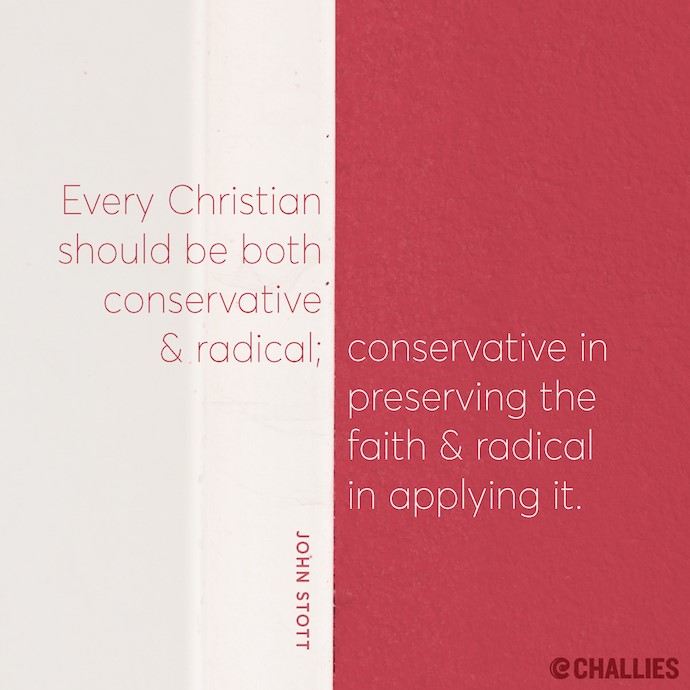
After reading H. L. Mencken and seeing the John Stott quote that Tim Challies turned into an infographic (yowza!), put me on the side of honor. I’ve seen too many obedience boys and girls who show not the slightest interest in being human when sanctity is the ultimate aim. But plenty of parents know they can’t apply high standards of conduct all the time. Sometimes you let the down the guard so you can win another day. Life is not a court of law. It’s a pilgrimage and honor aids dignity and relationships that may down the road help holiness prevail.
That’s why Mencken yet again shows uncanny insight:
In the face of so exalted a moral passion it would be absurd to look for that urbane habit which seeks the well—being of one’s self and the other fellow, not in exact obedience to harsh statutes, but in ease, dignity and the more delicate sort of self—respect. That is to say, it would be absurd to ask a thoroughly moral man to be also a man of honour. The two, in fact, are eternal enemies; their endless struggle achieves that happy mean of philosophies which we call civilization. The man of morals keeps order in the world, regimenting its lawless hordes and organizing its governments; the man of honour mellows and embellishes what is thus achieved, giving to duty the aspect of a privilege and making human intercourse a thing of fine faiths and understandings. We trust the former to do what is righteous; we trust the latter to do what is seemly. It is seldom that a man can do both. The man of honour inevitably exalts the punctilio above the law of God; one may trust him, if he has eaten one’s salt, to respect one’s daughter as he would his own, but if he happens to be under no such special obligation it may be hazardous to trust him with even one’s charwoman or one’s mother—in—law. And the man of morals, confronted by a moral situation, is usually wholly without honour. Put him on the stand to testify against a woman, and he will tell all he knows about her, even including what he has learned in the purple privacy of her boudoir. More, he will not tell it reluctantly, shame—facedly, apologetically, but proudly and willingly, in response to his high sense of moral duty. It is simply impossible for such a man to lie like a gentleman. He lies, of course, like all of us, and perhaps more often than most of us on the other side, but he does it, not to protect sinners from the moral law, but to make their punishment under the moral law more certain, swift, facile and spectacular.
By the way, honor is even key to the way Christians should regard the civil magistrate. Paul recommends honor in Romans 13, and Calvin agrees. But if you really want morality, say hello to the religious right and the permissive left.

Do you remember a fragrance girls acquire in autumn? As you walk beside them after school, they tighten their arms about their books and bend their heads forward to give a more flattering attention to your words, and in the little intimate area thus formed, carved into the clear air by an implicit crescent, there is a complex fragrance woven of tobacco, powder, lipstick, rinsed hair, and that perhaps imaginary and certainly elusive scent that wool, whether in the lapels of a jacket or the nap of a sweater, seems to yield when the cloudless fall sky, like the blue bell of a vacuum, lifts toward itself the glad exhalations of all things. This fragrance, so faint and flirtatious on those afternoon walks through the dry leaves, would be banked a thousandfold on the dark slope of the stadium when, Friday nights, we played football in the city. (John Updike, “In Football Season” from Olinger Stories)


Inspired by a post that questions Reinhold Niebuhr’s contributions to foreign policy and national politics, here goes a few morsels I ran across while teaching Christianity and politics last fall.
As much as conservatives and (some) evangelicals perceived the former president as a captive to secularism and relativism, President Obama’s use of civil religion was down right gobsmacking, so much so you wonder what the secular left was thinking when he said this:
For me, the celebration of Easter puts our earthly concerns into perspective. With humility and with awe, we give thanks to the extraordinary sacrifice of Jesus Christ, our Savior. We reflect on the brutal pain that He suffered, the scorn that He absorbed, the sins that He bore, this extraordinary gift of salvation that He gave to us. And we try, as best we can, to comprehend the darkness that He endured so that we might receive God’s light.
And yet, even as we grapple with the sheer enormity of Jesus’s sacrifice, on Easter we can’t lose sight of the fact that the story didn’t end on Friday. The story keeps on going. On Sunday comes the glorious Resurrection of our Savior.
“Good Friday may occupy the throne for a day,” Dr. King once preached, “but ultimately it must give way to the triumphant beat of the drums of Easter.” Drums that beat the rhythm of renewal and redemption, goodness and grace, hope and love. Easter is our affirmation that there are better days ahead — and also a reminder that it is on us, the living, to make them so.
Or this:
Around the world, we have seen horrific acts of terrorism, most recently Brussels, as well as what happened in Pakistan — innocent families, mostly women and children, Christians and Muslims. And so our prayers are with the victims, their families, the survivors of these cowardly attacks.
And as Joe mentioned, these attacks can foment fear and division. They can tempt us to cast out the stranger, strike out against those who don’t look like us, or pray exactly as we do. And they can lead us to turn our backs on those who are most in need of help and refuge. That’s the intent of the terrorists, is to weaken our faith, to weaken our best impulses, our better angels.
And Pastor preached on this this weekend, and I know all of you did, too, as I suspect, or in your own quiet ways were reminded if Easter means anything, it’s that you don’t have to be afraid. We drown out darkness with light, and we heal hatred with love, and we hold on to hope. And we think about all that Jesus suffered and sacrificed on our behalf — scorned, abandoned shunned, nail-scarred hands bearing the injustice of his death and carrying the sins of the world.
And it’s difficult to fathom the full meaning of that act. Scripture tells us, “For God so loved the world that He gave His only Son, that whoever believes in Him should not perish but have eternal life.” Because of God’s love, we can proclaim “Christ is risen!” Because of God’s love, we have been given this gift of salvation. Because of Him, our hope is not misplaced, and we don’t have to be afraid.
And as Christians have said through the years, “We are Easter people, and Alleluia is our song!” We are Easter people, people of hope and not fear.
Now, this is not a static hope. This is a living and breathing hope. It’s not a gift we simply receive, but one we must give to others, a gift to carry forth. I was struck last week by an image of Pope Francis washing feet of refugees — different faiths, different countries. And what a powerful reminder of our obligations if, in fact, we’re not afraid, and if, in fact, we hope, and if, in fact, we believe. That is something that we have to give.
His Holiness said this Easter Sunday, God “enables us to see with His eyes of love and compassion those who hunger and thirst, strangers and prisoners, the marginalized and the outcast, the victims of oppression and violence.”
To do justice, to love kindness –- that’s what all of you collectively are involved in in your own ways each and every day. Feeding the hungry. Healing the sick. Teaching our children. Housing the homeless. Welcoming immigrants and refugees. And in that way, you are teaching all of us what it means when it comes to true discipleship. It’s not just words. It’s not just getting dressed and looking good on Sunday. But it’s service, particularly for the least of these.
And whether fighting the scourge of poverty or joining with us to work on criminal justice reform and giving people a second chance in life, you have been on the front lines of delivering God’s message of love and compassion and mercy for His children.
This is the theology of progressivism. Jesus died to better the world, to advance equality, reduce poverty, spread peace. Conservatives have their own civil religion. It is just as bad. Jesus didn’t die for a stronger military or free markets. If reading Reinhold Niebuhr doesn’t prevent you from this excess, then reading Reinhold Niebuhr is pointless.
So cut it out. Join the 2k movement and hope in a kingdom (not a republic or democracy) not of this world.

Turns out Reformed Protestant is better than Calvinist.
First, Clark:
The greatest problem of the acronym TULIP is that it “perpetuates a basic misunderstanding about the Reformed tradition: that predestination is the center of Reformed theology from which all else flows.” Here Todd is echoing the criticism by Richard Muller and others against the “Central Dogma” theory of the history of doctrine, i.e., that the Lutheran “Central Dogma” was justification and the Reformed “Central Dogma” was predestination and that two distinct, parallel systems were deduced from these dogmas. This historiography has been thoroughly debunked but it continues to undergird the way many evangelicals and mainliners (and too many sideliners!) think about Reformed theology, piety, and practice.
In contrast to the caricature created by the TULIP Billings makes an argument that will be familiar to readers of RRC, namely, that there is much more to being Reformed, that to be Reformed is to be committed to a sacramental theology, to a “catholic” vision that connects the Reformed tradition to the whole church, and he argues less persuasively that it entails a “kingdom vision.” He says a, “Reformed view of the church avoids seeing it as a colony separated from society, or as the particular aspect of society that relates to ‘being religious.’” The truth of this claim depends on what one means by “church.” If by it one means “the visible, institutional, organized church” then his language is somewhat problematic. If,however, by “church” he means, “professing” Christians, then most would probably agree with him. The question of a sacred/secular distinction has been much controverted in this space. Todd’s identification of a Reformed “kingdom vision” with the “cultural mandate” is open to discussion and even debate. After the fall are they identical? See Calvin, Institutes 2.2.13, 20 where he clearly made a distinction between the “secular” and the “sacred” and associated the latter with the kingdom of God while not disparaging the goodness of the former.
We should certainly agree with Todd when he says the “New Calvinists pick the TULIP from the Reformed field, overlooking the other flowers. There is much besides the TULIP in this spacious field that has grown from the seed of God’s word.”
Then, Jones:
Opposition to the term came from the Reformed as early as 1555 where Reformed ministers in Lausanne protested against the term “Calvinists.” The French Reformed theologian, Daniel Tossanus (1541–1602) also clearly rejects the term. Herman Selderhuis gives the following account, “In his writings Tossanus speaks continually about the ‘so–called Calvinists.’ Others call us Calvinists, but we are the catholic evangelical church, said Tossanus. Moreover, we were not baptized in the name of Luther, nor in the name of Calvin, but in the name of Christ.” 5 Again, the fear is clearly real, acute among Protestants, that God and Christ are jealous for their glory.
By the time of the Synod of Dort (1618), the Reformed were still sometimes referred to as “Calvinists.” At Dort, the preferred terms were, however, “Reformed” or “Contra–Remonstrants” – the latter a term coined in reference to the Remonstrant (Arminian) theologians who wrote up a Remonstrance that contained five theses that most likely came from Arminius’s Declaration of 1608. The five articles of the Remonstrants were debated at Dort, but these five articles may not do justice to the broader theological project of Arminius, even though he surely would not have disagreed with what was presented by his “followers.” As a point of fact, just as many “Calvinists” do not wish to be known by that name, so too many “Arminians” would prefer to be known as “Remonstrants.”
Oh, happy day, but I wonder if Jones knows he agrees with the disagreeables.
When I read Jake Meador’s index of political theologies, I was generally in agreement and thought he accurately describe 2k. I guess my biggest disagreement was over his definition of liberalism:
When I speak of liberalism, I am referring to something broader than just left-wing politics or even some brand of liberalism realized in a single discipline, such as theological liberalism.
At its heart, liberalism is concerned with how human beings know things. As a system, it is suspicious of knowledge not derived from empirical observation. Thus it is suspicious of the claims of religious faith as they inform social life. Religious practice is fine for individuals, but any attempt to enforce a set of religiously based moral norms beyond the religious individual or maybe a voluntary religious community is suspect because the knowledge is not sure enough to justify political application. Indeed, this skepticism goes beyond a skepticism toward religious faith and goes so far as a skepticism toward any kind of comprehensive moral system that claims to be true in anything beyond a particular, local sense. We simply do not trust our moral judgments enough to think they can be binding in anything beyond an individualistic, voluntaristic sense. When this epistemological agnosticism becomes pervasive in a social order, you basically have some species of liberalism.
In an odd way, these instincts can make liberalism like a more traditional Christian sort of social order. It tells us that men should be persuaded rather than coerced into belief. It tells us that there is, as one friend put it, a “just area of sovereignty,” that each person possesses. However, the way that liberalism arrives at these ideas is not necessarily through the belief in a God who rules over creation and endows his creatures with dignity, honor, and freedom. Rather, they arrive at it through a lack of confidence in the ability of anybody to wield coercive authority justly or to infringe upon a person’s autonomy.
I don’t understand why you conceive of a political order in epistemological or philosophical categories. For mmmmmeeeEEEE, liberalism was mainly a way to overcome divine right monarchy that extends from Hammurabi through to those audacious claims for the papacy by canon lawyers in the thirteenth century down to French and British kings (among others) who objected to checks upon their power. The question that liberalism (classical) tackled was not how we know but what authority is legitimate. I guess you could push that back to epistemology. But why unless you privilege philosophy?
Meador went on to describe 2k’s relationship to liberalism this way:
The best way to get at the key difference between this group and the Radical Anabaptists is to highlight the differences in how they see the church’s relationship to civil society. For these thinkers, there is no problem with Christians participating in civil society. Indeed, such participation is inevitable. That is why Dr. Moore heads up an organization dedicated to protecting religious liberty and why Dr. Leeman and a number of his colleagues with 9 Marks pastor in Washington D.C. and support church planting efforts in the capitol city.
However, the good that these thinkers hope to achieve in all societies outside of the institutional church is purely natural while the goods they hope to achieve within the church are supernatural. The institutional church is, in Leeman’s understanding, an embassy for the Kingdom of God. Thus the institutional church as such is an institution of a qualitatively different sort than any other physical, visible institutions in the world. Likewise, Drs. VanDrunen, Hart, Clark, and Trueman have all at various times gotten very nervous about what they see as an attempt to sacralize work that is rightly understood as secular.
Thus there are two core pieces that unite the Post-Liberal Retreatists:
First, they have what I take to be a realistic and appropriately sober assessment of our cultural state.
Second, they see the work to be done in non-ecclesial institutions as being primarily defensive not only in our current moment, but in principle.
The positive work of taking hold of supernatural goods happens primarily in the institutional church. Thus the Post-Liberal Retreatists are suspended, as it were, between the Post-Liberal Protestants and the Radical Anabaptists. They share a similar read of the current cultural moment with both groups. Like the Post-Liberal Protestants, they still have a place for Christian participation in civil society. Like the Radical Anabaptists, they see the work of the institutional church as being qualitatively different than the work Christians do outside the church and essentially constructive in a way that civil society participation cannot be. So they would say, with the Anabaptists, that the church is a polis, but that it is not a comprehensive polis in the way that the Anabaptists use the term.
That sounds fair enough. But it locates 2k too much within the categories of the pre-modern and modern West. In fact, much of the blow back that 2k receives comes from Protestants who have a soft spot for Christian establishment in the form of the confessional state, whether Geneva’s City Council, Scotland’s monarch, or the Netherlands’ republic. Most critics of 2k want a Christian society of some kind. 2k is suspect, then, because it won’t support such a desire or programs to achieve such a society.
But what if Christendom or post-Christendom are not the only options? What about pre-Christendom? Here the idea is not that the time before Constantine was ideal but that a religiously diverse or even a religiously hostile environment is normal. It’s what Jesus and the apostles faced. Those are the conditions under which the church emerged and the canon established. For that reason, modern Christians should not think that either Christendom or a Christian friendly liberal government (like the U.S. before 1965) are the default settings for the church. Christianity can persist in any number of circumstances. It can be like the Old Testament promised land, like the Israelites in exile, like the early church under the domination of Rome, or even like Scottish Presbyterians in covenant with a divine-right monarch. Christianity is flexible. It’s not tied to one political order.
This perspective seems to inform Proto-Protestant in his assessment of political liberalism. Notice that he starts by identifying the way that Rome used to regard liberalism and the United States:
Classical Liberalism so poignantly represented by the United States was viewed as poison and a triumph of the secular over the sacred. Rome sought to protect its flock from the influences of American ideology. Classical Liberalism was the spawn of the Reformation’s triumph of the individual. The lone man was allowed to challenge and cast down all authority. This is the sociological aspect to Luther that many Protestants have failed to grasp. The individual gets to decide what is right and wrong and the Reformation unleashed epistemological uncertainty and the social chaos which began the long process of dismantling Christendom.
The Reformation led to Modernism and as a consequence Post-Modernism and now Nihilism.
Undoubtedly there is some truth to this narrative and the post World War II period has brought about a time of intellectual reconsideration on the part of Evangelical Protestants and not a few defections to both Rome and Constantinople. The political Papacy utterly defeated by the late 19th century reformed its teaching and came up with a new paradigm for the industrial secular age. Consequently it allied first with Fascism then with the West (in general) at the conclusion of the war. It began to build a new empire, one wed to the Capitalist forces so dominant in the Protestant world and joined the fight (real or imagined) against world Communism. Today Rome no longer rules a geopolitical realm but instead reigns over a vast financial empire and has regained a little of its lost ground.
Evangelicals have been forced to reckon with the problems of Christianity wed to Classical Liberalism and as I’ve written elsewhere there are tendencies both toward revisionist history and increasingly in the direction of abandoning Liberalism for a more Roman Catholic-friendly Throne and Altar type paradigm.
So if Protestants don’t follow Roman Catholics, where do they turn? The Bible and in so doing they abandon the sufficiency of Scripture. Protestants have made Scripture do more than it was supposed to:
There is undoubtedly much that is valid in the critique of Classical Liberalism and in what the Reformation unwittingly unleashed. And for this reason the glorification of Protestantism which is at its zenith in this 500th anniversary year, ought to be weighed carefully if not rejected.
But the truth of the critique is limited to the sociological realm.
The true problem is not individualism (which can indeed work to destroy society) but the attempt to formulate Sola Scriptura into a comprehensive societal worldview. That was a rival philosophical project rooted in speculation and dependent on speculative philosophical coherence… thus it fragmented.
The Reformers only began to toy with this question. Luther, perhaps the more conservative of the Reformers was content to sustain the Medieval-Renaissance order and sit under the protection of a so-called Christian prince. Calvin’s Geneva moved in the direction of Authoritarian Republican government. Zwingli took up the sword (so to speak) and died by it on the battlefield.
It was in the 17th century that Protestant Scholasticism began to earnestly reckon with the implications of the Reformation applied to society. It was at this point that Sola Scriptura as a social organising principle failed. Rightly so I would add, as the New Testament nowhere even envisions a Christian State/Christendom project. In fact it repudiates the very notion of it.
In wedding Reformation theology to the Christendom project the Protestant Reformers and certainly the Scholastics after them undermined their own vision and sowed the seeds for epistemological collapse. They employed (and even exploited) the Scripture for something it was not meant to be used for. In the end their project exploded into the 17th century Wars of Religion and ultimately undermined not only their social vision… but their theological and ecclesiastical hopes as well….
But even granting the narrative that Liberalism and Modernism were the natural outgrowth of Protestant theology applied to society, then such a notion must be condemned as sub-Biblical. It does not represent New Testament doctrine either in its concepts of values. Confidence in reason? I think not. Rights? The individual? Progress? None of the concepts are found in the New Testament. Only deformed Judaizing hermeneutics can locate them through distorted readings of the Old Testament.
If liberalism is not the basis for evaluating politics or its reaction to Christendom, the proper starting point for political theology is as Paul Helm recently observed Christ’s teaching that his kingdom is not of this world. Proto-Protestant explains what that means for 2k (even if he does not self-identify as 2k):
Speaking generally if both paradigms were and are wrong, what then are we to make of the so-called and very misnamed Judeo-Christian West? Not much. As a society it has some very good things about it and many that are rightly condemned. Christian it is not. And the more it is associated with Christianity the more problematic it becomes.
As pilgrims we understand that this world is not our home. We look for a city to come, a new heavens and new earth. We can live and function as the salt and light Oracular Church in any culture and civilisation. That said, some will be more pleasant than others. But pleasant isn’t always better, especially if it leads to laxity, complacency and confusion. Though not pleasant the most spiritually vivacious times of my life have been during periods of hardship and opposition. It’s not pleasant to live that way but the antithesis becomes razor sharp which spiritually speaking is healthy. It’s a good place to be. If goods, lands, and prosperity are set aside and no longer important to me, then hardship becomes certainly less hard. The yoke of suffering, the burden of Christ to which we are called, becomes a little lighter.
And though on a practical level I lament the downfall and paganising trajectory of the West … spiritually speaking it’s probably the best thing that could happen. The widespread apostasy is like a forest-burn. In the end it will make for a healthier forest. The forest to which I refer is not society, but the Church. Don’t ever confuse the two.
While on the one hand I celebrate the fact that the Protestant Classical Liberal narrative is being exposed as a lie… both doctrinally and historically, I am concerned that many Protestants are quickly succumbing to an equally problematic lie… the Pre-Liberal Throne and Altar vision of Medieval Roman Christendom.
If Jake Meador had started with the church in exile and Christians as pilgrims as the frame for his index, he might have used a this-worldly (immanentize the eschaton) vs. an otherworldy (don’t immanentize the eschaton) division. That one even pits 2k against Anabaptists since the latter regard (as I understand it) the company of believers as an outworking of “the perfection of Christ.”

 Old Life