Presbyterian Polity 201

Presbyterian polity 101 is rule by elders.

201 is living in submission to the rule of elders within a communion’s assemblies unless a member or officer appeals the rules.

So imagine if Tim Keller were as particular about the rules of the PCA and NAPARC as Craig Barnes, president of Princeton Seminary, is about the PCUSA:

On the question of who can receive the award: anybody can. Again, this is a family argument within the Reformed communions between the PCUSA and the PCA. And as a Presbyterian seminary, it’s in our bylaws, we have to uphold the polity and the procedures of the Presbyterian Church (U.S.A.). So once the award became a matter of affirming a man who doesn’t believe women can be ordained, you know, that’s a problem for us. And that’s what the entire controversy became about. Not [about] what I wanted, which was just to have Tim Keller on campus to speak, because we have all kinds of people speaking.

We’ve had other people receive this award in the past who aren’t particularly Reformed, even. If you look at the list of previous recipients, it isn’t that we have criteria like that for the award. It’s just that this particular issue for Presbyterians against other kinds of Presbyterians — the award just became impossible to maintain, because we were, through the award, affirming Keller’s position on women’s ordination.

What do the rules of the PCA polity say about cooperating with Baptists and Pentecostals in the ministry of word and sacrament? Think The Gospel Coalition and City-to-City (partners for C2C churches are Acts 29 and Christian Reformed Church).

Not to be missed is that the Kuyper award has not exactly gone to people who battled modernism the way Kuyper did. Notice too that if you can’t tell the difference between Presbyterians and Methodists, you may have trouble with discerning modernism.

Machen’s Warrior Mother

Another difference between New Calvinists and Reformed Protestants — sentimentality. Tim Challies does his best to present J. Gresham Machen as — we used to call them mama’s boys — the godly Christian son:

Because Gresham was a lifelong bachelor, his mother would remain the closest woman in his life until her death in 1931. This was the most grievous event he had experienced, for no one had held him in greater esteem than his mother. No one had been so unswervingly loyal to him. Perhaps no one had been so impacted by him. She once wrote to him: “I cannot half express to you my pride and profound joy in your work. You have handled in a very able manner the most important problem of the age, and you have given voice to my own sentiments far better than I could myself.” On the day the family laid her to rest, Gresham wrote, “My mother seems—to me at least—to have been the wisest and best human being I ever knew.”

God used Minnie’s powerful intellect and warm kindness to raise up a man who would benefit generations of Christians by his stalwart defense of the faith. And he continues to use such mothers to this day. Mothers, as you struggle to instruct your children in the Word and in sound doctrine, learn from Minnie that your labor is setting a strong foundation for years to come. As you strive to show steadfast love to your faltering children, learn from Minnie that God often uses such compassion to draw his children back to himself. Through your training and your tenderness, you are displaying the love of the Father.

Minnie had been her son’s first teacher and, with her husband, the one who led him to Christ. “Without what I got from you and Mother,” he would tell his father, “I should long since have given up all thoughts of religion or of a moral life. . . . The only thing that enables me to get any benefit out of my opportunities here is the continual presence with me in spirit of you and Mother and the Christian teaching which you have given me.” At his time of deepest need, she had comforted him with love and counseled him with the Word of God. She had remained loyal to him in that crisis and through every other controversy he endured. In his greatest and most enduring work, Christianity and Liberalism, it is fitting that its opening page bears this simple dedication: “To my mother.”

Tender. Warm. Kind. Compassion. Love. Loyalty. Those are all appealing words and they no doubt capture some of the relationship that Machen had with his mother, Mary Gresham.

But that portrait of the close relationship of mother and son (which those skeptical of Machen’s virtues have used to raise questions about his sexuality) doesn’t prepare New Calvinist admirers for the Warrior Children side of Machen. And to keep the spread sheets properly balanced, the New Calvinists (at least) need to remember how John Frame described the less than appealing side of Machen’s controversial proclivities:

The Machen movement was born in the controversy over liberal theology. I have no doubt that Machen and his colleagues were right to reject this theology and to fight it. But it is arguable that once the Machenites found themselves in a “true Presbyterian church” they were unable to moderate their martial impulses. Being in a church without liberals to fight, they turned on one another.

One slogan of the Machen movement was “truth before friendship.” We should laud their intention to act according to principle without compromise. But the biblical balance is “speaking the truth in love” (Eph. 4:15). We must not speak the truth without thinking of the effect of our formulations on our fellow Christians, even our opponents. That balance was not characteristic of the Machen movement.

Fighting for the sake of contention is one thing. Fighting for a Reformed church according to the word is another. Many of Machen’s warrior children think they fight for the sake of God’s word. New Calvinists tend to be skeptical, as Frame is, about the extent of battle fronts. They even call Old Calvinists mean and ornery.

As long as New Calvinists also know that Machen had critics who called him mean and ornery, they might avoid sentimentalizing Machen. If they want to sanitize him, they need to explain how Minnie Machen ever let her son become such a controversialist.

This IS White Normativity

Maybe not, but who can imagine that regeneration washes away the perspective that comes with being a white man? Joe Carter, for instance, wrote a series on Christian journalism for the gospel allies that contains this nugget:

Almost all news stories we encounter are devoid of context. They assume we understand the broader background and that we have followed the details from previous iterations of the story. But most of us tend to “catch up” on a news item only when we have to, when we realize that a particular current event item is not going away that we should probably develop a basic awareness and understanding of why it’s important.

My role as an explanatory journalist is to “make complicated things clear, quickly” by reinserting some of the missing context. Again, this doesn’t take any unique skill. I’m able to do this not because of my own specialized knowledge but merely because I have the time, willingness, and patience to dig through a backlog of material to put together a few key details that might be useful to a casual consumer of news.

What does race do to Carter’s perspective? If, as Thabiti Anyabwile and other African-American pastors tell us, that white Americans can never escape the blinkers that filter their perceptions of the news of a black young man shot by police, how are the non-white readers of Carter going to trust the context he supplies? Won’t his perspective reflect white-middle-class America with a helping of Christianity on the side?

Or maybe regeneration is supposed to supply a better perspective. But since Carter and Anyabwile are both regenerate, then why do they see some news matters differently? So much for Christian w-w. More like ethnic/racial-Christian w-w.

When Carter further explains the work of the Christian journalist, he summons help from Tim Keller:

“When the third, ‘eschatological’ element is left out,” Keller says, “Christians get the impression that nothing much about this world matters. Theoretically, grasping the full outline should make Christians interested in both evangelistic conversions as well as service to our neighbor and working for peace and justice in the world.”

This eschatological element motivates and frames the calling of the gospel-oriented journalist. The Christian journalist must constantly ask how, in the light of the gospel, we are to do God’s work of enlightening our neighbors with truth. Sometimes this means the work will have a definite and obvious gospel outcome (i.e., the article is explicitly biblical in the “Christian” genre). Other times it may mean that while the final product is indistinguishable from “secular” work (in the “common grace” sense), the journalistic process (the choosing of sources, the purpose for the writing, and so on) was guided by a commitment to the gospel.

This is where neo-Calvinist-like endeavors to claim every square inch break down. Journalism is properly a matter of providence, not redemption. Secular journalists, thanks to their creaturely capacities, have the ability to see and understand the real world in ways that escape Christians. Some of it may be IQ. Some of it may be more experience as a journalist and being skeptical about the claims that humans make. Regeneration doesn’t make someone a better journalist. One’s location in the created order — family, schooling, native ability, personal instincts — makes someone a better journalist.

Just the same, if Carter and Keller want to claim that the gospel makes Christians more interested in peace and justice in the world, they need to use that argument the next time that an African-American pastor or activist claims that white Christians “don’t get it.” If getting the gospel is what really matters for seeing things whole, Joe Carter is just as good a source on race relations at Ta-Nehisi Coates.

Not Every Square Inch but 25% of the Columns

Here is a good overview of what taking every square inch looked like in the Netherlands. The outcome was pluralism, not the magistrate enforcing both tables of the law. A Calvinist labor union, not rich Presbyterians living luxuriously:

For centuries, the Dutch knew just who they were: mostly blond- or red-haired, blue-eyed, white, straight-talking, Calvinist capitalists who believed in God, family, hard work, and doing the right thing. Looking around, a Dutchman saw himself in his neighbors, and that was reassuring. Collaborating with them, he built dikes, pushed back the sea, and established the shipping industry that made this low-lying country safe and prosperous.

By opening its borders to Jews and Protestants in search of freedom of religion (think of the Pilgrims who came to Holland before going to America), the Dutch gained a somewhat deserved reputation for tolerance. I say “somewhat” because this same openness did not extend to Catholics, whose religion was that of the hated Spanish king the Dutch had once been subject to. As a result, Catholicism was banned in the Netherlands in the 1580s, and the Catholic hierarchy was not allowed back in for two-and-a-half centuries. Still, even this conflict got smoothed out in time. Catholics eventually claimed their place in the twentieth century as one of the four “columns”—alongside the Protestants, socialists, and laissez-faire liberals—that upheld Dutch society. This created a unique social arrangement in which like associated with like, each in its own sector. Thus did each group have its own schools, trade unions, newspapers, and sports clubs.

This form of societal organization lasted until the late 1960s, when it quickly unraveled in the face of secularization and rising individualism. By this time, increasing numbers of mostly Muslim immigrants had begun arriving. The first group came from Indonesia, a former Dutch colony, in the 1940s. In subsequent decades, larger numbers of Muslims came from Turkey and Morocco as “guest workers.” Finding much to appreciate in Holland, many stayed on to raise families here, establishing in the process a largely Muslim economic underclass.

If this made the Dutch uneasy, that feeling has been exacerbated by the current migration crisis. The Dutch take pride in their reputation for inclusion and tolerance. (During the First World War, Holland took in a million Belgian refugees.) As a small country that was itself occupied by Germany in World War II, Holland knows the importance of helping people in wartime. But the rapid influx of refugees in 2015, when over a million came to Europe from the Middle East and Africa, caused concern. Just a short walk from my workplace, in Nijmegen, 3,000 refugees were given temporary housing. It was a generous humanitarian gesture that also sparked worries in the surrounding community; fortunately, the refugees were soon relocated to better, more permanent housing without any significant problems arising.

That kind of cultural transformation has a very different feel from the kind that keeps getting a second wind in North America, where cultural transformation is all about the arts, sciences, and professions, and has little to do with people making a living or governing a society. Like this:

Wherever Christians may be tempted toward slothful disengagement from the world, we want to raise up voices that can wake us from our doldrums. We want to feature the contributions of scholars, practitioners, and ordinary people who can draw our attention to corners of the world we may have forgotten.We want to find the places and activities that are shot through with God’s creational grace. In short, we want to be at the forefront of the grassroots resurgence of Christian engagement with the arts, culture, and society.

One place neo-Calvinists seem to have forgotten is Kuyper’s Netherlands.

In Christ There is no White, but Lots of Multi-culture

Trigger warning for those who oppose Lutherans (does that include Princeton Seminary these days?), I’m about to quote from a Lutheran pastor who thinks confessional Protestant churches face straw-man objections about how blinkered and ineffective they are:

We are not better than you. However, we do have the same struggles as you do. Namely, we struggle with sin. We have the same inclinations toward pride, jealousy, selfish ambition and self-aggrandizement that you do. We like things a certain way. We like our carpets certain colors. We like people to dress certain ways because those ways make us feel comfortable. We can be hypocritical, judgmental and prejudiced without cause. We are all of these things because we are sinners. No, dear culture, we are not better than you. But that is why we are here every Sunday. We do not seek to be confirmed in those things that divide us. We seek to be forgiven for the times when we do not act like Christ. And we are. We are forgiven and renewed by Christ, and that makes all the difference. You do not want us to judge you by your checkered-past of sins? Why would you judge us by ours?

The church is for sinners of whom we are the worst. The church is the place where God has ordained the forgiveness of sins to take place. The church exists to proclaim the Gospel. It exists to proclaim that you are a sinner, but you are a forgiven sinner when repentant. Why would you exclude yourself from that because you are surrounded by other sinners? Are you differentiating sins and making one sin worse than another? Judging, by chance? Hmmm. Interesting. Please forgive the snark, but this is the point that is made time and time again by the historical Christian Church. We are sinners and we are saints! We are forgiven only by the blood of Christ. The blood of Christ is for us. The blood of Christ is for you. We beg you, come–for your sake, not ours.

The church is bigger than you. This is the part that you might not like to hear, but it is the truth. The church is not about you, your preferences or your tastes. The church is about Jesus. It is about the Son of God who came down to earth in humility as part of His creation. It is about this same God-man who dies willingly on the cross bearing the sins of the whole world–bearing your sins. It is about Jesus who left your sins in the tomb and rose victorious to reign for you. It is about the victorious Christ who will come again, who will create a new heaven and a new earth, who will restore these lowly bodies to be like His glorious body by the power that allows Him to subdue all things to Himself. This is the church in which uncounted saints have had their uncounted sins forgiven. Uncounted souls have been saved through the waters of Holy Baptism, taught through countless hours of instruction, bowed at numerous altars and received the infinite body and blood of Jesus Christ for the forgiveness of sins and strength for their lives in Him. This church is the voice of ages of martyrs who have not recanted the faith that we make to appear so malleable. This church has a language, an order, a life that is bigger than you. It is a life that includes 90-year-old Uncle Bud and 9-day-old Stryker. It is a life that is big enough to include you also. So if you want to be part of this church, show some initiative. Learn the language. Learn the story of the church that spans all time and space in the promises and words of Jesus.

Some in the PCA, though, may deem this understanding of the church as “white normativity.” Duke Kwon explains:

White Normativity is defining ministry to certain communities and contexts with qualifiers— “ethnic ministry,” “urban ministry,” “international ministry,” or “outreach ministry”—while calling ministry to the majority culture simply, “Ministry.”

It’s savoring the doctrine of justification in Galatians—which we should do, yes—while overlooking the original context in which the Apostle points to cross-cultural fellowship as one of the preeminent fruits—and proofs—of our justification. It’s embedded in an ecclesiology that habitually warns against the dangers of emotionalism in worship, yet ignores entirely the spiritual dangers of joylessness. When was the last time you heard a workshop or read an article that warned against intellectualism in worship?

White Normativity is moral silence on social issues that are ancillary to white communities, but core concerns of black and brown communities. It’s dismissing as “political” what is in fact personal and pastoral and practical theological for brothers and sisters of color. White Normativity is desiring diversity without discomfort. It tries to add diversity without subtracting control. It’s the preservation of dominant culture authority in the name of theological purity. It’s what makes so many young seminarians of color that I’ve spoken to nervous about entering the PCA, as they all-too-often feel forced into a false choice between ethnic identity and theological fidelity.

Because what keeps folks of color out of our churches, friends, is not public racial hostility. And the greatest hindrance to racial harmony in our denomination is not crass bigotry. It’s our shared, institutional blindness to the exclusivity of a white normativity that is protected by plausible deniability.

Mr. Kwon thinks the church should follow Multi-cultural Normativity instead:

Multicultural Normativity is when the Church is a resurrection Banquet Hall more than a Lecture Hall—and, occasionally if you dare, maybe even a Dance Hall. Multicultural Normativity rejects “racial reconciliation” as a pursuit of interpersonal harmony unless it also seeks interracial equity and mutuality. Because it’s about inclusion, not just “diversity.” It’s placing men and women of color in positions of influence and leadership. It’s inviting Irwyn Ince to serve as chair of the Overtures Committee one day again, not because we’re debating racial reconciliation but simply because he’s a Bad Man! Because diversity is about who’s on the team, but inclusion is about who gets to play.

So I wonder, does Mr. Kwon think only white Protestants need to feel discomfort, or does it go both ways — that the banquet hall has to make room for the lecture hall also? Is Mr. Kwon willing to make room for the Gospel Coalition and fans of Tim Keller? Or has PCA church planting been captive to white normativity?

Bill Smith has been asking these questions. So far, the answers are only coming from folks that might fall in the category of white normativity.

So You Want Christian Law but Not Shari’a?

Don’t forge that Christians can be as threatening to non-Christians as Muslims to Christians (and we’re barely talking about Old Testament law):

So with all other great movements in malignant morals. For example, that of the Lord’s Day Alliance. There are plenty of members of the alliance, I venture to opine, who devote at least a part of Sunday to recreation–perhaps automobiling, or piano-playing, or gastronomy, or novel-reading, or the beating of children. But that doesn’t take anything from their noble passion to destroy and prohibit the recreations of the common people. That doesn’t detract from their gallant effort to make the average man’s Sunday a day of tedium and horror, of sullenness and gloom. That doesn’t make the less laudable their vicious and violent attack upon the poor fellows who go to Back River on their one day of rest to sit under the trees and drink a few bottles of beer and hear a happy song or two and get a breath of fresh air.

The Anti-Cigarette League follows the examples of these elder lodges of chemical purity. It does not ask its members to stop smoking themselves; it merely asks them to advocate laws putting heavy penalties upon smoking by others. Its funds will be divided fairly into two parts. One part I shall keep myself, as a modest recompense for my laborious shaking down of the pious. The other part will be devoted to the propaganda. Rabble-rousers will be supplied to Sunday-schools and Chautauquas. Horrible examples will be exhibited to trembling children. Eminent cigarette manufacturers will be denounced by name. Candidates for public office will be browbeaten into line. Literature will be distributed showing that the cigarette is the mother and father of crime, that every cigarette smoker is a potential pirate and murderer, that all the sorrows of the world are caused by the abhorrent coffin-nail.

Between Tim and Carl — The NAPARC Dilemma

Rod Dreher calls attention to one NAPARC pastor who is not thrilled with current ecclesiastical options and so curious about — wait for it — The Benedict Option:

Meanwhile younger evangelicals are busy recapitulating the 20th century church’s fatal embrace of theological liberalism. As long as it’s packaged in an emotionally compelling way, their elders can be induced to swallow it as well, as “The Shack” easily demonstrates.

Within the more conservative strains of Reformed and Lutheran Protestantism there are other problematic dynamics. I have many Lutheran friends, but I’ll stick to generalizing about the Reformed. There is a spectrum in the PCA, for instance. The disciples of Tim Keller are almost as ready to give away the store in the name of reaching the culture as the mainstream evangelicals are, and there is a small but significant number of these Young Turks who are busy trying to combine AngloCatholicism and hipster feminism into a small enough package to smuggle into the PCA. On the other extreme are the Confessionalist Conservatives (with whom I mostly identify, tho less and less) many of whom seem to be suffering from Asperger’s Syndrome. Carl Trueman’s denomination is chock full of these. The focus here is on doctrine in an increasingly nuanced form, but it’s not particularly connected to real life most of the time. They tend to build small, unattractive churches full of Christians with advanced degrees in physics or engineering. They love doctrinal controversy, not because they love controversy, but because they love debating ideas. But regular people have no desire to follow the subtle arguments and hate the atmosphere of conflict coupled with a lack of any recognizably pleasing social interaction, so they run away pretty quickly. At my worst, I could easily fall into these pitfalls (indeed, I have) but the Lord is graciously restraining me and reshaping me, and by grace I am better than I was.

Pastor Brian, as he identifies himself in Rod’s comment boxes, should add that an important help to his dismissal of Keller’s giving away the story is the doctrinal zeal for which Carl Trueman’s Asperger Presbyterians are known.

But missing from this pastor’s dilemma is a recognition that the politics of identity (think race and gender) are leaving Tim Keller without a secure legacy in the PCA. Could it be that Keller is too white for the Leadership and Diversity Resource (talk about an Orwellian title) of the PCA?

When Wy Plummer invited one African-American seminarian to Chattanooga, Tennessee, to see a multiethnic PCA congregation, he had no idea the weekend would turn into an annual event attracting hundreds of men and women in Reformed denominations.

The event is now called Leadership and Development Resource (LDR), a weekend for African -Americans to see that they have a place in Reformed denominations. Since blacks are usually the minority in a PCA church, many feel as though they need to hide their ethnic culture in order to fit in at church, Plummer said. . . .

Now Plummer works with Tisby and Michelle Higgins to organize the annual gatherings. As LDR attracts more people, Higgins wants to equip teams to host regional LDR gatherings.

Plummer believes that LDR is playing a key role in creating diversity in the PCA. It gives Reformed African-American leaders the chance to address a national audience. For whites who attend, it is a place to learn about how African-Americans preach, pray, and worship.

If the OPC is getting too much doctrinal precision (haven’t heard that one before), has the PCA been getting too much Keller? Then again, the PCA establishment has to know that if push comes to shove and they have too choose between Tim and Kathy Keller or Jemar Tisby and Michelle Higgins, they’ll choose New York City over Chattanooga.

These days, though, you never know.

So You Want the Magistrate to Enforce both Tables of the Law?

Does that make you more extreme than a Muslim? It very well may, according to Aaron Rock-Singer (you can’t make up a name like that).

On the one hand, Shari’a law admitted a diversity of mechanisms for enforcement:

Historically, Muslims understood the Shariʿa as a broad framework within which one could live a proper Islamic life. The Shariʿa represented a comprehensive ethical system, the bulk of which was not understood as law in the sense of regulations that state authorities must enforce. Instead, acts were divided into five categories: obligatory, recommended, neutral, disapproved, and forbidden. Crucially, it was only those acts that fell into the category of “forbidden” that were to be enforced by the state. Put differently, prior to the last 200 years, the obligations set forth by the Shariʿa, though they were obligatory for Muslims, neither assumed nor depended on enforcement by state authorities.

That’s an intriguing point if only because ecclesiastical authorities won’t enforce the Fourth Commandment (Third for the Roman Catholic slackers).

On the other hand, the insistence that civil authorities enforce Shari’a was a function of the West’s brilliant diplomatic hegemony:

With the onset of colonial rule, British and French officials made a momentous decision to implement foreign legal codes while limiting religious law to questions of personal status such as marriage and divorce. While Islamists today recall this moment as decisive because it limited the role of Shariʿa, just as important is the shift that they do not mention: that it codified the Shariʿa. In the place of the relative flexibility and accommodation to local diversity exercised by judges who were tied to local communities, state-appointed graduates of modern law schools, with little knowledge of over a millennium of Islamic legal scholarship, now interpreted a code of Islamic law. Crucially, however, legal codes were not solely a colonial imposition: in the late 19th century, the Ottoman Empire introduced a legal code, based on the dominant Sunni legal school in that area (Hanafism) in an attempt to formalize and define a civil legal code throughout the empire.

As Middle Eastern states gained independence over the first half of the 20th century, new secularist elites, like colonial officials, restricted the Shariʿa to family law. Notwithstanding their opposition to colonial rule, they were no more interested than their colonial predecessors in empowering Muslim scholars to interpret the Shariʿa. Instead, these new elites wanted to reshape the legal system to their own liking and in terms that they understood. Looking abroad, they saw the combination of military, political, and economic power that had enabled colonial rulers to take control of their countries, and sought to use law as a tool to expand the reach of their newly independent states. The appeal of a powerfully interventionist state would only grow as the United States and Soviet Union vied for Cold War supremacy.

In the shadow of a codified family law, powerful post-colonial states, and Cold War ideological contestation, Islamists began to argue that Shariʿa was central to state power.

The good news for folks worried that behind every Muslim is the Islamic equivalent of [insert name of favorite theonomist here], most Muslims are content with a separation of civil and religious law (in good 2k fashion, mind you):

A community whose roots go back to early migration between 1875 and 1912 from Greater Syria (an area that included what is now Syria, Lebanon, Jordan, Israel, and Palestine), Muslim American ranks grew following World War I following the fall of the Ottoman Empire. Between 1947 and 1960, Muslims increasingly arrived not only from the Middle East, but also from Eastern Europe, South Asia, and the Soviet Union. The past 40 years, in turn, have seen, once again, substantial immigration from the Middle East.

The American Muslim community is, as a 2007 Pew survey puts it, “Middle Class and Mostly Mainstream.” In this vein, American Muslims have, by and large, sought to live according to their religious obligations through a set of daily practices that bear little resemblance to the specter of “Creeping Shariʿazation.” Whether by securing permits to build mosques, observing dietary laws through Halal butcheries and restaurants, or buying shares in Islamic finance companies that allow them to purchase homes or pay for higher education while avoiding interest-bearing loans, American Muslims today work within the American legal system and live devout lives. And like members of so many other religious and ethnic minorities, Muslims have set up a number of political advocacy organizations. There is no evidence, however, that American Muslim organizations have ever attempted to replace the American constitution with an Islamic legal code.

America, the beautiful.

You Can’t Claim the Reformation and the First Gross (think German) Awakening

While the Gospel Allies put on the mantle of Luther — LUTHER!!! (that antinomian, beer drinking, potty mouth) — they should really be reading Garry Wills on the problem with evangelicalism. As I’ve been trying to say for some time, revivalism is antithetical to reformation. The church (as in reform the church) matters to Luther and Calvin. The parachurch is at the heart of revivals and the Gospel Coalition. To that end, consider the following:

Evangelicalism tends to break out of any single denomination—think of the preachers from various bodies at Cane Ridge. It is fissiparous even in its most favorable environments—think of Methodism branching into the Disciples of Christ, the Holiness Movement, the African Methodist Episcopal Church. (Whitefield, it should be remembered, was an ordained Anglican.) Evangelicalism is a style—Mark Noll calls it a “value system.” It can affect even some “high church” bodies or members. There are Pentecostalists among Roman Catholics. (Phyllis Schlafly, it should be remembered, was a Catholic, as Kellyanne Conway and Steve Bannon are. Bannon showed his allegiance in his 2014 Skype address to the Institute for Human Dignity at the Vatican.)

Given this description of evangelical style, two things should be noticed. America is, or likes to think of itself as, a “do-it-yourself democracy.” Many of the traits I have been listing are ones Americans will fancy themselves as embodying (or wanting to). People who hit the sawdust trail are working a kind of do-it-yourself salvation. The credentialing by the people is what all presidents claim. No wonder Noll thinks of evangelical religion (despite its roots in Wesley’s England) as native to America, as giving America its most recognizable God. Calvin said God “elects” his chosen ones. In America we choose to elect our leaders. The crowd credentials the preacher. Historians rightly observe that our national political conventions have borrowed elements from revivals.

The Allies should be especially mindful, as the crowds gather this week that “crowds credential preachers.”

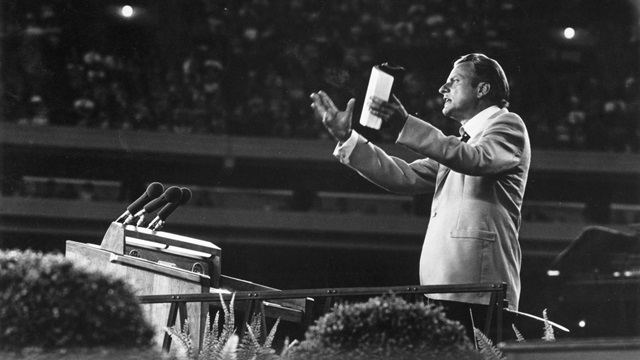
When You Think Billy Graham You don’t Think Lent

But such are the fortunes of evangelicalism that the people running the magazine that Billy Graham (trans-denominational) helped to found with Carl Henry (Baptist), and J. Howard Pew (anti-Communist Presbyterian) are fully comfortable with Anglicanism, and so have posted another article recommending Lent. In this case, telling points mount to show how poorly Lent fits with Christian piety:

heightened devotion is fruitful for a season, but cannot be sustained indefinitely. The Christian calendar offers a sustainable rhythm of which Lent is a part, and the fasting of Lent gives way to the feasting of Easter. Fasting and feasting are interconnected disciplines that teach us to love the King and his coming kingdom. In Lent, we learn to confess our sins, practice self-denial, and take on the humility of Christ. In Easter, we learn to rejoice, exult, and feast in Christ’s victory. As historian William Harmless explains, “In these two liturgical seasons Christians drank in, by turns, the ‘not yet’ and ‘already’ of New Testament eschatology.”

Repentance is fruitful for only part of the year? Moderation is something to observe but only for a time? Imagine if American Christians were moderate and humble the entire year. They wouldn’t binge or purge on American greatness or heinousness depending on which of their favorite presidential candidates was in the White House. Indeed, encouraging the idea that restraint and repentance are only for a while and not for all of life nurtures antinomianism: “I wouldn’t do this during Lent, but the other 325 days I will.”

If Lent is not supposed to lead to those thoughts (which I assume it’s not), then why not make Lenten practices year round? Because repentance and moderation can’t be “sustained indefinitely”? So people practicing Lent are Snowflake Christians? They don’t have the stomach for life-long dying to sin and living to Christ?

Aaron Damiani concedes that “Many Christians choose to keep or modify their Lenten disciplines for the rest of the year, as they have established helpful routines.” So now you have churches divided between full-time Lenten Christians, and ones who only observe Lent in late Winter and early Spring? Christians who truly sanctified and some who aren’t? Not only does this allow a culture of spiritual superiority to gain traction, but it also violates the rules of the liturgical calendar. Who sings Lenten hymns during Advent (oh, the hay that evangelicals make of tradition)?

Then there is the argument that Lent and the church calendar evoke the Jewish liturgical calendar (have you heard that Jesus fulfilled all of the law?):

It’s important to remember that the Christian liturgical calendar developed in part out of the rhythms of Jewish practice. The Old Testament indicates seasons of both heightened devotion and celebration, including Levitically led “sabbaths, new moons, and feast days” (1 Chron. 23:31) and “seasons of joy and gladness and cheerful feasts” (Zech. 8:19). Fasting and feasting were part of the “architecture of time,” in which Jesus participated as an observant Jew.

So what does Father Damiani do with Apostle Paul:

So let no one judge you in food or in drink, or regarding a festival or a new moon or sabbaths, which are a shadow of things to come, but the substance is of Christ. (Col 2:16-17)

Here‘s what Calvin did:

The reason why he frees Christians from the observance of them is, that they were shadows at a time when Christ was still, in a manner, absent. For he contrasts shadows with revelation, and absence with manifestation. Those, therefore, who still adhere to those shadows, act like one who should judge of a man’s appearance from his shadow, while in the mean time he had himself personally before his eyes. For Christ is now manifested to us, and hence we enjoy him as being present. The body, says he, is of Christ, that is, IN Christ. For the substance of those things which the ceremonies anciently prefigured is now presented before our eyes in Christ, inasmuch as he contains in himself everything that they marked out as future. Hence, the man that calls back the ceremonies into use, either buries the manifestation of Christ, or robs Christ of his excellence, and makes him in a manner void.

In other words, Lenten Christians are still holding on to a piety that clings to outward and physical attributes of unseen realities (heard of faith vs. sight?). They are incomplete Christians. They demand outward expressions of spiritual realities. They forget that Paul also wrote:

Jews demand signs and Greeks look for wisdom, but we preach Christ crucified: a stumbling block to Jews and foolishness to Gentiles, but to those whom God has called, both Jews and Greeks, Christ the power of God and the wisdom of God. For the foolishness of God is wiser than human wisdom, and the weakness of God is stronger than human strength. (1 Cor 1:22-25)

Oh by the way, Paul’s contrast between the visible and invisible, between the external and internal, is why the Confession of faith contrasts Old Testament and New Testament worship this way:

Under the gospel, when Christ, the substance, was exhibited, the ordinances in which this covenant is dispensed are the preaching of the Word, and the administration of the sacraments of baptism and the Lord’s Supper: which, though fewer in number, and administered with more simplicity, and less outward glory, yet, in them, it is held forth in more fullness, evidence and spiritual efficacy, to all nations, both Jews and Gentiles; and is called the new testament. There are not therefore two covenants of grace, differing in substance, but one and the same, under various dispensations. (7.6)

The comparison of Lent to the Old Testament is epic fail.

But remember what Calvin went on to say about Colossians 2. The rejection of the church calendar and other external ways of commemorating salvation doesn’t mean that Protestants throw out the sacraments:

Should any one ask, “What view, then, is to be taken of our sacraments? Do they not also represent Christ to us as absent?” I answer, that they differ widely from the ancient ceremonies. For as painters do not in the first draught bring out a likeness in vivid colors, and (eikonikos) expressively, but in the first instance draw rude and obscure lines with charcoal, so the representation of Christ under the law was unpolished, and was, as it were, a first sketch, but in our sacraments it is seen drawn out to the life. Paul, however, had something farther in view, for he contrasts the bare aspect of the shadow with the solidity of the body, and admonishes them, that it is the part of a madman to take hold of empty shadows, when it is in his power to handle the solid substance. Farther, while our sacraments represent Christ as absent as to view and distance of place, it is in such a manner as to testify that he has been once manifested, and they now also present him to us to be enjoyed. They are not, therefore, bare shadows, but on the contrary symbols of Christ’s presence, for they contain that Yea and Amen of all the promises of God, (2 Corinthians 1:20,) which has been once manifested to us in Christ.

I understand the appeal of Lent over the Anxious Bench. The followers of Billy Graham needed to graduate to something more meaningful, something more historical. How about the Reformation? How about the Bible? It replaces the altar call with the Lord’s Supper and gives us fifty-two Easters a year, fifty-two feast days with six days every week to prepare.