You Can’t Claim the Reformation and the First Gross (think German) Awakening

While the Gospel Allies put on the mantle of Luther — LUTHER!!! (that antinomian, beer drinking, potty mouth) — they should really be reading Garry Wills on the problem with evangelicalism. As I’ve been trying to say for some time, revivalism is antithetical to reformation. The church (as in reform the church) matters to Luther and Calvin. The parachurch is at the heart of revivals and the Gospel Coalition. To that end, consider the following:

Evangelicalism tends to break out of any single denomination—think of the preachers from various bodies at Cane Ridge. It is fissiparous even in its most favorable environments—think of Methodism branching into the Disciples of Christ, the Holiness Movement, the African Methodist Episcopal Church. (Whitefield, it should be remembered, was an ordained Anglican.) Evangelicalism is a style—Mark Noll calls it a “value system.” It can affect even some “high church” bodies or members. There are Pentecostalists among Roman Catholics. (Phyllis Schlafly, it should be remembered, was a Catholic, as Kellyanne Conway and Steve Bannon are. Bannon showed his allegiance in his 2014 Skype address to the Institute for Human Dignity at the Vatican.)

Given this description of evangelical style, two things should be noticed. America is, or likes to think of itself as, a “do-it-yourself democracy.” Many of the traits I have been listing are ones Americans will fancy themselves as embodying (or wanting to). People who hit the sawdust trail are working a kind of do-it-yourself salvation. The credentialing by the people is what all presidents claim. No wonder Noll thinks of evangelical religion (despite its roots in Wesley’s England) as native to America, as giving America its most recognizable God. Calvin said God “elects” his chosen ones. In America we choose to elect our leaders. The crowd credentials the preacher. Historians rightly observe that our national political conventions have borrowed elements from revivals.

The Allies should be especially mindful, as the crowds gather this week that “crowds credential preachers.”

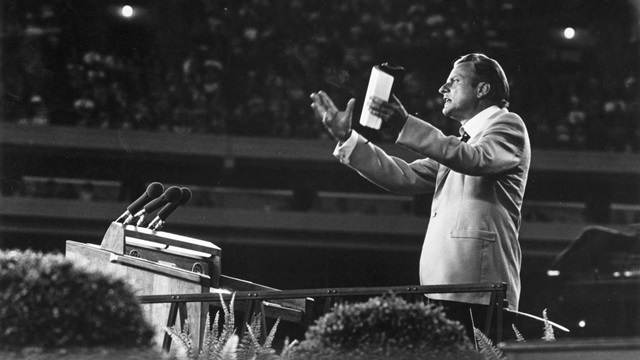
When You Think Billy Graham You don’t Think Lent

But such are the fortunes of evangelicalism that the people running the magazine that Billy Graham (trans-denominational) helped to found with Carl Henry (Baptist), and J. Howard Pew (anti-Communist Presbyterian) are fully comfortable with Anglicanism, and so have posted another article recommending Lent. In this case, telling points mount to show how poorly Lent fits with Christian piety:

heightened devotion is fruitful for a season, but cannot be sustained indefinitely. The Christian calendar offers a sustainable rhythm of which Lent is a part, and the fasting of Lent gives way to the feasting of Easter. Fasting and feasting are interconnected disciplines that teach us to love the King and his coming kingdom. In Lent, we learn to confess our sins, practice self-denial, and take on the humility of Christ. In Easter, we learn to rejoice, exult, and feast in Christ’s victory. As historian William Harmless explains, “In these two liturgical seasons Christians drank in, by turns, the ‘not yet’ and ‘already’ of New Testament eschatology.”

Repentance is fruitful for only part of the year? Moderation is something to observe but only for a time? Imagine if American Christians were moderate and humble the entire year. They wouldn’t binge or purge on American greatness or heinousness depending on which of their favorite presidential candidates was in the White House. Indeed, encouraging the idea that restraint and repentance are only for a while and not for all of life nurtures antinomianism: “I wouldn’t do this during Lent, but the other 325 days I will.”

If Lent is not supposed to lead to those thoughts (which I assume it’s not), then why not make Lenten practices year round? Because repentance and moderation can’t be “sustained indefinitely”? So people practicing Lent are Snowflake Christians? They don’t have the stomach for life-long dying to sin and living to Christ?

Aaron Damiani concedes that “Many Christians choose to keep or modify their Lenten disciplines for the rest of the year, as they have established helpful routines.” So now you have churches divided between full-time Lenten Christians, and ones who only observe Lent in late Winter and early Spring? Christians who truly sanctified and some who aren’t? Not only does this allow a culture of spiritual superiority to gain traction, but it also violates the rules of the liturgical calendar. Who sings Lenten hymns during Advent (oh, the hay that evangelicals make of tradition)?

Then there is the argument that Lent and the church calendar evoke the Jewish liturgical calendar (have you heard that Jesus fulfilled all of the law?):

It’s important to remember that the Christian liturgical calendar developed in part out of the rhythms of Jewish practice. The Old Testament indicates seasons of both heightened devotion and celebration, including Levitically led “sabbaths, new moons, and feast days” (1 Chron. 23:31) and “seasons of joy and gladness and cheerful feasts” (Zech. 8:19). Fasting and feasting were part of the “architecture of time,” in which Jesus participated as an observant Jew.

So what does Father Damiani do with Apostle Paul:

So let no one judge you in food or in drink, or regarding a festival or a new moon or sabbaths, which are a shadow of things to come, but the substance is of Christ. (Col 2:16-17)

Here‘s what Calvin did:

The reason why he frees Christians from the observance of them is, that they were shadows at a time when Christ was still, in a manner, absent. For he contrasts shadows with revelation, and absence with manifestation. Those, therefore, who still adhere to those shadows, act like one who should judge of a man’s appearance from his shadow, while in the mean time he had himself personally before his eyes. For Christ is now manifested to us, and hence we enjoy him as being present. The body, says he, is of Christ, that is, IN Christ. For the substance of those things which the ceremonies anciently prefigured is now presented before our eyes in Christ, inasmuch as he contains in himself everything that they marked out as future. Hence, the man that calls back the ceremonies into use, either buries the manifestation of Christ, or robs Christ of his excellence, and makes him in a manner void.

In other words, Lenten Christians are still holding on to a piety that clings to outward and physical attributes of unseen realities (heard of faith vs. sight?). They are incomplete Christians. They demand outward expressions of spiritual realities. They forget that Paul also wrote:

Jews demand signs and Greeks look for wisdom, but we preach Christ crucified: a stumbling block to Jews and foolishness to Gentiles, but to those whom God has called, both Jews and Greeks, Christ the power of God and the wisdom of God. For the foolishness of God is wiser than human wisdom, and the weakness of God is stronger than human strength. (1 Cor 1:22-25)

Oh by the way, Paul’s contrast between the visible and invisible, between the external and internal, is why the Confession of faith contrasts Old Testament and New Testament worship this way:

Under the gospel, when Christ, the substance, was exhibited, the ordinances in which this covenant is dispensed are the preaching of the Word, and the administration of the sacraments of baptism and the Lord’s Supper: which, though fewer in number, and administered with more simplicity, and less outward glory, yet, in them, it is held forth in more fullness, evidence and spiritual efficacy, to all nations, both Jews and Gentiles; and is called the new testament. There are not therefore two covenants of grace, differing in substance, but one and the same, under various dispensations. (7.6)

The comparison of Lent to the Old Testament is epic fail.

But remember what Calvin went on to say about Colossians 2. The rejection of the church calendar and other external ways of commemorating salvation doesn’t mean that Protestants throw out the sacraments:

Should any one ask, “What view, then, is to be taken of our sacraments? Do they not also represent Christ to us as absent?” I answer, that they differ widely from the ancient ceremonies. For as painters do not in the first draught bring out a likeness in vivid colors, and (eikonikos) expressively, but in the first instance draw rude and obscure lines with charcoal, so the representation of Christ under the law was unpolished, and was, as it were, a first sketch, but in our sacraments it is seen drawn out to the life. Paul, however, had something farther in view, for he contrasts the bare aspect of the shadow with the solidity of the body, and admonishes them, that it is the part of a madman to take hold of empty shadows, when it is in his power to handle the solid substance. Farther, while our sacraments represent Christ as absent as to view and distance of place, it is in such a manner as to testify that he has been once manifested, and they now also present him to us to be enjoyed. They are not, therefore, bare shadows, but on the contrary symbols of Christ’s presence, for they contain that Yea and Amen of all the promises of God, (2 Corinthians 1:20,) which has been once manifested to us in Christ.

I understand the appeal of Lent over the Anxious Bench. The followers of Billy Graham needed to graduate to something more meaningful, something more historical. How about the Reformation? How about the Bible? It replaces the altar call with the Lord’s Supper and gives us fifty-two Easters a year, fifty-two feast days with six days every week to prepare.


Remember When Being Nice Would Win the Day?

How a little reminder of 1929 clears the cobwebs.

Once upon a time, the Gospel Allies scored points against Reformed confessionalists by claiming the high ground of nice. Remember when Jared Wilson wrote this?

Cold-hearted rigidity is not limited to those of the Reformed persuasion, of course. You can find it in Christian churches and traditions and cultures of all kinds. In fact, to be fair, I have found that those most enthralled with the idea of gospel-wakefulness, those who seem most prone to champion the centrality of the gospel for life and ministry, happen to be of the Reformed persuasion. So there’s that. But gracelessness is never as big a disappointment, to me anyway, as when it’s found among those who call themselves Calvinists, because it’s such a big waste of Calvinism.

Or how about when Justin Taylor chimed in?

Angry Calvinists are not like unicorns, dreamed up in some fantasy. They really do exist. And the stereotype exists for a reason. I remember (with shame) answering a question during college from a girl who was crying about the doctrine of election and what it might mean for a relative and my response was to ask everyone in the room turn to Romans 9. Right text, but it was the wrong time.

This raises an important qualifier. The “angry” adjective might apply to some folks, but it can also obscure the problem. In the example above, I wasn’t angry with that girl. I wasn’t trying to be a jerk. But I failed to recognize what is “fitting” or necessary (cf. Eph. 4:29) in the moment. This is the sort of thing that tends to be “caught” rather than “taught” and can be difficult to explain. But there’s a way to be uncompromising with truth and to be winsome, humble, meek, wise, sensitive, gracious. There’s a way of “speaking the truth in love” (Eph. 4:15) such that our doctrines are “adorned” (Titus 2:10) and our words are “seasoned” with salt and grace (Col. 4:6). To repeat, the category of “anger” is often too broad and can miss the mark. As Kevin DeYoung pointed out to me, “Some Calvinists are angry, proud, belligerent people who find Calvinism to be a very good way to be angry, proud, and belligerent. Other Calvinists are immature—they don’t understand other people’s struggles, they haven’t been mellowed by life in a good way, they can only see arguments and not people. The two groups can be the same, but not always.”

So when Tim Keller advocated women’s subordination, he did so in precisely the categories that elicit New Calvinist religious affections (thanks to our southern correspondent):

We feel that there is a deep inconsistency in the phrase “evangelical feminism”. The feminists who are consistent recognize the Bible as a sexist book throughout. They reject it. The feminists who try to hold to complete Biblical authority have, really, an impossible balancing act to conduct. . . .

We know from experience that our position on women-in-ministry dissatisfies many people. Many friends from the traditional evangelical church find it far too “liberal” and “permissive”, while many other friends on the other side still feel it is oppressive. Our position is not totally unique. See J. Hurley’s book, Man and Women in Biblical Perspective or Susan Foh’s book, Women and the Word of God. They come close to where we are.

The fact remains that nearly everyone we meet is more “conservative” or else more “liberal” than we are. Thus we appeal to our friends to work with us on this. We do not to make this issue a cause of division, as we said above. We see no reason why friends with the same view of the Bible cannot work together, all the while influencing each other and refining one another’s viewpoint in order to become truly Biblical. Please be partners with us.

Balance, moderation, partnership — these were the calling cards of the New Calvinists. And for them, it was the Old Schoolers and Truly Reformed who were poorly positioned to represent Calvinism to the contemporary urban and global world. Some of us tried to explain that disagreement was not anger, and that standing in a specific tradition might cut down on “partnership.” We even thought that the medium of the World Wide Interweb thrived better on provocation than moderation. But for almost fifteen years the New Calvinists thought they had squared the circle, and Keller was proof positive at ground zero of global urban life in the United States.

What went wrong? One problem may have been living in a Gospel Coalition bubble and not engaging the concerns of “angry Calvinists.” But even more harmful was forgetting the antithesis and misreading the culture. Keller’s “success” in New York suggested (and sometimes actually asserted) that a new day had dawned for conservative evangelicalism. Modern Americans were truly willing to hear a kinder, gentler Protestantism. How could you deny that if the most secular and most urban place in the United States had received Keller the way New York City did? You certainly had to think that modern America was much more hospitable to faith if Keller was a best-selling author and the darling of religion journalists? Keller himself told lots of Presbyterians how the direction of the modern world was heading in a faith-friendly direction. I still remember the Power Point presentations I witnessed while on the faculty at WTS about the church in the city’s future.

What if while considering those trends predicted by economists and futurologists, New Calvinists had pondered the Bible more?

3 Above all, you must understand that in the last days scoffers will come, scoffing and following their own evil desires. 4 They will say, “Where is this ‘coming’ he promised? Ever since our ancestors died, everything goes on as it has since the beginning of creation.” 5 But they deliberately forget that long ago by God’s word the heavens came into being and the earth was formed out of water and by water. 6 By these waters also the world of that time was deluged and destroyed. 7 By the same word the present heavens and earth are reserved for fire, being kept for the day of judgment and destruction of the ungodly. (2 Peter 3)

That may tilt more Rod Dreher than Jamie Smith. But if you’re going to minister the word and teach in a seminary, doesn’t the apostle Peter count more than Peter Drucker?

Would Keller Be Even Welcome in the PCA?

What an odd question, but this group of Presbyterian women might help Princeton Seminary administrators not feel so bad about the kerfuffle over Keller and the Kuyper Prize:

Meanwhile, Todd Pruitt has found another sign of harmonic convergence between women on both sides of the mainstream/sideline Presbyterian divide. Pastor Pruitt writes this:

If you listen to the podcast what you will hear is typical boilerplate liberation theology which is fundamentally unbiblical and incompatible with the gospel and the church’s mission. Sadly this has been allowed a foothold in the PCA. Some of us have been warning about it, apparently to no avail. It is nothing more than the latest incarnation of the social gospel which ironically destroys the gospel by replacing it with something else.

During the discussion the hosts dismiss the biblical pattern of male leadership within the church as nothing more than a manmade rule. They also mock those who uphold that biblical pattern and join that mockery with crude language. Keep in mind that these men and women are members of and serve in churches whose standards uphold those biblical patterns of leadership.

Near the very end of the podcast one of the hosts gives a brief nod of legitimacy to transgenderism. This is not surprising given the radical roots of their categories.

I will not labor over every problem with the content of this podcast. You will be able to hear for yourself if you choose. But be warned. It is very tedious. It is something that would be warmly received in the PC(USA) for sure. What is so troubling is that it is being received by some within the PCA. This will not end well. Experiments in the social gospel never end well.

If Tim Keller had done more to warn Presbyterian urbanists and Neo-Calvinists about the pitfalls of making the gospel social (and political or cultural), he might have shielded himself from recent controversy. That’s right. If he had done that, he’d never have been nominated for the Kuyper Prize.

Did Machen found Westminster Seminary for nothing!?!

You Gotta Serve Somebody

Will it be the Bible or the magisterium? Massimo Faggioli worries that papal audacialists are turning into magisterial fundamentalists:

Now, four years into the pontificate of Francis, only the traditionalist wing still uses the hermeneutics of “continuity and reform” versus “discontinuity and rupture” in interpreting Vatican II; Francis has never used it. But the damage is done, and not just in Rome or in the Vatican. For while on one side there is the minimizing of the role of critical thinking about Church history, on the other there is the cultural turn to an emphasis on identity studies. Even at those universities where a historical-critical approach to Church institutions and magisterial texts persists, things tend to gravitate around “religious studies” instead of theology.

This poses a problem for history and religious studies as disciplines: trying to understand the past lives of Christians without a theological line of credit open toward the faith of those Christians limits the ability of the historians to understand the lives of those Christians. But it’s an even bigger problem for theology. The historical-critical method is facing some pushback today even when it comes to biblical studies, as seen recently in overblown reactions to what the new general of the Jesuits said about the interpretation of the Gospel a few weeks ago. Paradoxically it seems more acceptable in today’s Catholic Church to bring the historical-critical method to bear on Scripture than to documents of the magisterium; it’s become more acceptable to critique divinely inspired authors of Scripture than a pope writing on sexual morality. A creeping magisterial fundamentalism toward the encyclicals of this last century is part of the “biopolitical” problem of Catholicism. This is clearly visible in the debate over Amoris Laetitia. But it would also be worth exploring how naively and uncritically Leo XIII’s Rerum Novarum is sometimes used (or misused) in the U.S. church to make arguments about Catholic social teaching.

But with a reduced papacy, what separates Roman Catholicism from Anglicanism? And without the audacity of the papacy, how do you argue for Rome’s superiority to Geneva?

If Only Princeton Seminary had Read Sarah Posner on Tim Keller

They would have spared themselves a lot of grief (though one has to raise questions about Posner’s reasons for opining the way she does). Way back in 2009, the liberal journalist saw through the public relations success of New Calvinism’s favorite urban pastor/apologist:

Counterfeit Gods is an attractive, compact volume that a busy urbanite might tuck in his murse alongside his iPhone. It’s got a “there’s-an-app-for-that” sort of answer for the anxiety of contemporary city living. It’s a handy Jiminy Cricket to set you straight when you might be thinking of having sex with someone you’re not married to, contemplating a risky investment opportunity in the hopes of hitting the jackpot, or staying late at the office instead of having dinner with the family. While you’re at it, you might remind your spouse not to over-schedule the kids, because Jesus doesn’t like that, either.

Imagine: Wall Street casts its eyes upon Saint Timothy instead of Timothy Geithner! Dalton minus the uptight parents! A Manhattan nightlife free from casual sex! Coffee shops and bars purged of political ideology and discourse!

Such “counterfeit gods” ail the suburbs, too, but they are already saturated by big box mega-churches to counteract the false idols of Sam Walton-inspired strip malls and hyper-competitive Saturday morning soccer tournaments for six year-olds. Keller doesn’t bother with them. His schtick is to break into the untapped urban market for potential believers.

It’s hard to see, though, how New York’s wide swaths of spiritual diversity would take to Keller’s air of Christian superiority. For him, the Bible “comprises a single story, telling us how the human race got into its present condition, and how God through Jesus Christ has come and will come to put things right.” See? It’s that simple.

The focus isn’t eternal salvation, but rather remaking the cultural and political world. He offers a way of making sense of what Jerry Falwell-style fundamentalists might call the scourge of secular humanism. Instead of spiritual warfare against these satanic enemies, Keller asks his readers to confront them as biblical figures might have rejected false idols.

Thus, the hovering, over-protective mother might take lessons from Abraham: let God test your love for the children by letting them be free. The man who lusts for someone other than his wife might learn from Jacob’s misguided quest for the more beautiful Rachel. Jacob’s wife, Leah, provides cues for anyone looking for love and sex and transcendence in their romantic lives, rather than through God. The inevitable result of looking for everything in romantic love, Keller maintains, is “bitter disillusionment.”

One would think the Jacob-Leah story might yield some feminist deconstructions. But feminism, apparently, is also idolatry. Every such political ideology, Keller maintains, creates a sort of idolatry of its own. “An ideology,” he writes, “like an idol, is a limited, partial account of reality that is raised to the level of the final word on things.” Keller can’t see, somehow, that our body politic was designed to be secular, and that a religious prescription for its ills—itself portrayed as a final word—is one of the scourges that has, over the last four decades or so, led to the single-minded extremism he decries.

Keller is a favorite of flagship evangelical magazines like Christianity Today and World, but he receives glowing coverage in mainstream outlets as well. “While he hardly shrinks from difficult Christian truths,” observed a 2006 profile in the New York Times, “he sounds different from many of the shrill evangelical voices in the public sphere.” Keller, the piece went on, “shies away from the label evangelical, which is often used to describe theologically conservative Protestant Christians like him, because of the political and fundamentalist connotations that now come with it. He prefers the term orthodox instead, because he believes in the importance of personal conversion or being ‘born again,’ and the full authority of the Bible.”

This assertion—that biblical orthodoxy is somehow apolitical—was put to the test recently when Keller became one of over 100 original signatories to the Manhattan Declaration unveiled on November 20th. Billed as a statement of “religious conscience,” the Manhattan Declaration is something more, something unmistakably fundamentalist and quintessentially political, a regurgitation of the religious right’s assertion that sexual and gender rights are somehow a threat to good Christians’ religious liberty.

What Kind of Art Will American Greatness Leave Behind?

Talk about greatness after you watch The Great Museum, a documentary about The Kunsthistorisches Museum in Vienna:

The museum was the creation of Emperor Franz Joseph I of Austria-Hungary. Opened in 1891, the museum (a combination of two) holds the Habsburgs’ formidable art collection and makes many of the effects of the Holy Roman Emperor accessible to the general public. As much as the Protestant and republican in me wonders about that kind of wealth, concentration of power, and even accumulation of relics, it doesn’t take a high school diploma to understand that The Great Museum should be on my bucket list and should likely have been higher than the Louvre or London’s National Gallery. Say what you will about the Habsburgs, they acquired lots of stuff that people interested in history and art want to see.

(Although, I could not fight the impression that the art world, even as accessible as it is now compared to when it fenced in for only the aristocracy and friends to enjoy, has become one big commodity to be bought and sold. The documentary has one auction scene that took the missus and me back to The Red Violin, arguably the best historical treatment on film of the changing value of a musical instrument. Let’s just say, moderns know monetary value better than artistic achievement. I’ll confirm that by noticing that even though the Republic of Austria subsidizes the Great Museum with significant Euro’s, admission in 2013 to the Great Museum was almost 34 Euros — $37. Ouch!)

Meanwhile, back in the greatest nation on God’s green earth, the feds debate whether to cut funding for the National Endowment for the Arts. Stephen Limbaugh keeps it real when he warns about the NEA’s ideological outlook:

Be it the misuse of funds, waste, or deleterious governing philosophy, the National Endowment for the Arts has proven to be a recidivistic cultural butcher.

The NEA’s process for cultivating art is informed by standards set by universities and critical theorists. Those standards of what qualify as “acceptable” contemporary art seem to be any phenomena that offends an individual’s inherent aesthetic disposition. Preferential treatment is given to those works that 1) are able to evoke the most unpleasant reaction and 2) are created with the least amount of discernible purpose. This destructive artistic praxis is thoroughly documented, and there are few examples of NEA-backed art that does not adhere to it.

Be that as it may, so what? Even if the NEA retains their funding, will the artists they subsidize produce anything that will command attention in three centuries? Anything like Peter Brueghel’s Tower of Babel (the film’s closing image)? Can a top hat worn by President Wilson really compare with the Bratina of King Ladislaus IV of Poland?

I don’t think so.

Why I Wouldn’t Sign (if I were evangelical)

Would you sign this expression of empathy with people who are not citizens of the United States? Here is how it begins:

The United States has experienced a contentious election and post-election season marked by fear, polarization, and violence. The current political climate reveals longstanding national sins of racism, misogyny, nativism, and great economic disparity. As faculty members of Christian institutions of higher education who represent varying degrees of privilege and power (but who are not representing those institutions in this document), we, the undersigned, join our voices with those who are most vulnerable.

We affirm the dignity of every human being as created in God’s image (Gen. 1:27). We submit to the sovereignty of Christ who humbled himself unto death. As members of his body, we strive to consider others above ourselves (Phil. 2:2–8); to speak the truth in love (Eph. 4:15); to serve one another in humility (Matt. 20:26–28); and to honor and steward God’s good creation (Gen. 1:28). As one body, if one member suffers, all suffer (1 Cor. 12:26); if one weeps, the body laments with them (Rom. 12:15); even creation groans in bondage to decay (Rom. 8:19-23).

I wonder if these Christian faculty would be inclined to sign a man-made creed, say like the Westminster Confession or the Book of Concord? I thought evangelicals were supposed to be anti-creedal.

Oh well.

Here‘s why Chris Gehrz signed (even though he admits he hesitated):

Indeed, I think most Christians would affirm them, whatever their theological, political, or other differences. While hardly an exhaustive list of Christian beliefs, these convictions are nevertheless foundational to Christian faith, community, and mission. And, as the statement goes on to explain, such commitments need to be restated and acted upon in a time when there is “falsehood that seeks to undermine truth and any propaganda intended to obscure it,” when a “large portion of our communities is weeping” and there is genuine anxiety and fear among many of our neighbors.

A concern for truth is obviously important for academics, whatever their religious beliefs and doubts. Why our role as Christian educators would compel us to acknowledge “pain and woundedness” and then “entreat Christian communities to seek healing, reconciliation, and justice” may be less evident.

Here‘s why his colleague, Ray VanArragon (what a Dutch-American name), wouldn’t sign:

First, the petition is unduly expansive, covering a range of topics that include racism, economic disparity, the environment, and our lack of neighborliness. At the same time it does not offer any recommendations for concrete responsive action.

Second, it employs language that tends to put off people who live outside of academic circles. It speaks vaguely about “structural injustice” and “degrees of privilege and power,” without explaining what those terms mean. It slyly suggests that Christians ought to share the priorities of the political left – a suggestion reinforced by the fact that, expansive as it is, it makes no mention of abortion. Right-of-center Christians, even well-meaning ones, may be inclined to dismiss the petition as pompous, disingenuous, and one-sided.

Here’s why I’m not.

This statement:

The current political climate reveals longstanding national sins of racism, misogyny, nativism, and great economic disparity.

Does not go with this statement:

we affirm our deep resolve to pursue truth, to reason carefully, and to rely on sound evidence.

Outrage is easy. So is moral posturing. Thinking carefully so that you don’t exhibit moral overreach is a challenge. I’d have thought educators would know this.