Is Donald Trump Mainstreaming Apostasy?

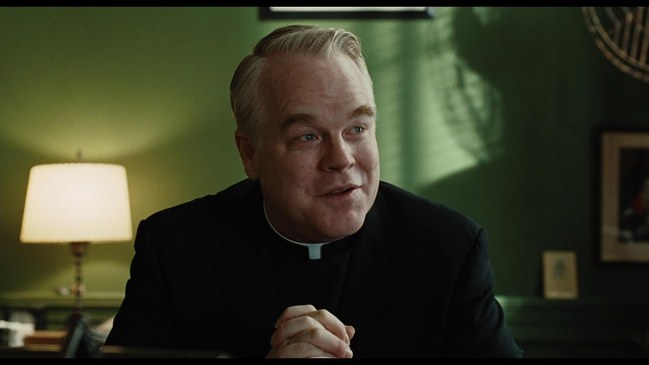
While Mike Horton zeroes in on the personalities associated with Word of Faith who will be speaking or praying (or speaking in tongues) and the presidential inaugural, not to be missed is the rest of the clergy assembled. Among them, Cardinal Timothy Dolan:

Dolan will be the first Catholic to take part in a presidential inauguration in 40 years, since President Jimmy Carter’s in 1977, the Religion News Service reports. Rabbi Marvin Hier will be the first Jewish clergy involved since Ronald Reagan’s in 1985.

His inclusion “may reflect, in part, homage to the Jewish faith of Trump’s daughter and son-in-law,” Black said. Eldest daughter Ivanka Trump, a convert to Orthodox Judaism, is moving to Washington and expected to serve as a stand-in to the First Lady.

The broad faith representation may also reveal a desire to please the American electorate, more pessimistic about the president-elect than any of his recent predecessors. According to the Pew Research Center, Trump’s overall campaign grade is the lowest among any presidential candidate—winning or losing—since it began collecting data in 1988.

White is the only pastor from Trump’s group of evangelical faith advisors scheduled to speak at the inauguration. The Mormon Tabernacle choir is slated to perform. Trump has downplayed the celebrity factor in his confirmed guest list. So far, Carter is the only former president expected to attend.

Horton puts his objection this way:

Thanks to the First Amendment, Christian orthodoxy has never been a test for public office. But it is striking that Trump has surrounded himself with cadre of prosperity evangelists who cheerfully attack basic Christian doctrines. The focus of this unity is a gospel that is about as diametrically opposed to the biblical one as you can imagine.

But is it fair to say “surrounded”? Kevin Kruse, who teaches at Princeton puts it this way:

“The traditional tasks of an inaugural—bringing the country together and setting an uplifting and unifying agenda for the future—are even more pressing for president-elect Trump,” said Kruse. “And that, I suspect, is why he’s enlisted a much larger lineup of clergy to speak at the inauguration than his predecessors. He knows he needs their help in elevating the tone and, in turn, elevating his presidency as well.”

Either way, a confessional Protestant could object to every religious figure scheduled for the inauguration. Especially in the year that Protestants commemorate the Reformation, shouldn’t Calvinists be up in arms about a Roman Catholic bishop at the event? Why single out Paula White? Looks too much like Megyn Kelly?

How Theological Liberalism Wins

First, you have the traditionalists:

I think you can see Professor Esolen’s essay as reflecting the long-term concerns of one group, in particular: Catholic faculty members who share a particular vision of the college’s mission. They assume that our Catholic identity should be at the center of everything we do, and they look to the long history of Catholic tradition, including recent documents like Pope St. John Paul II’s Ex Corde Ecclesiae, as crucial.

This group of faculty, in which I include myself, are worried. To put it simply, they don’t want to see Providence College join other religious universities who have moved away from their religious foundation. (Jim Burtchaell’s The Dying of the Light chronicles this phenomenon.)

Second, you have the social justice warriors:

Another group immediately involved here are some of the people who tend to fall on the margins in our community-and also those supporting them. They have serious concerns about systemic forms of exclusion. (And here, too, are a number of concerns that I myself share.)

They can see, for example, that Providence College’s 100-year history includes almost nothing of the African-American experience, or of Hispanic culture and tradition. In the last few years, the college has made a concerted effort to recruit more students, faculty, and staff from underrepresented groups, but frankly, it hasn’t always succeeded in offering needed support once they arrive.

For all those who are part of this second group, their frustrations are also part of a larger story: longstanding exclusion and unjust mistreatment of marginalized people. And, it’s important to say, some of these folks would also note that their concerns are prompted by Catholic commitments, beginning with a recognition of the dignity of every human being.

Third, you notice that tradition doesn’t get you satisfaction social justice.

Esolen’s essay was read as opposition to individuals, and, by extension, as disregard for the specific cultural realities they represent. Unfortunately, the essay’s polemical tone contributed to that reading, especially once the editor had framed the whole piece with a headline that was pure clickbait.

When a number of people voiced criticism of the essay, the president responded with his own critique in a campus-wide email, and the executive vice president reported the impact of the essay as “implicitly racist” in another campus-wide email. In the end, these official responses then confirmed fears of that first group of faculty that questioning the way that diversity is being conceived and pursued means you’ll be cut off at the knees.

Fourth, you see that lots of people outside the faith also want social justice.

Finally, you conclude either that those non-believers are really on the side of the faith, or that justice is as or more important than doctrine for real Christianity.

That means reversing what Paul wrote. Instead of “If in Christ we have hope in this life only, we are of all people most to be pitied,” you now say, “If in Christ we have hope for resurrected life only, we are of all people most to be pitied.”

The 2017 Challenge

How can Christians who voted for Hillary show charity to Donald Trump?

This fellow doesn’t seem to have figured it out:

The “Year of our Lord” 2016 deserves the label, “The Year of the Jerk.” It has been a long time since exhibiting the maturity level of a toddler has been enabled so fiercely or rewarded so completely. Donald Trump looms as the obvious example in a crowded field. Trump’s bombastic style elevated the antics of schoolyard bullies to morbid political theater.

Many of the very people who encouraged me to stand up to bullies as a child in my small southern town were fervent flag wavers for the bully of bullies this campaign season. Rather than rejecting his candidacy due to these antics, Trump’s supporters seemed to feed on his absolute disdain for his fellow humans. Each broken taboo was like throwing red meat to a den of lions for many of his enthusiastic supporters.

Over and over again, we heard fervent Trumpites express their conviction that Trump is “real” because he “tells it like it is.” Yet there was nothing original, or even remotely factual, in much of what Trump had to say. It was the crass way he said it that appealed to an angry subset of American culture. The candidate himself, a trust fund product whose persona was manufactured by tabloid magazines and reality television, could not have been more manufactured, inauthentic, or unreal.

None of this is inherently wrong or objectionable as part of political debate (nor is it wrong to recognize Trump’s failure to manifest the fruit of the Spirit). But how do you promote Jesus’ message, the guy who hung out with publicans (not republicans) and tax collectors, and then do what the Pharisees did?

And as he reclined at table in his house, many tax collectors and sinners were reclining with Jesus and his disciples, for there were many who followed him. And the scribes of the Pharisees, when they saw that he was eating with sinners and tax collectors, said to his disciples, “Why does he eat with tax collectors and sinners?” And when Jesus heard it, he said to them, “Those who are well have no need of a physician, but those who are sick. I came not to call the righteous, but sinners.” (Mark 2:15-17 ESV)

When oh when will the Christians who voted for Hillary stop being so unforgiving of the president-elect? When will they show charity even to sinners?

History Doesn’t Have Sides (take it from a professional)

Citizens of the U.S. have become used to presidents talking about “the right side of history”:

Most recently, during his December 6 Oval Office address on terrorism, Obama said: “My fellow Americans, I am confident we will succeed in this mission because we are on the right side of history.” It’s a phrase Obama loves: He’s used it 15 times, in debates; at synagogues; in weekly radio addresses; at fundraisers. Obama is almost as fond of its converse, “the wrong side of history,” which he has used 13 times; staffers and press secretaries have invoked it a further 16. (These figures are all based on the archives of the American Presidency Project at the University of California Santa Barbara.)

But the expressions are hardly original to Obama. Bill Clinton referred to “the right side of history” 21 times over his time in office, while his staffers added another 15. Clinton also mentioned the “wrong side of history” several times. Ronald Reagan, for his part, wryly resurrected Leon Trotsky’s relegation of the Mensheviks to the “dustbin” or “ash heap of history.” Speaking to the British Parliament in 1982, the Gipper said, “The march of freedom and democracy which will leave Marxism-Leninism on the ash-heap of history as it has left other tyrannies which stifle the freedom and muzzle the self-expression of the people.”

That kind of naivete from the smartest people in the country (minus Reagan, of course) makes you (okay mmmmeeeeEEEEE) wonder what it feels like to lose and be on the wrong side of history (now Democrats know how Jerry Falwell felt in 1993).

But this is not simply an American problem. Paul Helm (not licensed as a historian) points out that history is not so readily categorized as right or wrong. But it is the legacy of the Enlightenment and a departure from Augustinianism:

This idea of history having a ‘side’, which is liberal, enlightened and so on, harks back to the enlightenment of the 18th century, to the emergence of what David Hume called ‘these enlightened ages’, in sharp contrast to the side of the ‘dark ages’ of medievalism. The idea is that such a surge as the Enlightenment, having begun, is inevitable, tending unstoppably in one direction. This side of history is on the move to better times, and so if we wish these times for ourselves and others, we had better get on the right side. And that direction becomes ‘obvious’ to those with enlightened minds.

The forces of darkness, of barbarism and superstition, are history’s other side, its faltering side, the side of those intent on ‘turning the clock back’, impeding or interrupting and so delaying its progress. Sooner or later history’s other side is to be decisively supplanted by the enlightened. So that dark side is destined to fail. The light side of history will succeed. Who wants to be left behind? So do not get left behind, for the Light and its forces will ultimately triumph over Darkness, reason against unreason, liberty against slavery, and so on. This is somehow connected with what Herbert Butterfield and others referred to as the Whig interpretation of history. Though this seems to have been, insofar as it existed, a gentler version of the current ‘sides of history’ view, at least insofar as it is view of history that is the outcome of ongoing parliamentary debate. In fact it may be said that so long as freedom of speech and the working of government and opposition in Parliament continues, the enlightened ages continue.

One implication is a lesson for those who think progressively about Christianity making the world a better place (read transformationalism). Don’t mimic Enlightenment progressivism:

Also linked with the winning side of history view is the idea of Western leadership and hegemony, which causes the rising sun to shine on the Sunny Side until the entire world basks in it. These are the engines of light. Currently these are the forces of globalism, international corporatism, and the waging of the war against global warming. Its personal ‘values’ include unlimited tolerance, and the freedom from offendedness of various kinds, along with the renouncing of the vestiges of nationalism and popularism, two currently-favoured examples.. Though it is said that we are living in a post-Enlightenment period, the confidence of the Enlightenment persists. Whatever ‘post-modernism’ is, it is not pessimistic.

The solution? Thinking like aliens and strangers, not conquerors and transformers:

It is a feature of living ‘between the times’ that God’s activity in history, his macro activity we might call it – cannot be correlated with the ebb and flow of history. Why is this? Because there is now no fixity between the events in history and the saving purposes of God. The only possible exception is the history of the church. But that is also rather uncertain. During the eras if special revelation – in the call of Abraham, and the history of Israel, and of course in the coming into flesh of the eternal Son, there is redemptive history in something like the usual sense of history. There were times in which the purposes of God with those with eyes to see, could be discerned. Through the ebbing and flowing, a trajectory of the divine redemptive purpose is discernible. But no longer. There is no ‘open vision’. Attempts to make a connection between historical states as the centuries roll, and the redemptive purposes of God are doomed. . . .

Such an understanding of history and the place of the Christian church in it throws into sharp relief the New Testament teaching on Christians as pilgrims and strangers, whose citizenship lies exclusively in a future city whose maker and builder is God. Any ‘Christian’ activity which seeks to impact dimensions of this present age and its cities –through social policies, political agendas, or arts and crafts – as so many expressions of Christian faith, inevitably compromises the root importance of a pilgrimage of men and women who otherwise may agree on little else, but whose eyes and hopes are in the New Jerusalsem. Besides these, the questions of history, its various sides and significances, matter not.

Helm should add, this outlook is not inspiring. No conferences on “Embrace the Suck” or “Endure the Uncertainty.”

Reading about Machen in The Reformed Journal

Reformed Protestants 50 and up may have spent some of their reading hours with The Reformed Journal, a magazine of Dutch-American Calvinist provenance that came into existence as a forum for Christian Reformed Church progressives. I read it from my days as a seminary student until 1990 when it folded. I didn’t always agree with the politics or theology, but it was provocative and thoughtful.

Given the “progressive” character of the magazine, I should not have been surprised that TRJ’s regular contributors were slightly sympathetic but underwhelmed by J. Gresham Machen. That outlook bothered me because the deeper I went into the archives, the more impressed I was by the man who started Westminster Seminary and the OPC (with lots of help from others). In light of yesterday’s post with an excerpt from Machen’s testimony at his trial and with some reflections still fresh from the fall Presbyterian Scholars Conference (where several participants were experiencing the joy of post-PCUSA life but still not on board with Machen’s own version of that experience), I reproduce some high or low lights of TRJ takes on Machen.

First comes Rich Mouw’s argument that Machen’s departure actually hurt the cause of conservatism in the PCUSA (one echoed by George Marsden at the Wheaton conference):

Barbara Wheeler and I have argued much about the issues that threaten to divide us, but we share a strong commitment to continuing the conversation. She regularly makes her case for staying together by appealing to a high ecclesiology. The church, she insists, is not a voluntary arrangement that we can abandon just because we do not happen to like some of the other people in the group. God calls us into the church, and that means that God requires that we hang in there with one another even if that goes against our natural inclinations.

I agree with that formulation. And I sense that many of my fellow evangelicals in the PCUSA would also endorse it. The question that many evangelicals are asking these days, though, is whether God expects us to hang in there at all costs.

One of my reasons for wanting to see us stick together is that a Presbyterian split would be a serious setback for the cause that I care deeply about, namely the cause of Reformed orthodoxy. I spend a lot of time thinking about how people with my kind of theology, have acted in the past, and I am convinced that splits inevitably diminish the influence of the kind of orthodoxy that I cherish — for at least two reasons.

First, the denomination from which the dissidents depart is typically left without strong voices to defend orthodox. This is what happened in the early decades of the 20th century when J. Gresham Machen and his colleagues broke away from the northern Presbyterian church.

I know that this is not a very popular thing to say in this setting, but I happen to be a strong admirer of Machen. I think that he pretty much had things right on questions of biblical authority, the nature of Christ’s atoning work, and other key items on the theological agenda. But I have strong reservations about his ecclesiology and I regret that his views about the unity of the church led him to abandon mainline Presbyterianism. As long as he remained within the northern church, he had a forum for demonstrating to liberals that Calvinist orthodoxy could be articulated with intellectual rigor. When he and his friends departed, this kind of witness departed with them.

The evangelicals who stayed on in the northern church generally did so because they were not as polemical as the Machen group; they were also not nearly as inclined as the Machenites to engage in sustained theological discussion. This meant that the quality of theological argumentation in mainline Presbyterianism suffered for several decades — some would even say up to our present time.

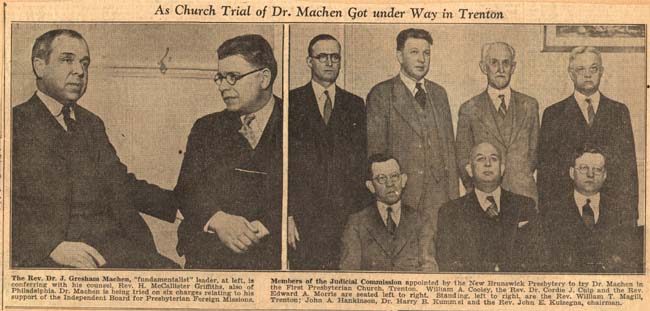
Not to let facts get in the way here, but Mouw would do well to remember that the PCUSA brought Machen to trial and excommunicated him. Yesterday’s post shows that Machen was not eager to flee even if it would have been a lot more pleasant. Whether his actions were legitimate or constitutional is another question. But he asked about the constitutionality of PCUSA actions and that didn’t endear him to the people who stayed. In fact, they tried him for having the temerity to question the soundness of the Board of Foreign Missions — as if that’s never happened — and the administrative fiats that condemned dissent.

I too wonder if Mouw considers that from 1869 until 1920 the PCUSA became infected by the social gospel and Protestant ecumenism. During that very same time Princeton Seminary as the voice of Reformed orthodoxy in the northern church was still dominated by conservatives. What happened during the years when Princeton kept alive the theology that Mouw values? Princeton and it’s orthodoxy became marginal and then a nuisance — hence the reorganization of Princeton Seminary in 1929. The idea that had Machen stayed conservatives would have done better is naive and ignores what actually happened before Machen “left.” Plus, what kind of high ecclesiology settles for articulating “Calvinist orthodoxy with intellectual rigor”?

George Marsden and Mark Noll regularly wrote for TRJ and again the returns on Machen were not always positive. First, Marsden:

Both at the time and since critics of Machen have suggested that there was something peculiar about him. Most often mentioned are that Machen remained a bachelor and his very close relationship to his mother until her death in 1931. Neither of these traits, however, was particularly unusual in the Victorian era, which certainly set many of Machen’s social standards.

More to the point is that he does seem to have had a flaring temper and a propensity to make strong remarks about individuals with whom he disagreed. One striking instance is from 1913 when Machen had an intense two-hour argument with B. B. Warfield over campus policy, after which Machen wrote to his mother that Warfield, whom he normally admired immensely, was “himself, despite some very good qualities, a very heartless, selfish, domineering sort of man.” You can imagine that, if someone says things like this about one’s friends, that it might be easy to make enemies. Machen does not seem to have had a great ability to separate people from issues, and this certainly added to the tensions on the small seminary faculty. Clearly he was someone whom people either loved or hated. His students disciples were charmed by him and always spoke of his warmth and gentlemanliness. His opponents found him impossible, and it is a fair question to ask whether, despite the serious issues, things might have gone differently with a different personality involved.

This observation continues to baffle me, as if people do not distinguish public from private statements. Maybe we are only learning that lesson after Donald Trump, but historians generally know that in the archives you find people saying all sorts of things that they wouldn’t say in public. In private we blow off steam, unless we are all walking John Piper’s and sanctified all the way down. I also don’t understand why Marsden starts his sentence on Machen’s personality with the man’s opponents found him impossible. Hello. The feeling was mutual. But Machen as a sanctified believer was supposed to find his adversaries hedonistically delightful?

And finally, Mark Noll’s estimate on the fiftieth anniversary of Machen’s death:

By reading controversies within Princeton Seminary, Presbyterian missions, and eventually the Presbyterian denomination as battles between two separate religions, “Christianity and Liberalism,” Machen undermined the effectiveness of those Reformed and evangelical individuals who chose to remain at Princeton Seminary, with the Presbyterian mission board, and in the Northern Presbyterian Church. By committing himself so strongly to theological and ecclesiastical combat, Machen left successors who were ill-equipped to deal with the more practical matters of evangelism, social outreach, and devotional nurture. By pursuing the virtues of confessional integrity, he opened the door to sectarian pettiness.

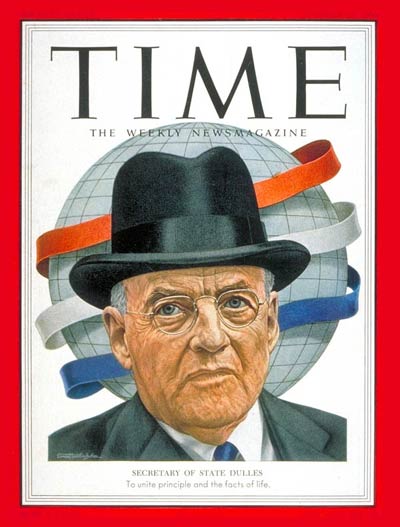
No real sense here that blaming the victim is a potential downside of such an interpretation. The perspective seemed so often in TRJ to be that Machen was a man on a mission and looking for a controversy. The bureaucrats and seminary administrators were innocent. (Yes, the lawyer who defended modernists in the 1920s, John Foster Dulles, became the Secretary of State who crafted the Eisenhower administration’s Cold War policies — the very administration that the founding editors of TRJ questioned.) The Presbyterian hierarchy simply responded — with a hammer, mind you — to Machen’s provocations. That could have been the case but no one argued that. They largely reduced Machen to a cantankerous figure who got what most of us would expect if we rock the boat the way he did.

And now in hindsight I wonder what these same men would think of Abraham Kuyper who was also part of a church that came out of the Netherlands’ state church. Didn’t Kuyper’s GKN (Reformed Churches of the Netherlands) make it a lot harder for conservatives who stayed in the NHK (Dutch Reformed Church)? And didn’t Kuyper’s Free University make life more complicated for orthodox theologians who remained at Leiden or Utrecht? (In other words, why wouldn’t it be possible to imagine Machen akin to Kuyper? Why doesn’t the Kuyper glow trickle down to Machen? Because Kuyper became Prime Minister and Machen merely president of the Independent Board for Presbyterian Foreign Missions?)

And what of John Calvin? Was he wrong to leave France? Did he leave Huguenots in the lurch? Was the Roman Catholic Church worse off without Calvin’s ministry and theological reflection? Or does the mind boggle at the questions you need to start asking other historical figures when you become so demanding of a figure of which you disapprove?

Why Machen Left the OPC

He died (on this day eight decades ago).

Machen’s reasons for being a critic of the PCUSA — to the point that some thought he was impossible and failed to show Christian charity — were clear in his testimony before the Presbytery of New Brunswick (you know, the one that the Synod of Philadelphia created to make the revivalists feel welcome), the body that tried, found him guilty, and excommunicated him from the mainline church:

Suppose a minister obtains his ordination by promising to support the boards and agencies, as he is required to do by the plain intent of that addition to the manual of the Presbytery of New Brunswick and by the plain intent of the action of the 1934 General Assembly. Suppose he later becomes convinced that the boards and agencies are unfaithful to their trust. Let us even take an extreme case. Let us suppose that he has become convinced that those in charge of the boards and agencies are guilty of actual embezzlement. That case, is, of course, entirely hypothetical, but an extreme case does illustrate plainly the principle that is involved. Let us insist upon putting that extreme case. Here is a minister who has promised that he will, as long as he remains a minister in the Presbyterian Church in the U.S.A., support the boards and agencies as they are established by successive General Assemblies. He he has become convinced that those boards and agencies are positively dishonest, even with the kind of dishonestly that is contrary to the criminal laws of the land.

What course of action is open to such a minister? He is convinced that the boards and agencies are dishonest. The general assembly is convinced that they are honest. What shall he do in such a situation? . . . Only two courses of action are open to a minister who is in such a quandary.

In the first place, he may continue to support boards and agencies which he holds to be dishonest. That course of action would plainly involve him in dishonesty. An honest man cannot possibly recommend to people that they should give to agencies which he hold to be dishonest.

In the second place, a minister who is in such a quandary may withdraw from the Presbyterian Church in the U.S.A. That plainly means evasion of the solemn responsibility which he has as a minister. I really wonder whether those who advocate this action of the General Assembly have ever thought this thing through. Do they really mean to tell us that just because a majority in the General Assembly has made a mistake one year and has placed in charge of the missionary funds of the church men who are dishonest, therefore a minister should withdraw from the church and allow that dishonesty to go on? I say that such conduct is an evasion of a solemn responsibility. No, it is the duty of a minister in such a situation to remain in the church and to seek by every means in his power to bring about a change in that policy of the General Assembly which he regards as involving dishonest. Meanwhile (and this should be particularly observed), he cannot for any consideration whatever give a penny to what he regards, rightly or wrongly, to be a dishonest agency; and still less can he recommend to any other persons the support of such an agency. . . .

I could never promise to support any human agency as a condition of my being ordained. I could not promise to support the Independent Board for Presbyterian Foreign Missions, which I believe now to be sound in the faith. . . . It is at the very heart and core of my ordination pledge, in accordance with the law of the Presbyterian church, that I should repeatedly examine any agency that appeals to me for support in the light of the Word of God, and support it only if it is in accord with that blessed Word. Moreover, in determining whether it is in accord with that Word, I must be governed by my conscience, as God may give me light, and not by the pronouncements of any human councils or courts.

If that is contrary to Presbyterian law, then I should certainly be removed from the Presbyterian Church in the U.S.A. But all the glorious history of the Reformed faith should teach a man if the Word of God does not teach him, that it is not contrary to Presbyterian law but is at the very heart of Presbyterian law. (Statement to the Presbytery of New Brunswick, 347-48, 349)

Those in fellowship with the Bishop of Rome, eat your hearts out.

Happy Year’s End

For those staying in tonight, the Old Life movie recommendation for New Year’s reflections is Hudsucker Proxy, the fifth movie that Joel and Ethan Coen made. It is their homage to the genre of RomCom, and it even explains wisely (for mmmmeeeeEEEEE anyway) why people make such a big deal of changing wall calendars. From the script:

NARRATOR (VOICE OVER) It’s 1958 — anyway, for a few mo’ minutes it is. Come midnight it’s gonna be 1959. A whole ‘nother feelin’. The New Year. The future…

The SINGING, a little MORE AUDIBLE, but still not close, is “Auld Lang Syne.”

NARRATOR (V.O.) …Yeah ole daddy Earth fixin’ to start one mo’ trip ’round the sun, an’ evvybody hopin’ this ride ’round be a little mo’ giddy, a little mo’ gay…

We are MOVING IN TOWARDS a particular skyscraper. At its top is a large illuminated clock.

NARRATOR (V.O.) Yep…

We hear a SERIES OF POPPING sounds.

NARRATOR (V.O.) …All over town champagne corks is a-poppin’.

A big band WALTZ MIXES UP on the track.

NARRATOR (V.O.) …Over in the Waldorf the big shots is dancin’ to the strains of Guy Lombardo… Down in Times Square the little folks is a-watchin’ and a-waitin’ fo’ that big ball to drop…

The LOMBARDO MUSIC gives way to the CHANTING of a distant CROWD: “Sixty! Fifty-nine! Fifty-eight!”

NARRATOR (V.O.)…They all tryin’ to catch holt a one moment of time…

The CHANTING has MIXED back DOWN AGAIN TO leave only the WIND. Still TRACKING IN TOWARD the top of the skyscraper, we begin to hear the TICK of its enormous CLOCK. The clock reads a minute to twelve. Above it, in neon, a company’s name: “HUDSUCKER INDUSTRIES.” Below it, in neon, the company’s motto: “THE FUTURE IS NOW.”

NARRATOR (V.O.) …to be able to say — ‘Right now! This is it! I got it!’ ‘Course by then it’ll be past. (more cheerfully) But they all happy, evvybody havin’ a good time.

We are MOVING IN ON a darkened penthouse window next to the clock. The window starts to open.

NARRATOR (V.O.) …Well, almost evvybody. They’s a few lost souls floatin’ ’round out there…

A young man is crawling out of the window onto the ledge. With the opening of the window, “AULD LANG SYNE” filters out with greater volume.

NARRATOR (V.O.) …This one’s Norville Barnes.

When You’re In the Business of Righteous Politics, It’s Hard to See the Beam in Your Own Eye

The BeeBee’s don’t seem to care for Kenneth Woodward’s complaint about the Democrats’ politics of righteousness, but the former religion editor for Newsweek and ongoing Roman Catholic makes a lot of sense. Who knew the Democrats were the Moral Majority before Jerry Falwell formed the Moral Majority?

The party’s alienation from the white working class began in the streets of Chicago outside the 1968 Democratic National Convention. There, antiwar protesters and activists for a host of countercultural causes fought the police of Mayor Richard J. Daley while the nation watched on television. As President Bill Clinton later observed in the first volume of his memoirs, Vietnam was only one point of contention in what was really a wider clash between generations, social classes and moral cultures:

“The kids and their supporters saw the mayor and the cops as authoritarian, ignorant, violent bigots. The mayor and his largely blue-collar police force saw the kids as foul-mouthed, immoral, unpatriotic, soft, upper-class kids who were too spoiled to appreciate authority, too selfish to appreciate what it takes to hold a society together, too cowardly to serve in Vietnam …”

The 1968 convention marked the end of the New Deal coalition that had shouldered Franklin Roosevelt, Harry Truman, John F. Kennedy and Lyndon B. Johnson to the White House. It wasn’t that white working-class Americans turned away from the party so much as that political reformers representing the young, the newly wealthy, the suburban and the higher educated deliberately cut party ties with them. “Boss” Daley, the authoritarian Irish Catholic mayor from the blue-collar Bridgeport neighborhood, became the poster boy for all that was “bigoted” and socially regressive in neighborhood-based, white ethnic America.

The new era

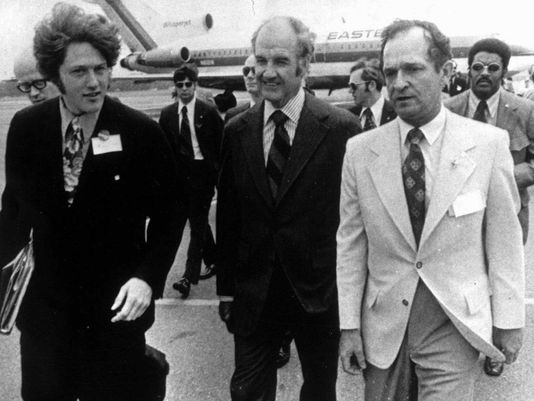
Over the next four years, a commission on party structure and delegate selection, with Sen. George McGovern as chairman, introduced a series of reforms ensuring that, culturally as well as politically, the delegates to the 1972 Democratic convention would resemble the young activists who had battled the police in Chicago more than delegates who had been seated inside. The McGovern Commission, as it came to be called, established state primaries that, in effect, abolished the power of the old city and state bosses, most of whom came from white ethnic stock. The commission also established an informal quota system for state delegations to assure greater representation of racial minorities, youths and women that by 1980 became a mandate that half of every state delegation must be women.

The 1972 Democratic platform formally introduced the party’s commitment to identity politics. Rejecting “old systems of thought,” the platform summoned Democrats to “rethink and reorder the institutions of this country so that everyone — women, blacks, Spanish speaking, Puerto Ricans, Native Americans, the young and the old — can participate in the decision-making process inherent in the democratic heritage to which we aspire.” There was also this: “We must restructure the social, political and economic relationships throughout the entire society in order to ensure the equitable distribution of wealth and power.” The delegates put flesh on these lofty moral commitments by adding a plank commending the forced busing of students in order to achieve racial balance in public schools. Blue-collar Boston exploded.

McGovern naively took for granted the traditional party loyalty of union leaders and the white working class. But these pillars of the New Deal collation recognized that McGovern’s creation of a new “coalition of conscience” built around opposition to the war, identity politics and a redistribution of wealth excluded some of their own conscientiously held moral convictions. McGovern went on to lose every state but Massachusetts and the District of Columbia — and with them the party allegiance of blue-collar workers, union leaders and — what often amounted to the same voters — conservative Roman Catholics.

Jimmy Carter was not a member of McGovern’s coalition of conscience: He had his own powerful sense of moral righteousness, one he derived from his Southern Baptist heritage of personal rectitude rather than McGovern’s secularized Methodist heritage of moral uplift and social reconstruction. There was much in that mix that was admirably righteous, especially the instinct to protect racial and sexual minorities from social oppression. The problem is that pursuing righteousness by expanding individual rights at the expense of communal values often creates greater social conflict. As sociologist Robert Bellah argued in 1991, “rights language itself offers no way to evaluate competing claims.” One side wins, the other loses.

Shazzam! You mean that entering the public square with the certainty that you are pursuing holiness and your opponents are depraved is bad for The Union? You mean “I’m right and you’re wrong” is divisive? Who knew? (Actually, most married couples do.)

How to Make Mencken a Christian

Turn doubt into fruit of the Spirit:

Doubt signals that this process of dying and rising is underway. Though God feels far away, at that moment God may be closer than we realize—especially if “know what you believe” is how we’re used to thinking of our faith.

Doubt isn’t cool, hipster, or chic. Doubt isn’t a new source of pride. Don’t go looking for doubt; don’t tempt it to arrive out of time. But neither is doubt the terrifying final word.

Doubt is sacred. Doubt is God’s instrument, will arrive in God’s time, and will come from unexpected places—places out of your control. And when it does, resist the fight-or-flight impulse. Pass through it—patiently, honestly, and courageously for however long it takes. True transformation takes time.

Being conscious of this process does not relieve the pain of doubt, but it may help circumnavigate our corrupted instinct, which is to fear doubt as the enemy to be slain. Rather, supported by people we trust not to judge us, we work on welcoming the process as a gift—which is hard to do when our entire life narrative is falling down around us. But we are learning in that season, as Qohelet did, to trust God anyway and not to trust our “correct” thinking about God.

Doubt is divine tough love. God means to have all of us, not just the surface, going-to-church, volunteering part. Not just the part people see, but the parts so buried no one sees them.
Not even us.

Imagine how great it must be to have faith.

Grade Giver, Grade Thyself

Actually don’t. The optics are off, but end-of-year blogging brings out the worst of the medium:

There is always both wheat and chaff in hurried weekly commentaries. A look back on the past year of my RNS writings reveals plenty of both.

I was right, I think, in my claim that progressive and conservative evangelicals are heading for divorce, though it will never be an entirely clean or complete one.

I was right that America’s national character is eroding — that one sign of that erosion is the nature of our politics and another is the nature of our social media.

My improved peace of mind and retention of good relations with friends and family suggest I was right to abandon Facebook last summer.

I was right that clergy entanglement with American politics is an abiding temptation that regularly makes clergy useful idiots to politicians.

I was right that the (mainly white) Christian right’s embrace of Donald Trump was deeply discrediting to the Christianity that group purports to represent. At least, I believe I was right.

I also think I was right in my regular critiques of the campaign rhetoric and policy proposals of Mr. Trump. Now we all hold our breath to see what kind of president he will actually be.

I was right that differences about ideology, politics, and faith continually tear at the fabric of our society, our churches, and our friendships.

I was right that middle ground on the LGBT issue is eroding.

I was right that the resolution of the Wheaton College/Larycia Hawkins case and her forced departure deeply wounded the cause of Christian higher education, not to mention Professor Hawkins and Wheaton.

It goes on.

Why don’t the smartest people in society not see the problem of self-evaluations? Have they never watched a Coen brother’s movie?