Obedience Girl

Wesleyans aren’t the only ones to promote perfectionism:

Following Jesus is a serious task, and, at the same time, one filled with joy; it takes a certain daring and courage to recognize the divine Master in the poorest of the poor and those who are cast aside, and to give oneself in their service. In order to do so, volunteers, who out of love of Jesus serve the poor and the needy, do not expect any thanks or recompense; rather they renounce all this because they have discovered true love. And each one of us can say: “Just as the Lord has come to meet me and has stooped down to my level in my hour of need, so too do I go to meet him, bending low before those who have lost faith or who live as though God did not exist, before young people without values or ideals, before families in crisis, before the ill and the imprisoned, before refugees and immigrants, before the weak and defenceless in body and spirit, before abandoned children, before the elderly who are on their own. Wherever someone is reaching out, asking for a helping hand in order to get up, this is where our presence – and the presence of the Church which sustains and offers hope – must be”. And I do this, keeping alive the memory of those times when the Lord’s hand reached out to me when I was in need.

Mother Teresa, in all aspects of her life, was a generous dispenser of divine mercy, making herself available for everyone through her welcome and defence of human life, those unborn and those abandoned and discarded. She was committed to defending life, ceaselessly proclaiming that “the unborn are the weakest, the smallest, the most vulnerable”. She bowed down before those who were spent, left to die on the side of the road, seeing in them their God-given dignity; she made her voice heard before the powers of this world, so that they might recognize their guilt for the crime – the crimes! – of poverty they created. For Mother Teresa, mercy was the “salt” which gave flavour to her work, it was the “light” which shone in the darkness of the many who no longer had tears to shed for their poverty and suffering.

But did she trust Jesus as her savior from sin?

Buyer’s Remorse or Remorse over Buyers?

Alan Jacobs warns converts who would be apologists:

Waugh is one of those converts in whom Catholics take great pride. If I were in their position, I would do everything in my power to prevent the world from finding out that he belonged to my communion. If the rightly administered sacraments are presumed to be instruments of grace, it appears that Waugh, at any rate, was invulnerable to their power. I would appreciate it if my Catholic brothers and sisters took the unremitting nastiness of the man more seriously. I have yet to hear one say that when Waugh took the Sacrament he did so unworthily, though I do not believe, given his gleeful and freely expressed hatred of almost everyone he knew, that anyone could reasonably say that he did so worthily.

He believed that by becoming Catholic he had ensured his own salvation, and from that elevated seat taunted his friends who remained Outside: “Awful about your obduracy in schism and heresy,” he wrote to the Anglican John Betjeman. “Hell hell hell. Eternal damnation.” Only some wholly unacquainted with Waugh’s views would think he was joking. Betjeman certainly didn’t.

Winning?

A war that won’t end:

Thus neither side won the Twenty Years’ War. Victory would mean achieving core aims at an acceptable cost relative to the benefits. Al-Qaeda did meet some of its goals: With limited resources, bin Laden gained incredible notoriety and inflicted enormous damage on a great power. In 2003, U.S. troops left Saudi Arabia—the key goal outlined in the 1996 manifesto. In 2004, bin Laden released a video that compared the costs of the 9/11 attacks to al-Qaeda versus the United States: “Al-Qaeda spent $500,000 on the event, while America, in the incident and its aftermath, lost—according to the lowest estimate—more than $500 billion, meaning that every dollar of al-Qaeda defeated a million dollars.”

But in a broader analysis, bin Laden failed. Yes, U.S. forces left Saudi Arabia, but they did so voluntarily, after Saddam was toppled. Crucially, al-Qaeda was unable to mobilize Muslims around a strict Islamist identity that transcended other loyalties. As Charles Kurzman showed in his book The Missing Martyrs, after 9/11, fewer than one in every 100,000 Muslims became jihadist terrorists. The vast majority of Muslims completely reject bin Laden’s ideology. And national, tribal, and other local identities remain profoundly important from the Palestinians to the Pakistanis. From 2003-2011, confidence in bin Laden collapsed in many Muslim-majority countries, falling from 59 percent to 26 percent in Indonesia, and from 56 percent to 13 percent in Jordan. In a 2013 poll taken in 11 Muslim countries, a median of just 13 percent had a favorable view of al-Qaeda, whereas 57 percent had an unfavorable view.

Al-Qaeda’s loss is not U.S. gain:

Let’s turn first to the United States on offense: the invasions of Afghanistan and Iraq. Recounting the costs is numbing: over 7,000 Americans killed, tens of thousands of soldiers seriously wounded, trillions of dollars expended, and over 100,000 civilian deaths in Iraq alone. And there’s the wider impact of spending on America’s debt, of enhanced interrogation and torture on the U.S. global image and ethical standing, and of seemingly endless quagmires on domestic political unity.

In an interview, Zbigniew Brzezinski, the national security advisor to President Jimmy Carter, told me, “The Iraq War was unnecessary, self-damaging, demoralizing, delegitimizing, and governed primarily by simplistic military assumptions that didn’t take into account the regional mosaic in which Iraq operates and the internal mosaic inside Iraq.”

The eclipse of al-Qaeda by ISIS is a loss for al-Qaeda but not a gain for the United States. ISIS is an even more ruthless and capable adversary.

Does idealism hurt the United States (and are believers responsible for imbuing America with too many ideas?)?

But the main combatants in the struggle lost for similar reasons: They were hobbled by ideology. Al-Qaeda’s vision of austere Wahhabi Islam and endless global jihad is profoundly unappealing to the vast majority of Muslims. But ideology also shaped U.S. strategy, sometimes in dangerous ways. American idealism is one of the country’s most attractive qualities, central to its moral standing and “soft power.” But idealism also helped to frame the Twenty Years’ War as a struggle between good and evil, which required grandiose goals to topple regimes and build beacons of freedom in the Middle East. It also encouraged Americans to lump terrorists and rogue states together into a big bucket of bad guys. At the same time, Americans are also hostile to the whole notion of nation-building, often seeing stabilization missions as a kind of big-government welfarism, and not something that the country’s warriors should be doing. In a recent foreign-policy speech, Donald Trump said, “ISIS will be gone if I’m elected president,” but at the same time, the United States will be “getting out of the nation-building business.” This combination of beliefs is as American as apple pie.

As a result, the United States is an impatient crusader: eager to smite tyrants and terrorists but unwilling to invest the time and resources needed to win the peace.

And Here I Thought W-w Was Hard

Turns out, obedience is harder:

In the first place, it seems that Gahl does not consider adequately the role of conscience. Is it sufficient that the confessor enunciates a principle such that it can be assumed that the conscience has been sufficiently enlightened? Perhaps not. Cardinal Newman made an illuminating distinction between a merely notional assent and a real assent of the conscience. It is possible that the penitent does not understand or does not accept the confessor’s admonition and refuses to promise that, in the same situation, he will not act once again in the same manner. The conscience will be enlightened only in the moment in which it has given real assent. What should be done if the penitent does not give real assent to the confessor’s admonition?

Pity the potato farmer who needed to find Denzinger‘s entry on notional assent.

When It Was Unthinkable that the State Would Affirm God

Thanks to his typing skills, Mark Van Der Molen reproduces a remark that Alan Strange made in his discussion at Reformed Forum on the spirituality of the church:

The separation of church and state, the distinction of church and state is something entirely different from the separation of faith from politics, or even God from State. None of those men believed in the separation of God from State. Even in public ways, all of them believed….basically Thornwell argued and so did Robinson, that it is immoral. Any state that is atheistic is immoral. They both argued that. If you read Robinson and Thornwell, and particularly Hodge, I think you will see they have clear points of integration. They have them in any number of ways, they all believed that it was immoral and unthinkable that the State would deny God or Christ in a general way.

(Alan, if you’re reading, I’m not picking on you. I am using your remarks to clarify, in which case disagreement may be beneficial.)

First, I do wonder about the difference between an atheistic and an idolatrous state. If the false gods are no gods, isn’t then every state without the Triune God revealed in Holy Writ an atheistic state. Is Turkey any better than the Soviet Union if the former acknowledges Allah in some way but the Soviets denied God? What about a Jewish state like Israel? Or how about a Mormon state like Utah? If states become immoral by virtue of atheism, aren’t they also immoral by denying the true God?

That puts Alan and Van Der Molen, perhaps, closer to the Puritans and a confessional state than to Robinson and Hodge who seemingly welcomed a secular government like the United States but rejected an atheistic state.

But keep in mind the progression of states that include God in their operations:

Puritans — they admitted only Puritans and excluded Baptists, Quakers, and Lutherans (for starters)

1820s U.S. — was friendly primarily to Protestants though all faiths could worship, which was a decisive break from 1640 Boston and 1550 Geneva

1950s U.S. — American society recognized a tri-faith monotheism informally of Protestants, Roman Catholics, Jews while also putting God on coins and in the Pledge of Allegiance, which was a break from 1820s Protestant dominated America

2010s U.S. — American society apparently has no religious standards and may even give sectarian faiths a hard time, which is a break from 1950s tri-faith America

The trend here is toward greater diversity and toleration. 2kers are trying to stop the bleeding by reconfiguring what God requires. The 2k conclusion, tentatively, is that God does not reveal a definite pattern for politics. The church is one thing, the state another. 2kers also try to learn lessons from the past and how earlier efforts to establish religious standards could not compete with the movement of peoples or the growing authority of the nation-state to regulate its citizens affairs in a way that achieved a measure of social unity.

What critics of 2k need to do is stop showing how 2k departs from the past. We get that. What critics need to do is not foment fear for disagreeing with Calvin or Winthrop — as if Protestants have post-canonical authorities whom we must follow. Critics need to propose an equation for God-and-state that is either required by God’s word (especially the part where Paul recommends submission to Nero) or that does justice to the lives that Christians now lead and somewhat enjoy.

2k is not novel in one sense. It advocates the spirituality of the church which is a part of the Western Christian tradition going back to Augustine, Paul, and Jesus. In another sense it is new — in the novos ordo seclorum way. 2k proposes a re-consideration of political theology in the light of modern social arrangements that is still true to Scripture and Reformed theology.

Is that any more scary than suggesting that the United States ban idolatry?

I’ll See Your 2 Popes and Raise You 5 Presidents

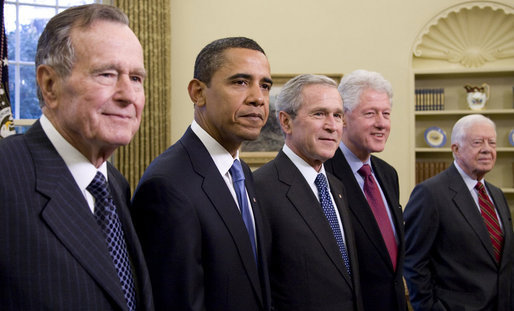
That would be, after the next inauguration, Jimmy Carter, George H.W. Bush, Bill Clinton, George W. Bush, and Barack Obama all improving the world during the reign of Hilary or Donald. I wonder if Michael Sean Winters had President Obama in mind when he wrote:

All politicians should write their memoirs. After that, they should retire from the public stage beyond the occasional speech and whatever work the management of a presidential library entails. It is unhealthy for a democracy if new slots on the stage are not opened with regularity. Stroking the egos of former presidents is redundant. And, creating these personalized, secular and necessarily politicized charities will, beyond doubt, harm the brand of charity over time.

When professional athletes retire, they have a long life ahead of them. But they have precedents. Color commentators. Coaches. Automobile dealerships. Not so with presidents. Where do you go after being the most powerful man in the free world? Even presiding over Harvard seems like slumming.

Winters thinks the Clintons’ problem is moral earnestness:

The real problem here is not so much the foundation itself as the tone deafness of the Clintons to the suspicions of their motives. I have noted before that there is something creepy about the ethics of the Clintons, something commonly found among the do-gooders of the world. It goes like this: I am a good person, and X is not a good thing to do, yet I did it, therefore X must not be such a bad thing after all. It is true that they no doubt mix up their prideful motives with their altruistic ones. Find me the politician who doesn’t? But they take it to a level that is noxious.

I think it has more to do with their former lack of wealth. Hilary had to find a law job after Bill lost the Arkansas governor in 1980. They were supposedly in serious debt. How do you rub shoulders with the rich and famous (and Yale Law alums) if you aren’t rich? Well, you speculate in real estate, you take really really big speaking fees. Once out of the White House, you form a charity like the Gates. That shows you are philanthropic and rich. But it doesn’t play well with the hillbilly/hound dog in Bill, just as Huma’s break with Anthony Weiner doesn’t make Hilary look all that virtuous for standing by her man.

One of the Two Kinds of People is Dead Wrong

Thanks to John Fea for truth:

Think of the left lane as filled with hot coals. If you use it, do so quickly (and get out of the way!).

Catching Up

Mark Galli thinks evangelicals have opened a new chapter on race. But I wonder if it is the chapter that mainline Protestants opened — oh — fifty years ago:

We are currently experiencing a new “God moment,” when God is shining his burning light on how our nation and our churches are fractured by racial division and injustice. In the past two years, we’ve seen image after image of injustice perpetrated against black Americans. We’ve studied the statistics. And most important, we’ve heard the anguished cry of a suffering community that is understandably hurting, angry, and demanding progress.

Moderate white evangelicals, who make up the bulk of our movement, see more clearly than ever how racism is embedded in many aspects of our society, from business to law enforcement to education to church life. We have been slow to hear what the black church has been telling us for a while. And in all that, we hear God calling his church to seek justice and reconciliation in concrete ways.

To be evangelical now means to be no longer deaf to these cries or to God’s call. In 2012, only 13 percent of white evangelicals said they thought about race daily (41% of black evangelicals did so). Today, we’re thinking about race more than daily—due partly to the news cycle, and partly to our rediscovering biblical teaching.

I used to hear a lot about how evangelicals were always about 10 to 15 years behind the times.

So I wonder when evangelical Protestants like Galli will get around to reading John McWhorter whose book, Winning the Race, came out ten years ago:

It’s not that there is “something wrong with black people,” but rather, that there is something wrong with what black people learned from a new breed of white people in the 1960s. . . . The nut of the issue is that [people who see racism everywhere] want neither justice nor healing. What people like this are seeking is, sadly, not what they claim to be seeking. They seek one thing: indignation for its own sake. . . .

Two new conditions were necessary for alienation among blacks to so often drift from its moorings in the concrete and become the abstract, hazy “race thing” that whites just “don’t get.”

One condition was that blacks had to be prepared to embrace therapeutic alienation, and ironically, this could only have been when conditions were improved for blacks. When racism was omnipresent and overt, it would have been psychological suicide for blacks to go around exaggerating what was an all-too-real problem.

Second, whites had to be prepared to listen to the complaints and assume (or pretend) that they were valid. This only began during the counter cultural revolution, within which a new openness to blacks and an awareness of racism were key elements. . . . Many whites were now, for the first time, ready to nod sagely at almost anything a black person said. And in that new America, for many blacks, fetishizing the evils of the White Man beyond what reality justified was a seductive crutch for a spiritual deficit that we would be surprised that they did not have. It was the only way to feel whole. Even blacks less injured were still injured enough to let the loudest shouters pass, as bards of their less damaging, but still aggravating, pains. (4, 5, 7)

What will Galli’s successor write about evangelicals and race in twenty-five years when she discovers John McWhorter?

Integration and Separatism

I’m behind on podcasts at Reformed Forum and Proto-Protestant nudged me to listen to Camden Bucey’s discussion with Alan Strange about the spirituality of the church. I was not surprised to learn that Alan (and Camden) have concerns about aspects of the spirituality of the church as articulated by contemporary 2k folks like David VanDrunen, John Muether, and mmmmmeeeeeeEEEEE. I was surprised, though, to hear the word “integration” used as much as Alan voiced it during the hour-long recording. Alan wants to affirm the spirituality of the church and on this we agree — the church can’t take a stand on say the War between the States. But he also wants some measure of integration between the church’s witness and civil authority and seems to think that the Scottish Presbyterians are a good model of such engagement.

I am not sure that I would put my disagreements as starkly as Proto-Protestant does:

His final appeal to Acts 17 struck me as patronising and pedantic if not silly. Of course we preach the Word. Does any Two Kingdom adherent deny that? We call all men to repent. That’s a far cry from arguing for the Sacralisation of culture and the state, let alone taking covenant law and ‘integrating’ it with the temporal non-holy order. There is no Biblical precedent for his view in either the Old or New Testaments and he assumes categories completely outside anything found in the Apostolic writings. Instead what he suggests is that natural fallen man can be compelled to ‘keep’ God’s commandments and work together with the Spirit to build the Kingdom of God on Earth in the form of institutions and culture.

Calvin’s comments on the state are wrong. He misinterprets Romans 13 let alone Christ’s words concerning Caesar in Matthew 22. The state is not holy or redemptive. It is temporary and yet serves a ‘ministerial’ purpose. That’s true with Assyria, Persia and in the New Testament context, the Roman Empire under Nero. The Reformed tradition got this desperately wrong and sadly their view has become the Evangelical standard.

It is a caricature to suggest that 2k folks don’t think the church can preach about abortion or same-sex marriage. The Bible forbids the taking of innocent life and has no grounds for marriage between two men or two women. But just because the church preaches against idolatry doesn’t mean that the OPC, for instance, opposes Roman Catholics or Muslims living and worshiping in the United States. Morality is one thing. Civil legislation and public policy are another. And if Hodge was correct that the Presbyterian Church could not back the federal government during the beginning of the Civil War (as Gardiner Spring proposed) even if the Bible requires subjection to the powers that be, is it really that far to go to say that the church cannot endorse a politician or legislative initiative even though the church affirms the morality for which said politician might stand?

But here’s the aspect of this discussion that caught my ear. What does it mean for the church to be integrated with the state? At first, I thought of the Roman Catholic position on integralism. Here’s how one Roman Catholic blogger describes it:

Contrary to popular belief, Catholic integralism—or what I shall refer to simply as “integralism” for the duration of this essay—is not first and foremost a political program. For the integral understanding of Christianity begins first with the supernatural society established by our Lord and Savior Jesus Christ, namely the Corpus Mysticum, the Holy Catholic Church, which transcends the temporal sphere and has for its end the salvation of souls. By carrying out its mission in the world, the Catholic Church possesses indirect power over the temporal sphere which is exercised for the good of souls. This indirect power in no way sullies the Church’s divine mission nor dilutes it by way of overextension since the civil authority retains at all times direct power over temporal matters.

Of course, Alan does not endorse this or even Erastianism. But integration is too close to integralism for that word to work for Protestants (in my book).

As matters now stand, churches in the United States are related (integrated?) to the civil government but obviously not in the way that the Church of Scotland is to the United Kingdom. The latter is likely somewhere in the constitutional provisions for religion in the realm. In the United States churches relate to the federal and state governments as tax exempt institutions. That means that churches don’t pay taxes and that contributions to churches can be deducted by individual tax payers. That’s not a recognition of Jesus Christ as Lord. It means the OPC is no better or worse than Rotary (another 501c3 organization). But it is a relationship between church and state at which Christians should not sneeze.

And mind you, the church and Christians in the U.S. fair better than Christians during the Roman Empire. What kind of integration to Paul or Peter experience? Did they have a tax-exempt status?

If we want more overt forms of integration, though, what might that involve? If the United States is going to give legal preferences to Christians, does that include Protestants and Roman Catholics, Calvinists and Arminians, Lutherans and Wesleyans? It’s not a foolish question since even the venerable Puritans (who did believe in the spirituality of the church) wouldn’t let Baptists or Lutherans in Massachusetts Bay. Then again, if we want religious freedom for believers (as many seem to since gay marriage went on-line), then where does the good form of religion to free stop and become the bad kind of faith? In other words, isn’t the system we have for church state relations the best we can do without an established religion/church?

But let’s complicate the idea of integration even more. Churches are integrated in the federal government through the military chaplaincy program. But boy oh boy does that look like a disagreeable relationship. In the Armed Services, Orthodox Presbyterian chaplains minister God’s word cheek-by-jowl with female Lutherans and male Wiccans. Of course, if that sounds provocative, it should. If Orthodox Presbyterians insisted on being separate from modernist Presbyterians in the PCUSA, and if those same OP’s remained separate from Arminians in the National Association of Evangelicals, why wouldn’t Orthodox Presbyterians be comfortable now with separatism rather than integration? I mean, if you have the stomach for being separate from other Protestants, surely you can fathom separation (rather than integration) from the federal authorities.

I understand that Alan Strange wants to prevent Presbyterians from being Anabaptists. But 2kers are not separate from the government because civil authority is a corruption of Jesus’ rule. 2kers advocate separation of church and state because politics is only good but not holy. Magistrates maintain public order. They don’t minister salvation. The one is good. The other is great.

Some Matters Should Really Stay in the Closet

Full and unequivocal equality for Petra fans? I don’t think so:

My best friend became a loser right around age 14. I had hopped a Greyhound from Hamilton to the far side of Toronto to spend a weekend with Paul. We sat down to do what boys that age do—probably something destructive—and he popped a new tape into his stereo. “These guys are Christians.” I scoffed. “They’re called Petra. The album is Beyond Belief.” I laughed. What a weakling. It really was beyond belief. He and I used to listen to Duran Duran together. Bon Jovi. Guns N’ Roses. And now we were going to listen to this tripe? Come on. Plus they can’t actually be Christians. Not good Christians, anyway. They play electric guitar! They’ve got long hair, for pity’s sake!

I endured it for the weekend, though I’m sure I griped and complained all the while. Or maybe I played along—I don’t exactly remember. But I do remember that moments before I left for home I scrounged up a blank tape and copied just one song—just one song to take home to my friends so we could laugh together. I ended up with the first song on the second side: “Underground.” Then I went home.

Sure enough, I played it for my friends and we laughed. After all, we were Reformed and baptized and catechized—we didn’t need Christian rock. Christian rock was for Arminians or Pentecostals or Baptists—weaklings all of them. It certainly wasn’t for the likes of us.

I played it for some more friends. I played it for my family. I kept playing it until I realized I was playing it for me. This song was saying something to me. At some point I had started to hear the lyrics—to really hear them. I realized “Underground” was a song about professing Christ instead of denying him, of being bold instead of intimidated. That was strong, not weak. Was I willing to stand for Christ? Or was I a weakling? Uh oh.

“Mom! Can you take me to the Christian bookstore?”

I bought the album and listened to the rest of the songs. It started with “Armed and Dangerous,” a song about relying upon God, then went to “I Am on the Rock,” a proclamation of confidence in God. “Creed” was simply The Apostle’s Creed set to music, “Beyond Belief” was about current and future hope, while “Love” was an adaptation of 1 Corinthians 13. And that was just side 1. I listened to it until I wore it out. I listened to it on my ghetto blaster, in my parent’s minivan, on my awesome walkman—whenever and wherever I could. I listened until I knew every one of John’s words, every one of Louie’s beats, every one of Bob’s solos.

I listened until I became a Christian.* Late one night I caught a glimpse of the ugly depravity of my heart side by side with the heart-stopping holiness of God. (A night, as it happens, when I was also reading a Frank Peretti book, but that’s a story for another day.) I was undone. I was redone. I was reborn. All of that parenting and Bible-reading and sermonizing and catechizing had done its work in me, but somehow it was just waiting for one more thing—for news of the warm and personal relationship with God that Petra kept singing about.

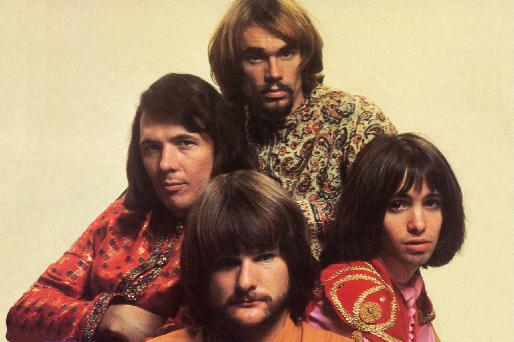
I could respond with my own encounter with Iron Butterfly and In A Gadda Da Vida (BABY!!), but as I (mmmmeeeeeeEEEEEE) say, some thing are best left in our private selves, divorced from our public identities.