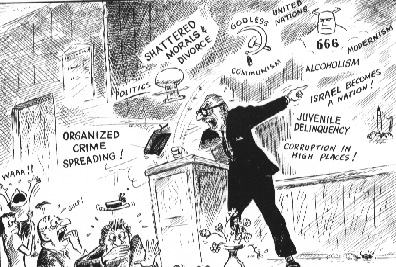
Is Conservatism Liberal?

For political conservatives, the answer is “sort of” since movement conservatives since the 1950s have generally understood themselves as classical liberals — in favor of markets, representative government, and constitutional separation of powers (including church and state). Modern political liberalism (i.e. New Deal) saw problems of economic inequality, the nature of large-scale war, and foreign diplomacy that classical liberalism could not answer beyond standing up and yelling “stop.” So modern liberals tried to update classical liberalism and ever since we have the leading wedge dividing red and blue states.

But when it comes to theology, how do conservatives fare? Richard Weaver is the fellow who will ever be associated with the conservative conviction, “ideas have consequences,” a phrase that the University of Chicago Press applied to Weaver’s 1948 book which in turn became a classic for intellectual or traditionalist conservatives (which overlaps with movement conservatism at least in the figure of William F. Buckley, Jr. and his circle). According to a recent post, Weaver was a believer in the ancient virtue of “piety”:

… the Christian ideal and Plato­nism produced in Weaver’s conservatism the final key concept of piety, which Weaver described as “one of the oldest and deepest human attitudes.” “I would define piety,” he wrote, “as an attitude of rever­ence or acceptance toward some overruling order or some deeply founded institution which the mere individual is not to tamper with.” Or to put the proposition somewhat differently: “Piety comes to us as a warning voice that we must think as mortals, that it is not for us either to know all or to con­trol all. It is a recognition of our own limitations and a cheerful acceptance of the contingency of nature, which gives us the protective virtue of humility.”

The source of his piety (other than Plato) was the fall (a version of it):

As Weaver explained, “The recovery [of a sense of piety] has brought a satisfaction which cannot be matched, as far as my ex­perience goes, by anything that liberalism and scientism have to offer.” Weaver con­tended there was a “structure of reality” called creation. Man was not the Creator; he was not self-produced. Man is the crea­ture; therefore, he is limited in his poten­tial. Confronted with choices between evil and good, man frequently chooses evil with its accompanying anguish, and this condi­tion is compounded by that ever-present matter of tragedy. In view of these impos­ing realities, would not wisdom and prudence dictate that man ought to be modest, restrained, and humble—in a word, pious? Should he not stand in reverence and awe before this miracle called life?

To compare this sense of limitation and reverence and awe for finite existence to the Shorter Catechism may be unfair. But why wouldn’t the question of this human tragedy lead to a sense of despair, like the string of questions that explain the significance of human sinfulness:

Q. 17. Into what estate did the fall bring mankind?
A. The fall brought mankind into an estate of sin and misery.

Q. 18. Wherein consists the sinfulness of that estate whereinto man fell?
A. The sinfulness of that estate whereinto man fell consists in the guilt of Adam’s first sin, the want of original righteousness, and the corruption of his whole nature, which is commonly called original sin; together with all actual transgressions which proceed from it.

Q. 19. What is the misery of that estate whereinto man fell?
A. All mankind by their fall lost communion with God, are under his wrath and curse, and so made liable to all miseries in this life, to death itself, and to the pains of hell forever.

Q. 20. Did God leave all mankind to perish in the estate of sin and misery?
A. God having, out of his mere good pleasure, from all eternity, elected some to everlasting life, did enter into a covenant of grace, to deliver them out of the estate of sin and misery, and to bring them into an estate of salvation by a redeemer.

Not to be misunderstood. Any conservative or Christian it seems to (all about) me should welcome a recognition by another human being that we are not gods, that we can’t control the world, and that it is a conceit of monumental calamity to think that humans have any power to remedy or redeem our circumstances. But for conservatives to call this awareness “piety” is to invite all sorts of confusion about the real piety that looks at sin as abhorrent and hopes for a miraculous intervention to save sinners by the only true God.

If conservatives want to be the true friends of religion who mock secularists for dismissing faith, they will need to own religion. It can’t simply be a wave of the hand at “higher things” or faith-based humanism. It needs to be the real deal. And that could well involve choosing between Plato and Moses, between Richard Weaver and Fulton Sheen, or between Whitaker Chambers and Cornelius Van Til.

Sunday Reading (not necessarily edifying)

Accent the positive:

Pope Francis as good cop:

In fact, Müller claimed, there’s an explicit division of labor at work between his office and Francis, hatched from the very start three years ago. (Remember that Müller, 68, took office under Pope Benedict XVI in 2012.)

“At the beginning of his pontificate, we spoke with Pope Francis, observing that during the previous pontificates the press accused the Church of talking only about sexuality, of abortion and these problems,” Müller said.

“For this reason, we decided, with Francis, to always, always, always speak in a positive way. If you look at the complete texts of Pope Francis, there’s gender ideology, abortion … yes, these problems are still there, but we concentrate on the positive.”

That’s not a matter of “revolution,” Müller said, insisting that Francis “is in line with his predecessors.”

“His originality,” he said, “is his charisma, thanks to which he succeeds in overcoming people’s blocks and their hardened positions.”

Look beyond the internet to find the positive:

The Internet, Rosica said, “can be an international weapon of mass destruction, crossing time zones, borders and space.” He also described it as “an immense battleground that needs many field hospitals set up to bind wounds and reconcile warring parties.”

“If we judged our identity based on certain ‘Catholic’ websites and blogs, we would be known as the people who are against everyone and everything!” he said. ” If anything, we should be known as the people who are for something, something positive that can transform lives and engage and impact the culture.”

The good news, according to Rosica, is that in the broader media universe, Pope Francis has had exactly that effect.

“Prior to Pope Francis, when many people on the street were asked: ‘What is the Catholic Church all about? What does the pope stand for?’ The response would often be, ‘Catholics, well they are against abortion, gay marriage and birth control’,” Rosica said.

“They are known for the sex abuse crisis that has terribly marred and weakened their moral authority and credibility,’” he said.

It’s a new (and positive) day:

The cultural warrior Catholicism that favored political confrontation to personal engagement and partisan fighting to authentic dialogue has given away to a Catholicism that is willing to engage, encounter, and befriend anyone.

Positivity has its limits, however:

The pope complained of “rich people who exploit others,” saying they offer contracts only from September to June, and then the employees have to “eat air” from July to August.

“Those who do that are true bloodsuckers, and they live by spilling the blood of the people who they make slaves of labor,” Francis said, according to a summary of the homily provided by Vatican Radio.

At least Americans are not bloodsuckers:

At one stage, Pentin asked Fellay about the pope’s repeated denunciations of “doctors of the law” and “fundamentalists,” wondering if Fellay takes those jibes as directed at his society or traditionalists generally. In response, Fellay said he’s asked around Rome what the pope means by that language.

“The answer I got most was ‘conservative Americans!’” Fellay, who’s Swiss, laughingly told Pentin. “So really, frankly, I don’t know.”

One might suspect Fellay was deflecting, except for this: He’s absolutely, one hundred percent right about what one typically hears in Rome on the subject of who leaves this pope cold.

By now, it’s clear that one defining feature both of Francis’ personality and his approach to governance – which shouldn’t be at all surprising, when you think about it – is a distinct ambivalence about the United States and about Americans.

Still, are Americans responsible for income inequality in the Vatican:

A cardinal based in Rome, for example, gets a “cardinal’s check” of $5,600 a month, plus benefits that include access to a tax-free electronic store, supermarket, clothing shop and pharmacy, up to 475 gallons of gas a year and cigarettes at discounted prices, benefits that are applicable to all Vatican employees.

A lay person, however, gets a salary that corresponds with Italian law.

Italy is among the few European countries that doesn’t have a minimum wage law, so salaries are set through collective bargaining agreements on a job-to-job basis. Around half of the employees in the country are covered by a collective bargaining agreement, and the Vatican uses the same basic framework.

The net result is that the average Vatican employee makes around $22,000 a year, tax free.

That may seem shockingly low by American standards, but for those already in the system it’s at least a secure source of employment: Odds are, the Vatican is never going out of business.

Under the Vatican’s labor law, it’s also virtually impossible to get fired. One veteran Vatican official said that some years ago, a pontifical commission tried to fire a lay woman who, after taking the usual 9 months of maternity leave, managed to get paid for an extra ten by navigating the system.

After four years of trying to get rid of her, superiors at the commission simply gave up.

Yet another indication of the gap between Roman Catholic journalists and Roman Catholic apologists.

Jesus Only Christianity

Since a new set of interlocutors has emerged of late I am going to persist with a contrast between Protestantism and Roman Catholicism that seems to be fairly crucial for considering the Reformation — namely, what to do about Mary. May seems to the month of our Lord’s mother, hence a number of posts at National Catholic Register (see what EWTN did there?) about Mary. To contrast the liturgical and national calendars, please keep in mind that for Americans May is Asian Pacific Heritage Month.)

Mark Shea persists with a defense of Mary’s immaculate conception and concludes that the church arrived at a two-fold doctrine of salvation (and we’re not even talking about God’s covenant with Jews — though since Mary was Jewish, I guess we are):

Jesus saves from sin in two ways just as a doctor saves from sickness in two ways: cure and prevention. Mary was prevented from contracting original sin in the moment of her conception by a singular act of grace through Christ. In her, we see, not the absence of Christ’s saving grace, but its fullest expression. Hence, she is “full of grace” and praises “God my savior” (Luke 1:47).

For confessional Protestants, that seems like a stretch since we believe in only one mediator between God and man. This implies that some persons can have a different relationship with God. If one has a unique relationship with God, why not a lot more? Why didn’t God simply reboot after Adam’s sin and “prevent” Cain and Abel from sinning?

Meanwhile, Dwight Longenecker tries to explain why Mary as Mediatrix or Co-Redemptrix is not an offense but affirms the sole mediation of Christ:

Once we have recognized that Mary suffered with Jesus we should take a moment to try to understand the depth of that identification with her son. Remember she is linked with her son like no other Mother and her son is like no other Son. How often have we seen and experienced the deep identification between a mother and her child? The child suffers at school. Mama bear steps in for she has suffered too. The child experiences hardship and tears. The mother’s heart is broken too. Only when we understand the depth of Mary’s suffering and the depth of her unique identification with her son will we begin to understand the Catholic doctrines of Co-Redeemer and Mediatrix.

We should be clear that we are not saying that Jesus’ work of redemption on the cross was in some way insufficient. Neither is his work as mediator between God and Man inadequate. We acknowledge that his redemptive suffering on the cross was full and final and totally sufficient. We acknowledge that he is the only saving mediator between God and Man. So what do we mean with these titles for Mary?

What we mean is that she participates in the full, final, sufficient and unique work of Christ on the cross for the salvation of the world. She walks beside him and through his work she joins in that work. It is like Christ’s love and sacrifice is a fast flowing river, but Mary swims in the current of that river. Her work is dependent on his work. Her participation and co-operation could not happen without his work going before and enabling all that she does.

But again the question arises, why single out Mary? Aren’t all believers united to Christ? Don’t we all swim in the current of his work? And wouldn’t it be fair to say after a reading of the New Testament that the apostles (and prophets before them) participated much more directly in Christ’s work than Mary (who is on the sidelines for most narratives)? Why not at least call Peter a Co-Redemptrix? He is after all the original Vicar of Christ. And why appeal to a special relationship between mother and child when Christ himself said that his followers bore a special relationship to himself in ways that were closer than blood relations (“Then his mother and his brothers came to him, but they could not reach him because of the crowd. And he was told, ‘Your mother and your brothers are standing outside, desiring to see you.’ But he answered them, ‘My mother and my brothers are those who hear the word of God and do it'” [Luke 8:19-21].)

The point here though has less to do with some of the questions that Longenecker and Shea raise (even as they try to answer objections). It is instead this: what would Christianity lose if Mary was not understood the way these apologists conceive her? Would Christianity be somehow deficient without the immaculate conception or Mary as co-redemptrix?

Simplicity is not always a good thing. But one way of reading the Reformation is as an effort to remove the clutter that had accumulated after a millennium of passing on the faith. Anyone who has changed residences knows the unenviable task of deciding what to do with the basement. Reformers did just that with the western church in the sixteenth century. Some might argue that they donated too many boxes with useful items to United European Charities, Inc. But if Longenecker really does affirm that Christ’s work was sufficient in and of itself (along with Christ’s Spirit, of course), why the attachment to Mary? What does her uniqueness profit the gospel or the Christian religion more generally?

And if Protestantism is really about trying to exalt the work of Christ — and doesn’t mind stepping on traditions that get in the way of seeing Christ’s sufficiency — why would it generate the hostility that it did from Rome?

Since We’re Talking about Talking

The Pertinacious Papist cautions Roman Catholic apologists about how to talk to confessional Protestants (via Greg Krehbiel). An excerpt:

Get Over Jack Chick Already

Along with these accusations of hard hearts and thick skulls comes the staple of apologetic discussion: your apologists are meaner than ours. Yes, we all know that some anti-Catholics misrepresent Catholicism. Guess what? It goes the other way, too. And yes, we all know that some people can be very mean. Guess what? People are sinners. I even heard a rumor that one of the apostles wasn’t a choir boy.

Along those lines, former Protestants who have converted to Catholicism are not necessarily experts on any form of Protestantism, including the one they left, and they can misrepresent Protestant doctrine. Do you trust a former Catholic’s knowledge of Catholicism? Then don’t expect Protestants to trust a convert’s view of Protestantism.

When it comes to the “your apologist beats up old ladies” argument, the best thing to do is to get over it. Or, as a friend says in a slightly different context, “don’t feed the energy creature.”  I’s best to ignore rude noises at the dinner table, and I think we can treat the apologetic variety of those rude noises the same way. Fussing and whining about how mean the other guy is just makes you a crybaby.

23,000 Denominations

Some Catholics have the apologetic equivalent of Alzheimers. They criticize Protestantism because there are (so the story goes) 23,000 separate Protestant denominations, all teaching different things. And then a minute later the Catholic apologist will speak to a Methodist as if he is a Baptist, or a Lutheran as if he’s a Pentecostal. If they all teach different things, then for heaven’s sake don’t treat all Protestants the same.

It is very annoying to a confessional Presbyterian to be treated as if he’s guilty of the same errors as the non-denominational charismatic. Listen to what the other guy is really saying without putting his words through an apologetic filter that says “this guy is a Protestant, and I’ve read all about those guys.” You may find that you have more common ground than you suspected.

BAD HABIT: Learning about Protestant doctrine from Catholic sources.
BAD HABIT: Learning about generic Protestant doctrine and applying it to all Protestants.
REMEDY: Let your Protestant friend speak for himself. Listen to what he’s saying without imposing any doctrinal template on his words. . . .

No One Ever Heard of ____ Until the Reformation

It’s very common for a Catholic apologist to argue that Protestant doctrine is unhistorical, that nobody held to Protestant positions until the Reformers came along and invented them all out their fevered brains. (Remember, of course, that there are all kinds of Protestants, and on many issues the Reformers would be on the Catholic side arguing against many modern Protestant beliefs.)

The claim goes like this. “No one ever heard of sola scriptura, or sola fide, or doubted the canonicity of the deuterocanonical books, [or whatever,] until Martin Luther.”

Really now. Have you read all the Christian theologians of east and west from the time of Christ until 1517? If you’re particularly ambitious, you may have read bits and pieces from a very small sample of the church fathers. The Reformers were serious scholars, and they also read the church fathers. They did not believe their doctrines to be novelties, and only an expert on the history of doctrine is qualified to say that they were. And there are experts on both sides of that question.

Pointing out the contrast between the faith of the early church and the faith of your modern Protestant friend is a very effective apologetic tool. It’s very easy to show how Catholic doctrine developed from the faith of the early church, and it’s very hard to show any continuity between the early church and the faith of Bethel Bible Church down the road. So don’t spoil a good argument with claims you can’t prove or defend.

BAD HABIT: Asserting a universal negative.
BAD HABIT: Repeating extravagant claims you read in apologetic literature that the apologist himself could not possibly have known.
REMEDY: Stick to what you really know.

What’s that Verse Scott Hahn Uses?

Every once in a while I meet someone on the train, or in a store, and I get a sense that person is an Evangelical Christian. I spent a lot of years among Evangelicals, and I got to know their mannerisms. Sometimes it’s a certain tone of voice, or a choice of words. When someone’s been baptized into Evangelicalism, it starts to wear off on him. It makes a difference.

Scripture is the same way. When you start talking to someone about the faith, it’s very obvious who has and who has not devoted himself to Bible reading. It comes out.

Again and again I’ve run across well meaning Catholic apologists who seem to know Scott Hahn better than they know their Bibles. Believe me, it shows, and every decently trained Protestant is going to spot it and recognize that apologist for what he is. The Protestant will know that the Catholic is just proof-texting — that he hasn’t internalized the text. It’s just something he cites to prove his point, and when he does read the Bible, it’s only to find ammunition for the next battle. The Protestant will assume that the Catholic apologist lacks a personal relationship with Christ, and he’ll have all the more reason to mistrust Catholic arguments.

If you’re that apologist, it’s time to stop, retire, apologize to your opponents, wish them well, and spend some time (a few years, perhaps) getting to know God through His word. Donate all your apologetics books to your priest and spend the next few years reading nothing but the Bible and the catechism. Your goal isn’t to find 25 reasons why Protestants are wrong about Baptism. Your goal is to listen to what God says to you about your soul.

When apologetics is a distant memory, if you still feel the call to witness to other Christians about the Catholic faith, praise the Lord. You’ll be better prepared.

BAD HABIT: Using the Bible like a tool to win arguments with other Christians.
REMEDY: Quit apologetics, major in Bible study and work on your personal relationship with Jesus.

What Good is an Infallible Bible?

“What good is an infallible Bible without an infallible church to interpret it?” I’ve heard that too many times to count. What good is an infallible Bible? That any Christian can seriously ask the question defies belief. We want to know what God is like. We want to know how He regards us, and what we have to do to please Him, and here we have, not just a document, and not just a pretty good document, but the very words of God.

What good is the Bible? That kind of language makes Protestants roll their eyes. “Those Catholics really don’t get it, do they?” Any serious Evangelical knows scores of people whose lives have been miraculously transformed by reading the Bible. Besides that, the Evangelical himself has personally experienced God speaking to him in the words of Scripture.

When a Catholic says, “What good is an infallible Bible?” he has given up any claim to credibility with that Evangelical. It would be like asking a man who was just rescued from the desert, “What good is water without a crystal glass to drink it in?”

BAD HABIT: Trying to magnify the church and Catholic doctrine by disparaging the Bible.
REMEDY: Always speak of the Bible reverently. Read Psalm 19 and 119 and learn to regard the Bible the way king David did. Never, ever even consider saying “What good is the Bible?” You’d be better off to cut out your tongue and chop off your fingers.

Now, some will complain that I’ve missed the point of the question. The Catholic doesn’t mean to disparage the usefulness of the Bible, but the usefulness of the Bible as the sole guide for the church. I’ll get to that, but I felt it necessary to point out the horrible blunder that is made by making the point by criticizing the Bible.

The Catholic apologist looks around at the mess in the Protestant world and wonders why Baptists interpret the Bible one way while Presbyterians, Lutherans, Methodists and the Assembly of God all interpret it differently. He concludes, correctly, that the Bible alone is not a sufficient guide to regulate faith and life.

It is clear that something else is necessary, and that something else is an authoritative church.

But the Catholic apologist typically makes two errors while making this argument. The first is to imply that authority requires infallibility, which is clearly not true since parents and governments have authority but are not infallible. The second error is to claim that infallible Scripture requires, in the very nature of the case, an infallible interpreter: that it does no good to have infallible Scripture unless someone can tell us infallibly what it says.

The obvious reply to the question “What good is an infallible Bible without an infallible church?” is “What good is an infallible church without an infallible church interpreter?”

Just as the Catholic criticizes the variety of opinion among those who confess the authority of an infallible Bible, so the Protestant can criticize the variety of opinion among those who confess the authority of an infallible church. Traditionalists come to mind.

The problem is that there has to be a break in the chain somewhere. God is infallible, we are not. If we diagram the progression from God’s infallible self-revelation to our fallible perception of that revelation — for simplicity’s sake let’s just say the steps are A then B then C then D — the infallible part has to get lost somewhere. It starts off infallible in God’s mind and ends up a muddled mess in mine. It really doesn’t matter where you put the transition; the logical problem is the same. We can ask, “What good is an infallible A without an infallible B?” just as well as we can ask “What good is an infallible C without an infallible D?” It’s simply the wrong question.

The Protestant confesses that Scripture is infallible, but the church that tells us which books belong in Scripture is not. The Catholic confesses that the Magisterium is infallible, but the ministers who teach us what the Magisterium says are not. Both have to move from an infallible something to a fallible something, so the Catholic apologist has to guard against unleashing an attack dog that bites his own leg.

BAD HABIT: Tossing around infallibility as if it solves everything.
REMEDY: Focus on the need for an authoritative church. Once that is established, then work on infallibility.

Roman Catholics and Calvinists Together

It may not be ecumenical, but Michael Sean Winters understands what some of us have been sayin‘:

What is it about bathrooms? Throughout the Jim Crow South, there were separate restrooms for blacks and whites. When I bring my dad, my uncle and my niece to Puerto Rico every winter, my niece claims the one bedroom with the private bathroom and the guys share the other one. Three hundred years ago, it was a mark of honor to be able to accompany the monarch as he took his toilette. Now, privacy seems most significant, and therefore the most easily endangered, when we discuss bathrooms.

Still, even I have been taken aback by the current “bathroom wars,” fought over the issue of whether or not transgender persons should use the bathroom that corresponds to their gender at the time of their birth or to the gender by which they now identify themselves.

I am surprised, first, that this issue has seemingly become the next frontier in the civilizational struggle for equality. I understand that the issue is of great concern to the sliver of the population that is transgender. A family I know has a child that just changed his gender, and the process, and the result of the process, has certainly not been without anxiety and stress. The fact that the legal struggle seems focused on schools, when all kids are going through puberty, seems especially designed to throw gasoline on the fire. My sense is that this issue has less to do with the people it ostensibly concerns and more with those who are professional culture warriors on both the left and the right.

It baffles me that the Obama White House has latched on to this issue as a key part of its legacy. The fact that his administration has done so does not evidence the breadth of concern for other human beings and their travails. No, it evidences the degree to which some on the left, especially those with power, glom on to whatever issue seems trendy and cool at the moment. As Thomas Frank points out in his new book Listen Liberals, the “creative classes” that dominate the liberal establishment are far more animated by the need to get someone an abortion than they are to get people a job. Furthermore, how is this a federal issue?

It also baffles me that conservative critics of any accommodations being made for transgender people use such false and inflammatory language to describe the situation, warning darkly that the Obama Administration rules would allow men to prey on your daughters in the bathroom. (What is to prevent predators from doing that now?) A transgender person who now identifies as female and desires to use the women’s bathroom is probably going to cause less of a stir in the ladies’ room than in the men’s room. Think of Caitlyn Jenner. The way she looks now, I can’t imagine feeling comfortable if she walked into the men’s room.

Don’t We Pay Pastors to Answer These Questions?

Joseph Franks lists questions that have hounded him throughout eighteen years of ministry:

Does God care about theater seats, stackable chairs, or pews?

What is God’s preference in regards to instrumentation? Are the the organ or piano more excellent and preferable than the guitar and drum?

What about the songs people sing? Are uninspired older songs that we call hymns more holy than uninspired new songs that someday might be called hymns? Some would have us only sing psalms.

Are women and men who sing from the choir loft more preferable to God than men and women who sing from the stage? In God’s eyes, is a choir more sacred than a praise team?

What sort of bowing, kneeling, hand-raising, clapping, and bouncing is allowable in the presence of God? Exactly when does responding with tears or dance become too emotional?

How ought water be applied to worshiping folk? This is an especially problematic question when sprinkling, pouring, and dunking can be found throughout the pages of sacred scripture.

Should believers be concerned over the amount of fermentation found in the fruit of the vine or leaven found in the bread?
Where would one go in Scripture to find the discussion of how the communion elements must be properly covered?

Are all good sermons delivered in the same manner? Does God prefer robed men, suited men, or less formal men? Does God love the wooden pulpit? Does plexiglass really prove the compromising minister? Should the faithful church disapprove of the man delivering his sermon from a seated position?

What would we say to Jesus who often sat while those who listened stood?

Why can some appreciate air-conditioning technology, lighting technology, audio technology, but then look at visual technology as a step down the slippery slope of sin?

Before the worship of God, ought men and women come together in quiet, meditative, somber silence, or should the worship service of God be preceded by festive communion between worshiping friends?

Ought generous New-Covenant worshipers to make a big deal of the percentage and the plate in financial giving?

Who was it in the Presbyterian tradition that declared a young man could be licensed to preach, deliver his sermon, but then not be able to declare the benediction from Jesus to those who just received his message?

Must the pulpit be centrally located in order for the Word of God to be rightly honored?

Such a list might imply that those who ask such questions are trivializing worship. But Franks insists that’s not his purpose:

I am not saying that anything goes; my Bible is full of stories of good-hearted individuals who are judged or disciplined due to their failure to take God’s commands seriously. I would just merely ask them to not confuse the “Traditions of Man” with the “Doctrines of God.” I am not even asking them to let go of their traditions. Some love the worship style passed down from Jerusalem, to Rome, to Geneva, to Scotland, to Westminster Abby, and to our Scots-Irish fathers in the South. But again, allow them to prefer and pass along their traditions without pretending they come from the sacred text.

The missing category here it seems is wisdom. Lots of the answers to these questions are “it depends.” If you are a church plant meeting in a theater, deciding whether to use theater seats is a no-brainer. And if you are an established congregation with a pulpit centered at the front, why would you even countenance a church renovation that moved the pulpit to the side?

After eighteen years, doesn’t a pastor have answers to these questions? Even more pressing, after eighteen years haven’t you had a chance to instruct church members so they can see the difference between the elements, circumstances, and forms of worship? Or is it wise to pile up questions without answers so that believers think most aspects of worship are mere preferences. Franks writes,

Let us not throw away our ancient roots, but at the same time, let us not be bound by the extra-biblical regulations of our fathers that some well-intentioned friends present as the “Doctrine of God.”

Does that apply to heating, plumbing, and speaking in known tongues? Or might some of the aspects of church life that modern people living in the West take for granted be valuable even if not holy? I mean, Franks asks questions the way that John Frame used to about worship. That’s ironic because that defense of contemporary worship included the notion that all of life is worship (which is not from from all of life is sacred) and so the regulative principle should apply to all of life. If that’s the case, then each of the questions Franks asks have holiness and eternity written over every square inch of them. And since he is a minister of God’s word and the Bible speaks to all of life, he’s got the answers.

Sunday School as Open Forum?

Scott, Aimee and (here I tread in rake territory) Todd try to sort out the differences between Sunday school teaching and authoritative church instruction. I tend to sympathize with the point made (I hear) by Carl and Aimee that women can do whatever non-ordained men do (except of course when it comes to reproduction). And I think Scott’s points about the flimsy origins of Sunday school as a church institution should make all Christians re-think the mechanisms by which churches instruct the faithful. Need I remind folks of the fun that even H. L. Mencken had at Sunday school (even though the Christian religion didn’t really take hold):

The one thing I really remember about that Sunday-school is the agreeable heartiness of the singing. It is, of course, the thing that all children enjoy most in Sunday-schools, for there they are urged to whoop their loudest in praise of God, and that license is an immense relief from the shushing they are always hearing at home. . . .

My favorite then, as now, was “Are You Ready for the Judgment Day?” — a gay and even rollicking tune with a saving hint of brimstone in the words. . . . We grouped it, in fact, with such dolce but unexhilarating things as “In the Sweet By-and-By” and “God Be With You Till We Meet Again” – pretty stuff, to be sure, but sadly lacking in bite and zowie. The runner up for “Are You Ready?” was “I Went Down the Rock to Hide My Face,” another hymn with a very lively swing to it, and after “the Rock” come “Stand Up, Stand Up for Jesus,” “Throw Out the Lifeline,” “At the Cross,” “Draw Me Nearer, Nearer, Nearer, Blessed Lord,” “What A Friend We Have in Jesus,” “Where Shall We Spend in Eternity?” . . . and “Hallelujah, Hallelujah, Revive Us Again.” . . . It was not until I transferred to another Sunday-school that I came to know such lugubrious horrors as “There Is A Fountain Filled with Blood.” The Methodists avoided everything of that kind. They surely did not neglect Hell in their preaching, but when they lifted up their voices in song they liked to pretend that they were booked to escape it. (Happy Days, 178-79)

Not sure Sunday school is the best method of delivery for passing on the faith.

The problem however goes beyond the qualifications posed. What session wants to deal with questions and complaints that arise from non-ordained teachers providing instruction on subjects revealed in Holy Writ? It’s one thing for a woman or non-ordained man to teach math, plumbing, banking or baking. But what about a Christian view of math, plumbing, banking, or baking? Doesn’t the Christian character of the instruction indicate some kind of normative (hence authoritative) instruction? I mean, if I offer a Christian view of history, should Christians not feel a certain pull in the direction of considering this is THE way believers should think about history? Or are Christian views of subjects simply optional for Christians (that’s accepting the premises of w-w thinking).

How much more is instruction seemingly normative if a woman or non-ordained man is teaching the Bible or confession related material? Do such teachers come with a disclaimer — what you are about to hear is just one person’s opinion? If advertised that way, what church members would come (if not for having to find a place to wait while children are in Sunday school)? And if Sunday school is just a place for Christians to opine, is that a good way to prepare for worship (if services follow Sunday school)? Can I really get another member’s objectionable opinions out of my head simply because the pastor invokes God’s presence?

So the issue isn’t one of office, ordination, or even the history of Sunday school as an institution. The issue is the content of the instruction. If that content includes material that comes from the church’s standards — Bible and confession — then the setting involves some version of binding address. At that point, a session will likely want the teaching to reflect the norms of the communion. And at that point we are in the ballpark of having officers who have been vetted and approved for teaching up front behind the podium for — wait for it — Sunday school.

The Mystery of Dialogue

Another blog is up and running and it targets yet again Calvinists for ecumenical dialogue with Roman Catholics (most of whom converted from Protestantism to Roman Catholicism). This ecumenical endeavor, however, is different from Bryan and the Jasons Called to Communion. In fact, Bryan Cross would likely be fairly dismissive of “Catholics and Calvinists” (CaC vs. CtC). Cross once identified two kinds of ecumenism, one false, and one true. The former is wrong because it is — well — liberal:

That is because it seems to seek its goal of achieving general agreement about doctrine by way of compromise. So those who think a particular doctrine is essential feel pressured to drop their belief that this doctrine is an essential doctrine in order to attain some unity with those who think that that doctrine is adiaphorous (i.e. indifferent, non-essential). The very nature of the goal of this type of ecumenicism makes this kind of compromise essential to ecumenical progress. As someone said to me a while back, “True ecumenicism means everybody has to compromise.” And the necessary result of such a methodology is a least-common-denominator minimalism regarding doctrine, an acceptance as sufficient of something far short of the unity in communion to which Christ calls all His people.

In contrast for Cross, true ecumenism comes from recognizing the truth and unity of Roman Catholicism:

. . .this ecumenicism has complete agreement on doctrine as its goal, or more precisely, complete agreement on what each person believes to be essential doctrine. Moreover, and perhaps most importantly, it rejects compromise regarding what anyone believes to be truly essential as a means of achieving its goal. As a result, there is no pressure to compromise in order to attain this ecumenicism’s goal. Instead of proposing compromise as a means to reaching a watered-down unity, this type of ecumenicism recognizes that we are not fully united until we are doctrinally united on every doctrine about which anyone believes to be essential. In this ecumenicism we do not sweep our essential doctrinal differences under the rug. We even straightforwardly, and in genuine charity and sincerity, remind each other that the other person’s position, from the point of view of our own tradition, is nothing less than heresy.

That is not exactly a conversation starter and explains why discussions with Bryan and the Jasons generally descend to Dr. Dave Bowman’s conversation with H.A.L. 9000.

How then is CaC different from CtC? Put simply from this observer’s perspective, it’s the difference between the pre- and post-Vatican II church. While Bryan and the Jasons reflect a no-salvation/truth-outside-the-church outlook, CaC seems to embrace Vatican II’s ecumenism:

Our refusal to engage in “sheep stealing” is not merely a rhetorical front, as if that posture itself were a guise under which to carry on a still-deeper project of effecting conversions. It is also not a bracketing of theological questions for the time being, as if we will for a time carry on a project of “ground-clearing” only to then change gears and begin bringing in the sheep. We recognize that this a pervasive – and deeply problematic – style of Catholic and Reformed engagement, and we repudiate it in no uncertain terms.

Rather, our approach is rooted in the ecclesiological vision articulated by the Second Vatican Council and by other leading ecumenists that there are genuine gifts cultivated by the Holy Spirit outside the boundaries of those churches in communion with the Bishop of Rome that are genuinely beneficial to the churches which are in such communion, and which lead these churches into a deeper desire for union. We want to understand those gifts more clearly, and we want to help other Roman Catholics understand the under-appreciated richness of the Reformed tradition more deeply. We do this while seeking, of course, to have our own views as Roman Catholics – devoted first to Scripture and then to the Roman Catholic tradition expressed in such thinkers as St. Augustine, St. Thomas Aquinas, John Henry Cardinal Newman, and the great theologians of the twentieth century – come to be better understood by our brothers and sisters in the Reformed tradition.

An initial observation is this: why don’t CaCers engage in dialogue with CtCers? After all, it sure looks like Roman Catholics are on different pages when it comes to church unity and what to make of Reformed Protestants.

That conversation might then include discussions of Vatican II and the apparent rupture of the church’s understanding of its relationship to those outside the church (both other professing Christians and non-Christians). In fact, since CaC is interested in the shared use of scholasticism by Roman Catholics and Protestants, the dialogue it promotes might include trying to reconcile a church that was for much of its modern intellectual history committed to Thomism and then after 1965 opened itself to non-scholastic methods (and more). In other words, I don’t understand (maybe a dumb Protestant) how you invoke both scholasticism and Vatican II on theological discussion since the former achieved remarkable clarity and the latter was purposefully equivocal.

That difference between Vatican II and scholasticism also brings up the tricky matter of the Council of Trent. Why is it that the church that relied on scholasticism as its method for articulating theological and dogmatic truth did not open dialogue with but condemned Protestantism? Trent was not an invitation to dialogue. It put an end to it. So the challenge for CaCers is how to read 16th- and 17th-century theological sources as a way to pursue what Vatican II had in mind when those old sources drew clear lines between truth and error and pursued ecumenism far more along the lines that Bryan Cross advocates than what Pope Francis embodies.

The larger point here is one about Roman Catholics understanding Roman Catholicism. Instead of trying to understand Calvinism, making sense of Rome’s fits and starts and changes might be much more useful for dialogue (whether ecumenical or academic). For Protestants like mmmmeeeeeeEEEE, Roman Catholicism looks like a moving target. That is a mystery that needs much more attention from Roman Catholics than appreciating Luther or Calvin. In fact, as Mark Massa has argued, it is a mystery up to which the post-Vatican II church is still catching:

. . . the widespread acceptance of the seemingly self-evident truth that things change will make it increasingly difficult to propound or defend Church teaching and practice by appealing to timeless, static categories of propositional truth. This applies most particularly to the intellectual tradition of scholastic natural law, which the Catholic tradition has relied on for presenting its most important teachings since the thirteenth century. The fractious nonrecption of Paul VI’s encyclical on birth control, if nothing else, illustrates this with startling clarity. Whatever the truth of Paul VI’s teaching, the massive noncompliance accorded his encyclical shows that the great majority of American Catholics did not form their consciences along the lines of such moral reasoning, and have not since. There are of course many possible reasons for this lack of compliance on the part of the vast majority of practicing Catholics on an issue that the hierarchical Church has termed “serious matter.” Some of those reasons may indeed involve personal ignorance, sinful willfulness, or just plain selfishness. But an important reason for that noncompliance, what I would label as the main reason, is that the classical unchanging world it presupposes no longer makes sense to the vast majority of the faithful in the United States. What Bernard Lonergan so elegantly called the “transition from a classicist world view to historical mindedness” in fact describes the intellectual revolution that mainstream Catholics underwent during the sixties.

Whatever the strengths of that older classicist worldview — and it served the Catholic Church extraordinarily well for centuries — it can no longer provide plausible explanations for Church teaching . . . . The older intellectual categories of scholastic natural law, first enunciated so brilliantly by St. Thomas Aquinas in the thirteenth century, appear unable to accomplish that now. Perhaps the intellectual justification offered in its place to explain Catholic teaching will represent the most important long-term fruit of the intellectual revolution sponsored by historical consciousness in Catholic Christianity. Time will tell.

Some of us are still waiting for converts to Roman Catholicism to have a conversation with clergy and academics like Massa. It sure doesn’t seem like a meaningful conversation can take place between confessional Protestants and Roman Catholics as long as one side is so uncertain about that for which it stands.

Postscript: Comments should be open at a cite committed to dialogue.

Jimmy and Freamon Never Had It This Good

Back then they needed a search warrant. Not now:

Shemar Taylor was charged with robbing a pizza delivery driver at gunpoint. The police got a warrant to search his home and arrested him after learning that the cell phone used to order the pizza was located in his house. How the police tracked down the location of that cell phone is what Taylor’s attorney wanted to know.

The Baltimore police detective called to the stand in Taylor’s trial was evasive. “There’s equipment we would use that I’m not going to discuss,” he said. When Judge Barry Williams ordered him to discuss it, he still refused, insisting that his department had signed a nondisclosure agreement with the FBI.

“You don’t have a nondisclosure agreement with the court,” replied the judge, threatening to hold the detective in contempt if he did not answer. And yet he refused again. In the end, rather than reveal the technology that had located Taylor’s cell phone to the court, prosecutors decided to withdraw the evidence, jeopardizing their case.

And don’t imagine that this courtroom scene was unique or even out of the ordinary these days. In fact, it was just one sign of a striking nationwide attempt to keep an invasive, constitutionally questionable technology from being scrutinized, whether by courts or communities.

The technology at issue is known as a “Stingray,” a brand name for what’s generically called a cell site simulator or IMSI catcher. By mimicking a cell phone tower, this device, developed for overseas battlefields, gets nearby cell phones to connect to it. It operates a bit like the children’s game Marco Polo. “Marco,” the cell-site simulator shouts out and every cell phone on that network in the vicinity replies, “Polo, and here’s my ID!”

Thanks to this call-and-response process, the Stingray knows both what cell phones are in the area and where they are. In other words, it gathers information not only about a specific suspect, but any bystanders in the area as well.

And they wouldn’t even need Pryzbylewski to break the code.

No peace, no justice.

Blogging is Essential to Being a Christian

That is a conclusion that someone could possible draw from a recent Pew Research Center poll on Christianity in the United States:

The survey shows a clear link between what people see as essential to their faith and their self-reported day-to-day behavior. Simply put, those who believe that behaving in a particular way or performing certain actions are key elements of their faith are much more likely to say they actually perform those actions on a regular basis.

For example, among Christians who say that working to help the poor is essential to what being Christian means to them, about six-in-ten say they donated time, money or goods to help the poor in the past week. By comparison, fewer Christians who do not see helping the poor as central to their religious identity say they worked to help the poor during the previous week (42%).

The same pattern is seen in the survey’s questions about interpersonal interactions, health and social consciousness. Relatively few Christians see living a healthy lifestyle, buying from companies that pay fair wages or protecting the environment as key elements of their faith. But those who do see these things as essential to what it means to be a Christian are more likely than others to say they live a healthy lifestyle (by exercising, for example), consider how a company treats its employees and the environment when making purchasing decisions, or attempt to recycle or reduce waste as much as possible.

Is this circularity (which rivals the motives of credibility) merely a problem of Protestant subjectivity? I don’t think so:

Three-quarters of Catholics say they look to their own conscience “a great deal” for guidance on difficult moral questions. Far fewer Catholics say they look a great deal to the Catholic Church’s teachings (21%), the Bible (15%) or the pope (11%) for guidance on difficult moral questions.

Perhaps most discouraging is how poorly Sabbath observance fares, a weekly activity that winds up ordering all the days so that ceasing from work is possible:

To help explore this question, the survey asked U.S. adults whether each of a series of 16 beliefs and behaviors is “essential,” “important but not essential,” or “not important” to what their religion means to them, personally.

Among Christians, believing in God tops the list, with fully 86% saying belief in God is “essential” to their Christian identity. In addition, roughly seven-in-ten Christians say being grateful for what they have (71%), forgiving those who have wronged them (69%) and always being honest (67%) are essential to being Christian. Far fewer say that attending religious services (35%), dressing modestly (26%), working to protect the environment (22%) or resting on the Sabbath (18%) are essential to what being Christian means to them, personally.

Hearing the Word of God read and preached in the public assembly of the saints? Forget about it.