Did Sam Francis Hold a Fundraiser for Donald Trump?

Of course, not. The paleo-conservative died in 2005. But what about Bill Ayers (the co-founder of the Weatherman) fundraiser for President Obama?

The reason for asking is elite journalism’s tic of recognizing the tawdry associations of president-elect Trump while never having taken seriously President Obama’s associations with the radical left. For instance, I read this in the New Yorker:

Throughout the campaign, he was accused of being the leader of a white backlash movement, waging war on minorities: he says that he wants to expel millions of unauthorized immigrants, and calls for a moratorium on Muslims entering the country. Since his election, many analyses of his political program have focussed on his ties to the alt-right, a nebulous and evolving constellation of dissidents who sharply disagree with many of the conservative movement’s widely accepted tenets—including, often, its avowed commitment to racial equality. This connection runs through Stephen Bannon, Trump’s chief strategist, an “economic nationalist” who was previously the executive chairman of Breitbart, a news site that aimed to be, Bannon once said, “the platform for the alt-right.” Earlier this year, Breitbart published a taxonomy of the alt-right that included Richard Spencer, a self-described “identitarian” whose political dream is “a homeland for all white people.” At a recent conference in Washington, Spencer acted out the worst fears of many Trump critics when he cried, “Hail Trump! Hail our people! Hail victory!” Later, Spencer told Haaretz that the election of Trump was “the first step for identity politics for white people in the United States.”

It is important to note that the link between Trump and someone like Spencer is tenuous and seemingly unidirectional. (When reporters from the Times asked Trump about the alt-right, in November, he said, “I disavow the group.”) But it is also true that partisan politics in America are stubbornly segregated: exit polls suggest that about eighty-seven per cent of Trump’s voters were white, which is roughly the same as the corresponding figure for his Republican predecessor, Mitt Romney. It is no surprise that many of Trump’s critics, and some of his supporters, heard his tributes to a bygone American greatness as a form of “identity politics,” designed to remind white people of all the power and prestige they had lost.

It is true, too, that Trumpism draws on a political tradition that has often been linked to white identity politics. One Journal author suggested that the true progenitor of Trumpism was Samuel Francis, a so-called paleoconservative who thought that America needed a President who would stand up to the “globalization of the American economy.” In Francis’s view, that candidate was Pat Buchanan, a former longtime White House aide who ran for President in 1992 and 1996 as a fiery populist Republican—and in 2000 as the Reform Party candidate, having staved off a brief challenge, in the primary, from Trump.

Three graphs of a long story on Trump and the alt-right even though the reporter also concedes, “what is striking about Trump is how little he engages, at least explicitly, with questions of culture and identity.” “[A]t least explicitly” gives the reporter room to disbelieve Trump and to leave readers inclined to think the worst thinking the worst.

So doesn’t that make the New Yorker the alt-left equivalent of Breitbart?

The question is how to parse these associations and affinities. Do you rely on hard evidence? Do you define narrowly the overlap between the politician and the offensive action or idea? Consider how Noam Scheiber cleared President Obama of untoward associations with Ayers:

Suppose we were talking about a meeting Mike Huckabee attended during a (fictitious) run for state senate in the early ’90s. Let’s say the meeting took place in the home of a local pastor, who, back in the ’70s, had been part of a radical anti-abortion group that at times attempted, but never succeeded in, bombing abortion clinics. The pastor was never prosecuted and had since become a semi-respectable member of his community, where he also ran an adoption clinic for children of mothers he’d counseled against abortion.

If Huckabee had once addressed a group of local conservative activists at the pastor’s home, would that tell us anything about his views on political violence? Reasonable people can disagree about this. But I don’t think it would.

But that is not the standard that Kalefa Sanneh of the New Yorker is using for Trump or the alt-right. Although he has no clear links between Spencer and Trump, because people who like Spencer voted for Trump — kahbamb — association confirmed. But because Bill Ayers and former supporters of the radical left (even in its terrorist phase) voted for Obama, no connection. Just the way the system works.

Which is true. Bad people vote for good candidates all the time. We wonder why such candidates appeal to such voters. But to see the New Yorker do what Rush Limbaugh does is well nigh remarkable. Rush assumes that people who vote Democrat are overwhelmingly bad citizens or bad Americans. Turns out — thanks to the revelations that have arisen during Trump’s candidacy and election — that editors of “respectable” journalism do the same. If you voted for Trump you must be harboring views of white supremacy. Just because you think immigration and ISIS may be a problem?

History Doesn’t Have Sides (take it from a professional)

Citizens of the U.S. have become used to presidents talking about “the right side of history”:

Most recently, during his December 6 Oval Office address on terrorism, Obama said: “My fellow Americans, I am confident we will succeed in this mission because we are on the right side of history.” It’s a phrase Obama loves: He’s used it 15 times, in debates; at synagogues; in weekly radio addresses; at fundraisers. Obama is almost as fond of its converse, “the wrong side of history,” which he has used 13 times; staffers and press secretaries have invoked it a further 16. (These figures are all based on the archives of the American Presidency Project at the University of California Santa Barbara.)

But the expressions are hardly original to Obama. Bill Clinton referred to “the right side of history” 21 times over his time in office, while his staffers added another 15. Clinton also mentioned the “wrong side of history” several times. Ronald Reagan, for his part, wryly resurrected Leon Trotsky’s relegation of the Mensheviks to the “dustbin” or “ash heap of history.” Speaking to the British Parliament in 1982, the Gipper said, “The march of freedom and democracy which will leave Marxism-Leninism on the ash-heap of history as it has left other tyrannies which stifle the freedom and muzzle the self-expression of the people.”

That kind of naivete from the smartest people in the country (minus Reagan, of course) makes you (okay mmmmeeeeEEEEE) wonder what it feels like to lose and be on the wrong side of history (now Democrats know how Jerry Falwell felt in 1993).

But this is not simply an American problem. Paul Helm (not licensed as a historian) points out that history is not so readily categorized as right or wrong. But it is the legacy of the Enlightenment and a departure from Augustinianism:

This idea of history having a ‘side’, which is liberal, enlightened and so on, harks back to the enlightenment of the 18th century, to the emergence of what David Hume called ‘these enlightened ages’, in sharp contrast to the side of the ‘dark ages’ of medievalism. The idea is that such a surge as the Enlightenment, having begun, is inevitable, tending unstoppably in one direction. This side of history is on the move to better times, and so if we wish these times for ourselves and others, we had better get on the right side. And that direction becomes ‘obvious’ to those with enlightened minds.

The forces of darkness, of barbarism and superstition, are history’s other side, its faltering side, the side of those intent on ‘turning the clock back’, impeding or interrupting and so delaying its progress. Sooner or later history’s other side is to be decisively supplanted by the enlightened. So that dark side is destined to fail. The light side of history will succeed. Who wants to be left behind? So do not get left behind, for the Light and its forces will ultimately triumph over Darkness, reason against unreason, liberty against slavery, and so on. This is somehow connected with what Herbert Butterfield and others referred to as the Whig interpretation of history. Though this seems to have been, insofar as it existed, a gentler version of the current ‘sides of history’ view, at least insofar as it is view of history that is the outcome of ongoing parliamentary debate. In fact it may be said that so long as freedom of speech and the working of government and opposition in Parliament continues, the enlightened ages continue.

One implication is a lesson for those who think progressively about Christianity making the world a better place (read transformationalism). Don’t mimic Enlightenment progressivism:

Also linked with the winning side of history view is the idea of Western leadership and hegemony, which causes the rising sun to shine on the Sunny Side until the entire world basks in it. These are the engines of light. Currently these are the forces of globalism, international corporatism, and the waging of the war against global warming. Its personal ‘values’ include unlimited tolerance, and the freedom from offendedness of various kinds, along with the renouncing of the vestiges of nationalism and popularism, two currently-favoured examples.. Though it is said that we are living in a post-Enlightenment period, the confidence of the Enlightenment persists. Whatever ‘post-modernism’ is, it is not pessimistic.

The solution? Thinking like aliens and strangers, not conquerors and transformers:

It is a feature of living ‘between the times’ that God’s activity in history, his macro activity we might call it – cannot be correlated with the ebb and flow of history. Why is this? Because there is now no fixity between the events in history and the saving purposes of God. The only possible exception is the history of the church. But that is also rather uncertain. During the eras if special revelation – in the call of Abraham, and the history of Israel, and of course in the coming into flesh of the eternal Son, there is redemptive history in something like the usual sense of history. There were times in which the purposes of God with those with eyes to see, could be discerned. Through the ebbing and flowing, a trajectory of the divine redemptive purpose is discernible. But no longer. There is no ‘open vision’. Attempts to make a connection between historical states as the centuries roll, and the redemptive purposes of God are doomed. . . .

Such an understanding of history and the place of the Christian church in it throws into sharp relief the New Testament teaching on Christians as pilgrims and strangers, whose citizenship lies exclusively in a future city whose maker and builder is God. Any ‘Christian’ activity which seeks to impact dimensions of this present age and its cities –through social policies, political agendas, or arts and crafts – as so many expressions of Christian faith, inevitably compromises the root importance of a pilgrimage of men and women who otherwise may agree on little else, but whose eyes and hopes are in the New Jerusalsem. Besides these, the questions of history, its various sides and significances, matter not.

Helm should add, this outlook is not inspiring. No conferences on “Embrace the Suck” or “Endure the Uncertainty.”

Why Not Address President Obama?

I’m with Chris Bodenner that Brandon Victor Dixon’s remarks to Vice President-elect Mike Pence after a performance of Hamilton was not all that disrespectful or edgy. Here’s part of the speech:

We have a message for you, sir. We hope that you will hear us out. And I encourage everybody to pull out your phones and tweet and post because this message needs to be spread far and wide, OK?

Vice President-elect Pence, we welcome you and we truly thank you for joining us here at Hamilton: An American Musical, we really do. We, sir, we are the diverse America who are alarmed and anxious that your new administration will not protect us — our planet, our children, our parents — or defend us and uphold our inalienable rights, sir. But we truly hope that this show has inspired you to uphold our American values and to work on behalf of all of us. All of us.

What does President Obama not need to hear in this advice? Should he have been governing in a way to keep BLM protests from happening, opponents of gay marriage from feeling marginalized, and Americans with pre-Affordable Care Act health insurance from having to lose benefits in their existing their plans? Of course, a president has to make choices and not all of the electorate will be happy. But why do the elites in the U.S. — Democrats in D.C., Hollywood, university faculty, and mainstream journalists — think that partisanship in politics only happens when Republicans get elected?

And I wonder what Dixon makes of President Obama acting in a statesmanlike manner in meeting and greeting President-elect Trump? Was the President properly empathizing with those Americans who not only refused to vote for Trump but view his supporters as deplorable?

But We Don’t Want to Live in Lena Dunham’s World

We only want to watch it (sometimes).

That’s one thought that came to me when reading this (thanks to another of our southern correspondents):

During the eight years of the Obama administration, white evangelical Christians, who make up one-quarter of the U.S. population, felt that culture moving away from them. They watched gay marriage become the law of the land and Christians come under fire for saying they didn’t want to provide pizzas or cakes or photographs for those weddings. They heard college students demand “safe spaces” and “trigger warnings”; they heard “Black Lives Matter” and didn’t understand when they were demonized for responding “All Lives Matter.” Their president disparaged people like them who “cling to guns or religion,” and then said that religious employers should subsidize their workers’ birth control and anyone should use any bathroom they like.

But if evangelical Christians are like me, they watch a lot of television and should know that the rest of America doesn’t live as evangelical Christians do.

Even so, television is one thing, society is another.

And let’s think about what drove that whitelash. This kind of thing often happens when groups and identities feel under threat. We know this from history. And it mirrors developments in Europe, especially in the face of globalization and an influx of culturally-distinct immigrants.

Evangelicals and other Americans may have sensed that television shows were becoming the reality. When the President approves of rainbow lights on the White House after SCOTUS legalizes gay marriage, and then he sends letters that micromanage states’ bathroom policies, you begin to worry that you have entered Girls — get this — without your consent.

Michelle Obama is the Most Christian First Lady Ever

Okay, I’m borrowing a claim already made elsewhere about the First Lady’s husband.

But it is instructive when blessing Hillary Clinton as the Christian candidate in this year’s presidential contest to remember what Mrs. Obama said about Mrs. Clinton.

First, the baptism of Clinton (by a Fuller Seminary turned Yale University theologian no less):

The best case to be made for Hillary Clinton is that on balance she better represents the convictions and character that should concern Christian citizens. No candidate is perfect. There are certainly areas where Secretary Clinton’s policies and record might give Christians pause. But she takes the threat posed by climate change seriously. Her policies, such as paid family leave, would actually strengthen American families. She is committed to a just and welcoming approach to immigration that does not unduly compromise the legitimate good of security. She supports major reforms to America’s overly retributive and racially-biased criminal justice system. And, perhaps most importantly, she has demonstrated much deeper commitment to supporting the disadvantaged and the vulnerable than her opponent has, his grandiose rhetoric notwithstanding.

Second, keep in mind what Obama said about Clinton:

One of the important aspects of this race is role modeling what good families should look like. And my view is that if you can’t run your own house, you certainly can’t run the White House. Can’t do it.

Of course, Mrs. Obama and the president have not always been so discerning about certain popular entertainers or the lyrics to their songs which rival most of what Donald Trump has said.

Still, sorting out the Christianness of the candidates and their observers is getting really hard to do especially when partisanship clouds judgment.

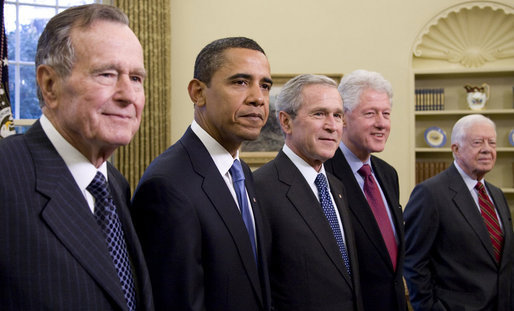
I’ll See Your 2 Popes and Raise You 5 Presidents

That would be, after the next inauguration, Jimmy Carter, George H.W. Bush, Bill Clinton, George W. Bush, and Barack Obama all improving the world during the reign of Hilary or Donald. I wonder if Michael Sean Winters had President Obama in mind when he wrote:

All politicians should write their memoirs. After that, they should retire from the public stage beyond the occasional speech and whatever work the management of a presidential library entails. It is unhealthy for a democracy if new slots on the stage are not opened with regularity. Stroking the egos of former presidents is redundant. And, creating these personalized, secular and necessarily politicized charities will, beyond doubt, harm the brand of charity over time.

When professional athletes retire, they have a long life ahead of them. But they have precedents. Color commentators. Coaches. Automobile dealerships. Not so with presidents. Where do you go after being the most powerful man in the free world? Even presiding over Harvard seems like slumming.

Winters thinks the Clintons’ problem is moral earnestness:

The real problem here is not so much the foundation itself as the tone deafness of the Clintons to the suspicions of their motives. I have noted before that there is something creepy about the ethics of the Clintons, something commonly found among the do-gooders of the world. It goes like this: I am a good person, and X is not a good thing to do, yet I did it, therefore X must not be such a bad thing after all. It is true that they no doubt mix up their prideful motives with their altruistic ones. Find me the politician who doesn’t? But they take it to a level that is noxious.

I think it has more to do with their former lack of wealth. Hilary had to find a law job after Bill lost the Arkansas governor in 1980. They were supposedly in serious debt. How do you rub shoulders with the rich and famous (and Yale Law alums) if you aren’t rich? Well, you speculate in real estate, you take really really big speaking fees. Once out of the White House, you form a charity like the Gates. That shows you are philanthropic and rich. But it doesn’t play well with the hillbilly/hound dog in Bill, just as Huma’s break with Anthony Weiner doesn’t make Hilary look all that virtuous for standing by her man.

Political Reflections — Pious or Otherwise

The debate last night has many Americans thinking about politics, not to mention the presidential campaign more generally. What these moments bring out are a host of observations on the nature of politics by believers. Some, like the Alliance Defending Freedom, have declared this coming Lord’s Day to be “Pulpit Freedom Sunday.” Pastors are supposed to use sermons to evaluate the presidential candidates according to “biblical truths and church doctrine.” Brian Lee, a URC pastor in Washington, D.C., doesn’t think much of this effort:

But most pastors are reluctant to exchange their spiritual freedom from politics to demonstrate their political freedoms for politics. A survey of 1,000 mainline and evangelical protestant pastors released this week suggests that only 1 in 10 believe they should endorse a candidate from the pulpit, despite the fact that almost half plan to personally endorse outside of their church role.

Furthermore, previous studies have shown that this reluctance isn’t based on belief that the government has a say on the content of their speech. Clearly, many pastors are constrained by the sanctity of their office, and in particular, the pulpit. They recognize the very real tradeoff that in our polarized age political speech may offend and drive off many members of the flock they are called to shepherd.

Furthermore, the New Testament offers no encouragement for direct political action. When Jesus was asked a trick question about the propriety of paying taxes — is there any other kind? — he asked whose name was on the coin, and told his followers to “Therefore render to Caesar the things that are Caesar’s.” Later, when on trial for his life, he did not deny his royal authority, but instead claimed “My kingdom is not of this world.”

Then there are those instances where Christians try to strike a balance — avoid extremes at all cost. Justin Taylor offers an example of this:

It is true that “this world is not our home,” but it’s not true that “I’m just passing through” like a leisurely amusement park ride.

We are dual citizens, responsible and active members of both God’s spiritual kingdom and earthly kingdom. And if we seek to love the Lord our God with all our heart, soul, and strength—and to love our neighbor as ourselves—then we should care to some degree about politics and elections and the role of government in our land. . . .

Some argue that we should be invested in evangelism or preaching or social justice instead of politics. But most of us can care about both. Let me offer two reasons why we, as Bible-believing, gospel-centered evangelicals, should care about politics at varying levels and degrees.

First, we care about politics because we care about God’s glory and God’s good gift. Everything is designed to be from God and through God and to God (Rom. 11:36)—including our government. Everything we do—from drinking our coffee in the morning to having a sandwich for lunch to voting at the booth to serving as an elected official—is to be done for the glory of God (1 Cor. 10:31). . . .

Second, we care about politics because we care about the good of our neighbors and the good of our country. If you have to choose between evangelism and politics, choose evangelism. Saving an eternal soul is more important than fixing a temporal need. But most of the time, we don’t have to choose.

In point of fact, we do need to choose based on how we reflect on this stuff. If evangelism is more important than transforming the city or electing the right candidate, it will mean that we treat cities and candidates as less important. People who aren’t invested in Major League Baseball don’t care about the playoffs, even if they care in some way about the players who are citizens or their neighbors who are fans. Our powers of assessment affect the time we devote to certain activities. Priorities matter. And that is why some members of the Gospel Coalition are trying to find ways to elevate the importance of the arts, cities, and Christian cultural (and political) engagement. One of the easiest Christian strategies is to follow Abraham Kuyper and call such activity “holy.” Then the temporal and earthly gains the significance of the eternal and the heavenly. I wish the folks at Gospel Coalition would mind the priority of their organization’s name.

This leaves the best reflection of all on politics — the one uncluttered by religious outlook. Here I cut and paste from a post earlier today at Front Porch Republic.

The blogosphere is filled with opinions on last night’s debate between the president and the challenger. The chattering classes has gotten a whole lot larger. Unless you are a historian and follow the posts at the History News Network, you probably didn’t see Leo Ribuffo’s reflections. A good friend who teaches history at George Washington University, is writing a biography of Jimmy Carter, and calls himself a McGovern Democrat, Leo is also wittily acerbic. Here is a good example (the rest is here):

Romney obviously won. The question is why. Quite possibly he won because he was channeling his inner Governor George Romney, a moderate Republican in the context of his era. In other words, having secured the Republican nomination, Mitt looked confident and relaxed because he was no longer confined to saying only things he didn’t believe. Perhaps if Romney is elected this inner George would prompt him to restrain the cultural conservatives and limited government zealots who dominate his party. I wouldn’t bet on it, but who knows? Lack of principle made Richard Nixon a better president for the welfare state than anyone expected.

Perhaps Obama lost the debate because he was having an off night. Or because he was over-confident. Or conversely, sensing the precariousness of his situation given the high level or unemployment, he channeled his inner Tom Dewey and decided to sit on his lead in the polls. Or perhaps, channeling his inner Michael Dukakis, he actually thinks a presidential election is about competence, not ideology. But I would speculate further that Obama had trouble mounting an effective and spirited defense of the welfare state because at heart he is a “new kind of Democrat” skeptical of government programs.

Whatever the reasons, Obama was lousy. Some pundits instantly attributed his abysmal performance to his “professorial” demeanor. This dopey short-hand has now become standard, akin to Jimmy Carter the engineer (wrong) and George W. Bush the “faith-based” president (even more wrong). Let’s abandon this cliché. Actual professors by definition hold jobs, which means that we had at least one successful job interview in which we looked people in the eye, explained our merits, and showed enthusiasm about our past work and future plans. Then, after being hired, we figured out how to adapt our complex and sometimes esoteric ideas to reach the audience at hand. As my old friend Warren Goldstein of the University of Hartford emailed me in mid-debate, “Most of us have to be 10 times better than that to keep 20 year olds awake in class.”

If George Washington Is Orthodox, What About Barack Obama?

Glenn Beck and Peter Lillback have teamed up again to keep the sacred fire of a civil religion burning, a strange fire that appeals to both Republican Mormons and Republican Presbyterians. Soon after his appearance on the Glenn Beck show, Lillback posted an article for the host’s website on whether or not the founders were religious. (Lillback is responding to a post at Media Matters that contends that Lillback has distorted Washington’s views.)

To make his case, the president of Westminster (Philadelphia), much like he did in his book on Washington, quotes extensively from America’s first president and other founding era worthies. Here are a few of the proof texts for the importance of religion to the original United States government.

Lillback cites a 1776 resolution from the Continental Congress that called for a national fast:

In times of impending calamity and distress; when the liberties of America are imminently endangered by the secret machinations and open assaults of an insidious and vindictive administration, it becomes the indispensable duty of these hitherto free and happy colonies, with true penitence of heart, and the most reverent devotion, publickly to acknowledge the over ruling providence of God; to confess and deplore our offences against him; and to supplicate his interposition for averting the threatened danger, and prospering our strenuous efforts in the cause of freedom, virtue, and posterity.

Lillback also offers evidence from Ben Franklin to support the idea that the founders believed in the power of prayer:

In the beginning of the Contest with Great Britain, when we were sensible of danger we had daily prayer in this room for the Divine protection – Our prayers, Sir, were heard, and they were graciously answered. All of us who were engaged in the struggle must have observed frequent instances of a superintending providence in our favor.

To that kind providence we owe this happy opportunity of consulting in peace on means of establishing our future national felicity. And have we now forgotten that powerful Friend? Or do we image we no longer need His assistance?

I have lived, Sir, a long time, and the longer I live, the more convincing proofs I see of this truth: that God governs in the affairs of man. And if a sparrow cannot fall to the ground without his notice is it probable that an empire can rise without His aid? We have been assured sir, in the Sacred Writings that ‘except the Lord build the house, they labour in vain that build it (Ps. 127:1).’ I firmly believe this, and I also believe that without His concurring aid we shall succeed in this political building no better than the builder of Babel. We shall be divided by our little partial local interests; our projects will be confounded and we ourselves shall become a reproach and bye word down to future ages. I therefore beg leave to move that, henceforth, prayers imploring the assistance of Heaven and its blessing on our deliberation be held in this assembly every morning. . .and that one or more of the clergy of this city be requested to officiate in that service.

Where does all of this material lead? The point of this exercise, at least for Glenn Beck’s audience is to point out bias in both the media and academy against the idea that religion was important to George Washington and company. Lillback writes: “if truth matters to the media, and it must if Media is to really Matter, then the truth of George Washington’s words must really matter as well” He adds that “it is unmistakably clear for those who will read the original sources, and not blindly rely on the unsubstantiated historical revisionism that so often passes as scholarship today, that faith mattered greatly to our Founders.”

Is it just me or does Lillback raise the stakes of truth and impartiality in ways that may be a tad uncomfortable for himself? After all, can the media really be faulted for following the work of historians who have taught and written about eighteenth-century British politics instead of a Presbyterian parson whose own training was in sixteenth-century theology? (By the way, for an interesting, civil, educational, and religiously sympathetic discussion of the American founding, readers should go to American Creation.) Of course, Lillback has a 1,200-plus page book behind his claim. But doesn’t it seem a tad biased for this book to be published by Lillback’s own book imprint? So if Lillback wants to avoid the error of media bias or historical revisionism, then shouldn’t he found an outlet for his historical scholarship a few steps removed from his own editorial control?

This problem of bias becomes even trickier when you consider that Barack Obama has spoken favorably about Christianity and his own faith in ways even more Christo-centric than Washington. Recall, for instance, the current president’s words at the White House Easter prayer breakfast. (For the entire speech, go here.)

Of all the stories passed down through the gospels, this one in particular speaks to me during this season. And I think of hanging — watching Christ hang from the cross, enduring the final seconds of His passion. He summoned what remained of His strength to utter a few last words before He breathed His last breath.

“Father,” He said, “into your hands I commit my spirit.” Father, into your hands I commit my spirit. These words were spoken by our Lord and Savior, but they can just as truly be spoken by every one of us here today. Their meaning can just as truly be lived out by all of God’s children.

So, on this day, let us commit our spirit to the pursuit of a life that is true, to act justly and to love mercy and walk humbly with the Lord. And when we falter, as we will, let redemption — through commitment and through perseverance and through faith — be our abiding hope and fervent prayer.

If you were as inclined to read Washington’s generic affirmations of providence as charitably as Lillback does, wouldn’t you also be inclined to view Obama as an evangelical Christian? Well, the reply might be, “Obama tolerated Jeremiah Wright and so that indicates the flaws in his devotion.” But Washington’s associations were not always so clean or holy. As the folks over at American Creation have explored, Washington made favorable comments about the Universalists. One could also point out that Washington was a Freemason. So it’s not as if Washington’s faith is squeaky clean compared to Obama’s.

In which case, the reason why Washington gets an orthodox grade and Obama fails has more to do with politics than religion. Why a Federalist is more attractive to Republicans than a Democrat is not entirely obvious since the political antagonisms that divided Federalists from Democratic-Republicans during 1790s about how to be a republic free from European political pressures are a long way from issues that divide today’s Republicans and Democrats over how best to be a superpower – an entity that the founders would hardly recognize. I for one would prefer Washington’s politics to the current convictions that dominate the city named after him. But Lillback’s point is not supposed to be about politics. It’s supposed to be about taking religion seriously. So then shouldn’t we take Obama’s religion seriously? And shouldn’t Obama’s assertions indicate that the bias of secular, liberal America is not nearly as partial as Lillback and Beck assume? Or that there is plenty of bias to go round?

But if Lillback’s point is finally about the need for the media and academy to take religion seriously, perhaps he could have pointed the way by not making too much of the civil religion that went with being a colonial white Protestant of British descent. In fact, one way to take religion seriously would be to follow the counsel of the psalmist who advised not putting our trust in princes. This was the instruction that led Martin Luther to write, “That word above all earthly powers, no thanks to them abideth.” If the psalmist and Luther were right, then a serious approach to the religion of the Bible might well teach that the search for a Christian America is a foolish enterprise the fortunes of the kingdom of grace don’t depend on presidents, senators, or monarchs.

Taking religion seriously might also mean taking irreligion seriously. Part of the point of the exercise of finding a devout and orthodox George Washington appears to be to discredit those Americans who are not as inclined to think about Christianity the way that our first president did. If we can show that the American republic was originally much more friendly to religion than the current regime, the logic seems to go, then Christians have the upper hand over secularists when it comes to understanding the character and identity of the United States.

The problem with this debating tactic for Presbyterians who live in the United States – aside from the religious freedom granted by the Constitution – is that American Presbyterians’ own confession of faith recognizes a similar responsibility of the magistrate to protect the religion, as well as the irreligion, of all citizens. About a decade after John Witherspoon signed the Declaration of Independence, he helped to revise the Presbyterian Church’s confession of faith in a way that went like this:

Civil magistrates may not assume to themselves the administration of the Word and sacraments; or the power of the keys of the kingdom of heaven; or, in the least, interfere in matters of faith. Yet, as nursing fathers, it is the duty of civil magistrates to protect the church of our common Lord, without giving the preference to any denomination of Christians above the rest, in such a manner that all ecclesiastical persons whatever shall enjoy the full, free, and unquestioned liberty of discharging every part of their sacred functions, without violence or danger. And, as Jesus Christ hath appointed a regular government and discipline in his church, no law of any commonwealth should interfere with, let, or hinder, the due exercise thereof, among the voluntary members of any denomination of Christians, according to their own profession and belief. It is the duty of civil magistrates to protect the person and good name of all their people, in such an effectual manner as that no person be suffered, either upon pretense of religion or of infidelity, to offer any indignity, violence, abuse, or injury to any other person whatsoever: and to take order, that all religious and ecclesiastical assemblies be held without molestation or disturbance. (WCF, 23.3)

One way to read this piece of Lillback’s own confession is to suggest that Westminster’s president has not taken religious seriously enough. Not only does he seem to conflate civil religion with the genuine article, but he appears to have neglected his own communion’s teaching about the freedoms for believers and unbelievers that the state should protect. Rather than scoring points in the culture wars against liberals, Lillback’s argument boomerangs on everyone who thinks that taking religion seriously applies only to the “other” side.