Fundamentalist Controversy Redux

John Allen explains how Roman Catholicism has come along side Protestantism. The Left and Right aren’t even on the same page of what constitutes truth:

… at this point most defenders of Pope Francis haven’t accused critics of being dissenters, nor have they suggested that people who uphold contrary positions on the substantive positions associated with the pontiff, such as opening Communion to divorced and civilly remarried Catholics, are thereby committing heresy.

The implication seems to be that fans of the pope are more generous, less vicious, and less inclined to question people’s bona fides as Catholics. There is, in other words, often a presumption of moral superiority in the observation that “we don’t talk that way.”

Simply as a descriptive matter, that proposition seems a bit disingenuous. Many in the pro-Francis camp don’t invoke concepts such as “heresy” and “dissent,” because frankly, it’s not the worst insult they can think of with which to slur an opponent.

Instead, they use terms that Francis himself also regards as abhorrent, such as “rigid,” “inflexible,” “legalistic,” “clerical,” and, of course, worst of all, “anti-Vatican II.”

In effect, what’s on display here is one of the defining differences between the Catholic left and the Catholic right over the last fifty years.

For the right, “heresy” and “dissent” are about the worst things imaginable, so when they want to say “x is terrible,” that’s the language that comes naturally. For the left, the equivalent horror is “rolling back the clock” on the Second Vatican Council, so when they want to call something or someone awful, that tends to be the verbal packaging in which the complaint comes wrapped.

Someone trying to remain objective about today’s debates would probably have a hard time concluding that either side has a claim on the moral high ground, since both are charging the other with virtually the vilest crime in their respective vocabularies.

At the same time, gatekeepers like John Allen don’t see when modernism is part of the warp and woof of church life:

Despite challenges intolerance brings, Camilleri stressed that religion, Christianity included, has an endless capacity for good, not only for individuals and communities, but for society as a whole.

The Church, he said, “does not pretend…to substitute for politics. Nor does the Church claim to offer technical solutions to the world’s problems since the responsibility of doing that belongs elsewhere.”

What religion does, then, is offer specific guidelines to both the community of believers, and to society as a whole.

Religion by its nature “is open to a larger reality and thus it can lead people and institutions toward a more universal vision” and a “horizon of fraternity” capable of enriching humanity, Camilleri said.

The Holy See, then, “is convinced that for both individuals and communities the dimension of belief can foster respect for fundamental freedoms and human rights, support democracy and rule of law and contribute to the quest for truth and justice.”

Dialogue and partnerships between religions and with religions, he said, “are an important means to promote confidence, trust, reconciliation, mutual respect and understanding as well as to foster peace.”

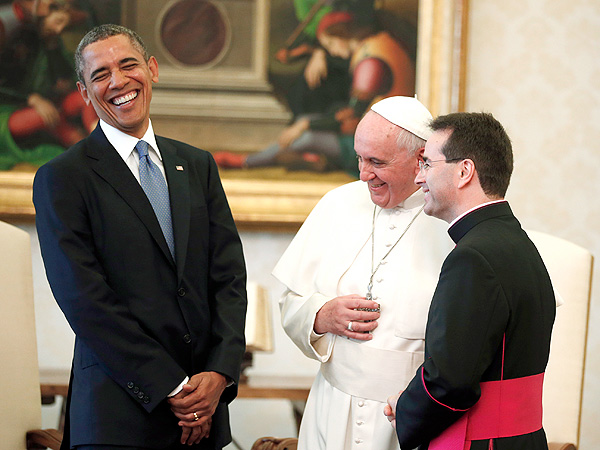
If religion did all that, I’m sure President Obama would have gotten on board. Wait. He did:

Holy Father, your visit not only allows us, in some small way, to reciprocate the extraordinary hospitality that you extended to me at the Vatican last year. It also reveals how much all Americans, from every background and every faith, value the role that the Catholic Church plays in strengthening America. (Applause.) From my time working in impoverished neighborhoods with the Catholic Church in Chicago, to my travels as President, I’ve seen firsthand how, every single day, Catholic communities, priests, nuns, laity are feeding the hungry, healing the sick, sheltering the homeless, educating our children, and fortifying the faith that sustains so many.

And what is true in America is true around the world. From the busy streets of Buenos Aires to the remote villages in Kenya, Catholic organizations serve the poor, minister to prisoners, build schools, build homes, operate orphanages and hospitals. And just as the Church has stood with those struggling to break the chains of poverty, the Church so often has given voice and hope to those seeking to break the chains of violence and oppression.

And yet, I believe the excitement around your visit, Holy Father, must be attributed not only to your role as Pope, but to your unique qualities as a person. (Applause.) In your humility, your embrace of simplicity, in the gentleness of your words and the generosity of your spirit, we see a living example of Jesus’ teachings, a leader whose moral authority comes not just through words but also through deeds. (Applause.)

You call on all of us, Catholic and non-Catholic alike, to put the “least of these” at the center of our concerns. You remind us that in the eyes of God our measure as individuals, and our measure as a society, is not determined by wealth or power or station or celebrity, but by how well we hew to Scripture’s call to lift up the poor and the marginalized — (applause) — to stand up for justice and against inequality, and to ensure that every human being is able to live in dignity –- because we are all made in the image of God. (Applause.)

You remind us that “the Lord’s most powerful message” is mercy. And that means welcoming the stranger with empathy and a truly open heart –- (applause) — from the refugee who flees war-torn lands to the immigrant who leaves home in search of a better life. (Applause.) It means showing compassion and love for the marginalized and the outcast, to those who have suffered, and those who have caused suffering and seek redemption. You remind us of the costs of war, particularly on the powerless and defenseless, and urge us toward the imperative of peace. (Applause.)

Holy Father, we are grateful for your invaluable support of our new beginning with the Cuban people — (applause) — which holds out the promise of better relations between our countries, greater cooperation across our hemisphere, and a better life for the Cuban people. We thank you for your passionate voice against the deadly conflicts that ravage the lives of so many men, women and children, and your call for nations to resist the sirens of war and resolve disputes through diplomacy.

You remind us that people are only truly free when they can practice their faith freely. (Applause.) Here in the United States, we cherish religious liberty. It was the basis for so much of what brought us together. And here in the United States, we cherish our religious liberty, but around the world, at this very moment, children of God, including Christians, are targeted and even killed because of their faith. Believers are prevented from gathering at their places of worship. The faithful are imprisoned, and churches are destroyed. So we stand with you in defense of religious freedom and interfaith dialogue, knowing that people everywhere must be able to live out their faith free from fear and free from intimidation. (Applause.)

And, Holy Father, you remind us that we have a sacred obligation to protect our planet, God’s magnificent gift to us. (Applause.) We support your call to all world leaders to support the communities most vulnerable to changing climate, and to come together to preserve our precious world for future generations. (Applause.)

Your Holiness, in your words and deeds, you set a profound moral example. And in these gentle but firm reminders of our obligations to God and to one another, you are shaking us out of complacency. All of us may, at times, experience discomfort when we contemplate the distance between how we lead our daily lives and what we know to be true, what we know to be right. But I believe such discomfort is a blessing, for it points to something better. You shake our conscience from slumber; you call on us to rejoice in Good News, and give us confidence that we can come together in humility and service, and pursue a world that is more loving, more just, and more free. Here at home and around the world, may our generation heed your call to “never remain on the sidelines of this march of living hope.”

For that great gift of hope, Holy Father, we thank you, and welcome you, with joy and gratitude, to the United States of America. (Applause.)

If More Congregationalists Read Machen

They might understand the difference between a Baptist and Presbyterian. But to UCC pastor, Peter Laarman, Tony Campolo and Shane Claiborne’s proposal to re-brand evangelicalism (post-Trump) is a fool’s errand:

Campolo and Claiborne even get their history wrong. What they regard as the first successful re-branding of Bible-centered “orthodox” American Christianity in the early 20th century was in fact a complete failure, just as their proposed “Red Letter” re-branding will be this era.

They cite Carl F.H. Henry as the principal re-brander in the 1930s, but Carl Henry was not really a force to be reckoned with prior to the 1940s and 1950s. Moreover, Carl Henry’s beliefs were immediately understood to be contaminated by the same poisons that had fatally tainted Fundamentalism: i.e., a rigid view of biblical inerrancy (including a literalist view of the miracle stories), insistence that mere individual conversion fulfills God’s will, complete acceptance of the old patriarchal frame, etc.

It would be hard to find any daylight at all between the theological commitments of Carl Henry and those of J. Gresham Machen, who was heralded during the 1930s as the single brightest light among the Fundamentalists.

See what he did there? Machen signals fundamentalism (and Laarman didn’t even give Orthodox Presbyterians a trigger warning). Therefore, invoking Carl Henry is really to say you haven’t progressed beyond fundamentalism (yuck!), which makes Campolo and Claiborne even more clueless from a mainline Protestant perspective than even progressive evangelicals can fathom.

The problem is that you can see separation between Machen and Henry if you actually care more about theology, sacraments, and polity than about being in the American mainstream. Henry may have been a Calvinist on soteriology but his Reformedness didn’t go much beyond that (plus his high view of the Bible). Henry also refused to baptize babies, which puts Machen closer to Laarman than to Henry. And then Machen took Presbyterian polity seriously — hello, his church refused interdenominational cooperation in settings like the National Association of Evangelicals where Henry was an intellectual guru.

But that kind of Protestant fussiness only comes up fundamentalist for mainliners. Even though telling the difference between Congregationalists and mainline Presbyterians is impossible (and something you’re not supposed to do in polite Protestant ecumenical company), if you do did in your heels on denominational identity you are merely a separatist. You lack the good graces and tolerant bonhomie of mainstream, well-connected Protestantism. Never mind that after 135 years of ecumenical activism, the UCC and the PCUSA remain — get this — separate. And by all means don’t notice that Congregationalists and Presbyterians descend from the mother of all church separations — 1054, the year that the church Christ founded (as some put it) split up.

Lots of separations out there in church history, but the UCC puts “United” in church unity. As if.

When Fundamentalists Do It, It’s not Sexy

It in this case is separatism. Back in grad school days the historiographical truism about evangelical Protestantism was that they were not separatists. Fundamentalists were. And so, evangelicals were good (broad minded) and fundamentalists were bad (intolerant). The dividing line was particularly the question of whether conservative Protestants could cooperate with the mainline (read liberal) Protestant denominations. When Billy Graham did reach out to mainline Protestants during his 1957 New York City Crusade (hee hee), fundamentalists like Bob Jones (harumph) broke with Graham’s evangelism. Thus you have separatism and the difference between an evangelical and a fundamentalist. The latter is an evangelical who is angry. Or, an evangelical is someone who likes Billy Graham (thank you George Marsden).

You wouldn’t know it, but separatism is rearing its poorly groomed head again and its not fundamentalists’ fault. Consider the following forms of separatism. First, the Benedict Option (as stated by Ken Myers):

The recovery of the culture of the people of God will make us look profoundly different from our neighbors. In a post-Christian society, all faithful people begin to look a little Amish. But we must remember that we are always against the world for the world.

Bob Jones didn’t withdrawal either. He didn’t even look Amish.

Then consider the academy’s moralism in the case of Yale professor, Thomas Pogge, allegedly guilty of sexually harassing female students:

To some students, responding means boycotting Pogge’s classes. A closed Facebook group called Students Against Pogge asks supporters to stand in solidarity with Lopez Aguilar “and the other foreign women of color targeted by [Pogge] by, at a minimum, not taking any of his classes in the fall.” The page notes that it’s also “a place to brainstorm other means of pressuring the university into making student voices heard and removing Pogge from the classroom,” according to the popular philosophy blog Daily Nous.

Other academics have said they won’t participate in conferences where Pogge is present. Most controversially, some professors have said that responding means eliminating Pogge from their syllabi.

James Sterba, a professor of philosophy at the University of Notre Dame, for example, told The Huffington Post that he’s no longer including Pogge’s work in exams for graduate students. “You don’t need him,” Sterba said. “He carries too much baggage — he doesn’t have to be cited anymore. … He’s a negative image and we don’t need that. Maybe if he was Einstein we’d have to cite him, but he’s not.”

That sounds like shunning.

But fundamentalists still bear the burden of separatism:

Thus, by the mid to late 1950s, the heirs of anti-modernist “second phase” fundamentalism were divided. An organization such as the American Council of Churches and separatists such as Rice and Jones Sr. and Jr. understood themselves as continuing in the historic line of militant, anti-modernist fundamentalism with a new emphasis on ecclesiastical separation. On the other hand, more open-minded heirs of second-phase fundamentalists, who would lead the neo-evangelical surge, sought to return to the era associated with the nineteenth-century evangelical scholarship of The Fundamentals.

On the verge of the tumultuous sixties, the fundamentalist movement had become deeply divided. Those who affiliated with the positive agenda of the non-separatist faction took the name neo-evangelical (eventually simply evangelical) and the separatists militantly clung to the label fundamentalist. Neo-evangelicals often repudiated the term fundamentalist, and fundamentalists did the same with the neo-evangelical moniker.

What if separatism is basic to what all humans do? We identify with some things and reject others. None of us are tolerant all the way down. We are all fundamentalists.

BenOp There, Done That

Alan Jacobs explains why Rod Dreher’s Benedict Option is unobjectionable:

The Benedict Option, as I understand it, is based on three premises.

1. The dominant media of our technological society are powerful forces for socializing people into modes of thought and action that are often inconsistent with, if not absolutely hostile to, Christian faith and practice.

2. In America today, churches and other Christian institutions (schools at all levels, parachurch organizations with various missions) are comparatively very weak at socializing people, if for no other reason than that they have access to comparatively little mindspace.

3. Healthy Christian communities are made up of people who have been thoroughly grounded in, thoroughly socialized into, the the historic practices and beliefs of the Christian church.

From these three premises proponents of the Benedict Option draw a conclusion: If we are to form strong Christians, people with robust commitment to and robust understanding of the Christian life, then we need to shift the balance of ideological power towards Christian formation, and that means investing more of our time and attention than we have been spending on strengthening our Christian institutions.

Jacobs doesn’t understand why anyone would dissent. I largely agree, though I have to admit I’m not willing to give up on HBO or Phil Hendrie just yet. At the same time, I understand that certain — ahem — television shows and Phil’s humor may not be appropriate for children.

The dissent is not with the specifics of Rod’s BenOp. The dissent is with Dreher’s (and Jacob’s) sense of discovery. Some Christians for a long time have thought about American society, the necessity of alternative institutions, and the problem of passing on the faith in ways that Dreher seems only now (after Obergefell) to have recognized. The dissent also includes some frustration over people like Rod ignoring those earlier forms of opting out of the cultural mainstream. For a long time, the mainline Protestant churches, which is where I believe Rod started his Christian journey, thought the fears of fundamentalists about the wider society were delusional, based on conspiratorial thinking or worse. Only once the good taste of mainline church life needed to reckon with homosexual clergy and marriage did conservatives in mainline churches begin to entertain the sort of thoughts that fundamentalists (and some ethnic Protestants) had sixty years (or more) earlier. Even at Jacobs’ former institution (Wheaton College) and probably at his current one (Baylor), fundamentalism is/was something to be avoided. Why? It was separatist, sometimes even — trigger warning — double separatist. But now, not separating is a bad thing? Hello. The train left the station.

Will naming such cultural segregation after a saint and linking it to a moral philosopher (Alasdair MacIntyre) make fundamentalism look more attractive? Probably. But I’d like Dreher to acknowledge those saints who came in between Monte Cassino and After Virtue. They were ahead of this time even if coming after Benedict.

How Far Will Conservatives Bend?

Ross Douthat finds the progressive fundamentalist inner-self of conservative Roman Catholics (is this what Bryan and the Jasons signed up for?):

Let’s make a partial list of the changes that most conservative Catholics have accepted — sometimes grudgingly, sometimes enthusiastically — in their church since the 1960s. A transformation in the church’s attitude toward liberal democracy and religious freedom. A transformation in the church’s attitude toward other Christian churches and non-Christian religions. A total renovation of the church’s liturgy, one with inevitable implications for sacramental life, theology, biblical interpretation, the works, that was staggering in hindsight but accepted at the time by everyone except a tiny minority. A revolution in sacred architecture, albeit one that stalled out once it became apparent that it was, you know, kind of terrible. Massive shifts in church rhetoric around issues of personal morality (sexual morality very much included) even where the formal teaching remained intact. Stark changes in the way the church talks about sin, hell and damnation, and openings (again, including among conservative Catholics) to theological perspectives once considered flatly heterodox. Clear changes, slow-moving or swift, in the Vatican’s public stance on hot-button issues like the death penalty and torture (and perhaps soon just war theory as well). The purging or diminution of a host of Catholic distinctives, from meatless Fridays to communion on the tongue to the ban on cremation to … well, like I said, it’s a partial list, so I’ll stop there.

So whatever the conservative religious psychology, however strong the conservative craving for certainty and stability, nobody looking at the changes wrought in the church over the last fifty years could possibly describe conservative Catholicism as actually committed, in any kind of rigorous or non-negotiable sense, to defending a changeless, timeless church against serious alteration. (Indeed, this is a point that traditionalist Catholics make about the mainstream Catholic right at every opportunity!)

Rather, conservative Catholicism has been on a kind of quest, ever since the crisis atmosphere of the 1960s and 1970s, to define certain essentials of the faith in a time of sweeping flux and change, while effectively conceding (to borrow Linker’s architectural image) that reformers can rearrange and remove the bricks of Catholicism so long as they don’t touch those crucial foundations. For a long time this conservative quest was lent a certain solidity and rigor and self-confidence by John Paul II and Benedict XVI. But the advent of Francis has made it clear that conservative Catholicism doesn’t have as clear a synthesis as conservatives wanted to believe, and that in some ways the conservative view of the post-Vatican II church is a theory in crisis — or the very least that it lacks a clear-enough account of itself, and of what can and cannot change in its vision of Catholicism, to navigate an era in which the pope himself does not seem to be “on side.”

The parallel here between Douthat and Carl Henry & Co. is striking. Try to preserve conservative Protestantism by identifying essentials like the National Association of Evangelicals list of doctrinal non-negotiables. The point about how to interpret history is also apt. Neo-evangelicals had to find a narrative that placed them in the mainstream of American Protestantism without offending Arminians, Calvinists, or Pentecostals. The way to do that was to read sixteenth-century Protestantism (Reformation) into the First and Second Pretty Good Awakenings. Meanwhile, like conservative Roman Catholics, Douthat has to distance himself from the SSPXers just as Henry and Billy Graham disavowed fundamentalism as mean.

That sort of spiritual and theological retrieval may have its moments, but it is hardly — as the those inclined to overstatement like to put it — “robust.”

Douthat goes on to do a pretty good impersonation of what it felt like to be an evangelical in the PCUSA who also belonged to the NAE while General Assembly after General Assembly did not perform as badly as it might:

. . . if Pope Francis was blocked from going the full Kasper, he still produced a document that if read straightforwardly seems to introduce various kinds of ambiguity into the church’s official teaching on marriage, sin and the sacraments — providing papal cover for theological liberalism, in effect, without actually endorsing the liberal position. It’s not the first time this has happened; as Joseph Shaw notes, it’s very easy to find “examples of Popes and other organs of the Church issuing documents which seemed, if not actually motivated by a rejection of traditional teaching, then are at least motivated by a desire not to be in conflict with those who reject it.” But it’s the first time it’s happened recently on a controversy of this gravity, on an issue where conservative Catholics have tried to draw a clear line and invested so much capital … and I think it’s fair to say that they (that we) don’t know exactly how to respond.

Do conservatives simply declare victory, because the worst didn’t happen, the full theological crisis didn’t come, and it’s important to maintain a basic deference to papal authority (itself a big part of the JPII-era conservative synthesis) so long as no doctrinal line is explicitly crossed? Do they acknowledge the document’s deliberate ambiguities, as my own treatment did, when doing so might give aid and comfort to liberals who are eager to make the most of any perceived shift? Do they deny that any real ambiguity exists, not out of pure deference to Francis but because given conservative premises this document should be read in the context of prior documents, not as a stand-alone, and if you read it that way there’s no issue, no rupture, everything’s fine? Do they stress the technicalities of what counts as magisterial teaching to make the document’s seeming ambiguity less important or less binding? Do they attack the document (and the pope) head-on, on the theory that conservative Catholicism’s essential problem is its vulnerability to constant end-arounds, constant winking “pastoral” moves, and that these need more forthright opposition?

Conservatives have tried all of these strategies and more. Some sincerely believe that the letter of the document is a defeat for liberals and that anxious Catholic pundits are overstating the problems with its spirit. Some think the problems with its spirit are real but also think the church will be better off if conservatives simply claim the document as their own and advance the most orthodox reading of its contents. Some think the best course is to downplay the document’s significance entirely and wait for a different pope to clarify its ambiguities. Some (mostly journalists, as opposed to priests or theologians) think it’s important to acknowledge that this pope has significantly strengthened liberal Catholicism’s hand, and to describe that reality accurately and answer his arguments head-on where they seem to cut against the essentials of the faith. Some think that this document, indeed this entire pontificate, has vindicated a traditionalist critique of post-conciliar Catholicism, and that the time has come for a complete rethinking of past concessions and compromises, past deference to Rome. Some are ambivalent, uncertain, conflicted, unsure of what comes next. Some have shifted between these various perspectives as the debate has proceeded. (And this long list excludes the many moderately-conservative Catholics who didn’t see a grave problem with the Kasper proposal to begin with, or who have simply drifted in a more liberal direction under this pontificate.)

Consequently, while conservative Roman Catholics discern the best defense of Pope Francis, the claims of papal audacity by Bryan and the Jasons look all the more dubious. If the interpret in chief nurtures uncertainty, what’s the point of abandoning Protestant diversity?

I do not have an answer, alas, to all of this uncertainty. But I do think it’s important to acknowledge its existence, rather than taking a kind of comfort, as some conservative Catholics do, in being accused of Total Inflexibility in Defense of Absolute Truth by writers like Damon Linker. For good or ill (or for good in some cases, and ill in others), that has rarely been an accurate description of the conservative position in the modern church, and it clearly isn’t accurate at the moment. Conservative Catholicism isn’t standing athwart church history yelling stop; since (at least) the 1960s it’s always occupied somewhat more unstable terrain, and under Francis it’s increasingly a movement adrift, tugged at by traditionalism and liberalism alike, and well short of the synthesis that would integrate fifty years of rapid change into a coherent picture of how the church can remain the church, what fidelity and integrity require.

You mean the instability of post-Vatican II Roman Catholicism was the church Christ founded? Note to apologists: update your defense as much as your bishops updated your communion.

We're Closer to Turkey than You Think?

This may be the most important context for considering the controversy over Islam at Wheaton College, namely, that Americans themselves are not all that comfortable with secularity and Islam reveals where the lumps in the mattress are. Rod Dreher quoted a poignant part of Ross Douthat’s column on how the West views Islam, as either as conservatives believe “radically incompatible with Western liberal democracy, and can never be reconciled to it; or, as many liberals believe, it is capable of assimilating to become as tame and non-threatening as most forms of Christianity and Judaism in the West.” In the Protestant world, either Larycia Hawkins or Tim Bayly. According to Douthat:

The good news is that there is space between these two ideas. The bad news is that we in the West can’t seem to agree on what that space should be, or how Christianity and Judaism, let alone Islam, should fit into it.

Devout Muslims watching current Western debates, for instance, might notice that some of the same cosmopolitan liberals who think of themselves as Benevolent Foes of Islamophobia are also convinced that many conservative Christians are dangerous crypto-theocrats whose institutions and liberties must give way whenever they conflict with liberalism’s vision of enlightenment.

They also might notice that many of the same conservative Christians who fear that Islam is incompatible with democracy are wrestling with whether their own faith is compatible with the direction of modern liberalism, or whether Christianity needs to enter a kind of internal exile in the West.

It almost sounds like Turkey’s war between Islamic friendly politicians and secularists, from a piece quoted sometime back from Mustafa Akyol:

As you probably well know, Turkey has long been stressed by political tension between religious conservatives and secular nationalists, the latter also known as the Kemalists. However, that main fault line is somewhat passé these days given the emergence of a new kind of tension between the religious conservatives who had triumphed together in (OR: previous) tension from years gone by. This time, it is the AKP (Justice and Development Party) government and the powerful Fethullah Gülen Movement that are at odds with each other. . . .

The term I translated here as “referee” (“hakem”) is a powerful word in Islam, referring to a neutral and fair judge who can settle disputes. And it is interesting that Ms. Eraslan, a pious, headscarf-wearing Muslim, thinks that this “referee” may be none other than secularism. Of course, this would not be the type of secularism that Turkey’s Kemalists have imposed for decades. That peculiar ideology, called “laiklik” (from the French laïcité), was based on the assumption that there was something wrong with religion and therefore it needed to be suppressed by the state.

What Ms. Eraslan probably implied, and what Turkey indeed needs, is a more American-like secularism. In other words, it should be based on the recognition that there is a problem not with religion, but with the concentration of political power.

Unlike Turkey, though, and the conflict between religion and laicite, could the struggle in the U.S. be the one that animated fundamentalists and modernists during the 1920s? The political left in the United States, like modernists, does not advocate the removal of religion from public life. They like religion (think Martin Luther King, Jr.). Jim Wallis is not a threat to them.

So too, the right also likes religion of the right sort (see what I did there?). It used to be Jerry Falwell and James Dobson. Now it’s Rick Santorum and Kim Davis.

The problem is that both left and right embrace a form of American exceptionalism that needs religion to endow the United States with a righteous or holy purpose.

In that case, if we are still living with the dynamics of the fundamentalist controversy, has the United States learned lessons it can pass on to the Muslim world?

Wheaton College: For Christ, His Kingdom, and Islam?

Thanks to John Fea I now know about a graduate of Wheaton College, Aaron Griffith, who thinks that Dr. Larcyia Hawkins is simply doing what the institution’s founder, Charles Blanshard, would do (WWCBD?):

With this history in mind, Hawkins’s activism on behalf of Muslims begins to look a lot less like an aberration and more in keeping with the original vision of the college. The antebellum evangelical tradition Hawkins drew upon was one primarily concerned with upholding human dignity and advocating for those on the margins. Muslims facing discrimination and threats of violence in present-day American life surely fit that description.

In 1842, Jonathan Blanchard preached a sermon on slavery before a church synod in Cincinnati. Over eight pages, he presented forceful arguments against slaveholding Christians, pointing out flaws in their Biblical exegesis and showing how “the property-holding of men is the worst conceivable form, and the last possible degree of oppression.”

During his sermon, Blanchard spent two short paragraphs in the sermon talking about the doctrine of God, where he argued that “Whatever leads men to regard Jehovah as something different from what he is, prevents their acting towards him as they ought.” It was clear from these few lines that Blanchard saw theological precision as an important good.

But Blanchard was not especially worried about muddled theology in and of itself. Instead he argued that slavery corrupted “true religion.” Failure to love one’s neighbor or denounce oppression was the real theological problem.

Hawkins, with her stress on “embodied solidarity” with her Muslim neighbors, would have found herself in good company in 1842. She drew not on liberal theology, secularized notions of human rights or shared American identity, but on a robust evangelical tradition of the biblical call to advocate on behalf of people made in the image of God.

So what happened to Wheaton? According to Griffith who follows John Schmalzbauer, it’s fundamentalism’s fault:

In the early 20th century, dancing, card playing, and theater attendance replaced slavery and mistreatment of Indians as Wheaton’s moral bugaboos. Focus on the fundamentals unfortunately meant that social concerns were often swept aside, and, as religion scholar John Schmalzbauer has shown, fundamentalists tied to Wheaton propounded their own brands of Christian bigotry (in this case anti-Semitism).

Schmalzbauer alleged anti-Semitism was part of Wheaton’s past (even though the dots were pretty disconnected):

In 2010 I returned to campus to deal with some of these ghosts. In a lecture series commemorating Wheaton’s 150th anniversary, I lamented the history of Protestant bigotry in my native Twin Cities, focusing on two fundamentalist firebrands. Together, they led journalist Carey McWilliams to declare Minneapolis the “capital of anti-Semitism in the United States.” Welcoming the paramilitary Silver Shirts to the First Baptist Church (“Why Shiver at the Sight of a Shirt?”), William Bell Riley actively promoted the Protocols of the Elders of Zion throughout the Upper Midwest. Preaching a similar message, Luke Rader’s River-Lake Gospel Tabernacle was deemed “the worst place, barring none in the Twin Cities, as far as anti-Semitic vitriol.” Both men had ties to Wheaton College. While Riley preached the funeral sermon for Wheaton’s second President Charles Blanchard, Rader’s brother Paul was a college trustee.

But what do these Wheaton grads think Wheaton was back in the days of Jonathan Blanchard? Lena Dunham’s Oberlin? George Marsden’s reasons for including Wheaton’s founder and founder’s son in his history of — ahem — fundamentalism were sound, even common sensical:

These fights [against Masonry and Roman Catholicism] were simultaneously conservative and radical. Blannchard, who had by now been joined in his campaigns by his son Charles, believed that America was a “Christian nation” and worked for a Christian amendment to the Constitution. Their concepts of Christian ideals, however, showed little regard for prevailing middle-class stands. The 1874 platform of the National Christian Association included recognition of Christianity in the United States Constitution, Sabbath and prohibition laws, outlawing secret lodges, preservation of the “civil equality secured to all American citizens by articles 13th, 14th, and 15th of our amended Constitution,” international arbitration for peace, that “land and other monopolies be discountenance,” “justice to Indians,” abolition of the Electoral Colleges, and election of the President and Vice President by direct vote of the people….

Jonathan Blanchard’s son Charles, thought deeply dedicated to preserving his father’s views, completed Wheaton’s transition into the new evangelical and eventually fundamentalist outlook. The alliance with the Moody forces was clearly the crucial step…. By the end of his career, Charles was a significant figure in the fundamentalist movement. In 1919 he drafted the doctrinal statement of the Word’s Christian Fundamentals Association and in 1926 arch-fundamentalist William Bell Riley delivered the eulogy at his funeral…. Among [Blanchard’s] favorite texts, recalled from his anti-Masonic forays, were “Have no fellowship with the unfruitful works of darkness” and “Come out from among them and be separate. (Marsden, Fundamentalism and American Culture, 29, 31)

We don’t need selective history to justify cherry-picked theology.

Yes, it’s a shame if Dr. Hawkins loses her position over her remarks. Yes, it’s tough for administrators to protect faculty privileges while also maintaining institutional identity (not to mention satisfying alumni and donors).

But we don’t need to make up theology or history to justify our own rooting interests. The idea that the Blanchards would have been on the side of Muslims is risible, almost as funny as thinking that anyone would want to justify an institutional policy or personal conviction today by appealing to — wait for it — Jonathan and Charles Blanchard. Those guys would chew any contemporary Protestant up and spit us out. If they’d do that to Protestants dot dot dot

Hey Pastor Fosdick, The Fundamentalists Did Win

First it was smoking. I grew up in a fundamentalist home where smoking was off limits. I have also related the story of how devastated I was when I first saw Richie (later Dick) Allen smoking in the Phillies’ dugout. But now the world has turned into the Hart home (of my parents). Thankfully, the missus tolerates an occasional cigar indoors. But everywhere else in “the worldly world,” I can’t smoke (at least indoors). Not even women, who have absolute sovereignty over their bodies in the pro-choice world, may light up indoors. When will that barrier to human freedom topple?

Now it is language. The worldly worldlings are as worried about speech and its power to hurt as my fundamentalist fellow believers were about four-letter words and references to sex or body parts. The desire to make the world a tolerant and liberated place has now extended to Princeton University where students are objecting both to associations between the institution and its former president, Woodrow Wilson, but also to the word — wait for it — “master.” (Will Princeton stop granting “Masters” degrees?)

The group Black Justice League occupied the office of President Christopher L. Eisgruber at Princeton and offered a series of demands: that the university “acknowledge the racist legacy of Woodrow Wilson and how he impacted campus policy and culture,” and that all buildings and programs named for Wilson have their names changed. The students also demanded that a portrait of Wilson come down from a dining hall. Other demands include having “classes on the history of marginalized peoples” be added to distribution requirements, and that a “cultural space on campus” be “dedicated specifically to black students.”

Also on Wednesday, the masters of Princeton’s residential colleges decided to stop calling themselves masters and instead to use the term “head of the college.”

At protests at Yale University, minority students have said that the word “master” is associated with slavery in ways that make it an inappropriate title for a college official.

Princeton’s announcement of the change noted that the use of “master” in the sense of an academic leader predates American slavery and has nothing to do with it.

“Though we are aware that the term ‘master’ has a long history of use in universities (indeed since medieval times), it seems to me by now to be anachronistic and unfortunate for the positions we hold,” said a statement from Sandra Bermann, head of Whitman College, Cotsen Professor of the Humanities and professor of comparative literature. “We are glad to take on the designation as ‘head of the college’ that describes our role more aptly.”

My forebears would have put “head” in Margaret Gray’s “filth file” because of its phalic associations. But everyone knows that contemporary fundamentalists give a pass to sex.

Perhaps the oddest part of this story was the following comment:

“We owe nothing to people who are deeply flawed,” the essay says. “There is an impulsive reaction to want to ignore uncomfortable or questionable legacies. However, what does it say about our society if we continue to glorify legacies without acknowledging — and at the very least caring about — the continuous promotion of unrectified inequalities and injustices? … By not recognizing the importance of this discourse, the university is telling its marginalized community and the outside world that it values its bleached-clean version of history over the prolonged discomfort and alienation of students of color. This erasure is especially dangerous in the present context of state-sanctioned violence against black people that prolongs this genocide.”

Actually, everyone owes a debt to our deeply flawed first parents, which is what we call original sin. But today’s self-righteous never recognize their own flaws or the possibility that they may have them.

And forget about all that outrage over Islamist attacks on Charlie Hebdo for its iconoclastic and blasphemous covers. The self-righteous, whether believers or tolerantists, cannot abide sin in this world.

Wait, maybe Fosdick won after all.

The Bible Can't Speak To All of Life

That’s why you need the Roman Catholic Church.

That, anyway, is the logic of a golden-oldie from U.S. Roman Catholic teaching about the dangers of fundamentalism:

Biblical fundamentalists are those who present the Bible, God’s inspired word, as the only necessary source for teaching about Christ and Christian living. This insistence on the teaching Bible is usually accompanied by a spirit that is warm, friendly, and pious. Such a spirit attracts many (especially idealistic young) converts. With ecumenical respect for these communities, we acknowledge their proper emphasis on religion as influencing family life and workplace. The immediate attractions are the ardor of the Christian community and the promises of certitude and of a personal conversion experience to the person of Jesus Christ without the need of church. As Catholic pastors, however, we note its presentation of the Bible as a single rule for living. According to fundamentalism, the Bible alone is sufficient. There is no place for the universal teaching church—including its wisdom, its teachings, creeds, and other doctrinal formulations, its liturgical and devotional traditions. There is simply no claim to a visible, audible, living, teaching authority binding the individual or congregations.

A further characteristic of biblical fundamentalism is that it tends to interpret the Bible as being always without error or as literally true in a way quite different from the Catholic Church’s teaching on the inerrancy of the Bible. For some biblical fundamentalists, inerrancy extends even to scientific and historical matters. The Bible is presented without regard for its historical context and development. . . .

We observed in biblical fundamentalism an effort to try to find in the Bible all the direct answers for living—though the Bible itself nowhere claims such authority. The appeal of such an approach is understandable. Our world is one of war, violence, dishonesty, personal and sexual irresponsibility. It is a world in which people are frightened by the power of the nuclear bomb and the insanity of the arms race, where the only news seems to be bad news. People of all ages yearn for answers. They look for sure, definite rules for living. And they are given answers—simplistic answers to complex issues—in a confident and enthusiastic way in fundamentalist Bible groups.

The appeal is evident for the Catholic young adult or teenager—one whose family background may be troubled; who is struggling with life, morality, and religion; whose Catholic education may have been seriously inadequate in the fundamentals of doctrine, the Bible, prayer life, and sacramental living; whose catechetical formation may have been inadequate in presenting the full Catholic traditions and teaching authority. For such a person, the appeal of finding the “ANSWER” in a devout, studious, prayerful, warm, Bible-quoting class is easy to understand. But the ultimate problem with such fundamentalism is that it can give only a limited number of answers and cannot present those answers, on balance, because it does not have Christ’s teaching church nor even an understanding of how the Bible originally came to be written, and collected in the sacred canon, or official list of inspired books.

Our Catholic belief is that we know God’s revelation in the total Gospel. The Gospel comes to us through the Spirit-guided tradition of the Church and the inspired books: “This sacred tradition, therefore, and Sacred Scripture of both the Old and New Testament are like a mirror in which the pilgrim church on earth looks at God” (Dogmatic Constitution on Divine Revelation, 7).

A key question for any Christian is, Does the community of faith which is the Lord’s church have a living tradition which presents God’s word across the centuries until the Lord comes again? The Catholic answer to this question is an unqualified yes. That answer was expressed most recently in the Constitution on Divine Revelation of the Second Vatican Council. We look to both the church’s official teaching and Scripture for guidance in addressing life’s problems. It is the official teaching or magisterium that in a special way guides us in matters of belief and morality that have developed after the last word of Scripture was written. The church of Christ teaches in the name of Christ and teaches us concerning the Bible itself.

The basic characteristic of biblical fundamentalism is that it eliminates from Christianity the church as the Lord Jesus founded it.

Notice that a desire for certainty in all of life’s dilemmas is not wrong. Neo-Calvinists take heart. The problem is asking the Bible to supply all the answers. The Bible only goes so far. After that, the church and tradition need to kick in.

A similar dynamic may very well be at work with neo-Calvinism. You need the Bible but you also need philosophy which provides the rudiments of w-w, which in turn yields the answers to life’s questions.

Both Rome and neo-Calvinism give a living tradition that augments Scripture. Both also like philosophy — a lot.

2kers should also take heart. The idea that the Bible doesn’t speak to all of life is like what we’re sayin’. We’re also saying, live with the uncertainty. To which the Romanists and Amsterdamists reply, “that’s not inspiring.”

A Fundamentalist Is A Mean Evangelical

It wasn’t supposed to work out this way. Evangelicalism of the Billy Graham variety was supposed to present a kinder gentler conservative Protestantism. But as Tommie Kidd recently observed, evangelicals rarely receive positive press these days:

It’s nice to be liked. But it also comes with temptation – that of focusing all the church’s work on things that will engender the world’s approval. A hundred years ago, social gospel Christians began to suggest that service and aid, not evangelism, should encompass all of a believer’s missionary responsibility. Thus began one of the most important turns away from evangelical Christianity which has haunted the mainline denominations in America ever since.

That lesson may be one that advocates of a progressive brand of evangelicalism may want to remember. I mean, if Jimmy Carter is the best you can do for presenting a positive image of evangelicalism, then you may not be operating from a position of strength. Unless, that is, you want to make this all about Christian truth and devotion and turn Jimmy Carter’s critics, whether political or Southern Baptist, into mean SOBs who don’t trust Jesus as their personal savior. In which case, the kinder, gentler, progressive version of evangelicalism is no less intolerant than fundamentalism.

The subject of evangelical meanness is much in the news these days with all the hysteria over Indiana’s religious freedom laws. It’s a hysteria that has the socially conservative Roman Catholics and evangelicals (and some Eastern Orthodox) pitted against the secular left who as some people tell it are out to destroy freedom in America. I had wanted to follow Eric’s advice and sit this one out with this assessment of the situation:

What we have here it seems to me are 3% of the population who would not do business with gay people in a fight with a minority of gay people who would try to force someone who is hostile to them to perform services for them or sell goods to them. Meanwhile the rest of the population takes sides and gets mad at each other over it while politicians of all stripes posture.

For the defenders of this law not to think that gay marriage is the subtext is well-nigh inconceivable and suggests a level of naivete that is truly destructive of politics since politics goes best when people admit self-interest rather than thinking themselves innocent.

Just as helpful was the Reformed Episcopal Curmudgeon’s point about the flaws of Civil Rights legislation and a legitimate question of whether the federal government should have such social engineering power as to legislate business transactions:

What the “public accommodations” law required, if originally in a limited fashion, was that businesses which provided “accommodations” were required to do business with anyone regardless of race. Goldwater believed it was morally repugnant to practice racial discrimination in providing “public accommodations,” but he believed the federal government had no power to coerce businesses that provided “public accommodations” to provide them to anyone who wanted to do business with them. In other words, the government should not force hotels to sell rooms, restaurants to sell food, or movie theaters to sell tickets to anyone who wanted to do business with them. Those were decisions for business owners to make.

What does this have to do with gay rights? We have accepted as a society that civil rights includes the requirement that all businesses sell their goods and services without discrimination. We believe that a person, regardless of race, ethnicity, or color has the right to buy gasoline from any business that sells gasoline. . . .

It seems to me that the only protection against being forced to do business with gays who want to marry is if there were a recognized right not to have to do business with anyone you don’t want to do business with. It is too late by much, but perhaps, if Goldwater had prevailed in 1964 and the freedom to do business or not do business with anyone you please, even if you are wrong, had been established, those with moral objections to doing business related to gay weddings would be protected. Put another way, perhaps protecting the freedom of people to do wrong (discriminate in doing business with blacks if that is what you want to do) is the only way to protect their freedom to do right when when an action violates their moral code (not do business with gays planning marriage).

Sheesh, what will the obedience boys do with civil magistrates who protect the freedoms of citizens to do wrong?

I still don’t understand why a gay or black person (caution, we’re treading in microaggression territory) would want to give business (and the inherent profits) to someone whose views they find repugnant. I understand the importance of sit-ins during the Civil Rights protests. But conceivably, an African-American who objected to Jim Crow could occupy a lunch-counter seat and not purchase anything. But after segregation laws went away, did African-Americans return to businesses that had refused to serve them? I could well imagine why they wouldn’t. So why do gay people and their enablers want to make anti-gay bakers make a cake for gay weddings and have gay people pay anti-gay people for such services? The whole understanding of human motivation is off. Doesn’t anyone fear an inedible cake? Or will the government set standards for tastiness to which all business must comply?

What I understand even less is the sensitivity of religious consciences to gay marriage. I do not support the legalization of gay marriage on social grounds. But I have no idea why some consciences object to gay marriage but not to providing services for other breakers of the Decalogue. Would a Protestant baker object to making a wedding cake for a marriage in a Roman Catholic church even when Rome’s teaching on marriage violates the sufficiency of God’s word? Or what about a cake for non-believers? I get it. Their money spends. But are we really supposed to think that homosexuals are the only ones with sin entering into nuptials?