The PCA Back in the Day

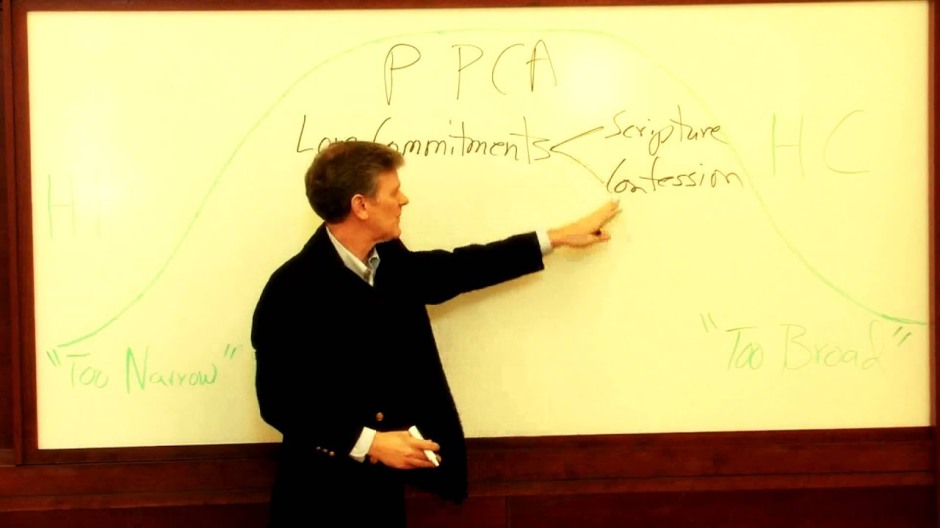
Since everyone in NAPARC is thinking about the PCA’s General Assembly meeting this week, Old Life turns back the clock with a series of essays written in response to the 2010 General Assembly’s adoption of its “Strategic Plan.” (Warning: assessments may be as dated as the author’s biographies.)

The first came from Jason Stellman, who was then pastor of Exile Presbyterian Church in Woodinville, WA. His essay was “The PCA Has Issues.”

Much like the kid brother of a member of your group of friends growing up who desperately wanted to fit in with the older guys, so the PCA has begun to display a similarly desperate tendency to seek the approval of those whom we seek to impress. The problem, of course, is that it is unclear just whose approval we’re seeking–it may be that of other missionally-minded churches, it may be that of the culture itself. But either way, like that kid brother, those who crave affirmation just end up annoying the rest of us who couldn’t care less.

It’s not that we Old School Presbyterians don’t care about pleasing anyone, of course. We certainly seek the approval of Jesus Christ in whose name we minister each Lord’s Day. Here’s the thing, though: Jesus doesn’t make me feel bad because my church is small; Jesus doesn’t chide me for not having transformed my city into the kingdom of God on earth; and Jesus doesn’t make me feel guilty because of all the white people who show up for church each Sunday (whites are fine in the suburbs, but ethnics are needed in The City, where real ministry happens). My point is that it is the smile of God that we should be seeking, not street cred (and God smiles at faithfulness, not necessarily at nickels and noses).

Why the rant? The reason is simple enough: the PCA’s Strategic Plan, the points of which were adopted at this summer’s General Assembly, represents the latest in our denomination’s hand-wringing over how supposedly irrelevant we have become (I mean, we didn’t even grow numerically in 2009!). Whether it’s withdrawing from NAPARC (which the original version of the Plan suggested) or shifting our discussions of worship and mission from the context of church courts to “safer places” with “more voices at the table,” the fact is that the movers and shakers of the PCA have determined that we’ve got to do something (did I mention that we didn’t grow in 2009?).

My aim here is not to discuss the Plan in detail, but rather to direct attention to what it says about us as a denomination. It seems that the everyday and ordinary are just fine when we’re surrounded by tokens of blessing and bounty, but when those outward, visible tokens disappear then we must come up with something out of the ordinary to make up the slack and restore what the locusts have eaten.

What many of the PCA’s leaders have failed to appreciate is the degree to which a church’s philosophy of ministry is indicative of its understanding of the Christian life more broadly. I’ve been told that Jewish rabbis are fond of saying “Our calendar is our catechism,” by which they mean that their faith is instilled and passed down by means of the regular rhythm of the synagogue’s times of worship and prayer. A similar principle is true in Christianity: we communicate the what by means of the how. If the Christian life is to be understood as one of marked and measurable success, then what better way to convey that expectation than by inventing new strategies and methods to deal with perceived failure? And contrariwise, what lesson is conveyed by an insistence upon the ordinary means of grace than that the Christian life is characterized by some ups but lots of downs, by smatterings of already amid plenty of not yet?

This ordinary-means-of-grace ethos was captured beautifully by PCA pastor Jon Payne, who submitted to the Assembly what was originally intended as an alternative to the SP. Its points include: a renewed commitment to exegetical, God-centered, Christ-exalting, Holy Spirit-filled, lectio-continua preaching; to the sacraments of baptism and the Lord’s Supper for the spiritual nourishment, health and comfort of the elect; to private, family and corporate prayer; to–and delight in–the Lord’s Day; to worship God according to Scripture; and to sing the Psalms in private, family, and public worship.

The first thing one is likely to notice while perusing Payne’s proposal is just how mundane and unexciting it all sounds. Absent are the clarion calls for the transformation of society and the democratization of the church’s leadership, and in their place we find a renewed commitment to sacraments, psalm-singing, and Sabbath-keeping. If you think about it, what lies at the back of the disagreement on the part of the Old-School opponents of the SP and its New-School supporters is the relationship of the church’s mission and marks. As the (original) SP’s talk of leaving NAPARC suggests, it is apparently not enough for a congregation to exhibit the marks of a true church if those congregations are not sufficiently “missional.” But aren’t the preaching of the gospel, the administration of the sacraments, and the practice of church discipline themselves the mission? And isn’t this what NAPARC churches do?

The mere exhibiting of these marks, however, hardly sounds “strategic.” A strategy, after all, is “a plan, method, or series of maneuvers or stratagems for obtaining a specific goal or result.” If you want to lose twenty pounds this year, you had better implement a strategy. But it is here that the analogy breaks down with respect to Christ’s church, for while the means are given to the church’s officers, the results are out of our control. “The winds blows where it will,” Jesus tells us, and though we can see its effects we cannot harness its power or predict it path. “So it is with everyone who is born of the Spirit.” This admission does not breed apathy, any more than an appreciation of divine sovereignty breeds prayerlessness. On the contrary, it is precisely because we believe that God is in control that we bring our petitions to him, and likewise, it is precisely because we believe that God will add his blessing to the means of grace that we insist so strongly upon their centrality in the life and ministry of the church. Last I checked, Jesus didn’t tell his disciples to go out and build him a church, but promised rather to be the Architect himself: “On this rock I will build my church, and the gates of hell will not prevail against it.”

But this is risky business, this stepping back and allowing Jesus to determine the success and relevance of the church. Size matters, at least in the minds of most American evangelicals, and nickels and noses simply cannot be guaranteed by such out-of-date methods as preaching and serving communion. But shouldn’t this be the point where faith comes in? If strategies are intended to bring about specific results, then what’s the point of faith (or the Holy Spirit, for that matter)? You get on the treadmill and cut out the Oreos, and you’ll lose that weight. You adopt a culturally savvy mission, and you’ll grow a relevant church. But all this talk of strategies and expected results makes the church sound like a mere human institution beholden to the laws of the free market rather than a Body whose growth comes in spurts unpredictable.

It’s gut-check time for the PCA. Are we as a denomination going to trust in the tried and true means of grace that Christ has ordained for the growth of his church, and commit our expectations concerning that growth to the Spirit who alone can bring it about? Or, are we going to fall into the old trap of sacrificing the church’s marks on the altar of “mission,” as defined by the cultural guardians of all things relevant? Many of our Reformed forefathers stood at this very same crossroads and blinked, and we have their failures to thank for the liberal Protestant churches that litter the current landscape. The temptation to innovate is strong, but what we must remember is this: choosing the old paths is what makes us a church, while seeking the novel is what will makes us a cliché.
Reasons to Subscribe to the NTJ (other than sending an email address)

You might read something like this (from the Spring 2009 issue – a roundtable on the state of the Presbyterian Church in America):

Can This Marriage Be Saved?

Just to lay my cards on the table up front, I will admit that both my ecclesiastical background and my geographical location are very different from Mr. Dunahoo’s. Having been reared in megachurch evangelicalism in Southern California, and currently pastoring a PCA in the Seattle area, I have neither the broadness of perspective that Dunahoo enjoys, nor the memories of this denomination’s early days that he retains. Still, I’ll do my best to make some worthwhile remarks about the Presbyterian Church in America, both present and future.

Dunahoo lists five distinct groups within the PCA. In my four years as a member of the Pacific Northwest Presbytery, I can identify groups 1 and 2 (the “Reformed Fundamentalists” and the “Reformed Evangelicals”) in this neck of the ecclesiastical woods. That’s not to say the others don’t exist elsewhere, but as I said, my experience is limited to the fringe of the movement (“fringe” being used literally with respect to my presbytery’s location, and perhaps metaphorically with respect to its self-perception. More on this below). Now although I balk at the label affixed to me by Dunahoo (I happen to think of “Fundamentalist” as rather antithetical to “Reformed”), I do consider myself to fit squarely into his first category. I believe the Westminster Confession and Catechisms to be the most faithful articulation of biblical truth, and I believe that it is my calling and duty as a minister to expound Holy Scripture through the lens of the doctrinal standards to which I have submitted myself.

I would venture to say that Dunahoo’s second group, the Reformed Evangelicals, is the largest subgroup within the PCA. I may be wrong about this, but my excuse for such misperception is that the denomination’s official publications, as well as its seminary, all seem to presuppose the missional model, with hardly a paragraph being written in their literature that doesn’t remind the reader to redeem this or transform that. Words like “contextual” and “incarnational” are nearly as important in church planting circles as the phrases “Word and sacraments” or “the ordinary means of grace.” Apparently, word, water, and wine are all well and good provided they’re dispensed with sufficient cultural exegesis and social sensitivity. But I digress.

What I do find refreshing about Dunahoo’s perspective is, well, its perspective. In other words, he doesn’t simply draw a circle around himself and his friends and act as if there is no one else in the denomination besides his own subgroup. The reason I mention this is that I know what it is like to be treated like a virtual alien simply because I haven’t drunk the contextual Kool-Aid. I still feel the sting from the lashing I received at the PCA’s Church Planters’ Assessment when, in a certain exercise, I dared use the word “covenantal” while giving a mock church planting presentation to a pretend presbytery. Apparently it is a cardinal sin to assume that presbyters in the PCA understand the nomenclature used in chapter seven of the Westminster Confession (I’m not bitter anymore, really). My point here is that the sooner the confessionalists and transformationists (or, groups 1 and 2) recognize each other’s existence, the better. True, the two may never become one, but at least they’ll realize they are shacked up as roommates in the same house.

In the Pacific Northwest Presbytery where I am a member, the line dividing the Reformed Fundamentalists from, well, everyone else was recently made painfully apparent. At our stated meeting in October 2007, Rev. Peter Leithart and I jointly requested that presbytery appoint a study committee to evaluate Leithart’s Federal Visionist views and compare them with the Westminster Confession, with a particular emphasis on the nine “Declarations” of the previous summer’s General Assembly report on Federal Vision theology more broadly. The committee ended up split 4-3, with the majority concluding that Leithart’s views, though at times confusing and unhelpful, were nonetheless within the bounds of confessional orthodoxy, while the minority (of which I was a part) found his views to strike at the vitals of the Reformed system of doctrine.

When we met a year later to present the reports, the debate on the floor of presbytery was rather telling (to say the least) in that it largely ignored the narrow issues that the committee was charged to address and focused instead on the larger (and, strictly speaking, irrelevant) question, “What is the PCA?” The concerns voiced were primarily focused on self-identity instead of whether Leithart’s theology was Reformed or not. The greatest fear on the part of the members of presbytery was that by voting to depose one of our own we’d become, well, like the OPC. In other words, we already represent a mere fraction of Christian believers anyway, and now, by defrocking everyone who fails to cross their t’s and dot there i’s the way we’d like them to, we will just paint an even smaller circle around ourselves, eventually paling into utter obscurity and irrelevance.

It seems to me that the events of the Pacific Northwest Presbytery’s October 2008 meeting demonstrate, albeit microcosmically, the identity crisis of the PCA as a whole. As the “A” in our name would seem to suggest, we are perhaps unduly fixated on being big, noteworthy, and successful, and whatever stands in the way of such success must be viewed with a measure of suspicion. Hence the ho-hum attitude on the part of Dunahoo’s “Reformed Evangelicals” towards a simple, ordinary-means-of-grace ministry that dismisses the fanfare and obsession with how many artists show up at our wine- and cheese-tasting soirees, and gives attention rather to preaching Christ and administrating the Supper each Lord’s Day. As much as the OPC’s obvious irrelevance (ahem) stands as an ominous warning to the movers and shakers at Covenant Seminary and sends chills down the collective spine of the powers that be in Atlanta, the fact is that our older cousin, though a runt in the Presbyterian litter, enjoys the freedom of Mere Presbyterianism to a degree that the PCA cannot (at least not as long as we’re pining for the approval of the artsy-fartsy, the bohemian, the indy, and the soul-patched).

Not being prone to prognostication, I am loath to guess where the rocky marriage between the confessionalists and transformationists will take the PCA. If Tim Keller’s work with the Gospel Coalition is any indication, it is at least possible that the Reformed Evangelicals will continue to value cultural engagement and renewal more highly than confessional exactitude, perhaps to the point of secession. Or to look at it from the other direction, if the so-called Reformed Fundamentalists continue to be made to feel hopelessly irrelevant and out of touch when we settle for a Sabbath-oriented, means-of-grace-driven piety, a withdrawal could potentially occur. Then again, we could just continue with the live-and-let-live, quasi-congregationalism that we now enjoy, according to which I can be left alone to don my Geneva gown on Sunday provided I don’t hassle the PCA pastor in the next town over for using multimedia and drama to reach the “teenz.”

But either way, the Emergents are certainly right about one thing: the church, if not a mess, is nonetheless messy.

Jason Stellman is pastor of Exile Presbyterian Church (PCA) in Woodinville, Washington.

Called to Drink

Bryan and the Jasons don’t seem to update their blog much. Jason Stellman’s conversion narrative is still there. But no one at Called to Communion seems to notice where their call led Jason (thanks to our Michigan correspondent):

JASON STELLMAN, cohost of the podcast Drunk Ex-Pastors, is a Southern California native and transplant to Seattle who wishes he still lived in Europe. He served as a missionary with Calvary Chapel of Costa Mesa in Uganda (’91-’92) and in Hungary (’94-2000). Ordained In the Presbyterian Church in America, he was called to plant Exile Presbyterian Church in the Seattle area where he served from 2004-2012. In September 2012, he was received into the Catholic Church. He drinks and questions his faith regularly.

Don’t get me wrong. I like a drink as much as the next man. But I haven’t made drinking a fruit of the Spirit or a reason to be Presbyterian (hey, wait a minute).

Does that Apply to Justin Bieber and Global Capitalism?

Jason Stellman is back in apologist mode and thinks it great that Roman Catholicism loves paganism (not even Michael Sean Winters says this):

Our paradigm has at its heart the Christmas story, the coming-in-the-flesh of the Son of God. If divinity assumed humanity to the point where the second Person of the Trinity will forever participate in human flesh and human nature, then there simply is no option for pitting heaven against earth, spirit against flesh.

If the Incarnation teaches us anything, it’s that God is all about affirming the world, not destroying it.

When a Catholic considers pagan culture, then, he doesn’t think of it as some kind of defective problem to overcome, but instead views it through the lens of Christ and sees a divine exclamation point placed after every true and beautiful pagan idea or endeavor.

In a word, we see kinship and commonality with paganism. Pagans may worship nature or bow before a sacred tree or stone altar, while we worship the Creator of nature and bow before the cross and venerate the altar on which the Eucharistic sacrifice is offered.

The problem for Jason is that Roman Catholicism didn’t embrace incarnationality when it came to Protestantism in the 16th century. And if what Jason says is true for contemporary Roman Catholicism, does that mean he has gone to the other side about the benefits of free markets and the beauty of Justin Bieber’s music (I seem to recall in the one episode of Drunk Ex Pastors that Jason was gleeful in mocking the teenage crooner)?

It also makes me wonder if Jason became a Roman Catholic because the communion now resembles liberal Protestantism. And that’s another wrinkle in Jason’s argument. Protestants of a certain kind also affirmed the incarnation to embrace the world. We used to call them modernists.

Some Protestants opposed modernism. So did Pope Pius X. Neither wanted Christians to embrace the pagan world the way Jason does. In fact, it used to be the case that Jason would need approval from his bishop to read John Calvin or David Hume. An index of forbidden books does not sound, in Jason’s words, like a “healthier avenue toward dialogue and mutual respect.”

So which Roman Catholicism is Jason talking about? And is that the one to which Bryan Cross is calling?

Reality Wins

Is it merely coincidental that the day that Nancy Pelosi tries to gain the upper Roman Catholic hand on Marco Rubio is also the day that Jason Stellman (of Bryan and the Jasons) announces he is throwing in the towel?

Here‘s Nancy on the Roman Catholic mainstream:

I thoroughly disagree (with Rubio’s opposition to gay marriage), being raised in a Catholic family, raising a Catholic family, mainstream Catholic – well, the Baltimore catechism, to get back to our hometown of Baltimore, was what we were raised on. And I think that this statement by Senator Rubio is most unfortunate. It’s a polarizing statement. The fact is, is that what we’re taught was to respect people in our faith and to say that this endangers mainstream Christian thinking is so completely wrong.

Does Jason sound here like he understands he’s in the Roman Catholic fringe?

While my days as an official apologist for the faith are over, my faith is still very much alive (albeit expressed differently nowadays).

It’s been a wild ride, and I’d like to say I will miss blogging at Creed Code Cult, but my feelings are mixed. I took a lot of abuse here, but I also handed out my share of it. In many ways the interaction I have had in these pages reflects the very best and very worst of me. To those I have offended, been impatient with, or smug toward, please accept my sincere apology. Grace should be received with grace, and I have received freely, and so desire to freely give.

Postscript: when Jason writes, “When ideas eclipse people, and when being right obscures being loving, everyone loses. Love God and love your neighbor. This is the Law and the Prophets,” wouldn’t that have been a reason to remain Presbyterian?

On the Upside

James White takes an I-told-you-so pose in the face of Jason Stellman’s post about how difficult life as a Roman Catholic convert has been. On the one hand, Jason seems to have no sense for how he comes across. First, he was surprised that his Chamber of Commerce posts on behalf of his new religious hometown would strike those in his old Protestant neighborhood as infuriating. Why not simply follow your conscience and shut up about it? Now he also provides his former co-religionists with an excuse for grandstanding. (Hey, wait a minute. Maybe Jason was playing the tempter. Pretty clever.)

On the other hand, White does not refuse the temptation but decides to gloat:

Rome never satisfies. It can’t. All the pomp and circumstance, all the liturgical fanfare, can never truly answer to the true needs of man. Since Rome has abandoned the gospel of grace and replaced it with a synergistic man-centered sacramentalism, she will never be able to offer to men anything but distractions, never true answers, to his real need. . . .

When it comes to Jason Stellman, I know one thing: I warned him, clearly, passionately, without question.

Actually, Mr. White, if you read Jason’s post, how can you say that Roman Catholicism doesn’t satisfy when Jason affirms explicitly that it does? And how can you, Mr. White, make it seem as if adversity for religious convictions is somehow a vindication of sola gratia? After all, didn’t our Lord say:

“Do not think that I have come to bring peace to the earth. I have not come to bring peace, but a sword. For I have come to set a man against his father, and a daughter against her mother, and a daughter-in-law against her mother-in-law. And a person’s enemies will be those of his own household. Whoever loves father or mother more than me is not worthy of me, and whoever loves son or daughter more than me is not worthy of me. And whoever does not take his cross and follow me is not worthy of me. Whoever finds his life will lose it, and whoever loses his life for my sake will find it. (Matt 10:34-39)

But there is a silver lining here for Protestants who don’t spiritualize everything and turn a blind eye to human suffering. It is that Jason must have been a heck of a Presbyterian pastor:

. . . I am denied entrance into the church I planted (where my family still attends on Sundays) — I wasn’t even allowed to attend the Christmas Eve service last year and just sit and sing the hymns. To most of my old Calvinistic friends I am simply a traitor to the gospel.

That sounds pretty rough and Jason’s original cheerleading for Rome likely accounts for some of this roughness, though I am only speculating. But that sort of resolve on the part of Jason’s family and former congregation, as painful as it is for him, is likely a tribute to his ability to minister the word and cultivate in both his family and congregants a commitment to what the Bible teaches. Is it any consolation to Jason that he was seemingly a successful Protestant pastor?

I Wonder as Jason Wonders

That’s one way of asking it:

As I continued wrestling through the issues of church authority and its relation to Scripture, one of the questions I kept returning to was that of likelihood. “All things being equal,” I would ask myself, “which is more likely: that Jesus had intended to establish his church in such a way that it was to be governed by Scripture alone (with leaders whose role was to interpret Scripture to the best of their abilities), or that he intended his church to be governed by leaders who, in some way and under certain conditions, were protected from error when exercising their authority?”

Here’s another:

All things being equal, which is more likely: that Jesus intended to establish his church in such a way that it was to be governed by pastors and elders who ministered and taught Scripture under the oversight of other church officers, or that he intended the church to be governed by a pastor in Rome (the city of the beast), far from the original churches in Jerusalem and Asia Minor where his chosen apostles labored?

That’s why we call them loaded questions (sort of like how would Jason know apart from Scripture of Christ establishing a church — oh wait, tradition — the pastor in Rome — told him).

Neo-Calvinists, New Calvinists, and Roman Catholics Together?

Both have trouble thinking about Christianity apart from culture.

Drawing together this vision of Scripture we see that God intends us to have dominion over the earth and the rest of creation – which means we must care for it and shape it. This is the foundation of culture, rooted in the land, which we cultivate and use to produce the material elements of culture. In the New Testament we see that culture from a higher perspective is way of life, which embodies the teaching of Christ and the will of the Father in our lives. This is a new dominion of holiness, which sanctifies the world. Both visions are united by seeking to enact on earth what God has made known to us and commanded. A striking image of this comes from Exodus: “According to all that I show you concerning the pattern of the tabernacle, and of all its furniture, so you shall make it” (25:9). Christian culture makes according to the pattern revealed to us by God. . . .

Pope John Paul II knew personally the power of culture as he sought to preserve his nation’s identity in the midst of Nazism and Communism. Through his trials, he became convinced that “the strength of the Gospel is capable of transforming the cultures of our times by its leaven of justice and of charity in truth and solidarity. Faith which becomes culture is the source of hope” (“The World’s Changing Cultural Horizons,” §7). He may also have given us the strongest statement on the necessary interconnection of faith and culture: “The synthesis between culture and faith is not only a demand of culture, but also of faith … A faith that does not become culture is not fully accepted, not entirely thought out, not faithfully lived” (“Address to the Italian National Congress of the Ecclesial Movement for Cultural Commitment,” Jan. 16, 1982). So, yes, faith does need culture so that it may be lived out in the world in a coherent and complete way.

As a 2ker, Stellman might not have used the gateway drug of transformationalism. Then again . . .

The Limits of Logic and the Benefits of Geography

Jason Stellman continues his brief for Roman Catholic superiority with the twist of posting at his own blog and, making his membership in Jason and the Callers complete, at at Called to Communion. Apparently, Bryan Cross and Sean Patrick will now edit comments on Jason’s posts so that Jason can do more televised interviews. The funny thing about this arrangement is that posting at CTC has not united Bryan’s logic with Jason’s style. In fact, if Jason’s first post is any indication, Bryan’s scholasticism has taken a back seat to Stellman’s intuition. But the oxymoronic ecumenical (call to communion) polemics (we’re better than Protestants) abide.

It turns out — surprise — that Roman Catholicism makes better sense of the incarnation than Protestantism. The simple logic is that since Christ assumed and maintains a physical body that could and can be seen, an ecclesiology that features visibility beats one that invokes invisibility. But the logic of Jason’s argument is almost as confusing as his understanding of geography.

If there is a connection between Christology and Ecclesiology (Umm, hellooo ? The Church is the Body of which Christ is the Head, so I’d label this connection as “uncontroversial”), then the idea that the eternal Son assumed human nature and took on a real, flesh-and-blood body just like ours, is more consistent in a visible-church paradigm than in an invisible-church paradigm. The physical body of Christ was visible; you could point him out in a crowd or identify him with a kiss as Judas did for the Roman soldiers.

The key word here is was. Jesus’ body is no longer on earth and cannot be seen. And by sending his Spirit to be with the church after he left planet earth, Jesus could very well have been teaching that the nature of the church, its bonds of fellowship and its worship, is going to be spiritual, not visible (like Old Testament devotion was with the altar, sacrifice and priests — sound familiar?). In fact, Jesus tells the woman at the well that the new pattern of worship emerging is one where place matters less than spirit and truth. And then Jason has the problem of being so insensitive to believers whose relatives have died and no longer have bodies. Are they visible? Are they excluded from the church because they don’t have bodies? Or is it the case that an ecclesiology that so features physicality is shallow compared to one that recognizes a fellowship among those saints who are both seen and unseen. (Hint: if God the Father is spirit and cannot be seen, fellowship with the unseen is important. Duh!)

Not to be tripped up by such theological or logical subtleties, Jason stumbles on to give two big thumbs up to the Roman Catholic doctrine of the Eucharist.

Is Christ present at the Table or not? Like with the question “Is the church visible or not,” the answer here is, “It depends.” If the worshiper is a worthy receiver, then yes, he indeed feeds spiritually and truly upon the body and blood of Christ. But if the worshiper is unworthy and faithless, then what he is eating and drinking is not Christ’s body and blood, but simply ordinary bread and wine. This also smacks of Docetism, as if Jesus of Nazareth could have been truly present with Zaccheus, partially present with Nicodemus, and completely absent with Judas, even though they were all standing right in front of him in the flesh.

First, Jason gets the Protestant position wrong. The unworthy receiver eats and drinks judgment. The last time I had ordinary bread and wine, I was not sinning overtly or deserving judgment. But that inaccuracy notwithstanding, second, the idea that Christ is present in the Lord’s Supper to everyone equally, just like he was to the people with whom Christ lived, walked and talked, commits some sort of Christological error — can’t remember which one — because the nature of a body is being limited in time and space, and if Jesus is not here then he can’t be here in the same way that he was here to Zaccheus. And since Jason doesn’t mention the Spirit, the person of the Trinity that helps Protestants understand Christ’s real presence in an omnipresent way, his bad logic suffers again from poor theology.

Jason’s last point exhibits a Romophilia that makes chopped liver out of the churches of Jerusalem, Antioch, Alexandria, and Constantinople.

Moreover, the Catholic paradigm makes much better sense of the Incarnation by its gospel demonstrating the need for the ongoing and continual humanity of Christ. If salvation consists largely (almost exclusively to hear some Protestants tell it) in the forensic imputation of the active and passive obedience of Christ by which the sinner is legally justified in the divine court, then the need for Jesus’ humanity can be said to have expired after the ascension. But if, as the Catholic Church maintains (echoing the fathers), salvation consists primarily in the deifying participation of humanity in the divine nature, which happens by means of Christ’s glorified humanity and risen flesh, then what happened at the Incarnation was a much bigger deal than some Protestants realize.

The deifying participation of humanity in the divine nature is what the Eastern Churches call theosis. In fact, Jason’s entire post may vindicate his personal decision to leave Presbyterianism but his boosterism apparently blinded him to the substantial difficulties he raised for his own ecclesiology from Eastern Orthodox challenges. After all, Jesus never made it to Rome to found a church — if we take the physicality of the incarnation seriously. He did though found a church in Jerusalem. If Jason wanted to talk about the Jerusalem Catholic Church he might have a point. But since he wants to root, root, root for his new home church, he needs help from Bryan to make his argument coherent.

Meanwhile, Jason may want to pay more attention to what’s going on in his visible church than tilting at Protestant windmills:

I think it is obvious that Wuerl belongs to the more traditional, pilgrim model and always has. In the 1970s and early 1980s, the prophet model was invoked mostly by liberal theologians to justify their positions. In the 1990s and first decade of the 21st century, it was conservatives who claimed the prophetic mantle for themselves. Both groups forgot that in the Hebrew Scriptures, the prophets were reluctant to accept the mantle. Both groups forgot that the dominant Catholic mode of leadership has almost always been the pilgrim model, and when the prophet model dominated, ruin came: Savonarola, Saint- Cloud, Pio Nono. The Church is not at Her best when Her leaders are busy hurling epithets or indulging what Pope Francis has called a “self-absorbed promethean neopelagianism.” Wuerl strikes me as one of those bishops who does not over-inflate his own significance. Yes, he takes his job seriously and expects his collaborators to do so as well. But, like Pope Francis, he leaves room for the Spirit to do its work. Let us have more bishops like this in the coming year. The first test will, of course, be Chicago. No need for extensive previstas from the nuncio on this nomination as all of the candidates will be well known. The rumors of any particular names have dried up, which usually means those who are being consulted are shifting from speculation to decision. I have no idea who it will be but I will venture one prediction: Some jaws will drop. . . .

The divisions within the Church are not going away, but they are likely to change in the coming year. I predicted early on that you would begin to see cleavage within the Catholic Left between those who are thrilled by the Holy Father’s focus on the poor, and for whom that focus is enough, and those who argue for changes where no change is likely to be forthcoming, the ordination of women, same-sex marriage, etc. And, on the Catholic Right, you will see a similar cleavage between those who will allow themselves to be challenged by Pope Francis and those who will shift towards a rejectionist position, either completely gutting the pope’s words of their obvious meaning and import as Morlino did in the article mentioned above or, for the more extreme members, moving towards schismatic groups. The Left, when it gets disaffected, just walks away. The Right causes trouble. In 2014, many bishops will face the prospect of clear, unambiguous dissent on the Right and it will be curious to see how they respond.

More Cosmopolitan Than Thou

The piece is a little old now, but in the October 7, 2013 issue of The New Republic, Abbas Milani thinks out loud about what to make of Iran’s new president, Hassan Rouhani:

The searing image of Mahmoud Ahmadinejad, the last Iranian president–all bombast and spite–makes the details in his successor’s archival folder jump from the page. There are Hassan Rouhani’s theological writings, which approvingly name-check Western thinkers from C. Wright Mills to Samuel Huntington. There is also the image of his graduation ceremony from Glasgow Caledonian University in 1999, where he received a doctorate in law. The video shows him in a doctoral gown, but without his clerical turban or robe–a surprising concession, by the standards of the mullahs, to the norms of his hosts. . . . The contrast between Ahmadinejad and Rouhani has filled the West with cautious optimism that the new leader might lead the confrontation over Iran’s nuclear program to an amiable conclusion. Indeed, the first months of Rouhani’s presidency have flashed hopeful signs of pragmatism and moderation. Rouhani proposed a Cabinet that contained defenders of the pro-democracy Green Movement. On his watch, the universities have readmitted faculty and students unfairly expelled on political grounds. Access to social media has broadened. In fact, his foreign minister used his Twitter account to wish Jews of the world a happy new year, a leap in tolerance from Ahmadinejad’s denials of the Holocaust.

When reading this, I wondered what another journalist for the magazine might do with the new president of Princeton Seminary, Craig Barnes. After all, as some have it, Calvinism is responsible for contemporary notions of American greatness, neo-conservatism, and exceptionalism and, to connect the dots, Princeton represents one of the most important and well funded institutions connected to Calvinist theology. So if a journalist wanted to understand the future of American foreign policy, he might be tempted — given all the explanatory powers of Calvinism — to do a back story on Princeton’s new president.

But of course, no one thinks Princeton has anything to do with American government. No matter how much Calvinism might explain the Religious Right or U. S. foreign policy, Craig Barnes has about as much chance of access to the White House or the State Department as I do to the trustees of Princeton Seminary. Depending on your perspective, we can thank or blame the American separation of church and state for that. Without that separation, reporters might be looking at Craig Barnes’ graduation pictures to see if he was carrying a copy of Calvin’s Ecclesiastical Ordinances with him.

Even farther off the media’s radar (sorry Peter) is Peter Leithart. But the parallels with Rouhani are intriguing and go well beyond the beard. In his recent piece on the end of Protestantism, Leithart made a plea for broad, catholic, well-adjusted, and well read Protestantism. And yet, Leithart has associations with people like the Federal Visionaries who seem to wear beards as a point of pride, talk a lot about Christendom, have big families, and he even wrote a book that defended Constantine and his policies as Christianizing the Roman Empire (which for a Old Lifer has about as much Christian plausibility as attempts to turn George Washington into an orthodox Protestant). In other words, Leithart has a past with theonomy that may still be a present, but its a kinder, gentler theonomy and goes by an ambiguous name. And yet, like Rouhani, Leithart aspires to a broader world than simply the one originally forged by Greg Bahnsen and Gary North. After all, he writes for First Things and drops the names of all sorts of writers and intellectuals in his posts, from Jane Austen to Catherine Pickstock.

As Fred Sanders noted, Leithart’s post was hard to decipher and Sanders himself is not entirely clear about the closed-minded, sectarian Protestants that we need to leave behind:

It’s very clear what he deplores. He deplores the kind of small-minded Protestant whose heroes are Luther and Calvin, and who has no other heroes in the 1500 years prior to them. He deplores the kind of knee-jerk Protestant who is locked into permanent reaction against whatever Roman Catholics do or say, and who enjoys setting up Roman strawmen (Vatican I, Catholic Encyclopedia vintage, if possible) to knock down. He deplores the kind of unimaginative Protestant who mocks patristic Bible interpretation and thinks that if the grammatical-historical mode of interpreting was good enough for Jesus, it should be good enough for us. He deplores the kind of amnesiac Protestant who leaps from “Bible Times” to the Reformation, thinking he has skipped over nothing but bad guys in doing so.

This is all certainly deplorable. Where shall we find men of such denominational ressentiment? Mostly in “the local Baptist or Bible church,” but also among “conservative Presbyterians.” Leithart deplores a few other things, like preaching in a suit and tie instead of vestments, and a low sacramentology, but let’s stick for a moment to the historical outline of the portrait. Leithart calls us away from that kind of small-minded, knee-jerk, unimaginative, amnesiac man of ressentiment, and conjures instead something free and fully realized. He calls it Reformational Catholicism, and builds up its portrait in bright, not to say self-congratulatory, colors, in contrast to the dark tones he has just used.

On the one hand, Leithart responds, “exactly so.” But then he adds:

Sanders reads something into the essay that’s not there when he claims that it involves “a massive act of catastrophic silencing” that creates a “new dark ages” between the Reformation and the present. No. The essay is not about historical theology; I didn’t mention confessional Protestants among the heroes of the Reformational Catholic because heirs of the Reformation already take them as heroes. In any event, the main point was not historical at all. The article (schematically) describes two contemporary forms of Protestantism. Or, more precisely, it offers a sketch of one form or feature of contemporary Protestantism, and contrasts to that a Catholic Protestantism that presently exists only in pockets and is mainly an item of hope.

Reading Leithart’s original piece with Sanders’ reaction and Leithart’s own clarification in mind, it looks like the Reformational catholicism for which Leithart is calling is really himself. After all, it exists “only in pockets” and is mainly a “hope.” Nothing wrong with hope, or even hoping against hope, but doesn’t some kind of intellectual humility (not to mention the Christian variety) kick in if you wind up thinking that the rest of the Protestant world needs to be like you? Sure. I think this all the time. But I only say it to my wife, and now much less frequently after all the grief those initial volleys received. Do I mean to imply that Leithart is narcissistic in this piece? To an extent, since I haven’t seen a reason why this is not a plausible construction. And because neither he nor Sanders actually names any of these small-minded Protestants — yes, I do fear they mean (all about) me and other Old Lifers, OF COURSE!! — their pieces do read like attempts to portray themselves as a better brand of Protestant, the way that Rouhani is to Ahmadinejad.

What good any of this posturing is actually going to do for the rest of the Protestant world is another question since in Leithart’s case, he does not appear to be a churchman who is going to General Assembly and pleading at least with his little platoon of Protestants to get with the program.

The irony of all this Protestant cosmopolitanism is that at roughly the same time that Leithart drew attention to his catholicity, his former nemesis in the PCA, the now really Roman Catholic, Jason Stellman, also announced his own effort to show a side different from the one he maintains with Jason and the Callers:

I would like take a quick break from our discussion about paradigms Protestant and Catholic in order to draw everyone’s attention to a little side project that a few friends of mine and I are just now beginning. It’s basically a small community of artists, writers, and thinkers from varying backgrounds whose aim is simply to give expression to the identity we share as misfits and malcontents in this cruel and beautiful world of ours.

From the misfits own website comes Stellman’s admission:

Our desire, then, is simply to think out loud, to vent, to muse, and to use whatever gifts of artistic expression we have to describe the identity we share as misfits and malcontents in this cruel and beautiful world. Because we know we’re not alone, and that lots of others share that identity, too.

And from the misfits’ page of “turn-ons” stuff we like comes a cast of characters that is silent about Roman Catholicism and not exactly clear on how Noam Chomsky fits with high papalism (though with 2k all harmony is possible).

Could it be, then, that Leithart really doesn’t know those small-minded Protestants? Maybe they are far more complicated — like Stellman — than his remarkably predictable (if he were a mainline Protestant who thought himself evangelical) portrayal of inferior Protestants? I mean, (all about me) I am a Machen warrior child and I like Orhan Pamuk. Does that get me any cosmopolitan street cred?