The First President to be Pried from His Bath

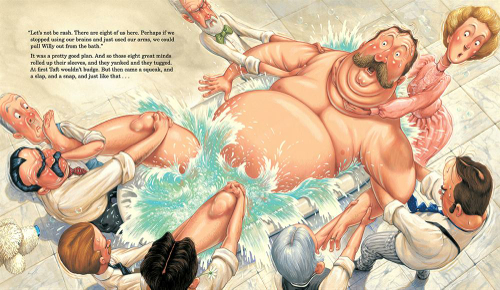
I heard this morning on Sports Talk radio of all things that on this day in history President William Taft, a man of gargantuan proportions, became stuck in his bath tub:

What most people associated with Taft, however, was his enormous size, and the image of his 300 plus pounds of presidential flesh offended some people and amused many others. When he became stuck in the presidential bath tub, requiring six men to pull him free, the nation’s press had a field day. His size made him the subject of countless jokes: “Taft was the most polite man in Washington. One day he gave up his seat on a streetcar to three women.” Within the capital’s social circle, Taft frequently embarrassed his family and associates by falling asleep at concerts, during presidential briefing sessions, and while presiding over his cabinet. At ease with his uncontrolled appetite and his need for sleep after eating or after exerting himself, Taft simply refused to be embarrassed by his weight or his behavior. He accepted his size and so did most of the American public in time.

What many Americans don’t know is that President Millard Filmore was the first to take a bath in the White House. Here is H. L. Mencken’s account:

But it was the example of President Millard Fillmore that, even more than the grudging medical approval, gave the bathtub recognition and respectability in the United States. While he was still Vice-President, in March, 1850, he visited Cincinnati on a stumping tour, and inspected the original Thompson tub. Thompson himself was now dead, but his bathroom was preserved by the gentlemen who had bought his house from the estate. Fillmore was entertained in this house and, according to Chamberlain, his biographer, took a bath in the tub. Experiencing no ill effects, he became an ardent advocate of the new invention, and on succeeding to the Presidency at Taylor’s death, July 9, 1850, he instructed his secretary of war, Gen. Charles M. Conrad, to invite tenders for the construction of a bathtub in the White House.

This action, for a moment, revived the old controversy, and its opponents made much of the fact that there was no bathtub at Mount Vernon, or at Monticello, and that all the Presidents and other magnificoes of the past had got along without any such monarchical luxuries. The elder Bennett, in the New York Herald, charged that Fillmore really aspired to buy and install in the White House a porphyry and alabaster bath that had been used by Louis Philippe at Versailles. But Conrad, disregarding all this clamor, duly called for bids, and the contract was presently awarded to Harper & Gillespie, a firm of Philadelphia engineers, who proposed to furnish a tub of thin cast iron, capable of floating the largest man.

This was installed early in 1851, and remained in service in the White House until the first Cleveland administration, when the present enameled tub was substituted. (“A Neglected Anniversary,” New York Evening Mail, 1917)

Whether presidents have been clean ever since is a separate question.

Sixty Hours I’ll Never Recover

But at least no naked actresses.

That is the general reaction in the Hart household to the completion of Mad Men, a tv series perhaps a tad better than Breaking Bad, but miles behind — wait for it — The Wire. (The atmospherics of Mad Men inch the series just barely ahead of Breaking Bad.) I had to go through 90 episodes to see Don practicing transcendental meditation, Peggy finding love, Joan being torn between love and career, Roger finding love appropriate to his age, and Pete landing in Witchita? Yes, it was uncomfortable to see Betty get sick, but not so much that you see a different side of her.

The morning after I read Louis Menand (who is emerging as someone worthy of a man-crush) on Charles Duhigg’s book, Smarter Faster Better: The Secrets of Being Productive in Life. Menand can’t quite understand why self-help books for business people sell. They are so obvious:

There is not much to disagree with here, and that is one of the intriguing things about the genre this book belongs to. Not dozens or hundreds but thousands of titles like “Smarter Faster Better” are published every year, and they account for a disproportionate percentage of total book sales. Yet they mainly reiterate common sense.

Does anybody think it’s unwise to be lean, nimble, and innovative? Who needs a book to know that rote behavior and fear of uncertainty are not going to take us very far? It’s not startling to learn that organizations that nurture a “culture of commitment” are more productive than organizations that don’t, or that setting ambitious objectives can jump-start innovation. “People who know how to self-motivate, according to studies, earn more money than their peers, report higher levels of happiness, and say they are more satisfied with their families, jobs, and lives.” I can believe that. “Determined and focused people . . . often have higher paying jobs.” I won’t argue. “An instinct for decisiveness is great—until it’s not.” An impregnable assertion.

In an uncanny way, Menand also explains the logic of Mad Men:

If you owned an advertising agency fifty years ago, on the other hand, you wouldn’t care how much pig iron your workers could carry in an hour. You would want your account executives to have winning personalities, to be able to bond easily with other people, to be likable. You would want them to have manners tailored to attract the patronage and retain the loyalty of your customers. Their task would be to persuade, not to push. You would therefore want them to be able to conceal, maybe even from themselves, the manipulative and possibly mercenary nature of their relationship with clients, and to transform a business transaction into a friendly quid pro quo. You would reward the most successful account executives with lavish expense accounts.

The series never goes beyond this (except when Don is being Don).

Evelyn Waugh Would Have to Re-Write Brideshead

Phil Lawler wonders about the pastoral implications of Pope Francis’ pastoral advice in Amoris Laetitia. Consider the plight of “regular” Roman Catholics:

In any Catholic community there will always be some devout believers who, following the Lord’s advice, “Strive to enter by the narrow door.” They will pray often and ardently, try to attend daily Mass, practice their own private devotions, and seek out spiritual direction from priests who demand a lot of them. For these people—let’s call them “high-octane” Catholics—Gresham’s Law will not apply. They are the equivalent of the folks who demand payment in doubloons.

But most Catholics, in most times and places, are not of the high-octane variety. Most “regular” parishioners will do what the Church demands of them, but will not seek out extra rigors. They will attend Sunday Mass on a regular basis, raise their children in the faith, follow the precepts of the Church as they understand them, contribute to the parish. Faithful if not zealous, they will form the backbone of the Catholic community. Nourished by the sacraments and encouraged by their pastors, they will grow in faith; some will eventually become high-octane Catholics.

Now notice how these “regular” Catholics—who sincerely intend to meet their obligations, without taking on extra burdens—are likely to choose between two hypothetical parishes:

In Parish A, Sunday Mass lasts 90 minutes or more; the liturgy is “high” and solemn; the Gregorian chant is unfamiliar. In Parish B, Mass is out in 40 minutes; the hymns sound like (and sometimes are) snappy show tunes.

In Parish A, religious-education classes are demanding, and students who do not master the basic catechism lessons do not advance. In Parish B, teachers assume that “they’re good kids” and don’t worry about details.

In Parish A, when a young couple comes to discuss marriage, and the pastor notices that they list the same home address on their registration forms, he tells them that they must live separately. In Parish B the pastor “doesn’t notice” the matching addresses, and plans for the wedding can move forward.

In Parish A, priests often preach on controversial topics, driving home the Church’s least popular messages, reminding the parishioners of their sins. In Parish B, the homily is always a gentle reminder that we should be kind to one another, and not too rough on ourselves.

Needless to say, high-octane Catholics will flock to Parish A. Regular Catholics will gravitate toward Parish B. Human nature being what it is, most people will choose the less demanding of two options.

Now notice what happens to priests in these parishes when they meet a couple that has been re-married:

In his apostolic exhortation, Pope Francis sets up the model of a pastor who will meet with these couples, help them to review and assess their lives, to repent their past failings, to bring their lives closer to the Christian ideal, and to do everything that they can in their current circumstances to grow in holiness. Exactly how this process will unfold is unclear, because, as the Pope explains, it is impossible to anticipate all the unique circumstances of any individual case. But clearly the Pope is describing a rigorous process, rather than a quick solution.

But what sort of priest would insist on that rigor in his dealings with a remarried couple? The pastor of Parish A, probably. But that pastor would very likely tell the couple that if they wish to receive the sacraments they must live as brother and sister. And the couple, for that matter, if they were active parishioners in Parish A, would probably have reached that conclusion for themselves already. So Amoris Laetitiae would bring no change in their case.

In Parish B, on the other hand, the pastor—having long ago established the pattern of requiring only the minimum—would be far more likely to tell the couple that they should not worry about details, that they should feel free to receive the Eucharist. In all likelihood he would already have conveyed that message, and they would already be in the Communion line every Sunday. Again, the apostolic exhortation would cause no significant change.

But consider what might happen in the marginal cases, where change is most visible. What will happen to divorced/remarried couples who, after years away from the faith, are inspired by the Pope’s message to return to the fold? If they happen to meet with a priest who expects them to go through a long and difficult process, aren’t they likely to seek a second opinion, and maybe a third, until inevitably, they find a pastor who will welcome them back immediately, with no requirements and no strings attached? Hasn’t that pattern already been clearly established by the young couples who want their wedding scheduled without a demanding marriage-prep program, or want their children confirmed without a rigorous CCD requirement?

This is not exactly the church that was opposed to any trace of modernity for at least 150 years.

Now imagine the real life (fictional couple) of Rex Mottram and Julia Marchmain:

Julia manages to match Sebastian’s dissolute lifestyle through her own acts of intransigence. She eventually plans to marry Rex Mottram, a Protestant Canadian, who has managed to gain a seat in the House of Commons. It is this relationship with Rex that marks Julia’s descent into chronic sin. Julia learns that Rex may be carrying on an affair with a mistress. She thinks that if they become engaged, this can put an end to the affair. When it doesn’t, she then begins to reason that if she is going to keep Rex from being unfaithful, she will have to offer sexual gratification to her fiancé before they are married. Julia justifies this in her own mind and presents the proposition to a priest: “Surely, Father, it can’t be wrong to commit a small sin myself in order to keep him from a much worse one?” The Jesuit responds in the negative and suggests that she make her confession. It is this moment, when Julia does not receive what she wants, that she turns against the faith: “‘No, thank you,’ she said, as though refusing the offer of something in a shop. ‘I don’t think I want to today,’ and walked angrily home. From that moment she shut her mind against her religion.”

During their engagement, Rex agrees to receive instruction so that he can convert to Catholicism. However, matters are exasperated when it is revealed that Rex was previously married and divorced in Canada. Rex does not understand how this can be an impediment to a prospective marriage to Julia and he sees no difference between his divorce and the granting of an annulment. When it is obvious that nothing can be done with only a few weeks before the wedding, Julia and Rex agree to marry in a Protestant ceremony, separating themselves from Catholic society and the Marchmain family. Julia’s intransigence reaches its peak as she voices a modern refusal to recognize objective sin: “I don’t believe these priests know everything. I don’t believe in hell for things like that. I don’t know that I believe in it for anything.”

So which priest would Rex and Julia seek? Parish A or Parish B? This writer thinks Parish B’s priest is closer to Pope Francis’ instruction in his apostolic exhortation:

If they were alive today, would Julia and Charles have had to part ways? Amoris Laetitia offers alternatives: “Because of forms of conditioning and mitigating factors, it is possible that in an objective situation of sin – which may not be subjectively culpable, or fully such – a person can be living in God’s grace, can love and can also grow in the life of grace and charity, while receiving the Church’s help to this end.” Couldn’t Julia and Charles have spoken with Father MacKay in the internal forum for the sake of contributing to the “formation of a correct judgment”?

Even the idea of living as brother and sister seems to be impossible in this modern age. While Julia explains to Charles that she plans to “[j]ust go on – alone” this is not a sad revelation because she is finally able to receive God’s mercy and to return to a right relationship with Him. However Amoris Laetitia makes it seem that “going on alone” or abstaining from sexual intercourse is impossible in 2016. Pope Francis explains that “many people, knowing and accepting the possibility of living ‘as brothers and sisters’ which the Church offers them, point out that if certain expressions of intimacy are lacking, ‘it often happens that faithfulness is endangered and the good of the children suffers.’” In the age of Brideshead, one didn’t die if they abstained from sexual intimacy. Apparently, in this sex-obsessed age, it is impossible for one to live without it.

Some will say that no dogma has changed. And sure the dogma of mortal and venial sins have not changed. But if priests’ pastoral counsel, with a green light from the magisterium, is defective by not warning the flock from sin, if it tolerates sinful practices under the guise of being pastoral, something has changed.

Evelyn Waugh knew that the Church of England had changed (even when dogma hadn’t). Do Roman Catholic apologists think Waugh wouldn’t notice this?

Third-Degree Racism

I was listening to Glenn Loury and John McWhorter yesterday on whether Donald Trump is racist. During the podcast, Glenn threw out the notion that something Trump said was third-degree racism, but not the full blown variety.

That got me thinking about why it is the case that when conservative Presbyterians talk about race, racism is an all or nothing proposition. Think back to Leon Brown’s post (discussed here) about racism in NAPARC communions after the shooting of Michael Brown:

This is why we need a movement of the Holy Spirit. Amid the horrific realities of Mike Browns all over the United States, and even the incidents that occur which are not broadcast (e.g., unjust acts taken against poor whites), we must demonstrate that the church is different. We are unlike the world, which can segregate, almost immediately, based on the color of one’s skin and other factors. Have you noticed that is what has occurred in the death of Mike Brown? Why do you think the pictures and quotations from Dr. Martin Luther King, Jr. have newly surfaced on the internet, largely from ethnic minorities? Why do you believe pictures from the 1950’s and 1960’s have been newly awakened? For many, history continues to repeat itself, and that angers African-Americans and other minorities. Perhaps we, specifically Christians, are also angry at the lack of representation in the ‘Christian’ blogosphere from others in the majority culture. Robin Williams is okay, but apparently Mike Brown is not.

Without dodging or answering the question of whether blacks and whites should necessarily worship together (since historically black communions are such a part of the African-American experience), is it possible to distinguish what transpires among the Ferguson, Missouri police force from what happens on a Sunday morning in your average PCA congregation in the middle of Tennessee? Is one perhaps first-degree racism and the other third-degree? If we can make distinctions when it comes to the loss of human life, can’t we distinguish among the levels of prejudice that humans manifest?

So here’s the proposal:

Banning students from attending a Reformed seminary on the basis of race is first-degree racism.

A search committee at a white congregation placing an application from an African-American licentiate is second-degree racism.

Church members choosing on their own to worship in congregations where the majority of members are the same race is third-degree racism.

Do any of the overtures before the PCA reflect such differences? I’m merely asking.

When Hebrews Weren’t Funny

The post title takes inspiration from a recent documentary we saw about Greatest Generation Jewish comics and what made Jewish Americans funny. What’s not funny is the way that Joseph Pearce leaves the Israelites and the Old Testament out of his attempt to pull Christianity out of the pagan philosophical hat:

Classical paganism brought forth the golden age of philosophy in which giants, such as Socrates, Plato, and Aristotle, mused upon the meaning of the cosmos and the meaning of life within it. This pagan philosophy, once she had been impregnated with the truths revealed by the Bridegroom, brought forth a new generation of Christian philosophy, her children including such giants as St. Augustine and St. Thomas Aquinas.

It would be a sin of omission, however, to celebrate the golden age of pagan philosophy without also celebrating the golden age of pagan literature, which, preceding the philosophical golden age by several centuries, brought forth the genius of Homer, whose creative brilliance is unsurpassed in the whole history of human letters, with the possible and arguable exception of Dante and Shakespeare.

But if Jesus and Paul are more important to understanding Christianity than philosophers like Augustine and Aquinas, then isn’t the Jewish background to the Word incarnate (who was Jewish) and the apostles (who were also Jewish) way more important to the church and the gospel than anything Plato or Aristotle read. After all, the author of the Epistle to the Hebrews seems not to have received the memo about the Greeks as forerunners of the gospel:

Long ago, at many times and in many ways, God spoke to our fathers by the prophets, but in these last days he has spoken to us by his Son, whom he appointed the heir of all things, through whom also he created the world. He is the radiance of the glory of God and the exact imprint of his nature, and he upholds the universe by the word of his power. After making purification for sins, he sat down at the right hand of the Majesty on high, having become as much superior to angels as the name he has inherited is more excellent than theirs.

For to which of the angels did God ever say,
“You are my Son,
today I have begotten you”?

Or again,

“I will be to him a father,
and he shall be to me a son”?

And again, when he brings the firstborn into the world, he says,

“Let all God’s angels worship him.”

Of the angels he says,

“He makes his angels winds,
and his ministers a flame of fire.”

But of the Son he says,

“Your throne, O God, is forever and ever,
the scepter of uprightness is the scepter of your kingdom.
You have loved righteousness and hated wickedness;
therefore God, your God, has anointed you
with the oil of gladness beyond your companions.”

And,

“You, Lord, laid the foundation of the earth in the beginning,
and the heavens are the work of your hands;
they will perish, but you remain;
they will all wear out like a garment,
like a robe you will roll them up,
like a garment they will be changed.
But you are the same,
and your years will have no end.”

And to which of the angels has he ever said,

“Sit at my right hand
until I make your enemies a footstool for your feet”?

Are they not all ministering spirits sent out to serve for the sake of those who are to inherit salvation? (Hebrews 1 ESV)

By the way, all those quotes in Hebrews 1 are not from the Loeb Classical Library.

Of course, if you want a religion that is civilizational in scope, and one ready to underwrite Europe (read Christendom), then leaving out the Hebrews and writing in the Greeks and Romans makes sense. But if you take special revelation seriously, you may want to do a little more with the Hebrews than Pearce does.

Come to think of it, if the Mass, a ritual that points to the sacrifice of Christ on the cross, a death that only makes sense after reading about all those sacrifices in Jerusalem’s Temple, then you may want to spend more time with the Hebrews than the Greeks. If you want a pagan inflected version of Christianity, that’s on you.

Among the Reasons Not to Go to Together for the Gospel

These stand out:

Don’t lollygag when it’s time to eat. 8,000 people are all trying to eat at the same time. Be decisive. Pick a place and go. You snooze, you lose. May his grace be with you.

Herds to eat.

Don’t go to the bathroom at the Yum Center. You are going to want to go in your hotel or restaurant. Again, 8,000 people in one building. May his grace be with you.

Herds to pee.

Don’t skip the singing. Don’t be that guy. If you are prone to skipping the singing for the sermons, reconfigure your theology of worship and preaching.

Herd piety.

The Lord’s Day is a wonderful practice.

When You Need a Precedent for Civil Disobedience

Go to Martin Luther King, Jr. and Dietrich Bonhoffer. That’s exactly what David Koyzis does in a curious way for readers of Christianity Today.

But first he clears the obstacle of 2k:

Of course, there was nothing wrong with following Rome’s legitimate decrees. Jesus had said so himself. When the Pharisees tried goading him into speaking against imperial taxes, he surprised them with words that form the touchstone of Christian reflection on civil disobedience: “Give back to Caesar what is Caesar’s and to God what is God’s” (Mark 12:17). Some mistakenly interpret this to mean that there are two kingdoms—one belonging to God and the other to Caesar. But that would put God and Caesar on the same level. In reality, Caesar receives his authority, including his divine mandate to rule, from God. As Jesus affirmed before Pontius Pilate: “You would have no power over me if it were not given to you from above” (John 19:11).

Whether Koyzis knows better, the point of 2k is not that politics belongs to (the) man and religion belongs to God. For the guhzillionth time, 2k affirms that government of all stripes — family, church, state — comes from God. The issue is whether church and state have different tasks and so different jurisdictions. It sure sounds like even the Westminster Divines thought so. The task of the state is:

God, the supreme Lord and King of all the world, hath ordained civil magistrates, to be, under him, over the people, for his own glory, and the public good: and, to this end, hath armed them with the power of the sword, for the defense and encouragement of them that are good, and for the punishment of evildoers. (23.1)

What the church does is not that:

Unto this catholic visible church Christ hath given the ministry, oracles, and ordinances of God, for the gathering and perfecting of the saints, in this life, to the end of the world: and doth, by his own presence and Spirit, according to his promise, make them effectual thereunto. (25.3)

Oh, that neo-Calvinists could keep straight what 2k is (as if all non-neo-Calvinists look the same).

Then Koyzis pulls an interesting feat. He notices that Protestants have no real tradition of civil disobedience until the Nazis and racism:

The Reformation forced Christians to reflect once again on the limits of Caesar’s domain. In previous centuries, when Western Europe was essentially a single Christian commonwealth, occasional clashes between political and church authorities rarely spilled over into the pews. But by the 16th century, the Reformers would face hostility from both pope and emperor.

Martin Luther may or may not have uttered his famously defiant declaration—“Here I stand. I can do no other”—before the Holy Roman Emperor. But he was certainly skeptical of civil disobedience. Condemning a German peasant uprising, Luther cited Romans 13 and 1 Peter 2, justifying disobedience only when government tries to coerce faith.

Like Luther, John Calvin supported obedience to political authority, which he praised in the highest terms: “Its function among men is no less than that of bread, water, sun, and air; indeed, its place of honor is far more excellent.” He held that Scripture requires obedience even to a bad king, who may be carrying out God’s judgment. Calvin favored constitutional checks on the ruler’s authority, but he opposed individuals launching rebellions.

Two major 20th-century events decisively shaped the church’s perspective on civil disobedience: the rise of Nazi totalitarianism in Germany and the struggle for black civil rights in the United States.

As the church lady used to say, “well, isn’t that convenient.” Too bad Koyzis doesn’t explain how the persecution of Christians by the Roman empire or the wars between Protestants and Roman Catholics or the taxes of Parliament on British colonists were such a walk in the park compared to Hitler and Jim Crow.

Top Down or Bottom Up?

I can’t say I’m waiting on baited bated breath for Bryan and the Jason’s response to Pope Francis’ latest encyclical apostolic exhortation (on the genres of papal communications, see this), Amoris Laetitia (why continue to use Latin titles when you write in the vernacular; imagine how down-with-the-peeps Pope Francis might have appeared had he used Spanish for the title). Since the main article at CtC was posted seven months ago and the current blog post is almost two months old the Reformed-turned-Roman Catholics have hardly established themselves as the go-to site for inquiring minds who want to inquire about all things audaciously papal during the tenure of one of the more audacious popes in recent history.

That being said, when you read reports like this one from John Allen, who reads more and more like the press secretary for Pope Francis, you do wonder why all the hubbub about the longest encyclical in the saeculum (and here I thought John Paul II and Benedict XVI were the thinking person’s popes). For it seems that Pope Francis is merely catching up to what is already going on in the parishes:

In effect, what he’s saying is that there may be cases in which a given divorced and remarried Catholic, after talking things out with a priest, could be justified in reaching the decision that they don’t carry the guilt that should exclude them from the sacraments, including Holy Communion.

In truth, that may not change very much in terms of in-the-trenches experience in the Church.

For one thing, that sort of pastoral adaptation, sometimes referred to as an “internal forum” solution, is already happening. In many parishes, you can find divorced and remarried Catholics who come forward for communion, and many pastors have either quietly encouraged them to do so or, at least, never discouraged them, choosing to respect whatever decision they’ve made in conscience.

For another, the language in Amoris Laetitia on the Communion question is sufficiently elastic that both sides in the debate can take consolation, meaning that those pastors and bishops inclined to a stricter reading of Church law probably won’t feel compelled to revise their thinking, and neither will those given to a more flexible stance.

In another sense, however, Amoris Laetitia represents a breakthrough of no small consequence, because for once in a Vatican text, what got enunciated wasn’t simply the law but also the space for pastoral practice – which is where the Church’s long-underappreciated capacity for subtlety and compassion usually enters the picture.

In other words, what may be astounding about Pope Francis is the recognition that the papacy doesn’t set the agenda, resolve controversies, maintain unity the way CtCer’s audaciously claim. It may be that the papacy merely reflects what already happens in the church. In which case, converting to the post-Vatican 2 church was a Doh! moment on the order of the Second Vatican Council’s determination to open the church’s windows to the modern world after four centuries of opposition. Could anyone think of a more audacious time to catch up to modern times than the decade of women’s liberation, sexual revolution, and anti-western radicalism?

Brilliant!

Postscript: David Gibson offers this perspective on Amoris Laetitia:

Yet others would in fact see Francis’ nuanced approach as precisely in keeping with the church’s tradition of developing doctrine over time in the light of changing historical realities, and the gradual movement — guided by the Holy Spirit — “towards the entire truth,” as Francis put it.

Reformed and always reforming.

Why Christians Shouldn’t See Christian Movies

Here’s one reason:

The glaring problem with God’s Not Dead, and most other films made for and marketed at the “faith audience,” is that instead of exercising and challenging the imagination of their audience in ways that would make their audience better Christians, they shut down imagination and whisper sweet nothings into their ears instead.

God’s Not Dead enlists an army of straw men (the evil atheist professor who will fail a student for refusing to sign a paper agreeing that God is dead, the evil atheist boyfriend who abandons his girlfriend as soon as she announces her terminal illness, the evil Muslim father who kicks his daughter out of the home for converting, the evil liberal ambush journalist with a bumper sticker on her car that reads “I love evolution”) then burns them in effigy. The movie isn’t content to merely convert our main antagonist, effectively forcing him to grovel before his 18-year-old student. It also trots in a deus ex machina and kills him off. (Spoiler, sorry.)

I can look past characters created by writers who have only heard about liberals and secularists on talk radio. But every non-Christian character in the movie, and so many others, “hates God” (direct quote). They believe or hope the Almighty has kicked the can, and do so for deeply personal reasons. They’re all secretly miserable, every last one. I believe in the power of representation enough to know that God’s Not Dead insidiously shapes the imaginations of the audience, especially if their daily lives don’t bring them into contact with people who don’t believe the way they do. And that’s true for many (and not just Christians).

Rarely do I even recognize myself or my family and friends in Christian movie characters. Left Behind, a faith-based film in which virtually all the Christian characters are weirdly portrayed as nutjobs, is a great example. And the God-fearing characters in God’s Not Dead seem like decent people, even if Duck Dynasty’s Willie and Korie Robertson co-star in a dash of ill-conceived product placement. But I believe we’re all in the same strange family of misfits. Which is why I get twitchy with the “faith audience” designation. The implication is that, if you’re not in that audience, you’re… what? The doubt audience? The unbelief audience?

The Coen brothers, however, gave a better reason in their latest, “Hail, Caesar”:

All of this means, however, that the Bible-Blockbuster religion depicted on the screen is going to be in significant ways distinct from actual Christian religion (or, in the relevant parts of Ben-Hur and the whole of the Ten Commandments, from actual Jewish religion). Hollywood owners, executives, and directors can sincerely believe that such Bible-Blockbuster religion is a unifying and salutary thing to portray for the nation, and more importantly, they can know that it is a very profitable thing to portray. But in the Coens’ telling, the problem is that Bible-Blockbuster religion cannot but be deceptive, hypocritical, and at the deepest level, faithless. Many of the key actors and many of the key film-makers will not believe in the relevant actual religions, and any serious believers that are on the set may either disagree with the religion that is being depicted, or disagree with one another about its correct interpretation. On the doctrinal level, it is only going to fully work for those who are in the vague sense believers but who have decided not to look into doctrine or the pages of scripture very much. On the dramatic level, it is going to involve actors, writers, and image-makers imitating a faith that many of them don’t have, and which is itself perhaps impossible to depict.

So the Bible-Blockbuster is going to have to primarily make faith seem to be a matter of melodramatic emotional inspiration, which from another angle, is a matter of manipulation. Hollywood magic, used…well, used for what? Not simply for escapist entertainment, but for more firmly setting the religion of America?

Carl Eric Scott admits that he feels awkward laughing at Jesus through the Coen’s smart alecky ways and tries to answer this here. But if Scott were truly a 2k Protestant, he’d know that he wasn’t laughing at Jesus in “Hail, Caesar.” He was only laughing at Hollywood trying to capitalize on Jesus. And if Alissa Wilkinson watched more Coen Brothers’ movies, she’d know not to go to Christian movies. What’s the point?

Why Worry About Change?

When you can always interpret.

George Weigel tries to get out in front of Pope Francis’ upcoming encyclical on the family. But he couldn’t beat Cardinal Kasper (and, oh, by the way doesn’t a Cardinal outrank a layman in teaching authority?):

As is his wont, Cardinal Walter Kasper was first out of the starting blocks, announcing that the apostolic exhortation (whose date of publication he got wrong) would be a first step in vindicating his proposals for a “penitential path” by which the divorced and civilly remarried could be admitted to holy communion—despite the fact that his proposal had been roundly criticized and rejected at both Synods and in various scholarly articles and books in between. The Kasper spin was then picked up by some of the usual media suspects, who called on the usual Catholic talking heads on the port side of the Barque of Peter, who took matters further by speculating that the apostolic exhortation would open up even more revolutionary paths, involving the Church’s eventual acceptance of same-sex marriage and other matters on the LGBT agenda.

But not to worry, the Council that many think unsettled the church has actually settled what popes can do:

By declining Paul VI’s suggestion about a papacy “accountable to the Lord alone,” Vatican II made clear that there are limits to what popes can do. On the bottom-line matters at issue in the two recent Synods, for example, no pope can change the settled teaching of the Church on the indissolubility of marriage, or on the grave danger of receiving holy communion unworthily, because these are matters of what the Council’s Theological Commission called “revelation itself:” to be specific, Matthew 19.6 and 1 Corinthians 11.27-29. Nor has Pope Francis indicated in any public statement that he intends any deviation from what is written by revelation into the constitution of the Church.

Michael Sean Winters is even later to the pre-publication spin and offers his own prebuttal.

But what if the bishop whose job it is to interpret Scripture and tradition interprets dogma so it doesn’t change but its meaning does? This was the option favored by Protestant and Roman Catholic modernists. If modernism could happen once, why couldn’t it happen again (as if it ever went away)?

And then we have the problem of reason and what people with minds do to texts. Sam Gregg recently invoked Benedict XVI’s Regensburg address to call not his communion but the entire West to its former high esteem for reason:

One of the basic theses presented by Benedict at Regensburg was that how we understand God’s nature has implications for whether we can judge particular human choices and actions to be unreasonable. Thus, if reason is simply not part of Islam’s conception of the Divinity’s nature, then Allah can command his followers to make unreasonable choices, and all his followers can do is submit to a Divine Will that operates beyond the categories of reason.

Most commentators on the Regensburg Address did not, however, observe that the Pope declined to proceed to engage in a detailed analysis of why and how such a conception of God may have affected Islamic theology and Islamic practice. Nor did he explore the mindset of those Muslims who invoke Allah to justify jihadist violence. Instead, Benedict immediately pivoted to discussing the place of reason in Christianity and Western culture more generally. In fact, in the speech’s very last paragraph, Benedict called upon his audience “to rediscover” the “great logos”: “this breadth of reason” which, he maintained, orthodox Christianity has always regarded as a prominent feature of God’s nature. The pope’s use of the word “rediscover” indicated that something had been lost and that much of the West and the Christian world had themselves fallen into the grip of other forms of un-reason. Irrationality can, after all, manifest itself in expressions other than mindless violence.

Gregg warns rightly that “irrationality is loose and ravaging much of the West—especially in those institutions which are supposed to be temples of reason, i.e., universities.”

But if Father Dwight is any indication, irrationality also has its moments well within the confines of Roman Catholic parishes (even beautiful ones). If you wonder why the virgin Mary is the Queen of Heaven, just take a rational look at your Bible:

We simply have to read the Scriptures with Catholic eyes and understand the Jewish context of the Scriptures to see how the Catholic beliefs about Mary are all contained in the Scriptures. The problem is, they are not stated explicitly. Instead they are locked in the Scriptures to be understood and teased out. As the church came to understand more fully who Jesus really was they then began to understand more fully the role of his Mother, and as that became clear they also began to see that these truths were already there in the Scriptures. . . . The truths about Mary are subservient to the truths about Jesus because she is always subservient to her Son and always points to her Son. It is about him. It is not about her. . . .

Luke chapter 1:26-38 and Revelation 12. Consider first the passage from Luke. This is, of course, the story of the Annunciation of Jesus birth by the Angel Gabriel to the Virgin Mary. . . . The angel Gabriel is called “the Angel of the Lord”. He is the main messenger direct from God. Therefore his words can be taken as a direct revelation from God. His message to Mary is therefore God’s message to the world. He declares solemnly that Mary’s Son will be the Son of the Most High, but he will also be the heir of David and the King of the Jews and furthermore his kingdom will have no end. In other words, he is king of heaven.

In the Jewish understanding of monarchy the Queen of heaven was not the king’s wife, but the king’s mother. Solomon’s mother Bathsheba played this role in the Old Testament. It follows therefore that if Jesus is to be the heir of David’s throne and be king, then his mother would be the Queen. Furthermore, if Jesus is also to reign over the kingdom of heaven, then his mother would be the Queen of Heaven.

At some level, Christians on both sides of the Tiber need to give up the idea that their convictions are rational in the sense that people with well functioning minds will recognize the point of Christianity. Aside from the noetic affects of the fall which predispose unbelievers to suppress the truth in unrighteousness, Christians also affirm truths that defy reason — like the resurrection and the Trinity.

But if what Father Dwight does with Scripture is any indication of the interpretations that attend sacred and infallible texts, no amount of bishops and cardinals bringing their conciliar foot down on papal authority will prevent interpreters from interpreting.

#interpretationhappens