Read This and Think Holy Plumbing?

All the benefits of Christ lead plumbers to see their craft in this text?

3 Blessed be the God and Father of our Lord Jesus Christ, who has blessed us in Christ with every spiritual blessing in the heavenly places, 4 even as he chose us in him before the foundation of the world, that we should be holy and blameless before him. In love 5 he predestined us for adoption to himself as sons through Jesus Christ, according to the purpose of his will, 6 to the praise of his glorious grace, with which he has blessed us in the Beloved. 7 In him we have redemption through his blood, the forgiveness of our trespasses, according to the riches of his grace, 8 which he lavished upon us, in all wisdom and insight 9 making known to us the mystery of his will, according to his purpose, which he set forth in Christ 10 as a plan for the fullness of time, to unite all things in him, things in heaven and things on earth. (Eph. 1)

When you work with basin wrenches, everything looks like a mounting nut.

O Canada!

Colonial religion north of the border was no more decent and orderly than it was in the U.S. of A. (though hats off to the Roman Catholics for allowing Presbyterians to use their facility):

For a time after the fall of Montreal to the British in 1760, the Presbyterians were content to worship with the city’s Anglicans. With the arrival in 1786 of John Bethune, a former army chaplain and Church of Scotland minister, they formed a congregation of their own, meeting in a rented room on Notre Dame St. But when Bethune himself moved on to Upper Canada the following year, they moved back with the Anglicans. Hard feelings? None has been recorded.

Then, in 1791, the Presbyterians moved once again to a new foster home, this time to nothing less than a Catholic one. The Recollet fathers invited the Presbyterians to use their handsome chapel in Notre Dame St. for worship once their own Sunday mass was over.

And so they did, for about a year, in front of an altar most unPresbyterian in its embellishment, a hint of incense perhaps lingering in the air. Again, no one seemed to mind.

Like the Presbyterians, the Recollets were used to sharing. They had already lent their chapel to the Anglicans, and in 1809, when the Presbyterians’ church was being reroofed, they would once again welcome the Scots.

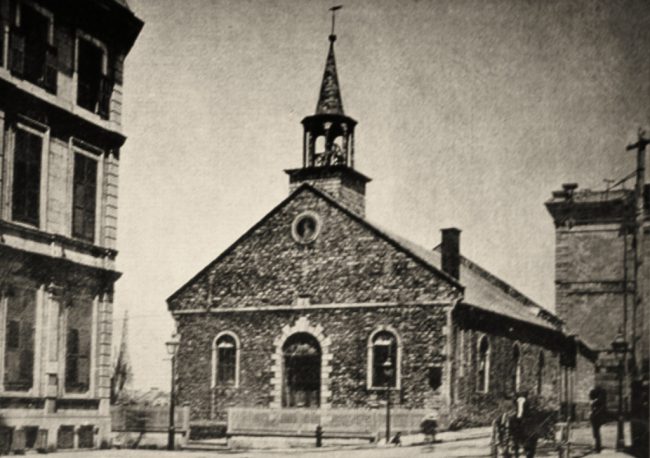
The Scotch Presbyterian Church that opened in the fall of 1792 was a plain fieldstone structure seating more than 500 people. In time, it took its name from the street where it stood, St. Gabriel. The site, which backed onto the Champ de Mars, is now occupied by part of the Old Court House on Notre Dame St.

Many Scots in the city, among them James McGill, Alexander McKenzie and William McGillivray, had grown wealthy in the fur trade, and money for the project was quickly raised to build the church. But as The Gazette noted, the speedy five months in which the work was completed also reflected “great honor on the Gentlemen of the Church of England in this City, by their having liberally contributed to the Undertaking.”At least two Catholics also contributed.

The Glasgow-born McGill was typical of the blurred lines among the various denominations here. Arriving in Montreal in 1766, he worshiped with the Anglicans and continued to rent a pew with them even after leaving with John Bethune’s new congregation. When the St. Gabriel St. Church opened, he rented a pew there as well. In 1796, he was happy to serve as the sole Protestant on a provincial commission charged with repairing and maintaining Catholic churches in Montreal.

The Presbyterians’ first minister, John Young, was an odd man. He was physically imposing – he stood six-foot-six tall, with “an eye in his head like a hawk” – but his character was flawed. Almost certainly, he was an alcoholic and what we would now call a problem gambler.

In 1788, he became pastor of a united congregation in Schenectady and Currie’s Bush, in upstate New York. But two years later, he sought to resign when his flock brought serious charges against him, probably for drunkenness. Chagrined, he made his way to Montreal and, a minister without a congregation, was doubtless pleased to find himself wooed by a congregation without a minister.

In December 1790, he was cleared of the original charge of misconduct. But when the American Presbyterians then censured him for “abruptly leaving his charge, in the sight of the slanderous accusations, and taking a journey into Canada without the knowledge of his people,” he surely concluded he had little future in Schenectady. He briefly returned, before finally throwing in his lot with the Montrealers early in 1791.

He was then about 32 years old, and was soon conducting services for the Presbyterians here. On Sept. 18, in the Recollets’ chapel, he administered the sacrament of the Lord’s Supper “in accordance with the usages of the Church of Scotland.” He took a leading part in the campaign to build a permanent home for his congregation.


Oh, What a Tangled Apologetic We Weave

When we convert to Roman Catholicism and wind up with Pope Francis.

Consider Fr. Dwight Longenecker’s recent explanation for the pope’s failure to answer those cardinals asking for clarification of Amoris Laetitia:

It is, if you like a religion based in an authoritative book, a creed, a catechism, a dogmatic systematic theology and, by extension a defined religious law. Those who favor a propositional faith like certainty and clarity.
Critics of propositional faith believe that, at best, the propositions are simply a framework or structure of belief, and that the real experience is far more complicated, but also far more exciting and real. They criticize those who like a propositional faith as being rigid, legalistic or Pharisaical. The critics of propositional faith like to emphasize the more subjective “encounter with Christ.” They advocate getting away from all the debates about doctrine or canon law, rolling up one’s sleeves and getting busy doing God’s work in the world.

Critics of propositional faith also believe that it is divisive. If “the encounter with Christ” is emphasized rather than propositional formulas of doctrine and morals, we will connect better with non Catholic Christians and people of faith and goodwill who are outside the boundaries of Christian belief. In other words, “doctrine is divisive” but if we focus on religious experience we are more likely to find common ground.

They also feel that a “propositional faith” is, by its nature, bound to the historical and philosophical constructs of the time and culture in which the propositions were asserted. So, the theology of Thomas Aquinas (they would argue) was fine for Europe of the thirteenth century, but it is rather clunky for the fast moving, fast changing global culture of the twenty first century. A faith that is not so propositional is more adaptable and fluid.

In reading the gospel it is difficult not to sympathize with those who criticize “propositional faith.” After all, Jesus’ main opponents were the religious people who were indeed legalistic, judgmental and bound to their laws and man made traditions. Jesus, on the other hand, waded in and “made a mess” to use Francis’ terminology. He defied the legalistic technicalities, met people where they were and brought healing, compassion and forgiveness.

Why does Pope Francis not answer his critics? I believe it is because he is not in favor of “propositional faith”. He wants Catholics to move beyond the technicalities, the details of doctrine and the constrictions of canon law to live out a Catholic life more like Jesus’–allowing for the complications and ambiguities of real life, meeting real people who face difficult decisions and are trying to be close to God while tiptoeing through the legalities and rules of being a Catholic Christian.

In other words, he does not answer his critics because he does not wish to play their game. He does not wish to be drawn into their legalistic arguments, but instead wants to continue to challenge them.

When you read Fr. Longenecker, though, on why he left Anglicanism for Roman Catholicism you start to wonder if he might have remained in the Church of England had he not been so propositional himself. Consider his lament about modernism which is non-propositional to the max:

Women’s ordination was a problem and the authority of Rome was the answer, but there was a deeper, underlying problem with the Anglican Church as I experienced it. The problem is modernism — a philosophical and theological position which is deeply opposed to historic Christianity.

The foundational problem with modernism is that it is anti-supernaturalist. The most foundational difficulty with the anti supernaturalism of the modernist is that he has an anti-Christian conception of God. For the modernist God is either totally immanent. That is He is ‘down here’ and not transcendent, or he is so totally transcendent as to be a sort of deist God who is ‘out there’ and does not intervene. What the modernist theologian cannot believe in is a God who is both immanent and transcendent–a God who is ‘out there’ but who touches this world and ultimately enters this world through the incarnation.. . .

If this is true–if Jesus’ death is no more than symbolic image, then the entire ecclesiological structure and sacramental system is no more than an archaic symbolical structure. It is a historic mythology that, at best, unlocks something within the human subconscious. It is a human construct that helps people to transition through their lives. . . .

So when they said they believed in the Incarnation they actually believed that “Jesus Christ was the most fulfilled human who ever lived. He was so self actualized that he achieved a kind of divine status. He, more than anyone else, was one with the god within.” When they ‘affirmed’ the Virgin Birth they really meant that Mary was an especially pure young woman before she had intercourse with Joseph or a Roman soldier. When they proclaimed from their pulpit on Easter Day, “Christ is Risen! He is risen indeed!” what they meant was, “In some sort of wonderful way I would want to say that Jesus Christ continued to inspire his followers after his tragic death.”

I used to think that his lie was simply being told in the halls of academia, that the rot was really only in the universities, but of course it was not only there. It had been disseminated throughout the Anglican Church through the education of the clergy for the last fifty or sixty years. Of course there were pockets of true belief and there are still. In making this critique of Anglicanism I am not damning all Anglicans.

Now that the pope doesn’t respond to his critics, Fr. Dwight gets non-propositional.

No wonder converts are always winning.

The Small Town and Its Defenders

The missus and I were glad to be in Jackson, Michigan, at the Grand River Brewery, for a set of presentations sponsored by The American Conservative. We heard Bill Kauffman, who is arguably conservatism’s funniest voice. Here’s an excerpt:

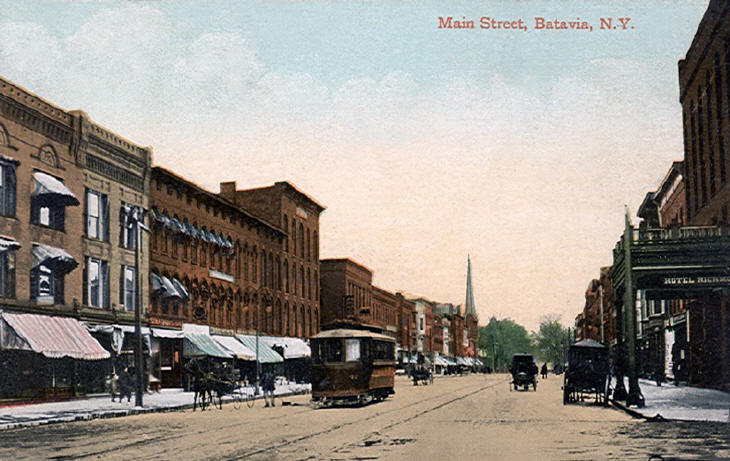
My hometown, Batavia, New York, population 15,500, has had plenty of Bill Baileys and Hughie Cannons over the years. I don’t mean by that shiftless drunks, daydreaming musicians, guys who stay out all night—they’re okay by me—but rather people who leave town, or who refuse to make a home in the place where they live. They reject Booker T. Washington’s wise injunction to cast down your bucket where you are.

In 2003 I published a book called Dispatches From the Muckdog Gazette, which is, megalomaniacally, a memoir about my repatriation to Batavia, but it’s also about the way that Batavia—and by extension all the Batavias from sea to dimming sea—has struggled to maintain a distinct identity, a character, rather than becoming just another formless wattle on the continental blob.

To the world, Batavia is merely Exit 48 on the New York State Thruway, that hideous gray scar across our green and lovely state, that drab version of the Erie Canal dedicated to that drab man Thomas E. Dewey, who fled his fine little hometown of Owosso, Michigan, which was too small to contain a man of his talent, or ego.

I don’t know how much anyone here knows of Batavia—I’m afraid we keep our little light well hidden under the bushel—but I will skip lightly over the first 160 or so years of our history and say only that it is rich, mythopoeic, beguilingly strange, as befits the cradle of the Anti-Masons, the first third party in American history.

Batavia was a prosperous little city, manufactory of combines and tractors and shotguns. English and Scots and Germans were the early settlers, coexisting uneasily with the late 19th-century polyglot influx of Italians and Poles. I’m a mongrel, a mixture of several of these streams—though my beloved late Italian grandmother insisted that we were “northern Italian—almost Swiss.” So in my book I gave myself license to write freely, even raucously, of the ethnic conflicts that once cleaved Batavia—but also gave it a good deal of its spice.

In some ways we were a typical small American city but in other ways we were “Batavia”—our own place. We did not yet bow down before the new American royalty: Burger King and Dairy Queen.

Then, as Joseph Heller would say, something happened. Urban renewal. My old boss Senator Pat Moynihan once said, when driving through Auburn, New York, which was decimated rather as Batavia was—I would do my Moynihan impression but I’m afraid I teetotaled at the reception—“in the 1950s, with a progressive government and newspaper, you got into urban renewal and destroyed everything of value in your town. If you’d had a reactionary newspaper and a grumpy mayor, you might still have it.” (Try to imagine any U.S. senator today saying something one ten-thousandth as perceptive.)

This is Your Society on Antithesis

Damon Linker explains:

Slightly (but just slightly) below the level of national politics, reverberations from news of Harvey Weinstein’s allegedly atrocious behavior with women over a span of several decades continued to radiate outward from the movie producer. Instead of a united front of disgust at the details revealed by the story that brought him down, reaction (of course!) split along partisan lines, with leading liberal and conservative writers denouncing one another for hypocrisy and double-standards (the easiest and laziest forms of moral denunciation). So the right accused the left of going easier on Weinstein than they had on conservatives Roger Ailes and Bill O’Reilly after similar behavior was alleged against them, and the left accused the right of precisely the opposite sin.

Every single event in our public life is now instantly swept up into the centrifugal whirlwind of a political culture in which the center has completely failed to hold. Democrats are increasingly defined by their hatred of Republicans, just as Republicans manage to agree about little besides their loathing of Democrats.

Isn’t this precisely what happens when culture is an outworking of ground motives, and when policy is part of the plan of salvation? Living in God’s two kingdoms sure looks more attractive. But it is not nearly as fulfilling or energizing.

Expiration Date Passed

Apparently Ta-Nehisi Coates’ magic has worn off. Several writers have recently taken issue with his ideas about race relations and whiteness (and white superiority). Thomas Chatterton Williams, who was one of the first black authors to take Coates on, returns for another at bat under with the approval of editors at the New York Times (not the New York Post or the Washington Times). This must be serious.

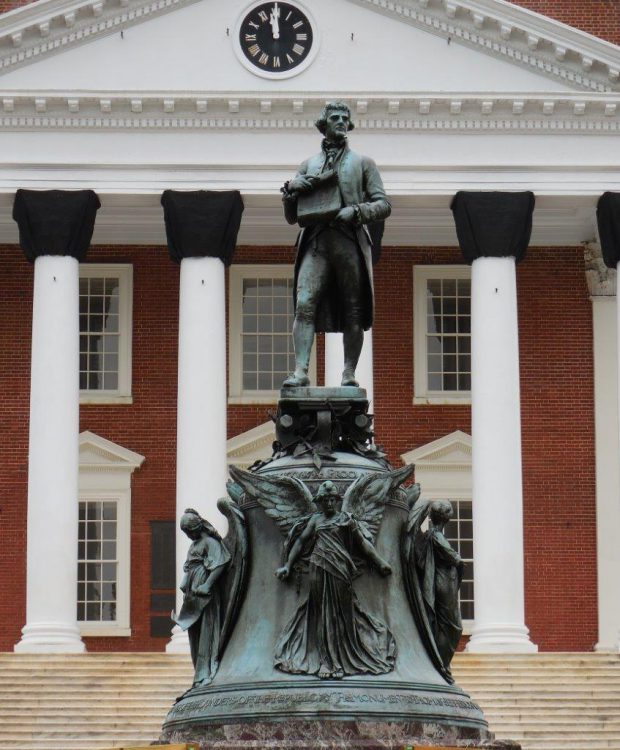
At the Atlantic though, where Coates writes regularly and achieved some of his fame, his editors still think Coates is brilliant and that they bask in the brilliance by publishing and endorsing his ideas. For instance, on a recent podcast about Charlottesville and the Confederate Monuments, Jeffrey Goldberg described President Trump’s reaction, in which he wondered if taking down Robert E. Lee leads to Jefferson and Washington, in cataclysmic terms:

It is an amazing moment when the president of the United States can’t delineate the difference between the Civil War and the Revolutionary War. I think this is a breakpoint in modern American history.

Hasn’t Goldberg read Coates? Someone well before Trump showed a lack of nuance in describing white supremacy in U.S. history:

For the men who needed to believe themselves white, the bodies were the key to ta social club, and the right to break the bodies was the mark of civilization. “The two great division of society are not the rich and poor, but white and black,” said the great South Carolina senator John C. Calhoun. “And all the former, the poor as well as the rich, belong to the upper class, and are respected and treated as equals.” And there it is — the right to break the black body as the meaning of their sacred equality. And that right has always given them meaning, has always meant that there was someone down in the valley because a mountain is not a mountain if there is nothing below.

You and I, my son, are that “below.” That was true in 1776. It is true today. (Coates, Between the World and Me, 104-105).

So what do the editors at the Atlantic think of a staff writer who cannot tell the difference between the Civil War and Revolutionary War?

What’s a Mayor to Think?

This doesn’t sound transformationalizational:

For we know that if the tent that is our earthly home is destroyed, we have a building from God, a house not made with hands, eternal in the heavens. 2 For in this tent we groan, longing to put on our heavenly dwelling, 3 if indeed by putting it on we may not be found naked. 4 For while we are still in this tent, we groan, being burdened—not that we would be unclothed, but that we would be further clothed, so that what is mortal may be swallowed up by life. 5 He who has prepared us for this very thing is God, who has given us the Spirit as a guarantee.

6 So we are always of good courage. We know that while we are at home in the body we are away from the Lord, 7 for we walk by faith, not by sight. 8 Yes, we are of good courage, and we would rather be away from the body and at home with the Lord. 9 So whether we are at home or away, we make it our aim to please him. 10 For we must all appear before the judgment seat of Christ, so that each one may receive what is due for what he has done in the body, whether good or evil. (2 Cor 5)

So is the mayor, or any elected or appointed official, supposed to turn to Abraham (Kuyper) rather than Paul?

What in the World (-w)?

If politicians or voters thought like this, wouldn’t the world be safer for theonomy?

The awareness that God acts in history in ways that we can only know in the context of our culturally determined experience should be central to a Christian understanding of history.

Yet the Christian must not lose sight of the premise that, just as in the Incarnation Christ’s humanity does not compromise his divinity, so the reality of God’s other work in history, going well beyond what we might explain as natural phenomena, is not compromised by the fact that it is culturally defined.

The history of Christianity reveals a perplexing mixture of divine and human factors. As Richard Lovelace has said, this history, when viewed without a proper awareness of the spiritual factors involved, “is as confusing as a football game in which half the players are invisible.”

The present work, an analysis of cultural influences on religious belief, is a study of things visible. As such it must necessarily reflect more than a little sympathy with the modern mode of explanation in terms of natural historical causation.

Yet it would be a mistake to assume that such sympathy is incompatible with, or even antagonistic to, a view of history in which God as revealed in Scripture is the dominant force, and in which other unseen spiritual forces are contending.

I find that a Christian view of history is clarified if one considers reality as more or less like the world portrayed in the works of J. R. R. Tolkien.

We live in the midst of contests between great and mysterious spiritual forces, which we understand only imperfectly and whose true dimensions we only occasionally glimpse.

Yet, frail as we are, we do play a role in this history, on the side either of the powers of light or of the powers of darkness.

It is crucially important then, that, by God’s grace, we keep our wits about us and discern the vast difference between the real forces of good and the powers of darkness disguised as angels of light.

If historians can see the forces of darkness and light in the past, imagine the powers of Christian magistrates and voters in recognizing sin and righteousness in society.

The problem is, I don’t think the Neo-Calvinists really want to go there. But they do need to acknowledge how they made the world safe for theonomists.

When the Fix is Broken

Papal infallibility looks good on paper, but not so much on the Interweb:

These criticisms of Pope Francis put progressive Catholics in an awkward position. Progressives are big fans of Francis, but it would be somewhat hypocritical of them to suddenly become papal absolutists when they clearly had disagreements with Pope John Paul II and Pope Benedict XVI. On the other hand, conservatives who are now critical of Francis accused progressives of being “cafeteria Catholics” when they disagreed with John Paul or Benedict.

All I can say is, “Welcome to the cafeteria.”

The truth is all Catholics are cafeteria Catholics. Conservative Catholics were quite willing to ignore John Paul’s and Benedict’s strong statements on justice and peace, and progressive Catholics are happy to ignore Francis’ opposition to women priests.

Disagreeing with the pope was not welcomed during the papacies of John Paul and Benedict. Bishops, priests, theologians, and Catholic publications were expected to unreservedly cheer any statement that came out of Rome. Priests were silenced, seminary professors were removed, and magazine editors were fired if they strayed from the party line. The open debate that occurred during the Second Vatican Council was closed down. Candidates for the episcopacy were chosen based on loyalty to Rome rather than on intelligence or pastoral abilities.

The atmosphere has changed under Francis. Bishops are being chosen because of their pastoral abilities and identification with the poor. Theologians are free to speak and write what they please. Catholic publications are not subject to censorship. And cardinals and theologians are publicly criticizing the pope, something that would never have been allowed in earlier papacies.

Francis can only blame himself for this. He asked for it. At the beginning of the 2016 synod on the family, he told the bishops to “Speak clearly. Let no one say, ‘This can’t be said, they will think this or that about me.’ Everything we feel must be said, with ‘parrhesia’ (boldness).”

Doesn’t mean that Protestantism is the fix, but for those thinking the other side of the Tiber has the fix, reconsider.

What’s a Plumber to Think?

In which category, flesh or Spirit, fall washers and gaskets?

5 For those who live according to the flesh set their minds on the things of the flesh, but those who live according to the Spirit set their minds on the things of the Spirit. 6 For to set the mind on the flesh is death, but to set the mind on the Spirit is life and peace. 7 For the mind that is set on the flesh is hostile to God, for it does not submit to God’s law; indeed, it cannot. 8 Those who are in the flesh cannot please God.

9 You, however, are not in the flesh but in the Spirit, if in fact the Spirit of God dwells in you. Anyone who does not have the Spirit of Christ does not belong to him. 10 But if Christ is in you, although the body is dead because of sin, the Spirit is life because of righteousness. 11 If the Spirit of him who raised Jesus from the dead dwells in you, he who raised Christ Jesus from the dead will also give life to your mortal bodies through his Spirit who dwells in you.

12 So then, brothers, we are debtors, not to the flesh, to live according to the flesh. 13 For if you live according to the flesh you will die, but if by the Spirit you put to death the deeds of the body, you will live. 14 For all who are led by the Spirit of God are sons of God. 15 For you did not receive the spirit of slavery to fall back into fear, but you have received the Spirit of adoption as sons, by whom we cry, “Abba! Father!” (Romans 8)