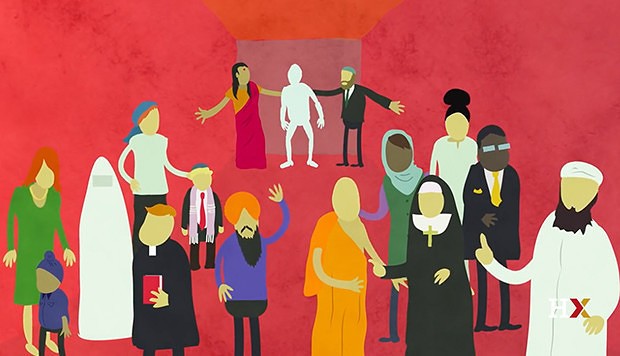
Machen Helps Keep Law and Gospel Straight

If he were living, he’d also straighten out the obedience boys:

But what ought to be clearly observed is that that Covenant of Works or Covenant of Life did not offer “salvation.” The word “salvation” implies something from which one is saved. Adam was not lost when that Covenant of Life was given him. On the contrary he had knowledge, righteousness and holiness. The Covenant of Works was not given as a way by which a sinner might get rid of his sin and merit eternal life.

Neither was the Mosaic Law given for any such purpose. It was not given to present, even hypothetically, a way by which a sinner, already eternally under the condemnation of sin, could by future perfect obedience merit the favor of God. And Dr. Charles Hodge surely does not regard it as given for any such purpose.

The root error, or one of the many root errors of the Dispensationalism of the Scofield Bible seems to me to be the utter failure to recognize and make central the fact of the Fall of man. I know that there are salutary inconsistencies in the Scofield Bible. I know that in the notes on the fifth chapter of Romans there is taught, not indeed the orthodox doctrine of imputation, but still some recognition of the universal corruption that has come from Adam’s sin. But by what a back-door even that much of the central Biblical teaching is brought in! As one reads Dr. Scofield’s notes one does not for the most part get the slightest inkling of the fact that anything irrevocable took place when Adam fell. After his Fall man continued to be tested in successive dispensations. See for example the definition of a dispensation which Dr. Scofield gives at the beginning. That is one of the things that seems to me to be so profoundly heretical in this commentary.

It is contrary to the very heart of the Augustinian and Calvinistic view of sin. According to that view — and surely according to the Bible — the guilt of Adam’s first sin was imputed to his posterity. Adam being by divine appointment the representative or federal head of the race. Thus all descended from Adam by ordinary generation are guilty. They are guilty before they individually have done anything either good or bad. They are under the penalty of sin when they are born. Part of that penalty of sin is hopeless corruption, from which, if there is growth to years of discretion, individual transgressions spring. How utterly absurd would it have been therefore for God to offer the Mosaic Law, to such an already condemned and fallen race, as something which, if only obeyed by that already condemned and fallen race, would bring salvation and eternal life!

Hard to love the law when it doesn’t do all that faith in Christ does.
Deconstructing Evangelicalism

I told you so:

There’s another problem here. Many of the best pollsters lack a deep understanding of the subtle outlines of the thing they’re trying to measure. It’s hard enough to quantify evangelicalism when you basically, if vaguely, grasp what it is, but it’s almost impossible to do so if you’re otherwise unable to tell a Pentecostal from a Presbyterian. So it would seem like the pollsters best-qualified to tackle this tricky business would be those with a first-hand, native-born understanding of what American evangelical Christianity is really like — knowledge that comes from living it on the inside.

But there’s a little problem with that, and a big problem with that. The little problem, as we’ve already mentioned, is that evangelical Christians themselves aren’t usually any better able to limn the outlines of their category than anyone else — hence the NAE turning to a British scholar of religious history to describe for them who they are. As the old joke says, if you want to know what water is like, don’t ask a fish.

The big problem, though, is a doozy. Part of the character of evangelical Christianity is that it is contentious and disputed. Bebbington didn’t include this in his quadrilateral, but it has been true ever since at least the Reformation, and it greatly intensified throughout the 20th century. Evangelicalism is, among other things, a category of people who are perpetually arguing over which among them does and does not legitimately belong in that category. The definition of “evangelical” provided by any given evangelical, therefore, tends to be fraught. Evangelicals have a hard time measuring their group without taking the opportunity to declare that others aren’t measuring up and don’t legitimately belong with the rest.
So even though we have some very skilled evangelical pollsters and data-crunchers, and even though they’ve done some laudable work trying to refine their measurements and metrics, these folks also tend to be bound up and beholden to the very same evangelical institutions involved in the tradition’s never-ending disputes over legitimacy. When those institutions seek a head-count of evangelicals or a measure of evangelical opinions, they’re almost always also seeking to count others out.

Back then W. was in the White House, evangelicals had access to power, and White Christian America was only in critical condition. Deconstructing evangelicalism then was a lot harder to do than it is in the age of Trump.

Supersessionist Shrug

An apologist’s post caught my eye and led to an exchange that produced this assertion:

I did admit Rome’s problems, but I didn’t bother laying them out in detail because that wasn’t the point of the post. And as I pointed out in the post and have said over and over again in our exchange, they don’t really affect my conclusion one way or another. If my main argument were that Protestants don’t act like Christians and Catholics do, you would have a point. But I never said that and never would. Sure, Rome has a lot of ‘skeletons:’ the Catholic Church is the oldest and largest of the communions; it makes sense that there would be more crimes, sins, and failures in her past than in that of the others. What of it? A one-by-one comparison of the crimes of the different Christian churches, even if we agreed on what constituted a crime, would tell us nothing about which one among them had the best claim to being the church founded by Christ. Again, the evil done by the Church is accounted for by hypothesis: that of being a Divine commission entrusted to fallen humanity.

Imagine if Jeremiah had said that to the Israelites. Don’t worry about your sins, you go all the way back to Abraham:

“Thus says the LORD of hosts, the God of Israel: You have seen all the disaster that I brought upon Jerusalem and upon all the cities of Judah. Behold, this day they are a desolation, and no one dwells in them, because of the evil that they committed, provoking me to anger, in that they went to make offerings and serve other gods that they knew not, neither they, nor you, nor your fathers. Yet I persistently sent to you all my servants the prophets, saying, ‘Oh, do not do this abomination that I hate!’ But they did not listen or incline their ear, to turn from their evil and make no offerings to other gods. Therefore my wrath and my anger were poured out and kindled in the cities of Judah and in the streets of Jerusalem, and they became a waste and a desolation, as at this day. (Jeremiah 44:2-6 ESV)

Too old to fail? Where would anyone reading the whole Bible come up with that?

But if the church is so different from Israel in a supersessionist way, then the lessons of Israel don’t apply to the church. And by the way, don’t bother reading the epistle to the Hebrews.

Oh, Canada

We don’t stand on guard for thee because we in the United States fear Mexico and its people more (think Trump).

I sometimes ask students to think what the United States would look like if we had not fought a war for independence from Great Britain. We would look like Canada, where a sign of national greatness is to be part of the United Nation’s Security Council. U.S. Americans (Canadians are American too) prone to revel in national greatness might sniff at such low aspirations. But Canada’s modesty as a nation should appeal to any real American conservative.

So does the way it appoints its Supreme Court justices — regionally rather than the political hot potato that U.S. Americans prefer:

The nine “supremes” are distributed geographically throughout the country. A limiting factor for appointments is the constitutional restriction that three must come from Quebec. Trudeau would like to appoint the first aboriginal justice, but is caught in the numbers game. The sole Atlantic Provinces justice has just retired, and Trudeau floated a trial balloon implying that it was not automatic that a justice from the region would be selected. The trial balloon turned to lead as Atlantic Province lawyers and politicians (and the region is a Liberal bastion) responded furiously. The idea seems to be set aside—for the moment. Also hiding in the wings is Trudeau’s intimation that new justices should be effective in both English and French upon appointment—a requirement that would highly restrict the pool of available legal talent.

For a peek at a country that U.S. Americans generally disregard, go here.

When I Reach for a Gun

When someone uses “faith traditions”:

John Milbank and Adrian Pabst (The Politics of Virtue, 269) argue that secular critiques of liberalism cannot hit home because “they are incapable of making the key argument that various different faith traditions are able to make—that nature is neither external to humanity, nor should humans ever aspire simply to dominate their own or external nature.”

Well, if you ask me, a faith that goes by “faith tradition” has already inhaled a good degree of liberal secularism. But oh how warm and fuzzy if feels to unite with Hindus, Muslims, and Jews in criticizing modernity.

Peter Leithart adds:

This is crucial. To deconstruct X as socially constructed, one has to be able to distinguish culture cleanly from nature. If that distinction is messy, then there’s no space for the easy deconstructive critique.

But isn’t faith tradition “socially constructed”? And isn’t it a tad messy to disaggregate Christians from Hindus so that once both sides unite to overturn liberal secularism, they can turn on each other? Messy indeed.

So is looking to Milbank as someone who will have your back when you’re teaching the Westminster Confession (and the Divines were English even).

Jesus for President

He’s about the only one left when it comes to a presidential candidate with character. Alan Noble laments:

In just five years, white evangelicals went from overwhelmingly denying a division between private and public character to overwhelmingly embracing the division. It is very difficult for me to imagine an explanation of this shift other than the candidacy of Donald Trump.

I do not want to speculate here on what exactly in Trump’s candidacy caused this shift in white evangelicals. Most of the possibilities are grim and warrant their own thorough exploration. But right now evangelicals can turn back to our traditional teaching that character matters and correct the mistake of supporting Donald Trump.

He concedes that Hillary has issues (which is why Jesus is left standing in that great day):

Some evangelical leaders have claimed that we just have two morally flawed candidates. They point to Hillary Clinton’s flawed character and her sins and conclude that since they are both sinners, we have to simply judge them on their policies. But that does not reflect a Christian conception of character and behavior.

Like many evangelicals, I cannot vote for Clinton because I do not believe she would be a good president for my neighbor. Since I believe that life begins at conception, Clinton’s intention to repeal the Hyde Amendment so that federal funds can be spent on abortions reveals a profound flaw in her character.

But her flaw does not magically make Trump’s flaws any less grievous.

What I enjoy about Trump’s candidacy as someone with a seat in the theater of American electoral politics, is how fundamentalists are now in fashion for both evangelicals and Democrats:

Having grown up as a conservative evangelical during Bill Clinton’s administration, I believe that character matters. This is what leaders on the religious right taught me when Clinton was caught in his affair with Monica Lewinsky. At the time, some people tried to shrug off Clinton’s infidelity as a private matter: Of course he shouldn’t have done it, but this didn’t affect his ability to be president. But conservative evangelicals rejected this logic, and they were right.

In response to President Clinton’s infidelity, the Southern Baptist Convention passed a “Resolution on the Moral Character of Public Officials”:

Therefore, be it RESOLVED, That we, the messengers to the Southern Baptist Convention, meeting June 9-11, 1998, in Salt Lake City, Utah, affirm that moral character matters to God and should matter to all citizens, especially God’s people, when choosing public leaders; and

Be it further RESOLVED, That we implore our government leaders to live by the highest standards of morality both in their private actions and in their public duties, and thereby serve as models of moral excellence and character; and

Be it finally RESOLVED, That we urge all Americans to embrace and act on the conviction that character does count in public office, and to elect those officials and candidates who, although imperfect, demonstrate consistent honesty, moral purity and the highest character.

So is Noble ready for the isolation that always comes to evangelicals who scold modern America for its sins? I thought evangelicals wanted a seat at the table, and fashioned a kinder, gentler Protestantism (than fundamentalism) to get there.

Now Falwell and Co. were right? Who knew?

That’ll Work

How to have a happy marriage:

First, divide all the work of running your family – from job to shopping to doing the dishes to feeding the dog — into three categories: Paycheck Work; House Work; and Childrearing Work. With scrupulous honesty (men, this means you!), calculate how many hours per week each of you spends doing these things; then add the two totals together. For instance, if Husband’s numbers are 45 hrs + 5 hrs + 10 hrs = 60 hrs total, and Wife’s are 40 + 21 + 21 = 82, then the combined total family work hours = 142. Now divide your individual numbers by the total to get the percentage of total work that each of you does: in this case, 60/142 = 42% (He), and 82/142 = 58% (She). Finally, multiply your respective percentages by two. The resulting final percentage compares you with the theoretical full contributor. Think of it as the percentage person your family setup is requiring you to be — or allowing you to be. In my hypothetical case, for instance, the husband is 84% of a fully contributing person, while his wife is 116%.

Is this part of Roman Catholic social teaching?

Why Does It Take an Election To See This?

But thank the dear Lord for general revelation.

Archbishop Chaput (of Philadelphia) thinks a leaner meaner holier church is preferable to one that is large but not very in charge.

In a stark prognosis for contemporary Catholicism, a leader of the conservative wing of the U.S. hierarchy has said that “a smaller, lighter Church” of fewer but holier believers is preferable to one that promotes inclusion at the expense of orthodoxy.

In a speech delivered Oct. 19 at the University of Notre Dame, Philadelphia Archbishop Charles Chaput also suggested that many prominent Catholics are so weak in their faith that they ought to leave the Church.

Chaput singled out Democrats such as Vice President Joe Biden and vice presidential nominee Tim Kaine for special criticism, linking them to the concept of a “silent apostasy” coined by Pope Emeritus Benedict XVI and saying Catholics who do not champion the truth of Church teaching are “cowards.”

“Obviously we need to do everything we can to bring tepid Catholics back to active life in the Church,” Chaput told a symposium for bishops and their staff members at the South Bend, Ind. campus.

“But we should never be afraid of a smaller, lighter Church if her members are also more faithful, more zealous, more missionary and more committed to holiness.

“Losing people who are members of the Church in name only is an imaginary loss,” he continued. “It may in fact be more honest for those who leave and healthier for those who stay. We should be focused on commitment, not numbers or institutional throw-weight.”

No shrug there and some support for those of us who marvel at the seeming innocence of Bryan and the Jasons and wonder what they are seeing. And kudos for a bishop who is acknowledging what at least Orthodox Presbyterians understood 80 years ago.

The problem though is that Archbishop Chaput doesn’t hold the mirror up to his own visage. Why has his communion become so loose and amorphous? Don’t the bishops have the mechanisms and authority and charism (no less) to make the ship ship shape?

Perhaps the problem is the general problem of our time is that we all want to be victims, from the abused to the bishops. It’s the new source of authority — my victimhood trumps your legitimate authority. But if the magisterium is what Bryan and the Jasons say it is, sure Archbishop Chaput can do more than give a speech.

And the question remains, why would it take a presidential election to provoke the Archbishop’s call to holiness?

Chaput’s main focus, however, was on the wider threat posed by what he said was a secularizing culture and a progressive political agenda that “bleaches out strong religious convictions in the name of liberal tolerance.”

Too many Catholics are guilty of cooperating with that process, he said, transferring “our real loyalties and convictions from the old Church of our baptism to the new ‘Church’ of our ambitions and appetites.”

He named Biden, Kaine and House Minority Leader Nancy Pelosi as prime examples of this phenomenon, as well as Supreme Court Justice Anthony Kennedy, a Catholic and Republican appointee whose deciding vote in the landmark 2015 gay marriage case made him anathema to many social conservatives.

The politics of the U.S. hierarchy are in flux largely because Francis, who was elected in 2013, has begun naming and promoting bishops who embrace his outgoing approach to ministry and evangelization.

That trend away from the “culture warrior” bishops who came to dominate the U.S. Conference of Catholic Bishops over the past three decades was evident in the men Francis chose this month as his first American picks to be cardinals.

The three – the archbishops of Chicago and Indianapolis and the former bishop of Dallas – are known for their moderate tone and pastoral style while hard-liners like Chaput, who in a previous era might have been a strong candidate for a red hat, were passed over.

But Chaput, 72, and other conservatives in the U.S. hierarchy have been speaking out with greater frequency about the election. They tend to lament Trump’s obvious faults while singling out the Democratic ticket for special criticism and noting that opposition to legal abortion – which is part of the Republican platform and a Trump campaign promise – overrides every other policy consideration.

Called to this communion? Is Bryan and the Jasons serious?

Is Calvinism the Donald Trump of Western Christianity?

This sounds off putting:

Oh, Calvinism—I don’t know if any doctrinal system has ignited more faith-feuds than this. Relationships have been fractured and churches have been split because believing men and women have allowed differing perspectives of God’s sovereignty to arouse the vilest parts of their sinful natures. Devilish pride and hellish rage have ravaged the hearts of Christians on all sides of this issue, dividing and sickening Christ’s beloved Body. It is for this reason that I have shied away from explicitly communicating my Calvinistic or Reformed (whatever you want to call it) theological position. I love the Church and have been fearful of causing unnecessary conflict within her—even among my little herd of faithful readers.

But it turns out TrumpCalvinism has some appeal:

I wasn’t groomed by a specific denomination to read the Bible with sovereignty-sensitive lenses on. The truths were just there—in almost every Spirit-inspired book—staring me right in the face.

God controls the human heart.
God draws people to Jesus Christ.
God causes people to be born again.
God predestined some people to become his children.

This rattled me, as I was under the assumption that my conversion to Christianity had been a decision I made purely of my own volition. I mean, I did make a real, non-coerced choice to follow Jesus. That’s inarguably true. But what the Bible seemed to be saying was that God was wooing, influencing, and even changing me to ensure that I would make that choice. There was something—some effectual, divine work—taking place underneath my desires and decisions.

I didn’t know what to do with this, so I ran to my Christian friends for guidance. They initially told me not to worry about it, saying those passages in the Bible didn’t mean what they seemed to mean. My friends explained that some folks—pesky “Calvinists”—believed that God chooses certain people to be saved. However, such theology contradicts what we know to be true about man’s free will. “God is sovereign, but he doesn’t influence or interfere with our personal decisions,” they told me, “Our choices determine our destiny, not some ‘predetermined’ plan of God.” Because they were far more seasoned in spiritual matters than me, I decided to trust their perspective and lay my curiosities to rest.

For about three days.

I couldn’t read the Bible without being confronted by this stuff!

Okay?!?

The Church Still Has Standards

While Ross Douthat worries about changes in church teaching about marriage and divorce, the cardinals in Rome have not lost discernment when it comes to commerce and food. At issue is the opening of a McDonald’s close to St. Peter’s:

Cardinal Elio Sgreccia, a former president of the Pontifical Academy for Life, has publicly voiced his opposition to the move, telling the Italian daily La Repubblica it is “a controversial, perverse decision to say the least”. The Italian cardinal doesn’t live in the property, a former bank that borders Borgo Pio and Piazza Leonina, but spoke on behalf of the residents who wrote to the Pope. Cardinals Walter Kasper and George Pell also live in the block and Benedict XVI was resident there when he was a cardinal.

Opening a McDonald’s so close to the Vatican basilica is “not at all respectful of the architectural traditions of one of the most characteristic squares which look onto the colonnade of Saint Peter’s, visited everyday by thousands of pilgrims and tourists,” Cardinal Sgreccia said. He added that the “business decision” is a “disgrace” which “ignores the culinary traditions of the Roman restaurant”, is “not in line with the aesthetics of the place,” and would “inevitably penalize” other restaurateurs in the area.

He also criticized McDonald’s, saying its mix of burgers and French fries are “far from the traditions of Roman cuisine” and that “according to analyses and studies by not a few nutritionists and doctors, do not guarantee the health of consumers.”

Is that a vote for In-and-Out Burger?

Once upon a time, Vatican officials worried about Americanism as a form of government and freedom of religion. Not any more.