For Those Without Ears to Hear

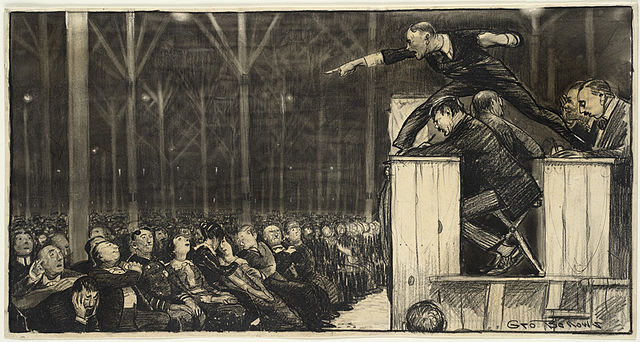
Justin Taylor revives Billy Sunday’s career by collecting comments on what the evangelist sounded like and even a few clips of the preacher himself. Taylor leaves out arguably the most insightful observer of Sunday, H. L. Mencken, whose critique extends as much to evangelicalism as to the baseball-player-turned-evangelist himself:

As for his extraordinary success in drawing crowds and in performing the hollow magic commonly called conversion, it should be easily explicable to anyone who has seen him in action. His impressiveness, to the vegetal mind, lies in two things, the first being the sheer clatter and ferocity of his style and the second being his utter lack of those transparent pretensions to intellectual superiority and other worldliness which mark the average evangelical divine. In other words, he does not preach down at his flock from the heights of an assumed moral superiority — i.e. inexperience of the common sorrows and temptations of the world — but discharges his message as man to man, reaching easily for buttonholes, jogging in the ribs, slapping on the back. The difference here noted is abysmal. Whatever the average man’s respect for the cloth, he cannot rid himself of the feeling that the holy man in the pulpit is, in many important respects, a man unlike himself . . . .; his aura is a sort of psychic monastery; his advice is not that of a practical man, with the scars of combat on him, but that of a dreamer wrapped in aseptic cotton.

Even setting aside [Sunday’s] painstaking avoidance of anything suggesting clerical garb and his indulgence in obviously unclerical gyration on his sacred stump, he comes down so palpably to the level of his audience, both in the matter and the manner of his discourse, that he quickly disarms the old suspicion of the holy clerk and gets the discussion going on the familiar and easy terms of a debate in a barroom. The raciness of his slang is not the whole story by any means; his attitude of mind lies behind it, and is more important. . . . It is marked, above all, by a contemptuous disregard of the theoretical and mystifying; an angry casting aside of what may be called the ecclesiastical mask, an eagerness to reduce all the abstrusities of Christian theology to a few and simple and (to the ingenuous) self-evident propositions, a violent determination to make of religion a practical, an imminent, an everyday concern.

Not Winning

Even if evangelicals think they are:

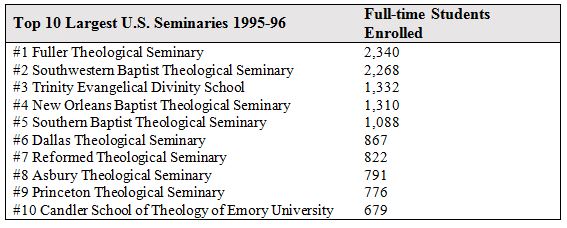
Since the 1995-96 academic school year, Princeton Theological Seminary has seen 30 percent fewer full-time enrolled students. Reformed Theological Seminary saw a 33 percent decrease to 547 full-time students while Candler School of Theology experienced a 39 percent drop to 414 full-time students.

Joe Carter spins this as victory for the Gospel Allies:

Kenneth Kantzer, the late academic dean of Trinity Evangelical Divinity School, once said that in 1890 all of the Protestant theological seminaries in the United States—with the notable exception of Harvard—were evangelical. Forty years later, though, almost all of them had become liberal (i.e., denied basic tenets of orthodoxy). By the 1950s, only four of the top ten largest seminaries were sponsored by evangelical denominations. Of those four, three were part of the SBC, which was struggling at the time to take back control of its schools from liberal professors.

By the 1990s, the trend had shifted once again back toward conservative evangelicalism. After the “conservative resurgence” in the SBC, all six of the denomination’s seminaries were solidly orthodox. And by 1995, only two liberal-leaning seminaries remained on the list of top ten schools by enrollment (Princeton at #9 and Candler School of Theology at #10).

Doesn’t he know that for some Southern Baptists, evangelical is a “Yankee” word.

And what does he not understand about Kenneth Kantzer’s reasons for leaving Fuller Seminary?

Roman Catholic apologetics are catchy.

Whatever Happened to Boomer Irony?

While the missus is still away, I watched a documentary over the weekend about folk music in Greenwich Village, Greenwich Village: Music that Defined a Generation. It was largely celebratory. Only scant attention to drugs, the cost of success and selling out, envy of Bob Dylan. And then there was politics. I had really hoped they would not go there but they did: folk music changed everything. The last segment included stars talking about how music changed the world. One example was how Harry Chapin rallied musicians to sing together (of all things) and so raise funds for worthy causes. No mention of how those funds were administered. No mention directly of folk music’s inspiration of either Martin Luther King or Malcolm X. And no images of Rev. King with ear buds during his marches while he listened to Don McLean or Peter, Paul, and Mary (and why did Mary come up last in the list?) and evaded barking dogs.

I’d have expected New Yorkers with New York sensibilities to be a little less self-congratulatory. But then there are the Yankees and their fans.

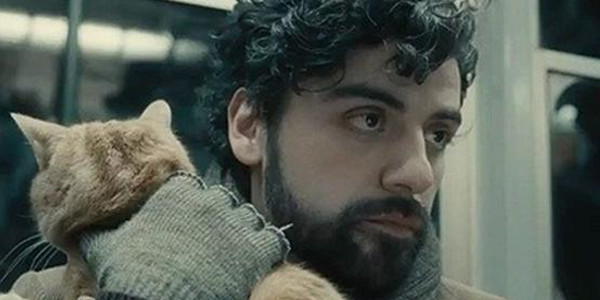
But amazingly, for a movie made after — underscore after — A Mighty Wind and Inside Llewyn Davis (okay, Greenwich Village and Inside LD came out the same year), how can you ever play folk music straight? Don’t you need a measure of ironic distance, a little self-awareness that you are the one touting yourself?

It struck me that folk musicians were for the left what evangelicalism is to Christianity.

And then comes this from another boomer New Yorker:

CoyrCxpXEAAcrLI

Forget irony. Whatever happened to the fall that follows pride?

Beaver Cleaver Was Lost in His Trespasses and Sins

Trigger warning to self: you’ve engaged Carl Trueman critically before and it did not go well. So be careful, be very careful.

The reason for bringing up Dr. Trueman again, even if ever so gingerly, has to do with his recent evaluation of Rusty Reno’s new book about prospect for a Christian society. Trueman writes:

I simply am not convinced that change can be achieved on any significant scale. The causes of the modern malaise are complicated, and their solution must be equally elaborate. For example, as George Grant and David Schindler have shown, technology brings with it a different view of reality from that of traditional Christianity. This mindset is now deeply embedded in our world. The entertainment industry mediates much of what is taken for reality and grips the moral imagination of the masses. The globalized economy has transformed communities and community expectations in ways we have yet to fathom. To borrow that hackneyed but poetic phrase from Marx, all that is solid melts into air. Zygmunt Bauman’s argument, that we live in a time when even the most longstanding and reliable social structures are in permanent flux, seems to me compelling. It must be accounted for by any hope that depends upon the solidity of concepts or institutions from the past. How does one reform or recapture or rebuild that which has been robbed of solid existence?

I generally agree.

But where I push (not shove) back is with the idea that modernity alone has these problems. Ever since the fall, it seems to me, the possibilities of pursuing lives of holiness and passing on the faith have been hard. Just remember what Paul warned Timothy about the “last days”:

understand this, that in the last days there will come times of difficulty. 2 For people will be lovers of self, lovers of money, proud, arrogant, abusive, disobedient to their parents, ungrateful, unholy, 3 heartless, unappeasable, slanderous, without self-control, brutal, not loving good, 4 treacherous, reckless, swollen with conceit, lovers of pleasure rather than lovers of God, 5 having the appearance of godliness, but denying its power. Avoid such people. 6 For among them are those who creep into households and capture weak women, burdened with sins and led astray by various passions, 7 always learning and never able to arrive at a knowledge of the truth. (2 Tim 3:1-8)

Was Paul predicting a time when Marx, Freud, and Nietzsche would dominate understandings of human nature and the created order, or was he talking about life in the Roman Empire circa 60 AD? My understanding is that he was talking about life in the Mediterranean world then.

So why do Christians believe modernity is so much worse than any other time? Well, it sure seems that Roman Catholics have a certain nostalgia for the Christian society of medieval Europe, neo-Calvinists for the Christian society of the Kuyperian era of Dutch history, evangelicals in the U.S. for the First Pretty Good Awakening that of course led up to the Christian founding of the United States. Here Protestants want to recalculate critiques of modernity since Kuyper and George Whitefield both fall on the modern side of the divide between medieval and modern periods. In other words, Protestant critiques of modernity play into the hands of certain Roman Catholic apologetics (even if nostalgia for the flourishing of the Middle Ages seldom extends to the Crusades or the Inquisition).

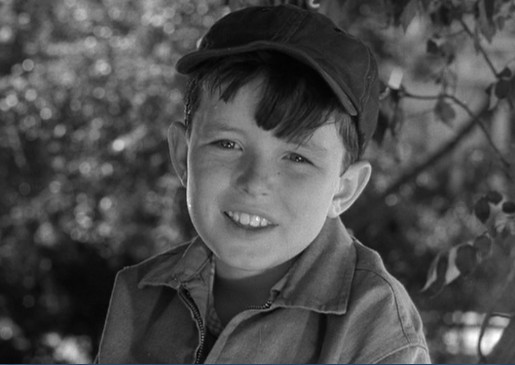
But surely anyone with eyes and ears has to admit that we are living in worse times than 1950s American when Ward and June Cleaver reared Wally and the Beave. I have eyes and ears. I will concede that the 2010s are worse than the 1950s, though I did live through 1968 and that was not a good time. But on a scale of fallen humanity, are modern or contemporary times really worse than what Noah lived through, or Lot, or Jeremiah, or our Lord himself? Doesn’t the fall mean we always live in desperate times?

The point here is not that people who believe in original sin should be relativists when it comes to assessing the way humans live together or proposing ways that are better for a common life together and for the proclamation of the gospel. But I think it is a mistake to cultivate the notion that human flourishing is possible whether by putting in place the right policies or institutions, or by thinking about the past a certain way. I know Dr. Trueman knows this. But it sounds like he thinks we are living through one of the worst times in human existence. No matter how pleasant and reassuring Beaver Cleaver’s America was, it was not the new heavens and new earth. When sin abounds, it’s not a good time. The Cleavers were certainly flourishing as we now count such living, but they were also drowning in sin (and never in church). Shouldn’t that perspective inform the way we view the West post-Foucault?

It’s Still Not 1968

Is this why Hillary Clinton will bring Bill back to the White House?

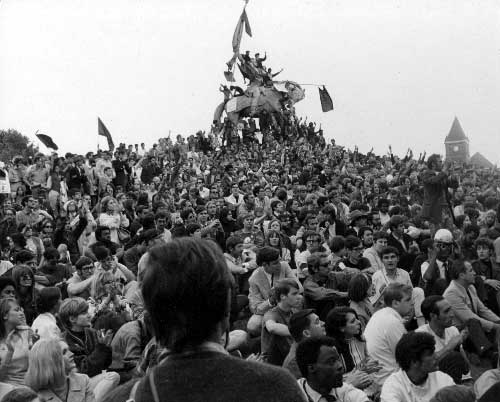
It’s worth repeating: there is no precedent in modern history for such a mass display of disunity by elected delegates at a national political convention as occurred this week in Philadelphia. Hundreds of people elected at primaries and caucuses not only vacated the Wells Fargo arena, they subsequently staged incendiary acts of civil disobedience and stared down Pennsylvania State Police riot cops—all to express the depth of their opposition to Hillary. Then, on Thursday, swaths of delegates chanted, booed, jeered, and walked out on Hillary during her nomination-acceptance speech. The closest analog may be the infamous Democratic convention of 1968, which erupted into turmoil mainly over the Vietnam War. But that turmoil mostly had to do with external protests met with violence by Chicago police. These acts of rebellion in Philadelphia were carried out by duly credentialed delegates.

The lack of coverage the tumult received, despite its historical significance, is indicative of a wider problem that Sanders supporters have long identified: few members of the elite media are sympathetic to the “Bernie or Bust” movement, which has resulted in disproportionately little media attention. Conversely, the failed #NeverTrump movement had countless devotees active in elite political, media, and ancillary spheres, so it received outsized coverage relative to the actual number of GOP voters who supported that position.

Preaching the Great Commission

Even Purgatory:

Today at my parish we had a missionary priest from India. I am happy to say that after years of disappointment, it was refreshing to finally here a missionary actually talking about bring people to Jesus. To talk about salvation. It was wonderful. And he wasn’t a traditional order priest or anything; he was just a Novus Ordo diocesan priest. But he preached about the Great Commission. About the necessity of bringing Christ to people. About baptism. About India’s great Christian traditions, both those begun by St. Thomas as well that brought by St. Francis Xavier and the 16th century Jesuits. He offered actual spiritual insights that were relevant.

I remember recently on one of my travels I heard a priest saying how he was preaching on Purgatory at this parish. And afterward a woman came up to him and said, “I never really thought about it, but I think that was the first sermon I heard on Purgatory in thirty years!” I think the same is true with the necessity of bringing the Gospel to pagans. Maybe intellectually Catholics know the Great Commission is out there, but it is so seldom preached about these days.

This is no surprise. Muslims worship the same God. Jews are no longer in need of conversion. Protestants are brethren. Orthodox are not to be expected to return to unity with Rome. Aberrosexuals are not to be made uncomfortable in any way. Pagans are able to find God in their own rituals and mythologies. Given all this, one wonders who is left that actually needs to hear the Gospel. Mafioso and arms dealers, according to Pope Francis; but they are a lost cause because the pope has already said they are going to Hell.

The point is, you can’t mentally affirm one thing but act in a manner contrary to it for forty years. You can’t affirm the Great Commission is still a mandate while acting as if there is no particular class of people who actually need Christ and His Church.

What hath salvation to do with conversion?

The World Just Got Bigger by A Third

Historians generally like the adage that the world is divided in two, between splitters and lumpers. The reason is that historians generally either stress continuity (lump) or discontinuity (split). Now comes a third category, a person who splits in order to lump:

In contrast to Trump’s strong law-and-order message, Hillary sought to split the difference between cops and Black Lives Matter. Blacks and Latinos are the victims of “systemic racism.” In a country where affirmative action, or in Nathan Glazer’s acute phrase “affirmative discrimination,” often governs hiring and college admissions, this is one of the more bizarre leftist codewords to adopt. But Hillary is now on record as believing in it. Yet she also spoke words of compassion to the cop who fears for his life, doing his “dangerous and necessary” job. The now widely pervasive anti-cop rhetoric and respect for police officers are fundamentally unreconcilable; Hillary’s acknowledgement of the fears of a cop saying goodbye to his wife and kids before going to work was an attempt to reconcile it, and a political necessity. She must hope dearly that the Black Lives Matter part of the Democratic coalition is not perceived as contributing to more urban violence in the weeks before November.

Ideas with stomachs have consequences. Get to the grocery store soon. Bread and milk may be gone.

A Paradox Epistemology Won’t Solve

Once upon a time Andrew Sullivan edited The New Republic. Once before that time, Sullivan was a graduate student in political theory at Harvard. He was and still is a practicing Roman Catholic. He is also of English descent and gay. Those may be reasons why he spotted way back when he was a graduate student what many contemporary converts never seem to contemplate — namely, that being American and Roman Catholic are incompatible identities. The same goes for Reformed Protestants, though you’d never know about any tension between church and nation — unless the nation is blowing it — from the every-square-inchers, the neo-Confederates, or the God-and-country Calvinists who dominate mainline and sideline Presbyterian churches. But Roman Catholicism comes to the U.S. table with different bags and Sullivan understood why thirty years ago:

There was a moment on the pope’s recent visit to Chile that still lingers in the mind. Tear gas was fired into the crowd in Santiago, Rioting broke out within a stone’s throw of the altar. And John Paul II knelt to pray. Faces were turned toward him, looked up to him to take sides; and instead he proceeded to pray. The act was moving, but more important it was ambiguous. The pope’s presence alone was to measure the extent of his commitment.

Political explanations for the pope’s behavior—the advice of local bishops, his personal experience in Poland, the dangers of encouraging violence—have been offered, but they fail to capture the drama of what was really happening in Santiago. It would be better to ask why the pope was there at all. The answer is simple: the Second Vatican Council. That event, decades distant, contains the clue to the pope’s predicament. After over 20 years, the Council’s most enduring effect has been to have removed the possibility of a complete separation between the Church and the modern world
(a separation represented perhaps most clearly by the late 19th-century papacy). For the Vatican, a political engagement with the world, a compromising commitment, is in full swing. It was such an engagement that was articulated in Santiago, where the ironies implicit in living the apostolic life in the modern world were bluntly revealed.

The Second Vatican Council was aware of the risks of opening a dialogue with the modern world, though the text of its proceedings breathes an optimism now quaintly anachronistic. In its mass of documents issues were grasped with unnerving directness. Pope John XXIII’s opening address to the Council was the first papal document addressed not merely to the faithful, but to “all men of good will,” He reached out even to the Communist world, by drawing a distinction between the systems of belief that it represented and the men and structures that enforced these beliefs, “Besides,” he continued, “who can deny that those movements, insofar as they conform to the dictates of right reason and are interpreters of the lawful aspirations of the human person, contain elements that are positive and deserving of approval?”

More significant, though less noticed, was the peace that the address made with liberalism. As Reinhold Niebuhr pointed out at the time. It rather easily laid to rest the long-standing confrontation between natural rights and natural law, by conflating the two. John XXIII both asserted the necessity For “freedom” and attempted to make it compatible with the moral strictures with which natural law constrained us. Catholics had a natural right to freedom, but they were not entitled to use that right for any ends they chose. Catholics were not “free” to accumulate wealth without
limit, nor to exploit, nor to commit adultery, nor indeed to commit any sin. Yet the admonishing rhetoric deliberately suggested that they were still “free” in a modern and politically charged sense of that word. It was, it is, an explosive mix.

These overtures made sense within the historicism of the documents, especially Pacem in Terris. It talked of a “new order” in which “the conviction that all men are equal by reason of their natural dignity has been generally accepted.” This was an order as inevitable as it was largely unsubstantiated in the text. It presented an opportunity for the Church to assist in the creation of a universal common good by which nations could address one another. A notion of progress had entered the spirit of the Church, bound up with particular political structures and ideas. And yet at the same time the Church was to maintain an independence from them. In subsequent years that independence proved rather paradoxical. . . .

. . . it is argument, not assertion, that is needed for the discussion inaugurated by the Vatican Council. That discussion can no longer be wished away. And that discussion will go nowhere fast unless it acknowledges the contradictory nature of Catholicism in the modern world. This Weigel, the happy synthesizer, does not do. By declaring natural law to be compatible with America, by making the solution so comprehensive and so simple, by articulating a theory that will banish all the complexities, Weigel misses something essential in the fate of the modern Church: its uncertainty. History has not provided the Church with a comfortably Hegelian purpose by which everything has been, or will be, resolved. It has instead presented faith with a moral challenge, with a choice that includes both good and evil. Far from showing the inevitable triumph of natural law, modernity has
seen the destruction of even the concepts that make natural law thinkable again. Weigel’s confidence misses the depth of this crisis, and its consequence for Christianity. Modernity leaves Christians with a challenge to gamble. We do not know whether alliance or attack is the safest option. But we do know that escape, or a cozy coincidence of philosophical and political opposites, is no longer possible.

Weigel’s book represents just such an escape from the dilemma that Hanson’s book describes. The escape is certainly coherent; but its coherence is its flaw, since it transforms the risk of faith into a safe bet. In so doing, it obscures the essence of the Christian calling: to act in radical doubt, in the knowledge that any action, even the best intended, can be a manifestation of evil. This is the risk for the Catholic Church in world politics. It is this uncertainty that explains the anguished expression on John Paul’s face as he knelt to pray in Santiago. And it goes some way, at least, toward explaining the contemporary challenge, even in America, of the cross to which he turned.

Machen Day 2016: Before Jimmy and Bunk

My father, who died in 1915 at the age of eighty-eight, and my mother, who died in 1931 at the age of eighty-two, were both Christians; from them I learned what Christianity is and how it differs from certain modern substitutes. I also learned that Christian conviction can go hand in hand with a broad outlook upon life and with the pursuit of learning.

My father was a lawyer, whose practice had been one of the best in the State of Maryland. But the success which he attained at the bar did not serve in the slightest to make him narrow in his interests. All his life he was a tremendous reader, and reading to him was never a task. I suppose it never occurred to him to read merely from a sense of duty; he read because he loved to read. He would probably have been greatly amused if anyone had called him a “scholar”; yet his knowledge of Latin and Greek and English and French literature (to say nothing of Italian, which he took up for the fun of it when he was well over eighty and was thus in a period of life which in other men might be regarded as old age) would put our professional scholars to shame. . . .

He was a profoundly Christian man, who had read widely and meditated earnestly upon the really great things of our holy faith. His Christian experience was not of the emotional or pietistical type, but was a quiet stream whose waters ran deep. He did not adopt that “Touch not, taste not, handle not” attitude toward the good things or the wonders of God’s world which too often today causes earnest Christian people to consecrate to God only an impoverished man, but in his case true learning and true piety went hand in hand. Every Sunday morning and Sunday night, and on Wednesday night, he was in his place in church, and a similar faithfulness characterized all his service as an elder in the Presbyterian church. At that time the Protestant churches had not yet become political lobbies, and Presbyterian elders were chosen not because they were “outstanding me [or women] in the community,” but because they were men of God. I love to think of that old Presbyterian session in the Franklin Street Presbyterian Church of Baltimore. It is a refreshing memory in these days of ruthless and heartless machinery in the church. God grant that the memory may some day become actuality again and that the old Christian virtues may be revived! (J. Gresham Machen, “Christianity in Conflict,” Selected Shorter Writings, 548, 549)

All Roads Lead to Trump

Detroit native, Tim LaHaye, died on Monday at the age of 90. Did his Left Behind novel series prepare the way for Donald Trump? Here‘s one reason for thinking so:

“Left Behind” follows a group of Americans through the days after the Rapture — which occurs shortly after an Israeli botanist wins the Nobel Prize for devising a way to grow crops in the desert, thereby making Israel a self-sustained trading partner with its neighbors and bringing peace to the Middle East. In the series that follows, the Antichrist, a charismatic young Romanian leader named Nicolae Carpathia, works through the United Nations’ machinery to consolidate currency and erase national borders. Eventually all are brought together under the Mark of Loyalty, a biochip inserted into the hand or forehead that allows one to purchase food, and a tattoo — the Mark of the Beast.

“Left Behind” was well-timed. In 1995, with the Cold War ended, the USSR effectively dissolved and the Berlin Wall down — and well past the expiration date for “Late, Great Planet Earth’s” predictions about the 1980s — the average conservative evangelical in the pew was less worried about Russia and the bomb and more concerned about a twofold threat: apostasy and liberalizing trends in the church as well as the loss of national sovereignty through the United Nations.