Why Crawford Gribben is Holier than I

He has read much more John Owen than I and in the introduction to his recent book, John Owen and English Puritanism, he explains that one of the ways to mortify sin is to read Owen:

My own sense in preparing this book is that biography is an especially demanding medium that continually refuses to permit intellectual shortcuts: at times, when I was overwhelmed by the demands of reading Owen’s millions of words in their very different contexts, I felt that he could not die soon enough. (20)

Sometimes when I read Owen, I think I can’t die soon enough.

So Owen’s affect on Gribben and me is opposite, either to wish the Puritan or the reader dead.

Wait, doesn’t that make me holier?

Married Presbyterian Pastors

Protestants do not receive nearly the credit they should for seeing 500 years ago what George Weigel recently observed (and it took Hillary Clinton — a Methodist).

First, marriage can be a good thing:

The Church’s unique, Christ-given structure invests great authority in bishops. And that, in turn, puts a high premium on the ability of the bishop to know his weaknesses and learn from his mistakes. But to know and learn from his weaknesses and mistakes, the bishop has to recognize them – or be invited to recognize them, if one of a number of vices prevents him from seeing himself making mistakes. Wives and children do this charitable correction for husbands and fathers. But Catholic bishops don’t get that form of correction because they don’t have wives and children. So it has to come from somewhere else.

Second, regular assemblies of clergy (think presbyteries or classes) also have their advantages:

“Fraternal correction” among bishops is an ancient and honorable tradition in the Church. Patristic-era bishops practiced it with some vigor, the most famous case being the controversy between Cyprian of Carthage and Stephen, Bishop of Rome. Today, bishops’ respect for each other’s autonomy tends to mitigate against the practice of fraternal correction. Still, if “affective collegiality” means anything, it ought to mean having enough care for a brother-bishop, no matter his position in the episcopal college, to suggest to him that he is off-course, if that is one’s conscientious judgment, tempered by prayer.

Fraternal correction is a delicate instrument, to be used with care. If its use completely atrophies, however, the Church risks becoming an ecclesiastical version of Clintonworld.

Hello! The conciliarists of the 15th century knew this. But when you hold on to “venerable” institutions, it’s hard to change (or admit when you do).

TKNY Even in UK

Even while in Ireland, I could not evade Tim Keller. One morning while reading the magazine Standpoint, I read a column which contained this:

As well as being one of the great delaying mechanisms of modern times, YouTube is one of the great gifts of our age. It not only allows us to watch videos of cats and people falling over, but also serious discussions like the recent one between Tim Keller and the sociologist Jonathan Haidt at NYU. What a model discussion it was. Haidt (whose book The Righteous Mind is one of the best explanations of modern politics I know) is respectful towards religion while being an atheist. Keller is a deeply learned reader of philosophy and sociology, and a pastor. Perhaps most striking was the agreement from both speakers over not only what is broken in our culture but what might be done to fix it. Particularly interesting was the observation that our society’s rewarding of outrage (fuelled by social media) means that we are ever less-inclined to give people what we used to call “the benefit of the doubt”. Increasingly, we put the worst possible gloss on people’s words and intentions so that any discussion across boundaries (believers versus non-believers, Left versus Right) becomes almost impossible. Can the urge be resisted? Perhaps, but we would have to have the right role models. Haidt and Keller are certainly two such.

A deeply learned reader of philosophy and sociology? That does not sound like Machen’s “specialist in the Bible.” But how would the op-ed writers and journalists know whether a pastor was properly explaining God’s word?

In the same issue, though, I read a review of Rodney Stark’s book about anti-Catholic myths:

Few now believe in the teaching of Luther or Calvin on Justification, or sola scriptura, but, as we see in the case of Sir Simon Jenkins, the myths of Catholic iniquity are embedded in many a Briton’s sense of who they are. Just as the French do not like to admit that their philosophes paved the way for totalitarianism, or Americans that the founding fathers of their Land of the Free owned slaves, so no amount of historical research will persuade today’s sceptics and secularists that, from the fall of the Roman Empire to the rise of the nation state, the Catholic Church was the source of most that is best in our civilisation; and that death camps and gulags are only to be found when Christianity lost its hold on the conscience of Europeans.

Imagine if Tim Keller had spent as much time defending the imputed righteousness of Christ as making belief in God plausible. Would he be as popular as he is? One reason for asking is that all the hype about New York City has not put a dent in the Roman Catholic apologists’ argument that the future of western civilization hangs on the fortunes not of the Big Apple but The Eternal City.

In the hierarchy of cities, New York may have to get in line behind Rome. Doh!

Jamie Smith’s Bait and Switch

I was afraid that neo-Calvinism’s refusal to distinguish the sacred and secular would go here — that is, to a defense of civil religion. Jamie Smith’s latest editorial does just that.

Mind you, he is aware of the defective versions of civil religion, especially the one that has sent U.S. soldiers “to die face down in the muck of Vietnam” (thank you, Walter Sobchak):

civil religion is what we get when we divinize the civitas, when devotion to “the nation” trumps other allegiances and inspires a fervor and passion that is nothing short of religious. David Gelernter names this in his 2007 book, Americanism: The Fourth Great Western Religion. Walter McDougall’s more recent book The Tragedy of U.S. Foreign Policy, which Robert Joustra reviews in this issue, identifies the same problem in its subtitle: How America’s Civil Religion Betrayed the National Interest. In McDougall’s argument, civil religion carries the usual whiff of irrationality: the hard-nosed rationality of national interests is compromised because of vaunted values and misguided mythologies.

But Smith still thinks civil religion is salvageable.

The envisioned good of a diverse, pluralistic, yet civil society that liberal democracies hope for is not a generic vision. It has a particular history—rooted in Christianity—and demands particular virtues. In short, the very project of a well-functioning, pluralistic, liberal society depends on the formative power of tradition-specific, “illiberal,” non-democratic communities that can inculcate virtues of hope, respect for dignity, commitment to truth, and more. Families, synagogues, churches, mosques embed their members in a Story that makes such virtues “make sense.” These non-political spheres of society cultivate people who become the sorts of citizens who know how to be patient and forgiving precisely because they believe in something beyond the state.

See what he did there? Civil society in liberal democracies owes its existence to Christianity. In those societies synagogues, churches, and mosques embed citizens in “a Story.” They become patient and forgiving.

Christianity did that? Or was it the Enlightenment (which owes its existence in part to medieval and early modern Europe). Maybe by using the indefinite article in “a Story” you can get away with blurring churches, synagogues and mosques into one happy, fuzzy, gentle, and kind civil society. But that is certainly not the experience of most western societies where Christians ran things and established their churches.

Smith really pours it on when he leads the following cheer:

But one of the by-products of a healthy church forming citizens of kingdom come is that they are then sent into the earthly city with Christlike virtues that also contribute to the common good. We might miss this because it doesn’t primarily play itself out on a national scale; rather, it is enacted at the parish level, in a thousand different neighbourhoods. There we also find Christians, Jews, and Muslims collaborating for the sake of the vulnerable, the lonely, and the marginalized while also nourishing the virtue incubators we call families.

Well, in point of fact, when Christians go into public with a comprehensive w-w they have to be especially aware that they are not like Jews or Muslims. Pot down the w-w gauge and perhaps you have less conviction about being distinct from those people who do not profess Christ. But I don’t know how Smith gets the Chamber of Commerce view of Christianity’s civil nature from Christ’s own words:

Do not think that I have come to bring peace to the earth. I have not come to bring peace, but a sword. For I have come to set a man against his father, and a daughter against her mother, and a daughter-in-law against her mother-in-law. (Matt 10:34-35)

That explanation of the antithesis is what makes Abraham Kuyper’s pillarization of Dutch society so intriguing. The Netherlands was not the American melting pot (or even the Canadian multicultural stew). It was a series of religious subgroups that kept to themselves the way that states’ rights advocates in the United States thought about relations between local and federal government.

But if Christians want a seat at the table of a liberal international order that preserves democracy from autocracy, Smith does a pretty good impersonation of 1950s mainline Protestantism.

Which Matters More, Branding or Order of Precedence?

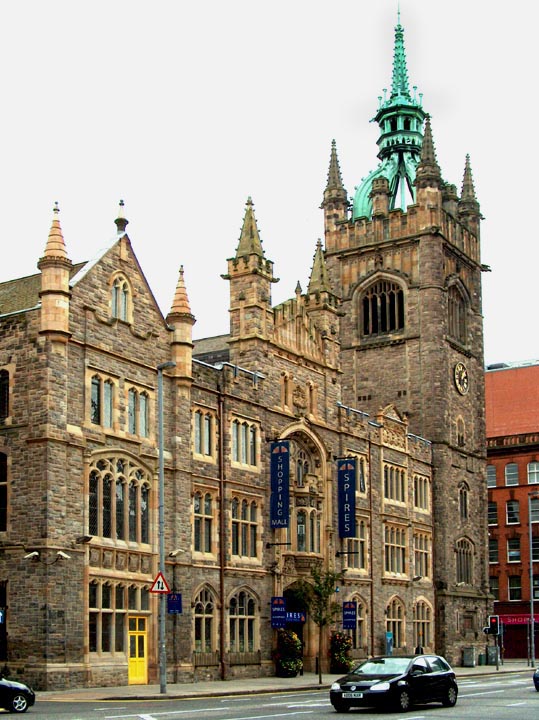
Old Life took a wee vacation last week thanks to (all about) my trip to Belfast which included delightful discussions with a historian who must remain anonymous for the sake of his good name and sightseeing with an old (not as old as mmmmeeeeeeEEE) friend who also deserves protection from tawdry associations with this blog.

I had the privilege of speaking informally with folks from the Presbyterian Church in Ireland and the Evangelical Presbyterian Church. Those communions are not in fellowship thanks to the split in 1927 over liberalism in the PCI, a debate that has all the earmarks of the so-called fundamentalist controversy in the U.S. In fact, W. J. Grier, who studied at Princeton Seminary with J. Gresham Machen, took some inspiration from conservatives in the U.S. to oppose the teaching of J. E. Davey, who taught church history and theology at Union College (in effect the seminary for Irish Presbyterians). When the trial against Davey failed, Grier led the formation of a new Presbyterian communion.

That parallel suggests that PCI is to the EPC what the PCUSA is to the OPC. But such reading of American dynamics into Ireland misses how different American Presbyterianism is. If anything, the U.S. equivalent to the PCI is the Evangelical Presbyterian Church (the American one that had Tim Keller speak at its GA). The PCI is more evangelical than the PCUSA and does not go out of its way to be inclusive. Whether it will ever go out of its way to discipline erroneous views is another matter.

Another difference is that the PCI’s moderator is tenth in the Orders of Precedence in the United Kingdom.

I have no idea how to reconcile the Wikipedia chart with the church’s website about political status in Northern Ireland. But I do suspect the matter has something to do with the Regium Donum, a “royal gift” from Charles II to dissenting Protestants (outside the Church of Ireland — Anglican) to support their ministry. In fact, the royal recognition of the PCI’s moderator means that he receives invitations to affairs in London held by the British government. I suspect it also means some sort of royal representative at PCI General Assemblies the way that the Queen still sends a delegate to the Free Church of Scotland.

This difference with the USA is striking. The federal government or POTUS never sends representatives or invitations to moderators of Presbyterian communions in the U.S. Not even the Presbyterians in the “Protestant establishment,” the PCUSA, have the standing that Presbyterians do in the UK. American Presbyterians are pikers compared to Presbyterians in the British Isles.

But we American Presbyterians compensate with celebrity.

Which raises the question whether a brand like Tim Keller has more influence in national (or urban) life than a royal gift. I am asking because inquiring minds want to know.

If It’s Any Consolation, Princeton Seminary Would Not Have Awarded Randy Nabors Either

As progressive as the founding pastor of New City Fellowship in Chattanooga is, Andrew Exum thinks this mixed race, multicultural church still fails to pass the Democratic/mainline Protestant litmus test:

Last weekend, I happened to be back in Jackson’s Tennessee, and my wife and I used the opportunity to go to a church we have long admired. New City Fellowship in Chattanooga was founded by a young interracial couple who grew up in housing projects in Newark, New Jersey, and started a ministry focused on racial reconciliation in my hometown in the 1970s. Today, it is a vibrant cross-cultural ministry and was one of the few places I remember growing up (that wasn’t a sporting event) where black and white Tennesseans would regularly gather together. I cannot imagine the courage it must have taken for a young white pastor and his black wife to have started that church just a few years after Martin Luther King Jr. was gunned down on the other end of the state.

Like most Protestant churches still thriving in the United States, New City follows a pretty orthodox—in this case, Presbyterian—theology. Most of the men and women with whom my wife and I were worshipping would also probably identify as evangelicals, that same group of people who have been Trump’s most committed supporters.

Now, may the Lord have mercy on me for this, but perhaps because I have lived in Washington, D.C., for the past several years, as I worshipped last weekend, I also saw something else in the pews: voters. These people—God-fearing Christians committed to racial reconciliation and social justice—should be among the voters for whom a multicultural Democratic Party is competing.

But one thing that shines through among many evangelical voters—as well as other, non-evangelical Trump supporters with whom I have spoken back home—is how turned off they are by the smug self-righteousness of contemporary progressive discourse.

Don’t support abortion rights? Well, obviously you hate women (even if you happen to yourself be a woman), and the late-night comedians are going to be merciless with what is left of your reputation.

Still believe marriage is a Biblical institution between a man and woman for the purposes of procreation? Be prepared to be mocked relentlessly on social media and shunned by peers and employers.

Last week, the Democratic Party debated whether it was even still possible to be pro-life and a Democrat before Nancy Pelosi—that arch-pragmatist who, so unlike her GOP successors, put a string of wins on the board for her party while speaker of the House—put an end to the debate by affirming that the answer remained yes.

These debates over doctrine and policy positions are exactly what the party should be doing in the aftermath of its 2016 debacle. But when paired with the self-righteous tone so characteristic of contemporary progressive discourse, it is potentially toxic to attempts to broaden the electorate for which the Democratic Party is competing. It replicates the mistakes of Alexander Hamilton’s own political writings before his own party collapsed.

Only the current configuration of national politics could make New School Presbyterians look like J. friggin Gresham Machen. Which might also make the people who voted for Trump (I did not) look a little more reasonable than Stephen Colbert.

United Statesist Christianity

We need a new name for Christianity in the United States. The contributors to this podcast at Christianity Today are still lamenting the turnout of white evangelicals for Donald Trump and so one of them called for more attention to what it means to be evangelical. Are you kidding? We’ve had almost four decades of scholarship on evangelicalism, and at least three of chanting the integration of faith and learning, and we still don’t know what evangelical is? Please.

Then comes the objection to calling Lee Stroebel, whose new film is drawing attention to the Bill Hybels-spawned apologist, a fundamentalist.

A note or two about Strobel, the legal-affairs journalist. He did his undergraduate degree at a top j-school, the University of Missouri, and then went to Yale University to get his law degree. That gives some clues as to his approach to research and writing.

Strobel converted to Christianity in 1981 and, after a few years, went into ministry – becoming a “teaching pastor” at the world famous Willow Creek Community Church in the Chicago suburbs.

Now, WIllow Creek – led by the Rev. Bill Hybels – has for decades been known as, literally, a globel hub for the “seeker friendly” school of mainstream (some would say somewhat “progressive”) evangelicalism. Hybels, of course, became a major news-media figure in the 1990s through his writings and his role as one of the “spiritual advisors” and private pastors to President Bill Clinton.

Willow Creek is not a fundamentalist church.

From there, Strobel went west and for several years served as a writer in residence and teaching pastor at Saddleback Community Church, founded and led by the Rev. Rick “The Purpose Driven Life” Warren. In addition to writing one of the bestselling books in the history of Planet Earth, Warren has also received quite a bit of news-media attention through his high-profile dialogues with President Barack Obama, both during Obama’s first White House campaign and in the years afterwards.

Saddleback is not a fundamentalist church.

Fair points. I don’t think Stroebel is a fundamentalist either. But evangelical is increasingly meaningless even among Protestants who haven’t read (hades!, heard of) Deconstructing Evangelicalism.

So why not simply identify Christianity in the United States according to the degree to which its adherents adapt their faith (or pick and choose) to national norms? (Do remember that in 1899 Leo XIII identified Americanism as a heresy.) Once upon a time, Protestants came to North American and tried to transmit the version of Protestantism (works for Roman Catholics and Jews also) they brought to a New World setting. Some confessional Protestants still do this and triangulate their ministry in the U.S. according to precedents set in Europe whether at the time of the Reformation or when specific episodes upset national churches (think Scotland, England, Netherlands, Germany). Presbyterians in NAPARC still live with a foot (or – ahem – toe nail) in Old World Protestantism even as they have repudiated (except for the Covenanters) the political structures that animated their European predecessors.

But then along came awakenings and parachurch associations and increasingly Protestantism in the U.S. was known less for the fingerprints of its European origins than for those innovators (Whitefield and Moody) or structures (American Bible Society or National Association of Evangelicals) who were as independent of Old World Protestantism as their nation was of the United Kingdom. Once freed from European constraints, American Christianity used markets, earnestness, activism, and relevance as the basis for Christian identity. Evangelicalism was the kinder gentler version of fundamentalism. But neither showed the slightest bit of deference to the churches that came out of the Reformation.

Now, even the labels fundamentalist and evangelical make little difference. The gatekeepers won’t stand at the gate and even if they did the gateway has no wall to make the gate functional. Anyone can be a Christian on their own terms, with celebrities and parachurch agencies gaining the most imitators. But those instances of fame collect no dues, make no demands, and provide no institutional support. It’s like belonging to Red Sox Nation. Wear your bumper sticker. Listen to your Tim Keller sermon (now on sale for $1,500). Got to the next Gospel Coalition conference. You have Jesus in your heart and United Statesist Christianity has lots of proprietors to make your heart burn.

The good thing about United Statesist Christianity is that it allows its adherents to revel in exceptionalism. If America is a great nation, United Statesist Christianity is no less exceptional. Instead of a Pretty Good Awakening, United Statesist Christianity puts the Great back in Great Awakening.

Christendom Exceptionalism

Not sure what Peter Leithart is working on, but recent posts on medieval and early modern Europe have shed new light on the claims that exalt Christendom and blame Protestantism for ushering in a disordered, licentious modernity.

Just how united was Christendom, you ask? Not much:

In a 1971 essay, H.G. Koenigsberger challenged the notion that the Reformation broke up a unified Europe. He criticizes historians and social scientists for assuming a norm of unity: “We have assumed that the theological and ecclesiastical unity of Catholic Christendom was its natural condition and that, in consequence, the Reformation was a dramatic break in this condition which ran counter to all previous Christian experience and which, in a sense, destroyed the natural order of things.”

Much of the essay presents an analysis of the kind of unity that existed in pre-Reformation Europe. Koenigsberger poses the question this way: “For the thousand years of the Middle Ages, Christendom and its institutions remained obstinately divided, and Christians remained distressingly prone to engage in deadly wars with each other. Why was it that only the Church survived as a unified institution?”

His first answer is sardonic: “it did not do so. Throughout the Middle Ages there existed Christian churches in Africa and Asia which were never in communion with Rome at all.”

The more elaborate answer answer is that “medieval unity, insofar as it existed, was a function of an economically poor society. The small surpluses of production of any given area would not be wanted in the adjoining area, which was probably producing the same commodities, but rather in much more distant areas. Medieval trade was, therefore, small in volume but covered large distances.”

Craft skills were specialized and scarce, and thus craftsmen had to be mobile: “Bell founding was a highly skilled and specialized craft. After a master founder had cast the three or four, or even six or eight, bells for the church of a small town, he would have to move on, for there would be no further work for him in this town nor, very likely, in the neighbouring towns. It was the same with all other skills, from the cathedral builder to the learned scholar, from the forger of fine weapons . . . . Different areas of Europe might advance in certain skills, as Flanders did in the weaving of fine cloth; but no single area of Europe could support all of the skills which European society required. Only the whole of Europe could do this.”

Cultural unity thus depended on a “thin crust of men highly skilled in the production of sophisticated commodities or in the performance of complex services. This upper crust was international in education, attitudes, and often, physical mobility; for this was the only way it could function.” Cultural unity depended on a low rate of entry into this upper crust. European unity was a unity of the “1%.”

Sounds like modern America. Substitute media elites, policy wonks, federal government workers, Ivy League professors, and Hollywood types for “thin crust of men highly skilled in the production of sophisticated commodities or in the performance of complex services” and you an American exceptionalist unity that rivals Christendom’s.

That means, the Reformation was not a break with the past but a fulfillment of medieval Europe:

Signs of centrifugal forces are evident throughout the centuries leading up to the Reformation – reforming movements within the church, sometimes breaking free into independent movements; rival papacies, with kings taking sides, anticipating the anti-papalism of their sixteenth-century Protestant counterparts. The conciliar movement tried to arrest this process but “the defeat of this movement, and the subsequent concentration of papal energies on Italian power politics made it virtually impossible for the Church to adapt itself to the changing conditions of European Society.”

Koenigsberger acknowledges that the Reformation broke the camel’s back, but sees it as the culmination of several centuries of mounting instability. He identifies two factors that made the sixteenth century decisive in this process: “the increasing political tension between the monarchies and the papacy over the question of the control of the institution of the Church and its personnel in the different countries of Europe; and the spread of the printing presses, which made the Bible available to the Christian laity and thus undermined the claim of the Church to act as the indispensable intermediary between God and man.”

Now if we reboot those arguments about the Reformation as the forerunner of 1776, we have lines of continuity between Roman Catholicism and Americanism.

The Whig historians will set us free!

When You Think Billy Graham You don’t Think Lent

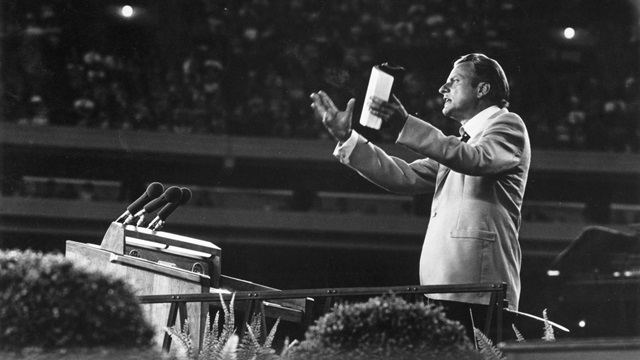
But such are the fortunes of evangelicalism that the people running the magazine that Billy Graham (trans-denominational) helped to found with Carl Henry (Baptist), and J. Howard Pew (anti-Communist Presbyterian) are fully comfortable with Anglicanism, and so have posted another article recommending Lent. In this case, telling points mount to show how poorly Lent fits with Christian piety:

heightened devotion is fruitful for a season, but cannot be sustained indefinitely. The Christian calendar offers a sustainable rhythm of which Lent is a part, and the fasting of Lent gives way to the feasting of Easter. Fasting and feasting are interconnected disciplines that teach us to love the King and his coming kingdom. In Lent, we learn to confess our sins, practice self-denial, and take on the humility of Christ. In Easter, we learn to rejoice, exult, and feast in Christ’s victory. As historian William Harmless explains, “In these two liturgical seasons Christians drank in, by turns, the ‘not yet’ and ‘already’ of New Testament eschatology.”

Repentance is fruitful for only part of the year? Moderation is something to observe but only for a time? Imagine if American Christians were moderate and humble the entire year. They wouldn’t binge or purge on American greatness or heinousness depending on which of their favorite presidential candidates was in the White House. Indeed, encouraging the idea that restraint and repentance are only for a while and not for all of life nurtures antinomianism: “I wouldn’t do this during Lent, but the other 325 days I will.”

If Lent is not supposed to lead to those thoughts (which I assume it’s not), then why not make Lenten practices year round? Because repentance and moderation can’t be “sustained indefinitely”? So people practicing Lent are Snowflake Christians? They don’t have the stomach for life-long dying to sin and living to Christ?

Aaron Damiani concedes that “Many Christians choose to keep or modify their Lenten disciplines for the rest of the year, as they have established helpful routines.” So now you have churches divided between full-time Lenten Christians, and ones who only observe Lent in late Winter and early Spring? Christians who truly sanctified and some who aren’t? Not only does this allow a culture of spiritual superiority to gain traction, but it also violates the rules of the liturgical calendar. Who sings Lenten hymns during Advent (oh, the hay that evangelicals make of tradition)?

Then there is the argument that Lent and the church calendar evoke the Jewish liturgical calendar (have you heard that Jesus fulfilled all of the law?):

It’s important to remember that the Christian liturgical calendar developed in part out of the rhythms of Jewish practice. The Old Testament indicates seasons of both heightened devotion and celebration, including Levitically led “sabbaths, new moons, and feast days” (1 Chron. 23:31) and “seasons of joy and gladness and cheerful feasts” (Zech. 8:19). Fasting and feasting were part of the “architecture of time,” in which Jesus participated as an observant Jew.

So what does Father Damiani do with Apostle Paul:

So let no one judge you in food or in drink, or regarding a festival or a new moon or sabbaths, which are a shadow of things to come, but the substance is of Christ. (Col 2:16-17)

Here‘s what Calvin did:

The reason why he frees Christians from the observance of them is, that they were shadows at a time when Christ was still, in a manner, absent. For he contrasts shadows with revelation, and absence with manifestation. Those, therefore, who still adhere to those shadows, act like one who should judge of a man’s appearance from his shadow, while in the mean time he had himself personally before his eyes. For Christ is now manifested to us, and hence we enjoy him as being present. The body, says he, is of Christ, that is, IN Christ. For the substance of those things which the ceremonies anciently prefigured is now presented before our eyes in Christ, inasmuch as he contains in himself everything that they marked out as future. Hence, the man that calls back the ceremonies into use, either buries the manifestation of Christ, or robs Christ of his excellence, and makes him in a manner void.

In other words, Lenten Christians are still holding on to a piety that clings to outward and physical attributes of unseen realities (heard of faith vs. sight?). They are incomplete Christians. They demand outward expressions of spiritual realities. They forget that Paul also wrote:

Jews demand signs and Greeks look for wisdom, but we preach Christ crucified: a stumbling block to Jews and foolishness to Gentiles, but to those whom God has called, both Jews and Greeks, Christ the power of God and the wisdom of God. For the foolishness of God is wiser than human wisdom, and the weakness of God is stronger than human strength. (1 Cor 1:22-25)

Oh by the way, Paul’s contrast between the visible and invisible, between the external and internal, is why the Confession of faith contrasts Old Testament and New Testament worship this way:

Under the gospel, when Christ, the substance, was exhibited, the ordinances in which this covenant is dispensed are the preaching of the Word, and the administration of the sacraments of baptism and the Lord’s Supper: which, though fewer in number, and administered with more simplicity, and less outward glory, yet, in them, it is held forth in more fullness, evidence and spiritual efficacy, to all nations, both Jews and Gentiles; and is called the new testament. There are not therefore two covenants of grace, differing in substance, but one and the same, under various dispensations. (7.6)

The comparison of Lent to the Old Testament is epic fail.

But remember what Calvin went on to say about Colossians 2. The rejection of the church calendar and other external ways of commemorating salvation doesn’t mean that Protestants throw out the sacraments:

Should any one ask, “What view, then, is to be taken of our sacraments? Do they not also represent Christ to us as absent?” I answer, that they differ widely from the ancient ceremonies. For as painters do not in the first draught bring out a likeness in vivid colors, and (eikonikos) expressively, but in the first instance draw rude and obscure lines with charcoal, so the representation of Christ under the law was unpolished, and was, as it were, a first sketch, but in our sacraments it is seen drawn out to the life. Paul, however, had something farther in view, for he contrasts the bare aspect of the shadow with the solidity of the body, and admonishes them, that it is the part of a madman to take hold of empty shadows, when it is in his power to handle the solid substance. Farther, while our sacraments represent Christ as absent as to view and distance of place, it is in such a manner as to testify that he has been once manifested, and they now also present him to us to be enjoyed. They are not, therefore, bare shadows, but on the contrary symbols of Christ’s presence, for they contain that Yea and Amen of all the promises of God, (2 Corinthians 1:20,) which has been once manifested to us in Christ.

I understand the appeal of Lent over the Anxious Bench. The followers of Billy Graham needed to graduate to something more meaningful, something more historical. How about the Reformation? How about the Bible? It replaces the altar call with the Lord’s Supper and gives us fifty-two Easters a year, fifty-two feast days with six days every week to prepare.

Would Keller Be Even Welcome in the PCA?

What an odd question, but this group of Presbyterian women might help Princeton Seminary administrators not feel so bad about the kerfuffle over Keller and the Kuyper Prize:

Meanwhile, Todd Pruitt has found another sign of harmonic convergence between women on both sides of the mainstream/sideline Presbyterian divide. Pastor Pruitt writes this:

If you listen to the podcast what you will hear is typical boilerplate liberation theology which is fundamentally unbiblical and incompatible with the gospel and the church’s mission. Sadly this has been allowed a foothold in the PCA. Some of us have been warning about it, apparently to no avail. It is nothing more than the latest incarnation of the social gospel which ironically destroys the gospel by replacing it with something else.

During the discussion the hosts dismiss the biblical pattern of male leadership within the church as nothing more than a manmade rule. They also mock those who uphold that biblical pattern and join that mockery with crude language. Keep in mind that these men and women are members of and serve in churches whose standards uphold those biblical patterns of leadership.

Near the very end of the podcast one of the hosts gives a brief nod of legitimacy to transgenderism. This is not surprising given the radical roots of their categories.

I will not labor over every problem with the content of this podcast. You will be able to hear for yourself if you choose. But be warned. It is very tedious. It is something that would be warmly received in the PC(USA) for sure. What is so troubling is that it is being received by some within the PCA. This will not end well. Experiments in the social gospel never end well.

If Tim Keller had done more to warn Presbyterian urbanists and Neo-Calvinists about the pitfalls of making the gospel social (and political or cultural), he might have shielded himself from recent controversy. That’s right. If he had done that, he’d never have been nominated for the Kuyper Prize.

Did Machen found Westminster Seminary for nothing!?!