The Debt Confessionalists Owe to Modernists

And we never said “thanks.”

Carl Trueman makes an observation that requires qualification:

And that perhaps is the real problem many Christians have with the current anti-Christian culture. It is not that they really object to vile insults, mischaracterizations of opponents, hashtag wielding mobs, and the use of corporate economic power and the politicization of the judiciary as a means to subvert constitutional rights and democratic process. It is that they no longer have the influence over the culture which embodies such things.

I read that and wondered when I or my people ever had cultural influence and power. I know, I am white and that’s supposed to come with privilege. But my fundamentalist parents never taught me how to act at my seat at the culturally privileged table (they went to Bob Jones, don’t you know). They reared me to think I was on the outside looking in. The same goes for my current communion, the OPC. I’m not sure when Orthodox Presbyterians ever had cultural reach or political influence. They certainly had big mouths and might complain about those in control. But they lived out the Benedict Option before it became trendy — that is, they retreated from the mainstream cultural institutions in order to pass on the faith.

What conservatives and confessionalists miss, however, is the benefits we enjoyed from mainline Protestants running things. Until roughly 1970 sectarian Protestants could count on American culture generally to be congenial to their faith and life. Public schools did not directly undermine faith, television might go blue but it was generally tame (think Leave it to Beaver), and institutions like the Boy Scouts, for as bad as their civil religion was, were still wholesome in a civilly righteous way. Expectations for public morality prevailed — illegitimate children, divorce, coarse language, and pornography were bad, respect for authority and participating in the nation’s ways were good. Every culture has to have a code, right?

But then the mainline became #woke about sex, race, gender, and U.S. foreign policy. In a word, it turned skeptical if not hostile to wholesome America and regarded the nation’s virtues as smokescreens for colonialism, imperialism, and bigotry. Once that outlook trickled down to public and private institutions, confessional Protestants had to think twice about whether the surrounding culture would impede what families and churches were trying to pass on to their kids. The point is not that pre-1970s America was actively Christian or genuinely wholesome. But it was a place that did not directly (unless you were a #woke neo-Calvinist) undermine shared expectations about families, sex, marriage, personal responsibility, and respect for authority.

In which case, the problem isn’t losing cultural influence or control, as Trueman has it. It’s a problem that no one seems to want to be a gatekeeper anymore, except when it is convenient.

Machen, Golden State, and Social Justice

What binds these three items together? Warrior, as in Machen’s Warrior Children, Golden State Warriors, and Social Justice Warriors.

The average American (unless you are LeBron James) thinks positively of the NBA franchise. If that American is under 30, she likely adds Social Justice to Golden State since both are very popular.

Your average Presbyterian in one of the NAPARC communions, you might think, would add Machen happily to the Golden State Warriors since J. Gresham Machen was arguably the greatest defender of historic Presbyterianism during the twentieth century. And if you are a conservative Presbyterian under 30 you might also want to add Social Justice to Machen and the Golden State team because Social Justice and Golden State are very popular.

But what does the PCA do? It embraces Social Justice and disdains Machen — Golden State is probably agreeable.

Consider that two of the more prominent figures in the PCA during the last twenty years are John Frame, who coined the phrase, “Machen’s Warrior Children,” and Tim Keller. Almost everyone knows Frame’s opposition to Machen’s spiritual offspring. Keller less so. Here is part of his take on twentieth-century conservative Presbyterianism:

A more normal result of church splits is the pruning off of branches in a way that both wounds and yet, ironically, does not last. Something of this pattern, I think, can be seen in the history of the Orthodox Presbyterian Church. Early in its history, after the death of J. Gresham Machen, the OPC went through a split in which its New Side/New School branch left, led by J.Oliver Buswell of Wheaton College and Carl T. McIntire. But, no surprise, by the 1970s the OPC had grown a new ‘pietist/revivalist’ wing under the influence of Jack Miller. The New Life Churches and their Sonship course was classic revivalism, and it did not fit well with the more doctrinalist cast of the OPC. While not a formal split, like that of 1937, the New Life churches were made to feel unwelcome and nearly all left in the early 90s to swell the pietist ranks of the PCA.

Whenever a Reformed church purifies itself by purging itself of one of its impulses, it finds that within a generation or two, its younger leaders are starting to at look in a friendly way toward the lost parts.

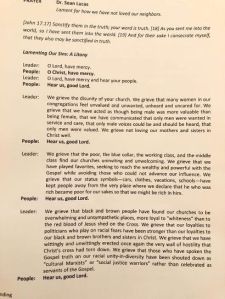
With that kind of suspicion about Machen’s Warriors, the liturgy at the PCA’s General Assembly this week was notable:

Notice that last line, the contrast between social justice warriors and servants of the gospel.  The idea that social justice is an extension of critical race theory was one that the curmudgeon, Bill Smith, proposed. Curiously enough, Sean Lucas accused Bill Smith of the genetic fallacy.

And that raises a question of whether Pastor Lucas himself has committed the liturgical fallacy. Does simply praying that Social Justice Warriors need to be celebrated as “servants of the gospel” measure up to the rigors of logic? Simply praying it doesn’t make it so.

But it does seem safe to say that Bill Smith is in Sean Lucas’ head.

Something for All Commissioners to Consider before Heading Off to General Assembly (or Synod)

What’s true for liberals may also be true for Christians who think they have social justice covered:

Consider some ways liberals have used their cultural prominence in recent years. They have rightly become more sensitive to racism and sexism in American society. News reports, academic commentary and movies now regularly relate accounts of racism in American history and condemn racial bigotry. These exercises in consciousness-raising and criticism have surely nudged some Americans to rethink their views, and to reflect more deeply on the status and experience of women and members of minority groups in this country.

But accusers can paint with very wide brushes. Racist is pretty much the most damning label that can be slapped on anyone in America today, which means it should be applied firmly and carefully. Yet some people have cavalierly leveled the charge against huge numbers of Americans — specifically, the more than 60 million people who voted for Mr. Trump.

In their ranks are people who sincerely consider themselves not bigoted, who might be open to reconsidering ways they have done things for years, but who are likely to be put off if they feel smeared before that conversation even takes place.

It doesn’t help that our cultural mores are changing rapidly, and we rarely stop to consider this. Some liberals have gotten far out ahead of their fellow Americans but are nonetheless quick to criticize those who haven’t caught up with them.

Within just a few years, many liberals went from starting to talk about microaggressions to suggesting that it is racist even to question whether microaggressions are that important. “Gender identity disorder” was considered a form of mental illness until recently, but today anyone hesitant about transgender women using the ladies’ room is labeled a bigot. Liberals denounce “cultural appropriation” without, in many cases, doing the work of persuading people that there is anything wrong with, say, a teenager not of Chinese descent wearing a Chinese-style dress to prom or eating at a burrito cart run by two non-Latino women. (Gerard Alexander, “Liberals, You’re Not as Smart as You Think You Are,” New York Times, May 12, 2018)

Resist that temptation to feel good after a vote for the right side of history.

When the PCA Might actually Want to Follow Southern Baptists

I do not pretend to know the Byzantine world of Southern Baptist life but I do follow one SBC website, SBC Today, to keep tabs on the opposition to Calvinism in the Convention. Some of the staunchest voices against the so-called Calvinist takeover appear at SBC Today.

Another arresting wrinkle to these anti-Calvinists is first their defenses of Paige Patterson and their current opposition to Social Justice Warriorism. Here is an excerpt from a resolution the editors posted today:

Whereas social justice is showing it’s true colors at George Washington University and other campuses in 2018 where they are holding classes and seminars seeking to combat “Christian Privilege,” and attacking Christianity for it’s prominence in society using the social justice ethic, wherein the seminar at GWU students are taught “American Christians receive things they don’t deserve and are not worthy of getting,” and

Whereas Southern Baptists ought to furthermore be warned by the example of the Methodist and Episcopal denominations that have already embraced the social justice movement, and instead of growing in number, these same denominations continue to lose membership at an alarmingly fast rate, and

Whereas we have a present crisis point in the Southern Baptist Convention, in that the same social justice has been recently defended and promoted by Russell Moore of the ERLC within the Southern Baptist Convention, with Dr. Moore writing multiple articles and hosting events promoting social justice, and

Whereas the social justice agenda in the Southern Baptist Convention has become pervasive in some seminaries and state conventions, even to the point that it is apparently an unwritten rule not to speak against the social justice movement, or one’s job or position will be in jeopardy, and

Whereas we are repeatedly warned in Scripture concerning such error and being deceived, with Ephesians 5:6, Hebrews 13:9, Colossians 2:8, and 1 Timothy 4:1 being just a few of these warnings, and

. . .Whereas true Christian theology builds people up to be resilient in the face of trials, but social justice seeks to stoke discontentment (1 Corinthians 10:10; Hebrews 13:5), and

Whereas our own denomination must reject this harmful social justice philosophy in it’s entirety, and

Whereas biblical doctrine and the Christian ethic must be chosen over social justice, then be it

RESOLVED, That the messengers to the Southern Baptist Convention, meeting in Dallas, Texas, June 13–14, 2018, decry and reject the terms and framework of social justice as insufficient to adequately reflect the Gospel of Jesus Christ and the Christian worldview; and be it further

RESOLVED That the entities of the Southern Baptist Convention be encouraged to avoid the terms “social justice” and social justice warrior” when referring to Christian ethics or activism, and that the Holy Scriptures be used as a guide without mimicking the verbiage of the Anti-Christian social justice movement, and be it

RESOLVED That all SBC Colleges and Universities be encouraged to review their teaching programs with special attention given to Humanities Departments to ensure that Marxist based social justice is not being taught in our colleges, universities, and seminaries, and be it

RESOLVED, That we encourage churches in preaching, teaching, and in discipleship to address the issues of racial reconciliation, poverty, the environment, sexual and gender issues, immigration, and education from a Christian worldview and reject the ideological underpinnings and verbiage of the social justice movement.

So here’s another wrinkle. Why are Calvinists in the PCA and SBC more prone to heed the calls for social justice while the opponents of Calvinism in the SBC find it easier to spot the errors implicit in certain efforts to use the gospel to underwrite politics? Just today, another Protestant declaration went live and invoked the legacy of Martin Luther King, Jr. to support a set of policy ideals that target the Trump administration’s errors. Will the recent defenders of King in the PCA and SBC worlds sign this new resolution? I doubt it if only because the worlds of Red Letter Christians and The Gospel Coalition are so far apart, and such support could be toxic in PCA and TGC networks.

But of late, they have been tracking in remarkably similar trajectories. And when that happens, when those who affirm total depravity, limited atonement, and perseverance of the saints wind up in gospelly poses with Protestants for whom Calvinism is bizarre, Reformed Protestants want to know what’s in the New Calvinist water.

I’ll See Your World Order and Raise You One Principality and Two Powers

Isn’t this what caused mainline Protestantism to go south, namely, identifying the church with the work of building human civilization? George Weigel explains:

If there’s anything Catholics in the United States should have learned over the past two decades, it’s that order—in the world, the republic, and the Church—is a fragile thing. And by “order,” I don’t mean the same old same old. Rather, I mean the dynamic development of world politics, our national life, and the Church within stable reference points that guide us into the future.

Didn’t the apostle Paul (saint if you will) think the church had/has bigger fish to fry?

11 Put on the whole armor of God, that you may be able to stand against the schemes of the devil. 12 For we do not wrestle against flesh and blood, but against the rulers, against the authorities, against the cosmic powers over this present darkness, against the spiritual forces of evil in the heavenly places. 13 Therefore take up the whole armor of God, that you may be able to withstand in the evil day, and having done all, to stand firm. (Ephesians 6)

Russia, neo-liberalism, social justice warriors have nothing on sin, the flesh, and the Devil.

Of course, political order is a good thing, so good that churches need it to function — it may actually be that political order precedes church order rather than the other way around. But if the church sees its mission as supporting political order, it may seriously underestimate the amazing work God called ministers of the word to do. And that perspective might prevent a reviewer from writing this about a book on the nineteenth-century papacy:

Whatever misgivings one may have about the First Vatican Council, one does not need to squint to see a providential hand in Pastor Aeternus. As secular governments continue to chip away at different forms of civil society, especially religious forms, a strong papacy can serve as a powerful counterweight.

Counter-weights to secular governments chipping away at civil society? Isn’t that why we have The New York Times?

Bigger is Bigger

The appeal of Roman Catholicism is size. It has 1.2 BILLION members. It has 2000 years of history. It has oh so many paintings, galleries, cathedrals, yada yada. Size matters.

Redeemer Big Apple’s appeal is also to size — but it is the big city, and being connected to churches in other big cities, in following a pastor who has enough celebrity even for New York City editors. It’s size has almost nothing to do with the past, at least if Kathy Keller is to be believed:

I’ve saved my most important value for last: carefully screening our language is the most critical thing we can do.

I can’t find enough words to stress how important this is. We must have a care for how we choose our words, our images, and our ideas when we communicate, no matter what we’re communicating — whether it’s donor updates, lectures, or emails about events that are coming up. You absolutely must comb out all of the Christian subcultural phrases that clutter up so much of the Christian church. This is vitally important, and perhaps it’s even more important today than it was 30 years ago, because the cultural moment that we’re in now loathes evangelical Christians, and we don’t need to give them any more reasons to disrespect and dislike us.

Redeemer has been pretty good at this, partly because it was actually one of the major parts of my job description to search and destroy any piousbabble. That’s the word I coined to describe the-language-that-must-not-be-spoken. You’ve heard of psychobabble? That’s pop psychology drawn from catchphrases, media, podcast pontification and other non-academic sources.

Piousbabble are those phrases and those words that creep into your prayers and into your language.. Lord, we just, we just, Lord … We want traveling mercies, we want to bathe it in prayer, and we need prayer warriors, and we need a hedge of protection. All that sounds kind of normal-ish to most Christians. But it’s like Swahili to the nonbelievers and the seekers who are coming.

Does pious babble extend to words like Presbyterian, justification, Holy Spirit (Ghost is even more alarming, I guess), eschatology, ministry, or vocation?

That may explain why Tim Keller thought he needed a catechism other than the one his own communion uses.

But isn’t this piousbabble?

Sixth, that we do not hurt, or hate, or be hostile to our neighbor, but be patient and peaceful, pursuing even our enemies with love. Seventh, that we abstain from sexual immorality and live purely and faithfully, whether in marriage or in single life, avoiding all impure actions, looks, words, thoughts, or desires, and whatever might lead to them. Eighth, that we do not take without permission that which belongs to someone else, nor withhold any good from someone we might benefit.

Even so, if I can count on Kathy Keller to renounce the use of such pious phrases as “dead orthodoxy,” I’m on board.

Maybe not Delegated but Self-Selective General Assembly

I enjoyed listening to Chortles and Wresby talk to Charlie Nave about the problems of under representation among elders (OPC lingo) at GA. Mr. Nave made his case in e-print before the podcast. Here is how he described his experience at the 2017 PCA GA:

The experience was certainly instructive, but I found that the troublingly secretive caucus controlled the assembly entirely. It installed its own candidate for Moderator; it cut off debate on topics about which it had already made up its mind; it defeated a measure to protect biblical marriage within the PCA; and it approved recommendations to open the door to ordaining women.

This all struck me as very odd and un-Presbyterian. How are things being done “decently and in order” if a caucus is making decisions in secret and then imposing them upon the General Assembly? How are we abiding by the plurality of elders principle if this caucus is predominantly Teaching Elders (TE)?

Worse still, I found that REs were outnumbered by TEs by 4:1 at General Assembly (apparently this is typical). Ultimately, this is the root of the problem. After all, we know that everyone – even a TE! – is a sinner. And people who prioritize politics in a convention system will eventually network together for mutual benefit. The formation of this caucus was inevitable.

One major reason why they were able exercise control was that there weren’t enough REs there to counsel them otherwise. So that raises the question: why don’t more REs attend General Assembly?

As it turned out, this was the same day that I registered for the OPC GA. I don’t want to gloat, but the OPC has a fairly good representation from its elders and that has to do partly with all costs being reimbursed. You ask, how does the OPC do it?

Well, we meet on college campuses and have commissioners share rooms and bathrooms. This year at Wheaton I will share a bedroom with one other commissioner and a bathroom with three others (my sphincter is already tightening).

I’d much prefer to have a hotel room to myself and even meet in the comfortable surroundings of a convention center. But dorm rooms and gymnasiums go with the OPC’s no-nonsense approach to affect.

In which case, one way to even out the proportion of pastors and elders (OPC lingo) is to meet in settings that weed out the under motivated.

Presbyterianism In Secret or in Private?

1“Beware of practicing your righteousness Presbyterianism before other people in order to be seen by them, for then you will have no reward from your Father who is in heaven.

2“Thus, when you give to the needy commission deaconesses, sound no trumpet before you, as the hypocrites do in the synagogues and in the streets, that they may be praised by others. Truly, I say to you, they have received their reward. 3But when you give to the needy, do not let your left hand know what your right hand is doing, 4so that your giving may be in secret. And your Father who sees in secret will reward you.

So what does it mean when a pastor is Presbyterian in name but known nationally and interdenominationally by his own evangelical brand? You could say, he is practicing his Presbyterianism in secret and God, who sees in secret, will reward such Protestantism. He keeps his Presbyterianism to himself. Likewise, it could be that the critics of parachurch evangelicalism on Presbyterian grounds are the hypocrites who practice their Presbyterianism in public by identifying with a particular denomination or communion and letting that shape their reputation. This is a form of practicing Presbyterianism for others to see.

But what if practicing Presbyterianism in secret also cuts you off from practicing evangelicalism in public? Isn’t the point of the Sermon on the Mount partly to avoid hypocrisy? In which case, ministering in a Presbyterian church is inconsistent with ministering in an interdenominational setting. And avoiding an evangelical ministry because of Presbyterian convictions is a version of practicing Presbyterianism in secret since the confessional Presbyterian’s absence from the Gospel-Industrial-Complex conference is invisible — no one knows the Presbyterian isn’t there or why he or she is not.

So isn’t an application of Christ’s warnings about practicing piety in public that you better mean what you believe (and oh, by the way, vow)? And if you mean what you confess as a Presbyterian, why and how can you minister with non-Presbyterians?

At Least It’s Not a Conference about Lent

Redeemer Big Apple is sponsoring a conference during this Lenten reason not about repentance and abstinence but about work:

When we see that work is created to glorify God, our work doesn’t necessarily get easier, but it does become more meaningful. The pain in our work is faced with greater honesty, where the brokenness can finally be named and seen. The unseen potential of our work is faced with greater imagination, where an innovative spirit can unleash what yearns to be resurrected. In short, when we discover that we’re formed to work for God’s glory, we find that our small tasks aren’t so small, and our big tasks are in better hands. Work becomes desirable. Rest becomes possible. Faith becomes essential.

Join us for a two-day experience where we’ll investigate how we are formed to work for the glory of God. Artists and educators, designers and technicians, homemakers, engineers, managers, entrepreneurs, doctors, and everyone in between are welcome.

Plumbers? Janitors? Bakers? The only non-professionals included in that list are homemakers.

But the oddest part of the conference is its “Glimpses,” or “exciting opportunities throughout the city to participate in diverse experiences centered around work, culture and sabbath.” These include:

GREAT GOTHAM CHALLENGE

In this thrilling urban scavenger hunt, you’ll experience New York City as you never have before. Within teams, you’ll work through city-centric challenges and puzzles and learn new things about the Big Apple along the way.

COMEDY SHOW

Join us for a stand-up comedy performance followed by an in-depth look into how the gospel intersects with the entertainment sector.

ALPHABET SCOOP

Have some ice cream and see this newly opened and highly lauded East Village shop that blends a great product with a powerful mission.

TOWN REAL ESTATE WORKSITE VISIT

Come visit one of the largest real estate firms in New York City, where we’ll see how urban homes are found and made, and hear from a broker about the inner workings of the vast and complex NYC market.

FLOWER ARRANGING

Learn a simple and practical method for bringing God’s beauty into your personal space. Together we’ll learn a new restful hobby and the spiritual importance of fostering beauty in your daily life.

RUNNING TOUR OF CENTRAL PARK

How can running be a form of practicing rest? Come find out and run through a guided path with a group.

GOLDMAN SACHS TRADING FLOOR VISIT

Get an inside look at the excitement and energy of a trading floor. We’ll also hear from a panel of finance industry employees to hear about the shifts, values, and complexities of the financial sphere.

TOUR OF LOWER MANHATTAN/REVOLUTIONARY NEW YORK

With more than 400 years of history, come see the Lower Manhattan neighborhood where what once were cow paths and trading posts are now skyscraper lined streets.

MOVING MEDITATION: YOGA SESSION

Knowing His great care for our bodies, how can we invite God into our physical workouts? Through meditation and prayer, we’ll discover how to connect God to breathing and movement in this meditation that will also include an hour long yoga class and journaling.

Aside from blessing Goldman Sachs at a time when I would have thought progressive-leaning, Ta Nehisi Coates-reading evangelicals were woke about neo-liberalism (not to mention the 2008 financial collapse and the federals’ bailout), could this list of consumption, tourism, and entertainment be any more of a cliche? It would be like the OPC selling shirts that can’t be tucked in, pocket protectors, and slide rules at one of its pre-General Assembly conferences?

Or could it be that when you are this cool, you don’t worry about optics?

What would He Think of Machen?

This is about the reporter who has had many fruitful interactions with Tim Keller:

The late writer Christopher Hitchens had what you might call an intellectual jumper cable routine: he would wake up in the morning, open the New York Times, read its front page motto “All the News Fit to Print,” and allow that hackneyed boast to enrage him into carrying out his polemical duties. Lately I’ve found myself accidentally mimicking Hitchens, but with the Washington Post, which since Trump’s election has been running with the slogan “Democracy Dies in Darkness.” So long as that shamelessly self-aggrandizing, wokeness-overdosed, low-rent Dashboard Confessional refrain-cum-greasy fortune cookie slip remains the ethos of my local paper, it’ll only take one cup of coffee to wake me up, thanks.

This week, though, it’s the Times that’s got my goat, probably because, unlike the Post, I read as much of it as possible every morning (for its excellent foreign coverage, not its masthead). Last week the Gray Lady published a column by op-ed page fixture Nicholas Kristof, the Tom Bergeron of liberal internationalism, titled “Trump’s Threat to Democracy.” Kristof cites two political science academics at Harvard who list four omens as to whether a “political leader is a dangerous authoritarian”: he “shows only a weak commitment to democratic rules,” “denies the legitimacy of opponents,” “tolerates violence,” and “shows some willingness to curb civil liberties or the media.” “Donald Trump,” the profs ruefully announce, “met them all.” And then the clincher: “With the exception of Richard Nixon, no major-party presidential candidate met even one of these four criteria over the last century.”

Come again?

That timespan easily covers Franklin Delano Roosevelt’s presidency, during which the mildly anti-civil liberty policy of rounding up 120,000 Japanese Americans and interning them in camps was implemented. But you don’t even need to go back that far to refute Kristof’s professors: events still in the public memory can provide. The George W. Bush administration instituted a surveillance regime that stretched the Fourth Amendment into cellophane, and then tried to browbeat a hospitalized (and possibly addled) John Ashcroft into granting it his approval; it allowed prisoners to be indefinitely detained and tortured, and even mulled using the military against terrorism suspects on U.S. soil. Barack Obama assassinated American citizens with drones, invoked the Espionage Act to spy on reporter James Rosen, launched a war against Libya’s Moammar Gaddafi without congressional authorization, and set a record for the most Freedom of Information Act requests denied in American history. Bush and Obama didn’t just “show some willingness to curb civil liberties or the media,” to use the academics’ soupy words; they rammed right through them with the brunt power of the federal government.

With friends like these. . .