Don’t Take the Bait

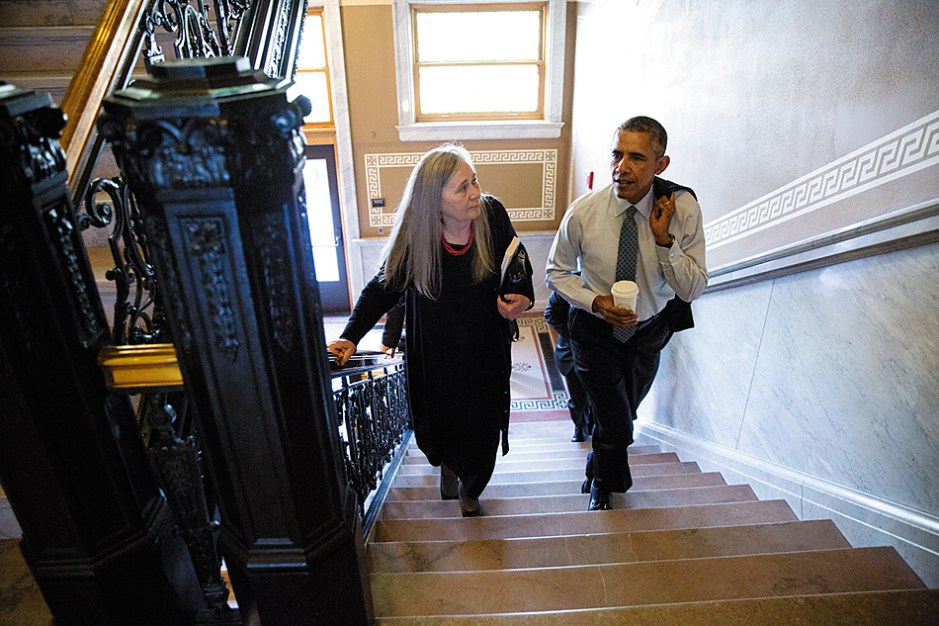
Lots more hue and cry doom and gloom about President Obama’s “letter” (is that have the same authority as an apostolic exhortation?) that instructs all public schools to make bathroom provisions for transgender students. I’m not sure how the president has the stomach for this kind of helicopter presidency when he has time for stop-and-chats with Marc Maron and Marilyn Robinson. Is he really prepared to send federal troops into schools — a la University of Alabama under George Wallace — that don’t comply. If the IRS lets $20 billion get away every year in unclaimed, unpaid, or fake returns (I hear), what’s a bathroom or two to the cause of transgender rights? Heck, is President Obama going to write a letter that specifies the most environmentally friendly way for bathroom users to dry their hands (in the light of climate change; has transclimate as an identity dawned on anyone, a hot planet trapped inside a cold earth?).

But culture warrior Christians feel embattled and are itching for a chance to show the state is tyrannical, wicked, and liberal. Denny Burk’s blood is boiling anyway:

The Obama administration is announcing its intent to coerce through force of law every public school to accept this. He expects your local school to allow boys to use bathroom and shower facilities with girls and vice versa. So long as the child’s parents are willing to go along with their child’s new identity, the school has to let students into the bathroom and locker room of the opposite sex.

This directive is jaw-dropping. The Obama administration doesn’t care whether the local or state school system supports such a move. It doesn’t care whether parents want male students showering with the female students or vice versa. . . .

What is going on here? The answer is very simple. President Obama feels the wind at his back in advocating LGBT rights. Gay marriage is now the law of the land, and gay people are now serving openly in the military. Now President Obama is turning to the “T” in LGBT, and he’s making bathrooms and locker rooms the issue. As the Attorney General has made clear, those who refuse to go along will be treated like Jim Crow bigots.

This radical directive is a heavy-handed, unconstitutional overreach in order to force Americans to pretend that some boys are girls and some girls are boys. It is absurd and wrong. And I wonder if this may not be a bridge too far even for people who are otherwise liberal. Are fathers going to be okay with their daughters undressing in locker rooms where boys can see them? No matter how much one may support President Obama, what dad would go along with this?

Has Prof. Burk considered that a school principal could ignore this letter in much the same way that U.S. drivers ignore speed limits? And what if conservative pundits also decided to ignore the letter and not push the indignant button. After reading recently Andrew Hartman’s book on the culture wars, I tempted to think that conservatives overreacted to matters (like Serano’s Piss Christ) and by protesting gave such transgressive displays more weight than they would have had had no protesters shown up — like millions were going to see Serano’s exhibit without the politics of self-righteousness to motivate them.

If only Kim Davis would come back and lead the charge against bathroom reforms. That’ll work.

Is Neutrality Anti-Religious?

The insightful Bruce Froehnen offers a standard brief against neutrality:

The lie of a neutral public square, in which we can debate important issues on the basis of “public reason,” is at its heart an anti-religious lie. It rests on the notion that we can set aside our faith and discuss important issues on the basis of reason alone. But faith and reason are not distinct categories of thought and action. Faith and reason are intimately bound up with one another and with a more generalized approach to the world—the imagination. Historically, the vast majority of people have seen the world as intrinsically moral, that is as made up of structures and choices that have intrinsic moral importance. Ethics is central to life, on this view, and is bound up with our general approach to both daily and life-changing issues such as whom to marry and what to demand of government, community, local association, family, neighbor, and self. This conception of life is intrinsically religious, for it rests on recognition of a natural order to our being that makes sense, has moral importance, and calls us to virtue, despite our own failings and limitations. It is a vision that has been under attack for more than two centuries, however, as a seemingly secular vision rooted in human emotions and impulses has sought dominance. This latter view, often termed the “idyllic” imagination and ascribed to Rousseau, sees the intrinsic goals of life as bound up with self-expression and self-actualization. It blames the injustices of life on social structures deemed oppressive or unjust and sees duty as something to be imposed on other people and especially on institutions.

But where would Froehnen put Calvinists who have a distinctly different estimate of humans’ moral potential? Is it possible for Protestants who affirm the following to have a place in Froehnen’s dressed public square:

Q. 25. Wherein consisteth the sinfulness of that estate whereinto man fell?
A. The sinfulness of that estate whereinto man fell, consisteth in the guilt of Adam’s first sin, the want of that righteousness wherein he was created, and the corruption of his nature, whereby he is utterly indisposed, disabled, and made opposite unto all that is spiritually good, and wholly inclined to all evil, and that continually; which is commonly called original sin, and from which do proceed all actual transgressions.

Q. 26. How is original sin conveyed from our first parents unto their posterity?
A. Original sin is conveyed from our first parents unto their posterity by natural generation, so as all that proceed from them in that way are conceived and born in sin.

Q. 27. What misery did the fall bring upon mankind?
A. The fall brought upon mankind the loss of communion with God, his displeasure and curse; so as we are by nature children of wrath, bond slaves to Satan, and justly liable to all punishments in this world, and that which is to come.

Such an understanding of human nature post-fall certainly qualifies Froehnen’s sense that ethics are “central to life” or that we all share an understanding of existence that “calls us to virtue.” If neutrality is deceptive, so too is an ethical public square if it leads people to think they can be good “naturally,” apart from grace. And if Froehnen wants to claim that goodness only proceeds from grace, then what does he do in the public square he envisions with people who don’t have grace? Do they need to leave? Or does he expand his understanding of grace — as so many western Christians have done while holding the keys of the establishment — to include everyone as a recipient in some sense of grace? (Say hello to Pope Francis praying with Hindus and Buddhists.)

So maybe a “neutral” public square is not so bad after all. It doesn’t mean having to cut and paste Christian orthodoxy in order to include non-Christians in a common ethical endeavor. Let the civil realm be the civil realm, and the church the church.

The Gypsy Curse

“May you get everything you want.”

Some Calvinists have a special attachment to the original Westminster Confession:

The civil magistrate may not assume to himself the administration of the Word and sacraments, or the power of the keys of the kingdom of heaven: yet he hath authority, and it is his duty, to take order, that unity and peace be preserved in the Church, that the truth of God be kept pure and entire; that all blasphemies and heresies be suppressed; all corruptions and abuses in worship and discipline prevented or reformed; and all the ordinances of God duly settled, administered, and observed. For the better effecting whereof, he hath power to call synods, to be present at them, and to provide that whatsoever is transacted in them be according to the mind of God. (23.3)

2kers point out that U.S. Presbyterians had good reasons for revising that affirmation, reasons like Thomas Jefferson or George Washington or James Madison (Virginians all) having jurisdiction over church assemblies.

For some, though, it takes Donald Trump to recognize what 2kers have long understood:

It would be one thing for Trump to disagree with Moore. That would be totally fine and appropriate. But Trump does more than that here. Trump criticizes Moore not for bad views but for being a bad evangelical!

The problem with this is obvious. Do Americans really want a president who thinks it a part of his job description to pontificate about who is and isn’t a good evangelical? Or a good Catholic? Or a good Muslim? Or a good Jew? This is totally outside the norms and traditions of the presidency.

Presidents are fine to have convictions, religious or otherwise. But to single out a political opponent and to define him as an unfaithful evangelical simply because he opposes the Trump candidacy is an absurd and dangerous precedent.

Deep down, everyone understands 2k. Sometimes they even recommend it.

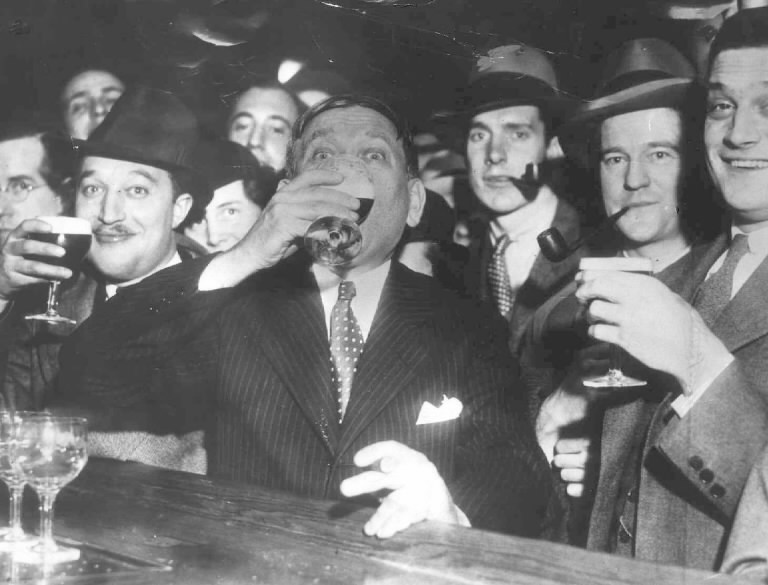
Kant, Mencken, and Locke Walk Into a Bar

And the politicians come out poorer:

Locke has first dibs:

In advocating tax dodging you forget the Social Contract. Is it decent for a citizen to evade his fair obligations to other citizens? Suppose everyone did as you recommend? What would become of the State?

That’s a problem for Kant to solve:

An interesting objection–if only because it proves that the corpse of the late Dr. Immanuel Kant is still dancing. But though it may thus dance, it is nevertheless indubitably dead—and with it the crazy doctrine of a universal moral law. There is, of course, no such thing. Nothing is ever moral for all men—at all events, not with equal horsepower—and by the same token nothing is ever immoral. It may be wrong for a rich man, with so much money that he doesn’t know what to do with it, to dodge his taxes, but it is certainly not wrong in the case of a man whose family must suffer if he pays them. An individual’s first and paramount duty is to himself and his second duty is to his children. Then, in order, come his duties to his wife, his parents, his friends. his brothers and sisters, his creditors, his nieces and nephews, his uncles and aunts, his cousins, his second cousins, his third cousins and so on. Finally come his duties to his enemies, his wife’s relatives and the community in general.

Mencken tries to get the last word:

If the Social Contract were really a free contract, made in cold blood by autonomous principals, then it would lay upon every man a plain duty to pay his taxes in full. But it is really nothing of the sort. On the contrary, it is a contract forced upon him without his leave, and one which he couldn’t evade if he would, and what is more, its terms are grossly unfair and extortionate. The State, in brief, is a professional swindler. Its incessant effort is to make every taxpayer pay $2 or $3 or even $10, for something worth but $1. Theoretically, it collects only enough money each year to pay the actual expenses of government—not a cent more. But actually it collects enough in addition to pay a handsome profit to thousands of men—men who are theoretically servants of the State, but in sober truth are private individuals engaged in the universal human business of getting as much money as possible for as little work as possible.

Certainly, it is no crime for a taxpayer to refuse to submit to this brigandage, and to oppose it with whatever means are at hand. The members of the so-called Government, it is obvious, enter the contest with all of the advantages on their side. Not only have they the police power of the State behind them, to enforce their extortionate demands, but they are also supported by the indifference and superstition of the vast majority of taxpayers, some or whom are too lazy or too ignorant to protect themselves, and others of whom think it would be wrong to try. Therefore, it is perfectly moral, in warring upon such unfair assaults, for the intelligent taxpayer to use devices which, in themselves, may be frowned upon by his private code. In brief, it is moral for him to meet brute force with guile, with chicanery, with downright mendacity—to lie like an anti-vivisectionist whenever the truth would expose him to indefensible and ruinous robbery.

Kant won’t let Mencken have it:

But hark! the corpse of old Immanuel rises to ask a question, to wit: What would happen if every taxpayer swore off most of his takes? How could the State exist? A silly question—like most of those asked (and answered) by that cadaver—for it must be obvious that the majority of taxpayers are so poisoned by moral ptomaines that they will never get the courage to save themselves. The average man is, and always will be, a born sucker. What with his stupidity on the one hand and his morality on the other, he is paralyzed from birth, and so he goes through life a chronic victim. The temptation to rob him is irresistible. Even his wife, his pastor and the policeman on the beat can’t keep their hands off him. He almost begs the world to take his money.

But Mencken persists:

But, supposing the question to be intelligible, it may be answered quickly. And here is the answer: If every taxpayer refused to pay more than, say, 50 per cent. of his taxes, the efficiency of government would not only suffer no diminution, but would probably be vastly augmented. Economy, which is now a mere abstraction, would then become a reality, a necessity. And in the business of cutting down expenses, thus suddenly made the chief concern of the State, nonessentials would go first. If, by any unyielding stupidity of the heads of the State, they didn’t go first—if essentials were thrown overboard to protect supernumeraries and grafters—then the people would rise against the Government and take things into their own hands, and for the first time in the history of the Republic the State would be run as honestly and as economically as the average coal yard, or newspaper, or building association.

The curse of our present scheme of government lies in the fact that it puts no limitation upon taxation. The men who run the State are able to rob us as they will. Naturally enough—since their one aim is to get all they can for themselves and their friends—they lay on all the traffic will bear. The present tax rate on realty in Baltimore, counting in direct and indirect taxes, is fully $3 on the $100—a rate wholly indecent and proposterous. In the absence of legislation reducing it to $1—which rate, if constantly maintained, would be ample to pay all the legitimate expenses of the government—it is the supreme duty of every self-respecting taxpayer to reduce his own bill himself, and in that endeavor he is justified in employing any means, however “immoral,” that may achieve the desired end. Every time he pays a cent more he hands over his good money to meet the costs of pediculine debauchery.

And Mencken wrote this before the states ratified the sixteenth amendment.

Serious Politics

Why does Tim Challies find this wise or insightful?

10 Guidelines for Christian Voters
APRIL 22, 2016

1) Make God’s Word your primary voting guide. “Your word is a lamp to my feet and a light to my path” (Psalm 110:105).

2) Pray before casting your vote. Ask the Lord, first, for guidance as you vote. “Trust in the LORD with all your heart, and do not lean on your own understanding. In all your ways acknowledge him…” (Prov. 3:5-6). Pray also for the candidates even the ones whom you do not like. “I urge that supplications, prayers, intercessions, and thanksgivings be made for all people, for kings and all who are in high positions, that we may lead a peaceful and quiet life, godly and dignified in every way” (1 Tim. 2:1-2).

3) Vote for a candidate who upholds Christian principles. Are his/her views on important social and moral issues biblical? Religious freedom. Will the candidate hinder you from exercising your faith in Jesus Christ, or will he/she protect your liberty as a Christian? Sanctity of human life. Will the candidate promote abortion, or will he/she fight for the sacredness of life in the womb? Marriage. Will the candidate endorse (so-called) “same-sex marriage,” or will he/she uphold the biblical definition of marriage—a union between one man and one woman only? Each candidate should be evaluated in light of these and other moral questions. As followers of Christ, we must not “give approval to those who practice” what God has declared to be morally evil (Rom. 1:32). . . .

Mass incarceration of African-Americans?

Policing and victims of urban crime?

Free trade?

Immigration?

Middle-eastern foreign policy?

National sovereignty?

This “Christian” counsel does nothing for the common good. But it is the perfect identity-politics for Christians to push back against gay or transgender or adultery advocates. Booyah!

The Problem with U.S.

H. L. Mencken explains:

. . . here in this great republic we have the materials for the most superb victualry the world has ever seen, and our people have the money to pay for it. Even the poorest Americano, indeed, eats relatively expensive food. His wife knows nothing of the hard pinching that entertains her French sister. He has meat in abundance and in considerable variety, and a great wealth of fruits and vegetables. Yet he eats badly, gets very little enjoyment out of his meals, and is constantly taking pills. The hot dog is the reductio ad absurdum of American eating. The Sicilian in the ditch, though he can never be President, knows better: he puts a slice of onion between his slabs of bread, not a cartridge filled with the sweepings of the abattoirs.

The national taste for bad food seems all the more remarkable when one recalls that the United States, more than any other country of the modern world, has been enriched by immigrant cuisines. Every fresh wave of newcomers has brought in new dishes, and many of them have been of the highest merit. But very few of them have been adopted by the natives, and the few have been mainly inferior. From the Italians, for example, we have got only spaghetti; it is now so American that it is to be had in cans. But spaghetti is to the Italian cuisine simply what eggs are to the Spanish: a raw material. We eat it as only those Italians eat it who are on the verge of ceasing to eat at all. Of the multitudinous ways in which it can be cooked and garnished we have learned but one, and that one is undoubtedly the worst.

So with the German sauerkraut — a superb victual when properly prepared for the table. But how often, in America, is it properly prepared? Perhaps once in 100,000 times. Even the Germans, coming here, lose the art of handling it as it deserves. It becomes in their hands, as in the hands of American cooks, simply a sort of stewed hay, with overtones of the dishpan. To encounter a decent dish of it in an American eating house would be as startling as to encounter a decent soup.

***

What ails our victualry, principally, is the depressing standardization that ails everything else American. There was a time when every American eating house had its specialties, and many of them were excellent. One did not expect to find the same things everywhere. One went to one place for roast goose, and to another for broiled soft crabs, and to another for oysters, and to yet another for mutton chops. Rolls made the old Parker House in Boston famous, and terrapin a la Maryland did the same for Barnum’s and Guy’s hotels in Baltimore. . . .

in America the public cooks have all abandoned specialization and everyone of them seems bent upon cooking as nearly as possible like all the rest. The American hotel meal is as rigidly standardized as the parts of a flivver, and so is the American restaurant meal. The local dishes, in all eating houses pretending to any tone, are banned as low. So one hunts in vain in Boston for a decent plate of beans, and in Baltimore for a decent mess of steamed hard crabs, and in St. Louis for a decent rasher of catfish. They are obtainable, perhaps, but only along the wharves. One must take a squad of police along to enjoy them in safety. (“Victualry as Fine Art,” 1926)

Would Donald Trump Fire Curt Schilling?

I don’t know much about the tweet that cost Schilling his job with ESPN other than that it made fun of transgender efforts to liberate the nation’s bathrooms from sexual tyranny. I understand that Schilling has a bit of a problem keeping his opinions to himself in the realm of social media.

But I am still wondering why this “issue” is absorbing the attention of state and federal officials (not to mention the news media). If Hillary Clinton can ask, “If we broke up the big banks tomorrow, would that end racism? Would that end sexism?”, why can’t other Americans wonder, “If we allowed cross-dressing men to use women’s bathrooms tomorrow, would that put an end to police brutality?” And people wonder why other people find Donald Trump refreshing (emphasis on fresh)?

Are the Democrats that serious about the politics of (make up your own) identity? Michael Lind knows that they are:

The centrality of identity politics, rather than progressive economics, to the contemporary Democratic Party is nothing new. In 1982, the Democratic National Committee recognized seven official caucuses: women, blacks, Hispanics, Asians, gays, liberals and business/professionals. Thirty-four years later, this is the base of the Democratic Party of Hillary Clinton. The pro-Sanders left objects to the solicitude of the Democratic Party for Wall Street and Silicon Valley, the sources of much of its funding. But it is safe to assume that most progressives, when confronted with conservative candidates, will prefer incremental, finance-friendly Clintonism over the right-wing alternative. Moreover, the ability or even willingness of Mr. Sanders to help down-ballot or state candidates is doubtful. The next generation of Democrats are figures like Julian and Joaquin Castro and Senator Cory Booker of New Jersey, who are much more in the mold of the Clintons and Mr. Obama than of the maverick outsider Bernie Sanders.

If true, that means that both parties are guilty of not being serious about politics. I understand when Glenn Loury says he will vote for Hillary. None of the Republican candidates (except for Kasich) seem like three-dimensional candidates who are above sloganeering. But can the Democrats be all that serious a party when they let human private parts drive American understandings of liberty and equality?

Interpreting the Bible

Tommie Kidd and Gerald McDermott try to salvage providential history. Of course, such an exercise is dangerous:

Over-readings of God’s providence were relatively easy targets of ridicule for the new skeptics and deists of the eighteenth century. For them, Edwards’ kind of interpretation raised obvious questions with no easy answers. Does an absence of drought or worms mean that people are without sin? What did it mean when non-Christians around the world enjoyed abundant harvests, and heavily Christian regions went without? And what of Matthew 5:45’s statement that God “makes his sun rise on the evil and on the good, and sends rain on the just and on the unjust”? Many traditional Christians abandoned close providential readings of current events because, with all due respect to Edwards, those interpretations are easier to defend when no one is asking difficult questions about them.

But we lose something without it:

Yet Gerald McDermott suggests that we also lost good things when we gave up on providential readings of history. Christians certainly believe that God is the Lord of history, and that all things have meaning and purpose within God’s economy. No ruler comes to power, and no nation falls, without God’s sovereign permission. Providential interpretations of a nation’s suffering and turmoil remind us that we stand under universal moral standards. No matter how powerful and wealthy, no nation (perhaps especially those with high rates of professed Christian faith) can expect to provoke God forever with no consequences.

We didn’t already have those assertions from simply reading the Bible? And if we read the Bible and cogitated on its status as God’s word, we might notice that God is the one who interprets history, which is what happens in the pages of Holy Writ — something happens, and we learn its meaning from the apostles and prophets. When things happen and God doesn’t interpret, why would we ever think we have the capacity to fill the void?

Even so, Kidd will not relent:

The most appropriate occasions when we can make modest assertions about God’s historical interventions are when we detect dynamics of reaping and sowing. For example, the financial meltdown of 2008 was clearly connected to irresponsible practices and products, like the infamous “credit default swaps.” At a minimum, we can say that in 2008, God let our nation reap what we had sown financially. We are still trying to recover from the disaster that ensued.

Well, knowing that you reap what you sow is something that farmers understand without the aid of providential history. The challenge for arguments like Kidd’s is the dark side of providential history (and the fall more generally). If God let the nation reap what the banks had sown, isn’t it also the case that God let the banks sow?

Are providentialists really up to tackling the problem of evil? I don’t think so.

Human Flourishing is Flabby

Here’s another reason for thinking that the language of human flourishing (HF) is a cliche on the order of w-w:

“If you care about the flourishing of persons, especially the vulnerable in community, you will care about freedom of religion,” claimed Crouch. He continued to explain why this is so, because religion and the practice thereof, is “one of the deepest forms of human flourishing.” Religion is distinctive to humans, no animals nor all of nature practice religion or seek to find answers about life and God. All humans across history past and present seek to understand life and their situation in it. Further, all humans search for meaning and attempt to attach themselves to something bigger than themselves, constantly searching for significance and fulfillment. Inevitably, we all seek religion and devote worship, even the Atheist, though denying God’s existence, forms a set of beliefs to understand reality and worships something or someone (quite possibly themselves).

Therefore, Crouch explains “being denied religious freedom, being prevented from acting out your deepest commitments in public, is one of the deepest denials of human flourishing.” The test then to know if religious freedom and therefore the common good is being protected, “Is how it protects religious minorities,” claims Crouch.

What does this view of HF say to someone who thinks that blasphemy and idolatry are part of destructive living (DL)? But if you give people freedom to practice any religion, you also permit blasphemy and idolatry. Maybe the resolution is to say that in the interest of genuine devotion to God we also need to allow DL so that government doesn’t become tyrannical. But let’s not kid ourselves that freedom leads to HF. It has costs and benefits that require not chanting “winning” like Charlie Sheen but sobriety and moderation.

Crouch’s view of HF also seems to follow the pack in regarding as impossible or disloyal any effort to leave behind one’s “deepest” commitments when entering public life. But again, it’s a pretty, pretty, pretty good view of public life to think that everyone bringing their deepest commitments to the table will result in HF for everyone. Wasn’t the reason for leaving behind one’s deepest commitments when serving in public life that one’s deepest commitments might be at odds with the common good? After all, if a Calvinist brought his deepest commitments to a policy proposal for building a Roman Catholic parochial school next to First Presbyterian Church, wouldn’t his deepest commitments prompt him to vote no? Where’s your HF now?

After fifty years of culture wars shouting matches, people are still so naive to think that uplifting thoughts will prevail over contested points of view?

The First President to be Pried from His Bath

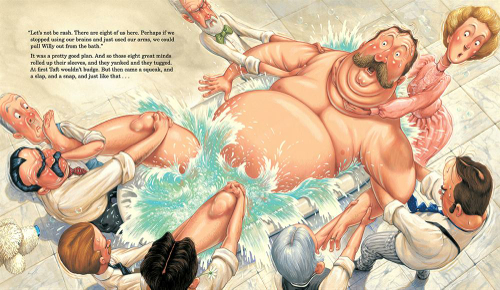
I heard this morning on Sports Talk radio of all things that on this day in history President William Taft, a man of gargantuan proportions, became stuck in his bath tub:

What most people associated with Taft, however, was his enormous size, and the image of his 300 plus pounds of presidential flesh offended some people and amused many others. When he became stuck in the presidential bath tub, requiring six men to pull him free, the nation’s press had a field day. His size made him the subject of countless jokes: “Taft was the most polite man in Washington. One day he gave up his seat on a streetcar to three women.” Within the capital’s social circle, Taft frequently embarrassed his family and associates by falling asleep at concerts, during presidential briefing sessions, and while presiding over his cabinet. At ease with his uncontrolled appetite and his need for sleep after eating or after exerting himself, Taft simply refused to be embarrassed by his weight or his behavior. He accepted his size and so did most of the American public in time.

What many Americans don’t know is that President Millard Filmore was the first to take a bath in the White House. Here is H. L. Mencken’s account:

But it was the example of President Millard Fillmore that, even more than the grudging medical approval, gave the bathtub recognition and respectability in the United States. While he was still Vice-President, in March, 1850, he visited Cincinnati on a stumping tour, and inspected the original Thompson tub. Thompson himself was now dead, but his bathroom was preserved by the gentlemen who had bought his house from the estate. Fillmore was entertained in this house and, according to Chamberlain, his biographer, took a bath in the tub. Experiencing no ill effects, he became an ardent advocate of the new invention, and on succeeding to the Presidency at Taylor’s death, July 9, 1850, he instructed his secretary of war, Gen. Charles M. Conrad, to invite tenders for the construction of a bathtub in the White House.

This action, for a moment, revived the old controversy, and its opponents made much of the fact that there was no bathtub at Mount Vernon, or at Monticello, and that all the Presidents and other magnificoes of the past had got along without any such monarchical luxuries. The elder Bennett, in the New York Herald, charged that Fillmore really aspired to buy and install in the White House a porphyry and alabaster bath that had been used by Louis Philippe at Versailles. But Conrad, disregarding all this clamor, duly called for bids, and the contract was presently awarded to Harper & Gillespie, a firm of Philadelphia engineers, who proposed to furnish a tub of thin cast iron, capable of floating the largest man.

This was installed early in 1851, and remained in service in the White House until the first Cleveland administration, when the present enameled tub was substituted. (“A Neglected Anniversary,” New York Evening Mail, 1917)

Whether presidents have been clean ever since is a separate question.