American Greatness

Liberalism may be failing, but at least the voluntary character of church life in the United States means that communions here do not need to worry the way those in Scotland do where the establishment principle is still in effect even for those outside the established church. David Robertson highlights the contrasting responses of Presbyterians — Church of Scotland vs. Free Church of Scotland — to the Scottish government’s proposal to allow Scots to self-identify their gender. Spoiler alert: the Free Church dissents, the Church of Scotland goes along.

But the arresting matter here is the degree to which a communion self-identifies with its nation:

Lets talk not about gender identity but the identity of the Church. It seems to be that the Church of Scotland is no longer self-identifying as a biblical, prophetic Christian church. It now self-identifies as the spiritual wing of the progressive state, affirming its every action and endorsing its liberal theology. State churches always run the danger of avoiding the prophetic, because they are tied in with the State, and therefore will find it difficult to tell the State the Word of God. If John the Baptist had been a Church of Scotland minister, he would have affirmed Herod in his sin, told him ‘he didn’t want to judge’ and offered to produce a booklet of stories of adulterers like him! I hope and pray that the faithful ministers who remain in the Kirk will not hand out this propaganda, but will challenge 121 and the bureaucracy that has collaborated in this document. Its time for faithful people to be faithful and to at least be prophets to their own denomination.

What about the Free Church (and other churches). We can moan from the sidelines – refuse to get involved – shout in anger or shrink in despair. Or we can be a biblical Christ loving church which does what we can to welcome and help transpeople who are seeking Christ. They need to know him and be saved from their sin – not their trans. And we must have a prophetic voice into the culture – whether its challenging schools when they seek to indoctrinate our children with Queer theory, or making representations to the Scottish Government. And of course we weep and pray….

God have mercy and save Scotland from itself.

At what point do you see the folly of ecclesiastical establishments? Nothing possibly could go wrong here (ever since Constantine).

Good but Different Americans

With Ash Wednesday comes Lent and different rationales for turning up those practices that increase holiness. George Weigel opts for the difference that Lenten practice makes:

Friday abstinence was once a defining mark of the practicing Catholic, and Lenten pork roll raillery aside, it ought to be again. The Catholic Bishops’ Conference of England and Wales is not renowned for its traditionalism, but some years ago the bishops mandated a year-round return to Friday abstinence south of Hadrian’s Wall, and good for them for doing so. If our baptisms really set us apart for Christ, then we should live a different temporal rhythm than the rest of the world: not to advertise our righteousness, but to remind ourselves, each other, and those who might be curious about these Catholics and their ways that we’re, well, different. And at a moment in Western cultural history in which the tsunami of the Culture of Me threatens to overwhelm everything, putting down behavioral markers of difference is no small thing. From Friday abstinence, who knows what might grow?

Well, these days at First Things someone might ask if Friday abstinence could lead to the kidnapping of baptized children from non-Roman Catholic parents.

Or how about the royal absolutism of French monarchs?

For those keeping score at home, liberalism is on the ropes at First Things, which is odd for a magazine that used to be (along with Weigel) firmly in the Americanist camp of U.S. Roman Catholics.

The problem is not Lent or abstinence from meat. I have great respect for minority groups that maintain their religious ways in face of a society that does little to encourage or foster such practices. The Amish and Orthodox Jews, for instance, who continue to maintain family and spiritual traditions without trying to Americanize their traditions are (or should be) obviously admirable in their fortitude and conviction.

But transferring such admiration to Roman Catholics comes with a catch. That snag is that Roman Catholic piety for a long time was not simply a way of being a good Christian before God but also came with expectations about society, the political order, and the church’s authority. To sever personal piety from Rome’s global reach or cultural aspirations was never possible, the way it has been for other faiths outside the political order that brought them into existence. The reason is that fellowship with the Bishop of Rome and all the affairs in which he had his hands was necessary to be a good Roman Catholic.

So Weigel’s proposal for being more distinct is no neutral proposition when Roman Catholicism in its most distinct expression was not necessarily a respecter of the sort of freedoms that allow the Amish and Orthodox Jews to practice their faiths. Like Neo-Calvinism, Roman Catholicism is not content with a personal faith. Religion is not a private affair but needs to take root in all areas of life — and there goes political liberalism.

When the Evangelical Left and Theonomic Presbyterians Agree

Shane Claiborne mocks Jerry Falwell for tweeting this:

Jesus said love our neighbors as ourselves but never told Caesar how to run Rome-he never said Roman soldiers should turn the other cheek in battle or that Caesar should allow all the barbarians to be Roman citizens or that Caesar should tax the rich to help poor. That’s our job.

Such two-kingdom thinking is heretical for the student of Tony Campolo:

Honestly, this is some of the worst theology I’ve ever heard. And this heresy is from the president of the largest Christian university in the world.

Not only is this “bad” theology… it is also deadly theology. Similar ideology was used to justify apartheid and to excuse Hitler… this notion that sin is personal but rulers are immune to it.

The idea that Caesar or a Roman soldier… or anyone… is exempt from God’s command to love our enemy, care for the poor, or welcome the stranger is heresy. Jesus said we will ALL be asked how we cared for “the least of these.” (Mt.25)

Larry Ball has a similar gripe against two-kingdom theology (inspired by Andrew White’s run for the governor of Texas):

Both natural law and the democratic process determine civil law for the body-politic. The Bible has no place in the body-politic. The Bible is a religious document and it must be restricted to the realm of the church and personal faith. The State must remain neutral toward religion.

Thus, the result of two-kingdom theology is that Religion (Christianity) is personal, restricted to the heart, and the rules for the body politic must not be determined by the Bible. In America all religions are equal, and therefore all religions are equally irrelevant in the public square. Religion is only useful in so far as it makes people good citizens who are obedient to the law of the land.

Either natural law or the voice of the Supreme Court makes right in society as a whole. Mr. White admits that he and his wife would personally not choose abortion, but this is only a personal and therefore a religious matter. The Bible must not be brought into the arena of the civil magistrate. This is to mix church and state.

Two-kingdoms aside and whether Jesus had anything to say about God and Caesar, why is it so hard for evangelicals to separate what America does from what they as believers do? I don’t build bridges, therefore the United States government should not. I would not declare war on another nation or shoot another person, therefore American governments should not fight or enforce the law by force? Can you say delusions of grandeur? Sure you can.

But if you want to side with the feminists that the personal is political, then welcome to evangelical political reflection.

Could Billy Graham Stand in Alan Jacobs’ Great Day?

Jacobs is a smart fellow and should have enough sense to beware of crowds. If the group is running one way, to paraphrase Glenn Loury, “head for the other.” Right now, group-think is decidedly against any evangelical who supported or voted for Trump.

I did not vote for Trump nor am I an evangelical. So I am a neutral in all the Trump- and evangelical-bashing.

Jacobs recently attributed Jerry Falwell, Jr.’s folly in coddling up to the current POTUS to the poor education he received from his father, Jerry Falwell I:

Point the first: Jerry Falwell, Jr., though not a pastor and holding no advanced degrees in Bible or theology, graduated from two institutions founded by his pastor father for the express purpose of offering seriously Christian education: Liberty Christian Academy and then Liberty University. (JF Jr.’s college major was Religious Studies.)

Point the second: As is evident from the statements that French discusses in his post, Jerry Falwell, Jr. shows no evidence of having even the most elementary understanding of what the Bible says and what the Christian Gospel is.

The problem, as discerning readers will already have noted, is how to reconcile these two points. How could someone raised as Jerry Falwell, Jr. was raised, educated as he was educated, living as he now lives, say that Jesus “did not forgive the establishment elites”? Could he really not know that Jesus said of those establishment elites who killed him, “Father, forgive them”? And this is not an isolated incident. Quite often in recent months JF Jr. (like a number of other evangelical leaders) has made statements that clearly contradict some of the best-known passages in the Bible.

Notice what happens if you apply these standards to Billy Graham. Did his “decisionism” actually express the gospel faithfully? You don’t need to read white papers from the Orthodox Presbyterian Church to know that the greatest evangelical of all time may have not used the best of methods or theology to reach the unconverted or lukewarm. Just listen to Tim Challies:

Last weekend Billy Graham preached at what may be his final crusade, preaching before up to 82,000 people at a time. A headline at Pastors.com proclaimed the crusade a great success, indicating that some 12,000 people made decisions for Christ. In a previous article I expressed concerns with Graham’s ecumenism and the fact that Roman Catholic counselors would be present at the event and any people who made decisions and indicated they were from a Catholic background would be directed back to their Catholic churches. Today I’d like to examine the idea of the “decision” that weights so heavily at these crusades.

If you were to do a survey of church history, reading books and documents from the first century all the way to the early nineteenth century, you would find no mention of “decisions for Christ.” Similarly one would find no reference to the altar calls which are the culmination of every modern evangelistic crusade. Those elements, which are found in nearly every evangelical church today, were inventions generally attributed to evangelist Charles Finney who lived from 1792 to 1875. He emphasized the need for a decision, usually made by “coming forward” to approach the altar. Becoming a believer became synonymous with making a decision and proving that decision by taking physical action. It is important to note that this system is entirely foreign to the Scriptures.

Bam!!

By the way, Billy Graham’s theological education was not exactly first-rate, but it didn’t prevent him from preaching his entire life. Nor did it raise questions about the institution where Alan Jacobs used to teach — Wheaton College — which in 1943 granted Graham a degree in — wait for it — anthropology.

In addition to Jacobs’ fastidiousness about Falwell’s theology is the professor’s distaste for the Liberty University president’s politics. Just say Donald Trump and you’ve said all you need to.

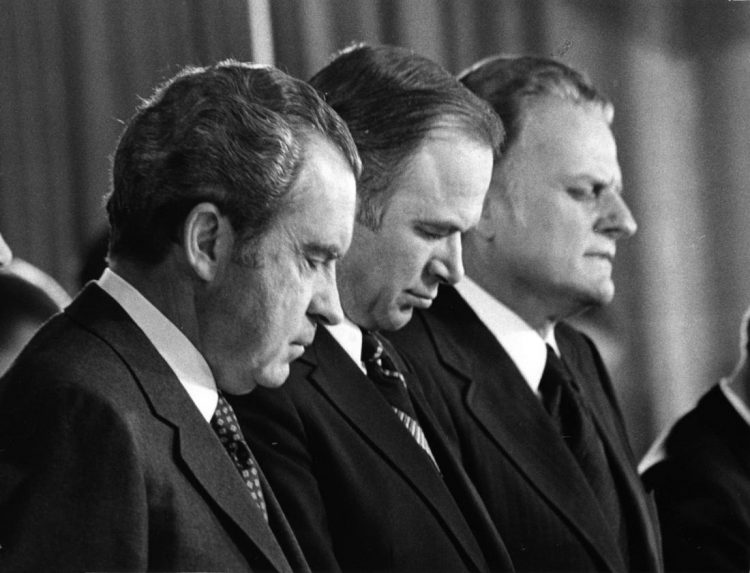
But just how reassuring were Billy Graham’s political ties during his long career? What would Jacobs’ have written about Billy Graham conducting worship services in the Nixon White House? And it went beyond worship:

Rev. Billy Graham, the Montreat-based, world-renowned evangelist, long ago addressed some of his troublesome interactions with President Richard Nixon, but disclosures about their behind-the-scenes connections have kept surfacing.

Now, formerly classified and otherwise hidden parts of the daily diary kept by Nixon’s chief of staff, H.R. Haldeman, have added even more to the record on Nixon and Graham’s tight relationship.

Last week, on the day before Graham celebrated his 96th birthday, the Nixon Presidential Library posted most of the previously unreleased parts of Haldeman’s “candid personal record and reflections on events, issues and people encountered during his service in the Nixon White House,” as the library describes the diary.

The records add a new level of detail on how Nixon and Graham consulted and bolstered each other during contentious times, with dissent over the Vietnam War sweeping the country, the Watergate scandal erupting, and both men sizing up their standing in national debates.

Most of the records came in the form of audio recordings, which can be heard below.

They expand on how Graham advised Nixon to make more effective speeches, clinch his 1972 re-election bid, address the nation’s spiritual woes and conduct matters of war and diplomacy.

“I talked to Billy Graham during the day,” Haldeman, who ultimately became the key conduit between the preacher and the president, noted in one newly released tape from May 8, 1971, the day Nixon made a major address on his decision to expand the war in Southeast Asia.

“And he said to tell the president to get tough, that that’s what people wanted.”

The point here is not to besmirch Billy Graham. If you were an evangelical you had to scratch your head a lot. Instead, the point is to wonder about the bar that critics of evangelicals like Alan Jacobs are now raising for the likes of Jerry Falwell II. Old Life holds no brief for Mr. Falwell’s mix of religion and politics. But some can wonder where the critics were in the days of Billy Graham.

As the Church Lady used to say, “isn’t that convenient.”

When You Ignore the Context

You have lose your outrage over evangelical hypocrisy.

John Fea argues that Damon Linker nails it when the latter writes:

No informed evangelical today seriously hopes for a reversal of same-sex marriage. (Even in the unlikely event that the Supreme Court’s Obergefell decision affirming a right to same-sex marriage were overturned, public opinion would by this point strongly support legalizing the institution through democratic means.) What they do hope for is protection from persecution for their religiously based views of sexual morality. That can be done most effectively by the appointment of judges who are friendly to religious freedom and the reining in of the power of executive branch bureaucracies to apply anti-discrimination law to every corner of American life. The Trump administration has been doing a lot of both. And evangelicals are understandably elated about it.

Those who loathe and fear the religious right should keep all of this in mind when they mock evangelicals for their cynical political maneuvering. The willingness of evangelicals to embrace Trump is a function not of their strength but of their weakness. It may not look that way from the outside, with an increasingly Trumpified Republican Party exercising so much control in Washington and in state houses around the country. Yet evangelicals are right to recognize that people like them have by now long since decisively lost the culture and the political support of the bulk of the American electorate.

The moral majority has shrunk to become a moral minority surrounded by a sea of secularism. For all the talk of the president serving as God’s instrument in the 2016 election, most evangelicals understand very well that he’s an emissary from the wider secular world. But that makes his willingness to serve as their strong man and protector all the more remarkable — and all the more an occasion for gratitude and loyalty.

But Linker’s point is not simply that evangelicals support Trump out of fear and weakness, thus adding to the woe of being hypocrites. His point is that evangelicals the alternative to Trump as even worse:

Like the residents of an urban neighborhood who gladly pay a local mob boss a share of their earnings in return for safety and security, evangelicals have made a transactional calculation. In return for obsequious, gushing, unconditional support, Trump will serve as their protector, surpassing all prior Republican presidents in his willingness to advance a religious right agenda for which he personally feels nothing but indifference.

The character of this arrangement shows just how much the situation for evangelicals has changed since the administration of their previous presidential champion, George W. Bush.

Bush spoke frequently and convincingly about his faith, and he backed it up by advocating for the passage of a constitutional amendment to ban same-sex marriage and working to get anti-same-sex-marriage referendums on the ballots of numerous states in the run-up to the 2004 presidential election. Trump, by contrast, expressed explicit support for LGBTQ rights in his acceptance speech at the 2016 Republican convention.

Meanwhile, in the intervening eight years, a Democratic president and just about every member of his party shifted from opposing gay marriage to supporting it while denouncing the remaining holdouts as bigots. Then, in the blink of an eye, progressives immediately began waging the next battle in the anti-discrimination wars: a defense of the rights of the transgendered, including an insistence that all public discussion and debate of the issue begin by affirming the absolute malleability of gender, a position radically incompatible with historic Christianity’s teachings on sexual morality.

This is the context in which the evangelical embrace of Trump needs to be understood.

John left that out of his post. He also leaves this context out of his apparent loathing for the so-called “court” evangelicals. His categories for evaluating Trump and evangelicals are chiefly moral. He leaves out the context of politics.

Normal for a fundamentalist or evangelical, odd for a historian.

Maybe not Audacious, but Supreme

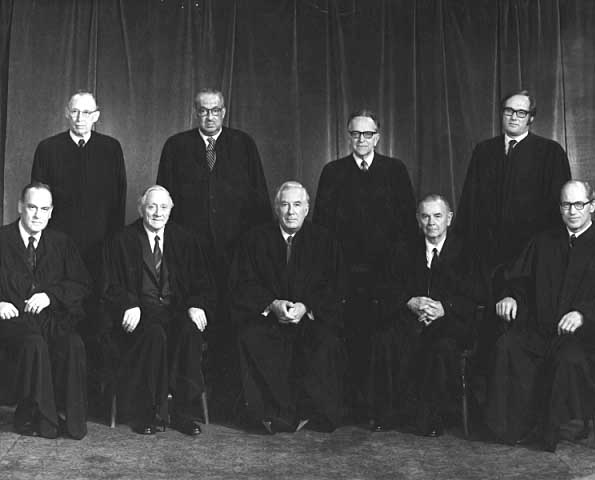
Look ma, an argument against the imperial Supreme Court without the crutches of w-w (trigger warning – not written by a Protestant):

Brown is the most important decision ever rendered by the United States Supreme Court. Its significance lies much less in its impact on the civil rights movement, which was indirect at most, than in establishing the idea that the judicial branch holds a monopoly on constitutional interpretation. Though controversial in 1954, the Segregation Cases (as Brown was initially called) are today almost universally regarded as the epitome of judicial wisdom and courage. Because the Supreme Court did what is considered so obviously right when the rest of the political system would not, it came to be considered preeminent among the three branches of the federal government.

It is still living off the moral capital acquired in Brown. Three years after that decision, the Court, enforcing the desegregation of Little Rock High School in Arkansas, went so far as to assert that its interpretation of the Constitution was the Constitution, the “supreme law of the land.” In 1992, the majority wrote in Planned Parenthood v. Casey:

The American people’s belief in themselves . . . as a people who aspire to live according to the rule of law is not readily separable from their understanding of the Court invested with the authority to decide their constitutional cases and speak before all others for their constitutional ideals.

In other words, the rule of law depends on the rule of judges. The American people and their elected officials have largely acquiesced in this usurpation. Public opinion polls show that the Court is near the top of institutions that Americans trust—way above Congress and the media, behind only the police, the military, and small business.

See? It is possible to reach politically conservative positions without resorting to theology or the Bible. In fact, theologians and pastors who write about politics as theologians and pastors usually let theology and the Bible get in the way of the Constitution.

Theonomists All

If you thought Calvinists and Muslims had a problem accepting political liberalism, wait til you see this (from a review of American Law from a Catholic Perspective: Through A Clearer Lens):

Over and over again, we see the deep chasm between the Catholic understanding of the human person and the anthropology implied by American liberalism. The difference is stark. The former conceives of each human being as a person—a relational being, in relationship to God and others and dependent on God and others. The latter sees each human being as an individual who can make and fashion his own being and existence autonomously and apart from God and others. God is a valid choice, but he is just that, a choice. The Catholic lawyer cannot help but feel a dissonance between his deepest beliefs and the law he is called to practice each day. American Law from a Catholic Perspective helps to remind readers where their allegiances must lie. The attentive reader can begin to see the ways in which he must work to change American law at its very roots to help it conform to the truth proclaimed by the Church. (Briefly Noted)

Doesn’t “at its very roots” mean radical?

And here I thought 2k was rad.

2K in the PCA

And Stephen Wolfe is young, to boot:

Voting does not therefore endorse all parts of the moral life, even the principal part. But why? Because proper worship and good soteriology do not concern the civil realm. Worship concerns heavenly life and the ecclesiastical administration, not the civil. The Second-Table concerns civil justice, order, and our earthly duties. Voting does not endorse all of the candidate’s moral life, only the part relating to earthly life. This is a matter of civil righteousness.

So the principle so far is:

Voting for a candidate is an endorsement of a candidate’s moral life as it pertains to civil righteousness.

Civil righteousness at this point refers to one’s perfect obedience to the Second-Table of the moral law. Let’s remember however that the Law has an external and an internal component. One must act outwardly in conformity with the Law and internally in accordance with the correct motivation (or principle, mode, and end). In our sinful world, even if one seems outwardly blameless, he cannot be internally blameless. He will be covetous, for example, without showing any external indication of it. Surely when people vote for such a person they are not endorsing one’s past or present propensity to sin internally. Why?

Because what matters in the civil realm is civil action, not internal motivations seen only by God. This hypothetical candidate’s internal sin has no impact on his outward behavior. Since there are no adverse consequences, the vote does not endorse evil. So the principle is:

Voting for a candidate is an endorsement of a candidate’s moral life as it pertains to his external conformity to civil righteousness.

But has there ever been such a blameless person, one who though internally sinful (like all of us) is perfect as to civil righteousness? Surely not. Everyone outwardly sins. Does voting for him endorse that evil? If a candidate badly failed to honor his parents decades ago, does one endorse that sin by voting for him? I think that most people would say it doesn’t. Why? Because one endorses another’s sin in voting for him only when those sins adversely affect the suitability of the candidate for civil office. The sin must relate in some way to civil office. So:

Voting for a candidate is an endorsement of the candidate’s moral life as it pertains to his external conformity to civil righteousness sufficient to qualify the candidate for civil office.

We’ve significantly reduced the scope of sins that voting can endorse. We have shifted away in part from who the candidate is to what he does. More precisely, we now care about his personal features pertaining to civil action. A civil officeholder fulfills a civil function, which necessarily involves action for civil ends; and qualifying for civil office is necessarily a matter of possessing characteristics conducive to producing good, long-term civil outcomes by means of civil action in a particular time, place, and set of circumstances.

In other words, what’s good for Al Franken is good for Kevin Spacey.

Living in a fallen world really is complicated.

If Daniel Could Serve a Pagan King, Why Can’t Old School Presbyterians vote for Bill Clinton?

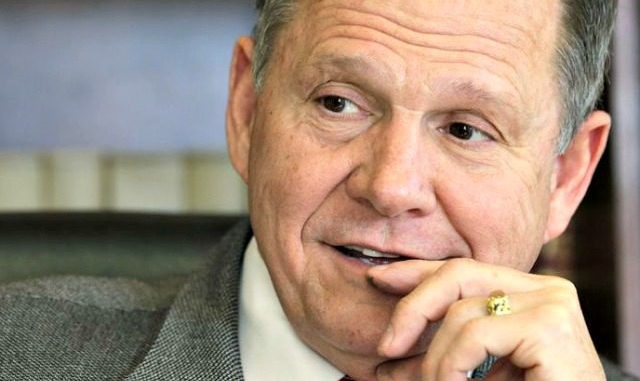
Kevin DeYoung offers some perspective for Alabama voters (though he never mentions Roy Moore):

9. Am I casting my vote for someone who will damage the reputation of Christ and may harm the cause of Christ in the world? While it is often good to vote for other Christians, we have to consider how someone conducts himself in public as a representative of Christian convictions, ethics, and character.

10. Am I willing to consider that thoughtful Christians may answer some of these questions differently than I would? I certainly have my opinions about how these questions might apply in specific instances, but more than a particular vote, I want to encourage Christians to think critically and strategically about their civic participation. There is more to consider than majorities for our side and defeat for theirs.

I am glad he follows point 9 with point 10 because Daniel, the prophet, would have had a hard time answering the ninth question. Not only could Daniel not vote, but he served a King who worshiped and served false gods. Sure, Daniel resisted the king in some ways, but he also excelled in pagan learning (and so distinguished himself for public service):

17 As for these four youths, God gave them learning and skill in all literature and wisdom, and Daniel had understanding in all visions and dreams. 18 At the end of the time, when the king had commanded that they should be brought in, the chief of the eunuchs brought them in before Nebuchadnezzar. 19 And the king spoke with them, and among all of them none was found like Daniel, Hananiah, Mishael, and Azariah. Therefore they stood before the king. 20 And in every matter of wisdom and understanding about which the king inquired of them, he found them ten times better than all the magicians and enchanters that were in all his kingdom.

If not obeying the first table of the law is a big deal — and we’re not simply talking about images of Christ — how could a faithful believer excel in pagan literature and wisdom (which by Neo-Calvinist standards had to be worse than public schools) and then also serve a king whose cult involved idolatry?

I get it, Daniel did eventually disobey, which is music to the socially righteous warriors ears (thanks to one of our Southern correspondents):

We might hide our motives or blanket them in a veil we call authority or expertise. We will always become like the things we worship. Daniel writes about three men who stood in bold ambivalence to the foolishness of a conqueror king, because he was not their true king. They knew who they worshipped, and the more they lived like Him the closer they came to His presence.

Resist!

But that perspective on Daniel entirely misses the prophet’s assimilation to a regime tainted throughout by blasphemy and idolatry. Again, if 1789 affected all of European society, imagine the intersectionality of Babylonian gods and society. What did Daniel do? He cooperated as much as possible.

Don’t resist!

Honor (even the pagan megalomaniac)!

13 Be subject for the Lord’s sake to every human institution, whether it be to the emperor as supreme, 14 or to governors as sent by him to punish those who do evil and to praise those who do good. 15 For this is the will of God, that by doing good you should put to silence the ignorance of foolish people. 16 Live as people who are free, not using your freedom as a cover-up for evil, but living as servants of God. 17 Honor everyone. Love the brotherhood. Fear God. Honor the emperor.

In which case, the lesson is that as long as a Christian does not worship the senator, create statues of him for worship, pray to the senator, hand out the senator’s voting guide on Sunday, still honors his parents while working or voting for the senator, is not the senator’s hit-man, doesn’t lust after the senator’s wife, doesn’t embezzle for the senator, doesn’t lie to or for the senator, and doesn’t envy the senator, or his wife, or servants, or property, the a Christian can vote for the senator.

But if you want to be a pietist about it and consider primarily what a vote says (all) about you, then chances are you have the makings for being an Anabaptist.

Roman Catholics at Plymouth Rock?

In the department of strange bedfellows comes George Weigel’s praise for the Museum of the Bible:

On September 29, 1952, the publication of the complete Revised Standard Version of the Bible was celebrated at the National Guard Armory in Washington, D.C., and the principal speaker was the U.S. Secretary of State, Dean Acheson. The son of the Episcopal bishop of Connecticut, Acheson movingly described the ways in which the King James Bible, which the new RSV was to supplant, had once shaped American culture and our national life:

In the earliest days in the Northeast, the Book was All. The settlers came here to live their own reading of it. It was the spiritual guide, the moral and legal code, the political system, the sustenance of life, whether that meant endurance of hardship, the endless struggle against nature, battle with enemies, or the inevitable processes of life and death. And it meant to those who cast the mold of this country something very specific and very clear. It meant that the purpose of man’s journey through this life was to learn and identify his life and effort with the purpose and will of God.

That biblical vision helped form the bedrock convictions of the American idea: that government stood under the judgment of divine and natural law; that government was limited in its reach into human affairs, especially the realm of conscience; that national greatness was measured by fidelity to the moral truths taught by revelation and inscribed in the world by a demanding yet merciful God; that only a virtuous people could be truly free.

Of course, the U.S. is a free country and anyone can assemble the past in ways consoling.

But does anyone else feel a certain discomfort with a Roman Catholic recommending the Bible without also mentioning the objections that sometimes Bishops registered against Bible readings in public schools without comment? The United States would not have as many parochial schools as it does if not for Bishops who worried about sending children to public schools where teachers read the Protestant version of the Bible.

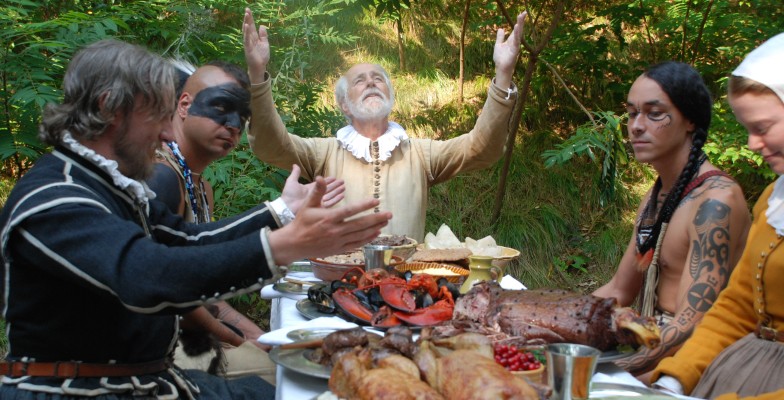
Not to be missed is the odd relationship between the Bible and the founding. If the settlers who came to America and launched the tradition of Thanksgiving wanted a society with a biblical vision at its bedrock, don’t you also have to mention that those same Bible-only Christians were a tad jittery about including Roman Catholics in the nation that emerged from their colonial enterprises?

This may be why some Roman Catholic political theorists are uncomfortable with Roman Catholics getting comfortable with the founding.