Does POTUS Define US?

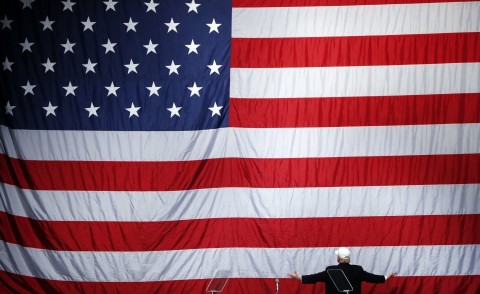
Of course, not. The federal government has two other branches and the United States is way more than its government. McDonalds? Hollywood? Caitlyn? Harvard? The military? Heck, we don’t even pledge allegiance to the White House.

But what’s true for a nation is not true for a church like Roman Catholicism. There the papacy does define Roman Catholicism. And Ross Douthat explains why investing all that power and identity in a single office is a mistake, or why Pope Francis is more of a threat than President Trump:

Friendly media coverage casts the pontiff as a man of the center, an ecclesiastical equivalent of Angela Merkel or Barack Obama or David Cameron, menaced by authoritarians to his right. But he is no such thing, and not only because his politics are much more radical and apocalyptic than any Western technocrat. In the context of the papacy, in his style as a ruler of the church, Francis is flagrantly Trumpian: a shatterer of norms, a disregarder of traditions, an insult-heavy rhetorician, a pontiff impatient with the strictures of church law and inclined to govern by decree when existing rules and structures resist his will.

His admirers believe that all these aggressive moves, from his high-stakes push to change church discipline on remarriage and divorce to his recent annexation of the Knights of Malta, are justified by the ossification of the church and the need for rapid change. Which is to say, they regard the unhappiness of Vatican bureaucrats, the doubts of theologians, the confusion of bishops and the despair of canon lawyers the way Trump supporters regard the anxiety of D.C. insiders and policy experts and journalists — as a sign that their hero’s moves are working, that he’s finally draining the Roman swamp.

Meanwhile the church’s institutionalists are divided along roughly the same lines as mainstream politicians in the face of Trump’s ascent.

There is a faction that has thrown in with Francis completely, some out of theological conviction, some out of opportunism, some out of simple loyalty to the papal office. (The analogy would be to the mix of populists, opportunists and institutionalists who smoothed Trump’s progress to the Republican nomination.)

There is a group that is simply silent or deeply cautious — note how few of the world’s bishops have taken any position on the controversy over divorce and remarriage — in the hopes that things will simply return to normal without their having to put anything at risk. (The analogy would be to most Republican elected officials, and a few red-state Democrats as well.)

There is a group that is relatively open in criticism of the pope’s agenda but also unwilling to cross the line into norm-smashing of its own. (The analogy would be to the American center-right and center-left, from John McCain to Hillary Clinton.)

This last group’s sheer diversity is one reason the Bannon-versus-Francis theory fails. The ranks of papal skeptics are filled with Africans and Latin Americans as well as North Americans and Europeans, with prelates and theologians and laypeople of diverse economic and political perspectives. Most are not traditionalists like Burke; they are simply conservatives, comfortable with the Pope John Paul II model of Catholicism, with its fusion of the traditional and modern, its attempt to maintain doctrinal conservatism while embracing the Second Vatican Council’s reforms.

But because this larger group is cautious, its members have been overshadowed by the more forthright, combative and, yes, reactionary Cardinal Burke, whose interventions might as well come with the hashtag #TheResistance.

Which places him in the same position, relative to Francis, that a Bernie Sanders occupies relative to Trump — or that Jeremy Corbyn occupies relative to Brexit. He’s a figure from the fringe whose ideas gain influence because the other fringe is suddenly in power; a reactionary critic of a radical pope just as Sanders or Corbyn are radical critics of a suddenly empowered spirit of reaction.

So the story of Catholicism right now has less to do with reaction alone and more to do with what happens generally when an institution’s center doesn’t hold.

You don’t hear Bryan and the Jasons saying much about church politics. It’s like reading the Federalist Papers and ignoring the 2016 presidential campaign. And yet, ideas do have consequences and the theory of chief and infallible interpreter of the faith is not simply an idea. It is a way of life. At least the federalists left behind a Constitution. What enumerated powers did papal supremacists leave behind?

Dressing Like a King is Not Unobtrusive

Hello.

Father Dwight again challenges reason:

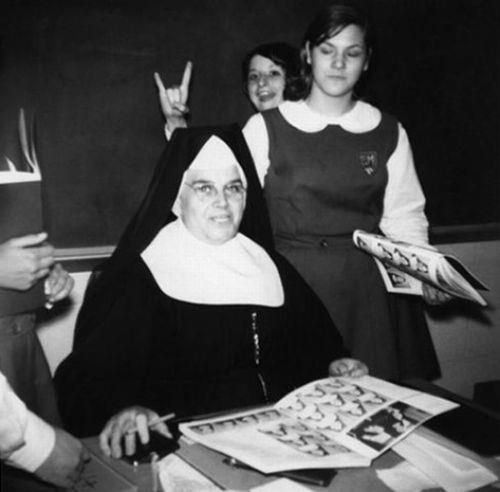
The priest’s robes are a ceremonial vesture—a uniform of their sacred office. They are meant to effectively obliterate the priest’s personality. They are also, by the way, meant to be unobtrusive. They should not be creative or clever or call attention to the smart vestment designer or the wonderful seamstress. They are simply to dignify the office of the priest and dignify and beautify the celebration of Mass.

If the Mass is the Royal Marriage Feast of the Lamb, then the priest should dress up for his entrance into the royal court. The robes should therefore be regal in their dignity, their simplicity and their style. As much as possible their beauty should be shown, not by cleverness of design or ornamentation, but through quality materials and fine workmanship.

Why should the priest dress like a king? Because he reminds the whole people of God that they serve Christ the King, and the priest is in persona Christi. Furthermore, they remind the people of God that they too are a chosen people, and a royal priesthood. The priest focuses in his own person and ministry the royal priesthood of the people of God.

The question is why priests still dress in a medieval manner when the church has opened the windows to and come alongside the modern world. Not even Queen Elizabeth dresses like a priest.

How to Argue for Christian Day Schools

Timothy Cardinal Dolan gives instruction indirectly to those neo-Calvinists spooked by Betsy DeVos:

These stellar Catholic schools help the community dramatically. Let me just mention one incredible stat: 98% of our high school seniors graduate on time, and 96% of them go on to college! A large part of that high school success is that our Catholic elementary schools do a great job getting students ready to learn and thrive in high school. No wonder we’re so proud of them, and committed to keeping them open!

But these celebrated schools that so help society need help! Although four of these school changes were decided because the school is no longer connected to a local parish church and office, and only two were made due to declining enrollment, it is still a fact that we must always fight for our schools. We often find ourselves in a catch-22: if we raise tuition, fewer parents, already sacrificing so much to meet even our modest tuition, can’t do it, and tearfully withdraw their children; if we don’t increase fees, well, we don’t have enough funds.

That’s why we’re so grateful to our benefactors, of all faiths or none, who are especially generous to our Inner City Catholic School Scholarship Fund, and to our own Catholic people, who dig deep each year to help keep them strong.

Notice that Dolan thinks by going private you help the public. The neo-Calvinist critics of DeVos seem to think education is a zero sum game — either pro-public or pro-private. If that’s the dynamic, why are neo-Calvinists still advocating private schools? (Thus, another way that Protestants shoot themselves in the foot on public education.)

The Nation-State with the Ethic of a Church

What does it mean to be American?

“For the Catholic community, the Gospel mandate to ‘welcome the stranger’ is a searing responsibility, not only in our personal lives, but also in guiding our efforts to create a just society in a world filled with suffering and turmoil,” San Diego Bishop Robert McElroy wrote in a statement about the executive orders.

“For this reason, the historic identity of the United States as a safe haven for refugees fleeing war and persecution is for American Catholics both a source of justifiable pride and an unswerving religious commitment, even as we recognize that at shameful moments in our national history prejudice, fear and ignorance have led our country to abandon that identity.”

We heard Chicago Cardinal Blase Cupich state: “It is time to put aside fear and join together to recover who we are and what we represent to a world badly in need of hope and solidarity. ‘If we want security, let us give security; if we want life, let us give life; if we want opportunities, let us provide opportunities.’ Pope Francis issued these challenging words to Congress in 2015, and followed with a warning that should haunt us as we come to terms with the events of the weekend: ‘The yardstick we use for others will be the yardstick which time will use for us.’ ” The cardinal’s statement got so many hits, the archdiocesan website crashed.

What does it mean to be Roman Catholic?

When it comes to religious affiliation, a distinctive pattern has emerged in President Donald Trump’s new administration: Most of the high-ranking appointees to military-related positions hail from a Catholic background.

That includes not only Gen. James Mattis, who was sworn in as secretary of defense in late January, but also the new secretary of the Department of Homeland Security, Gen. John Kelly. The pattern holds with the national security adviser, Michael Flynn, who is also a general and grew up in an Irish-Catholic family in Rhode Island.

Other high-ranking Catholics include the Army secretary appointee, Vincent Viola, an Army veteran and major donor to Fordham University; and Gen. Joseph Dunford, who was tapped to serve as chairman of the joint chiefs of staff under President Barack Obama and is viewed as likely to continue in that role.

That so many Catholics ended up in top military positions is not necessarily by design, but it is nonetheless significant, according to several military historians.

Lisa Mundey, a military historian at the University of St. Thomas in Houston, said the appointments reflect broader social trends. “I think what is interesting is how well Catholics are integrated into society [now] than they were historically,” Mundey said. A key turning point was the election of John F. Kennedy as president in 1960, which especially paved the way for other Catholics to serve in key government posts, according to Mundey.

Another watershed moment was the end of the draft and the birth of the all-volunteer army, in 1973. Since then, more of those who serve in the military have been making their careers there, according to Mundey.

The armed forces provide an environment that is friendly to the expression of faith, according to William Leeman, a military historian at Salve Regina University in Newport, Rhode Island, who formerly taught at West Point. “They seem very comfortable with their religion, in the sense that it seems to be a more conservative environment,” Leeman said.

For those in the military, their faith can help them get through the hardships they face, becoming an important part of their service, Leeman said.

The cafeteria is opening a franchise near you soon.

Aesthetic Relativism

If you don’t have standards for beauty, how do you have them for truth and goodness? Father Dwight doesn’t explain:

If you are a convert to the Catholic faith from Lutheranism or Anglicanism or any other form of tasteful religion, then you will have to deal with Catholic kitsch. What are we to do with the trashy trinkets, the horrid holy cards, the sappy statues? How do you put up with the banal hymns, bad preaching and sentimental religiosity? . . .

It’s true Catholics have some awful music and bad hymns. But we also have Palestrina, Elgar, Mozart and Byrd.

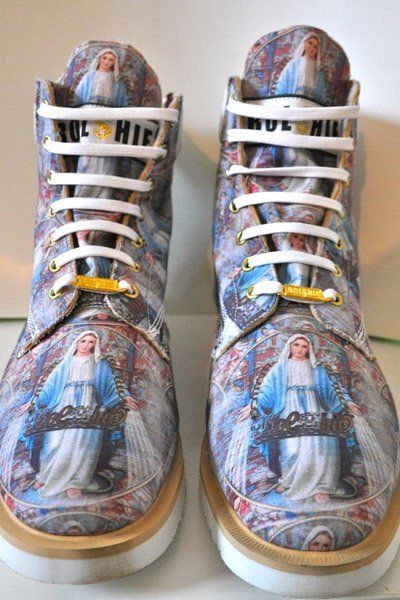
Yes, we do have plastic glow in the dark rosaries and those night lights you plug in where the plastic statue of the Blessed Mother lights up. But we also have the Pieta and the Sistine Chapel and Michelangelo and Caravaggio.

It’s true we have brutalist churches that look like a cross between a flying saucer and a parking garage, but we also have Chartres, St. Mark’s in Venice, Sainte-Chapelle, Notre Dame, St. Peter’s and Mont Saint-Michel.

This is the authenticity of the Catholic faith. It is universal. It has room for the peasant and the aristocrat, hoi polloi and high falutin’, the learned and the ignorant, the tasteful and the tacky, the sinner and the saint.

With that kind of tolerance, why would you ever reject Protestantism?

But Father Dwight insists he has standards:

“If I were choosing a church I liked I’d still be an Anglican. I didn’t become a Catholic because I liked the Catholic Church.” I retorted. “I became a Catholic because it’s the true Church.”

How would he know? Because the bishop with all the high end art told him?

You can’t argue this stuff up.

Just In Time for the 500th Anniversary of the Reformation

A papal crackdown:

For most of us, who are not Knights of Malta, the resignation of the group’s grand master will have little immediate impact. But the unprecedented papal intervention into the affairs of that venerable body fits into a pattern that should, at this point, worry all faithful Catholics. Under Pope Francis, the Vatican is systematically silencing, eliminating, and replacing critics of the Pope’s views.

During the reigns of Popes John Paul II and Benedict XVI, “progressive” Catholics frequently complained about a crackdown on theological dissent. On the rare occasions when the Congregation for the Doctrine of the Faith issued a warning about a wayward theologian’s published works, there were anguished warnings about a reign of terror at the Vatican. Now a crackdown really is occurring—instigated by the Pontiff who famously asked, “Who am I to judge?” And the objects of the current crackdown are not theologians who question established doctrines, but Catholics who uphold the traditional teachings of the Church.

The first and most prominent victim of the purge was Cardinal Raymond Burke, who was exiled from the Roman Curia soon after Pope Francis took office, and given a mostly ceremonial post as patron of the Knights of Malta. It is ironic—and perhaps not coincidental—that the latest incident involves his new charge.

As much as I admire and sympathize with conservative Roman Catholics (like Ross Douthat and the author of this piece, Phil Lawler), can such folks really complain about papal supremacy? Isn’t this what rule by one is supposed to look like (and why Americans love to talk about checks and balances)? In fact, as long as Rome depends on the Bishop of Rome to support its claims of superiority — unity, authority, antiquity — can devout Roman Catholics really object to popes who use their authority to enforce unity?

Why Mencken Matters

He is a reminder that belief is not normal (to fallen human beings).

The reason for that aside is Regis Martin’s article about the stupidity of atheists (trigger warning for the w-w deniers):

…people do not arrive at atheism as a result of hours heuristically spent perusing the philosophical journals. That is because it is not a matter of the intelligence that compels one to choose disbelief, but a movement of the will. One would have to be pretty witless if, on the strength of a syllogism, one were to conclude that there is no God. An atheist can no more eliminate God’s existence by his refusal to believe than a blind man can by his inability to see expel the sunlight. “The essence of God does indeed lie beyond the scope of intelligence,” Fr. Murray freely concedes, “but his existence does not.” And not to know at least that much, “is to nullify oneself as a man, a creature of intelligence.” Because belief in God is, very simply, the bedrock truth upon which everything else depends. To think otherwise, he argues, amounts to “a miserably flat denouement to the great intellectual drama in whose opening scene Plato appeared with the astonishing announcement that launched the high action of philosophy—his insight that there is an order of transcendent reality, higher than the order of human intelligence and the measure of it, to which access is available to the mind of man.”

In which case, we should never trust an atheist or unbeliever with any sort of responsibility (and we should live in a Christendom because only God-affirmers have the bedrock for truth).

But what if faith is not natural? What if philosophical inquiry and logical deduction still don’t make a man or woman believe? What if, get this, Paul was right?

28 And since they did not see fit to acknowledge God, God gave them up to a debased mind to do what ought not to be done. 29 They were filled with all manner of unrighteousness, evil, covetousness, malice. They are full of envy, murder, strife, deceit, maliciousness. They are gossips, 30 slanderers, haters of God, insolent, haughty, boastful, inventors of evil, disobedient to parents, 31 foolish, faithless, heartless, ruthless. 32 Though they know God’s righteous decree that those who practice such things deserve to die, they not only do them but give approval to those who practice them. (Romans 1)

Imagine that: Reformed Protestants take atheists more seriously than Roman Catholics because of the doctrine of total depravity. If you start with the reality that all people are lost in their trespasses and sins, that their minds are “darkened” as a result, you set your expectations of unbelievers accordingly. But if you look at faith as the bedrock of understanding the world (think w-w), and you need to trust your neighbors not to do irrational things, then you are going to attribute belief in God to them (and meanwhile deny total depravity).

Mencken matters because he’s proof that unbelievers are smart, and that the Holy Spirit is more powerful than reason in giving people faith in Jesus Christ as their savior.

How Theological Liberalism Wins

First, you have the traditionalists:

I think you can see Professor Esolen’s essay as reflecting the long-term concerns of one group, in particular: Catholic faculty members who share a particular vision of the college’s mission. They assume that our Catholic identity should be at the center of everything we do, and they look to the long history of Catholic tradition, including recent documents like Pope St. John Paul II’s Ex Corde Ecclesiae, as crucial.

This group of faculty, in which I include myself, are worried. To put it simply, they don’t want to see Providence College join other religious universities who have moved away from their religious foundation. (Jim Burtchaell’s The Dying of the Light chronicles this phenomenon.)

Second, you have the social justice warriors:

Another group immediately involved here are some of the people who tend to fall on the margins in our community-and also those supporting them. They have serious concerns about systemic forms of exclusion. (And here, too, are a number of concerns that I myself share.)

They can see, for example, that Providence College’s 100-year history includes almost nothing of the African-American experience, or of Hispanic culture and tradition. In the last few years, the college has made a concerted effort to recruit more students, faculty, and staff from underrepresented groups, but frankly, it hasn’t always succeeded in offering needed support once they arrive.

For all those who are part of this second group, their frustrations are also part of a larger story: longstanding exclusion and unjust mistreatment of marginalized people. And, it’s important to say, some of these folks would also note that their concerns are prompted by Catholic commitments, beginning with a recognition of the dignity of every human being.

Third, you notice that tradition doesn’t get you satisfaction social justice.

Esolen’s essay was read as opposition to individuals, and, by extension, as disregard for the specific cultural realities they represent. Unfortunately, the essay’s polemical tone contributed to that reading, especially once the editor had framed the whole piece with a headline that was pure clickbait.

When a number of people voiced criticism of the essay, the president responded with his own critique in a campus-wide email, and the executive vice president reported the impact of the essay as “implicitly racist” in another campus-wide email. In the end, these official responses then confirmed fears of that first group of faculty that questioning the way that diversity is being conceived and pursued means you’ll be cut off at the knees.

Fourth, you see that lots of people outside the faith also want social justice.

Finally, you conclude either that those non-believers are really on the side of the faith, or that justice is as or more important than doctrine for real Christianity.

That means reversing what Paul wrote. Instead of “If in Christ we have hope in this life only, we are of all people most to be pitied,” you now say, “If in Christ we have hope for resurrected life only, we are of all people most to be pitied.”

When You’re In the Business of Righteous Politics, It’s Hard to See the Beam in Your Own Eye

The BeeBee’s don’t seem to care for Kenneth Woodward’s complaint about the Democrats’ politics of righteousness, but the former religion editor for Newsweek and ongoing Roman Catholic makes a lot of sense. Who knew the Democrats were the Moral Majority before Jerry Falwell formed the Moral Majority?

The party’s alienation from the white working class began in the streets of Chicago outside the 1968 Democratic National Convention. There, antiwar protesters and activists for a host of countercultural causes fought the police of Mayor Richard J. Daley while the nation watched on television. As President Bill Clinton later observed in the first volume of his memoirs, Vietnam was only one point of contention in what was really a wider clash between generations, social classes and moral cultures:

“The kids and their supporters saw the mayor and the cops as authoritarian, ignorant, violent bigots. The mayor and his largely blue-collar police force saw the kids as foul-mouthed, immoral, unpatriotic, soft, upper-class kids who were too spoiled to appreciate authority, too selfish to appreciate what it takes to hold a society together, too cowardly to serve in Vietnam …”

The 1968 convention marked the end of the New Deal coalition that had shouldered Franklin Roosevelt, Harry Truman, John F. Kennedy and Lyndon B. Johnson to the White House. It wasn’t that white working-class Americans turned away from the party so much as that political reformers representing the young, the newly wealthy, the suburban and the higher educated deliberately cut party ties with them. “Boss” Daley, the authoritarian Irish Catholic mayor from the blue-collar Bridgeport neighborhood, became the poster boy for all that was “bigoted” and socially regressive in neighborhood-based, white ethnic America.

The new era

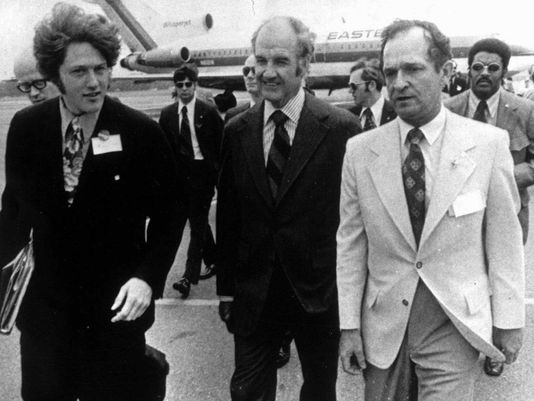
Over the next four years, a commission on party structure and delegate selection, with Sen. George McGovern as chairman, introduced a series of reforms ensuring that, culturally as well as politically, the delegates to the 1972 Democratic convention would resemble the young activists who had battled the police in Chicago more than delegates who had been seated inside. The McGovern Commission, as it came to be called, established state primaries that, in effect, abolished the power of the old city and state bosses, most of whom came from white ethnic stock. The commission also established an informal quota system for state delegations to assure greater representation of racial minorities, youths and women that by 1980 became a mandate that half of every state delegation must be women.

The 1972 Democratic platform formally introduced the party’s commitment to identity politics. Rejecting “old systems of thought,” the platform summoned Democrats to “rethink and reorder the institutions of this country so that everyone — women, blacks, Spanish speaking, Puerto Ricans, Native Americans, the young and the old — can participate in the decision-making process inherent in the democratic heritage to which we aspire.” There was also this: “We must restructure the social, political and economic relationships throughout the entire society in order to ensure the equitable distribution of wealth and power.” The delegates put flesh on these lofty moral commitments by adding a plank commending the forced busing of students in order to achieve racial balance in public schools. Blue-collar Boston exploded.

McGovern naively took for granted the traditional party loyalty of union leaders and the white working class. But these pillars of the New Deal collation recognized that McGovern’s creation of a new “coalition of conscience” built around opposition to the war, identity politics and a redistribution of wealth excluded some of their own conscientiously held moral convictions. McGovern went on to lose every state but Massachusetts and the District of Columbia — and with them the party allegiance of blue-collar workers, union leaders and — what often amounted to the same voters — conservative Roman Catholics.

Jimmy Carter was not a member of McGovern’s coalition of conscience: He had his own powerful sense of moral righteousness, one he derived from his Southern Baptist heritage of personal rectitude rather than McGovern’s secularized Methodist heritage of moral uplift and social reconstruction. There was much in that mix that was admirably righteous, especially the instinct to protect racial and sexual minorities from social oppression. The problem is that pursuing righteousness by expanding individual rights at the expense of communal values often creates greater social conflict. As sociologist Robert Bellah argued in 1991, “rights language itself offers no way to evaluate competing claims.” One side wins, the other loses.

Shazzam! You mean that entering the public square with the certainty that you are pursuing holiness and your opponents are depraved is bad for The Union? You mean “I’m right and you’re wrong” is divisive? Who knew? (Actually, most married couples do.)

Make It Stop

Yet another conversion account with these un-Francis like asides from a former Dutch Calvinist:

I also realized that there was actually no real Protestant faith in itself. The Protestant faith was founded on a protest against a faith, the Catholic Faith. Why would I ever want to part of a “church” that was actually no church at all; one that was racked by division and founded on protest!

The blindness that had always covered me was now gone. I saw that there were countless Protestant denominations, and that they all disagreed with each other on at least one important point of doctrine. This defied the very nature of Truth itself, and rendered all of them imperfect. I finally saw that there must be an authority to clear the air, which I now understand is the See of Peter.

But these questions soon evaporated into joy:

Towards the end of the Vigil, when I saw a number of people receiving their First Sacraments, I knew God was calling me to do the same thing. Mother Church was opening her arms out to me, and even though I knew many crosses would come my way if I ran to Her, I could not resist Her love. Family members of mine would shun me, professors would shake their heads as I had received prestigious scholarships in the Reformed Theology department, my future would be so uncertain, and friends would laugh, but it didn’t matter anymore.

Why doesn’t the fine print of conversion include mention of a stop in purgatory?

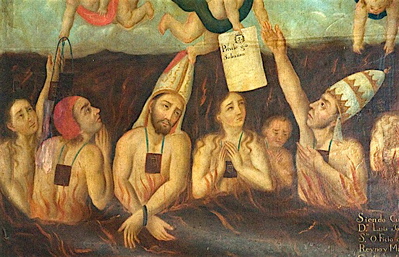
Purgatory (Lat., “purgare”, to make clean, to purify) in accordance with Catholic teaching is a place or condition of temporal punishment for those who, departing this life in God’s grace, are, not entirely free from venial faults, or have not fully paid the satisfaction due to their transgressions.

The faith of the Church concerning purgatory is clearly expressed in the Decree of Union drawn up by the Council of Florence (Mansi, t. XXXI, col. 1031), and in the decree of the Council of Trent which (Sess. XXV) defined:

“Whereas the Catholic Church, instructed by the Holy Ghost, has from the Sacred Scriptures and the ancient tradition of the Fathers taught in Councils and very recently in this Ecumenical synod (Sess. VI, cap. XXX; Sess. XXII cap.ii, iii) that there is a purgatory, and that the souls therein are helped by the suffrages of the faithful, but principally by the acceptable Sacrifice of the Altar; the Holy Synod enjoins on the Bishops that they diligently endeavor to have the sound doctrine of the Fathers in Councils regarding purgatory everywhere taught and preached, held and believed by the faithful” (Denzinger, “Enchiridon”, 983).

Further than this the definitions of the Church do not go, but the tradition of the Fathers and the Schoolmen must be consulted to explain the teachings of the councils, and to make clear the belief and the practices of the faithful.

Temporal punishment

That temporal punishment is due to sin, even after the sin itself has been pardoned by God, is clearly the teaching of Scripture. God indeed brought man out of his first disobedience and gave him power to govern all things (Wisdom 10:2), but still condemned him “to eat his bread in the sweat of his brow” until he returned unto dust. God forgave the incredulity of Moses and Aaron, but in punishment kept them from the “land of promise” (Numbers 20:12). The Lord took away the sin of David, but the life of the child was forfeited because David had made God’s enemies blaspheme His Holy Name (2 Samuel 12:13-14). In the New Testament as well as in the Old, almsgiving and fasting, and in general penitential acts are the real fruits of repentance (Matthew 3:8; Luke 17:3; 3:3). The whole penitential system of the Church testifies that the voluntary assumption of penitential works has always been part of true repentance and the Council of Trent (Sess. XIV, can. xi) reminds the faithful that God does not always remit the whole punishment due to sin together with the guilt. God requires satisfaction, and will punish sin, and this doctrine involves as its necessary consequence a belief that the sinner failing to do penance in this life may be punished in another world, and so not be cast off eternally from God.

Venial sins

All sins are not equal before God, nor dare anyone assert that the daily faults of human frailty will be punished with the same severity that is meted out to serious violation of God’s law. On the other hand whosoever comes into God’s presence must be perfectly pure for in the strictest sense His “eyes are too pure, to behold evil” (Habakkuk 1:13). For unrepented venial faults for the payment of temporal punishment due to sin at time of death, the Church has always taught the doctrine of purgatory.

Can you really be so happy about the uncertainty that awaits 99.9% of those who have to make, grace-assisted of course, satisfaction for their sins? If perfection is necessary, how can the imperfect ever be perfect? Protestantism may seem like a legal fiction. But Rome’s fiction is moral. Alien righteousness matters and this convert doesn’t seem to know that her welcoming mother church not only rejects but condemns such teaching.

Who shall ascend the hill of the LORD?
And who shall stand in his holy place?
He who has clean hands and a pure heart,
who does not lift up his soul to what is false
and does not swear deceitfully.
He will receive blessing from the LORD
and righteousness from the God of his salvation. (Psalm 24:3-5 ESV)