Giving Credit Where It’s Due

Sure, we’ve heard lots about how evangelicals overwhelmingly voted for Donald Trump and then the after-doom and gloom of evangelical leaders considering turning in their born-again credentials. But it turns out the really decisive demographic in the election was Roman Catholics (from one of our southern correspondents):

You only think you know what won the election for Donald Trump.

Hillary’s corruption? The betrayal of the American Dream? Vladimir Putin? Wrong. Wrong. Wrong. Let me tell you the real story, and the person behind it.

Elections are won by the marginal voter, the swing voter, the guy right at 50 percent. And in American politics he’s generally a Catholic. That’s the story this time, too.

It wasn’t the white Evangelicals. They went overwhelmingly for Trump, but that was also true in 2012 when they weren’t even sure Romney was Christian. They aren’t the swing voters.

Catholics, on the other hand, were plus-2 for Obama in 2012 and plus-7 for Trump this year. Evangelicals helped Trump in states he was mostly going to win anyway. Catholics? Now we’re talking about Pennsylvania, Ohio, Michigan and Wisconsin. And that was the election.

It nearly didn’t happen. Trump’s outreach people were tone-deaf about Catholic voters. They were putting their eggs in baskets marked Evangelicals, African-Americans and Hispanics. Catholics were of secondary importance.

But one Catholic leader, Deal Hudson, didn’t believe this, and he single-handedly organized a big-name Catholic Advisory Committee, a conference call with state campaign directors, a conference call between Trump and Catholic leaders, a tweet and video from Trump when Mother Teresa was canonized and an interview with Trump on the Catholic EWTN television network.

Meanwhile, the liberal press ran stories about how Catholics hated Trump and bishops condemned Trump’s immigration rhetoric. As for the Catholic intellectuals, they mostly went full-bore NeverTrump (with some honorable exceptions, such as Jim Piereson and Roger Kimball).

You mean all those stories about evangelical voters were fake? The wrong narrative?

Fundamentalist Controversy Redux

John Allen explains how Roman Catholicism has come along side Protestantism. The Left and Right aren’t even on the same page of what constitutes truth:

… at this point most defenders of Pope Francis haven’t accused critics of being dissenters, nor have they suggested that people who uphold contrary positions on the substantive positions associated with the pontiff, such as opening Communion to divorced and civilly remarried Catholics, are thereby committing heresy.

The implication seems to be that fans of the pope are more generous, less vicious, and less inclined to question people’s bona fides as Catholics. There is, in other words, often a presumption of moral superiority in the observation that “we don’t talk that way.”

Simply as a descriptive matter, that proposition seems a bit disingenuous. Many in the pro-Francis camp don’t invoke concepts such as “heresy” and “dissent,” because frankly, it’s not the worst insult they can think of with which to slur an opponent.

Instead, they use terms that Francis himself also regards as abhorrent, such as “rigid,” “inflexible,” “legalistic,” “clerical,” and, of course, worst of all, “anti-Vatican II.”

In effect, what’s on display here is one of the defining differences between the Catholic left and the Catholic right over the last fifty years.

For the right, “heresy” and “dissent” are about the worst things imaginable, so when they want to say “x is terrible,” that’s the language that comes naturally. For the left, the equivalent horror is “rolling back the clock” on the Second Vatican Council, so when they want to call something or someone awful, that tends to be the verbal packaging in which the complaint comes wrapped.

Someone trying to remain objective about today’s debates would probably have a hard time concluding that either side has a claim on the moral high ground, since both are charging the other with virtually the vilest crime in their respective vocabularies.

At the same time, gatekeepers like John Allen don’t see when modernism is part of the warp and woof of church life:

Despite challenges intolerance brings, Camilleri stressed that religion, Christianity included, has an endless capacity for good, not only for individuals and communities, but for society as a whole.

The Church, he said, “does not pretend…to substitute for politics. Nor does the Church claim to offer technical solutions to the world’s problems since the responsibility of doing that belongs elsewhere.”

What religion does, then, is offer specific guidelines to both the community of believers, and to society as a whole.

Religion by its nature “is open to a larger reality and thus it can lead people and institutions toward a more universal vision” and a “horizon of fraternity” capable of enriching humanity, Camilleri said.

The Holy See, then, “is convinced that for both individuals and communities the dimension of belief can foster respect for fundamental freedoms and human rights, support democracy and rule of law and contribute to the quest for truth and justice.”

Dialogue and partnerships between religions and with religions, he said, “are an important means to promote confidence, trust, reconciliation, mutual respect and understanding as well as to foster peace.”

If religion did all that, I’m sure President Obama would have gotten on board. Wait. He did:

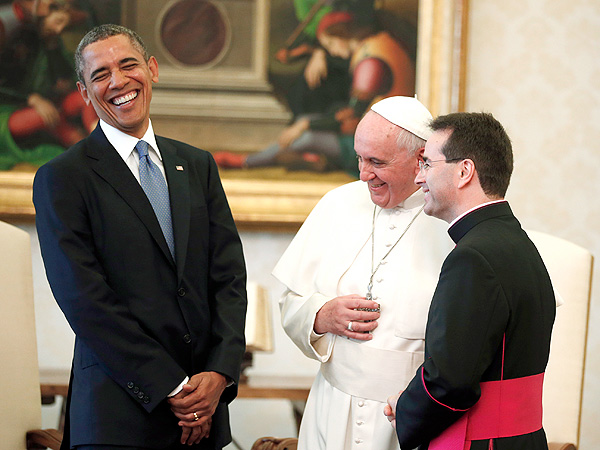
Holy Father, your visit not only allows us, in some small way, to reciprocate the extraordinary hospitality that you extended to me at the Vatican last year. It also reveals how much all Americans, from every background and every faith, value the role that the Catholic Church plays in strengthening America. (Applause.) From my time working in impoverished neighborhoods with the Catholic Church in Chicago, to my travels as President, I’ve seen firsthand how, every single day, Catholic communities, priests, nuns, laity are feeding the hungry, healing the sick, sheltering the homeless, educating our children, and fortifying the faith that sustains so many.

And what is true in America is true around the world. From the busy streets of Buenos Aires to the remote villages in Kenya, Catholic organizations serve the poor, minister to prisoners, build schools, build homes, operate orphanages and hospitals. And just as the Church has stood with those struggling to break the chains of poverty, the Church so often has given voice and hope to those seeking to break the chains of violence and oppression.

And yet, I believe the excitement around your visit, Holy Father, must be attributed not only to your role as Pope, but to your unique qualities as a person. (Applause.) In your humility, your embrace of simplicity, in the gentleness of your words and the generosity of your spirit, we see a living example of Jesus’ teachings, a leader whose moral authority comes not just through words but also through deeds. (Applause.)

You call on all of us, Catholic and non-Catholic alike, to put the “least of these” at the center of our concerns. You remind us that in the eyes of God our measure as individuals, and our measure as a society, is not determined by wealth or power or station or celebrity, but by how well we hew to Scripture’s call to lift up the poor and the marginalized — (applause) — to stand up for justice and against inequality, and to ensure that every human being is able to live in dignity –- because we are all made in the image of God. (Applause.)

You remind us that “the Lord’s most powerful message” is mercy. And that means welcoming the stranger with empathy and a truly open heart –- (applause) — from the refugee who flees war-torn lands to the immigrant who leaves home in search of a better life. (Applause.) It means showing compassion and love for the marginalized and the outcast, to those who have suffered, and those who have caused suffering and seek redemption. You remind us of the costs of war, particularly on the powerless and defenseless, and urge us toward the imperative of peace. (Applause.)

Holy Father, we are grateful for your invaluable support of our new beginning with the Cuban people — (applause) — which holds out the promise of better relations between our countries, greater cooperation across our hemisphere, and a better life for the Cuban people. We thank you for your passionate voice against the deadly conflicts that ravage the lives of so many men, women and children, and your call for nations to resist the sirens of war and resolve disputes through diplomacy.

You remind us that people are only truly free when they can practice their faith freely. (Applause.) Here in the United States, we cherish religious liberty. It was the basis for so much of what brought us together. And here in the United States, we cherish our religious liberty, but around the world, at this very moment, children of God, including Christians, are targeted and even killed because of their faith. Believers are prevented from gathering at their places of worship. The faithful are imprisoned, and churches are destroyed. So we stand with you in defense of religious freedom and interfaith dialogue, knowing that people everywhere must be able to live out their faith free from fear and free from intimidation. (Applause.)

And, Holy Father, you remind us that we have a sacred obligation to protect our planet, God’s magnificent gift to us. (Applause.) We support your call to all world leaders to support the communities most vulnerable to changing climate, and to come together to preserve our precious world for future generations. (Applause.)

Your Holiness, in your words and deeds, you set a profound moral example. And in these gentle but firm reminders of our obligations to God and to one another, you are shaking us out of complacency. All of us may, at times, experience discomfort when we contemplate the distance between how we lead our daily lives and what we know to be true, what we know to be right. But I believe such discomfort is a blessing, for it points to something better. You shake our conscience from slumber; you call on us to rejoice in Good News, and give us confidence that we can come together in humility and service, and pursue a world that is more loving, more just, and more free. Here at home and around the world, may our generation heed your call to “never remain on the sidelines of this march of living hope.”

For that great gift of hope, Holy Father, we thank you, and welcome you, with joy and gratitude, to the United States of America. (Applause.)

Where Will Converts Send Their Children to College?

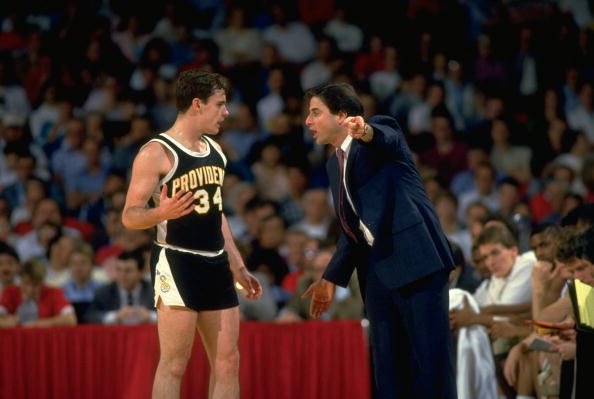
It probably won’t be Providence College where the conservative Roman Catholic professor, Anthony Esolen, is down for the count:

… when Prof. Esolen authored an article arguing, in his own inimitable style with his usual exuberant and evocative prose, that his institution had adopted a wrong-headed attitude toward “diversity,” one might have hoped that anyone who disagreed with his position would respond in a way worthy of the deepest traditions of any academic community: a thoughtful written response, laying out evidence, supplying facts, adducing arguments, contesting premises, disputing inferences, or perhaps merely appealing for a different set of perspectives.

Instead, Esolen’s argument was greeted with the academic equivalent of a loud, disapproving grunt, expressed in its commonest contemporary form: the planned creation by a faculty member of a “totally spontaneous” mob to march across campus, disrupting classes with chants and a bullhorn, until they reached the president’s office where they ceremoniously presented “their demands.” I say “ceremoniously” because representatives of this group had met with the president the night before to discuss their grievances, so he was quite clear on their wishes already. The march to present “demands” was simply a bit of planned political theater to make noise during classes the next day.

Why doesn’t the vaunted intellectual tradition of the western church prevent episodes like this? After all, lots of Roman Catholic intellectuals have rallied to Esolen’s side:

George, himself a faithful Catholic who writes from an orthodox perspective, contrasted Esolen’s treatment at Providence with Princeton hiring him, granting him tenure, installing him in one of its most celebrated endowed chairs and allowing him to create the James Madison Program in American Ideals and Institutions.

Wrote George, “If Princeton University — a secular institution the vast majority of whose faculty and administrators and many of whose students are ideologically on the left — can welcome the contributions of someone whose convictions are in line with the moral teachings of the Catholic Church (even when those teachings fly in the face of left-liberal orthodoxies) why can’t Providence College — a Catholic institution — welcome the contributions of an exceptional Catholic scholar such as Anthony Esolen?”

Meanwhile, Notre Dame professors Francesca Aran Murphy and Patrick J. Deneen have written a letter to Father Shanley, calling upon him to reframe the discussion of diversity in such a way that Esolen’s individuality as a scholar is respected and honored.

“Professor Esolen’s attempt to open a dialogue about the meaning of diversity and of its place within a Catholic and Dominican college has been greeted with a formal defense of his academic freedom, but a deeper implicit repudiation of the legitimacy of the questions he has raised,” wrote Murphy and Deneen, who added that they found it “alarming” that Esolen had been treated “in a dismissive manner by the administration.”

The letter has been signed by more than 100 scholars and observers across the country, including Ambassador Mary Ann Glendon of Harvard Law School; R.R. Reno, editor of First Things; and Ryan T. Anderson, the William E. Simon Senior Research Fellow at the Heritage Foundation.

Situations like this make a lot more sense if you conclude that the church’s institutions have accommodated themselves to modern academic standards (read modernism) and fail to uphold church teaching. This is what happens after the Land of Lakes Statement and university officials (some of them bishops) don’t pay attention to papal directives. What doesn’t make sense is all the hype of Bryan and the Jasons. Why don’t the converts reflect on the parallels between Roman Catholic and mainline Protestant higher education in the United States the way James Burtchaell did?

How to Redeem Christmas

Let Protestants have it.

Thomas (nee Tommy) Kidd’s review of Christmas in the Crosshairs notices that not until Protestants took up the cause of December 25, the holiday became safe for the women and children.

Before 1800:

In the medieval era, Christmas became a fixture of Catholic festive culture, which sometimes featured drunken celebrations and “social inversions” such as the “Feast of Fools” and “Feast of the Ass” (that is, the donkey that carried Mary). These rites made Christmas a prime target for many Reformers, who viewed them as an unbiblical “popish” riot. In the 1640s, the Puritan-dominated English Parliament banned Christmas and “all other festival days commonly called ‘Holy-days.’ ” A century and a half later, radical French revolutionaries renamed December 25 “dog day,” viewing citizens who stayed home from work as potential enemies of the secular regime.

Then English-speaking novelists saw an opening:

By 1800, Christmas was in bad shape, associated largely with working-class drunkenness and violence. But in the early 19th century, Christmas “revivalists” like Washington Irving and Charles Dickens began recasting it as a generically religious, culturally wholesome, and family-centered holiday. Clement Clarke Moore made perhaps the most significant contribution with his 1822 “Account of a Visit from St. Nicholas,” better known as “ ‘Twas the Night Before Christmas.” A friendly Santa Claus supplanted St. Nicholas’s traditional threats of wrath against disobedient children. Other menacing nocturnal visitors who had been fixtures of medieval Christmases, such as central Europe’s “Perchta the Disemboweller,” soon vanished before Santa’s kindly image. The gift-giving Santa also transformed Christmas into the merchants’ holiday par excellence.

As for me and my house, we’ll stick with Thanksgiving as the best holiday. Rule Americania!

You Cannot Argue with This

Nor does it redound to the great intellectual tradition.

It is Father Dwight’s conversion narrative about the Immaculate Conception. He concedes that it is not an ancient dogma and that Thomas Aquinas “didn’t believe it.” But when an overweight priest told him, “We believe in the Immaculate Conception because the pope tells us to. Pass the fried chicken,” Longenecker knew his interlocutor was right.

Still, he needed to own the Immaculate Conception. Here is how he had a really, really personal relationship with Jesus:

I was traveling in Normandy in France. I wandered into Bayeaux Cathedral. As in most of the medieval cathedrals there were lots of little side chapels. I was pretty much the only person in the cathedral. I stopped in a little chapel and saw the finger bone of St Thérèse who had lived just down the road in Lisieux.

Then I stopped in another chapel and knelt to pray. I don’t know what I prayed — maybe the Rosary. I don’t know. I was caught up in prayer for some time. Then I walked out of the cathedral and the morning sun was bright and clear in the plaza outside, and I suddenly realized that I believed in the dogma of the Immaculate Conception. Then I also remembered who the little chapel was dedicated to in which I was praying. It was St. Bernadette — to whom the Blessed Virgin appeared and confided, “I am the Immaculate Conception.”

I no longer simply understood the dogma and the logic of it, but I saw the beauty of it and the wonder of the simple girl of Nazareth becoming the second Eve. As I realized I believed in the Immaculate Conception I also suddenly became more aware, in a deeper way — a way very difficult to articulate — of the reality and historical concreteness of the incarnation itself.

Suddenly Jesus Christ — Son of God and Son of Mary — was more real than he ever was before, and I also grasped why the Church requires this belief and does not allow it to remain a pious option.

It is because the Church wants us, through the Marian dogmas, to be introduced to Christ in a more real and powerful way.

Could this be the explanation for evangelical conversions to Rome? Too little doctrine, too much experience?

Instead of a Shrug, Concern

James Schall has a concern about Pope Francis’ apparently intentional ambiguity:

The “concern” is not so much to “prod” the good Holy Father into answering his mail. Others have tried this approach and failed. Rather it is to articulate the core “concern” that many normal people have about their Church under Pope Francis’ leadership. The Argentine pope certainly attracts crowds and generous media attention. He is seen kissing little babies, waving, smiling, and talking earnestly with almost anyone from scientists to politicians to mullahs and rabbis. We all recall his visit with the late Fidel Castro.

Pope Bergoglio has been on some twenty travels out of Italy and all over the known world. He dutifully attends to papal liturgical, diplomatic, bureaucratic, and ceremonial functions. At almost eighty, he seems full of energy and zest. He appears in public to enjoy being the pope. He even gets annoyed. He is human. The people he seems to like the least are practicing Catholics and the poor ecclesial bureaucrats who have to do all the thankless grunt jobs in the Church. He certainly has a good press. The crowds at papal audiences seem down, while observers do not yet detect any remarkable “Francis effect” in increased vocations, conversions, or Mass attendance.

But none of these issues seems to be what most concerns people. We are used to maintain that the principle of contradiction binds us to the truth of things. Catholicism is a religion that takes mind seriously. Revelation and reason do not contradict each other. These affirmations about reason and revelation indicate a certain confidence in our Catholicism. When spelled out, what the faith teaches makes sense in all areas. We can articulate what we are talking about without claiming that we grasp absolutely everything about the mystery of being. In fact, we claim that we do not understand everything in all its intelligibility. We do not confuse ourselves with the gods.

What we can figure out by ourselves makes sense also. We hold that what was revealed by Christ still holds and was intended to do so over time. Among these teachings and practices that were revealed was that of the consistency over time of the content of revelation.

Given Roman Catholicism’s understanding of reason and revelation, why put all of your eggs in the papacy basket? Schall’s understanding of Christian truth is one that Protestants share (mainly). His papalism does not follow in practice or theory:

In this tradition, the Jesuit theologians, Francisco Suarez and Robert Bellarmine, at least considered the problem of a hypothetical pope who did not affirm what had been explicitly handed down. In general, they held that a pope who might enunciate any heretical position would cease ipso facto to be pope. But this was an opinion. The one or two instances in the history of the Church, when a given pope did state something dubious, were usually considered, on examination, to be merely private opinions or not taught infallibly. So the consistency record over time is pretty impressive from that angle.

In this light, the “concern” that exists today is whether the promise to Peter that what Christ did and held would be kept alive in its fullness. The Church thus must avoid contradicting itself; that is, teaching one thing in one generation or area and its opposite in another. We are not concerned here with equivocation or impreciseness. If some pope did cross this line, we can at least suspect that he would not admit it or see the point. If he had the issue pointed out to him and saw its import, he would simply acknowledge what is the truth and be done with it. Otherwise, a drawn-out struggle would follow to decide who is right.

In other words, if reason and revelation are such (relatively) reliable guides, why then glom the bishop of Rome on top of such reliability? Does Father Schall really need the papacy’s help to tell what’s true or to be faithful to the truth? Or is the pope like the English monarchy, something you trot out when you need pomp and ceremony?

Own that great pretty good intellectual tradition.

That Was Then

Here‘s why the church excommunicated Luther almost five centuries ago:

1. Separation of justification from sanctification.
2. Extrinsic, forensic, imputed justification.
3. Fiduciary faith.
4. Private judgment over against ecclesial infallibility.
5. Rejection of seven deuterocanonical books.
6. Denial of venial sin.
7. Denial of merit.
8. Sola Scriptura and radically private judgment: “if we are all priests . . . why should we not also have the power to test and judge what is right or wrong in matters of faith?”
9. Denial that the pope has the right to call a council.
10. Only justified men can do good works.
11. Denial of the sacrament of ordination.
12. Denial of exclusively priestly absolution. Anyone in the Christian community can grant absolution.
13. God has not instituted the office of bishop.
14. God has not instituted the office of the papacy.
15. Priests have no special, indelible character.
16. Temporal authorities have power over the Church; even bishops and popes: “The pope should have no authority over the emperor”.
17. Vows of celibacy are wrong and should be abolished.
18. Denial of papal infallibility.
19. Unrighteous priests or popes lose their authority.
20. The keys of the kingdom were not just given to Peter.
21. Private judgment of every individual to determine matters of faith.
22. Denial that the pope has the right to confirm a council.
23. Denial that the Church has the right to demand celibacy of certain callings.
24. God has not instituted the vocation of monk
25. Feast days should be abolished.
26. Fasts should be strictly optional.
27. Canonization of saints is thoroughly corrupt and should stop.
28. Confirmation is not a sacrament.
29. Indulgences should be abolished.
30. Dispensations should be abolished.
31. Philosophy (Aristotle as prime example) is an unsavory, detrimental influence on Christianity.
32. Transubstantiation is “a monstrous idea.”
33. The Church cannot institute sacraments.
34. Denial that the Mass is a good work.
35. Denial that the Mass is a true sacrifice.
36. Denial of the sacramental notion of ex opere operato.
37. Denial that penance is a sacrament.
38. Assertion that the Catholic Church had “completely abolished” the practice of penance.
39. Claim that the Church had abolished faith as an aspect of penance.
40. Denial of apostolic succession.
41. Any layman who can should call a general council.
42. Penitential works are worthless.
43. The seven sacraments lack any biblical proof.
44. Marriage is not a sacrament.
45. Annulments are a senseless concept and the Church has no right to grant them.
46. Whether divorce is allowable is an open question.
47. Divorced persons should be allowed to remarry.
48. Jesus allowed divorce when one partner committed adultery.
49. The priest’s daily office is “vain repetition.”
50. Extreme unction is not a sacrament (the only two sacraments are baptism and the Eucharist).

What about now?

If Lutheran teachings and practices don’t result in excommunication today, it likely has something to do with situations like this:

“Life is full of ambiguity”, Cardinal Cupich said, but the “important thing is to bring an attitude of discernment to a situation.” He then referred to a “wonderful article” by Professor Rocco Buttiglione in L’Osservatore Romano some months ago, “who situated historically that document in terms of the ongoing development of the teaching of the Church.” (Professor Buttiglione’s essay has since been refuted).

He ended by saying “there are enough voices out there in which the Holy Father doesn’t have to in any way have to defend a teaching document of the Church. It’s up to those who have doubts and questions to have conversion in their lives.”

Controversial passages never passed

But defenders of the Dubia argue that Cardinal Cupich’s comment that the controversial propositions in question were “voted on by two-thirds of the bishops” is especially problematic.

It is often forgotten, they point out, that despite the strenuous efforts by the Synod secretariat and others to manipulate and jostle the synod fathers into accepting the most controversial propositions (allegations detailed in my book The Rigging of a Vatican Synod?), none of the three most controversial propositions managed to obtain a two-thirds majority during the first, Extraordinary Synod on the Family, in October 2014.

One of them was a proposition relating to the “Kasper proposal” of admitting the divorced and remarried to holy Communion after a period of penitence. That failed to pass, and only a proposition calling for “careful reflection and respectful accompaniment” of remarried divorcees made it through.

Under such circumstances, they would normally therefore have been rejected.

In spite of this, the Pope controversially broke with custom, which he can do, and authoritatively insisted that all three rejected proposition be kept in the document, thereby enabling them to be carried over into the working document for the Ordinary Synod on the Family the following year.

Not to worry, the more ambiguity, the more it’s the church Christ founded. If only the consequences for souls dependent on faithful ministers of the gospel and reliable expositors of sacred mysteries were so ambiguous.

The Worse, the Better

It’s an odd argument, but in the Pope Francis era it seems to be more prevalent. It runs something like this:

He’s a lousy husband, angry, selfish, a slob, and abusive, but that makes him the husband God gave me all the more.

He’s a terrible employee — late for meetings, lies to customers, refuses to adhere to company policies, but he’s the co-worker God gave me.

He’s an awful king — he suspended habeus corpus, requires citizens to hostile to hostile and uncivil soldiers, forces us to pay taxes without giving us a voice in tax policy — but he’s the king God gave us.

And so, when it comes to the church, the fact that an institution so bad has existed so long is proof that it is the institution Christ founded.

For instance:

In the satirical writings, dialogues, of the 14th c. Italian author Boccaccio there is story about a Jew who has to go to Rome for something. The local Bishop has been trying to get the Jew to convert the Christianity. Knowing the Jew was about to see the Church at its worst in Rome, the corruption and moral turpitude of many of the clerics and religious, even Popes like the Borgias, the Bishop despaired that the Jew would ever covert on his return. However, once returned from his trip, the Jew went to the Bishop and said, “I’m ready to convert now!” The Bishop, flabbergasted, replied, “You went to Rome and you saw how horrid things were there… and you still want to join this Church?” “Yes”, said the Jew. “I figure that with so many wicked and corrupt people hard at work trying to destroy the Church, it shouldn’t have lasted 14 years, much less 14 centuries. It has to be of divine origin!”

Or again:

It was exhilarating, that moment when it hit me: “I’m going to become Catholic.” But as I experienced more of the modern church, and began RCIA, Patrick Coffin’s greeting to converts, “Come on in! It’s a mess,” started to make sense.

So did the words of Hilaire Belloc, which no longer seemed merely witty:

The Catholic Church is an institution I am bound to hold divine but for unbelievers a proof of its divinity might be found in the fact that no merely human institution conducted with such knavish imbecility would have lasted a fortnight.

Even more:

Worrying about the daily confusion and sorrow Pope Francis introduces into our lives can impede us from working on our first priority—which is living our Catholic life in Christ as fully as we possibly can. With only exceedingly rare exceptions, we are in no position to offer correction to the Holy Father. Therefore, it will do us little good to engage in endless arguments over what is wrong, whose fault it is, and how the problems posed by the current papacy might be resolved. And not only will this do us no good, but it can be a significant source of scandal to others, most of whom will have little or no awareness of the issues at stake.

I’d like to suggest that it is time to turn the corner on Pope Francis. Most of us have no cards to play in the game of improving the papacy. But we do have our own callings, our own God-given talents, our own opportunities to engage in the spiritual and corporal works of mercy, to teach the truth and to foster the good. When we can use something Pope Francis has said or done in our own Catholic service, then we should—all the better! But when we cannot take our inspiration from Pope Francis, we can still reference Our Lord and the Church He founded. We do not need to come up against Francis and grind to a halt. That’s what I mean about turning the corner.

I do not presume to know papal theory well, but am aware that reservations about papal authority were much more substantial in the Middle Ages than they are in the post-Vatican I church where infallibility is now dogma. In fact, important medieval philosophers like Marsilius of Padua and William of Ockham (does that make me Darryl of Hart?) made arguments against the tyranny of the papacy that would seem to be relevant for Roman Catholics today.

But the apologetic that the deficiencies of the church only prove its necessity and durability defy Thomistic logic no matter how tight the syllogisms are under Bryan and the Jasons Kangol cap.

Here’s why: if the church is deficient, how do you then know that its truth claims are not also deficient?

Because the reality remains: She is the bride of Christ, and the Truth is found nowhere but in Her. Conversion to the one true faith remains the greatest, most life-altering decision a person can make—even if things are a bit of a mess.

In point of fact, the truth about conditions in the church come almost entirely from sources external to the magisterium, which sort of pokes a hole in those audacious (warning, Bryan Cross has removed the article about Papal Audacity) claims about the magisterium’s infallible protection of the truth.

Root Root Root for the Home Team

A return to Called to Communion led me to a review of Rodney Stark’s book, Bearing False Witness: Debunking Centuries of Anti-Catholic History. Surprise, surprise, Casey Chalk finds the book valuable (even if his encouragement leans more heavily on faith than reason):

I have examined only two of the ten topics Stark addresses in this review of the historical data regarding a number of contentious issues pertaining to Catholic history. Readers will likely find all the chapters worthy of attention, including those on anti-Semitism (think “Hitler’s Pope”), the Dark Ages (did the Church seek to limit intellectual development?), slavery (how complicit was the Church in New World chattel slavery?), and Protestant Modernity (Weber’s “Protestant work ethic” thesis mentioned above). Stark has done the Catholic Church a great service in presenting a thorough dismantling of many anti-Catholic narratives, as well as offering analysis as to how and why this happened (the answer, in Stark’s review of the history of historians, is overt anti-Catholic bigotry). Even those outside the parameters of the Catholic Church should welcome this study, as it enables us to move beyond the usual sniping characteristic of so many church history debates, and pursue a more thorough, historically faithful ecumenical dialogue.

Have historians engaged in excess? Sure. But pointing that out does not right the wrongs committed by the Roman Catholic Church or its followers. As Eric Smith pointed out in his blog post/review, apologists like Chalk still have some ‘splainin’ to do:

Stark’s argument in many of them can be summarized as “it wasn’t as bad as you think.” Chapter 4: The dark ages weren’t as bad as you think. Chapter 5: The Crusades weren’t as bad as you think. Chapter 6: The Inquisition wasn’t as bad as you think. Chapter 7: The church’s anti-science views weren’t as bad as you think. Chapter 8: Slavery wasn’t as bad as you think. Even when Stark has good points to make (“dark ages” is a misleading and unhelpful category, the Inquisition wasn’t insatiably bloodthirsty always and everywhere, and the church opposed slavery at many points), the reader finds himself disagreeing with Stark, because of the questionable assumptions and poor evidence he brings to the table. He starts most chapters by building a straw man. He presents what he imagines is commonly held knowledge, and then proceeds to poke holes in the poor scarecrow. This is a compelling literary device, since it draws the reader into Stark’s indignation. “Everyone believes that the Catholic church loves slavery!” (I’m paraphrasing). “But it turns out that the Catholic church doesn’t love slavery! This is satisfying as an organizational structure, but it leaves out and excuses many instances in which the church was complicit, was turning the other way, was not keeping its hands clean. It obscures the actions of a few rogue individuals, which Stark almost always concedes while claiming that they didn’t stand for “official” church policy. This structure makes Stark read like an apologist for colonialism, slavery, violence, and ignorance–things I doubt he would claim for himself. And ultimately this book makes Stark read like an apologist for conservatism broadly construed, since somehow, the true enemy almost always seems to turn out to be liberals. (And Voltaire…Stark hates Voltaire). Examples of questionable claims could be multiplied from later chapters–Protestantism is most properly characterized by Max Weber’s work on capitalism, witches who were actually practicing magic probably had it coming, and the church was an innocent victim of the French Revolution–but this review is already too long.

All of which goes to the frequent claim made on behalf of Roman Catholicism by the apologists. It’s the oldest, most historic, church that Jesus founded. History is good! But when historical inquiry reveals aspects of church life less wholesome, then it’s the bias of historians. Is that anti-intellectual, anti-Enlightenment, anti-Protestant, anti-anti-Catholic? Whichever anti it is, it’s just as much a bias as anti-Catholicism is made out to be.

One way around the problem of church errors is to chalk them up to the limits of time and place. Did Roman Catholic officials treat Jews well in the thirteenth century? Not really, but who did? Given the possibilities of human imagination available at the time, to expect 13th-century Roman Catholics to think like moderns is anachronistic. They were creatures of their context and hard pressed to do any better.

But there’s the rub for the proponents of papal audacity. Isn’t the teaching of the magisterium about papal authority as much the creation of historical circumstance — the need for the Bishop of Rome to assert autonomy against European kings, or the collusion of European princes with the Bishop of Rome to outmaneuver a political rival — as the Fourth Lateran Council’s directives about Jews?

All the help of Aristotle’s logic or Aquinas’s scholasticism will not free Bryan and the Jasons from that riddle.

When the World Thinks Well of You

Chicago’s Mayor, Rahm Emanuel on Chicago’s Cardinal Blase Cupich:

What does he offer the city itself as a whole – you’re not Catholic yourself are you?

I’m Jewish. I would just add that his message, well obviously he’s speaking first and foremost to Catholic followers, has a universal value to it, one of tolerance and one of inclusion.

No modernism to see here (cue shrug), but that salt seems to have lost its flavor.