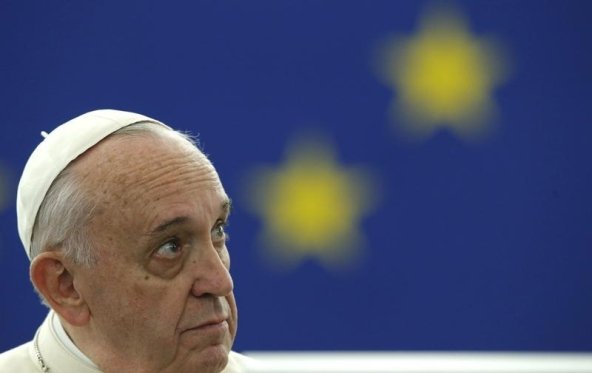
The Theology of Brexit

Massimo Faggioli reminds that Vatican II and the European Union are part of the same cultural moment:

The simultaneity of the Dublin conference and Brexit made me think about the tight relationship between development of Catholic theology (especially ecclesiology) in the 20th century and the development of Catholicism from multinational to truly internationalist/globalist. Catholic support for the European project after World War II (from Pius XII to the most important politicians of the Christian-Democratic parties governing Europe after 1945) was part of the transition from the nationalist, romantic roots of the theological ressourcement between the mid-19th century and the 1920s and ’30s. At Vatican II, Catholic theology internationalized what had been born as expressions of national movements during the previous century (adoption of the vernacular; the new role of national bishops’ conferences; anti- Curia sentiment; anti-capitalist, anti-democratic, and anti-liberal Catholic social movements, etc.). The internationalist quality of Pacem in terris and Gaudium et spes was a turning point in doctrine concerning the state and government in Catholic theology, and also a response to the most powerful internationalism of the second half of the century, Communism. At Vatican II, Catholicism became an advocate of globalization, which John XXIII had called in the opening speech of the council in 1962 “a new order of human relations.”

The ties between Vatican II and the EU are even closer in the minds of traditionalist Roman Catholics:

Brexit can be seen as a subset of the debate on Vatican II and the post-Vatican II period, at least among Catholics. It’s no secret that Catholics and the Catholic bishops of Britain were deeply divided over Brexit, and that for many conservative Catholics in Britain opposition to the EU and to Vatican II has similar roots. Traditionalist Catholics who today reject “the new order”—in terms of economic and social exclusion, as well as of the dominance of what Francis in Laudato si’ called “the technocratic paradigm”—tend to put Vatican II and the EU together in one category of internationalization and globalization; they choose a traditional, pre-global church and a nation-state (even though this fallback on the nation-state is for them theologically not unproblematic) as opposed to the larger framework of a globalized ecclesial context and a European political union. It is an opposition to a much more complex world, politically and theologically, and to the modern, globalized attitudes toward vulnerable life, marriage, family, subsidiarity, immigration, war, and peace. It is an opposition that puts back into question the Catholic perception of political power, and in particular the church’s perception of the sovereignty of the nation-state and of international/supranational institutions.

Meanwhile, Damon Linker notices aspects of Angela Merkel’s responsibility for the circumstances that led to Brexit that could also be applied to Pope Francis, perhaps the post-Vatican II pope that most embodies Vatican II:

Angela Merkel is the real catalyst behind the outcome of the UK referendum. Not only did the German chancellor insist on admitting well over a million refugees and migrants from the Greater Middle East into the heart of Europe. Supporters of the policy have also made it clear on numerous occasions that they consider racism and xenophobia to be the only possible grounds for opposing her stand.

From the standpoint of progressivism, this makes perfect sense. An open-door policy toward refugees and migrants fleeing unrest in the Levant and North Africa is obviously the only morally acceptable option. It shouldn’t matter whether those immigrants are Muslims, or if they’re Syrians or Libyans, skilled or unskilled, poor or middle class, literate or illiterate, eager to assimilate or convinced of the need to resist it, looking for freedom and pluralism or hoping to build an enclave of Sharia law within the West. And there’s certainly no reason to suspect that any of them might turn toward terrorism, now or a generation from now. They’re just placeless people — human beings in need of aid, comfort, and charity. That’s all that should matter.

Except that many millions of citizens in EU member countries don’t see it this way. It does matter to them, just as it also matters to them whether Turkey is eventually invited to join the union, and they don’t appreciate having their concerns about the ethnic, religious, linguistic, and economic character of their political communities dismissed as moral pathologies.

Nor do they care to have their religious institutions circumscribed by remote bishops and cardinals. Pre- or post-Vatican II, subsidiarity matters.
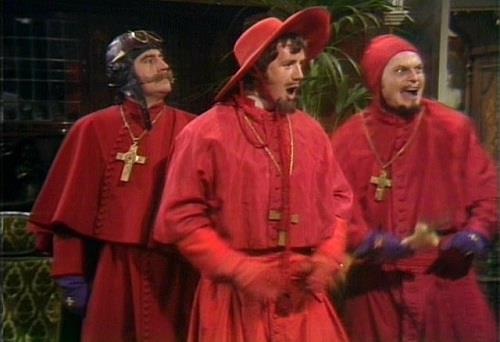
No One Expects the Puritan Witch Hunt

Some contemporary critics are debating whether Christians are experiencing something closer to a witch hunt or an inquisition. Turns out, the inquisition is worse:

By contrast, the purge of traditional Christians and Jews is a heretic hunt, an Inquisition, whose objective is to isolate and punish individuals who actually profess opinions contrary to the prevailing orthodoxy. There can be some overlap between an Inquisition and a witch-hunt, to be sure. But today’s liberal Inquisitors are not searching for individuals secretly in communion with God—yet.

This is a critical distinction. Witch-hunters eventually discover that burning a few old hags does not prevent cows’ milk from souring. Inquisitions, by contrast, usually succeed: The Catholic Church succeeded in stamping out broadly held heresies, as in the Albigensian Crusade of 1220-1229, which destroyed between 200,000 and 1,000,000 inhabitants of Cathar-controlled towns in Southern France. In many cases a town’s entire population was killed, just to make sure. For its part, the Spanish Inquisition eliminated all the Jews, Muslims, and Protestants, although it sometimes drove heretical opinions underground, with baleful consequences for the Catholic faith. (From David P. Goldman via Rod Dreher)

So, converts to Rome want to identify with all of THAT history? And were the glories of Christendom all that glorious?

But if you can defend that part of the church’s history, the recent past is easy peasy.

Tying Yourself Up In Knots

Yet another reminder of ecclesiastical superiority:

I am Catholic because Catholicism is true.

It is not a little true.

It is not some truth mixed with error; if I wanted that, I definitely wouldn’t be here. I am Catholic because the Catholic Church is the only place you will find the fullness of Truth. It is for Truth that I became a Catholic, and it is for Truth that I will die a Catholic.

So what’s a truth-affirming Roman Catholic supposed to do with the historical circumstances that reduce credibility, like the Index of Books?

The Index dated back to the Council of Trent, where the Council Fathers sought to protect the faith and morals of the Catholic population by preventing the reading of heretical and immoral books.

Even before that, at the Fifth Lateran Council and earlier, in the ninth century, the Church attempted to ban books which were considered inappropriate reading. And restrictions on the public’s right to read have been imposed, not only by the Catholic Church, but by the Puritans in the original American Colonies.

I remember first learning about the Index at my mother’s knee. In hushed tones she spoke of a neighbor, a woman who scorned the Church’s guidance and dared to read the banned books. At the same time, she raised an eyebrow at the thought that some might ignore the Catholic Legion of Decency’s “C” (Condemned) rating for films or its secular equivalent, the Hayes Code.

If the church has THE truth, and if it puts out an index on THE errors, then isn’t it odd that truth affirmers may now read error? The reaction to the Index on the anniversary of its abolition (that’s right) is mixed. According to Simcha Fisher:

“My take? The Index was a very bad thing, and it’s much more in keeping with a developed understanding of conscience for the faithful to make their own decisions about what to read…. At the same time, it would be a very good thing if the faithful had a clearer understanding that they do have a duty to make careful decisions about what to read.”

David Mills counters:

“…the idea of an index only sounds funny to us because we don’t think of ideas as dangerous. We recognise physical infections but not intellectual ones…. In that, the advantage goes to the men who invented the Index and kept it going. They took ideas seriously. They thought some ideas would poison you just like nicotine-filled smoke and that some people who might innocently indulge should be protected from poisoning themselves.”

Kathy Schiffer takes comfort from everyone doing it:

the truth is that censorship exists everywhere—and that frequently, those most determined to limit ideas are those on the left. Censorship is at play when people would ban the name of God in a public meeting, obliterate the Ten Commandments on a courtroom wall, prevent schoolchildren from being exposed to the Bible in the classroom. Christian parents, in a case of right-triggered censorship, may applaud the removal of the lesbian-themed “Heather Has Two Mommies” from the elementary school library, while at the same time celebrating as a victory for free speech the inclusion of a prayer by the valedictorian at a commencement ceremony.

Even Luther:

The heretical priest Martin Luther, whose rejection of Catholic teaching triggered the Protestant Reformation, engaged in censorship of ideas which he found incompatible with his personal worldview. Besides his inclusion into the Scriptures of the phrase “faith alone,” Luther reportedly burned St. Thomas Aquinas’ Summa Theologiae—his seminal survey of things social and moral and theological—as well as his other works on the nature of God and the world.

Where does this leave the one who says he’s found the truth in Rome? It leaves him in an awkward spot:

But one thing I had solved was the authority of the Church to teach these things. I knew that the Church was protected by the Holy Spirit from ever teaching error. And so I said to myself: Well, if the Catholic Church can not teach any doctrine that is false, then any remaining problems that I have are my own error, and not the Church’s.

That was a key moment for me: the realization that I am not the arbiter of Truth. The Church is, guided by the Holy Spirit. I am not the Church’s teacher; the Church is my teacher.

Except that the teacher no longer instructs about which books are bad, and the same teacher lets students make up their own minds.

Can someone tell the apologists (that includes Bryan and the Jasons) to act like Vatican II happened?

Aggiornamento Has Its Limits

Many bloggers and reporters are trying to make sense of Pope Francis’ remarks as reported here:

Pope Francis spoke yesterday at a pastoral congress on the family for the Diocese of Rome, and his remarks are causing consternation among faithful Catholics. In off-the-cuff remarks, the pope made the dual claim that the “great majority” of Catholic marriages are “null” – in other words, not actual marriages – and that some cohabitating couples are in a “real marriage,” receiving the grace of the Sacrament.

“I’ve seen a lot of fidelity in these cohabitations, and I am sure that this is a real marriage, they have the grace of a real marriage because of their fidelity,” he said.

Ed Peters wonders if the modern world has suddenly turned red in tooth and claw:

The collapse of human nature presupposed for such a social catastrophe and the massive futility of the Church’s sanctifying mission among her own faithful evidenced by such a debacle would be—well, it would be the matrimonial version of nuclear winter. I am at a loss to understand how anyone who knows anything about either could seriously assert that human nature is suddenly so corrupted and Christ’s sacraments are now so impotent as to have prevented “the great majority” of Christians from even marrying!

Phil Lawler questions the implications for Vatican II’s effort to engage modern society:

The Pope’s statement—if it was relayed accurately and meant seriously—would mean that our society is so thoroughly perverse that it has actually debased human nature. If that were the case, the Catholic Church could not reconcile herself to modern society; the faith would be in open conflict with the modern age. Yet in Amoris Laetitia, Pope Francis delivered a very different sort of message, suggesting that pastors should learn to work patiently, gradually, and sympathetically with people who do not share the Catholic understanding of marriage.

It is curious how Pope Francis’ openness to the less than ideal circumstances of modern romance and marriage is cheek by jowl next to an anti-modern prejudice (think industrial capitalism and modern finance).

Not holding my breath for Bryan and the Jasons’ authoritative interpretation.

The Gastronomicity of the Church

Where the BenOp meets episcopal flourishing:

Regardless of our religious backgrounds or belief systems, we tend to take note not only of what the pope says and does, but what he wears, what kind of -mobile he’s driven around in — and what he eats. Thus “The Vatican Cookbook,” published in April by the Sophia Institute in Nashua, N.H., which has the compelling subtitle of “500 Years of Classic Recipes, Papal Tributes and Exclusive Images of Life and Art at the Vatican.” But this is as much a practical cookbook as it is a coffee-table book for the devout. There are more than 80 recipes, including favorites of the current pope, as well as his two most recent predecessors. Thus, there are dishes from Argentina (Pope Francis), Bavaria (Pope Benedict XVI) and Poland (Pope John Paul II).

So: pierogi and dulce de leche, homey recipes for Christmas cookies and minestrone, and bistro favorites such as a Parisian beefsteak and chocolate amaretto cake. Threaded through these recipes are glossy photographs of patron saints, the Pietà, the pasta stations, and sections devoted to the recent popes and the Pontifical Swiss Guard, the uniformed men who pledge to serve and protect the pope and who “present” the cookbook (today, we’re told, there are 110 of them). The book was written not by the Polish nuns who do the majority of cooking at the Vatican, but by David Geisser (a former chef who published two cookbooks before joining the guard), Erwin Niederberger and Daniel Anrig, all current or former members of the guard. There are a few “table prayers” here, but they’re included at the end, after a section devoted to “basic recipes” that includes pasta dough, pizza dough, polenta — and truffle risotto. Because, in Vatican City, truffle risotto is a basic recipe. In other words, it’s all kind of lovely, whether your devotion extends to God or to tiramisu, or maybe to both.

Every Member Ministry Means No Christian Soldiers

Only a few neo-Confederates and Covenanters may disagree, but most Reformed Protestants assume that men ordained to the ministry of the word may not serve in capacities that involve the use of the physical sword (police, military, and even civil magistrate). The logic goes something like this:

Civil magistrates may not assume to themselves the administration of the Word and sacraments; or the power of the keys of the kingdom of heaven; or, in the least, interfere in matters of faith. (Confession of Faith, 23.3)

One could well suppose that if magistrates (who hold the civil sword) can’t have the keys of the kingdom, those who do have the power of the keys shall not assume the power of the civil magistrate. That fits with what the Form of Government says about ecclesiastical power:

All church power is wholly moral or spiritual. No church officers or judicatories possess any civil jurisdiction; they may not inflict any civil penalties nor may they seek the aid of the civil power in the exercise of their jurisdiction further than may be necessary for civil protection and security.(3.4)

So imagine what happens to this delicate balance between civil and ecclesiastical power when all of a sudden every Christian is a minister. How could we ever allow a minister to fight in a war, to operate under the authority of the Department of Defense, to bring criminals to justice?

Pope Francis may have the solution — to turn Christianity into a pacifist religion by opposing capital punishment and abandoning just war theory.

If Christians may not serve as soldiers or as executioners, then we need to revise assertions like this:

Public life is not just about politics but all the areas of human activity — thefamily, the workplace, shops and restaurants, leisure and the arts. It is the specific role of lay people to sanctify each and every environment of the world.

Sometimes “every” and “all” make you wish for dualism.

Even When Doctrine Doesn’t Change Doctrine Changes

Changes in pastoral practice indicate changes in understanding of doctrine:

The fact of the matter is that any doctrine that is not upheld is worthless. It becomes a doctrine that we are not willing to practice and, therefore, a doctrine that we do not really believe. That is where the PCA is at this time in her history. By these judicial decisions that elevate church polity above theology, the court is officially saying that she is not willing to decide between justification by faith alone and legalism; that she is not willing to reject the teaching of baptismal regeneration; and on and on.

Changing doctrine is better than ignoring doctrine. Ignoring doctrine is a bigger change than changing doctrine.

Only In America

From Julia Ward Howe, back to Jesus, and then forward to the Eucharist:

In the first moments of consciousness, Julia Ward Howe’s creativity penned what we now call “The Battle Hymn of the Republic.” Published in The Atlantic Monthly and sung to the tune of John Brown’s body, the song went viral, as we would say today, changing the war’s narrative from secession rights into a crusade for freedom.

Mine eyes have seen the glory of the coming of the Lord;
He is trampling out the vintage where the grapes of wrath are stored;
He hath loosed the fateful lightning of His terrible swift sword:
His truth is marching on.

I have seen Him in the watch-fires of a hundred circling camps,
They have builded Him an altar in the evening dews and damps;
I can read His righteous sentence by the dim and flaring lamps:
His day is marching on.

I have read a fiery gospel writ in burnished rows of steel:
“As ye deal with my contemners, so with you my grace shall deal”;
Let the Hero, born of woman, crush the serpent with his heel,
Since God is marching on.

In the beauty of the lilies Christ was born across the sea,
With a glory in His bosom that transfigures you and me.
As He died to make men holy, let us die to make men free,
While God is marching on.

Howe claimed that the song came to her on the border of consciousness, linking the Christ of long ago to the future of the war and the freedom of the slaves.

No one who preaches the Gospel can extol war. It is ever a curse and a sorrowful affliction. Yet consider the strength that Union soldiers took from this song, the consolation that Union families found in it. On June 8, 1968, as the train bearing the body of Senator Robert Kennedy rolled through Baltimore on its way to the capitol, the crowd along the tracks broke into the hymn’s refrain. I remember the song on the night of Sept. 11, in New York City. It wasn’t sung against someone; it was sung for those who had suffered a terrible injustice.

As America observes Memorial Day Weekend, the church celebrates Corpus Christi, the Solemnity of the Most Holy Body and Blood of Christ. The feast exists to foster devotion to the presence of Christ in the Eucharist. Paradoxically, pondering the humanity of our Savior is one way to see the extraordinary divine gift, which is the Eucharist.

The church professes that Christ was always “true God and true man” but that declaration doesn’t address the nature of his consciousness, his creativity. We have no interior access to the mind of Jesus, no way to watch how his divine and human natures interacted with one another. We do know that Christ possessed faith, which suggests that his incarnation represented some emptying of his divine consciousness. So our Lord would have come to that supper, the night before he died, a true man, one who had even reason for fear for his future, knowing that death was nigh.

That night Jesus did something similar to Julia Ward Howe. Seeking solace and strength in the past, he immersed himself in the faith of his people, reciting the promises made to Israel. And with radical hope for the future, the Son of Man gave himself over to the God of Israel, calling him “Father.”

When the church prays in that same voice and measure, expressing the very same surrender to the Father, we believe that Christ is truly present among us, in the mystery of his Body and his Blood, a sacramental splice between the ancient past and the, yet distant, future. By the power of the Holy Spirit, the church stands with the Son, giving herself completely into the hands of the Father.

Americanism lives. Sloppiness beats scholasticism again.

Make Christianity Pretty Good Again

That is more or less the idea that Donald Trump (on America) inspired Chris Gerhz to ponder. Here is an indication of when Trump supporters thought/think the nation was greatest (compared to other voters):

In general, Republican respondents favored the Eisenhower and Reagan eras. Democrats looked to the much more recent past: the 1990s, or even later. 2016 was the second most popular choice among Democrats.

Even among Trump supporters, the year 2015 was one of the 10 most popular choices. But there was no discernible pattern: 1955, 1960, 1970, and 1985 were all mildly popular, and the single most common response (8%) was the year 2000.

And that was true in general for Americans, regardless of party or other variables. Sanger-Katz observed that “The year’s popularity may partly reflect people’s fondness for round numbers. But many voters explained their choice by referring to a greater sense of security. The Sept. 11 attacks occurred the following year.”

The vast majority of votes were cast for years since the end of WWII, and almost no one opted for a year before 1900. (1776 did get some support.)

So I’ll ask Gerhz’s question: when was the church at its best? I imagine Protestants will not select dates between 350 and 1515. I’ll also wager that Roman Catholics (who read here) will not choose dates between 1965 and 2015. But in light of recent discussions about Mary, will Roman Catholics and Eastern Orthodox pick a date when the virgin lived on earth. In the realm of sectarian Protestantism, I suspect that Orthodox Presbyterians will not choose from the 1936 to 2016 era but prefer instead the time of the Puritans, Westminster Assembly, John Knox, or John Calvin’s Geneva.

My own preference is the antebellum period (after 1837) when Old School Presbyterians was at its height. The church was pretty sound, liturgy was sensible, theologians knew to be on the lookout for compromise, and Presbyterians were not tempted by the status (and loss of independence) that comes with ecclesiastical establishment.

Sunday Reading (not necessarily edifying)

Accent the positive:

Pope Francis as good cop:

In fact, Müller claimed, there’s an explicit division of labor at work between his office and Francis, hatched from the very start three years ago. (Remember that Müller, 68, took office under Pope Benedict XVI in 2012.)

“At the beginning of his pontificate, we spoke with Pope Francis, observing that during the previous pontificates the press accused the Church of talking only about sexuality, of abortion and these problems,” Müller said.

“For this reason, we decided, with Francis, to always, always, always speak in a positive way. If you look at the complete texts of Pope Francis, there’s gender ideology, abortion … yes, these problems are still there, but we concentrate on the positive.”

That’s not a matter of “revolution,” Müller said, insisting that Francis “is in line with his predecessors.”

“His originality,” he said, “is his charisma, thanks to which he succeeds in overcoming people’s blocks and their hardened positions.”

Look beyond the internet to find the positive:

The Internet, Rosica said, “can be an international weapon of mass destruction, crossing time zones, borders and space.” He also described it as “an immense battleground that needs many field hospitals set up to bind wounds and reconcile warring parties.”

“If we judged our identity based on certain ‘Catholic’ websites and blogs, we would be known as the people who are against everyone and everything!” he said. ” If anything, we should be known as the people who are for something, something positive that can transform lives and engage and impact the culture.”

The good news, according to Rosica, is that in the broader media universe, Pope Francis has had exactly that effect.

“Prior to Pope Francis, when many people on the street were asked: ‘What is the Catholic Church all about? What does the pope stand for?’ The response would often be, ‘Catholics, well they are against abortion, gay marriage and birth control’,” Rosica said.

“They are known for the sex abuse crisis that has terribly marred and weakened their moral authority and credibility,’” he said.

It’s a new (and positive) day:

The cultural warrior Catholicism that favored political confrontation to personal engagement and partisan fighting to authentic dialogue has given away to a Catholicism that is willing to engage, encounter, and befriend anyone.

Positivity has its limits, however:

The pope complained of “rich people who exploit others,” saying they offer contracts only from September to June, and then the employees have to “eat air” from July to August.

“Those who do that are true bloodsuckers, and they live by spilling the blood of the people who they make slaves of labor,” Francis said, according to a summary of the homily provided by Vatican Radio.

At least Americans are not bloodsuckers:

At one stage, Pentin asked Fellay about the pope’s repeated denunciations of “doctors of the law” and “fundamentalists,” wondering if Fellay takes those jibes as directed at his society or traditionalists generally. In response, Fellay said he’s asked around Rome what the pope means by that language.

“The answer I got most was ‘conservative Americans!’” Fellay, who’s Swiss, laughingly told Pentin. “So really, frankly, I don’t know.”

One might suspect Fellay was deflecting, except for this: He’s absolutely, one hundred percent right about what one typically hears in Rome on the subject of who leaves this pope cold.

By now, it’s clear that one defining feature both of Francis’ personality and his approach to governance – which shouldn’t be at all surprising, when you think about it – is a distinct ambivalence about the United States and about Americans.

Still, are Americans responsible for income inequality in the Vatican:

A cardinal based in Rome, for example, gets a “cardinal’s check” of $5,600 a month, plus benefits that include access to a tax-free electronic store, supermarket, clothing shop and pharmacy, up to 475 gallons of gas a year and cigarettes at discounted prices, benefits that are applicable to all Vatican employees.

A lay person, however, gets a salary that corresponds with Italian law.

Italy is among the few European countries that doesn’t have a minimum wage law, so salaries are set through collective bargaining agreements on a job-to-job basis. Around half of the employees in the country are covered by a collective bargaining agreement, and the Vatican uses the same basic framework.

The net result is that the average Vatican employee makes around $22,000 a year, tax free.

That may seem shockingly low by American standards, but for those already in the system it’s at least a secure source of employment: Odds are, the Vatican is never going out of business.

Under the Vatican’s labor law, it’s also virtually impossible to get fired. One veteran Vatican official said that some years ago, a pontifical commission tried to fire a lay woman who, after taking the usual 9 months of maternity leave, managed to get paid for an extra ten by navigating the system.

After four years of trying to get rid of her, superiors at the commission simply gave up.

Yet another indication of the gap between Roman Catholic journalists and Roman Catholic apologists.