From Goldwater to Trump

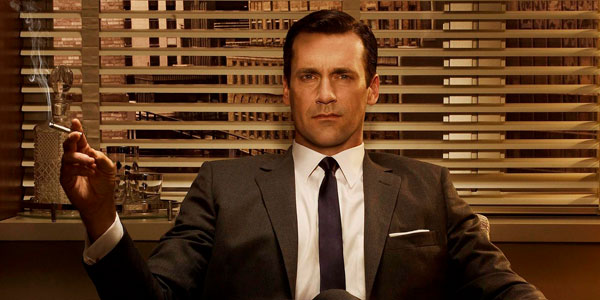
John Fea found an old LBJ ad that shows moderate Republican discomfort over ideological conservatives like Barry Goldwater, the 1964 Republican presidential nominee. If Don Draper had worked for the Democrats, this is how it would have looked:

Drawing parallels between Trump and Goldwater are somewhat overdone since the Arizona Senator had a distinguished record of public service and even vowed to support Nixon in 1960 to the dismay of political conservatives. But the parallels do contain an element of truth in the sense that since the 1950s conservatives (and I count myself as one) have stressed ideological purity over political pragmatism. Maybe it’s the effect of turning 39, or maybe it’s the Trump phenomenon, but compromise for the sake of not blowing things up looks a lot more appealing these days than fidelity to “the movement.”

And here’s the kicker for Roman Catholics reading, some of the most articulate and intellectually rigorous supporters of Goldwater were Roman Catholics like Brent Bozell and William F. Buckley, Jr. (the latter of whom during the 1964 campaign had to distance himself from Robert Welch, the leader of the John Birch Society). In fact, Brent Bozell was the man who put Barry Goldwater’s political convictions into words — The Conscience of a Conservative (as I understand it, the book was entirely Bozell’s effort — see below).

All of this to say, Trump may be much more the fruit of the conservative movement and its anti-establishment ways than conservatives are wont to admit.

Postscript: a little background on Goldwater, Bozell and the conservative conscience:

Goldwater and Bozell were incongruous collaborators: The easygoing Westerner and the intense Midwesterner; the college dropout and the Yale law graduate; the Jewish Episcopalian and the Roman Catholic convert; the principled politician and the activist intellectual (Bozell had run for public office in Mary-land). But they shared a Jeffersonian conviction that that government is best which governs least. They looked to the Constitution as their political North Star. And they were agreed that communism was a clear and present danger.

Goldwater gave his final approval of the manuscript in late December, and Clarence B. Manion, the moderator of a highly popular weekly radio program “The Manion Forum” and the former dean of the Notre Dame Law School, undertook the publication and promotion of a book he was convinced would “cause a sensation.” Indeed it did. Before The Conscience of a Conservative appeared, Barry Goldwater was an attractive but controversial senator from a small Western state who was at best a long-shot vice presidential possibility. After the publication of The Conscience of a Conservative, Goldwater became the political heir to Robert Taft, the hope of disgruntled Republicans, partyless Independents, and despairing Democrats, and the spokesman of a new national political movement—conservatism.

What had Goldwater—and Bozell—wrought? The Conscience of a Conservative was an original work of politics and philosophy, a vision of the nation and the world as it should be, not a compromise with the world as it was. It was a fusion of the three major strains of conservatism in 1960—traditional conservatism, classical liberalism or libertarianism, and anti-communism. It was a book by a conservative for conservatives at a time when conservatives were beginning to realize the potential of their political power.

Liberal Education After the Fall

Must a student be baptized before pursuing the true, good, and beautiful? That questioned occurred after reading Fr. James Schall’s summary of Tracy Rowland’s lecture on Roman Catholic education.

For Rowland and Schall, the Trinity informs the study of everything and so Christianity is at the foundation of any genuine education:

…the basic Catholic approach to education is that there “exists a relationship between the human intellect, the theological virtue of faith, and the transcendental of truth; there also exists a relationship between the human will, the theological virtue of love, and the transcendental of goodness, and there exists a relationship between the human memory, the theological virtue of hope and the transcendental of beauty.” The transcendentals—one, being, good, true, beautiful—are predicates we can apply to everything that is. They reflect in our being the inner relation of the three persons within the Trinity.

It is possible to pass through schools, even at the graduate level, and not really learn much of truth or of what is important. This result can happen also in Catholic schools. Thus, we need graduates who actually have “Catholic intellects, Catholic wills, Catholic imaginations, and Catholic memories.” They need to be conjoined in a proper order of soul. We want to know the truth, to control our own disorders, to imagine what can enlarge our vision. A Catholic memory will know of its saints and their foibles, of glories and tragedies.

But I wonder why a Christian approach to education, one that takes Genesis 3 and the triumph of Augustinianism over Pelagianism seriously, wouldn’t first start with fallen human nature and the incapacity for those, either unregenerate or unbaptized (depending on your communion), to see the Trinity in the true, good, and beautiful because unbelievers are turned in on themselves. In other words, doesn’t a Roman Catholic view of education presuppose that professors and students are baptized and belong to the same communion?

Schall goes on to explain that Rowland acknowledges that not all students have the same intellectual capacities:

This is not an evil, but an aspect of a common good that makes it possible to participate in a broad range of goods and fruits of labor, and insights of others. Some will be more gifted intellectually than others. Some will have greater hearts, be more insightful, or possess skills or virtues that are good. Not everyone is a genius. Indeed, studies show that only about twenty percent of students are able to grasp subtle abstract points of knowledge. The teachers and schools must know and attend to the differences.

An educational egalitarianism that presupposed that all students have the same capacities, talents, and discipline will probably end by teaching very little to neglect the real needs and skills of actual students. Some students will be more attracted to truth, others to goodness, others to beauty, and still others to all sorts of practical and unexpected things. “Human lives can turn into narrative wrecks if educators produce people who can think at high levels of abstraction but are emotionally retarded or who lack sapiential experiences, or who conversely are emotionally sensitive but have no intellectual framework with which to make judgments about their inner life.”

But imagine the narrative wreck that comes with a failure to acknowledge that students can’t understand the Triune God without a prior work of grace, that all students try to suppress the truth in unrighteousness apart from God’s saving work.

If Christian education is going to be redeemed, doesn’t redemption need to be part of the conversation?

Trumpsformational

One of the advantages of falling behind on reading is that the distance of several months adds the perspective of Monday morning’s quarterback to what at least in a magazine looked relatively reliable. For instance, while reading the October 2015 issue of First Things yesterday, I saw a review of Robert Putnam’s Our Kids: The American Dream in Crisis (Simon & Schuster) which sounded not nearly so smart now that we’ve had seven months of Donald Trump:

Well-designed policies supposedly can make up for the family’s collapse and set young people on the right course. Putnam recommends beefed-up tax credits, monetary transfers, benefits programs, better-trained and better-paid teachers, vocational education and apprenticeships, community college aid, widely available preschools, and free after-school sports programs. These lavishly funded initiatives will enable teachers and bureaucrats to substitute for parents from birth to adulthood, returning us to a previous idyll of mobility and equality. There is nothing really new here, and Putnam’s exposition seems half-hearted, as if he doesn’t really believe this laundry list will do the trick, even with renewed effort and much more money.

There’s also a call for a massive mentoring program for lower-class children, with the well-educated acting as surrogate parents and advisors on a wide scale. The goal is to socialize poor children to upper-class norms, thereby equipping them to attend and get through college. ­Putnam’s mentoring idea is a ­variant of the pet elite project of college-for-all, which looks to education as the force of salvation and rescues working-­class children by transforming them into upper-class kids.

This pie-in-the-sky dream reflects the deep logic of our post-1960s world, which offers the good life to the knowledge class, but lacks any approved or positive vision for others. On this view, careerism, “creativity,” ­consumerism, lifestyle cultivation, expressive ­individualism, and sexual adventure are fulfilling and prestigious, while civility, duty, ordinary work, and ­fealty to conventional social roles are exploitative and oppressive. ­Given this outlook, college for all makes perfect sense and anything else looks unjust.

In fact, the project is unrealistic and thus ultimately pernicious. Not everyone is able to join the knowledge elite, nor does everyone want to. Our society will always need basic low-skilled labor, from serving meals to caring for dependents to cleaning toilets. The working class cannot be phased out or made to disappear. Economic improvement for workers is an important goal, although difficult to achieve. But it cannot be enough. What is needed is a viable and vibrant culture that maintains the meaning of working-class life and recognizes its dignity. On this, ­Putnam has virtually nothing to say and little to offer.

Except that now, as opposed to last summer when this review was likely written, it turns out that Donald Trump is the one responding to the division between American elites and workers in an electorally successful way. Instead of a culture what the disenfranchised want is a reality show candidate. Did the Trump campaign actually read Putnam?

In that same issue, Russell Moore wrote a spokesmanish piece that put its foot squarely down on the conviction that evangelicals would not be cowed by same-sex marriage:

…the Evangelical cave-in on sexual ethics is just not going to happen. There is no evidence for it, and no push among Evangelicals to start it. In order to understand this, one has to know two things about Evangelicals. One, Evangelical Protestants are “catholic” in their connection to the broader, global Body of Christ and to two millennia of creedal teaching; and two, Evangelicals are defined by distinctive markers of doctrine and practice. The factors that make Evangelicals the same as all other Christians, as well as the distinctive doctrines and practices that set us apart, both work against an Evangelical accommodation to the sexual revolution.

And then came Donald Trump who apparently has shown that evangelicals (at least some of them), are far more interested in economic than social issues, thus making attractive a candidate who will if elected likely not do a thing to oppose same sex marriage. Could it be that evangelical spokesmen don’t really speak for evangelicals, that evangelical is too crude a religious identity to be useful for social analysis, that evangelicals are not all their cracked up to be (as in conservative)? Michelle Boorstein thinks so:

The divisions have led to a range of viewpoints about what is happening in American evangelicalism and whether the splits will endure after the fall election. Some, like Galli, see a new breakdown based on attitudes towards race and ethnicity. Others see an intensifying split between those who prioritize personal morality and those who emphasize free markets and capitalism as a route to power and freedom. Some frame the split as Christian pragmatists vs. Christian idealists.

“There was in the past a very large camp of evangelicals who were primarily interested in electing the most Christian kind of candidate. And then over time bigger doses of pragmatism set in,” said DeMoss, who was a top advisor to Mitt Romney’s two campaigns. “Evangelicals got splintered between the religious litmus test folks and the pragmatists.”

The Trump phenomenon has some leading evangelicals looking more closely at their label. Russell Moore, a Southern Baptist leader, wrote last month that he is so disgusted with being lumped in with Trump supporters that “at least until this crazy campaign year is over, I choose just to say that I’m a gospel Christian” instead of an evangelical.

Some pollsters say “evangelicals” have been way over-counted – or seen as a huge block — because the definition is so hazy. As a result, they say, practicing Christians who reflect traditional evangelical beliefs like the necessity of a born-again experience and a requirement to evangelize are being lumped in with people who are more nominally connected to Christian practice.

Perhaps the most lasting lesson of Donald Trump’s appeal to evangelicals is that no one has transformationalized the religious landscape the way the leading Republican presidential candidate has. If the comprehensive Christian crowd really wants to transform society — from neo-Calvinists and Kellerites to Roman Catholics and those nostalgic for Christendom — they may want to take a page from Donald Trump.

The More Things Change

The more apologists say they don’t.

Odd is the way that Protestants who notice changes in Roman Catholic life hear that they don’t have the correct paradigm for understanding the past. Odder still is that Roman Catholics who are in fellowship with the Bishop of Rome (and so have the right paradigm) don’t deny but notice changes:

Still, the Church of Pius was vastly different and I do not think there is any denying it. Great theologians, who would later play a key role at the Council, men like Henri de Lubac and John Courtney Murray, were silenced. Giovanni Battista Montini was exiled to Milan for his “liberalism”, and not given a red hat, but he would go on to become the greatest pontiff of the twentieth century. Pius’ obsession with communism muted his voice in denouncing the fascism of Italy and Germany and he was one of the few modern pontiffs not to issue an encyclical on social teaching. Even the visuals were vastly different: Compare this video of Pius’ coronation with a typical Pope Francis Mass.

Perhaps most importantly for the forthcoming discussion, there were obvious doctrinal developments, even changes, in the 74 years between 1939 and 2013. In 1939, the Assumption of the Virgin Mary was a theological opinion, not an officially proclaimed dogma of the Church. There were no “Fortnights for Freedom” because the Church still officially condemned religious liberty. And, while the Church taught that marriage must be open to procreation, she did not yet teach that every conjugal act must be open to procreation.

If you were to count back 74 years from 1939, you would see a vastly different Church. In 1865, the papal states, though considerably shrunken in 1860, were still in existence and the pope was the sovereign of all Rome, living in the Quirinal, not the Vatican. The Syllabus of Errors, condemning all things modern, was only one year old. On May 16th of 1865, Pope Pius IX appointed the convert Henry Edward Manning as the Archbishop of Westminster, and Manning would play a key role in the development of Catholic social teaching. He also kept a fellow Anglican convert, John Henry Newman, under a cloud of suspicion. The Kulturkampf, with its persecution of the Church in Germany, and the First Vatican Council, with its definition of papal infallibility,were still a few years in the future. In France, the Church flourished with spiritual energy and Marian visitations. Six years prior, Charles Darwin had published his book Origin of the Species which was the challenge all religions in profound ways yet, drawing on her intellectual resources, it was the Catholic Church that fared better than most at integrating his seminal work on evolution with the biblical account of creation. That intellectual work had to wait until Pius IX went to his eternal reward.

In the United States, of course, the Civil War came to an end that year. The war had broken the nation’s three largest Protestant churches – the Baptists, Methodists and Presbyterians – into northern and southern branches, but the Catholic Church and the Episcopal Church remained united. Bishop Patrick Lynch of Charleston, South Carolina, had conducted a diplomatic mission to Rome on behalf of the confederacy the year before and, in 1865, he was refused permission to return until his northern confreres secured a presidential pardon. Planning was underway for the Second Plenary Council of Baltimore. Canon law was still undeveloped in the United States and, so, there were no pastors with canonical rights, and the selection of bishops was still a complicated process beginning with the priests of a diocese and the suffragans of the ecclesiastical province both drawing up ternas of candidates for submission to Propaganda Fide. Yes, the Church in the U.S. was still governed through that congregation because we were considered mission territory.

Jump back another 74 years, to 1791, and we see a Church that was virtually prostrate. The popes had been forced to suppress the Society of Jesus, which had been the most stalwart support for papal authority, seventeen years prior. Pope Pius VI had gone to Vienna nine years earlier to cope with the spread of enlightenment ideas, sponsored by the Emperor Joseph II, but the trip had been a failure. And, of course, in France, the Assembly in 1791 mandated that all clergy take an oath to the Civil Constitution on the Clergy, adopted the previous year, provoking a schism that would last more than ten years and which laid the groundwork for the violence against the clergy that would commence in earnest in 1792 and last through the “Terror,” culminating with the suppression of the peasants in the Vendee. In the United States, on the other hand, our new, first bishop, John Carroll, was undertaking his first full year in office and, already, moving to help the Church engage the culture and avoid a sectarianism that he rightly feared would harm the Church in the U.S.

When you add that papal teaching (not dogma but infallible) comes precisely out of these changing contexts, you do wonder what the converts see who think they have escaped the fluidity and diversity of — yuck — Protestantism.

Locating Islam on the Map of the West

Sometimes Crux, though, registered a provocative take on Christianity in the West. In a piece on the Vatican’s diplomacy with Iran, Crux observed that Roman Catholicism is to the Christian world what Shia is to Islam:

Iranian writer Vali Nasr, author of the 2006 book “The Shia Revival,” argues that the divide between Sunni and Shia bears comparison to that between Protestants and Catholics, with Shia being the branch closer to Catholicism.

Among those points of contact are:

A strong emphasis on clerical authority

An approach to the Quran accenting both scripture and tradition

A deep mystical streak

Devotion to a holy family (in the case of Shiites, the blood relatives of Mohammad) and to saints (the Twelve Imams)

A theology of sacrifice and atonement through the death of Hussain, grandson of Mohammad and the first imam of Shia Islam

Belief in free will (as opposed to the Sunni doctrine of pre-destination)

Holy days, pilgrimages, and healing shrines

Intercessory prayer

Strongly emotional forms of popular devotion, especially the festival of Ashoura commemorating Hussain’s death

If only ISIS could find its inner Pope Francis:

Pope Francis apologized for Catholic mistreatment of other Christian traditions Monday, and called on Catholics to forgive followers of those traditions for any offenses of “today and in the past,” as a step toward deeper unity.

“As Bishop of Rome and Shepherd of the Catholic Church, I plead for mercy and forgiveness for non-evangelical behaviors by Catholics against Christians of other churches,” Francis said, referring to conduct not in keeping with the Gospel of Christ.

“We cannot undo what was done in the past, but we don’t want to allow the weight of past sins to pollute our relationships,” he said. “The mercy of God will renew our relations.”

Apologetics Catches Up with Journalism

The Boston Globe, perhaps to make up for its coverage of the Boston Archdiocese’s sex scandal, started Crux, a web-based publication devoted to reporting on all thing Roman Catholic. Now comes word that the Globe has pulled the plug on Crux.

Eighteen months is not a long time for any new venture to get firmly established. But the scariest part of the paper’s abandonment of Crux is that the vertical actually did get established, at least with readers. Allen said the section rallied roughly 1 million monthly readers, and those numbers “easily doubled” during big news events related to the pope, such as his recent trip to Mexico. Within the religion-journalism world, Crux quickly became a must-read, and Allen’s reporting is widely respected as some of the best-sourced in the business. The Globe could not have run a cleaner experiment in terms of testing market viability—as McGrory himself emphasized, the journalism was extremely high quality, but the dollars just weren’t there.

“It clearly is worrying for people who do this for a living to see a mainstream news organization like The Globe who launched a big project like this and then 18 months later backed out,” Allen said. Religion journalism is a notoriously tough sell for publishers, and the fact that the Globe would emphasize the editorial quality and importance of Crux while still choosing to shutter it suggests a fear of investing in topical coverage that isn’t directly appealing to advertisers. A spokesperson for the Globe maintained that the paper will continue its same level of coverage of the Church—this without Allen and the laid-off staffers, and with the editor of the vertical, Teresa Hanafin, being “redeployed [in] an exciting new position as an early morning writer for Bostonglobe.com,” as McGrory wrote in his memo. “I expect if The Globe had launched a vertical exclusively dedicated to coverage of the Patriots and Red Sox, we would not be here,” Allen said.

From the standpoint of religion journalism, the end of the Globe-supported version of Crux is a significant blow. A number of publications are solely dedicated to covering Catholicism, but the big differences between Crux and those organizations, Allen said, are independence and critical distance. Many outlets are expressly affiliated with the Church, and even independent publications such as The National Catholic Reporter have fairly close ties with Catholic institutions.

But I wonder. As much as I like to read Allen, he also massaged the papacy and the Vatican in much of what he wrote.

For instance, Allen applauded Pope Francis for showing a better way to be a culture warrior (read not to fight):

With regard to Italy’s Family Day, Francis used an address to judges of the main Vatican court on Friday to insist that “there can be no confusion between the family willed by God and any other type of union,” which was taken locally as a green light for resistance to the civil unions measure.

In the long run, a pope’s impact is measured not just by what he says or does, but also by which impulses in Catholicism rise or fall on his watch. Almost three years in, it does not seem that a drop-off in the Church’s commitment to what St. John Paul II called the “Gospel of Life” will be part of Francis’ legacy.

Perhaps the question is not whether Pope Francis will lead the Church away from its traditional positions, but whether he’s modeling a different way of making the argument.

It’s sometimes been said that the worst enemies of the anti-abortion movement can be the abortion opponents themselves, because they can seem shrill, angry, and judgmental, turning people off to the message because of the unattractiveness of the messengers.

Examples like this pile up.

Others have also wondered about Crux’s reporting on the church:

2016 March for Life. Allen writes “As to the March for Life, Francis didn’t offer any direct endorsement, but US leaders in the anti-abortion movement say they’re convinced he’s got their backs.” Sorry? This sentence says that Francis said and did nothing in regard to the March for Life, reporting only that some pro-lifers feel that the pope supports them. If it is anything, that sentence is not a claim about Francis, it’s a claim about pro-lifers.

Francis need not, of course, have attended the March for Life (no pope has); he need not have sent it a supportive message (though other popes have); he need not even mention the March for Life if he does not wish to. But, if he did not attend, did not greet, and did not even mention the March, how exactly is this series of non-actions evidence that the pope is ‘pioneering’ a new way to oppose abortion? If eisegesis is reading one’s opinions into another’s words, what is it when there literally are no words to read one’s opinions into, but a message is divined from them anyway? . . .

These remarks are not a criticism of Francis—there is no doubt whatsoever where he stands on the gravity of abortion and on the impossibility of ‘gay-marriage’ (even if his manner sometimes muffs his message) and he is not obligated to engage in any specific acts of opposition to either. But my remarks are a criticism of reporters who, with some proclivity these days, seem to offer the pope’s silence on various matters as evidence for what they think he means on various matters. May I suggest, instead, that silence is usually, pretty much, just silence.

Perhaps Allen was too deferential to his subjects and this undermined his relationship with the Globe. Or, perhaps the Globe wanted good public relations with the Boston Roman Catholic community and Crux failed.

The Problem with Universal Jurisdiction

Maureen Mullarky fears a resurgence of anti-Catholicism in response to Pope Francis’ discussions of economic and political matters:

As Francis’ insinuates himself into geopolitics and seeks to influence America’s immigration policies, Blanshard’s long-dormant question—Is this a foreign power?— begins to stir. Catholics themselves recoil from his will to inflate the episcopal jurisdiction of the Chair of Peter into an imperial mandate to determine secular agendas. Catholics and non-Catholics alike wince at the spectacle of Francis grinning delightedly with Iran’s President Rouhani. They shrink from his embrace of Raúl Castro, wonder at his regard for major figures of liberation theology, and resent his effort to undermine American authority over its own borders.

A solution to this would be a pastor who only ministers God’s word.

But the complications of universal jurisdiction become more complex. Imagine what a Roman pontiff will do with a Donald Trump presidency:

the Vatican is surely worried about the candidacy of Donald Trump. Vatican diplomats tend to be drawn from the same families, attend the same schools, and read the same magazines and newspapers, as their secular counterparts. It is no secret that the governments of Europe are appalled and frightened at the prospect of a Trump presidency, and that fright is surely shared at the Vatican. And, because opposition to immigrants is such a central part of Trump’s political rise, and concern for immigrants has been such a central focus of Pope Francis’ articulation of the Church’s social doctrine, it surely occurred to the Vatican leadership that an archbishop who has spent the last nine years in Mexico could be uniquely valuable at this point in time. As well, immigration is one issue on which the U.S. bishops are not only united, but on which they are totally in sync with the Vatican.

Again, the solution may be to worry less about worldly matters and attend more to the keys of the kingdom, the one not of this world.

But what if having all that power and having so much to say about the world’s affairs leads to pride?

Pope Francis, it seems to me, is described as a “humble” leader for a few reasons:

He rejects various aspects of papal ceremonial.
He moved out of the papal apartments.
He says things like bishops should “smell like their sheep.”
He emphasizes the “bishop of Rome” title.
He says he values decentralization and dialogue, has had a Synod and tweaked the Curial structures just a bit.

Perhaps.

But perhaps it is also fair to ask…

..knowing the role of the Pope, and understanding how easily misunderstood the role of the Pope is by most people today, is it a mark of humble leadership to allow your own words to become the dominant public face of Catholicism – on a daily basis?

So here’s the paradox. No, the contradiction: to brush away certain external expressions of papal authority while actually doubling down on the authority. Communicating in one way the supposed diminishing of the role while at the same time using the role to speak authoritatively to the entire world out of your own priorities on a daily basis.

If this isn’t clear, think of it this way: Change up the situation and imagine it happening in your workplace, your school or your parish with a new boss, principal or pastor.

What would you think then?

Here’s another comparison:

The Catholic Mass developed over time as an elaborate ritual in which the priest-celebrant was hidden behind a mysterious language, ceremony and vestments. It was, it was claimed, necessary to strip all of that so that the people could more directly encounter Christ. The end result is that all we have to look at now is the priest, and the “proper” celebration of Mass is completely dependent on his personal manner and how his style makes us feel.

One wonders if this is the best way to encourage humble leadership.

For all the reforms of Vatican II, the legacy of papal supremacy haunts even the least hierarchical of popes.

Even More Baffling than Evangelical Support for Trump

That would be Roman Catholic support for Trump. Korey Maas explains:

In heavily evangelical South Carolina, where a third of evangelicals voted for Trump, Monmouth had 42 percent of Catholics doing the same. Beaufort County, the only majority-Catholic county in the state, went to Trump with 30 percent of the Republican vote. Exit polls from much more Catholic Massachusetts placed Trump’s support from Catholics at an incredible 53 percent, four points higher than his support among evangelicals there.

Nor are state polls the only means by which to measure support for Trump. The comparative data national opinion polls have generated is equally revealing. Calculating the net favorability of candidates (by subtracting “very unfavorable” proportions from “very favorable”), the Barna Group finds Trump’s net favorability among evangelicals at -38. Not only was it twice as high among Catholics, at only -19, but Catholics viewed Trump more favorably than did any other religious category Barna denominated. When the same poll specifically asked respondents to choose a preferred candidate, evangelicals named Ted Cruz. Catholics? The unrepentant, pro-Planned Parenthood, adulterous strip club owner.

Trump’s favorability among Catholics is further confirmed by the Pew Research Center, which finds 54 percent of Catholic Republicans claiming he would, if elected, be a good or great president. Cruz (52 percent) and Rubio (51 percent) polled almost as well, but no candidate surpassed Trump. . . .

Still there’s more. Catholic support for Trump appears unhindered even after his recent and very public spat with the pope. Trump described as “disgraceful” Pope Francis’ assertion that “this man is not a Christian if he has said things like that.” The “things” in question were Trump’s proposed immigration policies, not least the building of a wall along the border with Mexico. Yet Monmouth pollster Patrick Murray notes that, contrary to the pope himself, a “whopping 76 percent of Catholic Republicans said they favored building a wall across the Mexican border and 61 percent specifically said they approved of Trump’s immigration plan.”

Partly prompting the bewilderment about evangelicals backing Trump has been the fact that prominent evangelical leaders—from Al Mohler and Russell Moore to James Dobson and Max Lucado—have publicly criticized him. None, though, is to evangelicalism what the pope is to Catholicism. For Catholic voters to defy the Democratic Party machine is remarkable enough; but to defy both party and pope? For Trump? For the unrepentant, pro-Planned Parenthood, adulterous strip club owner?

So much certainty, so much unity, so much authority, so little wisdom.

Communicants, Siblings, Friends, and Others

When you have a comprehensive view (w-w) of the world, when you think that your faith informs (or should) everything you do, hard are those distinctions that 2k so readily supplies, like — this is the church so Christian rules apply, this is not the church so freedom applies.

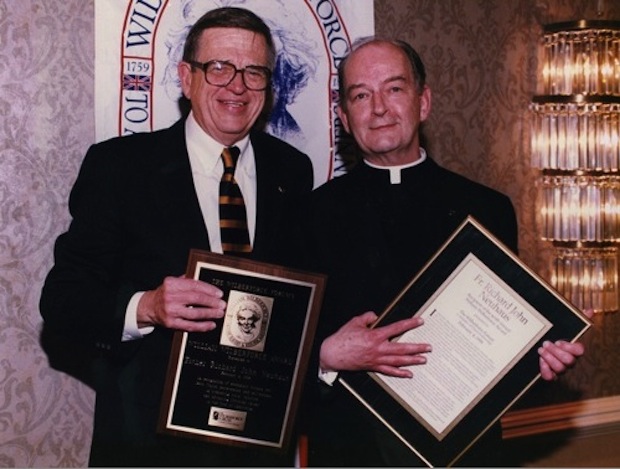
This problem is no less challenging for Roman Catholics than for neo-Calvinists since both are in the comprehensiveness business of showing how faith relates to EVERYthing a Christian does. Cathleen Kaveny took the comprehensiveness and catholicity of Rome in an arresting direction when she accused Richard John Neuhaus and the First Things crowd of partisanship and undermining the bonds of Roman Catholic unity:

Some conservative Catholics have blamed Pope Francis for sowing division among the members of the Body of Christ. But the charge is more properly lodged against one of the heroes of conservative Catholicism: the late Richard John Neuhaus.

It was Neuhaus, after all, who advanced the view that conservative Roman Catholics have more in common with orthodox Jews and Evangelical Protestants than they do with progressive members of their own religious communities. In fact, that view was an operational premise of First Things magazine under his leadership. This approach is based on a thoroughly distorted view of religious realities and commitments.

Does honoring Jesus as the Son of God count as a commonality? Like their conservative counterparts, progressive Roman Catholics acknowledge the divinity of Jesus Christ, and find the interpretive key to the Hebrew Bible in the New Testament. Orthodox Jews do not—indeed, must not—treat Jesus as the Messiah foretold in the Book of Isaiah. It would be blasphemous for them to do so.

Does living in the grace imparted by the sacraments count as a commonality? Both progressive and conservative Roman Catholics believe that God’s grace is channeled through the seven sacraments. Many Evangelical Protestants do not have the same view of grace or the sacraments; they often view the Eucharist as a memorial of a past event, not a way of being present with Christ here and now.

In trying to find common ground with evangelicals, then, Neuhaus was not truly Roman Catholic but actually Protestant:

Ultimately, Neuhaus’s focus was on nurturing these commonalities in the American political context—he was building a political movement. For a variety of partially overlapping reasons, conservative Roman Catholics, Evangelical Protestants, and orthodox Jews were inclined to vote Republican in political elections. Along with George Weigel and Robert George, Neuhaus coached Republican politicians in Catholic-speak to win national elections. . . . But here’s the irony of Neuhaus’s project: in treating theological belief and commitment as mere instruments of political will, Neuhaus’s view of religion resonated more with Feuerbach, Marx, and Leo Strauss than with the church fathers. In separating his own church of the politically pure from the hoi polloi of the body of Christ, his ecclesiology better reflects Protestant sectarianism than Roman Catholicism.

For the record, I too took issue with Evangelicals and Catholics Together for putting politics ahead of theology and for locating Christian unity not in ecclesiastical contexts but in parachurch groupings.

But Rusty Reno didn’t particularly care for Kaveny’s shot at Neuhaus. And so he tried to justify finding fellowship among religious people who were political liberals and then got mugged by reality:

many of the founding figures who played such a prominent role in First Things, as well as early readers like me, came to some shared conclusions. We became less and less impressed with the modern conceit that ours is a time of the unprecedented. We became more and more convinced that our traditions contained an inherited wisdom—a divine revelation—that provides greater insight into the human condition than any modern method, mentality, or revolution. Again, in the magazine’s early years, it was an exciting and invigorating to find others who were coming to the same post-liberal conclusions, whether they were Jewish, Catholic, or Protestant.

That is mainly true but does not represent the nature of Evangelicals and Catholics Together. Otherwise, ECT should have been called Evangelicals and Liberal Protestants and Roman Catholics and Mormons and Jews and Stanley Hauerwas Together. But at least Reno recognizes different layers of commonality:

When it comes to many things that are important to me, I have more in common with friends than with my brother. But my brother’s still my brother. It in no way compromises the truth of our fraternal bond for me to link arms with those with whom I have more in common politically, intellectually, or even theologically. The same goes for the sacramental bond that units us in Christ.

That is more or less a 2k point. But a 2ker would not call a magazine about religion and public life First Things. It’s not elegant but Penultimate Things or Proximate Things or Common Things would work better.

That left Michael Sean Winters to settle the debate and he did so (in neo-Calvinist-friendly ways) by taking issue with Reno’s separation of life into different spheres:

There may be “other dimensions” as Reno notes, but surely, for the Christian, those other dimensions need to be related to “what matters most.” It was this dualism between the Catholic faith and Catholic morality that stalked Neuhaus’s writings and continues to afflict the journal he founded. This dualism not only colored Neuhaus’ judgment, but it kept much of his otherwise enjoyable controversial writings at a fairly superficial level. It also led him to overlook the failings of his own team, both in politics and in religion: His defense of the Iraq War and of Fr. Maciel were stains on Neuhaus’ intellectual project that deserve attention and explanation by those who champion him.

. . . Reno, too, puts his sacramental beliefs in one silo, and his moralizing in another, and never the two need challenge each other. That is not how Catholics think when we are thinking at our best.

Apparently, 2k thinking is a no-no for Roman Catholics as much as it is for neo-Calvinists. Everything belongs to God. Or the papacy has universal jurisdiction (which is a topic for discussion in its own right). Which makes it hard to justify solidarity with people of a different faith.

But if you limit that solidarity to the church and find all sorts of room for cooperation outside the church, problem solved. Why does that solution seem so impious?

What’s Good for Interpreting the Constitution . . .

is good for interpreting the Bible:

Justice Scalia’s determination to take the law as it is earned him many enemies among our progressive elites. The criticism was and remains that Scalia’s textualism prevents the Constitution (and law more generally) from “growing” to meet the changing needs of the people and their government. Scalia was uncaring and a servant of injustice, we have been told, because he was not willing to use the law to do things its often privileged and corrupt authors did not intend it to do. The reprehensible hit piece sent out to faculty and students at Georgetown Law School by Professors Gary Peller and Louis Michael Seidman well illustrates the level of hatred aimed at Justice Scalia on account of his principled approach to law. It was wrong, according to these two professors, both of whom deny the legitimacy of our Constitution, for their law school to mark Justice Scalia’s passing with sympathy and respect because he was, on account of his judicial decisions, a bad man. The virtue progressive lawyers like Mr. Peller and Mr. Seidman demand of judges is quite clear. A good, virtuous judge is one who cares about the oppressed (defined by race, class, and gender), knows that law often is a tool of oppression, and sets himself the task of rewriting the law to make it a tool of justice by serving the interests of oppressed groups, as determined by progressive elites. In rejecting this hubristic model of the judge as savior, Justice Scalia earned endless calumnies, most especially the constant jibe that he was merely a tool of powerful bad actors.

The irony in these charges is thick, for it was precisely Justice Scalia’s refusal to go beyond the text of the Constitution or law that made his jurisprudence by far the most democratic and egalitarian, in the historical American sense, on the Supreme Court of his and perhaps any other time. The Supreme Court Justice who divines “emanations” from “penumbras” of various phrases and ideas in the Constitution and stitches them together into doctrines like the “right to privacy” is serving neither the law nor the people, but his own ideology.

Development of doctrine may allow interpreters of papal instruction to find coherence. But the similarities between development of dogma and a “living, breathing” Constitution are striking.