I Thought John Fea Is Evangelical

John linked to a report from Baylor on the outlook of Trump voters. Among those voters are these characteristics:

• are members of white Evangelical Protestant churches

• consider themselves “very religious”

• think of the United States as a Christian nation

• believe that God is actively engaged in world affairs

• fear Muslims and refugees from the Middle East

• believe that women are not suited for politics

• oppose LGBTQ rights

Here’s what’s odd about this finding. I’m betting John and I are on the same side of these bullet points.

He and I consider ourselves very religious.

He and I think the United States is not a Christian nation.

He and I believe likely that God is actively engaged in world affairs since we tend not to be deists.

He and I do not fear necessarily Muslims or refugees from the Middle East, though I bet if those Muslims or refugees had fought for ISIS John might be a little afraid as I would be.

He and I do not think that women are unsuited for politics, though John was far more congenial to Hillary Clinton than I was.

He and I likely overlap on rights for LBGTQ folks, though I also suspect that the extent of those rights might be qualified.

In which case, neither John nor I fit the profile of evangelicals who voted for Trump. And yet, John still self-identifies as evangelical. I do not and have not for at least 25 years.

In which another case, why does John object to Trump as strongly as he does? Is it because he identifies as evangelical even while the majority of evangelicals voted for Trump? That disconnect could make you wonder about the group to which you belong. I imagine if Bruce Springsteen came out in favor of Trump, John would have as much psychic discomfort as I would if Ethan Coen trashed J. Gresham Machen.

In which a third case, isn’t what matters here not someone’s religious w-w but his or her politics? I can belong to a communion that includes (or used to) Kevin Swanson and that’s okay because the OPC does not require fidelity on political or cultural matters. But if you are part of a religious group that includes a wide swath of Protestants and think that faith should inform a lot of what you do — not to mention that the group has been identified with a certain political trajectory for FORTY years, evangelical support for Trump might give you pause. In other words, if you think religion and politics need to be consistent, then you might assume that a self-identified Calvinist is also a political conservative (which Donald Trump is not). But doesn’t that also mean that if you are an evangelical, your politics should align in some way with the rest of the evangelical world? Being evangelical surely doesn’t make you a liberal (though evangelical professors seem to think otherwise). And oh by the way, some of the biggest opponents of Donald Trump like Russell Moore also oppose policies like gay marriage. In other words, you don’t need to oppose Trump and go over to the editorial page of The New Republic.

Even so, nothing on that list of Trump voters’ attributes is inherently Christian.

Regarding those qualities now as sub-Christian is going to take a little more work than simply finding Trump repugnant. Ever since Ronald Reagan, most Christians in either the Democrat and Republican parties would have agreed with those convictions.

In which a fourth case, Donald Trump justifies rewriting the rules governing yucky evangelicalism.

Does this Apply to Parks Departments and Historical Commissions?

13 Submit yourselves for the Lord’s sake to every human authority: whether to the emperor, as the supreme authority, 14 or to governors, who are sent by him to punish those who do wrong and to commend those who do right. 15 For it is God’s will that by doing good you should silence the ignorant talk of foolish people. 16 Live as free people, but do not use your freedom as a cover-up for evil; live as God’s slaves. 17 Show proper respect to everyone, love the family of believers, fear God, honor the emperor. (1 Pet 2)

Or is it better for Christians to be known for their protest love?

Perhaps most difficult of all, I believe victory will come through our obedience to the Lord who commanded us to love our enemies. We cannot live in the disobedience of ignoring the sin of racism and using the terminology “love your enemies” to justify the protection of prejudiced practices. This is not the example of Jesus.

Jesus taught us that telling the truth – and acting accordingly – is integral to godliness. As the Word of God and the Son of Man, he confronted the oppressive actions of church leaders. He challenged bigotry, judgmental attitudes, and injustice. He exposed the prejudices that his enemies loved. He knew exactly who his enemies were, and he took every opportunity to speak directly about the wickedness they shielded. The love of Jesus for his enemies was not a cover-up; it was rooted in revelation. This is the example we must follow. This is the work of love that the church has inherited.

But we have shunned the revealing, revolutionary acts of love because they are too difficult. We have invalidated our own message. The reason that the Church has not been able to rightly dismantle white supremacist notions is because the Church is guilty of undermining racial justice.

What Kind of Christian is John Fea?

John Fea responds to my post that wondered about his ongoing criticism of David Barton, Donald Trump, and the evangelicals who support the POTUS. As convenient as social media is (are?) for carrying on discussions, this one may be bordering on excess.

The nub of the disagreement seems to be the degree to which Christianity should inform judgments about secular politics (I sure hope John agrees that the U.S. is a secular government — it sure isn’t Throne and Altar Christendom). But even behind this question is one about Christianity itself. What kind of religion is Christianity and what are its political aspects?

John’s own religious convictions seem to veer. In one case, he objects to my raising the question of virtue signaling, that by opposing the “right” kinds of bad things, he shows he is not that “kind” of evangelical.

Hart implies that my convictions are not really convictions, but a clever ploy to show people that I am “not that kind of evangelical.” I will try not to be offended. And yes, Hart is correct. Indeed, some of my evangelical readers do understand the difference between Messiah College and Liberty University or David Barton U. I also think that many of my non-evangelical readers and non-Christian readers who may not have understood the difference between these schools have learned from reading The Way of Improvement Leads Home that the world of evangelical higher education is more diverse than they originally assumed. But I also get new readers every day. If my experience is any indication, many folks out there still don’t understand the difference between Messiah College and Liberty University or David Barton University. I hope my blog will teach people that evangelicals are not all the same when it comes to their approach to higher education or politics.

If John has to try not to be offended, I must have offended. My bad. But don’t Christians generally worry about posturing, pride, self-righteousness? Not much these days. And that could be a problem with a certain kind of Christianity, no matter how right in its public interventions, that comes across and being more moral than others. Jesus warned about public piety in the Sermon on the Mount. As a self-acknowledged Christian, should not John be thankful for someone who warns him about the dangers of moral preening?

But John retaliates kind of by locating me in the religious backwaters of Reformed Protestantism:

I should also add that The Way of Improvement Leads Home is not a Reformed Christian blog, a paleo-conservative blog, or a denominational (Orthodox Presbyterian Church) blog. In this sense, it is different than Old Life.

He is broad while Old Life is narrow. But then, even though I am narrowly Reformed (agreed), he faults me also for being secular.

I realize that the kind of approach to government I am espousing here is different from the kind of secularism Hart has written about in his book A Secular Faith: Christianity Favors the Separation of Church and State. According to one synopsis of the book, Hart believes that “the only role of government is to ensure that the laws do not injure faith and its practices.” (This, I might add, is the same kind of thinking put forth by court evangelicals such as Robert Jeffress).

In the end, I think Hart’s warning about mixing church and state is important. You should read A Secular Faith. I read it, enjoyed it, and learned much from it. I also agreed with much of it. I just don’t go as far as Hart in my secularism. This apparently makes me a Christian nationalist.

John does not try to make sense of being narrowly Reformed in church life and broadly secular in politics. His Christianity simply faults me for either being too narrow on religion or too secular on politics. This makes me wonder if John has thought much about two-kingdom theology, whether from Lutheran, Reformed, or Roman Catholic sources. If he had 2k in his tool kit, he might understand that his own evangelical approach to national politics very much follows the play book of neo-evangelical leaders from the 1940s, who followed the national politics (though with revivals thrown in) of the mainline churches. In both cases, ecumenicity, not being narrow in religion, was a way to build coalitions across denominations that would preserve or build (depending on the timing) a Christian America. Now of course, America is a good thing. But to look at the church or Christianity through the lens of its capacity to help the nation is one more instance of immanentizing the eschaton. In other words, you make Christianity (a global faith) narrow on nationalist grounds.

By the way, John’s quote of the synopsis of A Secular Faith — “the only role of government is to ensure that the laws do not injure faith and its practices” — is actually off. The summary of the book from Booklist included this: “That is Augustine’s distinction of the holy city of God from the secular city of man. Christians are perforce citizens of both, but their only specifically Christian obligation concerning secular citizenship is to ensure that the laws do not injure faith and its practices.” John’s quote of the synopsis does allow him to link me to Jeffress. But again, if he knew 2k, he’d be scratching his head over that comparison. Still this tie typifies the way many evangelicals read 2k: if you aren’t with them, you’re on the fringes, either sectarian or secular.

When John moves beyond tit-for-tat, he explains his understanding of government and Christianity’s place in America:

I believe that government has a responsibility to promote the common good. It should, among other things, protect the dignity of human life, encourage families, promote justice, care for the poor, and protect its citizens and their human rights. I also believe in something akin to the Catholic view of subsidiarity. This means that many of these moral responsibilities are best handled locally. This is why I am very sympathetic to “place”-based thinking and find the arguments put forth by James Davison Hunter in his book To Change the World to be compelling.

But when morality fails at the local level, such moral failures must be dealt with by higher governmental authorities. For example, I believe that the intervention of the federal government in the integration of schools during the era of the Civil Rights Movement was absolutely necessary. Local governments and white churches in the South failed on this front. Moral intervention was necessary. I use the term “sin” to explain understand what was going on in these racist Southern communities. Others may not use such theological language and prefer to call it “unAmerican” or simply “immoral.” But whatever we call it, I think we can still agree on the fact that what was happening in the Jim Crow South was morally problematic and the federal government needed to act. I hope Hart feels the same way. If he does, I wonder what set of ideas informs his views on this.

Here John identifies Christianity with morality. Not good. Christianity does point out sin through the moral law. But Christianity actually provides a remedy. Without the remedy, Jesus and the atonement, the moral law is just one big pain in the neck (for the lost, at least). A policy that enacts something that seems like Christian morality is not itself Christian without also including the gospel. This may be the biggest disagreement between John and me. He is willing apparently to regard mere morality as Christian. That means taking to the lost all the imperatives to be righteous without any way to do so. Christian morality, without the gospel, scares the bejeebers out of me (and I don’t think I’m lost), which is another reason for being wary of seeming self-righteous. Who can stand in that great day by appealing to Christian morality? What good is Christianity for America if it doesn’t lead to faith in Christ?

Another larger problem goes with looking to Christianity for moral authority or certainty. This is an old theme at Old Life, but how do you follow the second table of the Ten Commandments — many of which encourage the policies that John thinks government should pursue — without also taking into account those about idolatry, blasphemy, and keeping the Lord’s Day holy. I don’t see how you set yourself up as a follower of Christ while disregarding some of your Lord’s directives?

The kicker is that John admits he could support a president quoting Muslim sources to uphold American ideas:

I think much of what Obama celebrates in Pope Francis’s ideas is compatible with American values. If Obama quoted a Muslim thinker who spoke in a way compatible with American values I would say the same thing.

So is America the norm? Is it Christianity? Or is it John Fea’s moral compass?

John concludes by admitting:

I am opposed to Trump for both Christian and non-Christian reasons and sometimes those reasons converge.

I appreciate the candor but I wonder why John doesn’t see that he here identifies with every other evangelical — from Barton to Jeffress — who merge their political and religions convictions to support a specific political candidate or to argue for their favorite era of U.S. history. Because John converges them in a superior way to Barton and Jeffress, is that what makes his views on politics more Christian, more scholarly, more American?

John is willing to live with the label of Christian nationalist if it preserves him from the greater error of secularism. What I think he should consider is that converging religion and politics is how we got Barton and Jeffress. If John wants to stop that kind of Christian nationalism, he should preferably embrace two-kingdom theology. If not that, at least explain why his version of convergence is better than the court evangelicals, or why he is a better Christian.

Does Cultural Christianity Advance the Gospel?

Missionaries tell us no. Convincing indigenous peoples that they don’t need to become western or American in order to trust Christ has been a chief insight of modern missions at least since 1900. But for some of the younger Calvinistically inclined folks, the push back against liberalism also now includes a defense of cultural Christianity.

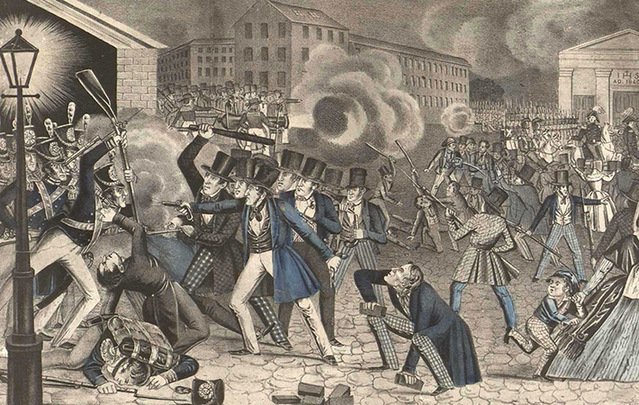
Picking your spots for such a faith surely requires discretion since the riots in Philadelphia between nativist Protestants and Irish Roman Catholics had all the earmarks of cultural Christianity. Protestants expected the public schools to use the Bible to reinforce republican norms but Roman Catholics objected that the Protestant Bible was not neutral — it was not even the right one — the Douay version. Those riots were far more about politics and culture, but defenses of cultural Christianity tread gingerly around such episodes.

What is especially perplexing about Stephen Wolfe’s defense of cultural Christianity is not simply how he might make sense of its darker moments in the past, but even how it measures up to the New Testament. For instance, he starts with this assumption:

We should first acknowledge that the civil recognition, establishment, and privileging of Christianity was the received and standard view for most of Christian history, amongst most major Christian traditions, including many Protestants, and only recently has it been rejected by a majority of western Christians.

That may be true after 350 AD, but imagine Peter and Paul thinking the privileging of Christianity was the air they breathed when they were receiving inspired and infallible revelations from the Holy Spirit.

Wolfe later asserts in a way that would have left Paul scratching his head:

Put differently, the civil and ecclesiastical are the twin species of the same genus, Christian communion. The people of God submit to these mutually supporting, separate and independent administrations because Christ is both the Creator and Ruler of creation and the Mediator of eternal life. The Christian communion is not coterminous with ecclesiastical membership, but is rather the same people submitted to both the civil and ecclesiastical.

Again, that might describe Christendom at some point, but how does it make sense of the apostle’s warning to Corinthians against going to court:

If any of you has a dispute with another, do you dare to take it before the ungodly for judgment instead of before the Lord’s people? 2 Or do you not know that the Lord’s people will judge the world? And if you are to judge the world, are you not competent to judge trivial cases? 3 Do you not know that we will judge angels? How much more the things of this life! 4 Therefore, if you have disputes about such matters, do you ask for a ruling from those whose way of life is scorned in the church? 5 I say this to shame you. Is it possible that there is nobody among you wise enough to judge a dispute between believers? 6 But instead, one brother takes another to court—and this in front of unbelievers! 7 The very fact that you have lawsuits among you means you have been completely defeated already. (1 Cor. 6)

If the civil and ecclesiastical are mutually supporting, why is Paul so incensed with the Corinthians for going to court? Might it be that Paul and the early church had no idea about the state reinforcing Christian norms? That’s what persecution means, I believe.

Calvin’s commentary on this epistle also suggests that he, even though living at a time before 1789 when expectations for Christendom were still in place for all Christians except the Anabaptists, was not as convinced of the easy harmony between church and state. The reason is that the magistrate is an avenger and the church is an instrument of God’s love and mercy:

Those who aim at greater clearness in their statements tell us that we must distinguish between public and private revenge; for while the magistrate’s vengeance is appointed by God, those who have recourse to it do not rashly take vengeance at their own hand, but have recourse to God as an Avenger. This, it is true, is said judiciously and appropriately; but we must go a step farther; for if it be not allowable even to desire vengeance from God, then, on the same principle, it were not allowable to have recourse to the magistrate for vengeance.

I acknowledge, then, that a Christian man is altogether prohibited from revenge, so that he must not exercise it, either by himself, or by means of the magistrate, nor even desire it. If, therefore, a Christian man wishes to prosecute his rights at law, so as not to offend God, he must, above all things, take heed that he does not bring into court any desire of revenge, any corrupt affection of the mind, or anger, or, in fine, any other poison. In this matter love will be the best regulator.

Of course, Calvin is no Anabaptist. He knows the legitimacy of the magistrate and even the competency of unbelieving civil authorities. But he also senses in ways that critics of modern secular liberalism do not seem to that the purposes of church and state are distinct. One implication is that they are not necessarily harmonious. Especially if upholding the Christian ideal of love.

Perhaps cultural Christianity aspires to such an ideal. But chances are what Christian societies produce when the church is established is more on the order of manners or politeness than the spiritual fruit that comes with sanctification.

If You’re Wrong about War, then Maybe Sex Also

Alan Jacobs picks up slack for Jamie Smith’s argument that modern Christians should not reduce orthodoxy to heterosexual sex (about which I tend to agree). But he loses me when he seems to agree with the analogy between sex and pacifism:

the grammar of credal orthodoxy is a generative one, from which the whole of Christian ethics emerges. But it does not inevitably do this in obvious ways, ways that Christians are generally agreed about. Smith’s example of pacifism is a telling one. For the Christian pacifist, the very heart of the credal grammar is that in Christ God is at work reconciling the world to himself, and that therefore the whole life of the Church is to participate in that reconciliation, which enjoins a steadfast refusal of armed conflict. For the Christian pacifist, the Christian who believes that wars can be just has simply failed to grasp that credal grammar. And yet most Christian pacifists do not say that just-war Christians fall outside the scope of orthodoxy. And I think they don’t say this because they recognize the difference between grammatical rules that are explicitly stated and the consequences that implicitly follow from those rules.

What Bible (or Christian tradition — think popes reigning over Papal States and emperors executing justice in Caesaro-Papist manner) are these guys reading?

Since when does the religion of the Bible oppose armed conflict? Redemption in the OT sure seemed to rely on a fair amount not merely of just war but jihad. Jesus redeemed his people by shedding his blood to the emperor’s sword. Jesus will return in judgment and from reading Revelation it does not look like Quakers will be in charge. And then there is Paul’s instruction that God ordains the emperor’s use of the sword.

With friends of pacifism like this, I’m not confident orthodoxy — even limited to Nicea — has a chance.

Shooting Fish in a Barrel

John Fea is back (it’s been a while) with an explanation of why he energetically criticizes the David Bartons and Robert Jeffresses of the evangelical world:

My approach to critiquing Jeffress, the Christian Right, and the court evangelicals is structural in nature. It is fitting with my vocation as a historian. Theologians and pastors are probably better equipped to make a direct biblical case for why Jeffress’s Christian nationalism is idolatry and harmful to the witness of the Gospel. Greg Boyd, Richard, Hughes, John Wilsey, and others have already made such a case. I encourage you to read their books. But early American historians are best equipped at taking a sledgehammer to the foundation of Christian nationalist politics.

So yes, I do get “bent out of shape.” Maybe I am obsessed. Somebody has to be. We need good American history more than ever. Christian historians have a public role to play in such a time as this.

My problem with this at one level is that John does not seem to acknowledge the optics or signaling. If he criticizes these evangelicals, then his readers will know that he is not that kind of evangelical — though I think his readers are way smarter than that and that no one confuses Messiah College with David Barton U. (or even Liberty U.).

But the bigger objection is that John only goes after evangelicals when they do this and not the entire enchilada of American Protestantism. To read John’s blog, you might receive the impression that only the Religious Right has engaged in a crass Christian nationalism (as if a refined Christian nationalism exists). But what about when mainline Protestants engage in the kind of civil religion that evangelicals advance?

Consider President Obama’s remarks while welcoming Pope Francis:

You call on all of us, Catholic and non-Catholic alike, to put the “least of these” at the center of our concern. You remind us that in the eyes of God our measure as individuals, and as societies, is not determined by wealth or power or station or celebrity, but by how well we hew to Scripture’s call to lift up the poor and the marginalized, to stand up for justice and against inequality, and to ensure that every human being is able to live in dignity – because we are all made in the image of God.

You remind us that “the Lord’s most powerful message” is mercy. That means welcoming the stranger with empathy and a truly open heart – from the refugee who flees war torn lands, to the immigrant who leaves home in search of a better life. It means showing compassion and love for the marginalized and the outcast, those who have suffered, and those who seek redemption. . . .

Your Holiness, in your words and deeds, you set a profound moral example. And in these gentle but firm reminders of our obligations to God and to one another, you are shaking us out of complacency. All of us may, at times, experience discomfort when we contemplate the distance between how we lead our daily lives and what we know to be true and right. But I believe such discomfort is a blessing, for it points to something better. You shake our conscience from slumber; you call on us to rejoice in Good News, and give us confidence that we can come together, in humility and service, and pursue a world that is more loving, more just, and more free. Here at home and around the world, may our generation heed your call to “never remain on the sidelines of this march of living hope!”

Maybe you agree with President Obama’s policies and Pope Francis’ teaching. But what is this “we” and “our” of which POTUS speaks? How is that anything but a mixing of Rome’s religion with America’s political norms?

And what about FDR’s “speech” that informed citizens of America’s involvement in the D-Day operations (June 6, 1944) — get this — in the form of a prayer?

My fellow Americans: Last night, when I spoke with you about the fall of Rome, I knew at that moment that troops of the United States and our allies were crossing the Channel in another and greater operation. It has come to pass with success thus far.

And so, in this poignant hour, I ask you to join with me in prayer:

Almighty God: Our sons, pride of our Nation, this day have set upon a mighty endeavor, a struggle to preserve our Republic, our religion, and our civilization, and to set free a suffering humanity.

Lead them straight and true; give strength to their arms, stoutness to their hearts, steadfastness in their faith.

They will need Thy blessings. Their road will be long and hard. For the enemy is strong. He may hurl back our forces. Success may not come with rushing speed, but we shall return again and again; and we know that by Thy grace, and by the righteousness of our cause, our sons will triumph.

They will be sore tried, by night and by day, without rest-until the victory is won. The darkness will be rent by noise and flame. Men’s souls will be shaken with the violences of war.

For these men are lately drawn from the ways of peace. They fight not for the lust of conquest. They fight to end conquest. They fight to liberate. They fight to let justice arise, and tolerance and good will among all Thy people. They yearn but for the end of battle, for their return to the haven of home.

Some will never return. Embrace these, Father, and receive them, Thy heroic servants, into Thy kingdom. . . .

Wow!

No matter how big Jeffress’ congregation is and no matter how many Americans Barton may reach with his materials, neither can hold a candle to the kind of resources POTUS brings to bear on the nation and the world. Can Barton or Jeffress make war? I don’t think so.

So why not go after the nationalism that informs American officials who actually use force legitimately and send American soldiers to battle?

Why not also cease treating President Trump as if he is unworthy of presiding over a righteous nation? If Trump’s critics actually had a different moral standard rather than an expectation that POTUS should conform to Christian morality, they might become less indignant. Plenty of reasons to oppose Trump without Christian ones.

All Political Sermons are Bad

In the spirit of J. Gresham Machen, remember that if you don’t mix religion and politics, you don’t have to perform the contortions that allow you to affirm Civil Rights legislation (as a work of God) and oppose Prohibition (not as a work of God even though Protestants did think it was a work of God). Just keep politics out of the church.

But that’s not what Christians do.

And American Presbyterians have been guilty for a long time before liberal Protestants went all in on the Social Gospel. Mark Tooley reminds:

This week I studied at the Army War College at Carlisle Barracks in Pennsylvania, a fort dating to the 1700s, when President George Washington led an army there in route to suppress the Whiskey Rebellion. Farmers in western Pennsylvania had revolted against the authority of the new republic to tax the whiskey they distilled from grain otherwise expensive to ship from their remote frontier.

Quickly realizing this threat to the new nation’s cohesion, Washington in 1794 summoned the militias from Pennsylvania and nearby states into an army of 13,000 that he personally led against the rebellion. At an evening celebration of greeting for the President and his army, the town of Carlisle illumined a special proclamation simply declaring: “The Reign of the Laws.”

Such a poignant and wonderful exclamation: “The Reign of the Laws.” The people saluted Washington, but they, like he, did not place their faith in his personal rule but in impartial law as the antidote to anarchy.

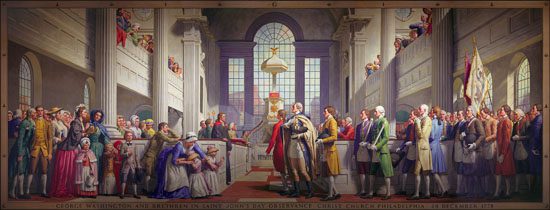
While in Carlisle Washington worshiped at the stone Presbyterian church, which I visited, and where he heard Dr. Robert Davidson preach “A Sermon on the Freedom and Happiness of the United States of America.” Washington described it in his diary: “Went to the Presbyterian meeting and heard Dr. Davidson preach a political sermon, recommendations of order and good government and the excellence of that of the United States.”

Washington’s summary was fair and succinct, but the sermon merits elaboration, both for illustrating how Christians in early America viewed God’s purposes for their nation, and for modeling, at least in part, how we today might view government, justice and nationhood providentially.

The sermon is based on King David’s question in 2 Samuel 7:23: “And what one nation in the earth is like Thy people, even like Israel?” Pastor Davidson warned against being “carried away by the spirit of the times, to substitute mere political harangues in the place of the Gospel of Christ,” recalling, per Proverbs 27:34, that “righteousness exalteth a nation; but sin is a reproach to any people.” And he noted the “duties of citizens are not to be considered as topics foreign to the Gospel” as the “Gospel views man in every condition in which man can be placed.”

Davidson heralded the “great goodness of God to our own state and nation in particular; our high and many privileges, the gratitude due from us to God for them; and the wise improvement which we ought to make of them.” As a national comparison, Davidson recalled:

The history of the Jewish nation, if read with suitable views, and especially in order to gain an acquaintance with the ways of God to men, would be one of the most instructive that could merit our attention. …We see how much superior, in point of privileges, the Jewish nation was, to all the other nations around them.

As God had showed unmerited and unprecedented favor to the Hebrew nation, Davidson urged considering the “great goodness of the Divine Being to our state and nation in particular; – our high privileges; the gratitude which we owe to God for them…” And he recalled:

This part of the New World presented itself as a place of refuge for those who wished to enjoy religious and civil freedom, unmolested, and to the greatest extent. They hoped that here they could worship God according to their consciences, and would be at a secure distance from all the insults of tyranny.

After reciting the British oppressions precipitating the American Revolution, Davidson declared the new independent nation had the “freest and best form of civil government, which could be learned from the wisdom and experience of ages,” and that with “all the imperfections” still “is one of the most free and excellent under the sun.”

Of the American republic, Davidson further rhapsodized:

This is a government, which all the real friends of freedom in the old world appear to admire; and under the wings of which the oppressed of every nation would wish to take refuge. Here is liberty and equality, according to the just acceptation of those favorite terms; liberty, civil and religious to the utmost extent that they can be, where there is any government at all; and an equality of rights, or provision made for the equal protection of the lives and properties of all. That all men should be equal, as to abilities, station, authority, and wealth, is absolutely, in the present state of things, impossible. But where every citizen has a voice in making the laws, or in choosing those who make them, and is equally under their protection, – there is equality.

I for one (why not five) am convinced that modernism did not begin with adapting Christianity to biology, higher criticism, or immigration reform. It began when Christians, like Pastor Davidson, started to adapt Christianity to modern nations like the United States. Once you start making the Bible say things it doesn’t, it’s hard to stop.

Nothing Could Possibly Go Wrong

In 1872 the Protestant churches in Scotland handed over all their schools to the State on the explicit condition that Scottish State Education should continue to be Christian. From that day on the Scottish Education system (unlike the American one) has officially been Christian. The Catholics, being wiser than the Protestants, didn’t trust the State and so they kept their own schools. Even within living memory most schools in Scotland would have had ‘religious’ worship, school chaplains and bible teaching. The ethos of the schools were largely Christian. But this is now virtually unrecognisable. Secular humanists/atheists have cuckoo like taken over the State education system and are now using Salami tactics (piece by piece) to dismantle the remaining parts of it – crying tolerance and equality in order not to tolerate Christianity and in order to prevent Christians from receiving the equal education that the UN Human Rights charter demands.

2k Protestants were not so gullible.

And that’s why 2kers give two cheers (sometimes three) for the separation of church and state. It is impossible for established churches to remain faithful. They will always need to do the magistrate’s bidding and reflect the attitudes of the citizenry.

Selah.

Northern Ireland Proves American Exceptionalism

The attempt by Conservatives to form a government with the Democratic Unionist Party, the anti-Catholic organization of Northern Ireland, has generated attention on a form of politics that has white American evangelicals scratching their heads. On the one hand, the DUP is even more conservative on social issues than America’s religious right:

The DUP is also wed to a list of views regarding society and the culture wars. They believe in six-day Creation, reject homosexuality and are opposed to abortion. All well and good. I agree with them, but when these positions and doctrines (rooted in faith apprehended revelation) are put into a political platform wed to nationalism and violence… we have a problem. Their conduct leads not only to the discrediting of these Biblical doctrines but places them within a framework of political extremism, coercion and threat. Holding them means one is potentially part of a sect devoted to political violence and the desire for power.

On the other hand, the DUP has no place for American conservatives’ attachment to small government:

Within the broader context of Northern Ireland, the DUP’s position on “social issues” is not peculiar, therefore, but neither is their position on finance best described as “conservative.” Their strategy is to seek the extension rather than the limitation of the state, and the success of this policy, widely shared among Northern Ireland parties, has contributed to the fact that the area has the UK’s highest public spending per person, with tax revenues of £8,580 per person in 2016 falling far short of the public spending per person of £14,020. Northern Ireland’s taxpayers contribute little more than half of what it costs to run the province.

In point of fact, the DUP’s commitment to big government on social and economic matters makes the most sense to me. How you have a government that enforces Christian morality but then turns liberal when it looks at markets is incoherent. If you have small government that trusts responsible citizens not to abuse the freedoms of the market place, why do you need the state to enforce Christian ethical norms?

Everyone’s Doing It or Stop It (another anti-civil religion post)

Inspired by a post that questions Reinhold Niebuhr’s contributions to foreign policy and national politics, here goes a few morsels I ran across while teaching Christianity and politics last fall.

As much as conservatives and (some) evangelicals perceived the former president as a captive to secularism and relativism, President Obama’s use of civil religion was down right gobsmacking, so much so you wonder what the secular left was thinking when he said this:

For me, the celebration of Easter puts our earthly concerns into perspective. With humility and with awe, we give thanks to the extraordinary sacrifice of Jesus Christ, our Savior. We reflect on the brutal pain that He suffered, the scorn that He absorbed, the sins that He bore, this extraordinary gift of salvation that He gave to us. And we try, as best we can, to comprehend the darkness that He endured so that we might receive God’s light.

And yet, even as we grapple with the sheer enormity of Jesus’s sacrifice, on Easter we can’t lose sight of the fact that the story didn’t end on Friday. The story keeps on going. On Sunday comes the glorious Resurrection of our Savior.

“Good Friday may occupy the throne for a day,” Dr. King once preached, “but ultimately it must give way to the triumphant beat of the drums of Easter.” Drums that beat the rhythm of renewal and redemption, goodness and grace, hope and love. Easter is our affirmation that there are better days ahead — and also a reminder that it is on us, the living, to make them so.

Or this:

Around the world, we have seen horrific acts of terrorism, most recently Brussels, as well as what happened in Pakistan — innocent families, mostly women and children, Christians and Muslims. And so our prayers are with the victims, their families, the survivors of these cowardly attacks.

And as Joe mentioned, these attacks can foment fear and division. They can tempt us to cast out the stranger, strike out against those who don’t look like us, or pray exactly as we do. And they can lead us to turn our backs on those who are most in need of help and refuge. That’s the intent of the terrorists, is to weaken our faith, to weaken our best impulses, our better angels.

And Pastor preached on this this weekend, and I know all of you did, too, as I suspect, or in your own quiet ways were reminded if Easter means anything, it’s that you don’t have to be afraid. We drown out darkness with light, and we heal hatred with love, and we hold on to hope. And we think about all that Jesus suffered and sacrificed on our behalf — scorned, abandoned shunned, nail-scarred hands bearing the injustice of his death and carrying the sins of the world.

And it’s difficult to fathom the full meaning of that act. Scripture tells us, “For God so loved the world that He gave His only Son, that whoever believes in Him should not perish but have eternal life.” Because of God’s love, we can proclaim “Christ is risen!” Because of God’s love, we have been given this gift of salvation. Because of Him, our hope is not misplaced, and we don’t have to be afraid.

And as Christians have said through the years, “We are Easter people, and Alleluia is our song!” We are Easter people, people of hope and not fear.

Now, this is not a static hope. This is a living and breathing hope. It’s not a gift we simply receive, but one we must give to others, a gift to carry forth. I was struck last week by an image of Pope Francis washing feet of refugees — different faiths, different countries. And what a powerful reminder of our obligations if, in fact, we’re not afraid, and if, in fact, we hope, and if, in fact, we believe. That is something that we have to give.

His Holiness said this Easter Sunday, God “enables us to see with His eyes of love and compassion those who hunger and thirst, strangers and prisoners, the marginalized and the outcast, the victims of oppression and violence.”

To do justice, to love kindness –- that’s what all of you collectively are involved in in your own ways each and every day. Feeding the hungry. Healing the sick. Teaching our children. Housing the homeless. Welcoming immigrants and refugees. And in that way, you are teaching all of us what it means when it comes to true discipleship. It’s not just words. It’s not just getting dressed and looking good on Sunday. But it’s service, particularly for the least of these.

And whether fighting the scourge of poverty or joining with us to work on criminal justice reform and giving people a second chance in life, you have been on the front lines of delivering God’s message of love and compassion and mercy for His children.

This is the theology of progressivism. Jesus died to better the world, to advance equality, reduce poverty, spread peace. Conservatives have their own civil religion. It is just as bad. Jesus didn’t die for a stronger military or free markets. If reading Reinhold Niebuhr doesn’t prevent you from this excess, then reading Reinhold Niebuhr is pointless.

So cut it out. Join the 2k movement and hope in a kingdom (not a republic or democracy) not of this world.