The Problem with U.S.

H. L. Mencken explains:

. . . here in this great republic we have the materials for the most superb victualry the world has ever seen, and our people have the money to pay for it. Even the poorest Americano, indeed, eats relatively expensive food. His wife knows nothing of the hard pinching that entertains her French sister. He has meat in abundance and in considerable variety, and a great wealth of fruits and vegetables. Yet he eats badly, gets very little enjoyment out of his meals, and is constantly taking pills. The hot dog is the reductio ad absurdum of American eating. The Sicilian in the ditch, though he can never be President, knows better: he puts a slice of onion between his slabs of bread, not a cartridge filled with the sweepings of the abattoirs.

The national taste for bad food seems all the more remarkable when one recalls that the United States, more than any other country of the modern world, has been enriched by immigrant cuisines. Every fresh wave of newcomers has brought in new dishes, and many of them have been of the highest merit. But very few of them have been adopted by the natives, and the few have been mainly inferior. From the Italians, for example, we have got only spaghetti; it is now so American that it is to be had in cans. But spaghetti is to the Italian cuisine simply what eggs are to the Spanish: a raw material. We eat it as only those Italians eat it who are on the verge of ceasing to eat at all. Of the multitudinous ways in which it can be cooked and garnished we have learned but one, and that one is undoubtedly the worst.

So with the German sauerkraut — a superb victual when properly prepared for the table. But how often, in America, is it properly prepared? Perhaps once in 100,000 times. Even the Germans, coming here, lose the art of handling it as it deserves. It becomes in their hands, as in the hands of American cooks, simply a sort of stewed hay, with overtones of the dishpan. To encounter a decent dish of it in an American eating house would be as startling as to encounter a decent soup.

***

What ails our victualry, principally, is the depressing standardization that ails everything else American. There was a time when every American eating house had its specialties, and many of them were excellent. One did not expect to find the same things everywhere. One went to one place for roast goose, and to another for broiled soft crabs, and to another for oysters, and to yet another for mutton chops. Rolls made the old Parker House in Boston famous, and terrapin a la Maryland did the same for Barnum’s and Guy’s hotels in Baltimore. . . .

in America the public cooks have all abandoned specialization and everyone of them seems bent upon cooking as nearly as possible like all the rest. The American hotel meal is as rigidly standardized as the parts of a flivver, and so is the American restaurant meal. The local dishes, in all eating houses pretending to any tone, are banned as low. So one hunts in vain in Boston for a decent plate of beans, and in Baltimore for a decent mess of steamed hard crabs, and in St. Louis for a decent rasher of catfish. They are obtainable, perhaps, but only along the wharves. One must take a squad of police along to enjoy them in safety. (“Victualry as Fine Art,” 1926)

The Problem with England

H. L. Mencken explains:

The badness of English cooking is proverbial all over the world, but no one seems to have investigated its causes. I suggest that it may be due, at least in part, to two things, the first being that the English have a Puritan distrust of whatever is bodily pleasant, and the second that it is practically impossible to grow good food in their country. The first point needs no laboring. Every American who has been in England in winter knows who the whole population shivers and freezes. The simple device of putting in adequate stoves has apparently never occurred to anyone — or, if it has, it has been rejected as unmanly. The English prefer to be uncomfortable, and think of their preferences as heroic.

So at the table. Most Englishmen have been abroad, and know very well what good victuals taste like. But when they are at home they take a gloomy, stubborn, idiotic delight in eating badly. To say that they have a diseased taste and actually enjoy their flabby flavorless, badly cooked dishes, — this is to go beyond plain facts. It takes only a glance to see that they suffer almost as much as visitors to their country. But they can’t get rid of the feeling that it is virtuous to suffer — that eating better stuff would be frenchified, wicked, and against God. So they remain faithful to a cuisine which Nietzsche long ago described as next door to cannibalism.

I have hinted that the native victuals of the English are all bad. An exception, of course should be made of their incomparable mutton, and another, perhaps, of their sole, but beyond that the judgment holds. Their beef, for all their touching veneration of it, is distinctly inferior to ours, as anyone may discover by eating in the form of steaks. Their pork, at best, is only so-so, and their veal is not better. They seldom eat lamb at all. Of the stuff they get out of the sea, not much is really good. Their oysters are vile, and their turbot is flabby and almost tasteless. Their salmon is better, but it is surely not to be mentioned in the same breath with our mackerel, blue-fish and shad. That leaves their excellent sole — usually ruined in the cooking. . . .

What saves England from complete culinary darkness is the mutton. At its best, it is probably the most magnificent red meat to be had in the world. . . . I believe it is one of the great glories of the English people — a greater glory, indeed, than their poetry, their policemen, their hearty complexions, or their gift for moral indignation. It is the product of English grass — unquestionably the best grass on this piebald ball. Ah, that the English nobility and gentry could dine as well as their sheep. (“Note on Victuals,” 1930)

Sixty Hours I’ll Never Recover

But at least no naked actresses.

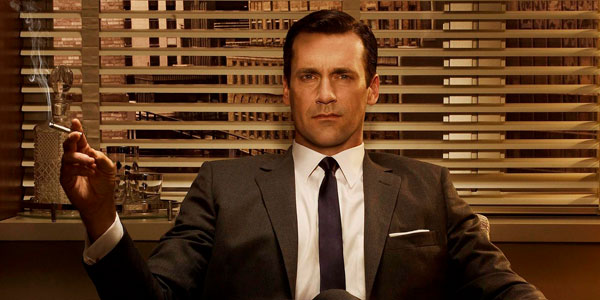
That is the general reaction in the Hart household to the completion of Mad Men, a tv series perhaps a tad better than Breaking Bad, but miles behind — wait for it — The Wire. (The atmospherics of Mad Men inch the series just barely ahead of Breaking Bad.) I had to go through 90 episodes to see Don practicing transcendental meditation, Peggy finding love, Joan being torn between love and career, Roger finding love appropriate to his age, and Pete landing in Witchita? Yes, it was uncomfortable to see Betty get sick, but not so much that you see a different side of her.

The morning after I read Louis Menand (who is emerging as someone worthy of a man-crush) on Charles Duhigg’s book, Smarter Faster Better: The Secrets of Being Productive in Life. Menand can’t quite understand why self-help books for business people sell. They are so obvious:

There is not much to disagree with here, and that is one of the intriguing things about the genre this book belongs to. Not dozens or hundreds but thousands of titles like “Smarter Faster Better” are published every year, and they account for a disproportionate percentage of total book sales. Yet they mainly reiterate common sense.

Does anybody think it’s unwise to be lean, nimble, and innovative? Who needs a book to know that rote behavior and fear of uncertainty are not going to take us very far? It’s not startling to learn that organizations that nurture a “culture of commitment” are more productive than organizations that don’t, or that setting ambitious objectives can jump-start innovation. “People who know how to self-motivate, according to studies, earn more money than their peers, report higher levels of happiness, and say they are more satisfied with their families, jobs, and lives.” I can believe that. “Determined and focused people . . . often have higher paying jobs.” I won’t argue. “An instinct for decisiveness is great—until it’s not.” An impregnable assertion.

In an uncanny way, Menand also explains the logic of Mad Men:

If you owned an advertising agency fifty years ago, on the other hand, you wouldn’t care how much pig iron your workers could carry in an hour. You would want your account executives to have winning personalities, to be able to bond easily with other people, to be likable. You would want them to have manners tailored to attract the patronage and retain the loyalty of your customers. Their task would be to persuade, not to push. You would therefore want them to be able to conceal, maybe even from themselves, the manipulative and possibly mercenary nature of their relationship with clients, and to transform a business transaction into a friendly quid pro quo. You would reward the most successful account executives with lavish expense accounts.

The series never goes beyond this (except when Don is being Don).

Third-Degree Racism

I was listening to Glenn Loury and John McWhorter yesterday on whether Donald Trump is racist. During the podcast, Glenn threw out the notion that something Trump said was third-degree racism, but not the full blown variety.

That got me thinking about why it is the case that when conservative Presbyterians talk about race, racism is an all or nothing proposition. Think back to Leon Brown’s post (discussed here) about racism in NAPARC communions after the shooting of Michael Brown:

This is why we need a movement of the Holy Spirit. Amid the horrific realities of Mike Browns all over the United States, and even the incidents that occur which are not broadcast (e.g., unjust acts taken against poor whites), we must demonstrate that the church is different. We are unlike the world, which can segregate, almost immediately, based on the color of one’s skin and other factors. Have you noticed that is what has occurred in the death of Mike Brown? Why do you think the pictures and quotations from Dr. Martin Luther King, Jr. have newly surfaced on the internet, largely from ethnic minorities? Why do you believe pictures from the 1950’s and 1960’s have been newly awakened? For many, history continues to repeat itself, and that angers African-Americans and other minorities. Perhaps we, specifically Christians, are also angry at the lack of representation in the ‘Christian’ blogosphere from others in the majority culture. Robin Williams is okay, but apparently Mike Brown is not.

Without dodging or answering the question of whether blacks and whites should necessarily worship together (since historically black communions are such a part of the African-American experience), is it possible to distinguish what transpires among the Ferguson, Missouri police force from what happens on a Sunday morning in your average PCA congregation in the middle of Tennessee? Is one perhaps first-degree racism and the other third-degree? If we can make distinctions when it comes to the loss of human life, can’t we distinguish among the levels of prejudice that humans manifest?

So here’s the proposal:

Banning students from attending a Reformed seminary on the basis of race is first-degree racism.

A search committee at a white congregation placing an application from an African-American licentiate is second-degree racism.

Church members choosing on their own to worship in congregations where the majority of members are the same race is third-degree racism.

Do any of the overtures before the PCA reflect such differences? I’m merely asking.

Why Christians Shouldn’t See Christian Movies

Here’s one reason:

The glaring problem with God’s Not Dead, and most other films made for and marketed at the “faith audience,” is that instead of exercising and challenging the imagination of their audience in ways that would make their audience better Christians, they shut down imagination and whisper sweet nothings into their ears instead.

God’s Not Dead enlists an army of straw men (the evil atheist professor who will fail a student for refusing to sign a paper agreeing that God is dead, the evil atheist boyfriend who abandons his girlfriend as soon as she announces her terminal illness, the evil Muslim father who kicks his daughter out of the home for converting, the evil liberal ambush journalist with a bumper sticker on her car that reads “I love evolution”) then burns them in effigy. The movie isn’t content to merely convert our main antagonist, effectively forcing him to grovel before his 18-year-old student. It also trots in a deus ex machina and kills him off. (Spoiler, sorry.)

I can look past characters created by writers who have only heard about liberals and secularists on talk radio. But every non-Christian character in the movie, and so many others, “hates God” (direct quote). They believe or hope the Almighty has kicked the can, and do so for deeply personal reasons. They’re all secretly miserable, every last one. I believe in the power of representation enough to know that God’s Not Dead insidiously shapes the imaginations of the audience, especially if their daily lives don’t bring them into contact with people who don’t believe the way they do. And that’s true for many (and not just Christians).

Rarely do I even recognize myself or my family and friends in Christian movie characters. Left Behind, a faith-based film in which virtually all the Christian characters are weirdly portrayed as nutjobs, is a great example. And the God-fearing characters in God’s Not Dead seem like decent people, even if Duck Dynasty’s Willie and Korie Robertson co-star in a dash of ill-conceived product placement. But I believe we’re all in the same strange family of misfits. Which is why I get twitchy with the “faith audience” designation. The implication is that, if you’re not in that audience, you’re… what? The doubt audience? The unbelief audience?

The Coen brothers, however, gave a better reason in their latest, “Hail, Caesar”:

All of this means, however, that the Bible-Blockbuster religion depicted on the screen is going to be in significant ways distinct from actual Christian religion (or, in the relevant parts of Ben-Hur and the whole of the Ten Commandments, from actual Jewish religion). Hollywood owners, executives, and directors can sincerely believe that such Bible-Blockbuster religion is a unifying and salutary thing to portray for the nation, and more importantly, they can know that it is a very profitable thing to portray. But in the Coens’ telling, the problem is that Bible-Blockbuster religion cannot but be deceptive, hypocritical, and at the deepest level, faithless. Many of the key actors and many of the key film-makers will not believe in the relevant actual religions, and any serious believers that are on the set may either disagree with the religion that is being depicted, or disagree with one another about its correct interpretation. On the doctrinal level, it is only going to fully work for those who are in the vague sense believers but who have decided not to look into doctrine or the pages of scripture very much. On the dramatic level, it is going to involve actors, writers, and image-makers imitating a faith that many of them don’t have, and which is itself perhaps impossible to depict.

So the Bible-Blockbuster is going to have to primarily make faith seem to be a matter of melodramatic emotional inspiration, which from another angle, is a matter of manipulation. Hollywood magic, used…well, used for what? Not simply for escapist entertainment, but for more firmly setting the religion of America?

Carl Eric Scott admits that he feels awkward laughing at Jesus through the Coen’s smart alecky ways and tries to answer this here. But if Scott were truly a 2k Protestant, he’d know that he wasn’t laughing at Jesus in “Hail, Caesar.” He was only laughing at Hollywood trying to capitalize on Jesus. And if Alissa Wilkinson watched more Coen Brothers’ movies, she’d know not to go to Christian movies. What’s the point?

From Goldwater to Trump

John Fea found an old LBJ ad that shows moderate Republican discomfort over ideological conservatives like Barry Goldwater, the 1964 Republican presidential nominee. If Don Draper had worked for the Democrats, this is how it would have looked:

Drawing parallels between Trump and Goldwater are somewhat overdone since the Arizona Senator had a distinguished record of public service and even vowed to support Nixon in 1960 to the dismay of political conservatives. But the parallels do contain an element of truth in the sense that since the 1950s conservatives (and I count myself as one) have stressed ideological purity over political pragmatism. Maybe it’s the effect of turning 39, or maybe it’s the Trump phenomenon, but compromise for the sake of not blowing things up looks a lot more appealing these days than fidelity to “the movement.”

And here’s the kicker for Roman Catholics reading, some of the most articulate and intellectually rigorous supporters of Goldwater were Roman Catholics like Brent Bozell and William F. Buckley, Jr. (the latter of whom during the 1964 campaign had to distance himself from Robert Welch, the leader of the John Birch Society). In fact, Brent Bozell was the man who put Barry Goldwater’s political convictions into words — The Conscience of a Conservative (as I understand it, the book was entirely Bozell’s effort — see below).

All of this to say, Trump may be much more the fruit of the conservative movement and its anti-establishment ways than conservatives are wont to admit.

Postscript: a little background on Goldwater, Bozell and the conservative conscience:

Goldwater and Bozell were incongruous collaborators: The easygoing Westerner and the intense Midwesterner; the college dropout and the Yale law graduate; the Jewish Episcopalian and the Roman Catholic convert; the principled politician and the activist intellectual (Bozell had run for public office in Mary-land). But they shared a Jeffersonian conviction that that government is best which governs least. They looked to the Constitution as their political North Star. And they were agreed that communism was a clear and present danger.

Goldwater gave his final approval of the manuscript in late December, and Clarence B. Manion, the moderator of a highly popular weekly radio program “The Manion Forum” and the former dean of the Notre Dame Law School, undertook the publication and promotion of a book he was convinced would “cause a sensation.” Indeed it did. Before The Conscience of a Conservative appeared, Barry Goldwater was an attractive but controversial senator from a small Western state who was at best a long-shot vice presidential possibility. After the publication of The Conscience of a Conservative, Goldwater became the political heir to Robert Taft, the hope of disgruntled Republicans, partyless Independents, and despairing Democrats, and the spokesman of a new national political movement—conservatism.

What had Goldwater—and Bozell—wrought? The Conscience of a Conservative was an original work of politics and philosophy, a vision of the nation and the world as it should be, not a compromise with the world as it was. It was a fusion of the three major strains of conservatism in 1960—traditional conservatism, classical liberalism or libertarianism, and anti-communism. It was a book by a conservative for conservatives at a time when conservatives were beginning to realize the potential of their political power.

Random Thoughts

With microaggressions, trigger warnings, and safe spaces in the news — as if university campuses are right around the corner from the projects in Baltimore’s West Side — I was wondering on our drive over to Chelsea Friday night about the need for greater sensitivity on the roads. Here in this part of Michigan, the major artery is the Old Chicago Road, U.S. Route 12, which runs between Detroit and Chicago. My only encounter with Highway 12 is in its two-lane version, which often means having to drive behind vehicles whose drivers hover around the 55 mph speed limit.

So when the broken lines give faster drivers the green light to pass, how do those being passed feel? As the one doing the passing, I am aware of some of the frustration that builds up while waiting for an opportunity to pass, along with the sort of speculation on a slow driver’s reasons for driving slowly — bad car? Almost home? Lots of time on their hands? Oblivious to other cars on the road? On the other side of the experience, do slow drivers feel embarrassed to be passed? Do they wonder if the faster driver is angry or frustrated? Do they resent being made to look like a slow driver? All these questions make me wonder if roads are safe spaces for Americans’ feeeeeeeeeeeeeeeeelings.

The other passing thought (see what I did there?) comes with the accumulation of years. I recently turned 39 according to a base 17 number system (and expect Jeff Cagle to correct the math) and am aware in ways I have not been until now that the clock is running out and that I am definitely on the back nine of life. So why is it, if I want more time rather than less, that I still want weeks like the last one to hurry up so that I can get to this week — which is Spring Break? Shouldn’t I savor every moment even the ones that are less pleasant or more hectic or more demanding than others? Won’t a time come when I want some of these minutes back?

Instead of being annoyed with a slow driver, should I be thanking him? Will the sufficiency of Scripture or papal authority resolve my dilemma, oh wretched man that I am?

Anti-Gun is Pro-Life, Right?

James Mumford thinks so:

To me, the Planned Parenthood scandal seems the ultimate commodification of the body under the conditions of late capitalism.

Moreover, I agree that in the end it comes down to a trade-off between life and freedom. Pro-lifers often sheepishly downplay what their view entails: radical restrictions to a woman’s autonomy, both in having to undergo pregnancy—a burden I will never experience—and then either embarking on the project of a lifetime in raising a child she didn’t choose or, if she opts for adoption, knowing her child is walking around in the world without her.

So it struck me as all the more strange that, in complete contrast to the abortion debate, when it comes to guns American conservatives reverse their priorities. They rank freedom over life. “I never saw a body with bullet holes that was more devastating than taking the right to arm ourselves away.” Dr. Ben Carson’s response to the Umpqua Community College shooting in Oregon befuddled me.

Presumably, those who own guns for self-defense wouldn’t accept the claim that they rank freedom over life. They would say the freedom to own guns is precisely a freedom to defend life, their own and other people’s. Yet are more lives saved than lost by people having such easy access to lethal weapons? . . .

no possible reading of the Second Amendment can possibly excuse the fundamental hypocrisy here. Just because you’re free to do something doesn’t mean you should do it. Conservatives like me who care deeply about family values typically forego their freedom to sleep around.

Plus, a right is never absolute anyway. In 2008 Justice Scalia, writing the majority opinion in Heller, recognized that even the individual rights reading allows for a raft of gun-control measures—prohibitions on carrying weapons in public, extension of background checks, etc., etc. So there’s a lot for consistent pro-lifers to be campaigning for with as much vigor as they’re trying to defund Planned Parenthood.

Mumford is British. So is it a form of American exceptionalism to make round the square of defending guns and opposing abortion?

Would You Let Your Wife Be a Physician?

We’ve seen this one before. Tim Challies applies the skin test to movies to argue against watching a performance that involves bare breasts:

What would it take for you to be okay with your wife participating in that scene? Would you send her off to work tomorrow knowing that she would be topless for hours at a time, that she would be rolling around on a bed with another man as a crew looked on, as they adjusted the lighting, as they practiced different angles, as the director instructed her, “No, put your hands there. Move in that way…” She would not be having sex with him, but she would be doing her best to act like it, to make others believe it. She would be taking all she knows of the movements, the motion, the pleasure of sex with you and imitating it with this other man. Wife, what would it take for you to be okay with your husband stripping her and kissing her and carrying her to bed? My guess is that you cannot imagine any scenario in which that would be tolerable, in which that would be moral and right. Now hold onto that conviction for a moment.

Why exactly is this a slam dunk?

Consider women who serve as physicians and examine men’s private parts (among others) for a living. Why doesn’t the skin test apply to careers in medicine? Heck, what about nurses who bathe men in hospital beds?

And it’s not just a question of exposed flesh. If we made comfort with-what-the-missus does a standard for engaging with the world, what do we do with a woman who is a defense attorney and represents people she knows to be guilty before the law? Or for those complimentarians out there, what do you do when your wife serves in the military? Leave the OPC?

The point is that we all have different standards for different levels of engaging the world. When my wife comes before session, either I recuse myself because I am going to have to relate to her as an elder rather than as her husband, or I put on a different vocational hat. Same goes for when I enter the voting booth. I don’t use the same standard for a political candidate that I do either for a wife or for a minister.

Life comes with different standards. For pietists that concession is the road to hypocrisy. For Old Lifers, it’s just life on planet earth between Christ’s advents.

Trump is What Conservatives Do (or have done since 1950)

Maybe Trump’s 45 minutes of fame (he certainly has more than the rest of us) are coming to an end. But I continue to be surprised by the woe-is-me-conservatism that accompanies his candidacy and appeal (and I am not going to vote for him — there). He is an insurgent, he is a populist, he is undignified, he’s a threat to the GOP establishment.

So was William F. Buckley, Jr. (and he was a traditionalist Roman Catholic).

First Rod Dreher’s hand-wringing:

What Trump has shown, and is showing every day, is how out of touch Conservatism, Inc., is with the people for whom it purports to speak. They haven’t had a chance to vote for someone like him in a long, long time because, as I’ve said, the GOP and Conservatism, Inc., gatekeepers kept them down. The conservative Christians who have gone to Washington and gotten invited to be in the inner Republican power circles? You think those professional Christians really speak for the people back home anymore?

Me, I’m in a weird and extremely unrepresentative place, politically and ideologically. I am mostly a cosmopolitan in my tastes, but I live by choice in deep Red America, and am a traditionalist by conviction. What Sean Trende says about the Republican and conservative elites living inside a cosmopolitan bubble is true — and the people who give money to the GOP and to the think-tank archipelago are Business Conservatives who, as we now know post-Indiana RFRA, regard we traditionalists are the problem.

Second, Michael Brendan Dougherty on the problem with the editors of National Review repudiating Donald Trump:

You could call it a freak out on the right.

National Review, the flagship journal of the conservative movement, published a surprisingly defensive symposium, asserting the continued relevance of conservative ideas against an election-year populist challenger, who promised to fight for American jobs and sovereignty. “The old guard threw everything they had at him, and their diminished power is now exposed,” wrote David Brooks. This crude challenger to the party’s status quo had to be stopped.

That was eight years ago. And it was Mike Huckabee, whose advisor Ed Rollins declared the Reagan coalition dead. The challenge was sufficiently contained, then. But it was the first time that I noticed that the anti-establishment kick reflex that the conservative movement had installed in its Frankenstein-coalition of voters had turned around and began kicking them.

Donald Trump and his coalition of voters kick a lot harder than Mike Huckabee. And so we have another symposium, now exclusively anti-Trump. But this time around, even movement-bred stalwarts are wondering if Ed Rollins had a point. Maybe the coalition is dead.

There’s something faintly comical about everyone in the Republican party shouting, “I’m not the establishment. That guy is.” The conservative movement long ago defeated the East Coast establishment of the party. It was a total rout; the last semi-moderate New England Republicans were defeated a decade ago. And yet, conservatives still insist that they are fighting some powerful establishment within the Republican Party.

The irony is that National Review’s founding editor, Buckley, had a lot to do with defeating the East Coast Establishment GOP. Garry Wills knows the score:

Joe Scarborough, in a recent book, The Right Path: From Ike to Reagan, How Republicans Once Mastered Politics—and Can Again, claims that moderate conservatism is the real Republican orthodoxy, interrupted at times by “extremists” like Goldwater or the Tea Party.3 He suggests Dwight Eisenhower as the best model for Republicans to imitate. Yet Scarborough is also an admirer of Buckley, and his thesis does not explain—as Dionne’s thesis does—why Buckley despised Eisenhower. Eisenhower, as the first Republican elected president after the New Deal era of Roosevelt and Truman, was obliged in Buckley’s eyes to dismantle the New Deal programs, or at least to begin the dismantling. Buckley resembled the people today who think the first task of a Republican president succeeding Obama will be to repeal or take apart the Affordable Care Act.

Eisenhower, instead, adhered to the “Modern Republicanism” expounded by the law professor Arthur Larson, which accepted the New Deal as a part of American life. Eisenhower said, “Should any political party attempt to abolish social security, unemployment insurance, and eliminate labor laws and farm programs, you would not hear of that party again in our political history.” It was to oppose that form of Republicanism that Buckley founded National Review in 1955, with a program statement that declared: “Middle-of-the-Road, qua Middle-of-the-Road is politically, intellectually, and morally repugnant.”

Buckley hated Eisenhower’s foreign policy as much as his domestic one. He said, “Eisenhower was above all a man unguided and hence unhampered by principle. Eisenhower undermines the Western resolution to stand up and defend what is ours.” When Russia put down the 1956 uprising in Hungary and Eisenhower did not intervene, National Review called for people to sign the Hungary Pledge—to have no dealings with iron curtain products or exchanges (Buckley’s wife had to give up Russian caviar).

Admittedly, Buckley did not, like Robert Welch (founder of the John Birch Society), think Eisenhower was a secret Communist (as many Republicans now think Obama is a secret Muslim). Buckley thought that Eisenhower had no greater purpose than his own success: “It has been the dominating ambition of Eisenhower’s Modern Republicanism to govern in such a fashion as to more or less please more or less everybody.”

The sense of betrayal by one’s own is a continuing theme in the Republican Party (a Fox News poll in September 2015 found that 62 percent of Republicans feel “betrayed” by their own party’s officeholders). The charges against Eisenhower were repeated against Nixon, who brought Kissingerian “détente” into his dealing with Russia and renewed diplomatic ties to China. On the domestic front, he imposed wage and price controls and sponsored the welfare schemes of Daniel Patrick Moynihan. Buckley joined the effort to “primary” Nixon in 1972 by running John Ashbrook against him. Buckley campaigned for Ashbrook in New Hampshire, but he succumbed to pleas from Spiro Agnew (before his disgrace) and Henry Kissinger (a new friend of his) that he endorse Nixon for the general election.

Any American with conservative instincts should in the presence of Donald Trump act like we’ve been here before.